Go-getter Bumbaiyya nurtures rugby dreams

Kolkata :

It’s probably apt that he has adopted the name Azad. Bumbaiyya, as he was known on the Howrah station platforms, has certainly broken free, thanks to a few well-wishers. Azad is now a strapping 20-year-old-youth, working in a glass factory in Odisha and looking after his widowed mother and sister. But things were not always this way for him. There was always the possibility of Bumbaiyya losing his way and ending up dead in some dirty gutter close to one of the busiest railway stations in the world.

Nobody seems to know what Bumbaiyya’s real name is. In 2004, when award-winning filmmaker Gerry Troyna was shooting at Howrah station for his BBC Four project ‘Monsoon Railway’, he came across the 10-year-old child and featured him in the documentary that won international acclaim.

“Bumbaiyya had apparently run away from home and turned up at the Howrah station. There, he collected used plastic bottles from the tracks and platforms. He also travelled a lot on trains, particularly those moving towards Mumbai. That is how he seems to have got the name ‘Bumbaiyya’. Gerry did not stop at featuring him in the film alone. He insisted that the boy start life afresh and seek shelter with an NGO in Kolkata. Bumbaiyya also came in touch with Mahindra Shinde, who is a former street child and part of Gerry’s crew now. He seems to have been inspired and actually adopted to the discipline involved in staying at the hostel run by the NGO. I would monitor his progress and Gerry would also keep in touch from wherever he was,” said Pallavi Biswas, a member of Troyna’s team.

It was at the hostel that Bumbaiyya adopted the name Azad. He took up studies and rugby. He was so good at the sport that Azad got selected to the national under-19 rugby team. “I played for the national side in several parts of the country. I also travelled abroad to countries like England and Thailand. By then, I had got in touch with my family in Odisha. Before I could sit for my Class X examinations, my father passed away and there was nobody to look after my mother and sister. I love rugby and would have loved to continue but had to start looking for a job to take care of them,” Azad said.

He believes that there is similar potential in other children who grow up on railway platforms. “They simply require a platform (not the railway kind) and some helping hands. They will certainly realize their potentials and grow up to be responsible adults,” Azad added.

Troyna doesn’t feel that he did anything out of the ordinary for the youngster. “I just opened a door for him. It was for him to take the opportunity. Today, when I watch this strapping young lad, I am proud. I am full of admiration. The films I make are not just entertainment. I believe that they must leave a positive effect. The people who agree to let us enter their lives must benefit in some way. I try to maintain a positive contribution and have never betrayed the trust of people, whether a beggar or a senior official. Azad loves rugby and is actually very good at it. I just hope he gets a job where he can continue to play the sport,” the 65-year-old filmmaker said.

source: http://www.timesofindia.indiatimes.com / The Times of India / Home> City> Kolkata / by Jayanta Gupta, TNN / July 12th, 2014

Solar power to light up 100 schools

The State pollution control board has taken an initiative to supply electricity to 100 schools across the State by setting up solar plants.

West Bengal Renewable Energy Development Agency (WBREDA) is taking up the work on installation of 10 kilo watt plants on the rooftops of school buildings.

“The Rs. 3-crore project will start with a few schools in every district. The maintenance of these plants will be carried out by the pollution control board,” an official of the WBPCB said.

Nodal agency
WBREDA has been the nodal agency to set up alternative and renewable energy units in the State.

“Now, other departments like pollution control board, public health engineering, and even the agriculture department have started work on installation of solar pumps,” the Trinamool Congress website that highlighted the initiative said.

“The step will not only ensure a pollution-free environment but also create awareness for the future generations,” the website said.

source: http://www.thehindu.com / The Hindu / Home> News> Cities> Kolkata / by Special Correspondent / Kolkata – July 08th, 2014

Businessman with green thumb turns sabziwallah for pleasure, not profit

ALL FOR THE LOVE OF FARMING

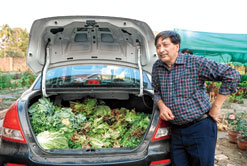
Pawan Khaitan packs the boot of his car with fresh produce to deliver to family and friends Pictures by Sanjoy Ghosh

Some watch movies, some play cards and some go salsa dancing. For businessman Pawan Khaitan, life after work is largely devoted to playing sabziwallah.

Khaitan, a 58-year-old resident of Lake Road, exports fishing tackles for a living and plays golf at leisure but nothing gives him more pleasure than getting his hands and feet dirty on his 40-cottah Rajpur farm and carrying back a carload of garden-fresh produce for family and friends.
FarmerKOLKATA11jul2014

“Different people get a kick out of different things. Some people go to a bar, spend a lot of money and get a kick out of drinking. Planting seeds and seeing them grow gives me a lot of happiness,” he says of his love of gardening, which he inherited from his father.

Khaitan has been involved in hobby farming for four decades, investing money, time and effort in it without ever expecting financial gain. “I get a lot of satisfaction out of it. So I don’t want any monetary involvement. Once the produce is harvested, I call a couple of friends and ask, ‘Do you need some?’ That’s my way of gauging whether they share my excitement,” smiles the businessman.

Pawan Khaitan works on his farm in Rajpur, South 24-Parganas /  Pictures by Sanjoy Ghosh
Pawan Khaitan works on his farm in Rajpur, South 24-Parganas / Pictures by Sanjoy Ghosh

He vividly recalls the day he told a chef at Taj Bengal about the different kinds of lettuce he grows on his farm and offered to send him a complimentary basket. “After receiving it, he and his general manager called back, offering me a year’s contract. I said no. I said I wouldn’t mind sending him a basket every Sunday but I won’t do business with this.”

Khaitan, who loves being on the RCGC green when not tending the greens in his garden, visits farms and agriculture fairs whenever he is touring. “From Delhi to Holland, there is something to learn everywhere because what grows in one place you might not find in another,” he smiles.

The businessman has reserved five hours every Sunday for his farm, “checking, watering, planting, instructing and harvesting the plants from start to finish”.

“I learnt how to cultivate vegetables from my father on his 80-cottah farm in Narendrapur,” he recalls. “Now there’s so much more information available, new technologies and reliable sources for seeds that I can bulk order online. Twenty years ago, we would depend on the para supplier or Chetla Haat and end up buying spurious seeds that would hardly sprout!”

This winter, Khaitan grew 13 varieties of lettuce alone. He is also fond of philodendrons (money plant), of which he has several species on his farm.

The most surprising thing about Khaitan’s hobby is that the bulk of the vegetable produce doesn’t go into his own kitchen. “Je ranna kore shey khaye na (the one who cooks doesn’t eat). I see these plants grow, so I don’t obsess about eating them. I give away the produce to friends, who appreciate it for what it is worth. That’s my way of being happy,” he says.

After every round of harvest, the produce is loaded in a van and taken to Khaitan’s Lake Road home, where he soaks the greens in ice-cold water. “I give them a cold bath with my own hands and put them in hibernation,” he says.

Khaitan then neatly arranges the produce in baskets layered with crushed ice, ready to be home delivered to members of his family and friends, “almost 20 of them”.

Even the Royal Calcutta Golf Club has benefited from having a green thumb like Khaitan among its members. It was while playing a round of golf at his club one day that the businessman realised the course didn’t have a flowerbed and proposed that there should be one. “I managed to trace a spot between tee numbers 9 and 11, collected flower seeds from my farm and planted them there.”

Voila! The RCGC course now has a flower patch, thanks to Khaitan. “I intend to get some summer flowers from my Delhi farm like sunflower and zinnia (for the course). I love nature. Even my business is linked to fishing. I interact with nature all the time,” smiles the businessman.

For the employees of his farm, Khaitan arranged a surprise feast of farm-fresh produce one day to show them how tasty a simple salad could be.

“I brought a big bottle of olive oil and balsamic vinegar to the farm and tossed some leaves in it and made a big salad platter for them to try,” he says.

Noorjahan Bibi, one of the workers, didn’t know what to expect but was pleasantly surprised by what was served. “At first, I thought what is this vegetable that we hadn’t grown before, let alone eat. Then, one day he organised a meal for 25 of us, including some neighbours, and we really enjoyed it. We have since learnt to prepare the soil with special manure for this type of lettuce and it seems quite easy now.”

Each winter, Khaitan grows vegetables different from the previous year’s mix. His next season is already planned — he intends growing varieties of spinach, greens and tomatoes that are not available in the market.

“I like to grow everything that you don’t get in the market. I plan to have six types of Italian spinach, six types of lettuce, six kinds of Chinese greens and different kinds of tomatoes, including Mexican and Spanish,” says Khaitan. “If I were to grow a flowering vegetable, it would take a long time to harvest. Leafy vegetables grow a lot faster. One can harvest in a month,” explains Khaitan, who also grows basil, celery, parsley and oregano.

His passion for farming doesn’t end there. Khaitan has printed a booklet containing traditional recipes to go with every kind of lettuce he has harvested this season.

So does he see more people taking up hobby farming like him to stay rooted to nature?

“Some years ago, there was a mass exodus from the villages to urban areas; now people are going back to the rural areas. It’s definitely happening in Delhi, Mumbai and south India, where people are setting up farms outside the city,” says Khaitan.

Do you know anyone like Pawan Khaitan. Tell ttmetro@abpmail.com

source: http://www.telegraphindia.com / The Telegraph, Calcutta / Front Page> Calcutta> Story / by Mohua Das / Monday – March 03rd, 2014

Ode to women who dared

They charmed audiences with their histrionics on stage and screen. Men sought their company and women envied their acting and singing skills. They didn’t care for the purdah and dared to defy social norms that prohibited women from stepping out in public. A tribute was paid to 10 actresses of Bengal who have left a lasting impression on the minds of audiences. Titled ‘Songstress’, the programme paid homage to Nati Binodini, Narisundari, Angoorbala, Kanan Debi and Keya Chakraborty among others. The programme weaved in storytelling by popular elocutionist Sujoy Prosad Chatterjee. Songs and dialogues from the plays and films in which they acted were performed.

Commenting on the actresses, an official of 40A Creative Studio that organized the homage said only those who also sang were chosen. Chatterjee also felicitated some prominent actresses of Bengali stage including legendary actress Chitra Sen and veterans like Dolly Basu, Anashua Majumder and Sohag Sen. Actresses Mumtaz Sorcar and Arunima, along with filmmakers Anindya Ghosh and Sekhar Das, were present at the programme.

Students’ tryst with Germany

Students of Birla High Schools Boys and Girls have completed a year-long exchange programme on a project with German partner school Amandus Abendroth Gymnasium in Cuxhaven, Germany. Ten students each from the boys and girls school and 20 from Amandus Adendroth Gymnasium started working on endangered species – mussels in Germany and tigers in India. Each student was hosted by the family of a German student and teachers were hosted by their German counterparts.

All the students worked on the project during school hours apart from attending some classes with their German partners in school. Various educational excursions were organized by the partner school during the stay – Klima Haus, University of Applied Sciences in Bremerhaven, Polar Haus (Alfred Wagner Institute) and Wadden Sea were visited. The entire group visited the mayor’s office where the students had a privilege to meet the mayor of Cuxhaven, Erika Fischer, and interact with her.

Nature in the city captured on lens

Young photographers aged between 16 and 18 years captured glimpses of nature and animals in Kolkata on their lens for a photography exhibition at Harrington Art Gallery. Rashbehari Centre for Ecological Movement (CEMO), an organization that has been spreading awareness on environmental issues for the past few years, held the exhibition on Friday and Saturday.

Students from leading city schools put on display around 40 photographs revolving around the theme ‘Nature-watch in Your Backyard’. The photograph taken by Tiyasa Mal, a student of Shri Shikshayatan School, featuring the flight of three birds in the sky, won the first prize. The second prize went to Kunal De of DPS Newtown for a tiger dragonfly’s photograph. Sweta Karmakar of National High School for Girls bagged the third prize for her excellent snap that featured a squirrel on the hunt for food. Dr Debal Sen, a cardiologist and amateur photographer, inspired the budding shutterbugs to play with light and shadow, striking a balance with their studies. Five members of the host organization exhibited some photographs on wildlife worth between Rs 2,000 and 5,000. “The money raised from the sale of these images will be donated to our organization,” said Purnima Dutt, a member of CEMO.

Show of Bengal tourism

The state tourism department organized a show at Eco Park in Rajarhat New Town to showcase Bengal’s tourism prospects. The venue was the glass house in the Eco island. More than 100 delegates from different parts of the country and also from abroad participated in the show. A presentation was given to the participants on how the tourism department was working towards developing tourism in the state. Hidco authorities handed over a special leaflet and a small souvenir to each of the delegates.

(Contributed by Prithvijit Mitra, Sarthak Ganguly, Jhimli Mukherjee Pandey & Suman Chakraborti. Compiled by Urmi Mukherjee. Photograph by Debobrata Shome)

source: http://www.timesofindia.indiatimes.com / The Times of India / Home> City> Kolkata / TNN / July 07th, 2014

Super girls show what it takes to beat the odds

SanaAfrinBENGAL09jul2014

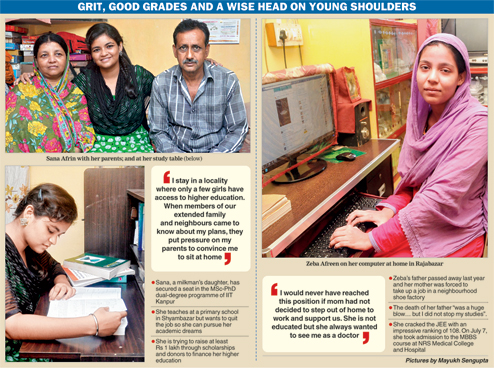
A milkman’s daughter made it to the IIT to pursue her dream of becoming a physicist. Sana Afrin funded her education and that of her brother’s by giving tuition and working as a primary school teacher.

Zeba Afreen, a fatherless girl whose mother works in a sweatshop to pay for her education, is set to become a doctor.

Metro meets the two inspiring girls.

SANA AFRIN

The test was tough but she secured an admirable countrywide rank of 23 to win a seat in the MSc-PhD dual-degree programme at IIT Kanpur.

The daughter of milkman Sheikh Rahi of Paikpara in north Calcutta had cracked tougher tests and hopefully overcome the one she is currently fighting: finance her education at an IIT.

Born in a financially weak and conservative family, 21-year-old Sana’s tryst with hurdles began at a young age when her father had to make a choice between daughter and son since he could afford to educate only one of the two children.

“My parents decided to support my education despite some unpleasant advice from relatives and friends. My younger brother had to wait a year to start his schooling,” said Sana at her home in Saudagar Patti, Paikpara.

Sana did not disappoint her parents, especially her hardworking father who delivers milk door to door to earn his living. She scored well in her Class X board exam and chose science for her Higher Secondary.

Just when she thought everything was on course, Sana faced her biggest hurdle. Her father didn’t have the money to pay her admission fee, leaving the daughter on the threshold of giving it all up.

To rub it in, some relatives advised her father that it was not wise to educate a girl so much. “They said I wouldn’t be able to cope with science. When I heard this, I was determined to prove that my parents’ decision to educate their daughter was right,” she said.

Loans from friends and scholarships from some NGOs helped her tide over the crisis and shut disapproving mouths.

Sana is now awaiting her BSc Part III results from Calcutta University.

She not only managed her education but also that of her younger brother, a Class XI student at an English-medium school in Dum Dum.

Sana remembers the hostile reaction when she announced her wish to go to college after Class XII. “I stay in a locality where only a few girls have access to higher education. When members of our extended family and neighbours came to know about my plans, they put pressure on my parents to convince me to sit at home.”

The gritty girl stuck to her plan: BSc with honours in physics. She filled in forms of various colleges and took admission in the first college where her name appeared on the merit list.

She knew all too well about her father’s financial situation and the people who wouldn’t let go any opportunity to scuttle her academic pursuit. Sana circumvented the situation by giving tuition, the earning taking care of her and her brother’s education to some extent.

Sana now teaches at a primary school in Shyambazar after clearing the Teacher Eligibility Test last year. Only one per cent of the several lakh candidates who appeared for the TET could get through.

In February this year, she appeared for the IIT Joint Admission Test for the MSc course. “I wasn’t well-prepared for the exam… I had just joined the school. I was also studying for my third-year final and doing private tuition,” she said.

Still she managed a ranking of 23.

She is aware that her current job will bring some financial stability to the family but her heart is with higher studies at IIT Kanpur. “I want to study and fulfil my dreams. I do not want to remain a primary school teacher.”

The new challenge is to arrange for her admission and semester fees. “I have been able to book my seat by paying a token amount of Rs 10,000. I need close to Rs 1 lakh,” she said.

When she visited a government department that apparently helps children from poor families with stipends and scholarships, she was told that she was not eligible. “They said they would have helped me had I been pursuing medical, engineering or civil services. They will not fund anybody’s education for research,” Sana said.

She never forgets to thank people who doubt her abilities. “They deserve credit. If they don’t question my ability, I will not be able to give my best,” she said.

Sana is eligible to apply for an IIT scholarship considering Sheikh Rahi’s financial situation, but she does not want to leave anything to chance.

If she manages to arrange the money, she would leave for Kanpur on July 16. The prospect of not spending Id with her parents does make her sad but she is determined to fulfil her dreams because her brother’s future is also at stake. “It will be tough but I need to do this and provide a better life to my parents and fund my brother’s higher education.”

ZEBA AFREEN

When Zeba Afreen’s father passed away last year and her mother was forced to take up a job in a neighbourhood sweatshop that manufactures footwear, she had several excuses to abandon her dreams.

But the 20-year-old did not lose sight of her goals, the immediate one being the Joint Entrance Exam. She studied 14 hours a day despite taking care of household chores and three younger siblings.

The Rajabazar girl cracked the JEE with an impressive ranking of 108. On July 7, she took admission in NRS Medical College and Hospital to its MBBS course.

Zeba did not let her father’s death influence her preparations, though “it was a huge blow… a bolt from the blue”. “But I did not stop my studies. I kept studying for the joint exam,” she said in her Rajabazar home opposite Tasvir Mahal cinema hall.

“I initially thought of quitting studies and taking up some odd job. Mother was dead against it. She wanted me to continue my studies,” she said.

Her father was a small-time envelope-seller and didn’t have any savings, forcing his wife Afsari Khatoon to work at the small shoe factory to support her children.

Zeba did not disappoint her mother.

She took help of senior teachers in her locality to prepare for the physics, chemistry and mathematics papers since she couldn’t afford classes at coaching institutions for competitive examinations.

“There was no way I could afford the expensive coaching centres. My only option was to study hard on my own,” said Zeba, who passed Higher Secondary from Shri Shikshayatan after Madhyamik in a neighbourhood school.

There was no dearth of distractions that cropped up every day to offset Zeba’s dream, the most annoying being the din on the road outside her house while she was preparing for her exams.

“I couldn’t concentrate even at night. Autorickshaws ply till late in the night… honking of vehicles. Ooph!”

This was Zeba’s second shot at the entrance exams. She came somewhere in the 2000s on the rankings last year and so decided to give appear again instead of taking up engineering in a lesser-known institution.

“I used the failure to identify areas I needed to work upon. From time management to improving my answers, I practised hard in the past one year,” she said.

“I would never have reached this position if mom had not decided to step out of home to work and support us. She is not educated but she always wanted to see me as a doctor,” Zeba said.

She now intends to focus on her two younger sisters and a brother. “I hope to guide my siblings the way my mother guided me.”

After completing her MBBS, Zeba wants to specialise in neurology and help the poor. “I owe my success to many people who came forward to help me when I was in need,” she said.

What message do you have for Sana and Zeba? Tell ttmetro@abpmail.com

source: http://www.telegraphindia.com / The Telegraph – Calcutta / Front Page> Calcutta> Story / by Zeeshan Jawed / Wednesday – July 09th, 2014

Jyoti Basu remembered for bringing the struggle of peasants, workers to the fore

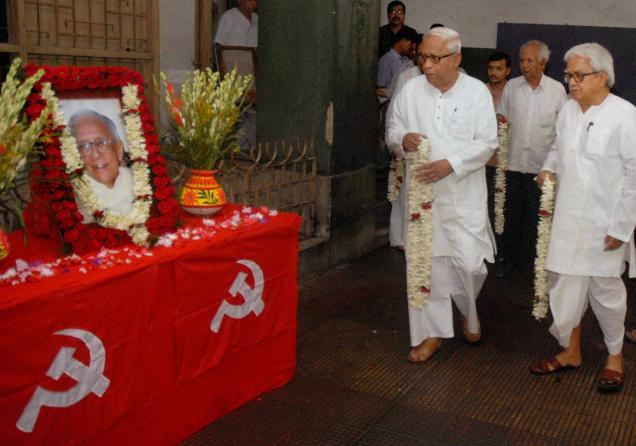
CPI(M) Politburo members Buddhadeb Bhattacharya and Biman Bose arrive to pay tribute to former Chief Minister of West Bengal Jyoti Basu during his centenary birth anniversary at the state party headquarters in Kolkata on Tuesday./ PTI

Elucidating the contribution of veteran Communist leader Jyoti Basu to parliamentary democracy, former Chief Minister and Polit Buro member of the Communist Party of India (Marxist) Buddhadeb Bhattacharjee said here on Tuesday that Mr. Basu had brought the struggle of peasants and working classes to the centre of politics in West Bengal.

Speaking at an event organised to mark the 100th birth centenary of Mr. Basu. he touched on the Communist leader’s conviction to democracy and the faith in secularism.

“He brought the issues of peasants and the workers to the fore in parliamentary democracy. Its origins lay in the workers movement which was followed by strikes and protest in factories. These protests turned into a phenomenon which engulfed the entire industrial sector and workers were successful is ascertaining their rights,” Mr. Bhattachrarjee said. When he came to power, unlike any other Chief Minister, he made it clear that the government will have to stand for the rights of farmers and agricultural workers.

“The fight for land went ahead with giving pattas (land rights) to the farmers and then identifying the rights of share croppers,” Mr. Bhattacharjee said.

The former Chief Minister reflected on how Mr. Basu ensured that the State remained insulated from the communal strife in 1984 after the murder of Indira Gandhi and 1992 after demolition of Babri Masjid.

“He was secular to the core of his heart. He knew that Communist movement and secularism has to go hand in hand,” Mr. Bhattacharjee said.

Recounting that Mr. Basu had even called the then Prime Minister P V Narashima Rao warning him that the developments could take a nasty turn, he said that Mr Basu had even told his colleagues jokingly that the Prime Minister was convinced that people would disperse from the Babri Masjid site only after performing bhajans.

“Jyoti Babu has an unwavering faith in democracy.. Despite himself being arrested a number of times for false charges when the Left Front government came to power in 1977 all political prisoners across political lines were freed. It was like a general amnesty,” he said.

Referring to present times Mr. Bhattacharjee said that it is clear that the politics in the country has taken a “right turn” with the alliance of corporates and Rashtriya Swayamsevak Sangha (RSS) ruling the nation but added that it is imperative for the Left forces to take lessons from Jyoti Basu’s life and put up a fight.

source: http://www.thehindu.com / The Hindu / Home> News> Cities> Kolkata / by Special Correspondent / Kolkata – July 09th, 2014

Veteran Communist leader Vidya Munshi dead

Arguably the first woman journalist of the country, Vidya Munshi was born in Mumbai in 1919 and worked in various newspapers and magazines

Veteran Communist leader, scholar and writer, Vidya Munshi, passed away on Monday in Kolkata. She was 94.

Arguably the first woman journalist of the country, Ms. Munshi was born in Mumbai in 1919 and worked in various newspapers and magazines, including The Blitz.

She stood first among women in the school-leaving examination and left for England to study medicine.

In 1942, Ms. Munshi joined the Communist Party of Great Britain (CPGB) and took part in several programmes of the Communist party in Europe, mainly against the violence and cruelty committed by fascist forces.

In 1945, on behalf of All India Student’s Federation, the student’s wing of the Communist Party of India (CPI), Ms. Munshi participated in an eventful women’s conference (World Federation of Democratic Youth) in Paris.

Ms. Munshi headed the board that publishes the CPI’s mouthpiece, ‘Kalantar’ for several years and was an active member of the party. She headed State Women’s Commission till 2000. She documented her life, the political upheavals and the shaping of women’s movements of her time in great detail in a brilliant memoir, ‘In Retrospect. War-time Memories and Thoughts on Women’s Movement.’

Many important leaders, including members of various political parties, paid their last respects to their favourite ‘Vidya-di’ on Monday afternoon. Her last rites were performed in a city crematorium.

source: http://www.thehindu.com / The Hindu / Home> News> Cities> Kolkata / by Staff Reporter / Kolkata – July 08th, 2014

Ode to women who dared

They charmed audiences with their histrionics on stage and screen. Men sought their company and women envied their acting and singing skills. They didn’t care for the purdah and dared to defy social norms that prohibited women from stepping out in public.

A tribute was paid to 10 actresses of Bengal who have left a lasting impression on the minds of audiences. Titled ‘Songstress’, the programme paid homage to Nati Binodini, Narisundari, Angoorbala, Kanan Debi and Keya Chakraborty among others. The programme weaved in storytelling by popular elocutionist Sujoy Prosad Chatterjee. Songs and dialogues from the plays and films in which they acted were performed.

Commenting on the actresses, an official of 40A Creative Studio that organized the homage said only those who also sang were chosen. Chatterjee also felicitated some prominent actresses of Bengali stage including legendary actress Chitra Sen and veterans like Dolly Basu, Anashua Majumder and Sohag Sen. Actresses Mumtaz Sorcar and Arunima, along with filmmakers Anindya Ghosh and Sekhar Das, were present at the programme.

Students’ tryst with Germany

Students of Birla High Schools Boys and Girls have completed a year-long exchange programme on a project with German partner school Amandus Abendroth Gymnasium in Cuxhaven, Germany. Ten students each from the boys and girls school and 20 from Amandus Adendroth Gymnasium started working on endangered species – mussels in Germany and tigers in India. Each student was hosted by the family of a German student and teachers were hosted by their German counterparts. All the students worked on the project during school hours apart from attending some classes with their German partners in school.

Various educational excursions were organized by the partner school during the stay – Klima Haus, University of Applied Sciences in Bremerhaven, Polar Haus (Alfred Wagner Institute) and Wadden Sea were visited. The entire group visited the mayor’s office where the students had a privilege to meet the mayor of Cuxhaven, Erika Fischer, and interact with her.

Nature in the city captured on lens

Young photographers aged between 16 and 18 years captured glimpses of nature and animals in Kolkata on their lens for a photography exhibition at Harrington Art Gallery. Rashbehari Centre for Ecological Movement (CEMO), an organization that has been spreading awareness on environmental issues for the past few years, held the exhibition on Friday and Saturday. Students from leading city schools put on display around 40 photographs revolving around the theme ‘Nature-watch in Your Backyard’.

The photograph taken by Tiyasa Mal, a student of Shri Shikshayatan School, featuring the flight of three birds in the sky, won the first prize. The second prize went to Kunal De of DPS Newtown for a tiger dragonfly’s photograph. Sweta Karmakar of National High School for Girls bagged the third prize for her excellent snap that featured a squirrel on the hunt for food. Dr Debal Sen, a cardiologist and amateur photographer, inspired the budding shutterbugs to play with light and shadow, striking a balance with their studies. Five members of the host organization exhibited some photographs on wildlife worth between Rs 2,000 and 5,000. “The money raised from the sale of these images will be donated to our organization,” said Purnima Dutt, a member of CEMO.

Show of Bengal tourism

The state tourism department organized a show at Eco Park in Rajarhat New Town to showcase Bengal’s tourism prospects. The venue was the glass house in the Eco island. More than 100 delegates from different parts of the country and also from abroad participated in the show. A presentation was given to the participants on how the tourism department was working towards developing tourism in the state. Hidco authorities handed over a special leaflet and a small souvenir to each of the delegates.

(Contributed by Prithvijit Mitra, Sarthak Ganguly, Jhimli Mukherjee Pandey & Suman Chakraborti. Compiled by Urmi Mukherjee. Photograph by Debobrata Shome)

source: http://www.timesofindia.indiatimes.com / The Times of India / Home> City> Kolkata / TNN / July 07th, 2014

Students’ date with robots

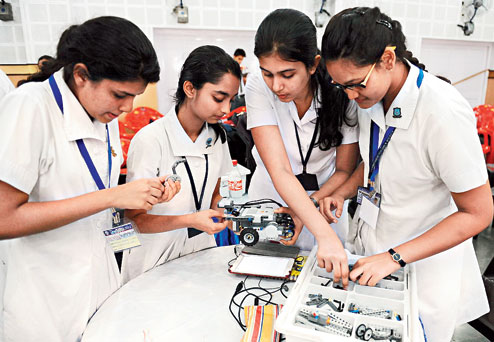
Students at the robotics workshop at La Martiniere for Girls. Picture by Sanjoy Chattopadhyaya

The first day of a robotics workshop at La Martiniere for Girls in May saw the girls struggling with motors, beams and light censors. But at the end of three days, they were adept at not just assembling a robot but also programming and navigating it through obstacles.

Five of the nine teams that participated in the workshop, including La Martiniere for Girls, qualified for the global round of International RoboCup Junior Competition presented by Indian RoboCup Junior Foundation. Tiro Nomura from Saitama University, Tokyo, judged the teams.

Lorraine Mirza, the principal of La Martiniere for Girls, met David Prakash, the chairman of the Indian RoboCup, in Bangalore. “Why not the east? I would like to host it in our school,” Mirza thought and soon enough she made arrangements to host the workshop and competition in Calcutta, in association with St. Augustine’s Day School, Barrackpore.

The students had to build autonomous robots and not remote-controlled ones, programme the robots and manoeuvre them through obstacles. “The robots have got sensors to sense the obstacles and avoid them,” Prakash said.

And then, as Mirza said, “it was time to test how much you (the students) have learnt and to pick out the teams that are going for the national competition”.

“On the first day, it was torturous for us and it took us three hours just to assemble. But over the next three days we learnt the programming as well,” said Nilakshi Padhi, a Class IX student of La Martiniere for Girls who was part of one of the teams that qualified for the national competition.

Four-member teams from South City International School, Mahadevi Birla World Academy, St. Augustine’s Day School, St. John’s Diocesan Higher Secondary School, La Martiniere for Girls and Boys and others took part in the workshop.

G.S. Rautela, the director general of National Council of Science Museums and the chief guest, urged the students to follow their passion. “Don’t be guided by peers or what your parents are pushing you to. If you like to build robots, build robots. If you want to write a poem, write poems. But follow your passion.”

source: http://www.telegraphindia.com / The Telegraph, Calcuta / Front Page> Calcutta> Story / by Jhinuk Mazumdar / Monday – July 07th, 2014

Partha: Not dropping Kabir name from book, adding more stalwarts

SUMMARY
After withdrawing the book last week, Partha Chatterjee had ordered the chairman to revise the book.
___________________________________________________________

Less than a week after it ordered to withdraw a Bengali textbook for Class 12, which contained a long paragraph on contribution of former Trinamool Congress MP and singer Kabir Suman to contemporary Bengali music, the state government Thursday said the book will be relaunched after revision and addition of some more names.

Among others, the revised boom will now detail the contributions of artistes such as legendary singers such as Hemanta Mukherjee, Manna Dey, Shyamal Mitra, Sandhya Mukherjee and Gautam Chatterjee in the book ‘Bangalir Bhasha o Sanskriti’ (The language and culture of Bengali people).

Education Minister, who had ordered the book to be withdrawn, Thursday told the Assembly that it was “unfortunate that the book did not refer to such stalwarts like Hemnata or Manna Dey or Sandhya Mukherhee.”

“But, of course, we are not in favour of dropping anyone from the list. If ‘Pachakanta’ (a derogatory term for Kabir Suman) can be there, other artistes can also be there,” Partha Chatterjee told the House after a meeting with Aveek Majumdar, chairman of the syllabus committee (for classes upto 12).

After withdrawing the book last week, Partha Chatterjee had ordered the chairman to revise the book. “The draft of the revised version will be shown to me on Monday,” the minister said, adding that the government would recruit poet Ganesh Basu and nuclear scientist Bikash Sinha as advisers to the syllabus committee.

Though the government mentioned factual errors in the book as the reason for its withdrawal, sources said, the riling party was not very happy at reference to rebel TMC leader Kabir Suman.

Suman, a Kolkata-based modern Bengali singer-songwriter and musician contested the Lok Sabha election on a Trinamool Congress ticket from Jadavpur constituency in 2009. He was subsequently suspended from the party after he fell out with the party leadership.

source: http://www.indianexpress.com / The Indian Express / Home> Cities> Kolkata / by Express News Service / Kolkata – July 04th, 2014