Nazrulgeeti legend passes away

Kolkata :

Nazrulgeeti exponent Firoza Begum, who was to be honoured with ‘Banga Bibhushan’ by the state government later this month, passed away in Dhaka on Tuesday evening. The 84-year-old was suffering from heart and kidney disease.

“She breathed her last around 8.15pm,” Bangladeshi media reports said. She had been undergoing treatment at the ICU of a private hospital. She was fitted with a pacemaker on Monday.

Mamata Banerjee grieved on social media as the news reached her on Tuesday night. “I am very sad to learn that the legendary Firoza Begum has just breathed her last. Her passing away will certainly create a huge void in the world of music and culture,” she posted.

The CM said her government had planned to confer the state’s highest civilian honour on her. “We had decided to honour her with ‘Banga Bibhusan’. She had also agreed to come to Kolkata to receive the award. But, now it’s all over,” she mourned.

Mamata recounted her last interaction with the legend by saying: “Hardly 10 days ago, we talked to each other. To me, her passing away is indeed a great personal loss. She used to treat me as a member of her family. On the last occasion of our meeting, she told me: ‘Ar ki dekha hobe? (Will we meet again?)’ Today, these words keep ringing in my ears,” the chief minister said.

source: http://www.timesofindia.indiatimes.com / The Times of India / Home> City> Kolkata / TNN / September 10th, 2014

Jewish past, digital present

A digital museum on the Jews of Calcutta is ready to go online on Monday after two years in the making.

“The archive documents the Jewish community’s contributions to Calcutta and celebrates the city where they thrived. It has taken me more than two years to curate this archive. I’m still fine-tuning it before the launch at Victoria Memorial on September 1 and have got wonderful feedback from community members across the world,” said Jael Silliman, a former women’s studies teacher at the University of Iowa and one of the members of the dwindling community in the city.

The website is a storehouse of information about Jews in Calcutta.

The community has dwindled from 6,000-plus members in its heyday to barely 20 people — mostly elderly — at present.

There hasn’t been a Jewish girl in the Jewish Girls School for about 40 years.

The Telegraph had reported last September how the community needed to include Israeli ambassador to India, Alon Ushpiz, who was visiting the city along with five other Jews, to achieve the “minyan” or quorum of 10 men needed for a formal service to celebrate Simhat Torah at Magen David Synagogue in Calcutta. It could not be held for 25 years because the community was not able to line up 10 men needed for the service.

Jews in India have branched into three main streams after the first batch arrived from West Asia in the late 18th century: the Bene-Israel (meaning Children of Israel), the Cochin Jews who prospered along the Malabar coast and Baghdadi Jews, who settled mostly in Calcutta and Mumbai.

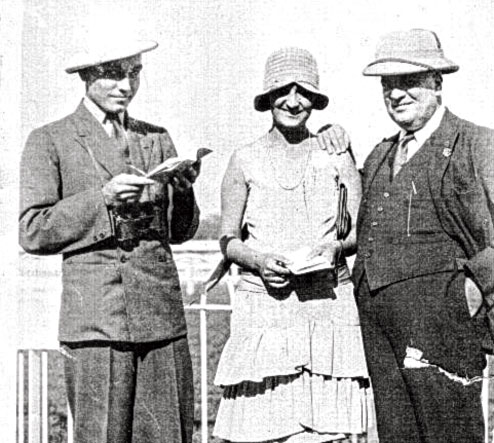
Calcutta’s Jewish community members at the Viceroy’s Cup racing derby in 1937
A guide to the races

The archive’s film section includes an audio-visual documentary of Jewish elders Cyril Cohen and Aaron Harazi, who passed away recently, speaking at length about their schooldays and work in Calcutta. The section offers a virtual tour of the Magen David on Canning Street and Beth El on Pollock Street — two synagogues no longer in use.

In a clip from the racecourse, Elijah Twena, an avid racer, gives an insight into the favourite pastime of Calcutta Jews.

A geniza at the Narkeldanga cemetery

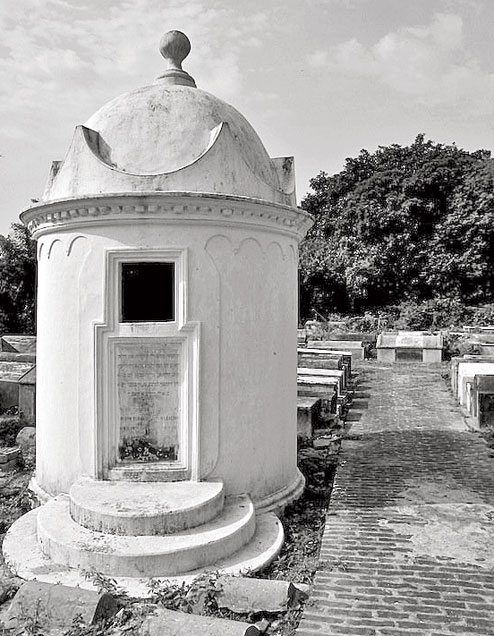
Another section talks about Jewish cemeteries in Calcutta, especially the ones at Narkeldanga.

Legend has it that the first Jewish burial ground — at 45, Narkeldanga Main Road — was “born” when Shalome Cohen, the first settler, decided to buy a plot of land for a cemetery and went about asking his friends and business associates for a suitable place. A Bengali business associate took him to a paddy field on the outskirts of Calcutta and asked if that would do.

Graves of Jewish people at 45, Narkeldanga Main Road

Shalome was delighted and told him to quote a price. The gentleman declined and offered to give the plot for free. But Shalome insisted that he must pay because the site would be used for religious purposes. The gentleman reluctantly agreed to accept “whatever Shalome wishes to give”. The settler pulled a gold ring out of a finger, gave it to the landowner and sealed the transaction.

It is assumed that Moses de Pas, an emissary from Safad, now in Israel, was the first Jew to be buried in Calcutta cemetery for the community in 1812. His grave is no longer traceable. The cemetery has a geniza too for storing worn-out Hebrew-language religious books and papers. A small private cemetery was opened in the 1870s, and closed after 20 years or so, half a mile from the main cemetery.

Other sections include maps of Jewish Calcutta, a film gallery, community portraits, music of the community recorded from Rivers of Babylon, war years and military service and their impact on the community.

The museum project is led by Jael Silliman, a former women’s studies teacher at the University of Iowa, and assisted by Amlan Dasgupta, professor at Jadavpur University. “Some of the speakers at the launch will be Amlan Dasgupta, Adam Grotsky of USIEF and Jo Cohen, who will talk about the life Jews made for themselves in the city,” said Silliman, an author of two books, The Man with Many Hats (2013) and Jewish Portraits, Indian Frames: Women’s Narratives from a Diaspora of Hope (2001).

“We’re happy to be associated with the project. It has been quite a journey and a very fruitful one. Our students have worked untiringly for the project. We’re also considering housing the material at the School of Cultural Texts and Records, Jadavpur University,” said Dasgupta.

source: http://www.telegraphindia.com / The Telegraph, Calcutta / Front Page> Calcutta> Story / by Showli Chakraborty / Monday – September 01sr, 2014

Astor revives its British heritage

Kolkata:

Gallops of horses then, dollops of history now.

Another feather will shortly be added to the city’s heritage hospitality industry as Astor Hotel opens its doors for guests.

Housed in a building that was a British barracks about a century ago, the hotel has retained the rooms of mismatching size and shape, and ironed out the colonial wrinkles with the precision of 21st Century.

“In its 120-odd years of existence, the interiors of the building never complemented its grand facade. Be it the electrical or plumbing system, it was a completely unplanned structure. A thumb-rule in construction is that a poorly-maintained building must be brought down and built over every 70-80 years,” said the hotel’s proprietor Vikram Puri.

“But with the help of the members of the heritage commission and a team from Delhi that specializes in restoring old havelis of Rajasthan, we managed to preserve the heritage elements of the building.”

Puri said the building used to be a British boarding house where soldiers would come riding on their horses and walk up the stairs to take rest in their rooms.

“What used to be the stable is now a lounge bar called Plush. We restored the same teak staircase the armymen walked up, instead of turning it into an elevator shaft. We retained the rooms with their mismatched dimensions, which gave us perfect material for a boutique hotel. A modern hotel resembles a block diagram, but here every room has a different character,” Puri said.

The guests here will use the same rooms that were once occupied by the army personnel of the imperialists, but the rooms have been fitted with modern facilities such as a big-screen television and air-conditioning.

“The main corridor of the hotel has a distinct Victorian look. But, we will adorn the walls with paintings and photographs of a century-old Kolkata,” Puri added.

To bring down carbon footprint, the hotel has done away with split air-conditioners and geysers and installed central systems. The corridor is not chilled but cool.

“This is not air-conditioned but filled with treated fresh air,” said a member of the hotel’s staff.

High ceiling, a four-poster bed and sepia-tainted lights give the suites the ambience of an era gone by. But water sprinklers, smoke detectors and Wi-Fi devices are a constant reminder of 2014.

source: http://www.timesofindia.indiatimes.com / The Times of India / Home> City> Kolkata / by Shounak Ghosal / September 12th, 2014

Book club boost to Bengali literature

Kolkata :

What if you had to read a Kakababu or Feluda story and get marks for reviewing it as part of a test in school?

Reading habit in Bengali is on a sharp decline for several years now and cinema has become the driving force behind book sales, especially when it comes to children. To stem this dip, Birla High School has come up with an innovative strategy — students can opt for a Bengali literature club as part of the curriculum. The last period is dedicated to a session of script-writing, reading, voice modulation, recitation and reviewing of stories, all in Bengali. And yes, they get marks for it too.

“If we didn’t have this strategy, we would lose the handful students who still have reading habits in Bengali. But students today don’t have the energy or time to explore the world of Bengali literature. So we made it part of the curriculum. Students can opt to join a club — Bengali, photography or something else — and they have responded positively to the book club. Even students, whose mother tongue isn’t Bengali, are opting for Bengali as the second language and joining the club. We have a junior section and the senior one is from Classes VI-X,” said Mandira Banerjee, a Bengali teacher.

Earlier, the clamour for special Puja editions of magazines used to start over a month ahead of the festival. But those days are long gone. College Street booksellers say whereas earlier individuals bought multiple copies to send to relatives and friends based out of the state, now the demand is at an all-time low. “But to ensure that students don’t miss out on the fun and flavour of Pujabarshiki issues, we give out copies and evaluate students based on their reviews,” added Joyita Basu of the Bengali department.

Saswat Banerjee, a Class IX student, said: “I’ve been a member of the club since Class VI. Here we are trained in drama, extempore, enunciation and summarizing stories in Bengali. We are also encouraged to write stories in Bengali.” However, the teenager admitted that since the last few years, the culture of exchanging Bengali books with classmates has gone down sharply.

The cast and director of ‘Gogoler Kirti’, a film based on the Samaresh Basu-created child sleuth, were present at a discussion at the school on Monday. Singer Paroma Banerji, who anchored the show, said: “The habit of reading Bengali books is dying. As parents, it is our duty to ensure our children don’t miss out on the books we grew up reading. We have now veered towards audio-visual over text. But cinema is a totally different medium. It can’t reproduce the exact story and a lot of improvisations are added to the script. Similarly, just because you know the story doesn’t mean you should avoid reading the original story.”

Actress Shakuntala Barua rued that the days when children would badger grandmothers for stories were gone. “For children, cinema is the easier option. But I’ve ensured my grandson develops a love for Bengali books by reading out to him and making him part of the storytelling sessions.”

source: http://www.timesofindia.indiatimes.com / The Times of India / Home> City> Kolkata / TNN / September 09th, 2014

Special 40

Pictures by Arnab Mondal

Students of Manovikas Kendra perform at a programme to mark 40 years of the organisation, at Science City auditorium on Thursday.

From tiny tots to students of vocational units, some of them on wheelchairs, everyone joined the celebration.

Sharada Fatehpuria, the founder- director of Manovikas Kendra, turned nostalgic as she remembered the first day of the institute. “It was January 28, 1974, and Saraswati Puja was being celebrated in the foyer of Gyan Manch at Abhinav Bharati High School.

The journey began with two children in one room and today Manovikas Kendra is spread over an acre and it is full of wonderful children who are studying and playing with 160 dedicated personnel,” she said.

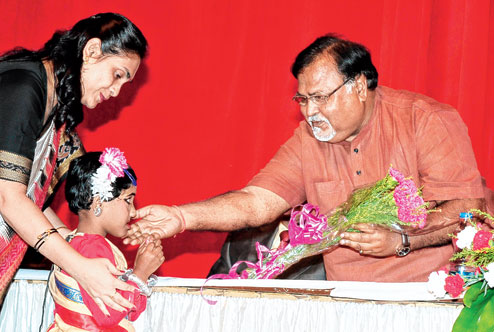
Education minister (below) Partha Chatterjee was the chief guest on the occasion.

Pictures by Arnab Mondal

source: http://www.telegraphindia.com / The Telegraph, Calcutta / Front Page> Calcutta> Story / Friday – September 05th, 2014

On song, 3G of Uthup women – Usha rocks with daughter Anjali and grandchild Ayesha

UshaUthupKOLKATA09sept2014

ANJALI KURIAN: daughter. She stays in Kochi and works as a radio jockey
USHA UTHUP: the one and only, performs at the CC&FC on Sunday evening
AYESHA JOHN: granddaughter. Called “the boss” of 3G, the Uthup band, the teen is training in vocals in Kochi.
Picture by Arnab Mandal

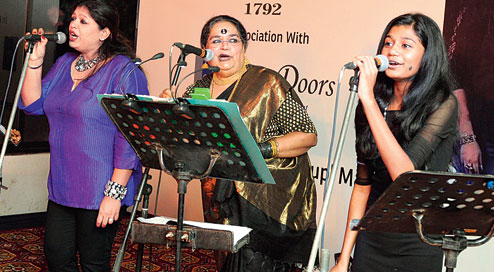
Uthup 3G jammed for the first time together in Calcutta as Usha Uthup took the stage at the CC&FC on Sunday evening with daughter Anjali Kurian and granddaughter Ayesha John.

If love, laughter and a lot of music keep the three generations — 3G — of Uthup women in concert with each other, they bonded as a band at the INK conference in Kochi a year ago. “When Amma was invited to INK to talk about how her music cuts across boundaries, Ayesha suggested she sings Shine Like A Diamond and Tumhi ho and Amma suggested we join her,” beamed Anjali.

“After a standing ovation at INK, we were invited to perform at GIMA. From there we went to Jaipur and London,” she said.

The Shine Like A Diamond and Tumhi ho mash-up is now a staple at every 3G show, including the one at the CC&FC.

“I don’t know how to explain what I’m feeling. It’s so sentimental today. I feel nostalgic. Everything good and beautiful happened from here in Calcutta. And its extraordinary and historical for us three generations singing here today,” said Usha before belting out old favourites from her Trinca’s days.

Her voice still holding strong as she sang I Believe In Music, Fever and the Bond number Skyfall, she called her “beautiful girls” Anjali and Ayesha to join in.

The crowd clapped, tapped and cheered as the Uthup trio sang Malaika, Oh Carol, La Bamba, I Will Survive, one after the other in perfect harmony.

Usha had a message for her 14-year-old granddaughter: “Remember, this is the most difficult audience to please and if they say yes, 45 years guaranteed.” The crowd applauded even more.

When Metro caught up with 3G on the sidelines, they spoke about how the three inspire one another. “I told my mother everything that girls couldn’t think of telling their mothers and Ayesha too does the same. We always know everything about each other,” said Anjali who lives in Kochi.

Usha described Anjali as somebody similar to herself in terms of “vocal quality and joie de vivre on stage”.

Ayesha, she felt, is different. “She has a huge range, a different timbre and sings old songs with as much ease as the new ones,” said the proud granny.

Anjali couldn’t help gloat over her mom and being the 3G go-between. “Some people excel in cooking or stitching, she excelled as a singer and inspired me to be a good human being. I’m happy being an RJ and dancing but since I seemed to be the missing link between my daughter and my mother I decided to join in and have fun singing.”

Ayesha, the older two agreed, is the “more serious singer” and also “the boss”. “We don’t do it because we are good at it but because we like it,” the junior-most Uthup said with authority.

“To me, she’s a grandmother who cooks, cleans and feeds me and, by the way, sings as well,” laughed Ayesha.

But then, she isn’t the typical grandmother either as she rocks her way through life post-60. “Sometimes we forget our age. She didn’t want me to call her ammachi, naani or daadi. She said, ‘Call me anything, even coconut tree if you want’.” Ayesha calls her umbukka, just a word she coined.

Park Street holds a special place in all the three hearts that beat inside 3G. Anjali exclaimed: “Thank god for Park Street, otherwise my parents wouldn’t have met and I wouldn’t have been born.”

Ayesha, training in vocals in Kochi, is yet to pay a visit to Trinca’s where her grandmother started her music. “She is the one who made me fall in love with singing… so Trinca’s is a must-visit.”

Retiring club CEO Deepankar Nandi said: “What a wonderful evening and such a great parting gift for me. Apart from being a very old club member and a brilliant performer, Usha is my favourite. The added bonus was the performance by Anjali and Ayesha.”

source: http://www.telegraphindia.com / The Telegraph, Calcutta / Front Page> Calcutta> Story / Tuesday – September 09th, 2014

Neel Mukherjee shortlisted for 2014 Man Booker prize

Mukherjee was the only Indian-origin author to be longlisted earlier this year.

London:

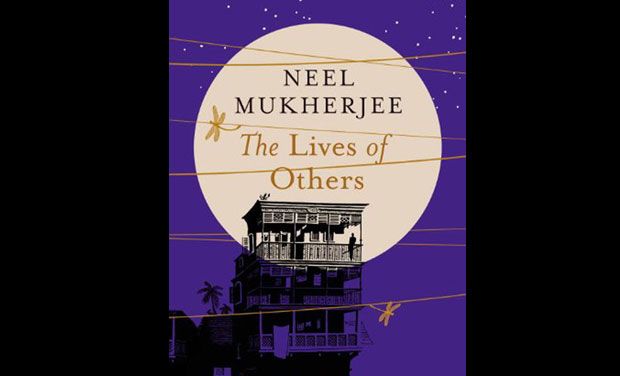
Kolkata-born British author Neel Mukherjee’s latest novel The Lives of Others, set in troubled Bengal of the 1960s and centres around a dysfunctional family, has been shortlisted for the prestigious Booker Prize 2014, in its debut as a global literary award.

Mukherjee, who studied at Oxford and Cambridge, was also the only Indian-origin author to be longlisted earlier this year, the first time the prestigious literary award opened up for anyone writing in English regardless of nationality.

“We are delighted to announce our international shortlist. As the Man Booker Prize expands its borders, these six exceptional books take the reader on journeys around the world, between the UK, New York, Thailand, Italy, Calcutta and times past, present and future,” said A C Grayling, chair of the 2014 judging panel.

“We had a lengthy and intensive debate to whittle the list down to these six. It is a strong, thought-provoking shortlist which we believe demonstrates the wonderful depth and range of contemporary fiction in English,” he added.

Mukherjee, now a British citizen, has been selected for his second novel published in May this year. The book is based in Kolkata and centres around a dysfunctional Ghosh family in the 1960s.

Mukherjee reviews fiction for the Times and the Sunday Telegraph and his first novel, A Life Apart was a joint winner of the Vodafone-Crossword Award in India.

The others on the shortlist include American authors Joshua Ferris for To Rise Again at a Decent Hour and Karen Joy Fowler for We Are All Completely Beside Ourselves; Australian Richard Flanagan for The Narrow Road to the Deep North; and British authors Howard Jacobson for J and Ali Smith for How to be Both.

Previously, the prize was open only to authors from the UK and Commonwealth, Republic of Ireland and Zimbabwe. For the first time in its 46-year history, the 50,000-pound prize has been opened up to writers of any nationality, writing originally in English and published in the UK.

source: http://www.deccanchronicle.com / Deccan Chronicle / Home Lifestyle> Books-Art / PTI / September 09th, 2014

A lesson in history for teachers

caleidoscope

A place steeped in history recently hosted a spirited discussion on the teaching of history. Teachers, academicians and people of letters gathered to take a fresh look at the teaching of India’s Freedom Movement.

The discussion, titled Teaching the history of the Freedom Movement to young children, was organised at Victoria Memorial on August 19, part of a series of critical conversations to be held at the heritage venue in future.

Moderated by Devi Kar, the director of Modern High School for Girls, the participants included history teachers Anirban Mondal of Netaji Nagar Colony High School, Durgapur, Tina Servaia of Calcutta International School, and Amita Prasad of Modern High School and Megha Malhotra of The Seagull Foundation for the Arts.

“At least somebody is thinking of schoolteachers. The onus of making students understand the essence of history lies on us teachers and textbooks. India’s struggle for freedom is usually an emotionally charged topic. Can it be taught?” wondered Kar as she threw open the discussion.

Mondal felt history as a subject is very abstract and often incorrectly interpreted. “History as a discipline may not match with history of everyday life and what is interpreted on screen. We need to blend the two to teach the subject effectively,” he said.

Prasad stressed on making history lessons more approachable and not reducing it to a litany of dates and places. “Teaching history can be difficult, especially when children have little idea about the events. It is the task of a teacher to concretise the knowledge and make it a real-life experience,” she said.

The only non-teacher in the group, Malhotra, spoke about her foundation’s project on teaching conflict to students and how they have a pool of teachers to work with various schools.

The general consensus at the end of the discussion was that teachers need to excite students and teach them in a language they understand. “I like to mix activities. A Class XII student can be involved in an activity meant for junior classes, if it is meaningful. It all depends on the approach,” said Servaia.

The teachers went on to discuss classroom experiences and the advantages of using visuals and staging plays as teaching aids.

Angels on canvas

She returned to India from Israel in 2002, terribly disturbed by what she saw there and that is what inspired her to work on Angels, a collection of paintings in oil and water colour.

Rumi at her exhibition. (Rashbehari Das)

The Angels series by Rumi was part of an exhibition of her works at Chitrakoot Art Gallery.

At the opening of the exhibition on August 23, her birthday, the artist recalled how she read the Bible very seriously after she was left shaken by the Israel experience. “I wished for angels to be sent to earth and protect mankind.”

The exhibition was also a fund-raiser event for Rumi’s dialysis and kidney transplant.

“When I met Rumi at a friend’s place I had a feeling that I had come across a natural artist. Being a musician, I know what it is to be natural. The care and love in her paintings is evident. I wish her speedy recovery,” said Monojit Datta, Rumi’s friend and musician.

Ancient art

It was a world of kings, queens and love. Self-taught artist Devirani Dasgupta’s third solo exhibition, held recently at the Academy of Fine Arts, transported one to ancient India. Heavily influenced by Madhubani art and resplendent in earth colours, Dasgupta’s acrylic-on-canvas compositions tell stories of their own. “I am a surrealistic painter trying to connect the known to the unknown through the association of forms,” said Devirani.

Contributed by Chandreyee Ghose & Samabrita Sen

source: http://www.telegraphindia.com / The Telegraph, Calcutta / Front Page> Calcutta> Story / Sunday – September 07th, 2014

Biz guru’s mantra for students

Kunal Banerji at the interactive session. (Anup Bhattacharya)

Kunal Banerji, an associate professor of management at Eastern Michigan University and a St. Xavier’s alumni, addressed students of JD Birla Institute’s management department on quality management.

The management guru dwelled upon the three cornerstones of business excellence — quality, profitability and productivity — at an interactive session organised by the Calcutta Management Association, in association with The Telegraph, on August 29.

He peppered his lecture with topics ranging from compensation and appraisal to use of suggestion systems and continuous improvement efforts to illustrate why it’s important to improve product quality, or how to do it more effectively, in the service sector.

Banerji drew from his Total Quality Management and Business Excellence, a research paper he co-authored with David E. Gundersen and Ravi S. Behara, to answer most of the questions.

He explained how quality is more perceptual than real. “Till a point of time all foreign goods were considered to be of the best quality… that is how our psyche was built. After 1992 (post-liberalisation of the economy), this perception of quality changed.”

On behalf of the CMA, its executive committee member Asok K. Banerjee thanked Banerji for discussing his research extensively with the students. “We had a great audience and a wonderful ambience.”

Banerji said: “It was a mixed crowd and that is always very interesting. Honestly, I didn’t expect such a big crowd. I don’t get such a big crowd in the US, probably because of the population rate.”

J.N. Mukhopadhyaya, the director of the JD Birla Institute’s management department, said he was happy that the seminar turned out well.

source: http://www.telegraphindia.com / The Telegraph, Calcutta / Front Page> Calcutta> Story / by A Staff Reporter / Friday – September 05th, 2014

Darjeeling’s Makaibari Becomes Most Expensive Tea in India

Kolkata :

After being sold at a record price of USD 1,850 (around Rs 1.12 lakh) per kg, Darjeeling’s Makaibari tea estate has become one of the most expensive tea producers in India.

“It is a matter of great pleasure and pride that Indian Tea, Makaibari, has booked orders at a record price of USD 1,850 per kg. That the orders have come from Japan, the UK and the US is also noteworthy,” Tea Board Chairman Siddharth said.

He said at a time when the Tea Board and the tea industry are grappling with the issues of value addition and brand building, this news has come as a shot in the arm.

“Makaibari has been an iconic tea garden and we are very pleased to note that even after its ownership has recently changed hands, the high standard of its quality and recognition has grown further,” Siddharth said.

Darjeeling Tea Association secretary Kaushik Basu said this is the highest ever price he has ever heard of for Indian tea.

“But this is a one off case. We have heard that it was a small sale of around 5 kg. I don’t think it was a commercial sale or auction. It may have been sold on charity,” he said.

Located in Kurseong, Makaibari is the ancestral property of Raja Banerjee who had recently sold off 90 per cent of his stake to Luxmi group.

source: http://www.newindianexpress.com / The New Indian Express / Home> Business> News / by PTI / September 06th, 2014