Punching above her weight

Sakina Khatum talks about her weightlifting career and her route to success at the Commonwealth Games

Such a long journey Sakina Khatum courted success after many trials including being struck by polio / The Hindu

Sakina Khatum hit the headlines with a bronze-winning effort at the Glasgow Commonwealth Games, last month. But the 25-year-old promises to do even better at the Incheon Asian Games, come October.

An irony, or call it fate, as polio struck Sakina, one of the four siblings when she was just a year and half old, and since then, it has been a story of determination and fighting all odds.

Four operations below the knee on the right leg helped her to walk, rather than crawl on fours. A doctor advised Sakina to take up swimming to strengthen the leg, and thus began her tryst with sports.

“I was national champion a year after taking up swimming, and for the next four years, ruled the pool in my category. I did not get any recognition or an international call up,” says the girl, who comes from a poor family. “My father is ailing. My brother does not stay with my family.”

She adds, “I came to Bangalore for the selection camp, ahead of the 2010 Commonwealth Games.

After three months away from home, I was not picked despite impressing coach Dabas, who referred me to ace para power-lifter Farman Basha. And the rest is history.” Farman, himself restricted to a wheelchair says, “She was lifting only 25 to 26 kgs. To turn her into an international star was a challenge, but with coach Dabas insisting, I agreed. I had no money to spare but asked her to train under me. I found her a small accommodation near K.R. Puram.. Four years down and she has won two international medals (both bronze) for her country,” says Farman.

The journey has not been easy.

“One Mr. Majumdar, from Kolkata used to send Rs. 5000 initially and then increased it to Rs. 10,000 per month for her basic expenses (though that has now stopped after her Commonwealth Games success). He supported her financially, till last month. He even procured her tickets to the Hungary Open, early this year where she won her first international medal. We don’t spend our money (on international tours) and save up to buy supplements – a must for every lifter. When I am short of money, we fall back on local produce,” adds Farman.

“I asked Sakina to move into my place to save up on rent and travel time for training. We train for about four-five days a week,” says the gritty lifter.

For more successes, it is important that the state government and the numerous corporates that endorses sports step forward and make it easy for them to travel and perform at the highest level. Is anyone listening?

source: http://www.thehindu.com / The Hindu / Home> Features> MetroPlus / by Avinash Nair / September 29th, 2014

Couple’s mati-manush tale with roots in Kentucky and shoots in Calcutta farm

AparjitaKOLKATA28sept2014

Kentucky, 2005: Aparajita Sengupta, a 25-year-old English literature student doing her PhD in Indian cinema, and Debal Mazumder, a 31-year-old senior software developer, rush out of their Kentucky home with a cup of cereal each in their hands, she to her university and he to his software firm. Weekends are a blur, driving around town, visiting malls and meeting friends over drinks at a pub.

Calcutta, 2013:
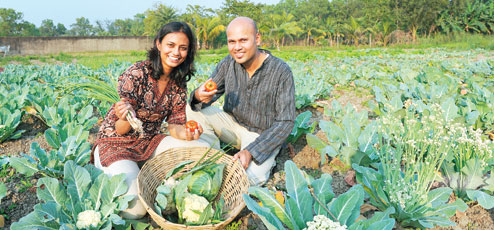
Aparajita and Debal are eight years older and in a different time zone, living a very different life. They have ditched their formal shoes to slip into work chappals. Instead of shopping and pubbing on weekends, they shovel manure and harvest crops. Meals are no longer about takeaways but growing food using organic and biodynamic methods. In their farm, called Smell of the Earth, said to be the first of its kind in the country!

“I am a full-time farmer now!” exclaims Aparajita, 33, her broad smile and sickle in perfect sync.

She is standing in an 11-bigha community-supported agriculture (CSA) farm in Thakurpukur on the southern fringes of Calcutta. “I join in the digging and harvesting but not the tilling because that requires a bullock and a plough, which I still don’t know how to handle,” she says, almost apologetically.

This rare mati-manush tale, with roots in Kentucky and shoots in Calcutta, began with Aparajita and Debal starting their life together in the US like any other young immigrant couple vying for their own small piece of the so-called American dream. Then something happened. Not professional instability, illness or a family crisis. Just a simple realisation that the food they were eating was “poison”.

“We were drawn to food-related issues in the US and the growing influence of GMO (genetically modified organisms) back home. It scared us that the rate of disease, birth defects, cancer and allergies related to food production was so high,” says Debal, 39, who continues to work as a software developer for his American employer while pursuing his other dream.
ArgiKOLKATA28sept2014

We had witnessed the beginning of farmers’ markets and CSA in the US, a movement that has gained unprecedented momentum in the last eight years. But India was going in the reverse direction and we felt the need to come back and do our bit in spreading awareness, starting with Calcutta’s urban population.”

And so, in the summer of 2011, the couple left their adopted American way of life to return to the chaos of Calcutta. “When we left Kentucky, we weren’t sure we would be able to start immediately because we knew we wouldn’t be able to afford land sufficient for farming in Calcutta. Our first aim was to raise consciousness among middle-class families by writing articles or filming documentaries,” says Debal.

An opportunity came knocking when a friend offered a family-owned plot in Thakurpukur, which they happily “borrowed” through a land-share agreement. In a matter of months, Debal and Aparajita’s Smell of the Earth farm had found 26 members, including software and advertising professionals, college professors, an accountant, a banker and a photographer. They pay Rs 2,000 each for organic vegetables every month.

The farm, over an hour’s drive from the couple’s Santoshpur home, is not your usual faux rural setting meant for weekend outings. It is a plot of land meant for agriculture and Debal and Aparajita intend to keep it that way.

Smell of the Earth had its first harvest in January with fresh leafy greens, radish, peas and cauliflower. Coming up are cabbage, coriander, French beans, tomato, pumpkin, brinjal, bitter gourd, potato, onion and chillies.

“Ours is a low-tech, low-energy and low-input poly and multi-cropping farm. We do inter-cropping instead of using pesticides to avoid disturbing the biodynamics. We use pond water and not ground water, and plan to make a transition to solar power,” says Aparajita.

She and Debal are quick to dispel the notion that they are in it for the money. “We don’t want to grow as a farm or expand as a business. What we would like to see grow is the idea. We want more people to look at our model and replicate it so that there can be a large network of such communities. If 30 more families were doing what we are doing, we could move towards a sustainable environment of healthy people,” Debal says.

What makes the couple happy is the enthusiasm of friends, colleagues and neighbours about their initiative. “When they came and saw the farm and attended meetings, they realised that this wasn’t just about paying Rs 2,000 for organic vegetables every month but about participation, building a community and protecting the ecosystem. The vegetables come as a bonus, as one of our members puts it,” says Aparajita.

The CSA model had started in Germany in the 1960s and was adopted by Japan before it made inroads into North America two decades later. But it was only in the new millennium that the movement gained momentum in the face of environmental awareness and food scandals in the US. Today, there are more than 7,000 CSA farms in the US and around 2,000 in Central and Eastern Europe, but just about a hundred in Asia.

A typical CSA farm comprises a community of individuals who pledge their support to an urban farm operation where the growers and consumers share the risks and benefits of food production using organic and biodynamic methods. In exchange for a monthly membership fee and a little labour during harvest, members receive shares from the farm’s bounty throughout the growing season, delivered every week.

At the Thakurpukur farm, Wednesdays and Fridays are reserved for delivery, when Aparajita fills organic cotton bags with the harvested veggies and ferries them across the city to members’ homes.

All other days, too, Aparajita is busy at the farm, having given up a post-grad teaching stint. She helps with the work and planning for the season with Manoranjan, a local farmer who has been appointed caretaker. Debal joins in on Sundays with the couple’s three-year-old daughter Kulfi.

Once a month, the members go on farm visits and assemble at the farmer couple’s Santoshpur home to watch documentaries and share books. “We keep updating our Facebook page [Smell of the Earth] with pictures of the farm and share tips and recipes on vegetables growing for the season,” says Debal.

“We recently had a wonderful experience: a two-week permaculture course [the development of agricultural ecosystems intended to be sustainable and self-sufficient] in a small village near Darjeeling. It’s still a learning process because what did we know about farming?” adds Aparajita.

Back in 2000, Jadavpur University alumnus Debal couldn’t see beyond the career that awaited him in Kentucky as a software developer, while ex-Presidencian Aparajita left Calcutta four years later to do her PhD at the University of Kentucky. It was in the US that they met, fell in love and got married.

“When we had left India we were looking at diverse opportunities of building our careers and starting a new life. We were quite unclear if we would ever come back. We bought a house, a car, had our daughter there, but once this issue started affecting us, we were convinced that we wanted to come back,” recalls Aparajita.

“We had never really been conscious about what we were eating until we started getting bothered by the taste of vegetables, the idea of processed food and TV dinners that simply go into your microwave. Onions were the size of papaya,” says Aparajita. “And chicken tasted like soap,” quips Debal.

A chance meeting with an Indian couple growing organic food helped them understand the difference between what they were eating and how nature meant food to be. “We borrowed some of their books, watched movies and visited websites they recommended. We started buying our grocery from organic food chains even though it cost us three times as much before exploring food co-operatives and farmer’s markets,” says Aparajita.

Joining a CSA farm at Lexington in Kentucky — set up by Erik Walles, “an American scientist who gave it all up to start farming” — sealed the dream Aparajita and Debal are now chasing.

WHO ARE THEY?

Aparajita Sengupta, 33, and Debal Mazumder, 39. They gave up their life in Kentucky to come back to Calcutta in 2011 and start a community-supported agriculture (CSA) farm in Thakurpukur, called Smell of the Earth.

WHAT IS A CSA FARM?

A farm comprising a community of individuals who pledge their support to an urban farm operation where food is produced using organic and biodynamic methods.

WHAT ABOUT SMELL OF THE EARTH?

Aparajita and Debal’s farm has 26 members who pay Rs 2,000 each for organic vegetables every month and participate in the movement. Its first harvest in January comprised fresh leafy greens, radish, peas and cauliflower. Coming up are cabbage, coriander, French beans, tomato, pumpkin, brinjal, bitter gourd, potato, onion and chillies.

source: http://www.telegraphindia.com / The Telegraph, Calcutta / Front Page> Calcutta> Story / by Mohua Das / Saturday – March 02nd, 2013

Vrindavan widows come ‘home’ after years

Kolkata :

As people in the city started opening their sleepy eyes on Friday morning, many early train catchers halted for a while seeing a group of white sari-clad elderly women coming out of Howrah station chanting “Radhe, Radhe, Radhe, Radhe”.

About 70 widows reached Kolkata from various ashrams in Vrindavan on Friday to visit the city and witness the spirit of festivity here.

Kanaklata Devi (105), who left the city 70 years ago, pointed at an advertising hoarding with a Hema Malini photograph and shot a humorous comment: “Tumi to asechho amader sahore, amra gele dosh ki?” (You have come to our city, so what is our fault if we stay at Vrindavan?”

BJP’s Mathura MP Hema Malini’s recent comment on the presence of many widows from Bengal in Vrindavan created a furore among various people and activists. The actor-turned-MP later clarified that these widows should not be thrown out of their native state by their relatives after their husband’s death. They should rather be treated with care and affection by their own people in their own state.

Kanaklata had a point to counter Hema Malini. “I am coming to this city after 70 years. Because I did not want to miss the chance of attaining ‘moksha’ by not passing away in that divine land of Vrindavan. According to myth, a person attains ‘moksha’ if he dies in Vrindavan. But this year, I could not refuse Pathak babaji’s requests to visit my hometown.”

Sunitra Devi (79) was nostalgic as she got down from the bus in which they were brought to Raj Bhavan to meet the governor. The lady, who lost her husband at the age of 26, used to live at Maniktala. “After our marriage, he brought me here to show Raj Bhavan. But at that time, we could see Raj Bhavan only from a distance,” she said.

The widows of Vrindavan will be in the city for two more days, during which they plan to visit the artisan’s hub at Kumartuli, hop some Puja pandals and enjoy a tram ride. “Getting an opportunity to see their favourite spots in and around the city after so long, the elderly women were behaving like teenagers,” said Bindheswar Pathak, founder of Sulabh Foundation, which is looking after about 1000 widows in Vrindavan.

source: http://www.timesofindia.indiatimes.com / Th Times of India / Home> City> Kolkata / by Kamalendu Bhadra, TNN / September 27th, 2014

‘I had decided not to marry and see what I have today, a family of 900!’

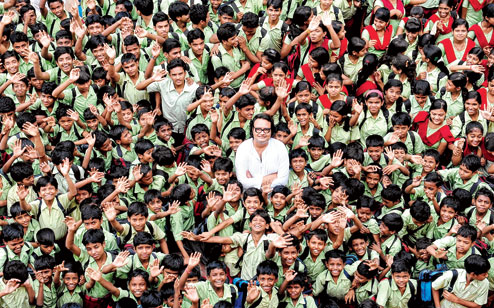
Vinayak Lohani basks in the love of his 900-strong Parivaar comprising destitute children whom he feeds, clothes and educates in Thakurpukur. Picture by Sanjoy Chattopadhyaya

His sartorial style is a crisp, white kurta-pyjama teamed with thick, black-rimmed glasses. He idolises Sri Ramakrishna and Swami Vivekananda and quotes Sunil Gangopadhyay. He worships Satyajit Ray and Ritwik Ghatak and unwinds with Anjan Dutt’s songs. He loves eating fish and roaming the old lanes and bylanes of Calcutta at night.

If 37-year-old Vinayak Lohani is catholic in his tastes, he is single-minded when it comes to his cause: providing home, hearth and education to the poorest and most vulnerable of children through the largest free residential school in eastern India.

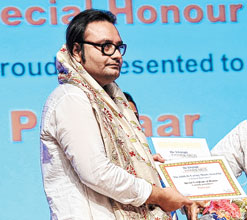
Vinayak receives a special certificate of honour on behalf of Parivaar in the ‘A School that Cares’ category of The Addlife Caring Minds Awards, along with a special honour from The Telegraph Education Foundation at The Telegraph School Awards for Excellence 2014, presented by Peerless in association with Parle-G and powered by Adamas University. The awards were given away at the Science City auditorium on Saturday

Vinayak, winner of The Telegraph Education Foundation’s certificate of honour at The Telegraph School Awards for Excellence 2014 on Saturday, was born in Bhopal but has made Bengal his home.

Vinayak had come to Bengal as a student, first to earn a degree in mining engineering from IIT Kharagpur and later an MBA from IIM Calcutta. It was while studying for his MBA that the then 20-something engineer sprang the first surprise of his career. He opted out of campus placements.

“I was the only one in IIM Calcutta’s history to do so!” he says with a laugh. “I wanted to do something in the social space. I wasn’t interested in a corporate career.”

By then, Vinayak had started skipping classes, writing journalistic pieces on social initiatives and volunteering with NGOs. He had worked with Infosys for a year in between his stints at IIT and IIM and realised that his calling lay elsewhere. Calcutta, with its “rich history of leaders and reformers”, fuelled his desire to be different.

“Being a good student from a middle-class family, engineering and MBA happened by default. But soon I found myself losing interest in a mainstream job and the corporate environment,” recalls Vinayak.

Vision & Vivekananda

For inspiration, Vinayak had Vivekananda. “I have always been inspired by the agents of change in society and the sense of sacrifice, service and devotion, especially Swami Vivekananda’s. I took diksha from the Ramakrishna Mission…spent time with monks. Mother Teresa’s influence was strong, as was the legacy of our freedom movement. I found no momentum to return to my hometown. All my thoughts became very Calcutta-centric.”

At 25, Vinayak became quite the non-conformist, determined to establish a reformatory institution of his own rather than be in the so-called rat race. “Doing what everybody else was doing didn’t excite me. My notion of success was different. I had been to the best of educational institutions, so I didn’t need to prove my abilities to anyone. I knew that if I put in my best I might be able to make it happen.”

Vinayak’s plans did irk his civil servant father, though. “My folks were worried whether I had the kind of maturity needed to carry out the responsibility of running an organisation, dealing with different domains and steering it safely and successfully.”

After moving out of IIM, he rented a small house in Sakherbazar in Behala. His plan was to start a free residential school for deprived children — the kind he had seen loitering on railway platforms and in red light areas. A few friends, researchers and professors from IIM were Vinayak’s “sounding board”.

Parivaar was born in 2003 but bringing up the child proved far from easy. “I prepared proposals, met people here and there, but all in vain because no one wanted to support something that was the wishful thinking of one individual,” says Vinayak.

With his efforts to raise funds leading nowhere, he rented a building near Thakurpukur with his earnings from lectures and tuitions to MBA aspirants. Vinayak started his mission with three kids, often not knowing where the next meal would come from. “It was a hand-to-mouth existence. I was spending whatever I was earning. My mother was my first donor,” he recounts.

In another six months, Vinayak had 55 children under his small roof, thanks to the support of “well-placed” IIM alumni who responded to his emailed appeal.

By the end of 2004, he had purchased a two-acre plot in Thakurpukur to build his dream brick by brick. Parivaar is currently spread across 20 acres. “Surely this is eastern India’s largest free residential institution for children today but not too many people know about it,” says Vinayak.

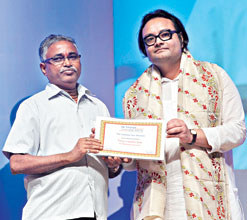
Vinayak presents The Shining Star Honour to Purna Chandra Rout, a non-teaching employee of La Martiniere for Girls for 37 years, at the Science City auditorium on Saturday. Pictures by Rashbehari Das

Parivaar path

Parivaar is today an institution that houses 672 boys and 298 girls whose lives have changed because of education and Vinayak’s encouragement. Some have gone on to get university degrees. “We have had a significant number of very inspired volunteers. They were mostly our donors who became our campaigners and spread the word actively,” says Vinayak.

Parivaar has two campuses that take in children between the ages of four and 10. The one for boys is called Parivaar Ashram. Located a few blocks away is the girls’ campus, called Parivaar Sarada Teertha. Each campus has dorm-like housing, a library, computer room, dining area, a soccer field and a volleyball court.

Parivaar also has its own co-educational school till Class X called Amar Bharat Vidyapeeth, located on the boys’ campus. “It’s not as if the kids’ stay is over once they are through with their education here. Would a parent ask a child to leave home? The older ones tutor the younger kids, earn pocket money and can move out of their own free will once they feel they are ready,” says Vinayak.

There are a few rules that set Vinayak’s initiative apart from others of its kind. “We don’t accept institutional support from any foreign agency. Ninety per cent of our donors are individuals of Indian origin, whether they are living in India or abroad. No government support. That’s how I could build it my own way because foreign or government agencies have their own parameters. I wanted to design my school my way, just like an artist would create his own piece of art,” he reveals.

Target 5,000

While his field teams are scouting for destitute children to bring home, Vinayak’s mind is preoccupied with the future challenges of the mission. “I hope to touch 1,200 by December. Since we have limited capacity at the moment, we admit children based on their neediness. Primarily orphans and the homeless are picked up from railway platforms and pavements, or those with one parent and incapable of taking care of the child.”

Apart from the city, Parivaar reaches out to rural areas, including the tribal belts of Midnapore, Bankura, Purulia and Jharkhand. The emphasis is on giving girls vulnerable to exploitation an opportunity to build their lives.

Vinayak’s IIT and IIM education hasn’t gone waste either. Parivaar is an example for institutions on how to “scale up” operations using entrepreneurial skills.

Unlike many social welfare organisations that are cagey talking about finances, Vinayak is upfront about money. “We raise around Rs 14 crore every year. I can raise Rs 100 crore over the next 10 years but I am not satisfied with that. For me, sky is the limit. I am taking Parivaar to 5,000 children in the next seven years. My aim is to convert Parivaar into the largest free residential school in the country.”

Model mission

The Parivaar model is already a case study at business schools. “A lot of people want to do things but don’t know how to get started. There’s a huge possibility of social enterprise and since I understand how it works, I want to help those who want to be agents of change — be it in education, health or livelihood,” says Vinayak.

His personal turning point was the decision to take the road less travelled, away from home and family. “When I took up the responsibility of these children I decided that I was not going to marry and raise a family. Otherwise, it wouldn’t have been possible for me to give myself completely, emotionally. I would have become nervous, I would have collapsed. So a strong focus was the emotional focus. I closed the door on any thoughts or feelings that might be distracting. And see what I have today, a family of 900!” he smiles.

Vinayak is now comfortable letting the institution run on “auto-pilot”. The faculty and his 179-strong office team take care of everything, his role being limited to “reviewing, mentoring and monitoring”. That is when he isn’t busy giving lectures at youth forums or in his new role as member of a special taskforce under the Union ministries of finance and women and child welfare. He also makes time for helping, mentoring and handholding young social entrepreneurs.

If there is one thing Vinayak is touchy about, it is about not being identified as “a Bengali”. His Bengali look, he says, has been “acquired through effort”. The dhuti was his choice of everyday attire until two years ago, when he switched to his trademark white kurta-pyjama.

“I would get offended when people wouldn’t take me as a Bengali. I have always identified with the Calcutta of the 1960s and ‘70s — the shilpis, buddhijibis and their simple-living-high-thinking philosophy that defined the city’s cultural aristocracy. Emotionally, I see myself as that and I have really tried to become one for all these years,” smiles Vinayak.

What message do you have for Vinayak Lohani? Tell ttmetro@abpmail.com

source: http://www.telegraphindia.com / The Telegraph, Calcutta / Front Page> Calcutta> Story / by Mohua Das / Monday – September 01st, 2014

Sourav Ganguly, man in a hurry at the CAB

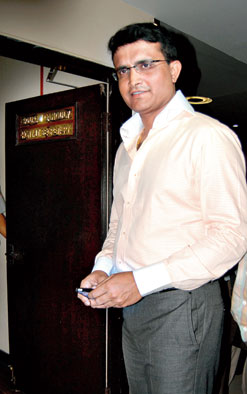
Sourav Ganguly, outside his room, at the CAB HQ

Calcutta:

Around an hour with Sourav Ganguly in his joint secretary’s room at Eden Gardens, where the Cricket Association of Bengal (CAB) is headquartered, actually makes you wonder whether captaining India was tougher for him or managing the many roles he’s now playing.

An administrator’s hat is just one that Sourav is wearing. He’s also co-owner of an ISL franchise, ‘architect’ of a mega project in education and co-opted member of the Justice Mukul Mudgal panel which is probing “13 individuals,” including Narayanswamy Srinivasan.

Besides, locally, Sourav is much in demand to be the face of a product or venture. From steel bars to health insurance to real estate.

“Different roles have different responsibilities… The demands are different… But, in everything, captaining India remains at the top… Doesn’t compare with anything,” Sourav told The Telegraph.

The No.1 difference?

“As captain, if I made a mistake, I didn’t get a second chance… It’s different today… I can correct an unintended error,” Sourav replied.

At the CAB, Sourav seems a man in a hurry. Nothing wrong, though… He has travelled the world, has ideas and wants cricket in the state to move forward.

As captain, both on and off the field, Sourav wasn’t conventional, which is one big reason why he was successful. He wants to be different at the CAB as well.

“I’m certainly not in this chair for (cream cracker) biscuits and tea in the evenings… There’s work to be done, but what’s amazing is the number of people on the staff who’re keen to make a difference…

“I accept this is a new hat that I’m wearing, but I haven’t got into the CAB to add to my CV,” Sourav said.

Not that Sourav isn’t aware of the high expectations. Talk of pressure and he counters by saying he’s been used to it for decades.

Sourav is 42.

Even if the biscuits aren’t touched, tea can’t be avoided. Not in the Maidan’s environment.

So, grinning, Sourav pressed a button and asked for “dudh diye cha.” With papers and cheques to sign, he definitely needed a cha break.

Sourav’s maiden appearance as an administrator, at the Eden, was in early August, but he’s begun to settle down only more recently, after India’s tour of England.

Media-related assignments kept Sourav, too, in England.

Till the early 2000s, at the Eden, mediapersons would follow every move of Jagmohan Dalmiya. Today, dozens scramble over once word spreads that “Dada” has arrived.

One bite, one quote… The Sourav-generated buzz is unmistakable.

Some probably feel they’re being marginalised rather quickly, but Sourav is confident he’ll be getting the support of everybody.

The CAB continues to be headed by Dalmiya.

New to the role or not, it hasn’t stopped some on the CAB’s payroll from directly approaching “Dada” for a hike.

Apparently, one of the staffers went to the extent of telling Sourav that if the CAB couldn’t raise his salary, then he could consider paying him extra from his own resources!

From the players’ mindset to the dreary look of the CAB’s indoor facility, Sourav wants plenty to change.

But just how much time would be needed for the changes to set in?

“At least a year… I’m settling down well and, as I’ve observed, a number of people in the CAB really want to put in that extra bit. I’m very hopeful,” Sourav pointed out.

Lest a wrong impression be created (and encouraged by those with a vested interest), Sourav added: “It’s not about me… It’s about the institution.”

Sourav, meanwhile, is off to New Delhi on Sunday for a meeting of the Justice Mudgal panel. He’s the cricket fraternity’s only representative involved with the Supreme Court-ordered investigations.

source: http://www.telegraphindia.com / The Telegraph, Calcutta / Front Page> Sport> Today / by Lokendra Pratap Sahi / Calcutta – Sunday, September 21st, 2014

Barcelona musician joins gypsy and Baul music

Kolkata :

He was born and brought up in Belgrade by his Bengali mother and Serbian father. He got his degrees, including a Masters, in Austria, where he spent eight-odd years. But with a name like Robindro, he could not escape music.

Barcelona Gipsy Klezmer Orchestra’s clarinet player-scholar Robindro Nikolic is in town, holding workshops and bringing the worlds of gypsies and bauls together.

“My mother, Manjula Mukherjee had gone to Europe with her parents who were diplomats based in Yugoslavia. She studied medicine, but later took up Ayurveda. She met my father, who is a Serbian, at Belgrade,” Robindro narrated in his accent.

He further explained what brought him to Kolkata for the first time, four years ago.

“In Switzerland in 2007, I was performing with Zubin Mehta when I met Pandit Tanmoy Bose, who was collaborating with Anushka Shankar. We exchanged numbers, spoke about music. He urged me to make my own music as I was part of a huge orchestra. He really inspired me. In 2010, I came to Kolkata, where Bose introduced me to many people — musicians like guitarist Bodhisattwa Ghosh with whom I jammed at Someplace Else, and the cultural organization Banglanatak. I was keen to research on music medicine and music therapy, so Bose’s wife, Bonnya, who was with ITC Sangeet Research Academy at the time, introduced me to their archive where I spent considerable time,” he told TOI on Wednesday.

“Many people think my name is Brazilian or Portuguese. But I tell them no, it’s Bengali,” he said.

When prodded on his association with Indian music, he said, “I have researched on the broad science of Indian ragas and music therapy in India. But this is the first time I’m having a musical exchange with Bengal folk musicians. We found many similarities between the folk forms of the two worlds. ‘Doina’, a Jewish folk form from East Europe, is very similar to Baul, as my fellow musicians pointed out. It’s about spirituality and not religion. I’m also keen on exploring the Bengal wind instruments.”

But Baul is not a “new love” for him, he said. “When I was little my mother would travel back home and get, among others, Baul music recordings for me.”

Singer Dipanwita Acharya, who was part of the workshop, said, “It was a wonderful experience. And I’m so happy to learn about ‘Doina’. So many similarities with our Baul music and the storyline of these music forms are the same globally.”

Percussionist Sandip Bag, who played ‘dubuka’, an instrument from Middle East, at the workshop, said the rhythms Robindro played were quite different, and this was a refreshing experience.

Arpan Thakur Chakraborty, a guitarist, added, “This was very helpful for me. I learnt a lot about scale variation and progression while playing ‘jazz manouche’ or gypsy jazz with him.”

source: http://www.timesofindia.indiatimes.com / The Times of India / Home> City> Kolkata / by Shounak Ghosal, TNN / September 25th, 2014

When Mahatma saved Netaji’s revolutionaries from gallows

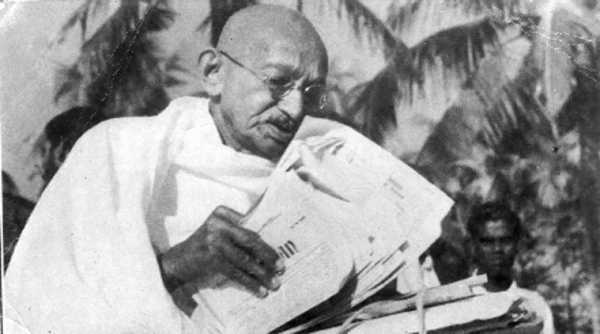
Mahatma Gandhi wrote seven letters to the then Viceroy of India after wife of revolutionary Haridas Mitra approached him. Haridas Mitra is the father of West Bengal Finance Minister Amit Mitra. (archive)

Mahatma Gandhi wrote seven letters to the then Viceroy of India, Lord Wavell, to commute the death sentence, and subsequently get released four young revolutionaries who were held guilty by the British of supplying information to Netaji Subhas Chandra Bose’s Indian National Army (INA).

The startling historical fact is just on of the many mentioned in the jail diary of freedom fighter Jyotish Basu who died in 2000. The diary has been compiled by renowned researcher Pallab Mitra in the form of a book —- ‘Phansi Theke Phire’ (Back from the Gallows) – and details the last few days of Basu at Presidency Jail where he was brought back from the gallows, just a minute before he was to be hanged.

The four revolutionaries for whom Gandhi sought clemency were Jyotish Basu, Amar Singh Gill, Pabitra Roy and Haridas Mitra. Haridas Mitra is the father of West Bengal Finance Minister Amit Mitra, and his wife Bela was the niece of Netaji.

All four were released in July-Agust 1946. While not much is known about the later life of Gill and Roy, Mitra joined Congress and later became the deputy Speaker of West Bengal Assembly. Basu spent his life in various social and cultural activities and died in 2000, at the age of 92.

As per the historians, the only known case when Mahatma Gandhi urged the British to commute the death sentence was for Bhagat Singh. The freedom fighter was ultimately hanged on March 23, 1931. “As far as we know it was in the case of Bhagat Singh that Gandhiji intervened,” says Sabyasachi Bhattacharya, historian and former chairman of Indian Council for Historical Research.

It was Jyotish Basu’s residence at 6A, Bipin Paul Road in Kolkata that the revolutionaries, then part of INA’s Secret Service, set up a communication centre. It was from this house that Basu was arrested on December 31, 1944 while other three were taken into custody some time later.

After a trial that lasted a few months, all four, lodged in Presidency Jail in Kolkata, were sentenced to death.

The book details the fearlessness of the revolutionaries. Asked if they had any last wish before they were hanged, Gill said he wanted to watched a dance recital by Sadhana Bose, while Basu said he wanted to hear Kanan Devi’s songs.

Bela Mitra, then 22, wife of Haridas Mitra, meanwhile, went to Poona and pleaded with Gandhiji to write to the Viceroy requesting for the release, or if that was not possible, commuting of sentence of all the four. A few days later, Basu’s father Ranjan Bilas Bose too met Gandhiji with the same request.

Gandhiji wrote seven letters requesting for release of first Haridas, and then the three others. All these letters have been kept at National Library, Kolkata.

In his first letter, dated September 14, 1945 and sent from Poona, Gandhiji wrote: “Shri Haridas Mitra, an MA of the Calcutta University, and the husband of Shri Subhas Chandra Bose’s young niece, age 22 years, is under sentence of death over what appears to be on untenable ground. I have perused the petition for mercy by the uncle of the condemned as also Advocate Carden Noad. I suggest that they furnish cogent grounds for exercise of mercy. In any event, the case for mercy becomes irresistible in that the war with Japan is over. It will be political error of the first magnitude if this sentence of death is carried into effect”.

“…My attention was drawn to the case by the prisoner’s wife as she has often sung at my prayer meetings when I had the honour of being a guest of advocate Sarat Chandra Bose (elder brother of Subhas Bose) who I am happy to learn from the government of India has ordered to be released”.

It was about five years ago that Jyotish Basu’s daughter told Pallab Mitra about the diary. “I consulted historians Amalendu Dey and Basudeb Chattopadhyay and then I got to know about Gandhiji’s letters. It was a wonderful revelation that because of his intervention four precious lives were saved from the gallows,” says Pallab Mitra.

Repeated calls and text messages to minister Amit Mitra failed to elicit any response.

source: http://www.indianexpress.com / The Indian Express / Home> Cities> Kolkata / by Sabyasachi Bandopadhyay, Kolkata / September 15th, 2014

Celebrating Puja in true spirit and ethos, dozen years on – 70-plus new clubs join cause

Actress Tanusree, who was a judge of the CESC The Telegraph True Spirit Puja 2013, at a pandal

More than 70 new puja organisers with varied age, budget and popularity quotients have joined a movement that is dozen years old, has 300 members and growing — the CESC The Telegraph True Spirit Puja.

In the true spirit of the movement for a safe, clean and people-friendly festival, the newcomers — from 10-year-old pujas to seasoned 44-year-olds — received their induction briefing at Spring Club on Saturday.

“The CESC The Telegraph True Spirit Puja is not about big idols or big pandals but something else. It is about whether you are environment-friendly or not, whether you are taking care of the pandal-hoppers or not, whether you have taken proper steps for their safety or not,” said Arijit Basu, the deputy general manager for customer relations of CESC, at the first club meet.

The movement started in 2003 with around 70 puja clubs and committees, swelling to 300 participating members in over a decade. The CESC The Telegraph True Spirit Puja judges pandals on three broad parameters:

n Safety measures top the list. Judges look into the organisers’ efficiency in crowd management and their capability in handling crisis situations, availability of first-aid, presence of fire safety measures and more.

n Civic consciousness comes next. Are the pandals following sound pollution norms? Are they eco-friendly? Is their waste disposal system efficient? Are they retaining or restoring public property in the locality?

n Social commitment of the organisers is the final category. Do the pandals have help desks to assist pandal-hoppers and how efficiently are these being managed? What facilities do they offer to people with special needs, like someone on a wheelchair or senior citizens? Do they have toilets and drinking water taps? Are the organisers committed to charity and community engagement?

The Model Puja award goes to the best pandal after two rigorous rounds of judging. A Viewers’ Choice Award has been added this year where pandals with the highest upvotes on the CESC Facebook page will get the trophy.

According to some of the new entrants, the best thing about the movement is that the CESC The Telegraph True Spirit Puja is not about big budgets but encouragement it offers to homely and small-scale pujas, such as the Dakhineswar Adi Sarbojanin Durgotsav O Dol Utsav Samity — in its 75th years this season.

“We don’t have a theme and we cannot compete with the grandeur of other pujas but we are committed to the spirit of the festival and we care about all those who drop in. Everyone is a VIP for us. The awareness this movement is creating is necessary and we fit into the spirit of it,” said Tarashankar Pramanik, the vice-president of the organisation.

Others have other reasons like civic and environmental aspects. For 21-year-old Sankha Ghosh and 18-year-old Ankit Saha of Pallibasi Durgotsav Committee in north Calcutta, the biggest draws are the issues the movement espouses.

“This is the first year our generation has taken the reins of the 44-year-old puja. We felt the need to participate in a movement like this. If we don’t take things like sound pollution, eco-friendliness and social commitment seriously, what will we leave for the next generation?” asked Sankha.

“Ours is a small puja, very homely… but it is the heart of it that counts, not the budget or the popularity,” added Ankit.

source: http://www.telegraphindia.com / The Telegraph, Calcutta / Front Page> Calcutta> Story / Monday – September 22nd, 2014

Reasons to pick adoption

Kajal and Anirban Banerjee at the Rotary Sadan programme on Sunday. / Picture by Arnab Mondal

An adoption agency had turned him away. “Are you blind?” an official had asked him as he entered the office with his wife. He was blind and was supported by his stick. “No child wants to have a blind father,” he was told. He left. He felt that though gifted with eyes, the officials couldn’t see.

Later, encouraged by a well-known social worker, he adopted a girl from another agency. Today he and his wife are very proud parents.

“It was the best decision of my life,” said the gentleman.

As it rained hard outside, Rotary Sadan on Sunday morning heard a number of heart-warming stories.

Adoptive parent Indrajyoti Sengupta read poems he had written on adoption. Kajal and Anirban Banerjee, who have an adopted daughter, regaled the audience with their stories. These parents were only happy that they had gone ahead, despite obstacles, inhibitions and apprehensions, and taken the step of adopting a child.

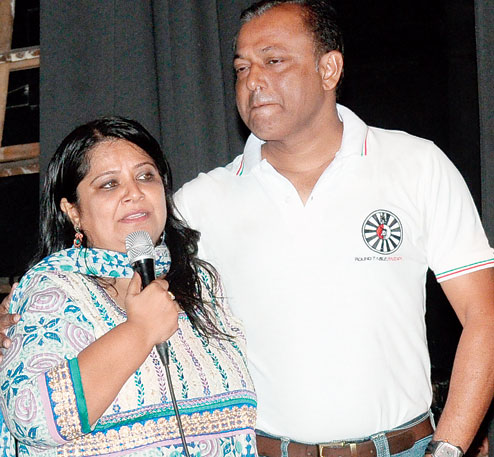
The occasion was “Lifeline”, an event organised by Rotary Club of Calcutta Renaissance, with Round Table India and Ladies Circle, two Rotary wings, to promote adoption. It was an open forum that brought together couples who have adopted children, couples who are contemplating adoption, representatives of adoption agencies and government organisations.

Round Table India national president Deepak Menda spoke about how the organisation in the last 17 years had built 1,700 schools in the country and helped with the education of 5.3 million children.

Lifeline is a recent initiative, he said, to advocate adoption, the need of the hour.

Adoption is a far better option than a long period of infertility treatment that can cause inconvenience and cost a lot of money, a Rotary official said.

The event also saw the launch of the website www.adoptionlifeline.in by the organisers.

Adoption can be a beautiful experience, but as many adoptive parents and prospective ones will attest, the process is not always easy. It is complex and there are inordinate delays.

The website, which people can access shortly, is meant to be an interface between prospective adoptive parents, adoption agencies and government agencies to facilitate more adoption, beside being a network for adoptive parents.

source: http://www.telegraphindia.com / The Telegraph, Calcutta / Front Page> Calcutta> Story / by Chandrima Bhattacharya / Monday – September 22nd, 2014

INCHEON ASIAN GAMES 2014 – Saurav Ghosal settles for silver in men’s squash

Saurav Ghosal on Monday outplayed 35th-ranked Beng Hee of Malaysia to enter the finals of men's squash event. / PTI
Saurav Ghosal on Monday outplayed 35th-ranked Beng Hee of Malaysia to enter the finals of men’s squash event. / PTI

Loses title clash to Kuwait’s Abdullah Almezayen, narrowly misses out on becoming the first Indian squash gold winner in Asian Games.

Saurav Ghosal on Tuesday squandered a two-game advantage to narrowly miss out on becoming the first Indian squash player to win the gold medal at the Asian Games.

Ghosal was leading after the first two games of the gold-medal match but his opponent, Kuwait’s Abdullah Almezayen, staged a dramatic fightback winning the next three games to clinch the top prize.

Almezayen won the title clash 10-12 2-11 14-12 11-8 11-9 at the Yeorumul Squash Courts. The Indian missed out on a gold-medal point with the scoreline reading 12-11 in the third game, which eventually proved to be the decisive game.

Ghosal took 21 minutes to take the first game before consolidating his position by clinching the second in merely six minutes of play. The Kuwaiti squash player then made a grand fightback as he took 19, 12 and 17 minutes respectively to win the next three games.

Prior to this, the 28-year-old Ghosal had three Asian Games medals to his name – singles bronze in 2006 Doha Games and two more, including one in doubles, in the 2010 edition in Guangzhou.

source: http://www.thehindu.com / The Hindu / Home> Sport> Other Sports / PTI / Incheon – September 23rd, 2014