Artist from a farmer’s family

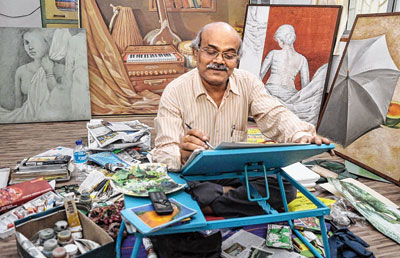
He is a still life artist who loves to paint in oil. Biraj Kumar Paul respects abstract art, but is not of that genre. As a teacher, he believes that an artist must first learn form before trying to break it. Paul is also one of the few artists who still likes to paint in oil. It takes up a lot of time, but the outcome is far more impressive and lasting, he says. Two large canvases in his room, based on still life, showing musical instruments in a classical singer’s house, are among his latest oil paintings that Paul exhibited at the Academy of Fine Arts in December last year.

“The effect of colours is far brighter and attractive in oil than acrylic paint. The painting also lasts longer,” explained Paul. It is not that Paul never uses other media. Currently, he is working on small paintings on nature that will be shown at the Charukala Utsav at Nandan from February 27. These paintings are made with acrylic. Another medium size canvas with an apple as subject placed on a mat, is also acrylic. “These are some of the few works that I have done in acrylic. But most of my paintings at exhibitions and those that I have sold, are oil paintings,” said Paul.

Paul makes his own canvases. “I still make my own canvas and treat it before painting on it. What is available in the market is never to my satisfaction. Also, painting on untreated canvas can cause fungus,” said Paul. His subjects are generally still life, figurative, landscapes and nature. “Many of my subjects are from my imagination. I sometimes mix reality with my imagination,” said Paul.

Biraj Kumar Paul working on his canvas. Picture by Gopal Senapati

Being an artist was an impractical proposition for Biraj Kumar Paul, considering his socio-economic background. Belonging to a farmer’s family in Midnapore, education for the family was too much to ask, let alone learning art. However, creativity was in Paul’s blood and he gradually became a self-taught artist. “I did not know what colours are. My mother’s alta was red, soot from the lantern was black, pui (Malabar spinach) seeds were crushed to make violet colour and leaves were ground to make green. I tell my students today that they are lucky to find colour pallets and tubes of paint in front of them when they work,” said Paul.

After completing school, Biraj found his way to Rabindra Bharati University in 1974, where he took admission in painting. “I came to know about the course from a boy in our village, who had taken admission in Rabindra Bharati University. I decided that I would study art because that was the only thing that I liked. There was no inspiration or motivation from people around me,” said Paul. In 1981, Paul passed his MA and joined as a teacher in Kisalaya School in Andul. Gradually he shifted to Howrah from Midnapore. After staying for some years at Santragachhi, Paul shifted to Andul in 1991.

While teaching, Paul joined Painters’ Orchestra, a well-know artists’ group in Calcutta with members like Partha Pratim Deb and Suchibrata Deb. At present, Paul is the secretary of the group. He has participated in numerous exhibitions around India from Painters’ Orchestra. “Every year, I participate in at least three to four exhibitions in Calcutta or outside,” said Paul. The artist is also part of a four-member group, We are 4, that does exhibitions around India and abroad. After teaching in RBU and at home, Paul now has a lot of time to spare for his own works. “I have just prepared another large canvas. I will start working on it soon,” he said.

MORE ABOUT PAUL

DoB: February 1, 1955
Born in: Midnapore
Education: MA (Painting)
Family: Wife, son, daughter (married)
Loves: Travelling
Hates: Misbehaviour

source: http://www.telegraphindia.com / The Telegraph, Calcutta / Front Page> Story / by Daila Mukherjee / Friday – February 20th, 2015

An evening to remember

Kolkata :

The Times of India organized Times Evening at The Residency, City Centre-I, Salt Lake on Valentine’s Day.

Presented by Airtel in association with Toyota – Quality Revolution, IFB, Bhagirathi Neotia Women & Child Care Centre, Adrija Gold and Diamond Jewellery Collections, Re-Feel, Kent – Mineral RO, The Braands – E mall, Lifespan Diabetes & Cardiometabolic Clinic, Lawrence & Mayo, SIP Abacus, Bubble Blue – Montessori School, Keventer Fresh, The State Bank of India, IFB Agro Ltd and Rikshiva Fashion, Times Evening began with a medical camp where Lifespan Diabetes & Cardio metabolic Clinic conducted free blood sugar test and doctors consultations. Lawrence & Mayo did free eye check-up.

Toyota-Quality Revolution organized a free test session for all residents throughout the day and also gave freebies to all the persons who took test drives. The special offer to residents included Rs 15,000 worth accessories free for spot bookings.

In the evening, a sit-and-draw competition was held for young ones up to the age of 12. In the event ‘Paint your Imaginations’, 18 kids participated in it. The first prize was won by Trisha Khilani, the second prize by Diya Gupta and the third prize by Pranit.

In the cooking competition titled ‘Master Chef Competition’ sponsored by IFB and IFB Agro Ltd, Ankita Mundra who made moong dal ka halwa won the first prize, an IFB microwave oven. Susmita Dash won the second prize, an IFB induction cook top, for her chilli chicken. Nisha Sharma’s veg pasta with mixed sauce was adjudged third.

The evening ended with a musical performance. The prizes were handed out by guests of honours Sumanta Bhaduri of Adrija Gold & Diamond Jewellery Collections, Shantanu Roy Chaodhury and Arnab Bhattacharya of Topsel Toyota, Anil and Nidhi Khandelwal of The Braand and Nabanita Bose Mukherjee of SIP Abacus

source: http://www.timesofindia.indiatimes.com / The Times of India / Home> City> Kolkata / TNN / February 20th, 2015

Weaving dreams in Shantipur

Shantipur :

Next time you marvel at intricate weaves on a handloom saree at an upscale garment retail chain in Delhi or Mumbai, it could well be the work of a weaver in a tiny hamlet in West Bengal’s Shantipur.

About 90km from Kolkata, Shantipur in Nadia district is historically famous for producing the fabled feather-touch handloom dhoti and sarees coveted by the connoisseurs. Besides being an ancient seat of Sanskrit and Vedic learning and Vaishnav culture, Shantipur has been a centre for handloom weaving for the last 500 years, at least.

Yet, skilled weavers have been struggling for bare survival for years. Some have shut down their looms and migrated out of Shantipur to eke out a living as day labourers at construction sites.

To tide over the rough patch, weavers are now breaking out of the traditional mould. Instead of the age-old matha sarees and jacquards, Shantipur weavers are turning to innovation to catch the contemporary woman’s fancy. They are picking up a colour palette including magenta, teal, burgundy and rust. Traditional motifs are coming alive with a modern twist to the ancient warp-and-weft saga.

Helping them with innovation and the much-needed monetary support is Madhumita Pyne of Kolkata. Her fondness for handloom fabric led her to explore its provenance. Somewhere on this journey, this former consultant with a global management consulting firm met Anjan Biswas, a young weaver from Shantipur.

Anjan belongs to a family of weavers. His father Manoranjan had experimented with innovative techniques like embedded sequins to up the style quotient of bland handloom sarees. Due to a dearth of avenues to market his ware, he, like scores of other weavers in Shantipur, stuck to the rut. They churned out a bland drape to earn a meagre livelihood.

Some, like Prasenjit Biswas, switched to the power loom, which churns out more sarees in much less time and effort. “The quality though is not half as good as handloom sarees,” he admitted.

After meeting Anjan, who introduced her to Shantipur’s weavers, Pyne’s long experience in corporate-marketing instantly helped her recognize the immense potential of handloom drapes.

“There is a huge demand for handloom fabric, not just in India but abroad, too. Foreigners love the fabric for its look and feel. More importantly, they are drawn to handloom for the unique story behind the weaves,” said Pyne.

Following her instinct and passion, she decided to take the plunge last November. “The weavers in Shantipur have immense skill. What’s lacking was marketing our products and keeping up with modern trends,” said Anjan.

Pyne pitched in with both and a little more. She designed sarees and chose the colours of the thread. After the first batch was off the loom, she was ecstatic with the product. She tapped several online stores like Indianroots and top retail chains to market Shantipur sarees. She also launched her brand Loomiere. She played on words to give expression to her intent — loom that can lighten up lives of weavers.

Pyne wants to make handloom popular and help weavers get a decent income. “It’s sad that such skilled weavers who create wonders on their looms have to battle only to survive,” she said.

“The response was unexpected. In the very first month, we were flooded with orders, including from the US and the UK,” said Pyne.

She has been goading weavers, used to a laid-back way of working, to stick to deadlines. “After the initial scepticism, the weavers were enthused about the project. They are working day and sometimes late into the night to meet Didi’s (Pyne) deadline,” said Anjan.

A boost in their income also helped matters. Lalon Biswas, for instance, takes two weeks to weave a saree on his family loom. “I earn Rs 2,000 for weaving one of these new sarees. About two years ago, one saree would fetch Rs 100-Rs 180,” he said.

They call Loomiere’s sarees “new sarees”. Over the months, Anjan’s enthusiasm for Pyne’s venture has grown. He calls her ‘Didi’ and does all the running around, getting more weavers into the fold.

Currently, 220 weavers are working on about 100 looms for Pyne’s project. With a steady stream of orders flowing in, she hopes to expand.

“Besides, we plan to hold workshops in May to introduce more weavers to improved techniques and hone their skills,” she said. Loomiere has also set up a sampling unit in a small brick room in Shantipur. Here master weavers experiment with trends and styles.

Encouraged by the way things are shaping, Pyne has given up her plum job as a consultant to focus full time on Loomiere. Anjan, too, now dares to dream big. Both hope for the day when every weaver in Shantipur will lead a decent life and their skills would bring them good returns.

source: http ://www.timesofindia.indiatimes.com / The Times of India / Home> City> Kolkata / by Rakhi Chakrabarty, TNN / February 22nd, 2015

Sky’s the limit at seventy – Book bazaar

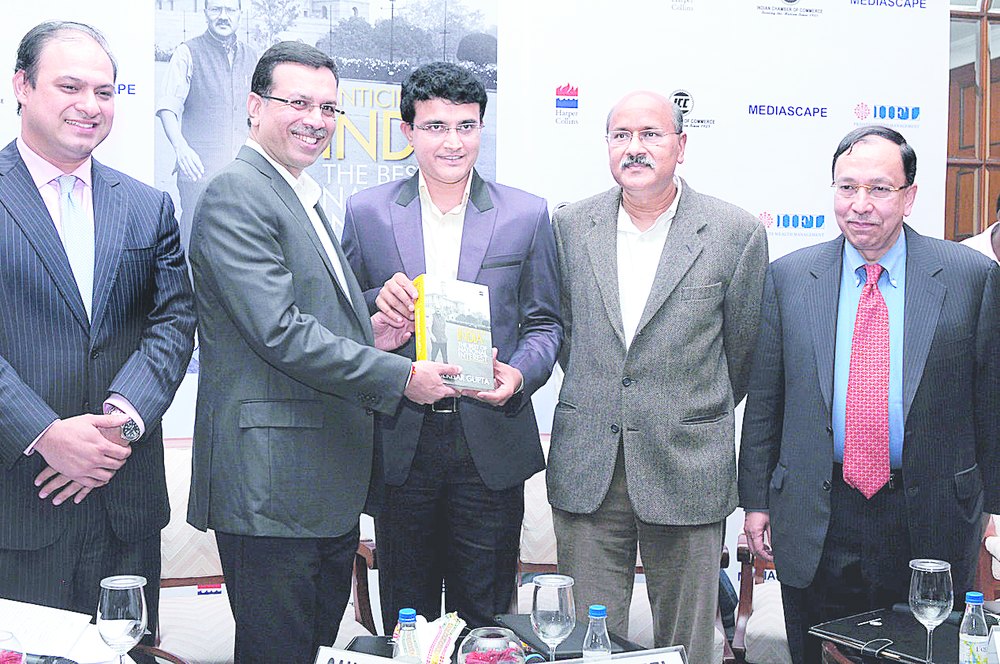
(From left) Sanjiv Goenka, Sourav Ganguly, Shekhar Gupta and Sugata Bose at a reading session of Gupta's book, Anticipating India: The Best of National Interest, at The Oberoi Grand. The book reading was interspersed with anecdotes from Gupta's repertory. "I do not hate politicians. Believe me, Indian politicians are the most interesting people you can meet," said the journalist at the session presented by the Indian Chamber of Commerce. Picture by Arnab Mondal
(From left) Sanjiv Goenka, Sourav Ganguly, Shekhar Gupta and Sugata Bose at a reading session of Gupta’s book, Anticipating India: The Best of National Interest, at The Oberoi Grand. The book reading was interspersed with anecdotes from Gupta’s repertory. “I do not hate politicians. Believe me, Indian politicians are the most interesting people you can meet,” said the journalist at the session presented by the Indian Chamber of Commerce. Picture by Arnab Mondal

Life began at 70 for Abhijit Gupta. A top-shot consultant, retirement opened up a new chapter in his life as his debut book was launched at Calcutta Club last month.

A Copper Sky is a coming-of-age tale of young Amar Das who moves from Delhi to London, much like the author himself.

“The first part of the book deals with the confusion of a youth who sees a foreign land and a liberated society for the first time in the 1950s. Even his own family is troubled with the changes in Amar’s life. As the novel progresses, the protagonist matures,” said Gupta, who now lives in Bangalore.

Abhijit Gupta at the launch of his book. (Chanchal Ghosh)
Abhijit Gupta at the launch of his book.
(Chanchal Ghosh)

Though set in the Fifties, Gupta feels his book has an universal appeal. “Certain issues don’t change,” he said. To connect with the youth, the author has also opened a Facebook account and started writing a blog.

Gupta did not rule out a sequel. “The book is not all darkness. There is a lot of fun and laughter in it too,” he signed off.


Flashback

A hit film, behind-the-scenes moments, a few laughs and some poignant memories – the audience was treated to all this and more at the city launch of Bimal Roy’s Madhumati, Untold Stories From Behind the Scenes written by the filmmaker’s daughter, Rinki Roy Bhattacharya.

The afterword for the book is written by filmmaker Anik Dutta, who is also Roy’s grand-nephew. “Perhaps I share a spooky connect with my mother’s uncle,” grinned the director of Aschorjyo Prodeep. “In Madhumati, he explored the supernatural and reincarnation of the human soul, a subject discussed for the first time in Hindi cinema. It was very different from his other films like Sujata, Bandini or Do Bigha Zameen, which had a social message. Every artist wants to explore the unknown, tread the untrodden path at least once in his lifetime.”

The author shared some trivia about the film and its crew. “It was a formidable team. The story was written by Ritwik Ghatak. The background score and music was composed by Salil Chowdhury. Hrishikesh Mukherjee was the editor though his assistant, Gurudas Dhaimade, edited much of the film. The credits mentioned Dhaimade as associate editor.” A few years ago, Dhaimade was felicitated by the Bimal Roy Memorial and Film Society, chaired by Bhattacharya.

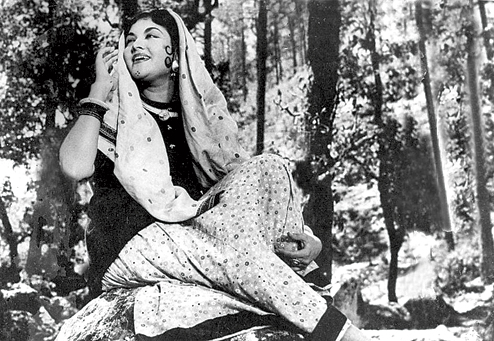
Vyjayanthimala in a still from Madhumati

Roy was possibly the only director who arranged for film screenings for his technical team, said the author. He would get copies of films he liked, many of them by Russian filmmakers, and get his team to watch them.

She described her father as a simple man at home who was strict with his children. “I never knew my father was in a glamorous profession. He never let us into that world. He believed in aesthetics. There was always a bronze vase full of flowers in his room and the walls were filled with black- and-white framed photographs. Every evening he came home, changed into his lungi and read the newspaper while relaxing on a couch in the living room.”

“We all had dinner together and we children were put to bed quite early. One particular evening, there was a frenzy of activity in the house even after dinner, something unusual in our house. I grew curious and stayed up with my friend who lived next door to find out what was happening. I almost fainted when I saw Dilip Kumar in our living room. Here was the man of my dreams just a few yards away and I couldn’t even ask for an autograph because my father wouldn’t allow it!”

The actor was there to discuss the script of Madhumati, Bhattacharya later found out. The Dilip Kumar-Vyjayanthimala starrer ran to a full house in Roxy for 24 weeks. “In those days if a film ran full house for more than 24 weeks, the workers at Roxy were entitled to double pay. Sadly, the owners didn’t want to pay and so stopped screening the film.”

Friendship & love

Sudeep Nagarkar turned impromptu love guru for the young audience at the launch of his fifth book, You’re the Password to My Life, at the Starmark store in South City Mall recently.

Sudeep Nagarkar at Starmark, South City. Koushik Saha
Sudeep Nagarkar at Starmark, South City.
Koushik Saha

“Friendship is the only ship that does not sink,” said the Mumbai-based author as he introduced his protagonists Virat and Kavya, best of friends sharing some wild and magical time together. “Not all girl-boy equations have to lead to love.” If Nagarkar had his way, Yeh Jawaani Hai Deewani would have ended differently, he said.

As the author spoke about the value of real friendship, the audience sought his advice on broken relationship and life after love. “Each person comes to your life to teach you something and bring you closer to your destiny,” said the author.

source: http://www.telegraphindia.com / The Telegraph, Calcutta / Front Page> Calcutta> Story / by Showli Chakraborty, Chandreyee Ghosh and Ayan Paul

A Classical Death

Once considered its mecca, classical music festivals are struggling to stray afloat in Kolkata. Tathagata Ray Chowdhury explores the reasons for the slow demise of the once thriving live music scene in the country’s ‘culture’ capital

Kolkata :

Not too long ago, Kolkata used to be steeped in the culture of live classical music. For the connoisseur, there was a plethora of fests to attend; for practitioners, a good show here, more than any where else, meant finally gaining acceptance among peers, perhaps even a chance to reserve a place in the pantheon of the greats. Cut to the last 10 years or so, and it’s clear that the once thriving culture is on the wane, with most classical music festivals staring at an uncertain future.

Even a couple of decades back, the city used to play host to a number of prestigious classical music gatherings. Now, only a few survive. Even fewer manage to do so with aplomb. Apart from a couple of names, most classical festivals are struggling to find sponsors, or are in the throes of a slow death.

But why this decay in the country’s “culture capital”? In a nutshell, it’s to do with the nature of classical music’s patronage. To start off with, it was the prerogative of the moneyed class, supported by zamindars and rajahs who truly valued it and understood its nuances. With the abolition of the feudal system, classical music finally travelled to the masses. Ironically, it was this that sounded its death knell.

In 1856, Lucknow’s exiled nawab, Wajid Ali Shah, had brought with him to the city the rich culture of classical music and established it in this part of the subcontinent. His court musicians — most notably Ustad Basat Khan and Ustad Sadiq Ali Khan — played a key role in establishing the genre in the city and its surroundings. By mid-20th century, Kolkata became a mecca for connoisseurs of this branch of the fine arts — so much so, that a number of stalwarts began to either settle down in the city or make it their second home.

Ustad Dabir Khan, the last khalifa of the Tansen family, made Kolkata his home, and other legends of the time — Ustad Allauddin Khan, Ustad Hafiz Ali Khan, Pandit Ravi Shankar, Ustad Vilayat Khan, Ustad Ali Akbar Khan and Ustad Amjad Ali Khan — all found a second home in this city. To all of them, this was the city where the real qadar daans (connoisseurs) lived. There were the music rooms — jalsaghars — of north Kolkata aristocrats, where both budding and prodigious musicians used to come for what then used to be called their “national audition”. And it was usual practice for the honorifics “Ustad” or “Pandit” to be bestowed on performers only after they gained enough acceptance in Kolkata’s aristocratic circles.

It is a matter of concern that a festival of the pedigree of All Bengal Music Conference is struggling to stay afloat nowadays. The first edition of the conference — on December 27, 1934, at Calcutta University’s Senate Hall — marked the day classical music breached the confines of north Kolkata’s aristocratic music rooms and reached the public. It was high time the lofty walls surrounding classical music were broken down: soon, the landed aristocracy would cease to exist, the country would become independent, and the zamindars would no longer be able to patronize the art form.

Sensing all this, Rabindranath Tagore, who was presiding over the event, had said: “We will have to keep in mind that Tansen and others were able to gift a certain form of music only because the royal opulence of the Mughal Empire could help them. That surrounding is no more there.”

Seventy-five years down the line, All Bengal Music Conference had to collaborate with another organization to hold this year’s event. “All Bengal Music Conference could not host any event because of lack of patronage and sponsorship for about 52 years,” says Robin Paul, general secretary of the conference and the founding secretary of Jalsaghar, an organization that promotes classical music. “It was Pandit Ravi Shankar who asked me to do whatever possible to revive the glorious organization. Pandit Asutosh Kanan also helped me revive it. When I associated myself with it in 2004, we could host events for a few years. But it is in very bad financial shape again. It is no longer in a position to host a soiree on its own. That is why it had to collaborate with ITC Sangeet Research Academy to host the music festival this year. Now that Babulal Ghosh, the last scion of the Pathuriaghata Ghosh family, who used to look after the once-famous music festival, also passed away a few weeks ago, I do not really know what the future holds.”

While the conference is staring at a possible extinction, many other music circles have either stopped functioning long ago or are counting their days. The reason is mainly to do with finances, particularly its lack.

Dipankar Sen, of the now defunct Calcutta Music Circle, has another take on the matter. “Organizers and sponsors often promoted a particular artist or gharana at the expense of others, and that also played spoilsport,” he feels. “Many organizations often used their platform to promote only a particular artist, or artists of one gharana. Naturally, connoisseurs started losing interest, as those concerts became repetitive.”

The lack of proper musical understanding by the sponsors — considered crucial in this genre — has also been a major issue. Tabla maestro Ustad Sabir Khan, who has been conducting an annual soiree under the banner of Ustad Keramatullah Khan Memorial Music Society for the past 28 years, has experienced this problem first-hand. “People who don’t know the first thing about music are directing organizers about which artist should perform, and who the accompanist should be on the tabla. It is not true that the money is not there. Corporate houses will happily spend crores to bring a Bollywood star on stage. But when it comes to classical music, the interest is just not there,” he rues.

Pandit Satish Vyas, of Gunidas Sangeet Sammelan, agrees. “Those who have money move toward sponsoring Bollywood events, as such events draw the crowds. But classical music traditionally catered to a niche crowd. It was never quite a mass thing. There was a time when corporate houses used to consider such kind of sponsorships a part of their corporate social responsibility. But the MBA guys who run corporate houses today first think about what they’ll get in return for sponsoring an event. This has diluted things. They take complimentary passes and give those to people who are not even interested in classical music. The front rows, thus, remain vacant these days, while the real music lovers wait outside for a pass to enter the venue.”

Vyas feels the media has a big role to play in introducing the masses to the stalwarts of classical music. “There is very little coverage for classical music events in most newspapers of the country,” he complains. “Today, there are also very few people in the media who can write with authority on classical music. So, it is natural that a five-year-old boy would know a Sachin Tendulkar, but not a legendary maestro. When Ustad Ali Akbar Khan passed away, there was no news in Mumbai. It was the same when Ustad Vilayat Khan died. Can you imagine that? They were like gods in the music industry. How would today’s sponsors come to know about great masters or budding talents if the media do not come forward to introduce them?”

Robin has a similar observation. “It’s difficult to get renowned artists on stage, as there is no one to sponsor us. We are running on donations. Some newspapers only write about some particular artists. There has been a fast and steady decline of general media coverage of classical music and musicians,” he says.

Indranath Pal, joint secretary of Uttarpara Sangeet Chakra, which completed its 59th annual soiree on the outskirts this year, said they were also struggling to make ends meet. “Our music festival was once as popular in the city and the suburbs as the Dover Lane Music Conference. But we are increasingly finding it difficult to sustain ourselves in the absence of sponsorship and media coverage — the two things that helped Dover Lane survive healthily. It is all the more difficult to find a sponsor in a mofussil town such as Uttarpara,” he says. Indranath also points to another very interesting aspect of the difficulty the organizers face in getting sponsors. “Most products available in the market are meant for young consumers. But most of those who come to attend a classical music concert are aged 50 and above. It is obvious that corporate houses are not interested in sponsoring events for this age group,” he says. An event manager, who did not want to be named, says: “Gone are the days of corporate social responsibility. In today’s corporate terminology, sponsorship of an event is termed as a ‘casual, soft advertisement’. The corporate houses are just not interested spending big money on it.”

Even the organizers of Dover Lane Music Conference — counted as one of the most prestigious in the country — admit that they face difficulties in promoting young but promising artists, primarily because of sponsorship issues. “The problem we face in getting sponsors is much less compared with what others face, because we have already established Dover Lane as a brand. Still, it is difficult for even us to present on stage an artist who is a very good performer but not famous, as sponsors prefer only some big names. A quantum leap in the remuneration of artists has also had an effect. Artists now charge about 300 to 500% more than what they used to charge even about two decades back,” says Bappa Sen, organizing secretary, Dover Lane Music Conference.

Vyas, who started the annual soiree of Gunidas Sangeet Sammelan in Mumbai in 1977, also feels that it would have been very difficult to keep the organization afloat, had he been settled in Kolkata. “It would have been impossible to look for a sponsor in Kolkata. So many external factors influence things in Kolkata, such as the political situation and so on. But this is not the case with other areas.”

These “external factors” have influenced the concert circuit in Kolkata — so much so that most music festivals that were once famous are now remembered only in the pages of old souvenirs or connoisseurs’ albums. Now, there are only a handful of concerts in Kolkata that have pockets deep enough to continue even in the face of losses. While the Shastriya Sangeet Sammelan, held at Rabindra Sadan every winter, is the only such event supported by the state government, in the private sector there are perhaps only the Ramakrishna Mission and ITC which have been running shows successfully without caring much for sponsorship. The spectre of financial losses looms large on almost all other concerts.

Sutanuti Parishad of north Kolkata, which was established in the early 1990s at the insistence of then mayor Kamal Basu, has also been conducting soirees every year despite incurring heavy losses. “We survive on donations. But we don’t know how long we will able to continue like this. The future of the about a century-and-a-half-old tradition of hosting classical music concerts in the city looks bleak if the government or private companies do not come forward to support us,” Subrata Dhar, the parishad’s secretary, signs off.

source: http://www.timesofindia.indiatimes.com / The Times of India / Home> City> Kolkata / by Tathagata Ray Chowdhury, TNN / February 21st, 2015
Chinese community in Kolkata ready for a fresh start

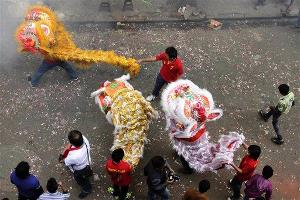
The Chinese community living in the city has always celebrated their New Year in their own unique style.

Kolkata :

The Chinese community living in the city has always celebrated their New Year in their own unique style. But this time, they have put their heads together and vowed to make a new beginning, in true sense of the term. To begin with, the community has already started renovating the Pei May School complex, which has remained abandoned for long. A cooperative has been formed to steer the community.

Pei May is the only Chinese-medium school in the city that was set up to teach kids of the migrating Chinese community. However, Chinese children started going to English-medium schools and Pei May lost its relevance with time. Gradually, people stopped visiting it. But finally, it dawned upon the community that wasting more than 2 lakh sq ft area was not a good idea.

Led by Liu Kuo Chao, the Chinese Welfare Association brought together 5,000 Chinese residents to form a co-operative that would run the trust governing the school and temple complex. The temple already stands spruced up. Interestingly, a statue of Sinthee, a man who is believed to have superhuman protective powers, stands outside the altar with his horse. Almost every Chinese home has prepared some offering for the deities and will visit the temple at least once during the weeklong festivities that start Wednesday.

The massive school building will be repaired after the New Year celebrations. The trust plans to start a Chinese language training school here for graduates and professionals. “Our kids are joining the hospitality, IT and teaching professions in China because they are proficient in English and they can also speak Chinese. The fact that they cannot read or write Chinese is not being counted as a dampener. The school will target those from outside the community who want to learn the language from Chinese trainers,” said Monica Liu, owner of several Chinese restaurants in Tangra.

“There are a large number of elderly people within the community who are extremely gifted as far as Chinese writing and even literature is concerned. We will rope them in to create easy speaking and writing modules for non-Chinese youth,” said Sze Shiyenyeh, a senior enthusiast of the Welfare Association.

The community has finally started feeling vindicated in Kolkata. “For years, Tangra has been neglected. A look at the streets outside the swanky restaurants will tell you how the Chinese have been relegated to one corner of the city. When the tanneries were ordered out, many of us shut our units and got into motley businesses, most of which did not work. But now we have found a cause to live once again,” said Liu Ka Keen, who might join as a part-time teacher in the school.

source: http://www.timesofindia.indiatimes.com / The Times of India / Home> City> Kolkata / by Jhimli Mukherjee, TNN / February 19th, 2015

Where cars go for a ‘workout’

Kolkata :

This nondescript automobile repair workshop on a narrow lane off the Hazra Bridge over the Adi Ganga wouldn’t be hard to miss… had it not been for a few unusual cars parked in and outside it.

Cars with scraped bumpers and dented bodies, but with many extra gadgets, special seats, reinforced interiors and, once you open the hood and look carefully, even modified and fortified engines.

Calcutta Motors, this 52-year-old workshop, is where car rallyists from all over Bengal send their automobiles for renovations, repairs, reinforcements and all other works.

And on most days, this is also where they drop in for a chat with the amiable and helpful Joydeb Ghosh, whose father Soumen had started this business in 1963.

Joydeb, 39, is an avid rallyist himself and winner of many awards in this adventure sport. And Calcutta Motors happens to be the most well-known name in Eastern India for converting ordinary vehicles into ones fit for all sorts of rallies across the country.

Converting an ordinary automobile into a “rally-worthy” vehicle is no easy or inexpensive task (see box).

“The first step is to fit a ‘sump guard’ (chamber guard) in the undercarriage of the vehicle and a fuel tank guard for added protection,” oydeb says. Special suspensions need to be installed and the suspensions’ lower arms and apron need to be strengthened. The entire body of the vehicle has to be reinforced through ‘tik’ (cold) welding. “‘Tik’ welding is a special and time-consuming process where all the joints need to be re-welded,” he adds.

Then comes the major task of ‘blue-printing’ the vehicle’s engine. “Engine components of a vehicle of the same make differ, and that affects their performance. We get the manufacturer’s blueprint with the exact specifications of all engine components and replace all the components that do not meet the specifications.

The purpose is to ensure optimum performance of the engine. We make all these new components ourselves,” Joydeb explains. Joydeb, who has participated in over 250 car rallies over the past 10 years, says that in order to save costs for rallyists, he does a lot of “jugaad”. “I and my mechanics go all over the country and observe how rally cars elsewhere are retrofitted and apply the same techniques at much lower costs here,” he says. This is because many automobile enthusiasts from Kolkata and Bengal are good rallyists, but hail from middle-class families and don’t have the very deep pockets required for upgrading their cars to the ‘rally-worthy’ category.

Special seats and seatbelts need to be installed, as well as probes for odometers, trip meters and sophisticated GPS equipment. And finally, a ‘roll cage’ needs to be installed inside the vehicle for protecting the driver and navigator. Joydeb, his team of mechanics and the drivers and navigators of the 20-odd automobiles — Maruti Gypsies, Esteems, Cedias, SX-4, and Maruti 800 — that have been retrofitted and undergo regular overhaul and servicing at Calcutta Motors, all form a large and happy family. Their passion for automobiles and participating in rallies is the bond that binds them together in a strong brotherhood. They call themselves the ‘CM Rally’ team.

Calcutta Motors also sends its service team, comprising its best mechanics, to rallies the ‘CM Rally’ team members participate in. “We go wherever our customers go as rallyists and give the best services to them,” said Sarbeshwar Dolui, a senior mechanic at the workshop.

Calcutta Motors’ service team has been awarded many trophies in various rallies across the country. Joydeb’s dream is to ensure that the ‘CM Rally’ team members win in every rally they participate in. And he’ll do all he can to make that happen.

source: http://www.timesofindia.indiatimes.com / The Times of India / Home> City> Kolkata / by Jaideep Mazumdar, TNN / February 21st, 2015

Former BCCL director no more

Kolkata :

Narendra Kumar, a former director of Bennett, Coleman & Co Ltd (BCCL) and chairman of Wearit Group, breathed his last in Kolkata on Saturday. He was 81 and is survived by wife Pramod Rani, son Manish and daughters Neerja and Nandita.

“As member of the board for many years, Narendra Kumar’s wise counsel was of great assistance to my husband Ashok Kumar Jain. The Times family remembers him with affection,” said chairman of the Times Group Indu Jain in a message. Vice chairman of the Times Group Samir Jain said, “Narendra Kumar’s long association with our company was cherished by my father.”

Kumar served as a director in the BCCL board for close to 50 years. Wearit Group has interests in the tea and textile businesses. Known as a visionary in the tea industry, Kumar held several important portfolios. He was the chairman of Indian Tea Association (ITA) from 1989 to 1991. He also headed Consultative Committee of Plantation Associations (CCPA) and was the chairman of Tea Research Association from 1993 to 1996.

According to Manish, Kumar leaves behind two tea companies and a robust textile business. The tea companies — Scottish Assam India and SPBP Tea India Ltd — have gardens in Assam. Wearit Group has textile plants in Madhya Pradesh and Rajasthan. The group has four plants in these two states. The Wearit Group is known for viscose, cotton and polyester yarns and polyester-viscose blends, polyester-cotton blends and polyester-linen blends. It has clients in Europe, the Middle East, the United States and the Far East.

A baithak to remember and pay homage to the departed soul was organized on Sunday at his Ballygunge Park home. Another baithak will be held on Monday at the same venue.

source: http://www.timesofindia.indiatimes.com / The Times of India / Home> City> Kolkata / TNN / February 16th, 2015

New start for grand lady – Descendants rededicate gravestone of botanist

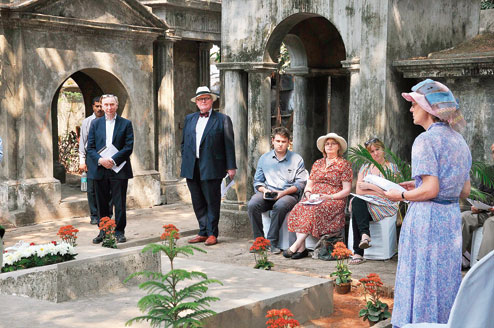
Lady Emma addresses the small gathering at the ceremony to dedicate the gravestone of her ancestor, Lady Anne Monson, at South Park Street Cemetery on Thursday morning. With her are Michael Dorrien Smith, Lady Emma Windsor-Clive, Isabella Monson (seated) and JM Robinson and James Miller (wearing panama).  Picture by Anup Bhattacharya
Lady Emma addresses the small gathering at the ceremony to dedicate the gravestone of her ancestor, Lady Anne Monson, at South Park Street Cemetery on Thursday morning. With her are Michael Dorrien Smith, Lady Emma Windsor-Clive, Isabella Monson (seated) and JM Robinson and James Miller (wearing panama).
Picture by Anup Bhattacharya

Calcutta :

Sleepy, leafy South Park Street Cemetery could have turned into a scene from the TV series Downton Abbey on Thursday morning as a small group of Englishmen and women gathered at the twin graves of Lady Anne Monson and her second husband, Colonel George Monson, for a quiet and solemn ceremony as a chorus of koels sang incessantly.

The frail, behatted Lady Emma Monson was with her granddaughter Isabella, her friend, the youthful Michael Dorrien Smith, a descendant of Lord Clive – Lady Emma Windsor-Clive – and two friends, architectural historian J.M. Robinson and art historian James Miller.

Lord Clive was a British officer who defeated Siraj-ud-Doula in the Battle of Plassey in 1757 and consolidated the East India Company’s rule.

Lady Emma was there to dedicate a tombstone inscription to her ancestor, Lady Anne Monson, who was a botanist, an exceptional figure in the 18th century, and great granddaughter of King Charles II.

Charles II, king of Great Britain and Ireland (1660-85), was restored to the throne after years of exile during the Puritan Commonwealth, according to Encyclopaedia Britannica. The years of his reign are known in English history as the Restoration period.

The genus Mansonia was named by Swedish botanist Carl Linnaeus in honour of Lady Anne. Colonel Monson was a member of the Supreme Council of Calcutta and an enemy of Warren Hastings. He died six months after his wife in September 1776. An inscription above his tomb was erected in 1908 by the Calcutta Historical Society. But Lady Anne’s tomb remained without an inscription. Both graves are quite nondescript by the monumental standards of this cemetery.

A wreath was laid on the spruced-up grave and newly inscribed tombstone by Ranajoy Bose, executive member, Christian Burial Board, with Ash Kapur, president of the Association for the Preservation of Historical Cemeteries in India, Bertie Da Silva, vice-principal of St. Xavier’s College, and Christina Mirza, who heads the English department of the college. Lady Emma said in her address that when she first visited Calcutta in 2012, both graves were in ruins and she wished to restore them. So she got in touch with the British Association for Cemeteries in South Asia (BACSA).

She thanked all concerned for refurbishing them. Both graves have been restored by an accredited architect and its surroundings have been cleared and neatly marked with brick dust. The service was conducted by Reverend Nigel Pope, vicar of St. Paul’s Cathedral.

source: http://www.telegraphindia.com / The Telegraph, Calcutta / Front Page> North Bengal> Story / A Staff Reporter / Saturday – February 14th, 2015

Grandniece continues Nivedita’s quest for truth

Kolkata :

When a 73-year-old woman stepped into Mayer Bari — Maa Sarada’s house at Bagbazar — everybody was busy with their daily chores. Sight of tourists is nothing unusual for them. But when they came to know that the lady was actually the grand-niece of Sister Nivedita, there was no leaving her alone. For rest of the day, a strong crowd milled around Selenda Margot Giardin, who came all the way from Newbury at Vermont in the US. By evening, it was a day well-spent for Saradha Math monks, students of Nivedita School and Selenda as well.

“I am fascinated. I feel like a celebrity,” beamed Selenda, who was the centre of attraction at Sarada Sarani on Monday. The pangs of Parkinson’s and acute arthritis could not dissuade Selenda from embarking upon the long journey in quest of “truth, love and God”.

Selenda didn’t know how to react when people touched her feet. Anushuya, a student at Nivedita School where Selenda led a prayer, said: “For us, it’s like being with Bhagini Nivedita herself.”

Some found the same eyes in Selenda, who shares her middle name (Margot) with her Irish grand-aunt Margaret Elizabeth Noble, whom Swami Vivekananda christened Nivedita. “My middle name is ‘curiosity’. From the age of seven, when I first read at the church that ‘God is Love’, I have been curious about God. The search continues…and now I am here, searching…” reminisced Selenda, who runs her choir at the United Church of Christ at Vermont.

The septuagenarian will be attending a host of programmes over the week. She will spend two days at Belur Math before flying back to the US on Saturday. Her son John Grow is accompanying her.

Selenda let out more about herself and the Nobles as she spoke to TOI: “Ever since I was a child, I remember my mother, Isabel Noble, telling me stories of her aunt who pursued her quest for truth and worked for the people living in this faraway land.”

She gifted the monks of Sarada Math the handwritten notes by Sister Nivedita circa 1909 and a replica of Michaelangelo’s Pieta, which Sister Nivedita had gifted Selenda’s mother Isabela. These items will be on display at the upcoming Nivedita Museum inside Nivedita House.

Mayer Bari head Swami Viswanathananda said: “Selenda’s amazing. We never imagined that a descendent of Sister Nivedita would come here after all these years.” Another monk Prabuddhaprana shared the euphoria: “We are glad to discover the Sister’s family at last.”

source: http://www.timesofindia.indiatimes.com / The Times of India / Home> City> Kolkata / by Ajanta Chakraborty, TNN / February 17th, 2015