A unique initiative involving the West Bengal Health Department and a non-government organisation here on Monday has brought hope to mentally ill patients of Kolkata’s Pavlov Hospital.
Ostracized by society and abandoned by their family members, patients of the biggest mental health facility in West Bengal can now dream of financial independence and a life beyond the confines of the hospital.
A memorandum of understanding for Dhobhi Ghar, a laundry project, was signed between the representative of State Health Department and Anjali, a mental health rights NGO, which at the outset will involve at least 12 patients who have recovered from their ailment but are unable to return home.
“Initially, we will be dry-cleaning clothes from hospitals and slowly we will take orders from hotels and restaurants. The 12 people who are involved in the project will be paid Rs 232 per day as per minimum wages laws,” said Ratnaboli Ray, who signed the MoU on behalf on Anjali.
While the machines for starting the project have been imported by the NGO, the Bengal government has provided necessary infrastructure and ensured water and electricity supply for the project.
“We thought that it was a good proposal to provide livelihood and rehabilitation to mental health patients. This is the first such initiative taken in Bengal involving mental health patients,” Moloy De, Principal Secretary of Bengal’s Health Department told The Hindu .
According to mental health activists like Ms Ray this is first such initiative tried anywhere in the country and it comes as good news from the mental health instruction of Bengal after many years.
In the past, the mental hospitals of Bengal particularly the Pavlov Hospital were in the news for unnatural deaths and human rights violations.
The death of 84 inmates in the mental health facility of Bengal in 2013 over the past three years had resulted in strong criticism by activists.
source: http://www.thehindu.com / The Hindu / Home> News> Cities> Kolkata / by Shiv Sahay Singh / Kolkata – March 03rd, 2015
Around 123 original works of Abanindranath Tagore, or Aban Thakur, as he is fondly called, will be on display at the Victoria Memorial from Tuesday onwards. The exhibition has been curated by art expert Ratan Parimu from Vadodara.
While Victoria Memorial is bringing out some of the never-seen paintings from its vaults, a large number of the creations on display will be from Rabindra Bharati Society’s collection, which had been gifted to Victoria authorities for conservation and safekeeping.
The mammoth display will offer glimpses of all the styles that Tagore toyed with and which gave birth to the Bengal school of art.
Though he was trained in Calcutta school of art under European masters like O Ghilardi, who taught him the use of pastels and Charles Palmer, who taught him oil painting, Aban Thakur did not let contemporary European styles influence him. Instead, he thought indigenous styles need to be showcased to the world, especially our own patachitra traditions, Mughal miniatures and Rajasthani styles of paintings. He imbibed these in his own drawing and painting patterns and developed a unique style.
Examples of all the best known innovations by Tagore will be on display like his landmark creations from Hindu mythology like the ‘Slaying of Putana by baby Krishna’ or Goddess Chandika from the attributes of the ‘Chandi Mangal’. Tagore was one of the earliest Indian artists to study wildlife in detail and his lifelike watercolour creations of the cheetah and rhinocerous have often been praised. His portrayal of the fasting Abhaya brings to light characteristics of rural life in Bengal. Some of the best examples of his adaptation from Mughal and Rajasthani miniatures, where the use of gold is striking, will also be on display.
It was not easy to get so many paintings ready. Victoria Memorial director Jayanta Sengupta said, “While the paintings were robust, they needed to be de-acidified and mounted on acid free mount boards for a better life. We have prepared a condition report for each painting, photo documented them and drawn up an accession history. We are calling it in situ conservation.”
source: http://www.timesofindia.indiatimes.com / The Times of India / Home> City> Kolkata / by Jhimli Mukherjee Pandey / March 03rd, 2015
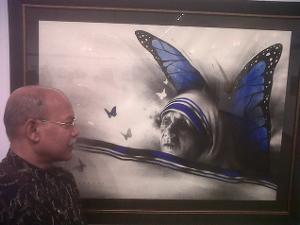
Even as the recent controversial statement of the RSS leader Mohan Bhagwat on Mother Teresa has received strong opinionated responses and also started an online war between opposing views on the issue, a Mumbai based artist has gently put forth his impression with charcoal and acrylic on canvas.
Artist Ajay De is currently holding an exhibition titled `Butterfly People’ at Jehangir Art Gallery where he has shown among other artworks two paintings in which Mother Teresa is a butterfly.
“I have correlated beautiful people as butterflies through art. In fact, I feel that everyone can be a butterfly, a creature that lives for just a few days but spreads beauty and happiness all around it,” explained De, whose exhibition is on till Monday (March 2).
When asked what he thinks of the latest controversy on whether Mother Teresa used to convert the people she rescued from the streets, De said: “I do not want to get into this political controversy, though I will say that it has not affected the reputation of Mother Teresa.”
The artist who had met Mother Teresa just once in the early ’80s in Kolkata, elaborated: “When a stone is thrown at a celebrity, his or her image is not tarnished, but someone else may get some publicity.”
His two artworks on Mother Teresa have already been sold, while the other paintings have also got a favorable response at the exhibition.
“From the time it breaks out of the chrysalis and transforms into a beautiful winged creature, the butterfly stuns the world with its beauty and soothes the world its spirit. In life, we humans come close to being the butterfly, yet only a few are able to embrace the life of a butterfly. That is the challenge we all have to think about,” he concluded.
source: http://www.timesofindia.indiatimes.com / The Times of India / Home> City> Mumbai / by Vijay Singh, TNN / March 01st, 2015
Sarod exponent Joydeep Ghosh tells Meena Banerjee his musical education allowed him to take uncommon ragas in his stride.
One discovered an intriguing fact from versatile musician Joydeep Ghosh, the concluding artiste of the annual soiree organised recently by Kolkata’s Ballygunge Maitreyee Music Circle, dedicated to the late Sangeetacharya Radhika Mohan Moitra (Radhubabu). On this occasion his sarod etched a rare raga, Kedari-Marwa, with admirable clarity. In this both Kedar and Marwa remained intertwined; like in a braid; without giving up their identity. Such an interpretation, replete with unexpected bends, does not allow complacency, either to the player or to his listeners. This was definitely a show by a maestro for initiated listeners only. The latter is a dwindling community even in Kolkata nowadays; but going by Ghosh’s usual selection of ragas, one was inspired to ask:
What encourages you to choose rare ragas for concerts?
I was only five when I started learning at the feet of great masters Anil Roychoudhury and Radhubabu; and later from Buddhadev Dasgupta. They all belong to the famous Senia Shahajahanpur sarod gharana and they are revered for their enviable melodic treasures. I also learnt tabla and vocal music from venerable gurus. Subsequently, I came under the wings of the erudite and versatile master Bimalendu Mukherjee, a doyen of the famous Imdadkhani gharana of sitar and surbahar. Under their priceless guidance I assimilated vocalism, instrumentalism and the style of rhythmic play along with raga elaboration.
The simple fact is that my gurus did not tell me what were common and what ‘rare’ ragas were. They all came naturally as sister ragas, with their key phrases loud and clear, during the learning process of one major raga; even the jod-ragas (blend of more than one) were taught to me without much ado; just as they did not categorise any instrument and made me learn to play sarod, surshringar and mohanveena.
Isn’t the mohanveena a newly invented instrument?
Radhubabu’s mohanveena.
Unfortunately, very few remember the history of the original mohanveena, conceived and invented by Radhubabu in early 1948! Once, around 1944, he played the surshringar in a jugalbandi (duet) with the famous beenkar (Rudra veena player) Ustad Sadiq Ali Khan in Lucknow. The concert inspired him to design a unique instrument in which the playable materials of both the sitar and the sarod could be appropriately exploited and the tonal quality of the Rudra veena could be equally maintained. Since he was proficient in both, having had his training from Ustad Mohammad Ameer Khan of the Shahajahanpur gharana and Ustad Inayat Khan of the Etawah gharana in the sarod and the sitar respectively, Radhubabu’s experiment succeeded.
The instrument’s majestic tonality impressed Thakur Jaidev Singh, the renowned musicologist who was then Chief Producer, All India Radio, Delhi. In 1950, Thakur Saheb named the instrument ‘mohanveena’ and also arranged an archival recording for AIR, followed by an extensive interview of Radhubabu, its inventor. Radhubabu was invited in several music festivals all over India to play the mohanveena. Some of his rare recordings for AIR archives are available in compact discs as precious documents.
So, despite the emergence of another, Hawaiian guitar-based instrument of the same name almost fifty years later, the original mohanveena exists along with its own unique excellence till date, through some of the devoted torchbearers of Radhubabu’s legacy. I am also a humble exponent of the mohanveena.
source:http://www.thehindu.com / The Hindu / Home> Features. Friday Review / by Meena Banerjee / February 27th, 2015
Yudhajeet and (right) Deeptyajeet De at the Welfare Society for the Blind tournament. (Arnab Mondal)
At 18, twins Yudhajeet and Deeptyajeet De have already won more accolades than their years put together. The Class XII students have not only beaten players on the other side of the chess board but also their greatest opponent – visual impairment.
Yudhajeet was introduced to the game by his mother when he was just six, while Deeptyajeet started picking up the moves from his brother a few years later. Both are FIDE-rated players and Yudhajeet added another feather to his already crowded cap when he won the first edition of the Rapid Blind Chess Tournament organised by the Welfare Society for the Blind last week. Deeptyajeet finished third at the same event.
“We eat, drink and sleep chess. We just love the game. We keep thinking about our moves all day,” said Yudhajeet, whose FIDE (Federation Internationale des Echecs) rating is 1554. The rating provided by the World Chess Federation denotes a player’s individual skill level. Viswanathan Anand, for instance, enjoys a FIDE standard rating of 2797 at present.
Yudhajeet has had no vision in both eyes since birth but that hasn’t stopped him from taking on sighted opponents. “We have to visualise the board in our mind and remember all the positions constantly. It is tougher when we play rapid chess as there is little time to make the moves,” said Yudhajeet, who finished runner-up in an all-Bengal under-14 sighted tournament in 2010.
The duo have been in the top 20 at the east zone chess meet quite a few times and qualified for Category B of the national championship for the visually impaired. Though Deeptyajeet, FIDE rating 1443, is yet to qualify for Category A of the national meet, Yudhajeet has played it twice.
“Both brothers are keen learners. Yudhajeet is quick to grasp the openings and remembers the moves I teach him. They have improved a lot in the past year. They have to compete more with sighted players now at the national level to gain confidence,” said chess player Laltu Chatterjee, who has been training the boys for more than a year.
The Uttarpara boys met their present coach at an all-Bengal open chess tournament in Rishra and requested him to train them. Before that it was their tutor, Madan Jana, who had taught Yudhajeet the basics of the game and got him interested.
When their mother, Ruma De, wanted Yudhajeet to engage in an indoor sport, she decided chess was the best option. “I thought he could excel in it as it’s more of a brain game and he has always been a good student in school,” Ruma said.
Yudhajeet’s first competitive event was an all-Bengal tournament for the visually impaired in 2008.
“It was held at St. Xavier’s College and I won the runner-up trophy. The taste of success in the very first tournament gave me a huge boost and made me dream,” he said. In 2012, he came third in the junior open national chess meet for visually impaired and in 2014, he found a place among the top 10 in the national A championship.
Last year was also good for Deeptyajeet, who started playing the game at age 10 and played his first tournament in 2011. In 2014, he won three all-Bengal tournaments.
A late entrant in the game, chess is now Deeptyajeet’s sole passion. It is brother Yudhajeet’s first love, too, but he also plays the sitar and is a big fan of Virat Kohli.
A dream they share is to become international masters, but their immediate goal is to make a mark in the ongoing open national chess meet in Nagercoil, Tamil Nadu.
What is your message for Yudhajeet and Deeptyajeet De? Tell ttmetro@abpmail.com
source: http://www.telegraphindia.com / The Telegraph, Calcutta / Front Page> Calcutta> Story / by Ayuan Paul / Saturday – February 28th, 2015
The Mamata Banerjee government is exploring the low cost media options to publicise its various schemes and projects across the state. With this in mind, the state information and cultural affairs department is giving much thrust on the ‘Lok Prasar Prokalpo’ that it has introduced not only to uplift the living standards of the folk artists across the state by giving them chance to perform in various stages organized by the government, but also to publicise government schemes through them.
The I&CA department has lined up several cultural programmes across the state this year to promote Bengal’s art and culture but officials said that the Lok Prasar Prokalpo could become the most effective in the government’s endeavor to promote Biswa Bangla brand.
According to the administrative calendar, the I&CA department has set a target to enroll 60,000 folk artists in the current year to bring them under the Lok Prasar Prokalpa.
I&CA department officials said that the objective of the scheme is to provide regular income to folk artists across the state and to preserve the art and culture of Bengal. In this way, the government thrives to publicise their various schemes and projects through the help of folk artists. “The process is going on to identify and select folk artists from across the state. The folk artist are being selected after audition and they are being given identity cards.
source: http://www.timesofindia.indiatimes.com / The Times of India / Home> City> Kolkata / by Suman Chakraborty, TNN / February 25th, 2015
Satyajit Ray astonished me at our first meeting. I had trotted out various Santiniketan connections I expected him to know. He looked at me for a moment while I felt his brain darting through the lanes and bylanes of the genealogical network. Then he said, “You must be related to Bussa Susheila Das!” It was the last name I expected to hear from the Maestro. Bussamami – whose death last week, three years short of a century, must be counted a merciful release – was the most fashionable, Anglicized and probably richest of my relatives. In georgette and furs, sporting a long cigarette-holder, she was a vision of elegant grandeur, the Last Burra Memsahib. When I told her about Ray, she said, “It must be because of Keshub Sen!”
If so, the Brahmo Samaj meant more to Ray than anyone imagined. Although neither Bussamami nor her husband, Mohie R. Das, had set foot in a Brahmo temple for many years, she was Brahmananda Keshub Chunder Sen’s great granddaughter. She was also the great granddaughter of General Sir Edward Barnes, India’s commander-in-chief and governor of Ceylon. That connection was embarrassingly highlighted when Bussamami stayed with us in Singapore. On the day she arrived, the afternoon tabloid, New Paper, which normally confined itself to sensational local tidbits, went to town with an unexpected cover story on Barnes and his Ceylonese mistress. As governor, he lived in what is today Colombo’s Mount Lavinia Hotel from which a secret underground tunnel snaked away to his inamorata’s dwelling. Bussamami wasn’t disconcerted.
She had flown in wearing a saree. It was her habitual garb when travelling abroad she explained. “I get better service.” At one time people laughingly called her “Susheila please!” because of her strenuous but unsuccessful efforts to banish the Bussa nickname. She was indignant when a British Indian woman in Singapore asked why she didn’t have a British passport. “Why should I?” she retorted. “India is my home. I’m Indian. I have property there.” The patrial clause in British immigration law would at once have granted her British citizenship. But people like her didn’t need to emigrate to raise their living standards or become Westernized. They easily did both in India. Her sister, Moneesha Chaudhuri, whose husband was the first Indian head of Andrew Yule, the biggest British managing agency in India, and an army chief’s brother, was also like that. She once refused the then whites-only Saturday Club’s invitation to play the piano in a concert under her English mother’s maiden name. “After all, you could pass for English,” they pleaded. She didn’t take it as a compliment.
Singaporeans found it intriguing that Bussamami and I were related twice over. She and my mother were second cousins, great granddaughters of Annada Charan Khastagir, who presided over an All-India National Conference session in 1883, preparatory to the Indian National Congress being launched two years later. Her husband, Mohiemama, and my mother were first cousins, grandchildren of Bihari Lal Gupta, who was responsible for the Ilbert Bill, which led to the AINC and INC. She and her husband being related, the marriage presented difficulties: one version for which I can’t vouch was they went to French Chandernagore for the registration.
Mohiemama’s father, S.R. Das, founded Doon School. He himself was the first Indian head of Mackinnon Mackenzie, the Inchcape shipping giant. When he joined Mackinnon’s exalted band of covenanted hands (UK-based officers who had signed a contract with the company) in England, the Numbers One, Two and Three were known in inverse order as Three, Two and One. Those figures indicated their monthly salary in lakhs of rupees. Mohiemama’s ways were upper-class English, the legacy of public school in Britain and Cambridge. My son, Deep, quoted Bussamami in this newspaper (“Learning To Speak Like The Masters”, October 13, 2004) as saying when asked if her husband went to Mill Hill or Millfield school, “Mill Hill of course. Millfield was only for the post-war nouveau riche!” Being dark and heavily built, he borrowed a turban from Maharaja Sawai Man Singh II of Jaipur – husband of the beautiful Gayatri Devi, who was Bussamami’s cousin – to visit America in the Fifties. He enjoyed describing how he clamped the turban on his head before entering restaurants in the American Deep South.
They settled down in a gracious villa called Faraway in remote Coonoor. But their world straddled Calcutta, Darjeeling, Hong Kong, London and the south of France. Or rather, small gilded niches in all these places, with extensions to Simla, Colombo and Singapore. World War II and the 300 Club had lent zest to their cosmopolitan set. Not everyone could come to grips with this dizzy diversity. Raj Thapar, wife of Seminar magazine’s Romesh Thapar, betrayed her own provincialism by dismissing Bussamami in All These Years as “an erstwhile crooner”. Yes, she, Moneeshamashi and their only brother K.C. (Bhaiya or Kacy) Sen were all gifted musicians. In her youth, Bussamami had indeed given music lessons in Calcutta, and Moneeshamashi continued to do so for free at St Paul’s School, Darjeeling. But the sleaziness that Thapar’s comment sought to convey just didn’t go with the Ingabanga (Satyendranath Tagore’s term for Anglicized Bengalis) elite.
Kacy called his delightful memoirs The Absolute Anglo-Indian. He wasn’t “a person whose father or any of whose other male progenitors in the male line is or was of European descent, but who is a native of India”, which is how the Government of India Act, 1935, defines Anglo-Indian. Nevertheless, his was the culture of the Rangers Club, Grail Club and the club of which he says “if ever there was a place that separated the men from the boys, and no angels feared to tread, it was the good old Golden Slipper”. I was struck as a child by his imaginative wedding invitation, “Bridgette and I are going to be married at the Golden Slipper Club.” His Cavaliers was a popular band. He frequently compered at the Oberoi Grand Hotel’s open-air Scherezade night club, which occupied the space now taken up by the swimming pool.
He provided Ray with Devika Halder aka Vicky Redwood for Mahanagar “over a cup of tea on the verandah” of his flat. The voice off-screen in Mahanagar was Devika’s, but the song was a ballad, Time Gave Me No Chance, he had composed in his rowing days. Major Sharat Kumar Roy of the American army was an unusual wartime buddy and surely the only Indian to be commemorated by a mountain in Greenland: he discovered Mount Sharat. Laced into the light-hearted banter of Sen’s memoirs was the fear that the “Absolute Anglo-Indian” would become the “Obsolete Anglo-Indian”.
Bussamami built personal bridges to very different milieus. Cooch Behar, Mayurbhanj, Jaipur, Nandgaon and other royals, some also descendants of Keshub Sen, were relatives and intimates. When I mentioned the novelist, Maurice Dekobra, she told me she had known him as the Paris-born, Maurice Tessier. Axel Khan, whom I met as India’s ambassador in pre-unification Berlin, was another old friend. Rumer Godden produced a flood of memories, which were borne out by Ann Chisholm’s biography, Rumer Godden: A Storyteller’s Life. Her apology for arriving late for dinner with my wife and I in our Calcutta flat was that she had got lost in the suburban lanes to Kanan’s house. Kanan who? She meant the legendary star, Kanan Devi, whom the young Bussamami had taught her dancing steps in the Thirties. They had remained friends ever since.
The real burra memsahib didn’t need to keep up appearances. Neither did she have to try to be stylish. To adapt the Comte de Buffon, the style was the woman herself. There won’t be another like her.
source: http://www.telegraphindia.com / The Telegraph, Calcutta / Front Page> Story / by Sunanda K. Datta-Ray / Saturday – February 28th, 2015
The Main Hoon Na actor is recognised for her efforts towards achieving social justice
Former Miss-Universe-turned-Bollywood-star Sushmita Sen has been awarded the Mother Teresa International Award by NGO The Harmony Foundation for her efforts towards achieving social justice.
Sushmita, who is associated with charitbale projects and NGOs, received the award Sunday and took to Twitter to express her feelings.
“Beautiful People!…wanted you to wake up to The Mother Teresa International Award, which I received last night…precious,” Sushmita posted on the microblogging site early Monday morning.
The Harmony Foundation also honoured former Outlaw motorcycle club member Sam Childers for his efforts towards rescuing children from a war-zone in Sudan.
“What a privilege to meet with Sam Childers..his life dedicated to saving the lives of children in Sudan from a Militant outfit,” the leggy lass added.
source: http://www.bollywoodlife.com / Bollywoodlife.com / Home> Sushmita Sen / by IANS / Monday – October 28th, 2013
Md Bilal, a student of Class II at a primary school near Rafi Ahmed Kidwai Road, never liked his classroom where thirty odd boys are crammed in a small room. But Bilal, son of a grocer in Ripon Street, knows that his father cannot afford to send him to schools which have big classrooms and large playgrounds. Hundreds of kids like Bilal, who live in and around Ripon Street, go to schools which lack basic infrastructure.
But, their dreams will soon come true when an English-medium school will come up in the area. The school, being built by the Kolkata Municipal Corporation (KMC), will cater to more than 1,500 students. Proposed to be affiliated to the ICSE board, the school will bring best education to these children free of cost. The foundation stone for the school was laid on Saturday.
“Unlike traditional corporation schools, this school will be run by professionals. The idea is to bring best education to those who can’t afford it,” said Iqbal Ahmed, local MLA. The school, proposed to be run under the guidance of some well-known ICSE schools in the locality, will involve an investment of Rs 2 crore.
“We have tried similar models in six places in the city before. This is the seventh such school. While we are starting with upper-primary sections, we will gradually expand to the tenth standard,” said Mitali Banerjee, MMiC (education) of KMC.
T H Ireland, principal of St James School, believes that good communication skills in English is the need of the hour for the children. “It is therefore essential that these kids get their education in English,” he said.
source: http://www.timesofindia.indiatimes.com / The Times of India / Home> City> Kolkata / TNN / February 22nd, 2015
The Indian Statistical Institute (ISI), Kolkata, felicitated its director Bimal K. Roy, an eminent cryptologist here on Wednesday on his nomination to Padma Shri award by the Union Government for his contribution in the fields of literature and education.
Dr. Roy has held several important academic positions in over 15 universities abroad.
Former Reserve Bank of India Governor and president of the Indian Statistical Institute Council, C. Rangarajan, stressed the importance of more research in applied Economics and Statistics as they provide vital inputs in the formulation of the country’s economic policy making and socio-economic development.
source: http://www.thehindu.com / The Hindu / Home> News> Cities> Kolkata / by Staff Reporter / Kolkata – February 26th, 2015