Bengali on Queen’s honour list

Kolkata :

Seventy-year-old Pratima Sengupta, who pressed on with her charity and social activities despite debilitating arthritis, is among those being appointed Member of the Order of the British Empire (MBE) in the birthday 2015 Honour List of the Queen.

The honour is recognition for her services to the community in East Renfrewshire, Scotland. Sengupta has been living in Glasgow since 1969 and is now confused about which of her five grandchildren she will take along to accept the honour from the Queen.

On April 30, Sengupta got a letter from the Cabinet Office stating that the British Prime Minister had proposed her name to the Queen. On June 12, her name was published in the London Gazette. “I started shivering when I heard this news. All those who are on the Honour List will be invited to an investiture. The events are organized by the Central Chancery of the Orders of Knighthood in St James’ Palace. I was told that I will receive the invitation about five weeks before the event,” Sengupta told TOI from Glasgow.

Sengupta had spent her early years in Kolkata where her father, Dr Promodranjan Dasgupta, was a teacher at Presidency College. After marriage, she moved to Glasgow where she worked at the tax office. Due to arthritis, she was forced her to take early retirement in 2002. Pain in her joints notwithstanding, she continues to do voluntary service at a hospital.

“I started the Women’s Voluntary Royal Service (WVRS) at the Victoria Infirmary. I loved to give company to patients. Some of them couldn’t speak English and I worked as their translator,” she said. But her failing health didn’t make it easy. “They made special shoes so that I could walk properly. I refused to use a wheelchair. Sometimes, I’d fall down or bleed from my hands. At night, I’d cry in pain. Yet, I never stopped working,” she said.

Wearing a sari with a red bindi, Sengupta would stand out in the crowd. “Initially, people would ask me about the red blot on my forehead!” she laughs. She became a director with Voluntary Action group in Glasgow that worked with children who couldn’t afford higher education. “I’d sing ‘Phule phule dhole dhole’ to them. I also got in touch with an NGO in Tollygunge that worked with impaired children,” she added. She joined an organization called Women Across the World. “I’d go door to door asking for donations. I remember telling people: ‘You don’t need to give me more. Even one penny is enough.”

Meeting the Queen is the big event on her calendar now. “My husband and I had once attended the Queen’s Garden party at Edinburgh. I have been told that I can take four guests to this event. But I have five grandchildren. And all of them want to go to see the Queen,” Sengupta laughed.

source: http://www.timesofindia.indiatimes.com / The Times of India / Home> City> Kolkata / by Priyanka Dasgupta, TNN / June 16th, 2015
India’s only double coconut tree artificially pollinated

The palm species bears largest seed known to science

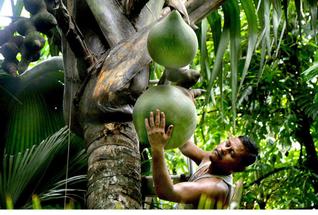
A double coconut tree stands at the Indian Botanical garden at Shibpur in Howrah district.— Photo: Sanjoy Ghosh

Scientists at the Indian Botanical Garden in West Bengal’s Howrah district have carried out artificial pollination of the only double coconut tree in India, which bears the largest seed known to science.

One of the rare and globally threatened species of palm, the double coconut ( Lodoicea maldivica ) tree was planted at the botanical garden in 1894 and the artificial pollination is a result of decades of work by scientists of the Botanical Survey of India (BSI).

“The tree took almost a hundred years to mature and when it started flowering, we started looking for this particular palm species in this part of world. We collected some pollen from palms from Sri Lanka but could not successfully pollinate it. Finally, with the help of pollen from another tree in Thailand, the pollination process was successful,” BSI Director Paramjit Singh told The Hindu .

Longest surviving palm

The Double Coconut tree not only bears the largest seed known to science — weighing around 25 kg — but this unique species is also the longest surviving palm which can live for as long as 1,000 years, he says. The palm tree also bears the largest leaf among palms and one leaf can thatch a small hut.

“Successful pollination means that we can have another Lodoicea maldivica in the country. In fact we have two fruits and it might take them another couple of years to mature,” said S.S. Hameed, BSI scientist who has been working on the pollination project since 2006.

This species of palm is diecious (where male and female flowers are borne on different plants). “Fortunately at the Botanical Garden, we had the female plant which can fruit and produce seeds,” Mr. Hameed said. The Indian Botanical Garden which serves as the repository 12,000 trees from 1,400 different species is careful in nurturing the palm.

The palm tree is located in the large palm house of the Botanical Garden which has the largest collection of palms in South East Asia with around 110 palm species.

This rare tree can be found in only two of the 115 Seychelles islands and is also called Coco de Mer (coconut of the sea), says Mr. Hameed

Legend

Legend bestows the seed with the power to bring good fortune to its owners. “There has also been a tradition of making kamandals [drinking vessels] from the double coconut by bisecting the shell. It was believed that those who consume water from these kamandals will be protected from poisoning,” Mr. Hameed said. Subsequently, sadhus started using Kamandals and it got its place in religious rituals.

source: http://www.timesofindia.indiatimes.com / The Times of India / Home> National / by Shiv Sahay Singh / Kolkata – June 13th, 2015

China to supply 14 trains to Kolkata subway

China will supply 14 subway trains with 112 carriages to Kolkata city, the biggest such contract for a Chinese company in South Asia.

China Railway Rolling Stock Corp Ltd (CRRC) will provide 14 subway trains with 112 carriages in total to Kolkata, CRRC said in a statement, state-run China Daily reported.

This is the first overseas order that CRRC has received after merger of China’s state-owned train manufacturing firms – China North Railway (CNR) and China South Railway (CSR) this month.

The Kolkata order was secured by CNRC subsidiary company – CNR Dalian Locomotive and Rolling Stock Company in February.

The value of the order has not been mentioned.
As the third-biggest city in India, Kolkata will replace the old trains that have been running for over 30 years in its south-north subway line which reaches a length of 23.45 km in order to ease the transportation pressure, the Daily reported.

According to the company, this is the first time that CNR Dalian has entered the market of South Asia.

CRRC started trading on the Shanghai and Hong Kong bourses on Monday, becoming the world’s biggest rail conglomerate in terms of market value and sales.

The Kolkata order came ahead of the visit of a high power delegation from West Bengal headed by Finance Minister Amit Mitra here to explore investment opportunities for his state.

Indian officials said the delegation will meet Chinese investors to showcase investment opportunities in the state.

Chief Ministers of several Indian states including Andhra Pradesh, Gujarat, Maharashtra and Karnataka have visited China to woo Chinese investments.

The two countries have also launched India-China Forum for State and Provincial Leaders during the last month’s visit of Prime Minister Narendra Modi to China to facilitate direct interaction between Indian states and Chinese provinces.

The order came as China is trying to make all out efforts to bid for high speed bullet trains against stiff competition from Japan.

China, which has built 40 bullet train lines with 16,000 kms of tracks in most part of the country, is currently conducting a feasibility study for the over 2,000-km New Delhi-Chennai high speed line while Japan is conducting a similar study for Mumbai-Ahmedabad route.

India has stepped up cooperation with China to modernise its railways with agreements in a number of area including speed raising of the tracks (Chennai-Mysore sector via Bangalore), training of 100 railway personnel in heavy haulage, setting up of railway university and modernisation of railway stations in Bangalore and Bhubaneshwar.

source: http://www.deccanherald.com / Deccan Herald / Home> National / PTI / Beijing – July 10th, 2015

State honour for Budhaditya, Rani Karnaa

Kolkata :

West Bengal State Music Academy will confer this year’s Allauddin Purashkar on sitar maestro Pandit Budhaditya Mukherjee.

The award, instituted in the name of legendary classical musician Ustad Allauddin Khan in 1987, carries a citation and a cash prize of Rs 25,000. Previous recipients of the award include Pandit Buddhadev Dasgupta, Pandit Manilal Nag and Manna De.

Mukherjee, who earlier won the Allauddin Khan Memorial Fellowship offered by the Madhya Pradesh government, plays sitar and surbahar in the Imdadkhani tradition of Etawah. Speaking to TOI, he said, “I am pleasantly surprised and honoured that the state government considered my name for this award.”

Academy’s member secretary and deputy director of information and cultural affairs department Malabasri Das said, “We will also honour dancer Vidushi Rani Karnaa with Uday Shankar Purashkar, tabla maestro Pandit Gobinda Bose with Jnan Prakash Ghosh Purashkar and Agra gharana vocalist Subhra Guha with Girija Shankar Purashkar for their contribution to various forms of performing arts.”

“I was born in Sindh in Pakistan. But Kolkata has been my second home for the last 40 years. It is great to see that the Bengal government has selected me for this honour,” said Karnaa, a disciple of Odissi legend Guru Kelucharan Mohapatra.

Chief minister Mamata Banerjee will hand over the awards to the maestros at an event at Nazrul Mancha on Tuesday.

source: http://www.timesofindia.indiatimes.com / The Times of India / Home> City> Kolkata / TNN / May 26th, 2015

Vanishing magic caught on reel

Kolkata :

Even a few decades ago, city’s theatres used to remain booked for months for magic shows. Newspapers were splashed with huge advertisements portraying magicians in prince-like attires spreading the net of ‘indrajal’. Now, the city’s hobbyists and illusionists slowly watch the glory fading away.

‘Fading Magic — The Story of Kolkata’s Magicians’ is a documentary film that brings those artists on celluloid once again. Some of them are old enough to perform, some are fighting with poverty and a lucky few are trying to make a decent living out of the passion that has driven them since childhood.

While India was known for illusions such as Indian rope trick which mesmerized the court rooms of the princes and zamindars, magic in Kolkata was mostly restricted to pavements and roadside kiosks even during the early 70s. It went through a huge facelift after Protul Chandra Sorcar catapulted the shows into theatre halls. The journey of Bengal’s magic from sidewalks to theatres continued under PC Sorcar Senior and K Lal.

Sam Dalal, a magician and one of the largest magic instrument manufacturers in the world, felt that while Kolkata had magicians such as Mrinal Roy and H M Wakil, hosting shows in theatres such as Mahajati Sadan was not common. “Kolkata was the magic capital those days. Magicians such as Samiran, Gautam Guha and Raj Kothari ruled the roost,” he said. Dalal, an engineer from Indian Institute of Technology, joined the profession to turn into a manufacturer and an innovator later on.

There were others such as Sanmay Ganguly, who continued to perform on stage despite being a doctor by profession. New names came to surface as magicians started getting handsome payments even beyond cabaret acts at bars. Some chose magic to be their sole profession. But times started changing even before they could fathom the reasons.

“Finance was always a problem. For feats such as vanishing the Statue of Liberty you need huge investments,” felt Rana Banerjee. Rana had even appeared in the Roland Joffe directed ‘The City of Joy’. But such achievements only added feathers to the city’s magicians’ caps and the coffers remained dry.

D Subhash, who used to perform across the states is now finding it difficult to arrange money for his ailments.

“There has been a shift again and magic in Kolkata went back to streets once again,” said director of the documentary Amit Sahai.

Jasjit Singh said the fading glory of the art needs to be showcased. “Kolkata needs to be reminded of the glorious past it had,” he said.

source: http://www.timesofindia.indiatimes.com / The Times of India / Home> City> Kolkata / TNN / April 26th, 2015

MCKV Institute of Engineering Hosts Tech Fest – PRAGATI 2015

Kolkata :

MCKV Institute of Engineering (MCKVIE) kick-started a two-day ‘Tech Fest- PRAGATI 2015’, on Thursday.

The major attraction of the day was the session on “Robotics Prelims”- a creative implementation of the students of various colleges with the latest technological trends.

“We have always been proud of our students who have attained heights in their endeavours. And as MUCH as I understand, COLLEGEfest is a platform where students are our prime focus and it is always a ground for talent hunt and an undefinable innovation. We look forward to more such platforms for the future leaders of our country,” said Mr KK Kejriwal Managing Trustee, MCKVIE.

Innovation FORMS an integral part of every engineer’s life. Generally the curriculum does not always suffice in developing the creativity and the knack for coming up with innovative ideas.

The event on ‘Robotics’ at Pragati is one of the most sought after events in this year’s fest. There are different categories in this competition under the core head Robotics Prelims, they are Robo soccer, Inferno, Line follower and Chase the Maze. All these events required a team’s participation. These events had inwardly helped develop a sense of team work amongst the students and to work with high end technological improvements. There were also other highlights of the event like Arcane (Treasure Hunt), Mathemania, CODE STORM (C PROGRAMMING), Gaming Prelims and many more.

There were 16 participating colleges along with schools in the Tech Fest. Some of them were Surendranath College, Rishra Bidhan College, Bangabasi College, JLD College of Engineering, and Dinabandhu College among others.

source: http://www.timesofindia.indiatimes.com / The Times of India / Home> City> Kolkata / by Jhimli Mukherjee Pandey, TNN / April 17th, 2015

IIEST to focus on industry knowledge

Kolkata :

Matching steps with global standards, the Indian Institute of Engineering Science and Technology (IIEST) is planning to introduce a unique hands-on teaching method where students will be asked to take assignments from reputable multinational companies and get their projects evaluated by the firms.

“Students will have to compulsorily undergo two months of industrial training. They will be required to do projects offered by the industry in their respective discipline,” said institute director Ajay Ray.

He explained: “For example, a civil engineering company dealing with design or structure of multistoried buildings or bridges will assign tasks to students who will work on those projects and submit it to the institute as well as to the company. The projects will be evaluated by both. This will give us an idea about the knowledge acquired by students. This exercise will be repeated from time to time. ”

“We hope to use these projects for societal needs. Students will have to learn 3D engineering objects, including 3D models of human organs or the aircraft or the automobiles. The students will also learn the essence of engineering design and simulation through advance simulation laboratories. Simulation laboratories will be set up soon,” Ray said, adding that the proposal will be placed before the IIEST board of governors soon.

To usher in more changes, IIEST-Shibpur has set up a senate committee to look into the complete restructuring of the five-year dual degree — BTech and MTech programmes. “IIEST is trying to make a model course structure to ensure that a student receives a holistic education with adequate skill in diverse fields. One of the features of the new structure will be to provide a large number of elective subjects so that the students can choose a subject they want to study. Projects will be compulsory in all semesters from second year onwards so that the students can learn industry methods while studying. The slogan of the new structure is ‘Active Learning’ as students will learn while they design and develop the engineering models, structures and systems, including software,” added Ray.

Students will get credit for all extra work like robotics, software writing or even dramatics, music, debating, quiz, etc. But it does not mean the credits will be mentioned alongside the scores obtained in core subjects. The credits will be a part of the aggregate. “Various schools of co-curricular activities will decide on the weightage and the methods in which students will be evaluated,” said Ray.

In the near future, the university will have industry experts as their honorary faculty members. The institute has initiated consulting experts from IITs, IISE-Bangalore and from various universities from the West.

Humanities will be an integral part of the new curriculum to make the syllabi holistic. Apart from it, environmental science and human biology will be compulsory subjects. “Students should understand environmental degradation, which has caused tremendous change in the ecology, and they should try and find solutions as well,” added Ray.

source: http://www.timesofindia.indiatimes.com / The Times of India / Home> City> Kolkata / by Somdatta Basu, TNN / April 07th, 2015

E-networking reunites alumni after 2 decades

Kolkata :

Online socialization paved the way for an ‘offline’ chat at a city hotel, bringing together many former students of Apeejay School, Park Street. They revisited their colourful school days and felicitated their teachers at a reunion ceremony, ‘Rejoice’.

The revelers were thrilled to have come across their classmates after a gap of as many as 25 years. Around 15 former students of the school’s 1988 batch chalked out the event over social networking sites, though they had been toying with the idea for the past two years.

The members of the school’s alumni association, APJOSA, Kolkata, who passed out between 1985 and 1993 reminisced about their bygone student life, reconnected with their school friends and sought the blessings of their teachers including Rita Chatterjee, current principal and administrator and Neville McNamara, former principal of the school.

The main objective of the event was to increase the membership of the alumni association, which was formed in the 1980s, according to Rajib Basu, a chartered accountant who was among the school’s 1988 batch. Around 10 alumni of the school, settled in different places outside the city, had also joined the party.

The school anthem, ‘Soaring High’, set the right mood for the evening that revolved around unadulterated fun mixed with nostalgia. Jyoti Vardhan Sonthalia, a corporate professional, said: “I left the school way back in 1988 but my bond with the alma mater is so strong because of the teachers who imparted discipline and value education to us; who groomed us for what we are today.” The party ended on a happy note when Manoj Lunia, an alumnus of the 1985 batch, sang the Hindi version of Kishore Kumar’s ‘Chirodini tumi je amar’. On McNamara’s request, silence was observed in memory of the students who passed away untimely.

source: http://www.timesofindia.indiatimes.com / The Times of India / Home> City> Kolkata / by Sarthak Ganguly, TNN / April 06th, 2015

Kolkata’s wooden trams chug into stardom

The streetcars lend authenticity to the city’s 1942 avatar in “Detective Byomkesh Bakshy!”

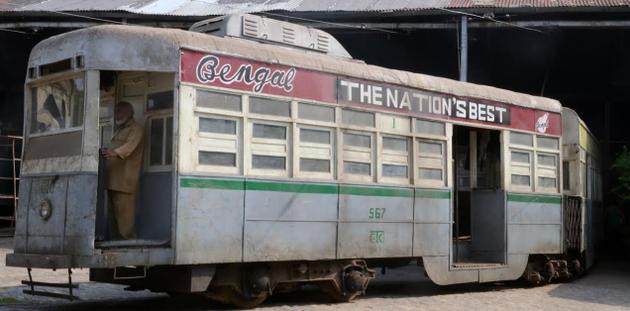
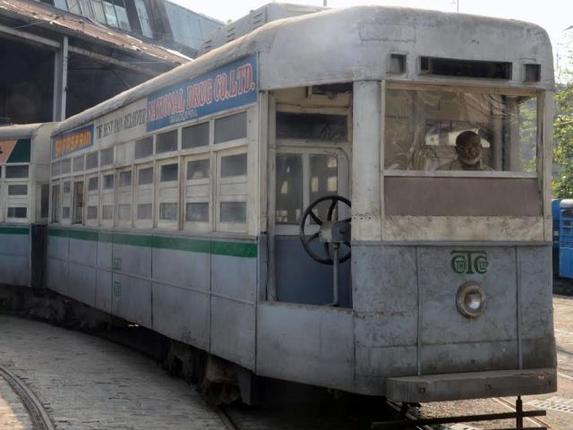
An unexpected but delightful outcome of the making of Dibakar Banerjee’s film Detective Byomkesh Bakshy! that released on Friday was the rescue from obscurity of two tramcars that were used to recreate the city’s 1942 avatar.

Tram No. 567, used in the film “Detective Byomkesh Bakshy!”, at the Nonapukur Tram Depot in Kolkata. Photo: Sushanta Patronobish / The Hindu

Using brands that have faded from public memory and antiquated ad campaigns, the project has revived interest in trams ‘No. 563’ and ‘No. 567’, now renamed ‘Byomkesh Bakshi’ Tramcars. The film, however, spells the detective’s last name as Bakshy.

The film used two wooden tramcars built in the 1930s and a watering car used to water the tram tracks of the city.

“The tramcar was renovated at their [the filmmakers] cost by us. They collected samples from old photographs and, accordingly, old-style branding was done on the top panel of the trams,” Nilanjan Sandilya, managing director of The Calcutta Tramways Company (CTC) Ltd. told The Hindu.

Mr. Sandilya said that trams were the main public mode of transport in the 1940s and were crucial to depict that period of the city.

Tram No. 567, used in the film “Detective Byomkesh Bakshy!”, at the Nonapukur Tram Depot in Kolkata. Photo: Sushanta Patronobish / The Hindu

The two tramcars used in the film are wooden ones that have seldom been taken out on the streets after the shooting of the film, said S.S. Ghosh, the Works Manager of the CTC. Tram No. 567 displayed advertisements of brands such as Bengal Lamp, Lux Toilet Soap and Dulaler Tal Mishri during the shooting. An old brand of palm candy was also advertised at Nonapukur tram depot. Tram No. 563, which was changed to No. 469 for the film, carried similar advertisements in English, Bengali and Hindi. Shooting was held at the Park Circus Tram Depot. The watering car used in the film predates the trams. According to Mr. Ghosh, watering cars were built between 1915 and 1920 and only two of them are now left with the tram company. Such is the enthusiasm surrounding the tram cars that a prototype called “Byomkesh Bakshi Tramcar” is on display at a tram museum-on-wheels called Smaranika.

source: http://www.thehindu.com / The Hindu / Home> News> Cities> Kolkata / by Shiv Sahay Singh / Kolkata – April 04th, 2015

Swimming through rough tides

KNOW YOUR NEIGHBOUR: Surajit Ghosh Swimmer

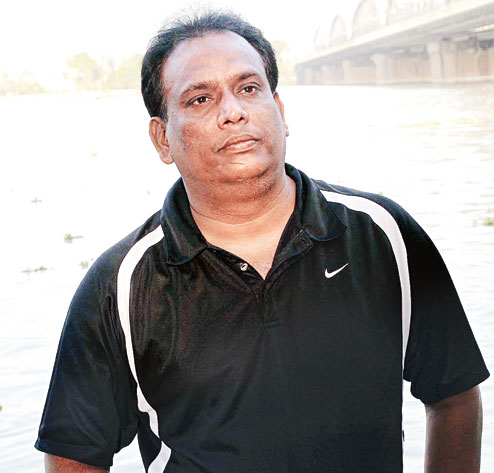
Surajit Ghosh. Picture  by Gopal Senapati
Surajit Ghosh. Picture by Gopal Senapati

For someone like Surajit Ghosh, who has won 12 gold medals in international swimming competitions, it is disheartening to lead a life without any recognition or acknowledgement. Ghosh had won the first gold medal for India in 1984 at the Asian Swimming Championships in Hong Kong. Since then, he was a winner for the next 10 years, in Asian and South East Asian Swimming Championships. Of the 19 medals that he has won, 12 have been gold medals and seven silver.

From 1985-89, Surajit was number one in South East Asia and number 2 in Asia. Apart from this feat, Surajit has over 100 medals that he has won at national swimming championships. He was champion for 10 consecutive years in the senior national championships for 200m butterfly and 400m individual medley. Despite his achievements and talent, Surajit laments that he has never been recognised by either the state or the central government. “My achievements have remained unrecognised. I have never received any kind of recognition from the state or central governments,” he said.

Surajit was a swimmer since childhood, when he started swimming in the neighbourhood pond. His elder brothers Abhijit and Biswajit were also swimmers. However, Surajit went a long way in this sport. His first guru was Jnanaranjan Das, who trained him and encouraged him to go to competitions. “My strength was 200m butterfly in which I had made a record time of 31 seconds in 1979, at my first junior national championship. Later, to perform better, I never stuck to one coach. I would go to other places around India, where I would practise with other good swimmers and practise under different coaches,” said Surajit.

A swimmer can only improve if he has a good competitor. “When I went to competitions, I would watch other swimmers and would contact them later so that I could go and practise with them to improve my speed. I have been to Madras, Kerala and other parts of India, with the aim of increasing speed,” said Surajit. Many swimmers in Bengal would want to practise with Surajit for the same reason.

“Bula Chowdhury has practised with me for a long time because she wanted to increase her speed,” said Surajit. He had also trained for many years under Australian coach, Eric Arnold, in Delhi. “I had stayed for a long time in Delhi, just to train under Arnold who was also training national champion Khajan Singh at that time,” said Surajit.

Although he has been a rank-holder in Asia and South East Asia, he regrets that he could never get a rank in world championship. “I had gone to the World Swimming Championship in 1990, but there I could not go beyond Rank 8. The competition was tougher because there were so many more swimmers from across the world who were better than me,” said Surajit.

Having a job with the Eastern Railway through the sports quota, Ghosh now coaches young swimmers in Bally and other swimming clubs. “I started Bally Swimming Centre but I also train students in other clubs in Hooghly and other places,” he said. He encourages young swimmers and is always on the lookout for new talent.

MORE ABOUT SURAJIT

DoB: January 15, 1968
Born in: Howrah
Education: HS
Family: Wife, two daughters
Loves: Long drives
Hates: Deceit

source: http://www.telegraphindia.com / The Telegraph, Calcutta / Front Page> Howrah> Story / Friday – April 03rd, 2015