Chinese churches stand test of time

Kolkata :

Crumbling buildings and filthy roads at Tiretta Bazar — or Old Chinatown — bear evidence to the depleting fortunes of the Chinese community in the city. But behind those closed doors lie a secret the community so proudly cherishes. The shabby buildings with a ‘falling-apart’ look and feel house some of the historic churches of Kolkata. Step inside and the regalia, incense sticks and intricate altars will give you a feel of the Chinese tradition.

The fact that KMC and the tourism department have joined hands with a Singapore-based organization to revive Old Chinatown has come as a shot in the arm for the community. They are happy that these churches, which were originally established in the 19th century and then rebuilt in the early part of the 20th century, will get restored.

The Indian Chinese Association has appealed to the project co-ordinators that the revival project should centre around the six churches (they were originally temples but later got converted to churches as most of the Chinese people embraced Christianity) that the community is guarding so dearly for so many years.

While the project so long centred around the Toong On Church and the famous Nanking restaurant that it houses, now five churches have also come into focus. A visit to the churches is an experience in itself. Take the case of the Namsoon Church, for example. It is the oldest of the six. It was established in 1820, almost immediately after the Chinese settlers abandoned Atchewpur near Budge Budge. Located at the far end of the snaky Damzen Lane, you will easily miss it. But the church, dedicated to Kwan Yin, the Chinese Goddess of War, has a magnificent altar complete with an intricately carved roof hanging.

There are three more churches on the same lane. Choong Hee Dong Thien, built in 1859, is in a sorry state but the deity, Kwan Kun, believed to be the God of Fortune, is still maintained and worshipped by the community. The Gee Hing Church was originally built in 1888 but it reached such a dilapidated state that the community rebuilt and relocated it in 1920 to its present location on 13, Blackburn Lane. Even that is in a sad state now, though the members of the community regularly visit for prayers and offerings there.

“Times are tough and you hardly find time to hang around as regularly as you did earlier. But we still try to meet up for our board games of Chinese Pair, after prayers as frequently as possible,” said Chang Yu Sen.

“Our tradition lives in these churches. It reminds us where we belong and the culture and tradition of that place. We cannot relate to the changes that have come over China today, so we guard these altars to remain close to our roots. Today many of us might have become Christians but we have not lost touch with Buddhism, Taoism and Confucianism that bind us,” explained Paul Chung, president of the Indian Chinese Association.

The other three churches — Sea Ip Church, Sea Voi Yune Leong Futh Church and Then Hane Miaw — too are crying for attention despite devotees’ best efforts at maintaining them.

source: http://www.timesofindia.indiatimes.com / The Times of India / Home> City> Kolkata / by Jhimli Mukherjee Pandey, TNN / June 23rd, 2015

Woman teaches slum girls to dream big

Kolkata :

Girls at Gobindopur railway colony would never dream of building their lives on their own terms with hardly any of them ever getting the opportunity of attending school and most of them being married off by 16. Many would face regular abuse at home, but they would not dare to protest. Finally, one of them, Uma Singh (27), decided to change things around and took up the cudgels for her tormented sisters in the colony, one of the largest slums in south Kolkata.

The first woman to graduate from the slum, Uma gathered youngsters from the area to launch a door-to-door campaign aimed at sending girls to school instead of marrying them off early. Eight years later, the number of girls dropping out of school has fallen dramatically, while underage marriages have stopped. Several girls from the slum are now training to be schoolteachers, painters or computer instructors.

Uma is pleasantly surprised with the transformation. “It pained me to see girls around me suffer like that. They had no ambition, no dream or desire. They were just happy to be alive which, I felt, was unfair,” she said. Uma got together a few of her like-minded friends and formed a group to fight for girls’ rights. It wasn’t a smooth start in troubled Gobindopur, where settlers were being evicted. Fighting to hold on to their shanties, residents did not really care about how their daughters should be treated. But Uma and her group didn’t give up.

They held meetings and workshops, performed street plays and screened films to spread the message of girls’ rights. Initially, they would be snubbed and asked to stay away from “personal affairs”. “It was a challenge for we were fighting a social evil and the deep-rooted belief that girls were not supposed to be ambitious. They were never treated on a par with boys. What’s worse, they didn’t have access to basic rights, such as education or even two square meals a day,” Uma said.

With her 20-member team, which was christened Nabadisha in 2008, Uma went from door to door, asking women to send their daughters to school. Some refused, fearing their husbands’ wrath. “We started sending those children to school without letting the men in the family know about it. Those who couldn’t be admitted to nearby schools were tutored at a centre in the slum. We noticed a slow change in the girls’ attitude. Even after the men learnt that their daughters were attending school, they didn’t really object,” said Uma.

Ratna Mandal said she would have been married off by now, had it not been for Uma. “She gave me the courage to dream of building a career,” said Ratna who is training to be a dancer.

Over the next two years, Nabadisha spread their work to five slums in the area. Most girls even in those slums now attend school, with more than 20 of them having cleared their higher secondary exams. Many are now preparing to work, which was unthinkable 10 years ago. Early marriages have been curbed but not stopped.

Nabadisha runs computer, drawing, dance and spoken English classes for girls who are counselled and guided every Sunday. “We hold ‘self-exploration’ sessions where we discuss their strengths, weaknesses and their future plans. Their problems are addressed. Girls in the slums have gathered the courage to dream big and stand up to wrongs within and outside the family,” said Poonam Sadhukhan, a Nabadisha member. Around 150 girls, aged between 10 and 18 years, are now being tutored, while over 100 have been assisted in three years.

Uma says she wouldn’t stop her work till drop-out rate among Gobindopur girls turns zero and they can support themselves financially. “We have managed to convince slum dwellers that girls deserve to be treated as equals and should be given a chance to realize their dreams. Once we have more girls working, their families will fall in. We are not going to rest till then,” Uma signed off.

source: http://www.timesofindia.indiatimes.com / The Times of India / Home> City> Kolkata / by Prithvijit Mitra, TNN / June 23rd, 2015

Playing for a job

Know Your Neighbour

 Sushila Ekka Basketball player
Sushila Ekka Basketball player

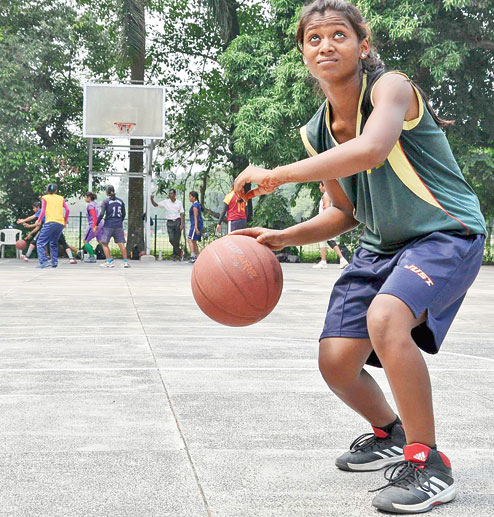
Survival has been a struggle for Sushila Ekka who has had to fight poverty and follow her passion of slam-dunking basketball to make a living. The young girl was a regular player in the Howrah district basketball team from where she has been selected to play national level tournaments. She started playing for the district when she was only 11 years old, a year after she started training under coach Alok Banerjee at Dumurjala Stadium.

“Sir (Alok Banerjee) had come to our school, Batore Adivasi Samaj School, and had told us that if anyone was interested in playing basketball, he or she should go to him. At that time, I was young and I had no idea about basketball. I went to play at Dumurjala and there I saw that this was a new kind of game that I had never seen before,” said Sushila. Prior to this, Sushila had no idea about any kind of sports and games. Living in poverty where her father, Lorenthis Ekka, is a labourer in a rolling mill and mother, Serophina Ekka, is a domestic help, Sushila’s prime interest was to get a job through sports quota. “I started to like the game and would practise as much as possible. My coach sent me to the district sub-junior tournament after a year from where I was selected for the state and national tournaments,” said Sushila.

She played her first national game in the West Bengal team in 2004. The team had won eighth position and Sushila was noticed for her performance as the playmaker in the five-member team. This year, the state team did not fare
well in the national tournament, but Sushila had still performed well. Sushila’s dream of landing a job came true two years back when she got a job in the electrical division of Eastern Railways. She joined the Railways basketball team and her coach, Satya Pattanaik, has always encouraged her to play well.

“Sir (Pattanaik) inspires me to play and has helped me in many ways. Before joining the Railways team, I would train under him and he ensured that I got all facilities, like jersey, ball and other accessories,” said Sushila. Before joining Eastern Railways, Sushila had also worked as games teacher in a private school. “I needed to earn a living to run the family expenses as well as my own. My parents would not be able to afford my expenses for playing basketball,” said Sushila. Although, she likes the game a lot, Sushila does not like to watch the big international teams playing on TV. “I have heard of the National Basketball Association in USA, but I have never watched them on TV. Also, I prefer watching games live than on television,” said Sushila.

Sushila has travelled across the country to play in various tournaments and invitation matches. Earlier this year, she went to Tuticorin in Tamil Nadu to play for an invitation match. There too, Sushila bagged the best playmaker award. “I have won several best playmaker awards in the past few years within West Bengal. The awards always inspire me to play better,” said Sushila.

She practises every morning at the basketball court in Calcutta Maidan, before going to work. However, her goals are more oriented towards her job than making it big in the game. “I have to practise a lot because I want to perform well. Only then will I get a promotion,” she said. Sushila also plans to study further. “I did not study after Class X because I wanted to play basketball. But now I think it would be better to complete higher studies so that I can get better job prospects,” she said.

MORE ABOUT SUSHILA

DoB: September 2, 1992
Born in: Howrah
Education: Class X
Family: Parents, two brothers
Loves: Singing
Hates: Backbiting

source: http://www.telegraphindia.com / The Telegraph, Calcutta, India / Front Page> Howrah> Story / Friday – June 19th, 2015

Diocese of Calcutta gets 1st Indian priestess

Kolkata :

It was a historic moment for the Diocese of Calcutta, Church of North India (CNI) on Sunday as Margaret Nilanjana Ali made it to the pulpit even as the diocese completed 200 years.

“It feels nice to be the first woman ordained as presbyter (priest) in the full time ministry of the Diocese of Calcutta, CNI. Rev Priscilla Papiya Durairaj was ordained earlier, but only in the part-time ministry,” Rev Ali told TOI.

The special service at St Paul’s Cathedral was officiated by Bishop Rt Rev Ashoke Biswas. On Sunday, he became the first bishop from the diocese to have ordained an Indian woman. Rev Biswas, a firm believer in gender equality, has been instrumental in having Ali take part in service along with the male priests.

Apart from Ali, the bishop ordained two male priests — Sebastian Hansda and Saikat Nath. At the ordination ceremony, he told the congregation, “Today is a very special day in the life of the Diocese of Calcutta. Ali, Hansda and Nath will now become Presbyter with God’s call upon their lives to serve.”

The solemn and elaborate oath-taking ceremony started at 6pm and continued till 7.30pm.

“Christianity was always a part of my growing up; my father (Rev John Nelson Ali) is a priest. My vocation evolved under his tutelage and today I feel complete,” Rev Ali said.

The clergy at Calcutta Diocese, the oldest diocese in the CNI, dating back to May 2, 1814, has been male-dominated and all a woman interested in theology could dream of was to become a lay worker in a parish or a deaconess.

Ordination of women remains a controversial issue in religious circles, either because of cultural prohibition, theological doctrine, or both.

In 1978, the ‘Movement for the Ordination of Women’ was founded in England. “There are a lot of women clergy now, and several women are entering theological colleges all over the world. But there are still pockets of resistance. If a woman felt that her vocation is to be a priest, she must be given the chance to explore the calling,” Rev Ali said.

The revolution came when a legislation for women priests was passed in 1994. On March 12 that year, the first batch of 32 women were ordained as priests of the Church of England.

As a priestess-designate, Ali was in charge of 40 children at the St Elizabeth Girls’ Hostel and had been attached to the Church of Epiphany where she gave sermons, read gospels and visited the sick as part of her grooming. She has been conducting services at St Paul’s Cathedral. She was groomed to succeed Margaret Macgregor, a Scottish woman who was the only other full-time priest.

“But she was white. I will be the first Indian priest from the diocese,” Rev Ali signed off.

source:http://www.timesofindia.indiatimes.com / The Times of India / Home> City> Kolkata / by Ajanta Chakraborty, TNN / June 22nd, 2015

Indian gets prestigious research grant under Obama initiative

New York :

An Indian neuroscientist in the US has been awarded a prestigious grant under President Barack Obama’s initiative to map the human brain.

The grant will help him to develop a “virtual neuroanatomist”, an artificial-intelligence system that can identify cell types and neural structures in microscopic images of brain slices.

The two researchers at the National Science Foundation, Partha Mitra and Florin Albeanu, have been awarded Early Concept Grants for Exploratory Research (EAGER) under President Barack Obama’s multi-year Brain Initiative, a statement released by the laboratory said.

The award provides $300,000 over two years for the development of innovative conceptual and physical tools to advance neuroscience. The awards are intended to fund short-term, proof-of-concept projects with the prospect of high-payoffs.

Mitra is working to develop an integrative picture of brain function, incorporating theory and experimental work, it said.

He is also the founder of the Mouse Brain Architecture Project, an experimental effort to develop a brain-wide connectivity map of the mouse brain, the statement said.

Mitra’s work extends to the interface of physics, engineering, and biology, where he is developing theories that will allow researchers to extract meaningful information about neural circuit function.

“Florin Albeanu and Partha Mitra are working at the edge of the technology limit in neuroscience, and are actively expanding the limits of what we can do to understand the ultimate mysteries of the mammalian brain’s structure and operations,” said CSHL president and CEO Dr Bruce Stillman.

“On behalf of the faculty I congratulate them on winning EAGER awards, through which the National Science Foundation (NSF) enables them to continue to innovate,” Stillman said.

source: http://www.timesofindia.indiatimes.com / The Times of India / Home> NRI’s> US & Canada / PTI / August 19th, 2014

Kolkata students develop system to help farmers switch on pump sets from home

Kolkata :

Five pass-outs from the Meghnad Saha Institute of Technology (MSIT) have bagged the runners-up prize at the prestigious Texas Instruments Innovation Challenge 2015 by inventing a system that will enable farmers to turn on their pump sets (to water their fields) from home by using mobile or landline telephones.

Not only will this help in conservation of water, the system also promises to protect farmers from snakebite. As per a latest WHO report, nearly 50% Indian farmers suffer snakebites while travelling through dense undergrowth in the night to reach the pump sets.

The ministry of water resources claims that nearly 40% water is wasted due to inefficient irrigation practices. An IAPC – World Bank report states that irrigation efficiency in India is only 35%. This is what Suman Basak, Anik Dutta, Sourav Sinha, Priyanjit Kumar Ghosh and Mostafa Kamal Mallick, from the electronics & communication engineering department of MSIT, set out to rectify in 2014. They participated in the challenge along with 3,200 other teams from engineering colleges across India and Sri Lanka.

“They came up with something they named XENCOM. Xen means water in Chinese and ‘Com’ is short for communication. They presented this idea to Nasscom’s Idea to Proto-type Challenge for eastern India and bagged first position in June, 2014. For the TI Innovation Challenge, they had to have the product ready. They toiled hard for the last one year to develop this,” says MSIT principal Tirthankar Datta.

Apart from the timer facility, the system considers several parameters such as temperature and humidity and after interpreting the data on the basis of test cases, lets the farmer know through SMS when it is time to water his field for better irrigation. Datta calls this ‘suggestive farming’. The farmer is also kept in the loop about power availability in his field at any point of time.

“We feel awesome. Our hard work paid off. We received a lot of support from out institute, Prof Datta, Kamalendu Langal and Saikat Paul, our point of contacts with the industry and Sudip Dogra, our faculty mentor,” says Priyanjit Kumar Ghosh.

source: http://www.timesofindia.indiatimes.com / The Times of India / Home> City> Kolkata / by Jayanta Gupta, TNN / June 20th, 2015

Portrait of an artist as a singer

RamanandaKOLKATA19jun2015


Sudeshna Banerjee

The country knows him as an eminent painter, a significant torch-bearer of the revivalist movement started by Abanindranath Tagore and developed by Nandalal Bose. Barely a month after he turns 80, a new facet of his accomplishments will be unveiled when Ramananda Bandyopadhyay’s first album of songs, Surer Anubhab, will be released on Friday.

A Visva-Bharati pass-out, Ramananda was trained by Santideb Ghosh. “Music was in the air in Santiniketan. In Kala Bhavan, we were encouraged to sing in the classroom. I remember Kinkarda (sculptor Ramkinkar Baij) singing Aj taray taray dipta in front of the sculpture studio. On seeing me, he stopped and said: ‘Bakita gao (Sing the rest)’. We all had to attend Baitalik (morning prayer songs). A music period was also scheduled for us which Santida took.”

The training was hardly structured. “Santida played the esraj and we sang along. Even now, I do not know notations.”

Young Ramananda was part of Visva-Bharati’s drama troupe as dresser. “We used to tour other states with productions like Notir Puja, Tasher Desh etc. Mohordi (Kanika Bandyopadhyay) used to sing. Santida insisted that I attend the rehearsals. The time coincided with my football practice, leaving me itching to slip out. But later I realised how watching the rehearsals helped me.”

He also had to hold the scale on the harmonium for the singers. Possibly not trusting him to stay focused, Ashesh Bandyopadhyay, a teacher, stuck two matchsticks under the Sa and Pa reeds so they stayed pressed. “All I had to do was bellow. The moment I stopped, getting engrossed in watching the play, he would rap me with the esraj bow.”

The other musical practice he recalls was singing in a group at the house of ” mastermoshai” Nandalal Bose on his birthday.

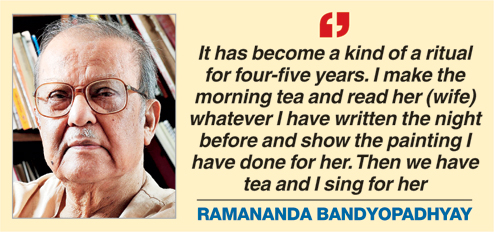
Five years at Kala Bhavan instilled in him the habit of singing while painting. And when his wife Krishna lost her mobility, he started singing three Rabindrasangeets to her daily. “It has become a kind of a ritual for four-five years. I make the morning tea and read her whatever I have written the night before and show the painting I have done for her. Then we have tea and I sing for her.”

He was unsure about going public with his singing. “But Biswa (Roy, the proprietor of Bhavna Records) persisted till I yielded.”

Weeks of practice followed. Ten songs were chosen, including Oi asontoler matir pore, “a Santida favourite”. The album, which bears a sketch by him for each song, has his wife’s illustration of Notir Puja on the cover.

The album will be launched at Calcutta Press Club at 5pm on Friday by Soumitra Chattopadhyaya and an hour later at Raj Bhavan by governor K.N. Tripathi.

source: http://www.telegraphindia.com / The Telegraph, Calcutta, India / Front Page> Calcutta> Story / by Sudeshna Banerjee / Friday – June 19th, 2015

Relic Hunter

On a rainy afternoon, Chittaranjan Dasgupta sits hunched on a chair in his dimly lit room in Bankura’s Bishnupur, working on the manuscript of his latest book, ‘Dakshin Paschim Banger Itibritto’ (History of South West Bengal).

He is 90 years old. For more than 50 years, he has been working tirelessly for preserving the history of Bankura and its surrounding region. Age has not dulled his faculties.

He has authored two other books on Bishnupur’s terracotta temple art. Recently, he wrote a paper on ‘International Trade and Cultural Diffusion in Medieval Southwestern Bengal: Some Architectural Evidence’.

His son Basab Dasgupta, economic advisor with the World Bank in Washington, has sent it to the University of Cambridge.

Dasgupta’s tryst with history began in the prime of his youth. He taught Bengali at Bishnupur High School. “Those were heady days,” he recalls. “We were still basking in the glory of new-found freedom after the British left. Everyone, especially the youth, were fired by a deep passion and commitment towards our soil.” They were free spirits, too. “We would travel to villages in and around Bankura regularly. On these trips, we stumbled upon archaeological relics buried deep in the soil.”

Bishnupur, best known for its terracotta temple art and Baluchori sarees, is a treasure trove of relics dating back to the prehistoric era.

Bankura-Bishnupur’s history can be traced back to thousands of years ago, when Proto-Australoids and Proto-Dravidians inhabited the region. Bishnupur was the core of Mallabhum that in its heydays stretched up to the Chhota Nagpur Plateau in the west and Burdwan in the east.

Its monarchs were called Malla Rajas. Bishnupur saw a confluence of various religions and sects, including Vaishnavism, Jainism and Islam. Bishnupur’s kings were patrons of art, music and culture. The eponymous Bishnupur gharana originated here.

Tansen’s descendant Ustad Bahadur Khan, a musician at the court of Bishnupur’s King Raghunath Singh Deo II, established the gharana.

The writ of time, however, ensured Bishnupur’s link with its glorious past became tenuous.

In the 1940s, Jogesh Chandra Roy, who settled in Bankura after retiring as a professor of chemistry and botany from Cuttack’s Ravenshaw College, tried setting up a museum for relics, books, manuscripts of a bygone era. Around that time, the area around the Kangsabati river was being excavated. “Prof Roy was pained to see government officials and others walking away with priceless archaeological finds,” says Dasgupta. Roy then placed an announcement in a reputable Bengali magazine, seeking help to build the museum. He received no response. Then, came a band of enthusiasts who cherished their history.

Besides Dasgupta, the motley group comprised teachers, scholars, students, businessmen and government officials. They wanted to preserve testimonies of the past for posterity.

Inspired by Roy, they set up the Bishnupur chapter of Bangiya Sahitya Parishad in 1951. Dr Manik Lal Singha was a prominent member who contributed immensely to preserving Bishnupur’s history. Like Dasgupta, he, too, taught at Bishnupur High School and became the parishad’s secretary.

“In 1970s, Manik Babu discovered a Chalcolithic site at Dihar, north of Bishnupur on the north bank of Dwarakeshwar river,” Dasgupta says. Coins, beads, semi-precious stone jewellery and pottery were excavated. The find helped establish that Bankura-Manbhum-Singhbhum was the hinterland of the Tamralipta port and part of the trade route that opened into the Bay of Bengal.

Dr Singha wrote to the Calcutta University’s archaeological department, which took charge. Parishad members scoured villages to collect bits of Bishnupur’s past. “We would go to houses asking for ancient manuscripts written on palm leaves or tulot kagoj (handmade paper). These were heirlooms and several families didn’t want to part with them,” Dasgupta says.

For about a decade — from the 1980s, till he retired in 1990 — Dasgupta, like Dr Singha, travelled through villages to collect relics. They found numerous ancient stone sculptures. Coins, ornaments, pot shards, arrow heads, weapons and tools were excavated from the banks of the Kansai, Shilai and Darakeshwar rivers. “Often, we succeeded in retrieving the relics. But there were times when villagers didn’t allow us, especially if the relic was an idol of a deity who they worshipped,” he says. Gradually, when they had a collection of manuscripts, the parishad decided to set up a museum.

In January 1951, Kabishekhar Kalidas Roy inaugurated a room from where the museum began.

Later, Bishnupur’s Bhattacharya family donated about 10 bighas of land, where then Union education minister Humayun Kabir laid the foundation of the museum, Jogesh Chandra Purakriti Bhavan, in 1954. Named after Prof Roy, today it is a two-storeyed building. The state government, too, chipped in.

During the Left Front regime, the foundation was laid for a new wing. Victoria Memorial gave a grant of Rs 15 lakh for its modernization. Dasgupta is the museum’s member-secretary. The museum became a crucible of culture.

The Parishad organized various lecture series, discussions and music performances. The list of speakers had Bengal’s best — scientist Satyen Bose, author Tarashankar Bandopadhyay, scholars like Shashibhushan Dasgupta, Suniti Chattopadhyay, Sukumar Sen, Kalidas Nag, economists Ashok Mitra and Biplab Dasgupta.

Now, most parishad members are either dead or old. Lectures and performances are no longer held. “Nobody seems to be interested in intellectual pursuits anymore,” Dasgupta feels. Also, today, moving in villages in search of relics would have been tough. “Violence and suspicion stemming from politics have eroded the innocence and peace in Bengal’s villages,” he rues.

The museum boasts a collection dating back to the Paleolithic Age. There are sculptures of Jain Tirthankaras, Parasnath, Choumukha votives and Hindu gods, including Chamunda, Vishnu on Ananta Shajya, Ganesha, Kartikeya, Shankha Purush, Indrani, Pragya Paramita and Ambika. The music gallery chronicles the Bishnupur gharana, its exponents and their instruments.

Curator Tushar Sarkar and two guards are in charge of the museum. During peak season, the museum attracts about 400 visitors a day.

Yet, such priceless treasures of Bengal’s history are left practically unguarded with not even electronic surveillance or high-tech round-the-clock vigil.

source: http://www.timesofindia.indiatimes.com / The Times of India / Home> City> Kolkata / by Rakhi Chakrabarty, TNN / June 20th, 2015
Akademi Ratna was most unexpected, says Vijay Kichlu

Kolkata :

Sangeet Natak Akademi’s decision to confer the prestigious Akademi Ratna Sadasyata award on Pt Vijay Kichlu has come as a perfect birthday gift for the legend, who will turn 85 this year. Away on a buddy-trip with his gang of eight friends in Mashobra, Kichlu was both surprised and elated with the news.

“This was the most unexpected news for me. I was the member of the last council of Sangeet Natak Akademi. As a member, one can’t receive any awards. The new chairman was announced only recently. This news came as a great surprise to me. I am humbled,” Kichlu told TOI. Musicologist S R Janakiraman, film-maker MS Sathyu and musician Tulsidas Borkar are the other recipients of the prestigious fellowships for 2014.

The last time a musician from Kolkata received the Akademi Ratna Sadasyata was in 2010. It was given to Girija Devi-ji. The fellowship constitutes a cash award of Rs 3 lakh beside an angavastram and a tamrapatra.

Of late, Kichlu has been keeping himself busy with a Prasar Bharati assignment. For this, he has to prepare 52 episodes of content that will offer a holistic view of Indian classical music. Work for this began early this year. “We have just about finished work on nine to 10 episodes,” he said.

Kichlu is being assisted by a team of researchers from Kolkata and Delhi. “Apart from Meena Banerjee and Arpita Chatterjee from Kolkata, our team also has Prashant Mallick from Delhi,” he said. As part of this project, Kichlu has himself interviewed Pt Hariprasad Chaurasia, Pt Rajan and Pt Sajan Mishra and Ashwini Bhide, among others.

source: http://www.timesofindia.indiatimes.com / The Times of India / Home> City> Kolkata / TNN / June 16th, 2015

Bonhomie the biggest winner – Young Metro

Junior boys of South Point High School in action at the Bengal Rowing Club

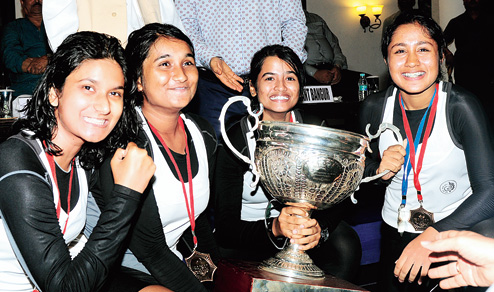
Aishwarya Krishnan couldn’t have asked for a better gift on her 17th birthday. As the Class XII student of GD Birla Centre for Education picked up the trophy with her three teammates, the smile on her face said it all. The real winner, however, was the spirit of the game as Aishwarya took her closest competitors for a celebratory dinner after the final race.

The 14th Bengal Rowing Club Student Rowing Championship, in association with The Telegraph, saw 43 teams from 25 schools rowing passionately to make their schools proud.

The competition was fierce but the bonhomie among participants outshone all rivalry. “I will never forget the moment when we stepped out of our boats after winning the race and one my best friends, who was my opponent, came running and hugged me tight. This is the sort of bond we share here. It’s true that when we are rowing we don’t think of anything else but finishing the race. But I have made the best of my friends here,” said Aishwarya, who has been participating in this event for four years. “This was the second time my team won the gold. It was the best gift I could have asked for.” The GD Birla team defeated defending champion Modern High School for Girls to lift the senior girls’ trophy.

In the senior boys’ race, St. Lawrence High School retained the trophy. The boys beat Future Hope in a close finish.

Aishwarya Krishnan (extreme right) and her teammates after winning the senior girls’ race at the 14th Bengal Rowing Club Student Rowing Championship. Pictures by Arnab Mondal

“Future Hope was leading even when we had travelled half the distance but then we just had to fly it out to the finishing point,” said Shubham Singh of the winning team.

Yash Juthani of MP Birla Foundation Higher Secondary School was disappointed on finishing fourth but happy that his school took home the award for best dressed school for their white jerseys with a special logo of two crossed oars and emblem showing the students rowing. “Participating in the competition is in itself a wonderful experience. Every year we make new friends and have great fun,” said the Class XII student. “But we will definitely do much better next time.”

Hemant Bangur, the president of Bengal Rowing Club, was all praise for the students. “Now that our flagship event is coming to an end, I will miss the bubbling energy of the students at the club. I would like to thank the school for their co-operation and active participation,” he said.

Governor Keshari Nath Tripathi, who graced the prize distribution ceremony, had words of encouragement for the young rowers. “I congratulate all the winners…. They have earned it by their devotion, concentration and hard work. Those who couldn’t win need not despair. Defeat many a times is the inspiration for better performance and ultimate success. I expect them to achieve this role in the next championship.”

Like every year, the club promoted other sports too, archery and chess being the highlights this year. There was also an indoor rowing competition.

Rowing glory

Junior Girls

Gold: Modern High School for Girls
Silver: Ashok Hall Girls’ Higher Secondary School
Bronze: La Martiniere for Girls

Junior Boys

Gold: South Point High School
Silver: La Martiniere for Boys
Bronze: St. Xavier’s Collegiate School

Senior Girls

Gold: GD Birla Centre for Education
Silver: Modern High School for Girls
Bronze: Sushila Birla Girls’ School

Senior Boys

Gold: St. Lawrence High School
Silver: Future Hope
Bronze: Seventh Day Adventist

source: http://www.telegraphindia.com / The Telegraph, Calcutta, India / Front Page> Calcutta > Story / by Samabrita Sen / Monday – June 15th, 2015