Librarian lifeline for library

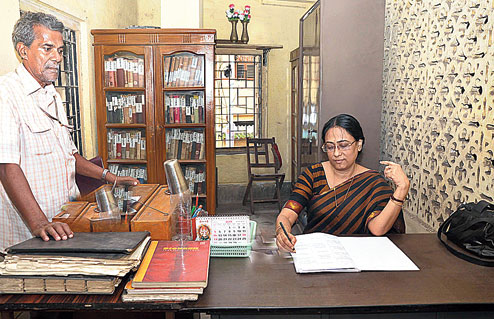
Gouri Sanyal has joined as librarian of Howrah Seva Sangha library from February this year. Picture by Gopal Senapati

After a seven-year fight, Howrah Seva Sangha Library finally got a librarian in February this year. The little room on the first floor of the clubhouse on Narasingha Dutta Road, has 9,500 books and since 2008, it was run by the club members themselves.

Howrah Seva Sangha, started as a social welfare group in 1923 and its members were involved in the freedom struggle. The library was established at around the same time, but later became a government-sponsored primary unit library. The club is popular for its sports, yogasana, gymnastics and multigym. The Durga Puja is also one of the oldest in the town. However, the library has been struggling to stay afloat for the past seven years. “Although this is a government sponsored library, we did not get a librarian after the previous one retired, even after repeated requests. The club members would open the library every evening,” said Amarnath Basumullick, the president of Howrah Seva Sangha Library.

Gouri Sanyal, who was earlier the librarian at Sahid Smriti Sangha Granthagar at Bakultala, was transferred to this library in February this year. “I visit this library three days a week. At present I am trying to bring some order to it, by making a fresh catalogue of books and arranging the shelves properly,” said Gouri. Funds had also stopped coming to the library in the past seven years but after the new librarian was appointed, a sum of Rs 30,000 was also sanctioned.

“The fund will be used for some basic furniture like a table, chairs and stationery for the librarian to work. This has been sanctioned from the library’s contingency fund. As the library starts coming back to the mainstream, we will sanction the regular annual grant as well,” said Tushar Kanti Chattopadhyay, the district library officer, who has taken an active interest in reviving this library. “We are trying to revive several such libraries in Howrah that are struggling to stay afloat. We have started with those in the Howrah Municipal Corporation (HMC) area and we are trying to help revive them,” added Chattopadhyay.

Although the library has started functioning, another huge task is to bring back readers to the library. “I think a career guidance section and a children’s section are necessary to attract young readers to the library. There are a number of schools in this area and we can try to get the students from the schools to come to the library regularly,” said Sanyal. Other interactive programmes and discussions like the one on the importance of books held at the club on July 4 on the 92nd annual programme of the club and library are being organised.

Barid Baran Ghosh, the president of Bangiya Sahitya Parishad, Arup Roy, agriculture marketing minister, Chaitali Dutta, professor at the library sciences and information department of Jadavpur University and Tushar Kanti Chattopadhyay, the district library officer were present at the July 4 programme and spoke about how books can be a person’s best friend.

source: http://www.telegraphindia.com / The Telegraph, Calcutta,India / Front Page> Howrah> Story / by Dalia Mukherjee / Friday – July 10th, 2015
Training to lift kettlebells

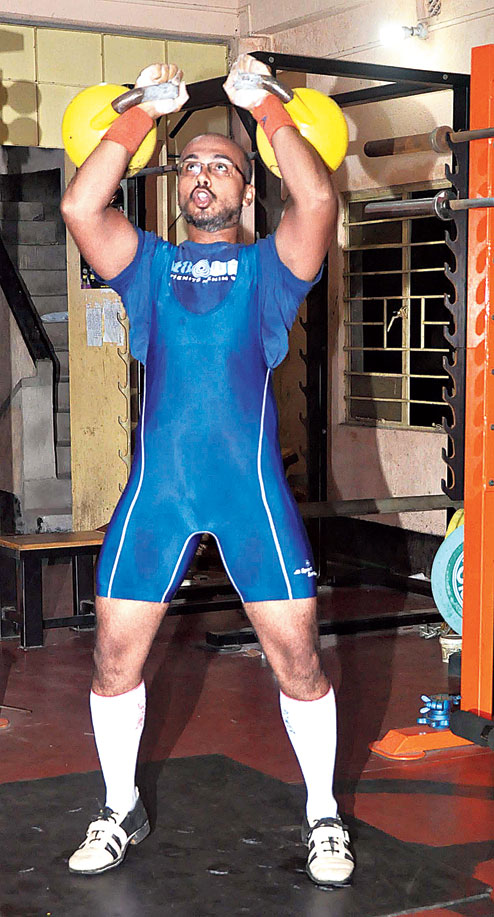
Kaushik Balial demonstrates kettlebell lifting at KB’s gym.  Picture by Gopal Senapati
Kaushik Balial demonstrates kettlebell lifting at KB’s gym.
Picture by Gopal Senapati

Kettlebell lifting has a long history in Russia and has been a competitive sport since the 1960s. Kettlebell sports, also known as Girevoy Sport, is a popular sport in Russia and Europe. It has started becoming popular in other countries around the world recently. A variation of weightlifting, the sport involves the same snatch and jerk techniques that are demonstrated in the former.

Along with the world, kettlebell sports have also made an entry into India and Calcutta. Health clubs and gyms where members are involved in regular kettlebell training, have introduced the sport as well. Kaushik Balial of KB’s Gym, introduced kettlebell training in his gym some months back and on July 4 and 5, he conducted a workshop on Level 2 kettlebell training. “In most gyms in Calcutta, kettlebells, which were treated as a fitness training equipment, have become a sports equipment. More people are trying this sport,” said Kaushik.

“Level 2 training includes training in the sport. Level 1 is all about strength and endurance and is usually done with one kettlebell. In Level 2, the trainees have to learn to lift two kettlebells together and gradually try to increase the weight limit,” he added.

Four members of KB’s Gym participated in the workshop. At this workshop, Kaushik demonstrated kettlebell lifting with two 4kg bells. “There are generally two events in competitive kettlebell events. One is the biathlon and the other is the long cycle. The biathlon is a classical event where the lifter has to perform a set of jerks followed by a set of snatches. In a long cycle, the lifter has to perform a set of long jerks,” said Kaushik.

At the workshop, Kaushik stressed on techniques – how to do the moves and how to develop a body for the sport. “Strength and endurance are the two most important things in kettlebell sports. This form of fitness training has become popular among the young generation because kettlebells are small equipment which require less space and also because training takes less time. The maximum time one should give to kettlebell training is 20 minutes,” said Kaushik. After this workshop, Kaushik hopes to be able to build a team of kettlebell lifters. “There is a kettlebell lifting competition next year in Calcutta and I hope to send a team there,” said Kaushik.

source: http://www.telegraphindia.com / The Telegraph, Calcutta,India / Front Page> Howrah> Story / by Dalia Mukherjee / Friday – July 10th, 2015
When 1,000 voices sang

The Choir paid tribute to Tagore and his ‘Gitanjali.’

CoirKOLKATA10JUL2015

Thousand voices and one celebration… The Netaji Indoor Stadium in Kolkata, reverberated with poems of Nobel laureate Rabindranatha Tagore recently as Sangeet Bharati Muktadhara presented ‘Echoes of Gitanjali’ to commemorate 100 years of Rabindranath Tagore’s Nobel in Literature and Gitanjali.

For the 1000 singers from all over India – Chennai, Patna, Mumbai, Delhi, Gurgaon, Bengaluru, Baroda, IIT-Kanpur, Allahabad and Bhilai – the show, conceptualised, scripted and directed by Arundhati Deb, president, Sangeet Bharati Muktadhara, came after months of rigorous practice. The theme was the lotus, and sure enough, the singers on stage were positioned to represent the national flower.

For the group of 12 singers from Chennai group, it was a perfect opportunity to pay tribute to Gitanjali and its profoundly fresh beautiful verse.

Years ago, travelling abroad, Tagore witnessed western classical music concerts featuring musicians numbering 1000 to 2000. This left a lasting impression on him, observers had said. Nevertheless, Tagore had not voiced his latent desire – to give a similar treatment to his compositions.

“The programme titled ‘Echoes of Gitanjali’ commemorates 100 years of Tagore’s English Gitanjali,” said the 60-something-Arundhati Deb, who travelled from city to city to refine the performances of the different groups. She was in Chennai to help the team with singer Swati Bhattacharya taking the lead.

Hailing from a family deeply interested in music, Arundhati Deb grew up fascinated with Rabindra Sangeet. After a Master’s Degree in English and an editing stint, her desire to do some serious work with Tagore surfaced. The result? The first 1000 Voices Choir in 2007.

source: http://www.thehindu.com / The Hindu / Home> Friday Review / by Renuka Suryanarayan / July 10th, 2015

New bone cancer cure without amputation

Kolkata :

Osteosarcoma, or cancer of the bone, now has an easier and cheaper cure. While the most commonly used treatment is to replace the affected bone with a prosthetic one, a team of city doctors has now used bone scraped out of a patient’s left leg to reconstruct the bone above the right knee (autograft). This has not only cut out cost of the prosthetic replacement, but also made recovery faster and less complicated.

While a prosethetic bone replacement costs Rs 1.5-2 lakh, an autograft can be done for just Rs 50,000.

Amputation of the affected bone was the only cure for osteosarcoma till recently. The ailment is triggered by a cancerous tumour on the bone, which is usually an aggressive form of malignancy. It is more common among children and young adults.

In this case, 19-year-old Sabaqur Nahar Begum, a resident of Burdwan, was affected by osteosarcoma last March. She had a cancerous tumour on her femur and amputation seemed to be the only option. Looking for another way, her husband Syed Badshah Ali got in touch with doctors at the Netaji Subhas Chandra Bose Cancer Research Institute.

“I was told that her leg would not only be saved, but that she would not even require an artificial replacement to heal the affected bone,” he said.

Led by orthopaedic surgeon P Pujari of Ramakrishna Mission Seva Prathisthan, the surgery removed the cancerous part of her femur and used bone fragments from her tibia to fill the gap. The surgery was preceded by a series of three chemotherapy sessions.

A rod has been inserted into the area to support the implanted bone. It will be removed after three to six months depending on how quickly the area heals.

“The trend is now to saving limbs and body organs affected by cancer. While previously we would ampute the bone or limb, now it is possible to save them with modern and more accurate surgical procedures. In this case, the patient has responded well to the surgery and is on the path of recovery,” Pujari said.

Osteosarcoma patients usually do not suffer a relapse in the area of the operation. “But metastatis or a recurrence can’t be ruled out in another part of the body. This is true of any form of cancer, though,” added Pujari.

Oncologist Subir Ganguly felt that while the surgical technique has opened up the option of saving the limb, a recurrence of the cancerous tumour can’t be ruled out.

“Microscopic cancerous cells, that are hard to detect, might linger in the area. It often happens that the tumour forms again, a reason why surgeons earlier preferred to ampute the affected bone. But the new procedure is useful for it allows the surgeon to delay or rule out the amputation as far as possible,” said Ganguly.

source: http://www.timesofindia.indiatimes.com / The Times of India / Home> City> Kolkata / by Prithvijit Mitra, TNN / July 09th, 2015

Mamata Banerjee Flags Off Kolkata-Dhaka-Agartala Bus Service

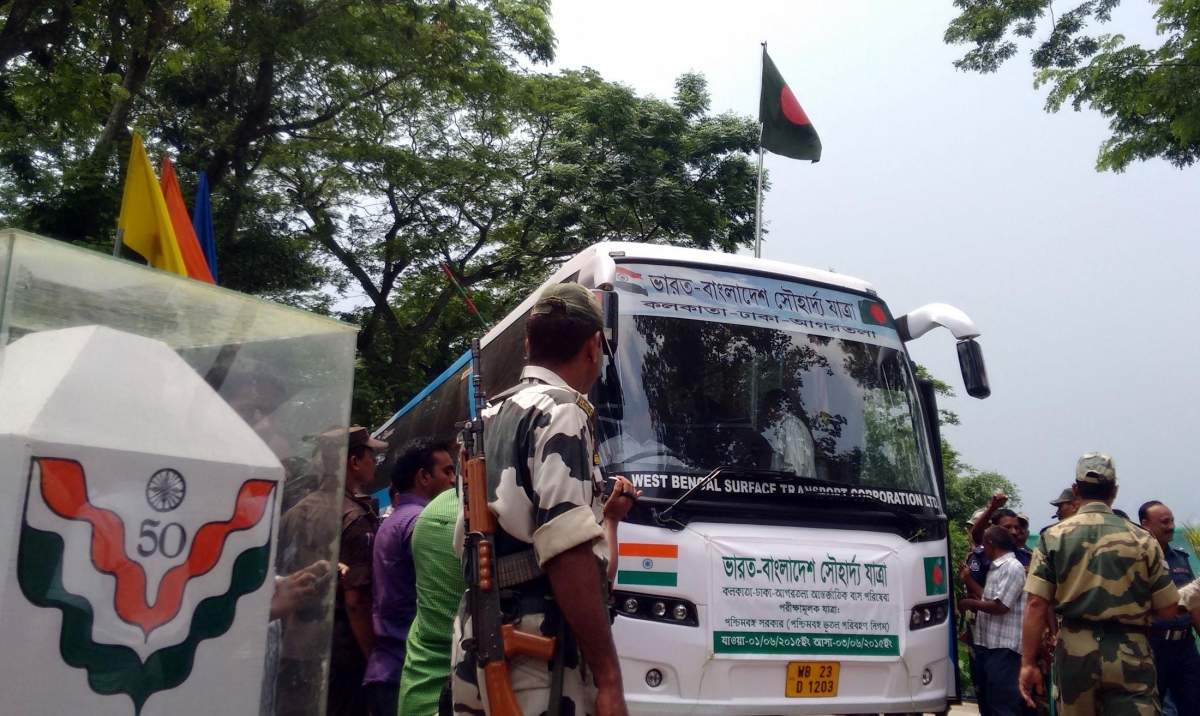
The first Kolkata-Dhaka-Agartala bus enters Agartala from Bangladesh through Akhaura integrated checkpost during a trial run on 2 June, 2015.IANS

Flagging off the Kolkata-Dhaka-Agartala bus service here on Thursday, West Bengal Chief Minister Mamata Banerjee said the initiative will turn the India-Bangladesh ties into an everlasting relationship.

“The launching of this service makes this day forever memorable and historically significant for both the countries,” Banerjee said at the flagging off event at the state secretariat, Nabanna, in Kolkata’s neighbouring Howrah district.

“This service will bring both India and Bangladesh closer and turn our cordial ties into an everlasting relationship,” she added.

The cross-border bus service was approved at a recent meeting between Bangladesh Road Transport Minister Obaidul Quader and his Indian counterpart Nitin Gadkari in New Delhi.

The bus service will facilitate visiting mainland Indian states for people of the mountainous northeastern region, reducing the distance by over 1,000 km.

Agartala via Guwahati is 1,650 km from Kolkata by road, but the distance between the tripura capital and the West Bengal capital via Bangladesh is only around 500 km.

Prime Minister Narendra Modi and his Bangladesh counterpart Sheikh Hasina are scheduled to flag off the Agartala-Kolkata direct bus service in Dhaka on June 6.

source: http://www.ibtimes.co.in / International Business Times / Home> News> Society / by IANS / June 04th, 2015

A beehive for a club

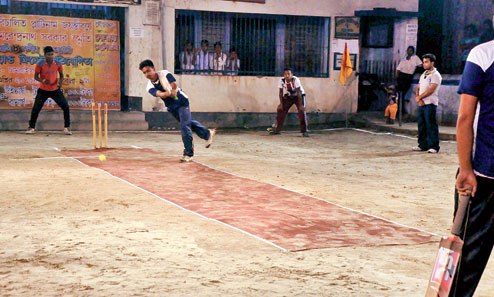
An inter-club underarm cricket tournament organised by Mouchak at  Chamrail High School ground. Picture by Gopal Senapati
An inter-club underarm cricket tournament organised by Mouchak at
Chamrail High School ground. Picture by Gopal Senapati

The name sounds unusual for a club, but the founders of Mouchak wanted the club to run exactly like a beehive, where the Queen bee orders around and the servants follow the orders. In this case, the secretary is the Queen Bee and all members are her workers. Mouchak has been functioning this way through its 75-year journey.

The club is one of the oldest among those around Kona, Chamrail and Jagadishpur. Senior members of the club remember seeing Martin Rail pass from the front of the club. Although established in the pre-Independence years, the members were not associated with the freedom struggle. “At that time, this was a remote village in Howrah with only a handful of residents, most of whom were farmers. Gradually, people from other places have come and settled in Chamrail,” said Sailendranath Mondal, the secretary of the club.

Those who liked to do physical training or were involved in music, did not have a place to practise. “They would go to local resident, Tarapada Mondal’s house which became a centre for physical exercise and cultural activities,” said Mondal. Later, the local zamindar, Panchkari Santra, donated land for a club. This was a low-lying pond which was filled to make the first club house. “Initially, the club house had a mud floor and bamboo walls and a tiled roof. Later, the building was made into a concrete structure,” said Mondal.

Mouchak was initially started with the purpose of providing space for gym and physical training. Later, however, the members took interest in social welfare of Chamrail, including literacy drives. The founders of the club were Sisir Kumar Ganguly, Rohini Kumar Mondal, Naresh Chandra Manna and Ashwini Kumar Mondal and they began several welfare activities. “Many institutions in Chamrail had started from this club. Chamrail High School was initiated at this club. When the school building was not there, classes were held at the club. Members were involved in welfare activities like clearing overgrowth in residential areas, cleaning drains and other activities,” said Sachin Das, a member of the club.

The children’s section of the club started 45 years ago. It started with bratachari sessions at the club and the children from this club would go to Sab Peyechir Asar. Much later, the club band was formed. The library was a part of the club at one time but became a government sponsored library in 1982. A blind school also ran from the club, till the school found its own building nearby. The new club house was built in 1998 and the first floor was extended in 2010.

At present the club is involved in cultural activities like holding classical dance and music, recitation and art and craft lessons. A handwritten magazine, Pora, was earlier published by the club members, but it stopped after a wall magazine started at the library. Yogasana is also practised at the club.

There are not too many sports activities, the reason being that the club does not have its own ground. “The club never had its own playground which is why we could never carry out regular coaching camps. We do have a volleyball team, but they practise at the barowari committee ground. We also organise an inter-club cricket tournament with underarm bowling,” said Mondal.

The platinum jubilee celebration started from January 4 with a colourful procession. More events are coming up later this year. “We will have cultural competitions at different times of the year and we also plan to organise an inter-district underarm bowling cricket tournament where 16 teams from Howrah, Hooghly and other districts will be participating,” said Mondal.

FACTFILE

Name: Mouchak
Estd: 1940
Address: PO and Village, Chamrail
Activities: Music, dance, recitation and yogasana

source: http://www.telegraphindia.com / The Telegraph, Calcutta,India / Front Page> Howrah> Story / by Daila Mukherjee / Friday – July 03rd, 2015

Kolkata engineer replicates Zurich model to address cerebral palsy

Kolkata :

Much like the campaign on polio, another one in right earnest will start soon. And this time Kolkata will be the city to anchor it. The audio visual campaign, that is presently getting designed will have voices of Babul Supriyo, Kumar Sanu, Abhijeet and Jolly Mukherjee to stress on the fact that cerebral palsy can largely be prevented through pre-natal and neo-natal care. The campaign is being spearheaded by a man, who is better known in the city for some of the iconic structures that he had created, but whose life is now governed by a tragedy – the death of his 27 year old son, Abhishek, a cerebral palsy patient.

Gautam Mitra, who now lives in Zurich on business, started by setting up an NGO for cerebral palsy patients in Switzerland, which attracted a lot of attention there. Enthused by that success, he has now come to Kolkata to start his Bishwa Bandhan, an NGO that will work to spread awareness and also provide supplementary support to children with cerebral palsy and their parents.

During his heydays as a structural engineer and consultant to Tata Steel, some of the structures that Mitra built were, Nazrul Mancha, the steel galleries of Mohammedan Sporting after the wooden ones got destroyed in a fire, the traffic diversions on Vidyasagar Setu, the mini bus shelter at BBD Bag and pedestrian over bridges at Ultadanga and Manicktala. But such accolades have stopped having any meaning for him anymore.

In Switzerland he continues to build tunnels, overbridges, pre-fabricated structures and other constructions using cutting edge precision technology, that is coming of age in Europe today, but only when he is not engaged in a dialogue with the WHO or state authorities in Zurich regarding his cerebral palsy awareness programme. Though he accedes that the level of awareness is very high in Europe, the fact that a large number of babies are born prematurely or with extremely low birth weight as a result of artificial insemination arising out of growing numbers of infertility cases, incidences of cerebral palsy are very high in Europe.

Bishwa Bandhan, which is headquartered in Zurich, has already partnered with WHO there and started its two pronged intervention – spreading awareness among pregnant women that cerebral palsy is preventable and supplementary therapy can make life bearable for children who are born with the problem. The NGO is making waves with its awareness campaigns that stresses on the fact that in most cases when sufficient volumes of oxygen do not reach the brain, babies develop cerebral palsy, so a great stress needs to be laid on administering oxygen on the mother during birthing. It has also started a unique music therapy on children with palsy to help rejuvenate them.

“We are trying to replicate the Zurich model here,” Mitra said. He is presently in the city to start up the the Kolkata chapter of Bishwa Bandhan. A teaser campaign on prevention of palsy will be up soon and the audio visual is getting readied now. Just like in Zurich, where the initiative is being partnered by WHO, Bishwa Bandhan here has tied up with the Institute of Child Health, the Indian Medical Association, leading gynaecologists and fertility experts. They are all enthisuastic about the impending campaign. “It is true that a large number of cerebral palsy patients would have been born normal had oxygen been administered on the mother well, this would not have happened. It is not a genetic disorder. Hence, a systematic campaign is a must. All stakeholders in the birthing process, right from the doctor to the nurses and even the mother should be made aware of this,” said Apurba Ghosh, director of the Institute of Child Health.

The Indian Medical Association has also thrown its weight around the campaign. “There are plenty of pre-natal routine procedures that are not followed in many cases. Again forcep birthing causes a lot of damage since it obstructs the flow of oxygen to the brain. When babies are born pre-mature or with low birth weight, oxygen deficiency is a related hazard. Inorder to maintain WHO standards, one has to eliminate negligence at every stage and that is possible only through an intensive campaign,” said Shantanu Sen, secretary of IMA Bengal chapter.

A 6000 square feet space at Red Cross Place off Raj Bhavan is being prepared as therapy space of Bishwa Bandhan for children with cerebral palsy. “We will experiment with different kinds of music and colour to excite and activate the slow moving brain of palsy kids. Physiotherapists will also work on their limp limbs and make them as active as possible,” Mitra promised.

source: http://www.timesofindia.indiatimes.com / The Times of India / Home> City> Kolkata / by Jhilmil Pandey, TNN / July 07th, 2015

All that jazz: Catch The Bodhisattwa Trio in Mumbai

Kolkata's experimental jazz rock outfit - The Bodhisattwa Trio.
Kolkata’s experimental jazz rock outfit – The Bodhisattwa Trio.

If you’re a fan of funky arrangements and odd time signatures, head to Blue Frog on Sunday to catch Kolkata experimental jazz rock outfit, The Bodhisattwa Trio, in concert. Led by Bodhisattwa Ghosh on the guitar, the band whips out mean progressions, backed by Premjit Dutta’s drumming and Bijit Bhattacharya’s bass lines.

This is the band’s second stint in Mumbai after having played with Ehsaan Noorani earlier this year. The trio has roped in Toronto-based jazz musician and saxophonist Andrew Key to improvise and collaborate on stage for the event, which is titled Phase Anomaly.

“Andrew had come to study Indian classical music earlier, when we did a show together. We have continued that collaboration,” says Ghosh.

“At this gig, we will play some new material that will make into our album, scheduled to release next year,” he adds.

The band has accrued some touring experience after playing at independent venues in London, Paris, Slovenia and Bangladesh, apart from performing at the Kolkata International Jazzfest.

From fiery progressive rock tracks like Annihilation to the downtempo melodies of 0305, the trio has been experimenting with soundscapes since they started in 2012.

Meanwhile, city gaming arena Smaaash will see some heavy duty metal acts from across the country, at the eighth edition of the popular crowd-funded gig series Control Alt Delete. The acts include Mumbai’s Bhayanak Maut, Zygnema and The Minerva Conduct, Aberrant from Shillong, Bengaluru/Chennai band Escher’s Knot and Delhi band Kraken. City band Cosmic Infusion and Pune-based Abraxas complete the line-up, which ranges from black metal to contemporary metal.

WHAT: Performance by The Bodhisattwa Trio (above)
WHERE: Blue Frog, Todi Mills Compound, Lower Parel
WHEN: Sunday, 9.30 pm
Call: 6158-6158
ENTRY: Rs 350 per head

WHAT: Control Alt Delete, featuring Bhayanak Maut, Zygnema and others
WHERE: Smaaash, Kamala Mills Compound, Lower Parel
WHEN: Saturday, 9 30 pm onwards
Call: 4914-3143;
ENTRY: Pay as you like

source: httpL.//www.hindustantimes.com / Hindustan Times / Home> Cities / by Mohan Kumar K / June 13th, 2015

Bandhan to start Banking Operations from Aug 23

Micro-finance institution Bandhan Financial Services, which got the final license from Reserve Bank of India to start universal banking, would formally start operations as a banker from August 23.

GhoshKOLKATA06jul2015
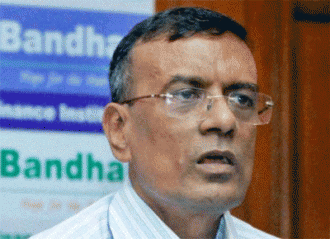
“We will start banking operations under Bandhan Bank from August 23 with the inauguration of 600 branches in 27 states across the country along with 250 on-site ATMs,” Bandhan chairman Chandra Sekhar Ghosh told PTI.

He said 247 branches would be opened in West Bengal, while Bihar, Orissa and Assam would also have a good share in terms of the number of branches.

Ghosh said 65 per cent of the branches would be rural, while the rest 35 per cent would be opened in urban areas.

The logo for Bandhan Bank has been designed by advertising agency O&M, Ghosh said adding that all the branches would be on core banking platform.

Bandhan is also in the process of obtaining separate RBI licenses for RTGS, NEFT, payments gateways and CTS, he said.

Ghosh said all the necessary hardware and software are in place to start the operations.

The MFI had got the in-principle license from RBI to start universal banking in April 2014 within 18 months time.

Along with Bandhan, IDFC had also got the same in-principle approval from RBI for starting universal banking operations.

With IFC, GIC Singapore and SIDBI as equity investors, Bandhan Bank would start operations with a capital base of Rs 2,616 crore.

source: http://www.dailypioneer.com / The Pioneer / Home> Banking & Finance / PTI / Kolkata – Sunday, June 05th, 2015

Shelter for cancer patients opens door – Premashraya will house 200 patients, 300 relatives

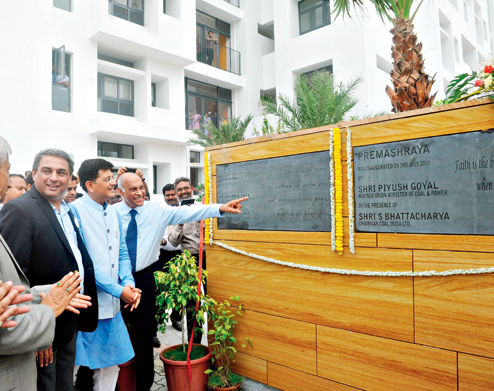
Kids with cancer (top) play at Premashraya in Rajarhat after it was inaugurated by Union minister Piyush Goyal, flanked by Tata Steel managing director TV Narendran and Tata Medical Center medical director Mammen Chandy, on Friday. Pictures by Amit Datta

A shelter for outstation cancer patients and their relatives visiting Tata Medical Center for treatment was inaugurated at New Town on Friday.

Premashraya, an 11-storeyed building less than a kilometre from the hospital in New Town Action Area III, can house 200 patients and 300 family members with separate wings for children and those needing palliative care.

“Relatives of cancer patients need to be with them. Poor patients can’t afford expensive hotels; but they need to stay in the vicinity of the hospital as they can’t travel for long,” Piyush Goyal, minister of state for power, coal and new and renewable energy, said after inaugurating the building.

Coal India Ltd has funded the Rs 41-crore project.

Goyal said his ministry would like to help out the hospital, run by the Tata group, with its annual operational expenses that have been calculated at around Rs 30 crore. He also urged the authorities to approach the people of Calcutta for funds.

“I would request Geeta Gopalakrishnan (director, donor relationships, Tata Medical Center, who raised funds for Premashraya) to approach every industrialist, businessman and Rotaries of Calcutta; connect with them and get a promise for Rs 30 crore. Then that’ll give them a satisfaction,” Goyal said.

Mammen Chandy, the medical director of Tata Medical Center, said many patients could not afford treatment for want of a place to stay. “Premashraya was planned when there was no money,” he said. “Then Coal India came forward. But maintaining and running it and keeping the place clean is a big challenge.” St. Jude’s Child Care Centre, a voluntary organisation, would look after the children’s wing.

The hospital authorities said they would hire agencies for housekeeping, cleaning and other daily jobs. Once the daily operational costs have been worked out, the charges for staying will be decided, an official said. The charges will be minimal though, he said.

“In some cases, cancer can’t be cured. But if we can’t cure cancer, we can allow a person to die with dignity. That is why we have two floors for palliative care,” Chandy said.

The third and fourth floors will house patients in need of palliative care. The hospital will counsel and train relatives of such patients in palliative care. The official said patients could return home after completion of the training.

Premashraya, spread over 100,000sq ft, has a library, prayer hall, cafeteria, physiotherapy centre, auditorium and a play area for children.

Four shops on the ground floor will sell vegetables, fruits, grocery and gift items. For every six-seven rooms, there’s a kitchen where family members of patients can cook.

The auditorium will be used for yoga classes, meditation and counselling. There will be vehicles to ferry passengers and their relatives from the building to the hospital. Vastu Shilpa Consultants has designed the building.

The hospital has expansion plans as well. A seven-storey building with 250 beds will come up on the same campus where the 183-bed hospital is now operating.

An official said Indian Oil Corporation had funded part of the Rs 200-crore project.

“It’ll have three radiotherapy machines. Currently, we have two machines and the average waiting time for a patient is two months despite both machines operating from 11am to midnight,” said V.R. Ramanan, the deputy director of the hospital. The target date for completing the building is 2017.

source: http://www.telegraphindia.com / The Telegraph, Calcutta, India / Front Page> Calcutta> Story / by Special Correspondent / Saturday – July 04th, 2015