The green gate of 3 Peary Charan Sarkar Street has been leading thousands into the enchanting premises of the Eden Hindu Hostel for almost 130 years now. The lush green field, the wooden staircase, the kharkharis, the high-ceiling rooms, everything oozes an old-world charm that’s hard to ignore. And on Wednesday, the hostel closed down for renovations -its first overhaul since its establishment in 1886. CT celebrates the heritage and history of the colonial building and takes a trip down memory lane…
RICH HERITAGE
The hostel was initially built for the Hindu students of Presidency College, but later accommodated students from outside Kolkata. In 1988, the building was extended in order to accommodate postgraduate students and research scholars.Among its many famous boarders were the first President of India, Dr Rajendra Prasad, who studied in Presidency between 1902 and 1907, and professor Amartya Sen. Presidency University registrar Debajyoti Konar said, “Dr Rajendra Prasad was a student here and his room in the hostel is still not used.”
Divided into six wards, the hostel houses over 274 boarders, including undergraduate and postgraduate students.
HOME AWAY FROM HOME
With its seasonal tournaments, annual athletic meets, Saraswati Puja, reunions, freshers’ welcome, political meetings and farewell ceremonies, this hostel has been a second home for thousands of students.”It feels bad to leave this place. I’ve been here for over three years now and have spent some wonderful times with my friends and seniors,” third-year chemistry student Swarup Maji said. He added that they had been shifting to the new address in Rajarhat for the past three weeks. “We will be staying in Rajarhat for 11 months till the work gets done here. It’s going to be difficult, as we are used to staying in central Kolkata with so many facilities within reach,” Swarup said.
A NEW LOOK
Konar said an architect from the Heritage Commission will oversee the renovation. “As of now, Partha Das will supervise the work. This is a heritage structure and the plan has been made keeping that in mind,” he said. An amount of Rs 3 crore has been sanctioned for the first phase of renovation, while estimation is still under way for the second phase.
HELPING HAND
The University is more than happy to receive help from the government of West Bengal. “The renovation will span over 11 months and the higher education department has arranged for 80 flats in Rajarhat for the 150 students who have been shifted. A canteen, too, has been arranged. That’s not all. A subsidized bus will ferry the students from Rajarhat to Presidency,” Konar told us.
SAYING GOODBYE
For Sajan Dewan, a postgraduate political science student, it’s time to bid adieu to the hostel. “I’ve been here for the last four-and-a-half years. We’ve spent some of the best and worst days of our lives in this building. By the time the work gets done here, I’ll be out of college. But I’m taking back some fond memories with me, so we had a small party last night to say goodbye,” Sajan said.
HOSTEL HIGHLIGHTS
Eden Hindu Hostel was established in 1886 The hostel was built using funds raised by Ashley Eden, WB Gwyther was the architect The first president of India Dr Rajendra Prasad and Nobel laureate Amartya Sen are its alumni The hostel has eight guest rooms where parents of students and other guests are allowed to stay The six wards in the hostel include a kitchen, dining hall and staff-quarters, which occupy a total area of 26,000 sq ft.
source: http://www.timesofindia.indiatimes.com / The Times of India / News Home> City> Kolkata /by Kathakali Banerjee, TNN / August 03rd, 2015
More than 40 industrialists and nearly 20 media personnel are also accompanying the Chief Minister.
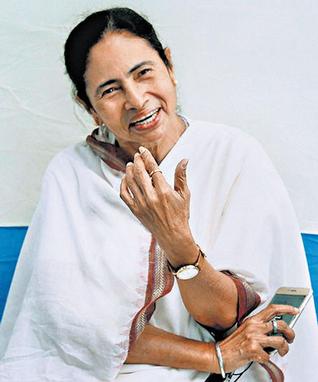
Ten musicians and an actor-cum-MP are accompanying West Bengal Chief Minister Mamata Banerjee on her maiden London trip to attract investment. The list includes vocalist Rashid Khan, harmonium maestro Jyoti Goho, tabla exponent Bickram Ghosh and actor-politician Deepak Adhikari (Dev).
More than 40 industrialists and nearly 20 media personnel are also accompanying the Chief Minister. While the industrialists and the media personnel are paying for their travel and stay, the musicians are going as State guests with the government footing their bills. West Bengal has a debt burden of over Rs 2.5 lakh crore making it one of the most cash-strapped States.
Ms. Banerjee will leave for London on Sunday for five days. During her stay, she will attend several meetings, including one with the Minister of State for Employment, Priti Patel. Dozens of Memoranda of Understanding (MoUs) are expected to be signed between the British departments and the West Bengal government in the fields of health, urban planning, transportation, exploration of natural resources, education and trade.
However, the inclusion of actor-MP Deepak Adhikari (Dev) and musicians in the delegation has not gone down well with many. The Ministers usually do not fly artistes to another country to perform, unless there is a particular reason to do so.
Only one event
The musicians will perform for about an hour at the British Historical Museum on July 28. “It will be an opportunity for cultural exchange showcase Bengal’s vibrant culture. It will be the only cultural event during the tour,” said harmonium maestro Jyoti Goho.
Criticising the government’s decision to host so many musicians for an hour-long programme, Left Front chairperson Biman Bose said the Chief Minister’s team would not be able to attract any investment. “It is not clear from the composition of the delegation, if she is going to London for investments or for other reasons. Among the artistes in her delegation, many have already been to London. But for those who have not been there yet, this is an opportunity,” Mr. Bose said.
Reception
The Chief Minister is accompanied by a host of politicians and bureaucrats who will interact with their British counterparts.
The Duke of York, Prince Andrew, will host a reception in her honour.
source: http://www.thehindu.com / The Hindu / Home> News> Cities> Kolkata / by Kolkata Bureau / Kolkata – July 24th, 2015
The father of modern Bengali language, in which books are written now, seems to have been relegated to the a mere footnote.
Wednesday was the 201st birth anniversary of Peary Chand Mitra, which passed unnoticed in the blaze of celebrations that are forever being added to Bengal’s calendar. Though Mitra’s name or his pseudonym, Tekchand Thakur, would not ring a bell among the youth, his ‘Alaler Ghare Dulal’ is the first Bengali book written in the “novel” form, a tradition taken up by Bankim Chandra Chatterjee and others. The novel is said to be the first major experiment with the subaltern language.
A key member of Henry Vivian Derozio’s Young Bengal, that played a leading role in the Bengal Renaissance, Mitra was born on 22 July 1814, but the only people who remember the date are his successors. His bicentenary last year was observed without any fanfare. “A milestone that would have proponents of Bengali Asmita (pride) unfurling the flags on the streets has barely been acknowledged. Mitra’s achievement is all the more significant because he had strong public support,” said great great grandson Debabrata Mitra.
A year later, his family and the Kolkata Little Magazine Library and Research Centre have organized Mitra’s bicentenary celebration on Sunday at their ancestral property, “Madanmohan Jeu”, which was built at the behest of the writer’s aunt. Young Bengal members would meet at the historical venue to debate and thrash out ideas on how to usher in reforms in society.
His father, Ramnarayan, sent him to Hindu College where he was taught English by Derozio. David Hare, who was instrumental in spreading education in India, was also fond of him.
Despite his strong orientation in the English ways, it was Mitra’s role in vernacular that should be celebrated. In fact, Rev. James Long, who translated Dinabandhu Mitra’s Neeldarpan in English, had christened him the “Dickens of Bengal”. Mitra, indeed, had changed the course of the Bengali language, from the formal, pundit’s style (shadhubhasha) to the language of the masses (chalitbhasha).
Mitra’s family has drafted a charter of demands, including a research centre, a place where discussions on improving society and spreading education would be held, naming of College Street after him and an awareness campaign to spread Bengali language.
source: http://www.timesofindia.indiatimes.com / The Times of India / Home> City> Kolkata / by Ajanta Chakraborty, TNN / July 26th, 2015
For more than 50 years now, his fingers have strummed the bass guitar, while his deep sonorous voice has kept pace with lead singers.
Noel Martin is 70 today and Park Street recognizes him as the senior most performing pop musician, who is hardly ever absent from his perch between 9pm and 11.30pm at Trincas, which remains a rare place where English pop music still rules the roost at dinner hour, a reminder of the heady Sixties.
Immediately after completing 56 years of existence in June, the Trincas management has now decided to felicitate Noel.
This is perhaps the first time that a senior musician will be publicly feted.
Naturally, hardcore Trincas fans and fellow musicians are thrilled. Music happened quite early to Noel. He started playing bass guitar at the Great Eastern Hotel, inspired by none less than Arthur Gracias. After being there for two years, Park Street beckoned. As the Flintstones rolled into Trincas, Noel joined them and rolled in with his bass guitar and unmistakable voice that jammed like a house on fire with Eddy Ranger, the lead singer. Bands have come and bands have gone, and Noel, too, has punctuated his stints with stops at Blue Fox (where he played with Carlton Kitto) and Mocambo (where he was a part of the electrifying psychedelics), but Trincas and its trademark ambience that the likes of Usha Uthup and Nondon Bagchi swear by has remained Noel’s most comforting shelter forever.
After the tea room of Mr Trincas got converted into a licensed nightclub in 1959, run jointly by Om Prakash Puri and Ellis Joshua, Trincas simply set Park Street on fire with sensations like Eve, Molly, Jenny, Linda, Brenda (who later went on to marry Jaideep Mukherjee), Usha Iyer (later Uthup), Vivian Hanson, Benny Rozario of the Elite Aces fame and crooner Flora.
Noel came to Trincas in the 60s and played with almost all of them. Usha Uthup, with whom he was a regular accompanist, remembers him as a person “who naturally had rhythm in his body and a way with his guitar that made the singer want to sing. As a new singer in a saree, completely foreign in the Trincas locale, Noel simply put me at ease, one of the finest humans I have come across… an institution.” Bagchi, too, had only praise for Noel. “Music is worship for him, you don’t see the likes of him any more. He plays with such harmony behind the lead singer, something that can be counted as a rare gift. I have jammed with Noel often and I am so happy that he will finally be recognized for the relentless work that he has put in.
Kolkata is gradually losing its original brand of musicians who practiced English pop music, and the likes of Noel are becoming rare. I can only say that the felicitation is very well deserved,” he said. ‘Black Magic Woman’, the Fleetwood Mac tune made popular by Carlos Santana, is perhaps the best loved of all the songs that Noel sings.
Sitting in his modest drawing room deep inside the Wellesley 2nd Bye Lane, Noel sings away, strumming his bass, by way of practice.
Today, as part of Sweet Agitation, he performs along with Cornel Bloud (singer), Candice Gray (singer) Gavin Keys (lead guitarist), Dibayan Banerjee (keyboard) and Nigel Gomes (drums). “I am lucky to have played and jammed with several generations of music-makers on Park Street. The scintillating 60s are no more, when so many corporate head offices were here and the place buzzed with young upwardly mobile professionals who looked only for Western pop. So we re-created Frank Sinatra, Cliff Richards, Elvis Presley, Tom Jones, Neil Diamond, Harry Belafonte and Bruce Springsteen. The patrons reciprocated with equal verve.
Today, tastes have changed and so Hindi and Bengali music are played in the evening tea time hours. It is only after 9pm that we come in to play for the dinner clientele that still comes here for Western pop alone,” Noel says.
Deepak and Shashi Puri, who run Trincas today, feel it is because of musicians like Noel that Trincas still remains a class apart. “As Trincas moves from strength to strength, it is a duty on our part to also felicitate its makers. Noel, being the seniormost, comes first on the list,” Deepak signs off.
source: http://www.timesofindia.indiatimes.com / The Times of India / Home> City> Kolkata / by Jhimli Mukherjee, TNN /July 11th, 2015
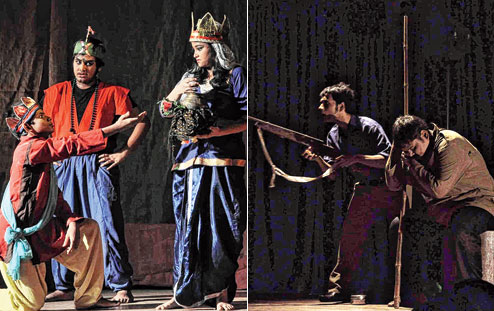
Scenes from Nagchampa (left) and Aborodh. Pictures by Anup Bhattacharya
Bijon Bhattacharya has inspired a number of theatre personalities but in Howrah most have not had the temerity to work on his plays or do any research on his works. On the birth centenary of this revolutionary playwright-director-actor, Natadha decided to pay tribute to Bijon Bhattacharya through some of his well-known plays and through discussions by theatre personalities. The three-day programme started from July 17, Bijon’s birth anniversary and continued till July 19 at Ramgopal Mancha.
“It is indeed a great effort by Natadha to organise a workshop on Bijon Bhattacharya when no other theatre group has yet done that. However, Bijon Bhattacharya was a playwright with a different vision who few people understand,” said Ashok Mukhopadhyay, the director of Theatre Workshop, who was present to speak about Bhattacharya on the last day of the festival. He also read a poem and an excerpt from one of Bhattacharya’s plays.
Other speakers of the evening included directors Chandan Sen, Debasish Majumdar, Soumitra Basu and Goutam Mukhopadhyay. “Few directors understood the villages of Bengal the way Bijon Bhattacharya did. Also, he had seen and felt revolutions, riots and destruction closely. Which is why there were magnified expressions of emotions in most of his scripts,” said Basu.
Portions of Bhattacharya’s plays like Nabanna, Aborodh, Hans Khali Hans and Nagchampa were enacted during the three days of the festival by members of Natadha.
“On the first day, we had staged a portion of Nabanna and Aborodh, which we had to re-stage on the last day on audience request. Because of inclement weather on July 17, many people could not come to watch the plays,” said Shib Mukhopadhyay, the director of Natadha.
“While the members of Natadha acted in all the plays, we had included actors from other groups as well in Nabanna. Subir Goswami from Bally Bidushak, Badal De from Samipesu and Chandrasekhar Ghosh from Trisha had acted in the play,” said Mukhopadhyay.
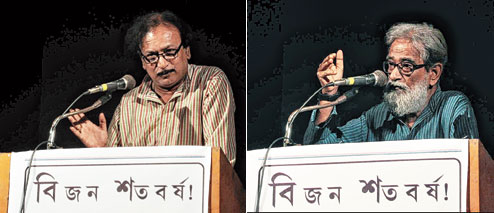
Meghnad Bhattacharya (Left) and Bibhash Chakraborty speak on Bijon Bhattacharya
School students were also involved in the festival. Students of different schools of Howrah had prepared short speeches on Bijon Bhattacharya, based on whatever information was provided to them. Students of Howrah Vivekananda Institution had even prepared a skit on the playwright.
Speakers like Shyamal Chakraborty, Kamal Saha, Kaushik Chattopadhyay, Bibhash Chakraborty and Meghnad Bhattacharya were invited to speak on Bijon Bhattacharya as well. An exhibition on Bijon’s life and works was on display at the entrance to Ramgopal Mancha.
source: http://www.telegraphindia.com / The Telegraph, Calcutta,India / Front Page> Howrah> Story / by Dalia Mukherjee / Friday – July 24th, 2015
A mighty fracas is raging between the descendants of Nawab Wajid Ali Shah in Calcutta and an Iranian woman who claims to be married to a scion of the Awadhi family. Hemchhaya De investigates the rumpus
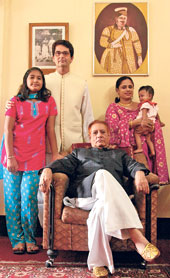
REGAL ROOTS: Shahebzade Wasif Mirza and his family pose before the portrait of Nawab Wajid Ali Shah;
A king-size portrait of Nawab Wajid Ali Shah will catch your eye the moment you step into the grand, old living room of Wasif Manzil on Talbagan Lane in Calcutta. “That’s my ancestor,” says Shahebzade Wasif Mirza, a dignified septuagenarian, pointing at the portrait — the pièce de resistance in a room bristling with Awadhi heirlooms.
“Satyajit Ray once asked me, ‘Why did the Nawab choose to move to Bengal after his kingdom was annexed?’ At that time, he had just made a film called Shatranj Ke Khiladi,” recalls the patriarch, a registered descendant of Wajid Ali Shah (1822-1887). “I told Ray that perhaps the Nawab felt he would get the respect he deserved only in Bengal.”
For Shahebzade Mirza, it’s a matter of family honour that he takes on what he calls “pretenders” to the Awadh legacy. In recent months, he has been fighting a fierce battle against Fay Ary, an Iranian woman who divides her time between Monaco, Paris and Dubai, and claims to have married a direct descendant of Nawab Wajid Ali Shah and his second wife Ronakara Begum.
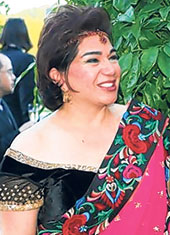
Fay Ary
But she refuses to disclose her late husband’s name for “fear of being drawn into family feuds.” Ary also wishes to do something for the underprivileged in India through her charity organisation, Royal Awadh Cultural and Heritage Foundation (RACH).
“All this sounds very nice. But she calls herself Her Royal Highness Princess Jehan Ara Fay Ary. I have the complete family tree and she figures nowhere. I’d like to know where her imaginary kingdom is located,” says Mirza. In a recent letter to the French ambassador to India, Jerome Bonnafont, he complained against Ary and RACH. “Our objection is to the use of our family’s name …for large monetary gains,” wrote Mirza.
Fay held a charity auction in Paris this May where her “personal collection of jewellery” went under the hammer. “We don’t know what she auctioned as her Awadhi legacy. And we don’t know where the proceeds are going,” says Ibrahim Ali Khan, a descendant of a 19th century Awadhi vizier, who heads the Royal Family of Awadh Foundation in Lucknow.
It all began a couple of years ago when Nawab Jafar Mir Abdullah — who reportedly claimed to be the Awadh rulers’ “direct descendant” — came under media glare. Abdullah, who’s on the RACH advisory committee, was accused of faking his nawabi heritage and arranging Awadhi banquets for foreign tourists in collusion with “unscrupulous” travel operators in Lucknow. It was also alleged that he charged tourists hundreds of dollars for banquets and mujras (dances) at his Lucknow home. His partner in this enterprise is said to be Prateek Hira, who heads a tour operating agency called Tornos India and is also associated with RACH.
Hira maintains that Khan and others have launched a malicious campaign to defame Ary, Abdullah and his agency. “Abdullah is well respected in Lucknow,” says Hira.
d in Lucknow,” says Hira.
_______________________________________________________________________ Dramatis personae
■ Shahebzade Wasif Mirza, descendant of Nawab Wajid Ali Shah (1822-1887) of Awadh (Oudh).
■ Fay Ary, an Iranian who claims to have married a direct descendant of Wajid Ali Shah and his second wife Ronakara Begum. Ary runs a charity, Royal Awadh Cultural and Heritage Foundation (RACH).
■ Ibrahim Ali Khan, a descendant of a 19th century Awadhi vizier, who heads the Awadh Royal Family Foundation in Lucknow. Does not support Ary.
■ Jafar Mir Abdullah, who is described as Wajid Ali Shah’s direct descendant and is on the RACH advisory committee.
■ Prateek Hira, who heads a tour operating agency called Tornos India and is associated with RACH.
Fay Ary gained some publicity in Lucknow around this time after announcing her charity projects. “She wants to do something for the poor — like arranging cleanliness drives in various Indian cities and providing slum dwellers with clean drinking water. She sought my help to implement the projects,” says Hira.
Ibrahim Ali Khan and others tried to blow the lid off what they called a “nexus” between Abdullah, Hira and Ary last year. “The issue was almost dying down when a freelance journalist from Delhi wrote to Hira and threatened action against his activities. He wrote to me as well,” says Khan.
Fay didn’t take it lying down. In an email dated June 29 this year, she wrote to her friends in Lucknow, Dubai and Paris, “A very nasty activity is being undertaken …(by a journalist)… for want of some money to sustain himself …ignore this man who keeps changing his name to fool people.”
Speaking from Paris, Ary expresses her “anguish and disappointment” over the “concerted efforts to pull down RACH.” “I claim nothing from the Indian government or from the Awadh families. I auctioned my own jewellery in Paris. I am hankering after no title. All I wanted to say to these people was that I had the resources to do some good work in India,” says Ary.
She wants to start her “slum cleanliness drive projects” in early October. She will also host a gala event in Dubai this November to seek support for her charity work. “People who claim to be true nawabs in India should stop bickering and do something for their country.
There seems to be another point of clash between Ary and Shahebzade Mirza. Ary told the media last year that she would renovate Nawab Wajid Ali Shah’s mother’s grave in the Père Lachaise cemetery in Paris. The Nawab’s mother, Aliya Begum, went to England to plead with Queen Victoria for returning Awadh to her son. On her way back, she fell ill and died in Paris in 1856 and was buried in Père Lachaise. Ary wants to project her grave as a site of historical significance.
The Shahebzade Mirza family, on the other hand, wants to rectify an inscription near the grave which says that her son Wajid Ali Shah was killed by British forces in 1856. “The Nawab died of natural causes in 1887. We have written to the French consulate in Calcutta to do something about it,” says Mirza. A spokesperson from the French consulate, who prefers not to be identified, confirmed receiving the letter.
“I accompanied Fay to the Paris cemetery this year. She is planning a renovation,” says Abdullah, the controversial ‘nawab’ who refutes all allegations against himself. “She doesn’t lay any claim to the Awadh royalty. She is herself related to Farah Diba Pahalvi, the queen of the last Shah of Iran who ruled till 1979.”
Abdullah also goes on to say that he will go on hosting banquets for tourists in order to interact with people and entertain them. “I tour the world and get invited by top officials. I will also continue to be part of RACH and the commendable work it does,” says Abdullah. “I never claimed to be a descendant of Wajid Ali.”
Agrees Rosie Llewellyn-Jones, a British scholar who’s writing a biography of Wajid Ali Shah. “Abdullah does not really claim descent from Wajid Ali Shah, but from Nawab Mohammed Ali Shah, who ruled Awadh from 1837 to 1842,” she says. She adds that it’s important to remember that “Wajid Ali Shah’s descendants are not the only descendants of the royal family of Awadh.”
“Each Nawab, from the time of Asaf-ud-daula (1775 to 1797), had a number of wives, and inevitably, a large number of children and grandchildren. These people are also descendants of the Awadh royal family. On Wajid Ali Shah’s death he left about 45 sons, and a larger number of daughters, and the descendants of these sons and daughters can obviously claim direct descent from him.” On Ary, she says that unless she is prepared to reveal her husband’s name “we can’t really check out her claim.”
Indian historian Ravi Bhatt, who penned a book called The Life and Times of the Nawabs of Lucknow, begs to differ. “Just as Nagpur is famous for oranges and Benaras for silk, Lucknow is known for its nawabs,” says Bhatt. “Every Tom, Dick or Harry calls himself a nawab these days. But let me tell you there is no descendant of the Awadh royal family in Lucknow now,” says Bhatt.
Meanwhile, Shahebzade Mirza is gearing up for the next round of battle. “We hope the French government will act on our complaint against Ary. The war is far from over.”
source: http://www.telegraphindia.com / The Telegraph, Calcutta,India / Front Page> 7 Days> Story / Sunday – August 23rd, 2009
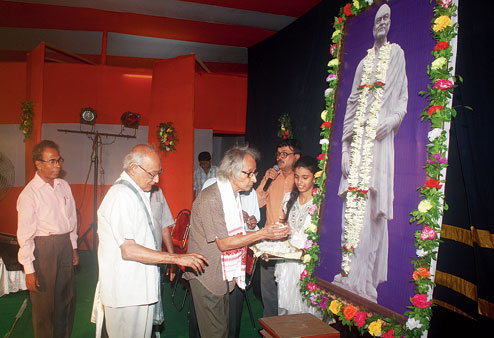
Author Sanjib Chattopadhyay offers floral tribute to a portrait of Dr Bidhan Chandra Roy at Bidhan Sishu Udyan as cartoonist Chandi Lahiri looks on
“Dr Roy was a rare combination of talent, personality and power. His upright gait and towering figure inspired awe in people. All officials were scared of him as he understood administrative matters inside out,” recalled author Sanjib Chattopadhyay, reminiscing about Bengal’s visionary chief minister. He was speaking at a programme organised on July 1 at Bidhan Sishu Udyan in Ultadanga.
Dr Roy was a friend of Chattopadhyay’s grandfather Swarup Bandyopadhyay who was a well-known doctor as well. Dr Roy did a lot of election work from his house while contesting from Barrackpore. “When I joined the cottage and small scale industries department as a 25-year-old, senior officials would send me to his house with the files, not daring to face him themselves. Dr Roy was a miracle worker as a doctor. He used to say that he could see, feel and smell a disease as the patient walked into his chamber.”
Chattopadhyay recalled his father’s colleague going to Dr Roy with a complaint of his head spinning every time he got off the bed. “Treatments for vertigo and spondylosis had failed. The man was about to lose his job due to continuing illness. Dr Roy saw him on my request and simply wrote ‘Reverse your head’ on the prescription. His family thought it was a rude joke. When I went back for an explanation, he said the man was surely sleeping with his head to the north and feet to the south and therefore was acting like a needle to the earth’s magnetic field. He changed his sleeping posture and in three days was fully fit!”
Educationist D.K. Sinha talked of Roy’s contribution as an administrator. “He used his proximity with Prime Minister Jawaharlal Nehru to expedite Bengal’s growth.”
Tagore’s Tasher Desh was staged in chhou dance style.
source: http://www.telegraphindia.com / The Telegraph, Calcutta, India / by A Staff Reporter / Friday – July 10th, 2015
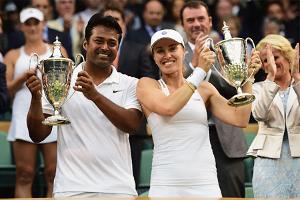
Leander Paes with his Swiss partner Martina Hingis won the mixed doubles title at Wimbledon. (Getty Image)
London :
A vintage Leander Paes clinched his 16th Grand Slam trophy, winning the mixed doubles event of the Wimbledon Championship with legendary Martina Hingis after a dominating win over Alexander Peya and Timea Babos, here today.
Seventh seed Indo-Swiss pair drubbed the fifth seed Austrian-Hungarian team 6-1 6-1 in the lop-sided summit clash which was over in just 40 minutes.
It was Paes’ eighth mixed doubles title and second with Hingis. They had won the Australian Open early this year.
42-year-old Paes has eight men’s doubles crowns in his Grand Slam collection.
Paes’ win capped an incredibly successful Wimbledon for India as the country took three titles this year. Sania Mirza won the women’s doubles and Saumit Nagal won the junior boys doubles trophy.
For Hingis, it was second title in as many days, having won the women’s doubles with Sania. Overall it was 18th Major title for the Swiss and third in mixed doubles.
Hingis was back on court less than 24 hours after that win with Sania but showed no sign of fatigue. She served well and was terrific at the net, complementing the Indian Pro.
Paes and Hingis literally toyed with Peya and Babos, who surprisingly failed to put any resistance.
In no time Paes and Hingis pocketed the first set as all they needed was 19 minutes to nose ahead. Two broke Babos in the fourth game and Peya in the sixth for a 5-1 cushion. Hingis served out the set when Paes smashed a volley winner.
Paes and Hingis kept the pressure on the Austrian- American combination right from the first game of the second set. Peya failed to negotiate a Paes return at deuce to hand the seventh seeds grabbed the opportunity to break them.
Babos’ could not handle a Hingis return and the Indo- Swiss pair got an early break. There was no stopping them from there as they raced to victory in less than one hour.
Babos failed to hold her serve even once and it was on her return that Paes hit a deft backhand volley winner to close the contest.
source: http://www.timesofindia.indiatimes.com / The Times of India / Home> Sports> Tennis> Wimbledon 2015 / by PTI / July 12th, 2015