Nadia royal family bears Puja torch since Akbar era
Krishnanagar :
Illuminated by earthen lamps and torches (mashals), the idol of Ma Raj Rajeshwari looks resplendent in the Akbar-era Natmandir at the Krishnagar Maharaja’s palace.
The serenity is suddenly shattered by the town crier’s shrill call: “Attention! Agnihotri Bajpeyi Raj Rajendro Maharajadhiraj Nabadwipadhipati Mahashaya Krishno Chandro Roy Bahadur is arriving.”
On cue, 108 dhakis beat drums to frenzy.
The Maharaj arrives in an elaborately carved silver palanquin that was gifted to one of his forefathers by Emperor Jahangir. He approaches the pulpit. Shortly thereafter, the palace cannon booms, a signal for the beginning of sandhi puja. A hundred and eight buffaloes are assembled before the Goddess. At shandhikshan, the heads are severed and placed before the Goddess as offering to cleanse the human spirit of its evils. “As a child, I grew up watching these rituals being performed while sitting on my grandmother Maharani Jyotirmoyee Debi’s lap. Growing up, I always held a grudge against Ma Raj Rajeshwari. How could the divine mother, the supreme protector of good and the destroyer of evil, devour so many harmless, helpless lives? I would often bring this up with my father. Being a God-fearing man, he would stick to tradition till the resistance melted away when he saw my infant son Manish crying on witnessing the sacrifice.The practice was stopped in 1987,” said Saumish Chandra Roy , the 39th descendant of Nadia royal family .
Nadia Rajbari’s Durga Puja remains the oldest puja in what was then Anga-Banga-Kalinga or undivided eastern India region. Started in 1603 by Maharaj Rudra Rai, the great grandfather of Krishno Chandro, it has continued uninterrupted till date. “The puja began two years before the death of Emperor Akbar. Since it all happened at the height of the Mughal era, the influence is very strong in the architecture of the natmandir,” said Saumish’s son Manish. However, though the gran deur of celebrations have shrunk over the centuries, the rituals have remained intact.
Ma Raj Rajeshwari has seen Nadia during the most tumultuous of times.In medieval India, persecution and heinous tyranny on the grounds of religion was common.
Blood was spilt for the protection and defense of Nadia’s “honour”, for the protection of the freedom to choose and profess the religion of our choice.”Jato dharma Stato jayo” (Stay in the path of good dharma and victory will be yours) is embedded in the Krishna gar royal family’s coat of arms.
Ma Raj Rajeshwari’s power was tested during Partition. Nadia had initially been ceded to what was then East Pakistan on grounds of religion. “For three nightmarish days, we were Pakistanis. My father Saurish Chandra Roy , the last officially recognized maharaja, had told Sir Cyril Radcliffe (the chairman of the Boundary Commission in British India) that if Nabadwip was lost to Pakistan, then what would remain of the great Hindu faith in the Anga-Banga-Kalinga region?
After three days of rioting, rape and arson, a significant portion of Nadia was returned back to India. The entire population went wild with joy when the news was broadcast over All India Radio. People arrived in trucks from far and wide and assembled in front of the palace gates, shouting ecstatically “Ma Raj Rajeshwari’r Jai!” Though the princely order was abolished by former Prime Minister Indira Gandhi, some royal customs are still followed. The Maharaj was believed to be the protector of his people.Accordingly a clay model of a “shatru”, symbolizing evil, is created which is slain by the Maharaj every year during the Durga Puja. Saumish does the slaying now.
source: http://www.timesofindia.indiatimes.com / The Times of India / News Home> City> Kolkata / by Subhro Niyogi, TNN / October 19th, 2015
18
17
16
An evening to remember for Pele
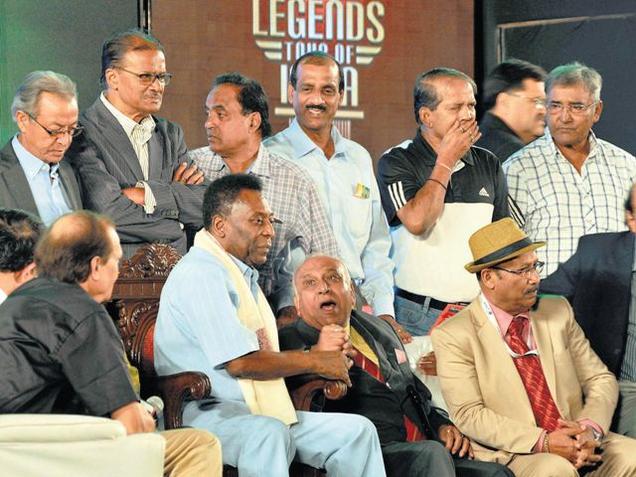
Felicitates the 1977 Mohun Bagan team, shares special moment with Rahman
Football legend Pele had an evening to remember as he renewed his acquaintance with the players of the Mohun Bagan team which hosted him in 1977.
Pele feted all the 13 players and coach P.K. Banerjee who were present to receive the honour from the greatest footballer on earth at the Netaji Indoor Stadium on Monday evening. Subrata Bhattacharya, the captain of the Bagan side then, called in his players to be felicitated by the owner of three World Cup crowns. The others players included the likes of Shibaji Banerjee, Prasoon Banerjee, Gautam Sarkar, Bidesh Bose, Shyam Thapa, and Pradip Choudhury.
Prasoon, the younger brother of P.K. Banerjee, asked Pele who he thought was better: Diego Maradona or Lionel Messi? “Both have the same style and are great players, but Maradona was a more complete player than Messi. For the last 10 years, Messi is the best player the world has seen,” said Pele.
Machine closed!
Asked whether the world would see another Pele, the legend quipped, “My mother and father have closed the machine.”
Pele also had a special moment with internationally-acclaimed music composer A.R. Rahman, who has scored the music for a biopic on the Brazilian great which is yet to be released.
“I am zero on sport, and know only names like Kapil Dev and Sachin Tendulkar. I have composed the music for Pele’s biopic without even knowing him. But, when I saw the ‘rushes’ of the movie, I cried thrice,” said Rahman, after meeting the legend.
“I wanted to see the real Pele. He is such an amazing personality, a great inspiration. All my musician friends were envious when they came to know that I was doing the music for Pele’s biopic,” said Rahman.
Rahman sang ‘happy birthday’ for Pele, who turns 75 on October 23. The Brazilian also cut a cake, shaped like the Jules Rimet Trophy, which he helped Brazil retain forever after becoming the world champion for the third time in 1970.
West Bengal Chief Minister Mamata Banerjee and former India cricket captain Sourav Ganguly were present on the occasion.
source: http://www.thehindu.com / The Hindu / Home> Sport> Football / by Amitabha Das Sharma / Kolkata – October 13th, 2015
Young entrepreneurs in Kolkata float startup ideas over boat ride
Kolkata :
Entrepreneurship is the last thing that comes to our mind while taking a rooftop boat ride. However, on Saturday evening, a boat packed with young entrepreneurs did just that, pitching their startup ideas to investors on a cruise along the Ganges. For many, it turned out to be a smooth sailing, with their ideas being appreciated, endorsed and taken up for funding by investors.
In a first of its kind, Nasscom’s startup wing 10,000 Startups joined hands with Catapooolt, India’s first industry-backed crowd funding platform, to organize a platform on which various startups from across the country pitched their ideas to investors, who assessed them and extended funds on the spot.
Just as the boat left the dock, the 10 startups that were selected, started pitching their ideas. Paritosh Sharma, head of channel partnerships of PayUmoney, said, ” This live crowd-funding pitch at Kolkata is India’s first. Catapooolt, PayUmoney and Nasscom 10K Startups have collaborated with a mission to build India’s largest growth ecosystem for startups and small and medium enterprises (SMEs). And the same happening while taking a boat ride makes it even more interesting.”
The idea was to present every member with a booklet which had five coupons worth Rs 100. Whoever would want to invest in a specific startup based on their presentation would write down it’s name and place it inside a ballot box. In the end, a counting was done and a winner selected.
Ravi Ranjan, the warehouse manager of 10,000 startups, said, “This would support startups to validate their ideas with crowd and initially get small but significant money.”
Fading Clouds, a startup, co-founded by 2008 Satyajit Ray Film and Television Institute(SRFTI) pass outs Sumon Majumder and Mrimoy Mondal, showcased their independent film sharing the same name. The movie centres around the loneliness of urban life, due to the over use of technology and how as a result, people are losing out on the family bonding.
Satish Kataria, managing director of Catapoolt said, “We are pleased to have organised India’s first ever live crowdfunding pitch event in Kolkata. We endeavour to make innovation accessible to all through crowdfunding and wish to inspire everyone to contribute and engage with new ideas.”
“While Kolkata had been slightly late in catching up with start up movement, we hope that with such concepts, the people here can leapfrog to new ways of funding ideas and together, put the city, sky high on Innovation map,” he added.
source: http://www.timesofindia.indiatimes.com / The Times of India / News Home> City> Kolkata / by Abhro Banerjee, TNN / October 12th, 2015
13
Calcuttan is kettlebell champ – 29-year-old gets top rank at Asian meet in Bangkok
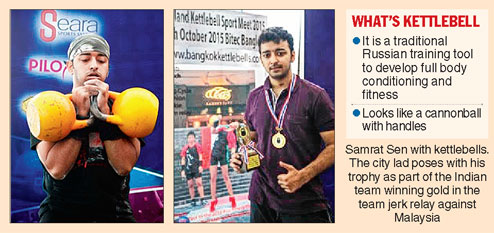
He is an expert in the long cycle category and he had 10 minutes to prove his strength. Beside him was a man ready to snatch. But the Calcutta boy came back with top billing and international prestige.
No, he is not a cyclist or a rugby player, nor was someone trying to grab something from him.
Meet 29-year-old MNC employee Samrat Sen who got the top ranking at the Thailand Kettlebell Meet (long cycle category) on October 10.
The annual event was held as part of Asia Fitness Convention at the Bangkok International Trade and Exhibition Centre.
Participants from nine countries tested their strength at the self-sponsored event, sanctioned by the International Kettlebell and Fitness Federation (IKFF).
The Indian contingent of six did the country proud by winning the team jerk relay against Malaysia. Sen was part of it.
“This is the first time India won a gold in kettlebell relay abroad. In a relay, the four best lifters of each country lift double kettlebells (2 x16kg) for three minutes each for a total of 12 minutes,” he said.
“India and Malaysia were head-to-head but towards the end we edged past them in a thrilling victory.”
A resident of east Calcutta, off the EM Bypass, Sen is happy to have gained international recognition for a sport that very few know of in the city, except those who are into fitness and weight training.
Kettlebell is a weight-training programme where you have to lift cannonball-like equipment as many times (repetitions) as possible in a minimum of 10 minutes.
Sen clocked 85 reps with double 16kg kettlebells. The feat secured him the top seed in the IKFF rankings.
“In Thailand, one could compete under the long cycle (clean and jerk), snatch (one bell), jerk (two bells) and biathlon (a combination of jerk and snatch) categories,” Sen told Metro over the phone from Bangkok.
“Lifters, of every category, stood side by side and put their strength and endurance to test for 10 minutes. But there is a catch – for those 10 minutes you cannot keep the kettlebells on the ground. You have to hold on to them and keep doing the reps. It is also a test of mental strength and focus.”
The Calcutta lifter, who has never compromised with his weight training despite work pressure, said the competition was not just about appearing on stage and lifting the kettlebells. “It is also about how you lift them. One needs to follow the right technique and pacing and have tremendous cardiovascular fitness to succeed in this sport,” he said.
What started as a fitness regimen in 2012 soon turned into a passion for Sen. “I took up kettlebell training to improve my fitness levels, not to compete. I found it difficult to lift them even a few times, leave alone holding on to them for 10 minutes,” he said.
“But I would keep surfing online about the discipline… I came across international lifters who would lift the heaviest of kettlebells with absolute ease and clocked ridiculous number of reps in 10 minutes, hardly breaking into a sweat. That motivated me… with my coach Arnav Sarkar egging me on, I soon took up the sport seriously.”
What followed was one gruelling session of practice after another to make Sen “competition ready” – a disciplined life and a strict diet with little leisure or fun time.
“I do not go to a gym, but I train every day after returning from work. It’s extremely challenging after a stressful day… but once I get started, I know I will complete the whole routine.”
Sen allows himself to cheat once a week with some ice cream, cold drinks, a plate of tandoori chicken or a Chinese meal.
A kettlebell is a traditional Russian training tool that is used to develop full body conditioning and fitness. The first-ever Kettlebell meet in India was held in Calcutta at the Calcutta Rowing Club in 2013. It had only 15 participants. By February 2015, the Calcutta meet saw a surge in lifters with 30 putting their strength to test.
“The kettlebell sport community is a small but extremely tight-knit one… with lot of support and encouragement for new lifters,” Sen said.
My message for Samrat Sen is…. Tellttmetro@abpmail.com
source: http://www.telegraphindia.com / The Telegraph, Calcutta,India / Front Page> Calcutta> Story / by Chandreyee Ghose / Monday – October 12th, 2015
Reviving an 800-yr-old art
Kolkata :
Among the stories of torture, loot and oppression that the British left behind for us, one of the most common is that of how the thumbs of muslin weavers from Bengal were chopped off to wipe out the ancient art form from the face of the country. Muslin has since then been an item only to be seen in museums across the world.
A fine cotton textile making art that originated in India in the ancient times, with the maximum concentration in Bengal, and proliferated under Mughal patronage since the 17th century, muslin died an unnatural death when the British decided to smother it so that they can bring in their own mill-made textiles from Manchester to India.
Recently, the West Bengal chapter of Crafts Council of India has taken up a project to revive the art of muslin making. It started in 2010 and now weavers who were being re-skilled for producing muslin, have finally been able to reach an enviable thread count of 500.
After the Mamata Banerjee government came into power, the state micro, small and medium enterprises department also started thinking on how the fine textile making art can be revived in Bengal. The MSME department scouted for experts in villages across five districts of the state where muslin used to be produced traditionally. In this manner, some 793 weavers’ families were chosen from Birbhum, Murshidabad, Nadia, Bankura, West Misnapur and Burdwan, who had all been connected with muslin making some generations ago. The state government encouraged them to take to the art once again.
When the thread count reached 300 last year, muslin made by weavers under MSME made its way to the government’s Biswa Bangla Haat. MSME department is trying its best to increase the count further because the higher the count, the better is the quality of muslin.
During the time of the Mughals, muslin weavers from Dhaka were able to reach a count of 1500. Samples of these are available in museums across the world. A 500 count means that the two threads crisscross each other to create a mesh 500 times in the span of a square inch. “It all started quite by an accident. An American advertising honcho, Anne Johnson, had visited us with inquiries about muslin and whether any efforts were being made to revive it. She was fascinated with muslin and was even prepared to fund it if we took up a revival project, which we eventually did at a cost of Rs 70 lakh,” said Ruby Pal Chowdhury, who heads the Crafts Council of India here.
The Crafts Council project took place in Kalna, where master weavers, who are otherwise associated with the production of khadi yards under the aegis of the Khadi and Village Industries Commission (KVIC) of the central government and West Bengal Khadi Board (WBKB), kept experimenting with spinning of the yarn with the right thickness out of cotton sourced from Gujarat.
“Once the yarn is spun, it has to be soaked in starch made of kolma or dohor nagra varieties of rice. The water used is essentially rain water to keep the solution soft. There is no formula for this, these are part of family knowledge that are being gradually recalled through re-skilling,” said Pal Chowdhury.
The weavers of the council have not only been able to weave muslin yards but also entwine antique jamdani motifs in it. These have been christened as muslin jamdani and a pure saree woven thus costs nothing less than Rs 20,000. These creations are now available for viewing at Artisana, the council’s outfit at Chowringhee Terrace, while a mega debut is also being planned.
Considering the huge expense that such revival incurs, the council is also trying to tie up with Biswa Bangla to take the revival issue a step forward.
“We would welcome this because the final aim is to bring back muslin to its original glory. That will be possible only if we are able to keep giving incentives to weavers to sacrifice other commercial interests and concentrate on spinning finer yarns and then weaving finer counts,” said Sinha.
source: http://www.timesofindia.indiatimes.com / The Times of India / News Home> City> Kolkata / by Jhimli Mukherjee Pandey , TNN / October 11th, 2015