28
Kolkata: Award for the best among equals
Kolkata :
On Panchami, celebrities and who’s who of the corporate world came together to name the winners of Ultra Force Premium presents Times Sharod Srestho 2015 (TSS), a contest to choose the best among the most popular pujas in Kolkata and Salt Lake.
The contest was powered by UCO Bank and jewellery partner Senco Gold & Diamonds; with associate sponsors Smithcucina Infracooka Super Cooktop and National Insurance Company, welfare partner Lions Club and co-sponsors LIC Housing Finance Ltd and CII Surakshit Khadya Abhiyan.
In its ninth edition, the initial two rounds of judging were carried out by Art College professors on the basis of parameters, such as best music, best theme and best surprise element. The final round of judging on Sunday saw celebrity judges —actors Abir Chatterjee, Swastika Mukherjee, Pauli Dam, Sonalee Choudhury, Rajatava Dutta, Anindya Chatterjee, Ritabhori Chakraborty, Priyanka Pal, Roja Paromita Dey designer Debarun Mukherjee, photographer Supratik Chatterjee, make-up artist Annirudh Chaklader, cinematographer Soumik Haldar, art director Koushik Dutta and director Sekhar Das—select the winners from among the shortlisted names, for different categories such as the best puja, best idol and jewellery. Ajeya Sanghati (Haridevpur), Behala Friends and Suruchi Sangha (New Alipore) bagged the Srestho Pujos.
“This is my fourth year with TSS. It’s fun to travel with friends and colleagues as we get to see the pujas in such a comfortable manner,” said Swastika. Director Sekhar Das said, “It was lovely to be associated with Times Sharod Srestho. An overall nice experience.”
For Pauli, it was a unique get-together, replete with adda, snacks and the opportunity to see some of the best pandals. “That is why I make it a point to keep myself free for this event every year,” she said. “I am thankful to The Times of India for giving me this opportunity to visit the best pujas and pandals,” said Abir.
Kuntal Chatterjee, COO, IMFL (Ultra Force Premium), Rajiv Mohan of UCO Bank, Suraj Prakash Gupta of Smithcucina Infracooka, Lion Swapan Bhattacharya, Lion Kishan Podar, Lion Mahendra Jain and Lion Hemant Marda, Ashim Bhuyan of LICHFL, Sarbani Pal of Senco Gold & Diamonds, R K Sahu of National Insurance Company, Indrani Ghosh and Subrata Banerjee of CII were also among the panel of judges.
source: http://www.timesofindia.indiatimes.com / The Times of India / News Home> City> Kolkata / TNN / October 20th, 2015
27
26
25
24
With a perfect eye
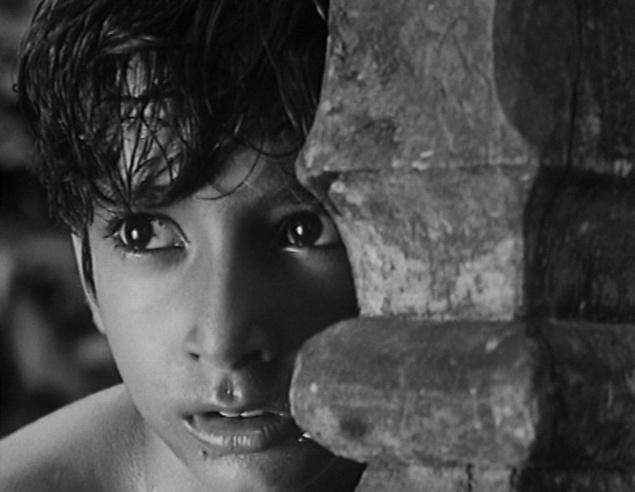
The man responsible for the distinct visual vocabulary of “Pather Panchali”, has unfortunately been forgotten.
Subrata Mitra was an observer of Jean Renoir when he was shooting The River at Kolkata in the late 40s. It was at this juncture he came across Satyajit Ray who was also a keen Renoir observer. Both struck a creative chord and agreed to work together.
No wonder when Satyajit Ray made his debut as a writer-director with Pather Panchali, he had Mitra as his cinematographer. The teaming of Ray, Mitra Ravi Shankar, Dulal Dutta and Banshi Chandra Gupta was perhaps the greatest combination in Indian cinema. With a Michele camera, Mitra created wonders in Pather Panchali. The incomparable use of natural light during the monsoon rains, shots of the kash flowers and a running train in the distance created cinematographic magic. Mitra won a National Award for his camera work in Pather Panchali.
By the time Aparajito went on floors, the Arriflex camera had arrived in the cinematic world. Mitra made superb usage of bounce lighting during the indoor shots in Aparajito. Prior to Aparajito, bounce lighting was unknown to Indian cinema. Even the iconic Ingmar Bergman made use of this technique years later in Through A Glass Darkly.
Mitra can best be described as the perfect cinematic eye of Satyajit Ray. So well did he understand Ray’s thoughts, imagination and visualisation that his camera interpretation of them was sans any flaws. Apur Sansar, Jalshaghar, Devi, Teen Kanya and all Ray films bore the masterly Mitra stamp of cinematography. When Ray decided to shoot Kanchenjungha in colour, it was a challenge for Mitra. Without opting for too many special effects or cinematographic jugglery, he used close-ups to capture the panorama of the Himalayas. The montages were lyrical. The first ever freeze shot in Indian cinema was used to perfection by Subrata Mitra in Charulata.
After Nayak in 1966, Ray and Mitra parted ways. It was mainly due to creative and not egoistic differences. Mitra believed in certain visions which did not gel with Ray’s.
They drifted apart with dignity never criticising each other in public. Ray’s films after Nayak lacked the genius of Mitra’s cinematography. Mitra sans Ray was also not at his altruistic best. One of Indian cinema’s greatest tragedies.
James Ivory and Ismail Merchant worked with Mitra very well in Householder, Shakespearewala, Bombay Talkies and The Guru. In Householder, Mitra used tight close-ups of Shashi Kapoor and Leela Naidu, five in quick successions creating visual poetry. Raj Kapoor made sure Mitra cinematographed Teesri Kasam for Basu Bhattacharya. The shot of the train through a hole in Hiraman’s (Raj Kapoor) cart shot without a tilt still haunts.
The genius took a sabbatical from cinematography in mid 70s. He returned in 1986 to shoot Ramesh Sharma’s New Delhi Times. The shot of Shashi Kapoor running in a dream sequence as his newspaper office burns remains a lesson in cinematography.
Mitra spent his last years teaching cinematography at SRFTII, Kolkata. He was an expert of monochrome and favoured soft colours compared to stark ones. He considered Saath Pake Bandha, Dakhal and Drishti truly well-lit films.
As Pather Panchali is completing 60 years Pather Panchali it is sad that the camera architect of the classic has been forgotten. Mitra still is an idol for any aspiring cinematographers.
source: http://www.thehindu.com / The Hindu / Home> Features> Friday Review / by Ranjan DasGupta / October 22nd, 2015
This is how Calcutta will become London?
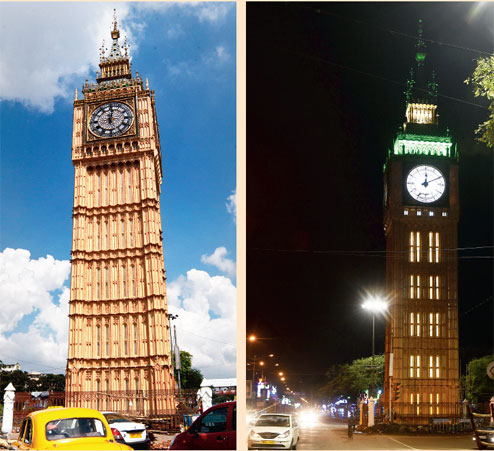
A replica of Big Ben, the famous clock tower of London, has come up at the Lake Town crossing on VIP Road. The 135ft-tall structure, however, falls far short of the original, which towers at 314ft.
The replica, designed by artist Sunil Chandra Pal, is made of concrete and has a fibre casing. Work on the structure had started in December.
Big Ben is the nickname of the Great Bell of the clock at the north end of the Palace of Westminster in London. Like the original, the replica will ring every hour, but the sound will not be produced by a bell like that in the London tower. Instead, a recorded sound will play from a speaker.
South Dum Dum Municipality spent over Rs 1 crore to build the clock tower.
Architect Partha Ranjan Das said the replica looked good but the money should have been spent on building something original.
“If they were so interested in making a tower’s replica, they could have chosen from Gour-Pandua (in Malda). There are many towers there,” he said.
source: http://www.telegraphindia.com / The Telegraph, Calcutta,India / Front Page> Calcutta> Story / picture by Amit Datta / Monday – October 19th, 2015