21
20
19
19
18
17
16
Part of history for eight centuries, Sen Dighi faces extinction threat
Kolkata:
Its rippling waters tell many a tale and history – dating back to the 12th century. Possibly the oldest waterbody in south Bengal, Sen Dighi in Boral on the southern fringes of Kolkata has survived centuries of negligence, contamination and encroachment. It has seen change of rule, dynasties, eras and witnessed the metamorphosis of the region from a marsh-infested forest land to a thriving habitat. While more than half the waterbodies in the area have vanished and an expanding city has consumed wetlands, Sen Dighi has existed for an incredible 800 years. The 23-bigha pond, a heritage waterbody, now faces a challenge from immersion-induced pollution and its fragile banks are steadily being eaten into by garbage dumps.
A study of its water revealed that the biological oxygen demand of Sen Dighi is high. The water quality has taken a beating ever since the pond was thrown open to immersions and Chhat festivities, according to locals and experts. Even though idols are removed quickly, the residue is enough to affect the water, they say. Perhaps, a bigger threat to the pond is posed by the eroding banks, made unsteady by devotees who have been clearing vegetation along the edges during Chhat. It has led to the uprooting of two trees and another has been left unsteady. These trees are crucial to the survival of Sen Dighi since they have been holding the banks together.
“Over the years, much of Sen Dighi has been lost through encroachment. It is important to protect the pond from pollution and infringement since it is part of our history. We must ensure that Sen Dighi retains its size and its water remains unpolluted,” said Dipayan Dey, chairman of SAFE, a green NGO that is now studying the pond’s water quality.
Around 20 km from Kolkata, Sen Dighi was dug by Ballal Sen, the second ruler of Bengal’s Sen dynasty, in the late 12th century. It must have measured close to a hundred bighas then and was the principal source of water for a large swathe of area to the south of Kolkata, according to Madhu Basu, who has chronicled the history of Sen Dighi. “The city didn’t exist then and it was a practice to dig huge waterbodies that would be taken care of by locals. Almost every house had a tank attached to it. But Sen Dighi stood out due to its size and the fact that it was maintained by the local Tripura Sundari temple that still survives. It is one of the last symbols of the region’s past prosperity,” said Basu, who runs an NGO called Economic Rural Development Society (ERDS).
Over the years, numerous archaeological relics of the Gupta, Maurya, Pala and Sen dynasties have been excavated from Sen Dighi and the areas around it. In the mid-Eighties, Sen Dighi was dried up and cleansed by ERDS. A local body of businessmen took the pond on lease for pisciculture. A part of the money earned from the lease goes to the Tripura Sundari trust. “We dug up numerous relics from the pond. They are now conserved at the Tripura Sundari temple, Ashutosh Museum and a few other places. That was the last time the pond was cleaned,” said Basu, who has penned a book on the history of Boral titled ‘Itihasher Darpane: Boral’.
Locals, on the other hand, pointed out that Sen Dighi is diminishing in size, bit by bit. Documents held by the Tripura Sundari trust mentions the size of the pond as 45 bighas. Less than half of it remains. “Immersions have led to the felling of trees and litter has filled up a portion along the northern bank. If this continues, the pond will get further reduced in size,” said a member of the local Boral Parliament Club that helps the temple trust in maintaining the pond. Basu, who is a resident of Boral, agreed. “Encroachments have always been a threat. With real estate activity being brisk in the area, the future is uncertain for Sen Dighi,” he said.
Till a hundred years ago, the pond would be surrounded by brick kilns. Legend has it that a trader named Maheshwar Shau from Odisha had introduced fish cultivation at Sen Dighi. “Locals got jealous of him and he was killed and thrown into the pond. For many years, people would keep away from Sen Dighi and believed it was haunted,” said Basu.
Green actvists believe immersions should be stopped and Sen Dighi should be cleaned to save it. “If it has to survive, Sen Dighi shouldn’t be used for bathing or washing. Once the water has been cleaned, a pump could be used to pull out water, which can then be used by locals. It would be a shame if Sen Dighi degenerates into a stinking pool like so many around it already have,” said environmentalist AK Ghosh.
source: http://www.timesofindia.indiatimes.com / The Times of India / News Home> City> Kolkata / by Prithvijit Mitra / TNN / February 10th, 2016
In Calcutta, from trick to truth
New Delhi :
Anuradha Samajdar, a research scholar in Calcutta, initially thought the first email alert she received about a possible gravitational wave signal was a “blind injection”, the community jargon for a simulation, a trick to test the integrity of the data analysis process.
The email was from Marco Drago, a scientist at the Max Planck Institute for Gravitational Physics, Hannover, Germany, telling a global consortium of physicists that two giant instruments on Earth had sensed (for just a fleeting one-fifth of a second) a signal.
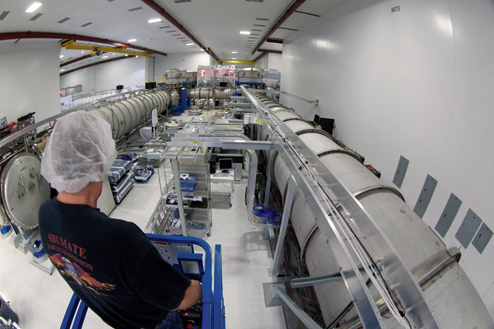
The arrays of lasers, mirrors and control electronics that make up the detectors of the Laser Interferometer Gravitational Wave Observatory (Ligo), located 3,000km apart in the US, had recorded what appeared to be ripples in space-time – possibly the first direct observation of gravitational waves.
It would be up to the data analysis groups scattered across the world, including in Bangalore, Calcutta, Gandhinagar, Pune and Thiruvananthapuram, to determine that they were genuine effects of gravitational waves – and not just noise from the cosmos masquerading as gravitational waves.
“I had heard about blind injections – where a very select few senior scientists release signals and data analysis teams work on them only to be told later that this was a test,” said Samajdar, a scholar working towards her PhD at the Indian Institute of Science Education and Research, Calcutta.
Drago, an Italian and a member of the Ligo consortium, was among the first scientists to be alerted that something interesting had been turned up by an automatic “pipeline” that scans and filters the signals picked up by the detectors.
Shortly before noon on September 14, Drago received the automated pipeline alert. “The signal was so nice, so perfect, it looked like it was coming from a binary (a pair of objects),” Drago told The Telegraph .
After telephone consultations with colleagues, he sent out the alert to the 900-odd consortium members.
Samajdar and physicist Rajesh Nayak at IISER were among scientists in India analysing the signals, trying to determine whether the patterns of ripples observed indeed matched theoretical predictions of what patterns would look like, depending on the source of the gravitational waves.
Nayak, a faculty member at the IISER department of physical sciences, said: “We first match the detected signal pattern with the theoretical predicted pattern, if there is a match, we try and use the signal to estimate various parameters of the source event.”
Supervised by Nayak, Samajdar, who graduated in physics from the Lady Brabourne College, Calcutta, before joining IISER’s integrated PhD programme, while still a bit sceptical about the nature of the signal, began the process of extracting information about the source.
“We began to calculate the masses of the (merging) black holes, their distance – and our estimates were similar to what others in the consortium were reporting,” Samajdar said. “We told ourselves noise wouldn’t give us such nice outputs – that’s when I wondered ‘is this really the big thing’?”
Scientists at the Inter-University Centre for Astronomy and Astrophysics, Pune, the Indian Institute of Technology, Gandhinagar, IISER, Thiruvananthapuram, and the International Centre for Theoretical Sciences, Bangalore, also played key roles in the data analysis.
The multiple efforts across the consortium converged on the same results – the signal had emerged from (the merger of two black holes) a distant part of the universe, perhaps a galaxy.
Physicists are celebrating the discovery for multiple reasons.
“This is an example of big science supported by big engineering,” said Dibyendu Nandi, a physicist at IISER, Calcutta, and head of the Centre for Excellence in Space Sciences, India, a facility supported by the Union human resources development ministry.
The Ligo detectors are marvels of engineering precision, designed to detect ripples or displacements in space billionths of the width of an atom using laser beams that are bounced off mirrors after travelling along two arms of the instrument, each 4km long.
“Gravitational waves was the one prediction of Einstein’s general relativity theory that had not been directly detected – until now,” said Nayak. “This discovery is important for another reason – it will open a new branch of astronomy, we can observe and study things we have never seen or observed before.”
Some physicists also point out that the signal represents the first direct evidence of black holes merging.
“There is no other way we could have detected such exotic events,” said Nandi, who is not associated with the search for gravitational waves. “This observation tells us that such events are not just theorists’ dreams, that the universe is as exotic as we have imagined it to be.”
source: http://www.telegraphindia.com / The Telegraph,Calcutta,India / Front Page> Story / by G.S. Mudur / Friday – February 12th, 2016