A window on history – Remains of Portuguese days

WindowKOLKATA04jun2016

Memory can be extraordinarily flexible. As the Portuguese coast recedes and our ship edges into Spanish waters, Évora’s reticence about the communist upsurge in the surrounding region called Alentejo reminds me of the stonewall I encountered in Hyderabad trying to talk of the Telangana revolt. Most people assumed I meant the agitation for a separate state. Few even remembered the earlier armed rising linked to the 1948 Calcutta Conference which also resulted in Malaya’s prolonged and bloody Emergency.

“In the Alentejo, you travel naturally with and to History,” writes a local chronicler. It didn’t know a revolution that never was like West Bengal where revolution means speeches, and revolutionaries fatten in office for decade after decade. Alentejo’s was a revolution that failed like Telangana’s. But without the violence. It also suffered from a confusion of aims. Both mixed the local with the global. The immediate impetus in Telangana was opposition to the Nizam of Hyderabad’s regime. However, the Calcutta Conference spoke of a wider ideological purpose. In fact, many believe the insurrection petered out because Moscow’s rapprochement with New Delhi prompted the Comintern to abandon the conference’s ostensible hosts, the World Federation of Democratic Youth and the International Union of Students.

The peasantry around Évora where we spent several delightful days also felt betrayed. Évora is a charming medieval walled town whose university students in black medallion-studded cloaks over their frock coats sing and dance in the cobbled central square, the Praça do Giraldo, chasing away horrible memories of the burnings that took place there during the Inquisition. Founded in 1559, the university closed down in 1759, when the authoritarian prime minister of the day turned out the Jesuits. It didn’t reopen until 1973. Évora was under Muslim rule for 400 years. They came to help a local contender for power and stayed to consolidate their own rule.

The real contradiction was between radical young officers of the Movimento das Forças Armadas and peasant and student protesters clamouring for reform in 1974. The officers overthrew Portugal’s long dictatorship in a last-ditch attempt to pre-empt more drastic change. The protesters in the streets who gave them carnations which they put into the barrels of their guns – hence the name Carnation Revolution – hoped for a drastic social and political transformation. The organizations of workers and young people that sprouted all over the Alentejo resembled the proletarian councils (soviets) associated with Russia’s October Revolution.

Ordinary soldiers weary of war also set up their own committees to demand democratic rights and an end to Lisbon’s imperialist wars. If national liberation movements could rock the foundations of colonial rule in the so-called “overseas provinces” of Angola, Cape Verde, Guinea-Bissau, Mozambique, and São Tomé, they asked, why should the metropole remain under the corporatist yoke? Landless labourers who toiled on the great estates called latifundio seized the fields they farmed. According to government estimates, about 2,200,000 acres were occupied. Some 1,000 estates were collectivized.

Something like the Spanish Civil War seems to have been fought out in miniature but with roles reversed. Claiming that fascism had to be defeated, Portugal’s reformist Socialist Party and Stalinist Communist Party sprang to support the MFA and the junta it had installed. Social historians believe they destroyed the chance of a socialist revolution. Lisbon promulgated the Land Reform Review Law in 1977. The collectives were dissolved. The original owners repossessed the latifundio. Portugal’s aristocracy has retained its wealth through centuries of upheavals. Some of the mansions and manor houses have been in the same family for generations. Hoardings in the vineyards along the road from Évora to Lisbon proudly proclaim the ownership of families like the Fonsecas. No lingering memory of the 1974 uprising disturbs Évora’s tranquillity.

The official justification is that the Alentejo collective farms could not be modernized. In the mid-1980s, agricultural productivity was half that of the levels in Greece and Spain and a quarter of the European average. Land holdings were polarized between small and fragmented family farms in the north and inefficiently large collectives in the south. Even Bangladeshi immigrants who had managed to acquire Portuguese work permits fled to more prosperous economies. Decollectivization was said to be the only hope.

I learnt more about Évora and its unexpected links with Bengal from Trilokesh Mukherjee, my graphic artist friend who lived in the Dordogne in France for many years. Now he seems to spend more time in Oxford and South Wales but remains a storehouse of the minutiae of Indo-European culture. Trilokesh told me Évora was the birthplace of Manuel da Assumpção, an Augustinian monk who spent many years near Dhaka and is credited with writing and printing the first dictionary and grammar of the Bengali language, Vocabulario em idioma bengalla e portugueza. “The Portuguese even cast some Tamil and Malayalam types. But they never could cast Bengali types.” It’s a matter of everlasting regret to Trilokesh that this final triumph eluded the Portuguese. “The first book to be printed in Bengali was printed in Lisbon though the writer, translator and the compiler came from Évora,” he wrote. Alas, it was set in Latin type.

Évora’s state library treasures another historic document, the manuscript of Brahman-Roman-Kyathalik-Samvada: an argument on Law between a Roman Catholic and a Brahmin by the Bengali Dom Antonio de Rozario. Dom Antonio’s life is shrouded in mystery. No one knows his Bengali name. He was apparently a princeling of Bhusana, which some place near Dhaka and others near Jessore. According to one version, Mug pirates took him to Arakan as their prisoner. Another has it he was sold into slavery in Goa. Both agree that another Portuguese Augustinian priest was his saviour and that he converted to Christianity.

The reinvented Dom Antonio is believed to have converted 30,000 Hindus in and around his estate, thereby arousing the wrath of the Jesuits in Goa who sent a senior priest to investigate. He confirmed Dom Antonio’s proselytizing success but added the converts had little knowledge of Christianity and had been paid to be baptized. It must be added before ghar wapsi fanatics reach for their purifying water that this was the competing camp’s verdict. No rivalry is more relentlessly bitter than that between the pious who are convinced of their monopoly of the truth.

Religion and language are the two main links. Vasco da Gama wasn’t quite the pirate in priest’s clothing that Bharatiya Janata Party loyalists made out on the 400th anniversary of his landing at Calicut, but he did have a strong religious motivation. Another Portuguese sailor, Luís de Camões, called Portugal’s Shakespeare, immortalized his achievement in the epic poem, The Lusiads. If Calcutta had Anthony Feringhee (Hensman Anthony), Dhaka’s Christians revere Sadhu Antoni (St Anthony of Padua). Some credit the Portuguese with creating Bengal’s first modern city in Hooghly. Others hold their imports of tobacco, potato and guava changed Bengali taste for all time.

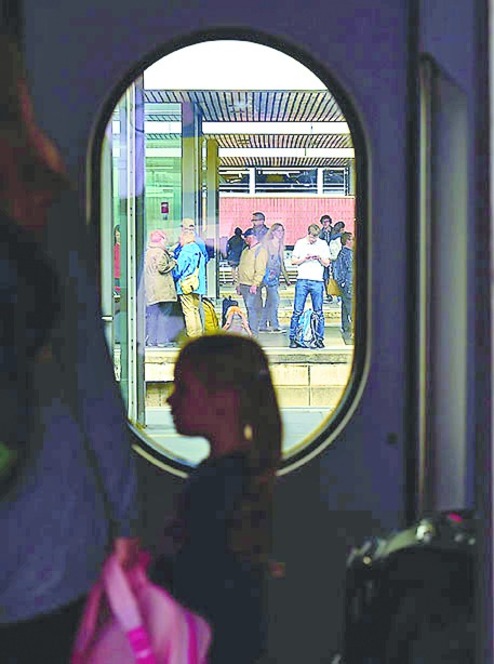
With so many connections, it was exciting to stumble upon a Bengali gift to Portuguese (or so I imagined) when my wife was allotted the janela seat on the train to Sintra. I emailed a friend in Calcutta who passed it on to Aditi Roy Ghatak who messaged me from Macau, where she was holidaying, to say the former Portuguese colony had given her a janela on Portugal. I now learn that far from being Bengali, janla is an import like potato, guavas or tobacco. Derived from the vulgar Latin januella, the Portuguese janela travelled east with those first Europeans to inspire the Sinhalese janelaya and Tamil cannal. Our own janla is like almirah or kameez. Borrowing within reason is all right providing it doesn’t prompt Mamata Banerjee to follow the late P.N. Oak and claim that Big Ben and the Eiffel Tower are really Bengali creations.

source: http://www.telegraphindia.com / The Telegraph,Calcutta,India / Front Page> Opinion> Story / by Sunanda K. Datta-Ray / Saturday – June 04th, 2016
Former Eden Gardens curator Prabir Mukherjee passes away

Kolkata :

Former chief curator of the Cricket Association of Bengal (CAB) Prabir Mukherjee, who was known for his no-nonsense steadfast approach, died at a city hospital late last night after a prolonged illness.

Mukherjee, 86, was suffering from a liver condition and depression and was being treated at the BNR Hospital since April 11, his grandson Pranay Mukherjee said.

His body, however, was not taken to Eden Gardens in a departure of the tradition followed in the city’s cricket fraternity to honour his last wish, Pranay said.

“He was severely depressed and would tell me the way he was ‘ill-treated’ despite serving 28 years at the Eden. ‘Please never take me there’,” Pranay told .

The veteran curator, who was involved with the Eden Gardens pitch for more than two decades including preparing the wicket for the 1987 World Cup final, had vowed not to return to the stadium after being blamed for the India-South Africa T20 International washout fiasco on October 8, 2015.

Even more than six hours after it had rained in the afternoon, the CAB groundsmen led by Mukherjee could not get the field ready and the third and final T20 was also called off as South Africa had swept the series 2-0.

During that time, Sourav Ganguly was the president-designate of CAB, who had squarely blamed the veteran curator for not covering the entire ground during the afternoon’s showers that left the field soggy.

“I never worked for money. I have told them (CAB officials) that I’m not coming back to the Eden again,” the snubbed Mukherjee had said and since then the CAB grounds including that of the Eden was managed by Sujan Mukherjee.

However, the CAB officials including joint secretary Subir Ganguly and treasurer Biswarup Dey visited his residence on Prankrishna Mukherjee road near Tala Bridge and paid their last tributes
.
In his condolence message, CAB joint secretary Avishek Dalmiya, the BCCI chairman of New Area Development Committee who’s away in Guwahati, said, “Prabirda’s contribution to Bengal cricket has been immense. He was not only involved with the Eden but various grounds across the state.” MORE TAP SSC SSC

source: http://www.timesofindia.indiatimes.com / The Times of India / News Home> City> Kolkata / PTI / June 02nd, 2016

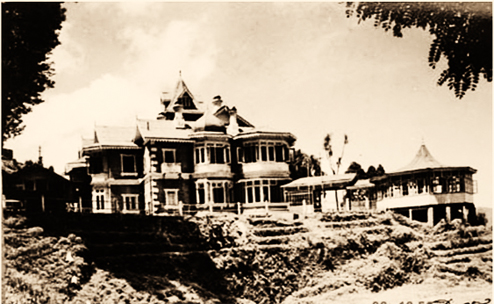
Hill royal relic now rubble – GTA pulls down Bangla king’s centuries-old palace to set up hotel management school

An undated photo of Sailabash: Courtesy Das Studio in Darjeeling

Darjeeling :

Darjeeling’s rare connection with present-day Bangladesh and a part of the hill town’s rich history has been reduced to rubble.

The GTA has pulled down Sailabash, the over-a-century-old summer retreat of the raja of Digapatia, to set up a modern hotel management institute and guesthouse in one of the last few available green spaces in Darjeeling.

Digapatia is now in Rajshahi, Bangladesh.

The palace under the tourism department of the GTA near Jalapahar and was brought down about two weeks ago. “The building was in a dilapidated state and recent earthquakes too had caused some damage,” said Kishore Ghimire, an executive engineer of the GTA.

In his book, A Concise History of The Darjeeling District Since 1835, which was published in 1922, E.C. Dozey, a writer and historian, said the building had been set up on land that was once owned by Capt J. Masson, the superintendent of Tukvar tea estate, by the “Digapatia Rajah”. The retreat was earlier called Girivilash and the name was changed to Sailabash after Independence.

The Late Nayan Subba’s soon-to-be-published book, Heritage buildings of Darjeeling, Kalimpong and Kurseong, says Raja Pramatha Nath Rai Bahadur had founded Girivilash whose garden was laid out by a German floriculturist and horticulturist, Morgenstern, and was looked after by 12 gardeners.

Nobody could say exactly in which year the building had been constructed. But its believed it was built in the last decade of the 19th century.

“Girivilash was a favourite place for the British governors of Bengal….The British army took over the palace in 1942. Later on, it was acquired by the government. It also served as a Tibetan school for a while. The palace has lost the historical grandeur of Girivilash,” writes Subba.

According to Subba, the colonial building had an attic with miniature gables and a small dome, and an all-weather glazed rotunda with small square windows in classical style. There was a tennis court as well.

“Raja Pramadanath Roy occupied the front suite on the ground floor, which included the library, with its precious screens of velvet and ornate wooden pelmets,” writes Subba.

The front suite of the upper storey with the snow view rooms was “for the rani”,

Subba writes. It was “beautifully furnished with a curtained brass cot and a chandelier. There was a huge grandfather clock, which indicated the days of the month and the full moon day (Ekadashi). On the ground floor were the drawing room, dinning room, tash khana (card room) and the billiards room,” Subba adds.

Despite being in a dilapidated state, Sailabash was still a landmark in Darjeeling and used to house a guesthouse after Independence. Once the building was taken over by the Darjeeling Gorkha Hill Council, the office of the hill body’s vice-chairman was housed there. For the past 20 years, the building had been lying vacant.

Bharat Prakash Rai, convener of the Indian National Trust for Art and Cultural Heritage (Darjeeling chapter), said: “How foolish can we be to dismantle such structures in the name of development. Could it not have been repaired? We have lost a piece of history and that is very sad.”

Dawa Lepcha, the GTA Sabha member in charge of tourism, said: “A big-scale hotel management institution will be coming up and the requirements were such that the building had to come down.”

GTA executive engineer Ghimire said the project cost had been pegged at Rs 55 crore. “Apart from the institution, there will also be a guesthouse with 24 rooms for in-house training. The infrastructure is being set up as per the parameters laid down by AICTE (All India Council for Technical Education)”

The five-acre plot in which the Sailabash was located has Annapurna and Kafal guesthouses, along with a pond built by the DGHC. “The Annapurna guesthouse will be used as an administrative building for the institution, while a part of Kafal will have to be dismantled. The pond will be smaller in size and we will have facilities for rainwater harvesting,” said Ghimire.

The engineer said restoration of the building would have cost much more.

source: http://www.telegraphindia.com / The Telegraph, Calcutta,India / Front Page> North Bengal> Story / by Vivek Chhetri / Wednesday – June 01st, 2016

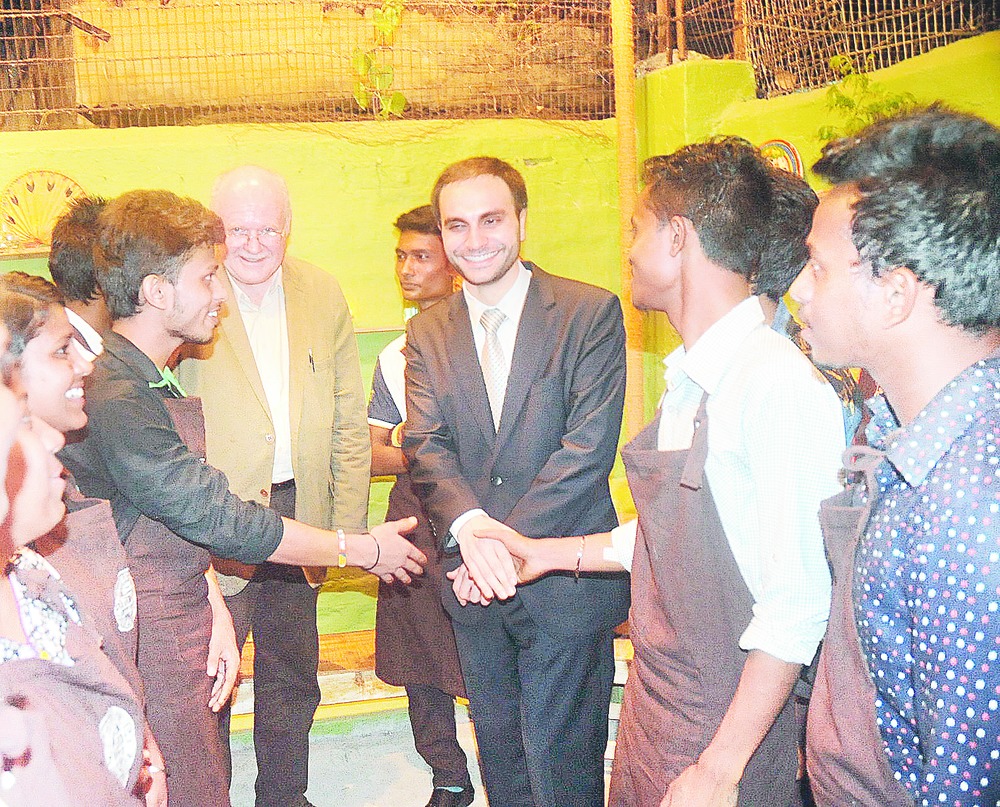
Restaurant school with French help

French consul general Damien Syed and German consul general Olaf Iversen meet the underprivileged youths being trained at Toto in Chetla. Picture by Bishwarup Dutta

Falafel served with pita bread. Chocolate cake. Apple pie.

These dishes were part of the food served by underprivileged youths from colonies in Kalighat and Tollygunge. The occasion was the inauguration of French restaurant school Toto in Chetla.

The school, which will also run a café, is a joint initiative of the local NGO Tomorrow’s Foundation and the French NGO Life Project 4 Youth (LP4Y), and is being supported by the French consulate in Calcutta.

“Our objective is education to employability. This is an entrepreneurship development project and we are looking at it as a business school,” said Arup Ghosh, founder of Tomorrow’s Foundation. Four volunteers of LP4Y have come from France to start the Calcutta project. “They are providing the knowhow, we are providing local help.”

In a two-storeyed house in Chetla which is housing both the school and the eatery, 15 youths are being trained to run a business when they are not busy picking up European recipes in the kitchen. “We had started off in October by recruiting five girls. When we started to think of the kind of business activities we should focus on, they suggested baking. It was important to take the idea from them based on their interest,” said Constance Delawstre, one of the volunteers.

That is how the seed of Café Toto germinated. The management is intent on serving only vegetarian fare. “We want to serve fresh and healthy food. We do not want to take a chance with meat in this heat,” says Delawstre.

The French volunteers are taking recipes of chosen Western dishes off the internet, preparing the dishes themselves for the students to taste and teaching them how to cook them. And if the reactions at the opening of guests like Marc Salesse, head of the consulate’s visa section, are anything to go by, their apple pie and chocolate cake are already tasting “just like back home”.

Not just cooking, the youths are also being trained in soft skills, like greeting a guest and taking orders, and management. “The youths have too much fire in the belly to not succeed. Once they complete the 12-month course, they should get entry-level jobs or set up their own place,” said Ranadeb Banerjee, a food and beverage industry veteran who is one of the coaches. The school offers them the option to continue beyond the course duration till they become self-sufficient.

Rama Rao and Gobindo Das, both orphans brought up in a Tollygunge NGO, are the biggest instances of the will to succeed. Rama had dropped out of school after Class VI but has taught himself spoken English. After a six-year gap, he has enrolled in an open school to appear in Madhyamik. Gobindo, too, picked up English on his own and took the Higher Secondary exams last year.

Other students stay with their families in slums. “I have to support my mother and two sisters. I am learning how to run a business,” said Sonu Kamti, who aims to deal in garments. Others like Laltu Singh and Gobindo Das are in it to learn computers. Such is their involvement that they have even sawed the café’s furniture themselves.

The guests left with a promise to return. “There was a need for such a café in our neighbourhood. The food is authentic and simple and the atmosphere convivial,” said Damien Syed, the French consul general. “It is a wonderful idea to create jobs through vocational training. Perhaps they can cook some German dishes too,” said Olaf Iversen, Syed’s German counterpart.

For now, the café will deliver food home on order and stay open only on advance booking. “Once the youths get trained, we will open thrice a week,” said Daniella, another volunteer.

source: http://www.telegraphindia.com / The Telegraph,Calcutta,India / Front Page> Calcutta> Story / byu Sudeshna Banerjee / Wednesday – June 01st, 2016

A Kolkata Laundry Helps People With Special Needs Find Employment

Kolkata :

A laundry service launched at Kolkata’s Pavlov Hospital, ‘Dhobi Ghar’ is being called a laundry with a difference.

The service will be run by people who have suffered stigma and often been abandoned by their families due to mental illness and aims to provide them an opportunity to a live a life of dignity.

Health and Family Welfare Minister of West Bengal Shashi Panja told NDTV, “This is the first of its kind project taking off in West Bengal. This laundry project empowers these individuals who are going to work here who have been through mental illness and recovered. It is about empowerment, self-respect and hygiene.”

The West Bengal government says it wants to improve conditions at hospitals for persons with mental illness. The government says they will work with NGOs and private players to create more such opportunities to integrate them into the work force.

The laundry project was set up by Anjali in collaboration with state government’s health and family welfare department. It has Sparsh Foundation as a technical partner and is enabled by The Hans Foundation.

Executive Director of The Hans Foundation Dr G V Rao told NDTV, “We are going to continue to see how we can replicate this and take it to the next level in order to increase the numbers.”

Those who have found work at the laundry say they want to be independent. Gita Kundu, who is undergoing treatment at Pavlov Hospital, told NDTV, “We feel nice doing this work. I am ironing these days. I feel better.”

“If we can do what we have been told to do here, then I can call myself successful as being able to earn and live independently is a man’s first responsibility,” added Ratan Nandi.

source: http://www.ndtv.com / NDTV / Home> Kolkata / by Saurabh Gupta / May29th, 2016

Bengal policeman scales Mt. Everest

A West Bengal police wireless operator scaled the Mount Everest, bringing cheers to the mountaineering enthusiasts who were distraught by the news of recent deaths while attempting to reach the world’s highest summit.

According to a statement released by the West Bengal Police Directorate, Rudra Prasad Haldar (39) reached the summit last Saturday at around 5.24 am. Halder had set out on his mission “Mount Everest” on April 7. He reached the top on May 21 and returned to the base camp two days later, the statement said.- PTI

source: http://www.thehindu.com / The Hindu / Home> News> Cities> Kolkata / PTI / Kolkata – May 27th, 2016

On a mission to save old buildings

CAL wants to go beyond heritage structures

ChaudharisKOLKATA29may2016

The Chaudhuris of Latu Mullick Lane in north Kolkata have unknowingly become part of a rather silent movement. Once part of Bengal’s landed gentry, they now have just this two-storeyed building left to their name. Built some time in late 19th century, the house does not offer much in terms of heritage value, given it was just the residential building of a family that had no great role in uplifting Bengal’s social or political consciousness. It is buildings like this that interests author Amit Chaudhuri.

Chaudhuri does not share any links with the said family, except a surname spelt the same way. Neither is this particular building, tucked away in a dingy lane, part of the initiative that is taking up much of his time these days. The author, however, is concerned with how the “heritage” tag is used in Kolkata. He feels somewhat disturbed that heritage only refers to buildings that had some role to play, even though the term should encompass much more than just achievements, he believes.

Once the second city of the British Empire after London, Kolkata, offers a visual feast of old houses, which stand out for remarkable architecture. These buildings represent not only an era but also stand testimony to the city’s history, giving an insight into the structural changes that influenced architecture over the years. Chaudhuri’s love for the architectural aesthetics in old buildings inspired him to launch the Calcutta Architectural Legacies (CAL), a mission to save old buildings.

It is also probably not a coincidence that the acronym spells out as CAL, the name most English-speaking Kolkatans refer to their home town by. CAL is what one would call a citizen’s initiative, with Chaudhuri bringing together a group of interested people. From conservation architect Partha Ranjan Das to G M Kapur of heritage preservation group INTACH, to activists Bonani and Pradeep Kakkar, ad guru Ram Ray and even Nobel laureate Amartya Sen, they will all pull in their ideas to help conserve buildings that have not found place on state’s heritage list.

Although CAL was formally launched in February, Chaudhuri has been working towards this for more than a year. In an article for The Guardian in June 2015, he laid down his ideas. He pointed out that in Kolkata, a heritage building is a landmark, either because it is a “significant institutional building” or “because a famous person frequented it or lived there”. “The architectural distinctiveness of the building is a secondary concern, or is a pre-ordained, generic feature of the structure: that is, we already know it qualifies as a heritage structure because it adheres to our idea of what a heritage colonial building looks like,” he wrote.

The author went on to say that heritage for Kolkata also “…means we cease to engage with the architectural individuality and difference of buildings and precincts. We don’t periodise, falling back on catch-all terms like ‘colonial’ or historicise; or describe; or define. Simply put, ‘heritage’ means we don’t see, or think about, buildings.”

While launching CAL, he pointed out that the time has come to rethink words like “architecture” and “heritage” in order to save buildings “before these are brought down and turned into generic multi-storeyed buildings”. CAL would also attempt to move beyond heritage and take the initiative to everywhere in Kolkata.

Chaudhuri pointed out how the city developed into neighbourhoods, “para” in Bengali, which were oases of resident communities, and stressed on the need to preserve their distinct characters, before these fall prey to realtors. He is of the opinion that the heritage tag should include far more than landmarks and involve buildings, which give the city its character. He also talked about the need for residents of such buildings to come forward and join the initiative, if they are keen on preserving their individual heritage, instead of a generic sense of history.

Chaudhuri’s campaign among the urban educate class for more than a year found fruition when Kumartuli Sarbojanin Durgotsav, the Durga Puja committee at the idol-makers’ district in north Kolkata, decided to turn his efforts into the theme for its Puja offering last year.

A much-visited Durga Puja marquee, the committee celebrated its 84th year with a cause that has faced criticism from some quarters as “elitist”. Disparagement aside, artist Subal Pal persuaded the Puja committee to go with the theme.

Chaudhuri observed how a number of aesthetic old buildings are being razed to ground, making way for box-like high-rises, on the Pratapaditya Road in south Kolkata. Pal, who has been noticing similar changes in north Kolkata, felt one with Chaudhuri’s woes and etched out the theme in his Puja marquee. The artist, however, admitted that without proper conservation of these buildings, there would be no point in having the theme, at a time when such houses are getting lost across the city. “…the message needs to be sent out to people before it’s too late,” he said.

A regular visitor to Europe, he pointed out in his Guardian article how the British have managed to preserve even the most mundane, old buildings, just because of their architectural and aesthetic brilliance.

The author, who first started the campaign online and sought signatures, stated in his expression note how the old-world Kolkata is fast falling prey to the real estate mafia. While the online petition received nearly 2,000 signatures in a matter of days, Chaudhuri said, “I am an admirer of Kolkata’s neighbourhoods. Its architecture is not just confined to colonial legacy or north Kolkata-based buildings owned by landed families. But there are many interesting architectures spread across the city which were built by the educated middle-class in the past,” Chaudhuri said. This petition also drew support from Sen, who has spent years amid the heritage corridors of educational institutes in Kolkata, England and the US.

The real deal for such an initiative, however, is to get the administration’s attention, admitted those pushing the initiative. While Das talked about the apathy of Kolkata Municipal Corporation, which is in charge of refreshing the city’s ‘heritage list’, Mayor Sovan Chatterjee seemed oblivious to such concerns.

Chaudhuri noted how bodies like the West Bengal Heritage Commission, entrusted with the job of refurbishing the list from time to time seem mostly toothless. “…the list of heritage buildings should be urgently revised and various neighbourhoods should be declared heritage zones,” Chaudhuri said.

While the author asked for empowering the Commission for better functioning, Das echoed his thoughts. A former member of the commission, he submitted a proposal to introduce transfer of development rights or TDR in 2013. A successful process at Mumbai and Ahmedabad, TDR provides a residential building owner to retain it, with the developer buying the land getting to build elsewhere where new construction is not an issue. There has been no move in the direction of allowing TDR, he said.

Chaudhuri hopes that like in Europe, owner of old buildings will take up the cause themselves and fight to preserve the character of their localities. The administration, however, continues to remain aloof, even after the Nobel laureate economist wrote a letter of support to Chaudhuri, stating, “We owe to future generations a preserved and un-mutilated heritage of Calcutta’s eccentric but exciting old buildings.

source: http://www.deccanherald.com / Deccan Herald / Home> Special Features / by Drimi Chaudhuri,Kolkata / May 29th, 2016

Indian-American scientist wins Springer Theses Award

Mr. De has dedicated his PhD thesis to cricketing legend Sachin Tendulkar and his alma mater, Kolkata’s Presidency University.

An Indian-American scientist has received the prestigious Springer Theses Award in recognition for his outstanding research in which he developed transgenic mice to study a critical tumour-suppressor called A20.

Arnab De’s thesis was nominated by New York’s Columbia University. Before this, Mr. De, who has also developed peptide-based prodrugs as therapeutics for diabetes, had received the Young Investigator Award at the American Peptide Symposium.

The thesis prize is awarded by Springer, a leading global publisher of renowned scientific journals and books, to recognise outstanding PhD research.

Internationally top-ranked research institutes select their best thesis annually for publication in the book series: “Springer Theses: Recognising Outstanding PhD research”.

Additionally, winners also get a cash prize of 500 euros.

The research work was highlighted by the European Molecular Biology Organization (EMBO) Reports.

Only research considered to be of ‘fundamental relevance to a general readership’ is chosen to be highlighted by EMBO.

Mr. De has dedicated his PhD thesis to cricketing legend Sachin Tendulkar and his alma mater, Kolkata’s Presidency University.

Mr. De said: “Two things that have influenced me the most is sports and education. This thesis is dedicated to Sachin Tendulkar not only for the cricketing joy he provided me, but also for being a constant source of inspiration to all Indian youth.”

Ole John Nielsen (University of Copenhagen), who shared the 2007 Nobel peace Prize as a member of the Intergovernmental Panel on Climate Change along with US vice president Al Gore, had in 2012 described the Springer award as an “insanely great honour”.

source: http://www.thehindu.com / The Hindu / Home> International / PTI / Singapore – May 28th, 2016

Start-ups… straight from the (he)art

It is often said that a successful start-up is like a love affair: demanding, but has its own prize. The story of Kultprit is like that, but with a twist. It all started when Salt Lake boy Saumya Jain, with a background in mining, went to London for a cousin’s wedding. He had no clue how his life was going to change.

Saumya always had a passion for fashion. Though he never had any formal training, he followed fashion trends and dreamt of starting a fashion start-up in Kolkata. But the fear of moving out of the mainstream always bothered him. In London, during a ride in the underground, he met Olena, a young Ukrainian girl. They had an instant connection, and love blossomed. Olena was mad about fashion and was working in the fashion industry in London, and Saumya always dreamt of the perfect partner with whom he could share his life and passion. Kultprit was born out of their love.

The merchandising brand has a website that deals in clothes and accessories. It has slowly carved a niche in the international circuit. “Kultprit was born in July 2014. We just got married, came back to Kolkata and wanted to do something different. So we decided to unite our passion for fashion and form a brand that represents the spirit of youth,” says Saumya.

The brand employs eight permanent designers and several freelancers from all around the world. “Designers and doodlers from India, Brazil, the UK, Singapore, Spain, Ukraine, the Czech Republic regularly contribute for us. Though Kultprit is our brainchild, it is also a stage for the amazingly talented young designers around the world to showcase their talent,” Olena says.

Speaking on the brands sustainability and future Olena said, “Kultprit is not only a fashion label. We support lot of fashion influencers around the world. Musicians, bloggers, actors and artists all over the world who give out strong messages to the youth are our fashion influencers. They are not our brand promoters but we are inspired by their work and in turn promote them though our designs,”

Colours used to intrigue Ranodeep Das since childhood. When teachers demonstrated algebra problems, he was busy scribbling and sketching a bird’s nest he could see outside the window. Since childhood, almost like every 90s kid, he was in love with Batman and Superman. And as he grew up, the idea of designing these characters and their merchandise came to him. And he gradually realized that the young generation was increasingly getting addicted towards customizable products.

When all his friends were busy hunting for mainstream careers, this young entrepreneur chose to have his own start-up: Rare Planet. On being asked how he dreamt up such an idea, Ronodeep says: “Everybody loves celebrity merchandise, customizable and designer products. And that is how I thought of the idea of Rare Planet.” Rare Planet designs superhero-themed earthen pots, kettles and wall art. Among the various products that Rare Planet has, the best are the colourful busts of Hellboy, Bane and the Joker. It also makes customized masks and movie memorabilia.

For Ekta Bhattacharya , it all started when she saw a poster of Satyajit Ray’s ‘Gupi Gayen Bagha Bayen’ at Nandan. She fell in love with the illustration. Since then, the girl from Barrackpore looked up to the other side of Ray — the illustrator — for inspiration. “I always loved painting, but Ray’s illustrations gave me direction,” she recalls. “Though I was never interested in a mainstream career, I was not sure of becoming a poster artist either. It happened by chance. A friend of mine, a short-film maker, asked me to design a poster for his film. He suggested I paint it, as it is rarely done nowadays. I always wanted to do a poster like that and readily agreed. It got lots of praise. I then realized this is what I am actually good at. I realized that that was who I am — a designer,” Ekta says. She launched her company — Ekta’s — in 2015, and leads a team of seven designers.
Her painted posters were hugely appreciated by artists like Soumitra Chattopadhay, Anupam Kher and Mahesh Bhatt. Ekta even painted a poster for Mahesh Bhatt’s last production ‘Hamari Adhuri Kahani’. “Money has never been the driving factor. It is the creative satisfaction that I derive working for my clients. Each one of them is a challenge,” she says.

From a very young age, Sharmila Dutta never liked looking at things devoid of colour. When kids of her age were busy playing, she choose to scribble and paint the walls of her room. Sharmila took this love forward and formed Colorblot , her start-up for those seeking customized walls an ​ interior designing.
Her company aims to design and customize rooms according to customers’ needs. “I have painted a lot of walls in people’s homes. Getting your wall painted is like getting a tattoo done. The art becomes a part of your existence,” she feels.

Sukanya Majumder never thought she would someday form a brand that would style some of the biggest Tollywood actors. The Behala girl was always into dancing and play-acting in her school days. But when she went to college, she saw herself in a new light. Her fondness for mingling metal and art became her calling.

“It was in college that I first met Neha Panda, who was a well-known stylist then. I was intrigued by her work. I thought about creating jewellery differently for people to wear it at work and play. Why not create something that is a statement and becomes part of one’s identity? It is then that I formed Sukanya’s, in end-2014,” she recalls.

Sukanya’s makes all kinds of daily wearable jewellery, from anklets to arty jhumkas and Rastafarian headgear. Everything she does is customizable. “I try to make my creations in a way that reflects the identity of my customers. Whatever one wants to wear, I try to make,” Sukanya says.

source: http://www.timesofindia.indiatimes.com / The Times of India / News Home> City> Kolkata / by Sayan Mazumder & Abhro Banerjee / May 28th, 2016

Darjeeling girls scale Mount Everest

– College students from hills make up first all-girl team of NCC to conquer the highest peak

Trishala Gurung (left) and Sulaxchana Tamang. File picture

Darjeeling :

The first all-girl team of the National Cadet Corps to Mount Everest, which included two college students from Darjeeling, has successfully climbed the world’s tallest peak.

Trishala Gurung and Sulaxchana Tamang, who study at Southfield College and Ghoom Degree College in Darjeeling, respectively, were among the 10 girls to be selected from across the country to be part of the NCC team to scale the highest peak.

Speaking over the phone from Delhi, Lt. Col. Umang Kohli, additional director publicity, NCC (headquarters), said: “It is confirmed that the first all-girl team of the NCC has successfully climbed Mount Everest. They were part of a 19-member group which reached the summit. The NCC team has done us proud.”

The expedition team consisted of 10 NCC girls selected from across the country and 15 officers. Of the total 25 members, five, including the team doctor, were to stay at the base camp. “Of the 20 members, who were to climb the peak, 19, including 11 girls, have succeeded,” said Lt. Col. Kohli.

Only one NCC team member could not reach the top.

Om Prakash Tamang, father of Sulaxchana, 21, said: “My daughter called me around 7am today. She had just returned to the base camp. She said the team had successfully climbed Mount Everest. We are very happy.”

According to Om Prakash, Sulaxchana was part of the first batch to climb the summit.

Ganesh Gurung, father of Trishala, 22, said she had called him this evening to confirm the success of the team.

Lt. Col. Kohli said the team had climbed the peak in two batches on May 21 and 22.

Preparation for the expedition by the NCC team had started more than a year back. In November 2014, 100 girls from across the country had been selected for training at the Himalayan Mountaineering Institute in Darjeeling.

After completing a nearly one-month training, 40 girls were shortlisted in February 2015. “The 40 girls were then taken to climb Mount Deo Tibba (19,688ft) in Himachal Pradesh. After the 41-day expedition, 15 girls were selected for another expedition,” said Ganesh.

Between August and October 2015, the 15 girls were taken to an expedition to Mount Trishul (23,353ft) in Uttarakhand. After 50 days of that expedition, 10 girls were selected to scale Mount Everest.

The team led by Col. Gaurav Karki was flagged off in Delhi on March 9.

Mountaineer in Siliguri hospital

Chetna Sahu from Calcutta, who developed frostbites while descending from the summit of Mount Everest, has been admitted to a private nursing home in Siliguri. She climbed the peak, along with her husband Pradip.

source: http://www.telegraphindia.com / The Telegraph,Calcutta,India / Front Page> North Bengal> Story / Vivek Chhetri / Wednesday – May 25th, 2016