The six-city tour of Bonjour India’s ‘Jazz meets Indian Classical’ started off in Kolkata with a packed audience and a mesmerising performance by the city’s tabla maestro, Bickram Ghosh, in collaboration with Mezcal Jazz Unit from France.
The programme was organised by Alliance Francaise at the Tollygunge Club’s main lawn recently. “I am happy that Alliance Francaise is organising such enriching events. I am really enjoying the night. I love tabla more than jazz,” said Fabrice Plancon, director, Alliance Francaise du Bengale.
Bickram Ghosh and Mezcal Jazz Unit had collaborated about 12 years ago.
The tabla maestro said, “Jazz and Indian classical are very similar in nature. Collaborating with top jazz artistes can bring out the best in each other’s culture. We have also recorded a video that will be out soon.”
Ghosh also added that he was very happy to see the audience enjoying the music. He added, “Kolkata still has an audience for good music. This show didn’t get much publicity yet the chairs were all full. I am glad that such collaborative projects interest the music lovers of Kolkata.”
source: http://www.timesofindia.indiatimes.com / The Times of India / Home> City News> Kolkata News / by Shrutanwita Chakraborty / March 05th, 2018
‘My grandparents, refugees from Bangladesh, have kept their house exactly the way they received it.’ | Photo Credit: Chirodeep Chaudhuri
Like many things in Calcutta at the turn of the 20th century, Park Mansions was built by Armenian merchant Thaddeus Mesrope Thaddeus
Can you love a beautiful thing without understanding what beauty is? I was eight years and something when I first saw Charulata, considered to be Satyajit Ray’s finest film and sometimes listed among the greatest films ever made. Ray had died that Calcutta summer, and Doordarshan was showing a retrospective of his films late at night, in remembrance. Those were the pre-DVD days, and even in VHS, Ray’s films were hard to come by. My parents would wake me late at night so I could watch with them, the only late-night activity I was allowed to participate in.
“Just watch a bit,” my mother would say, “it doesn’t matter if you don’t understand it.” At eight, even for the precocious, full-of-themselves Bengalis, I was a bit young for Tagore’s story of a young bored housewife falling for her brother-in-law, and recognising the loneliness of her marriage to an older, professorial man. (It was the typically uneven marriage of high-caste Hindus of the day — a young woman, a man at least a decade-and-a-half older.)
But I liked the film. I liked it from the start, because I liked Charu’s windows — the slatted windows through which she watched a man with a black umbrella on a Calcutta street, one of Bengali cinema’s most beloved scenes (and one of international cinema’s most recognisable scenes). My grandfather’s house had the same windows; windows operated with a spine to pry them open. The kharkhari, as we call it in Bengali, lets you glimpse the outside without letting the inside out. It is said to be designed specifically for tropical heat, and is typical of old, statuesque Calcutta homes from the turn of the 20th century.
Of stillness
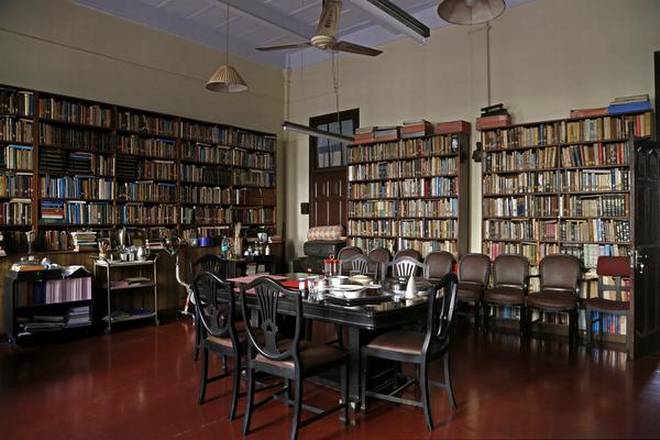
I felt at home in Charulata’s world, though her emotional dilemma was several years of understanding away from me. I felt like I was in my grandfather’s house, 25 Park Mansions, with its books, and long corridors and curvaceous, dark wood furniture. (Today’s furniture is a lot more angular, a lot more straight lines, no?) More than anything else, the house has the same air of stillness and non-fidgetiness that you sense in the film. Despite Charulata’s emotional turmoil, you see her sewing or writing or playing cards, rarely fidgeting.
My grandfather’s house has that same quality — even now, it makes me forget my phone and the notifications on my post. It keeps the outside out, and holds me inside. I had little idea then that the building would one day be classified as “heritage” property, that I had grown up in something that deserves to be preserved for the public and the future. I had loved it without understanding it, much like I did with the film.
The foundation stone of Park Mansions was laid in 1910, one year before the British announced that the imperial capital would be shifted to Delhi. Like many things in Calcutta at the turn of the century, it was built by an Armenian, a merchant and philanthropist called Thaddeus Mesrope Thaddeus. Park Street, Calcutta’s iconic restaurant and bar street, has at least three other buildings credited to Armenians. Stephen Court, which stands diagonally opposite to Park Mansions, was built by Arathoon Stephen, who also built the adjacent complex, Queen’s Mansion. These three majestic mansions were conceived as residential quarters.
A little further down the street, close to the beloved Olympia Pub, is the Masonic (Freemasons’) Lodge and Hall, built by Johannes Carapiet Galstaun. Many of the city’s most loved and recognised hotels have also been built by Armenians — the Grand Hotel, the Kenilworth, the Astoria and the late Shashi Kapoor’s favourite hotel, the Fairlawn.
What is most interesting about this building spree is the timing — the turn of the 20th century was the zenith of the Raj in India. Calcutta is widely considered to be built by the British, and little credit is given to the Armenians. The early 20th century was also the time of the genocide of Armenians by the Turkish state — in her book A Problem from Hell, the American academic Samantha Powers describes this as the first genocide of the modern period.
The Armenian touch
But the presence of Armenians in Calcutta predates the 20th century. The oldest church in Calcutta is the Armenian church on Armenian Street. The earliest grave in the churchyard adjoining it dates to 1630, says Iftekhar Ahsan, who runs one of the most popular walking tour companies in the city. The Armenian college near Park Street still admits and educates children of Armenian origin only. Geographically, Armenia is a land-locked country, and the Armenians have been subject to invasions over the centuries. Waves of Armenians have left and settled across the world. They are among the most resourceful and successful immigrant communities worldwide.
According to the Kolkata Municipal Corporation (KMC), “a heritage building means any building… which requires preservation and conservation for historical, architectural, environmental and ecological purpose…” This definition suggests that a heritage building is a public good meant to be sustained for the city as a whole.
When the heritage status came in for Park Mansions, a plaque was put in in memory of the company managing the estate. In the four years since, nothing has been put up about Thaddeus, about the Armenians of Calcutta, the style of Armenian buildings, or even the distinct architectural features of Park Mansions.
However, a whole lot of signage has come up on the façade of the building itself — advertising for commercial and institutional tenants. The KMC website on heritage specifically mentions that no display of signage or hoardings is allowed on heritage buildings unless it is approved, and in harmony with the building.
Gleaming new commercial tenants have arrived — the country’s largest car company has a showroom in Park Mansions, a store for a global computer giant whose favourite colour is white, the tech gadgets branch of India’s largest industrial conglomerate, a hip global café franchise known for live music performances. There are new institutional tenants too — the cultural wings of two prominent Western governments have set up office. In the course of these arrivals, the interiors of the mansion complex have been almost completely stripped. The hip café is set to its global décor template, and could well have been in a mall for all that it has retained of its 107-year-old setting. One of the cultural institutes has stripped the original floors and replaced them with a polished wood material. The arrangement of rooms and spaces has been wholly reimagined.
Crumbling edifice
My grandparents, refugees from Bangladesh who came to Calcutta with nothing, have kept it exactly the way they received it. Not a thing has been taken out. The laal mejhe (red floor) — red oxide mixed with cement — typical of old Calcutta homes is intact, still deliciously cold and creamy on bare feet. Our ceilings are still ages away, held up by criss-crossing beams and joists. They make the unreasonable Calcutta summers reasonable and the embarrassing winters a bit more draughty and respectable. His house is, perhaps, the only unit to have retained the space as it was originally conceived.
But the innards of the apartment are falling apart. The sewage pipes, after more than a century of use, often spill out waste in the bathrooms. They leak faecal matter into the walls and ceilings. The estate managers, puffed with the heritage tag, swat us residents away.
What is happening to Park Mansions is known as ‘adaptive reuse’ in urban planning language. A building conceived primarily for residential use is being refashioned for commercial and institutional use. In the process, the character of the building is changing. The interiors are being stripped away. The identity of Park Mansions is eroding.
I see this unfolding before me. When I walk down Park Street in the evenings, there is invariably a knot of people in front of the hip new café at Park Mansions. They wait to take selfies below the name of the café. Where they knock their heads close and ready their faces for the camera, they stand in front of the foundation plaque of the complex: “Park Mansions: The foundation stone of this building was laid by Lizzie, wife of T.M. Thaddeus, on the 1st May 1910.” Their photographs have no space for Thaddeus’ Park Mansions. It’s only the building housing the global café chain.
Park Mansions Adda: On a semi-regular basis on Sundays, my family welcomes people via a public post on Facebook to walk through our apartment, feel the red oxide floor, look out of our slatted windows, run hands along the spines of my grandfather’s library. And then we sit in the living room and talk, just like people still do in any apartment in the world.
The Kolkata-based writer and independent journalist writes on public health, politics and film. Her hobby is writing about herself in the third person.
source: http://www.thehindu.com / The Hindu / Home> Rubric> Society / by Sohini Chattopadhyay / March 03rd, 2018
‘For quite some time, only beer was available and that too in the front garden, which became rather raucous as the night drew on’ | Photo Credit: fairlawnhotel.com
A tribute to Calcutta’s Fairlawn Hotel
When the British left India they forgot to take Fairlawn Hotel with them. So for 70 years, this ‘corner of a foreign field’ has sat happily in Sudder Street, being British. Or rather, reminding us Britons of what we used to be like.
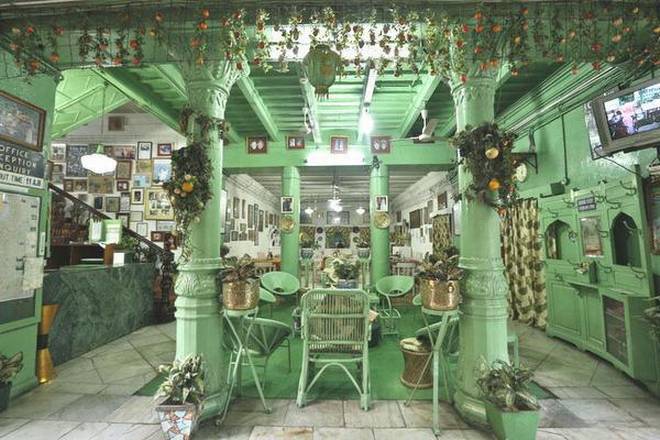
Not exactly frozen in time, because improvements were made over the years, Fairlawn nevertheless had an ambience firmly rooted in 1930s British India. There was a comforting atmosphere of chintz furnishings, proper dressing-tables, spacious almirahs, and a reliable dhobi service. When you dialled ‘Reception’ a room bearer came immediately to assist you. Fluffy white dogs belonging to the owners, Violet and Ted Smith, occupied chairs on the landing at the top of the handsome staircase. They (the dogs, not the owners) growled gently if you tried to move them, but any right-minded Briton would rather suffer hours of discomfort than move a sleeping dog or cat from its chair.
Jolly evenings
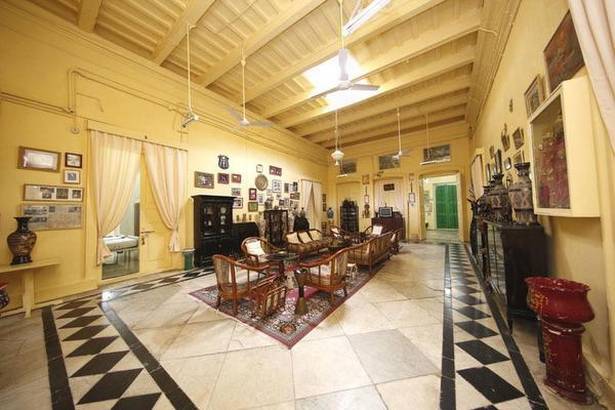
On the first floor of Fairlawn is the grandest room where parties and receptions were held in the 18th century. It had taken the British some time to figure out that rooms above street level could be cooler than those on the ground floor, particularly if there were open arches through which the fugitive breezes could enter.
The colonial bungalow at the core of Fairlawn was built in 1783 by the Englishman William Ford who had bought a plot of land here two years earlier. The original bungalow was a simple rectangular structure of two floors, each with a large central hall and with covered verandas running around the exterior walls. Access to the first floor would have been via an exterior staircase, but at some point during the 19th century, an interior staircase was constructed, which allowed extra rooms to be added.
A number of other alterations took place too, which the practised eye can see. The front verandah was extended outwards towards Sudder Street, and iron columns were inserted to support the new garden room above. It was from here that diners below could hear shrieks of laughter on jolly evenings when Violet entertained the British Deputy High Commissioner and other friends to drinks.
Those of us supping in the ground floor dining room were a little envious, because we couldn’t get the traditional gin and tonics with our evening meal. For quite some time, only beer was available and that too in the front garden, which became rather raucous as the night drew on.
I want to pay tribute to Fairlawn, where many happy days (and nights with a much-loved Indian friend) were spent from 1988 onwards. The first thing I looked for, whenever lucky enough to get the farthest ground floor room, was something that cannot be visualised — it was the smell, the heady perfume of antiquity, a bit naphthalene, a bit damp, and wholly old Calcutta.
My favourite room was part of the inner veranda, which had been compartmentalised at some point with panelled doors. The doors had been firmly painted over and couldn’t be opened, although the marks of the bolts and locks were visible through the thick cream paint.
At night I would imagine a procession of friendly phantoms from old Calcutta passing through these doors and into my room, dressed in their empire-line muslin costumes and stiff red broadcloth uniforms. These were British ghosts but there were also a number of faithful Indian spirits who spent quiet evenings in the corner of my room dozing on charpoys while they waited for the sahibs and memsahibs to retire for the night.
Guests and quirks
As a historian I am perhaps over-sensitive to the past — old buildings and old rooms attract and often haunt me. In an idle moment, when I happened to have a tape-measure with me, I measured the width of the outer wall in my room that led onto the veranda — it was 26 inches wide, over two feet of solid brick to keep out the heat. My ceiling was made of teak beams brought from Burma. When I sat at breakfast in the ground floor hall I could trace the outline on the far wall of earlier doors which had been bricked up when alterations were made.
Of course, not everything at Fairlawn was perfect. Indian staff were made to wear white gloves when serving food to Europeans until well into the 1990s. This peculiar custom arose because white people were said not to like the sight of brown hands serving their food. And there is no doubt that would-be Indian guests were discouraged from checking in at the hotel.
But I won’t let Fairlawn go lightly. It was special and it attracted special guests, whose names will be more familiar to Britons than to Indians — Dan Cruickshank, the architectural historian, Ian Hislop, the editor of the satirical magazine Private Eye, and many other quirky foreigners. All of us have sat in the uncomfortable basket chairs in the front veranda, reading the newspapers and waiting for our friends.
Fairlawn was one of the last places to positively encourage smoking — there were proper ashtrays on the occasional bamboo tables and even after I gave up smoking, the odd cigarette, bought from the corner store opposite, would entice me back to bad habits. Everything was painted apple green — the basket chairs, the iron pillars, and the reception area where Sam greeted guests and patiently answered their silly questions with unfailing courtesy.
It had a special place in old Calcutta for those who either couldn’t afford the Grand Hotel or the Great Eastern Hotel, or who preferred something more intimate.
Everyone who has stayed here will have their own memories — my friends who didn’t realise there was hot water until their third day there because no one had shown them how to turn on the hot-water heater; the British aid-worker back from a gruelling year in Odisha who needed to relax; the retired Calcutta policeman who sought me out last year and my numerous friends who knew where to find me whenever I stayed in the city.
Dr. Llewellyn-Jones is an independent scholar and historian, and lives in London with two cats called Havelock and Lawrence.
source: http://www.thehindu.com / The Hindu / Home> Society / by Rosie Llewellyn-Jones / March 03rd, 2018