Church organ falls silent
Man who made music at St John’s during Sunday prayers passes away
Calcutta:
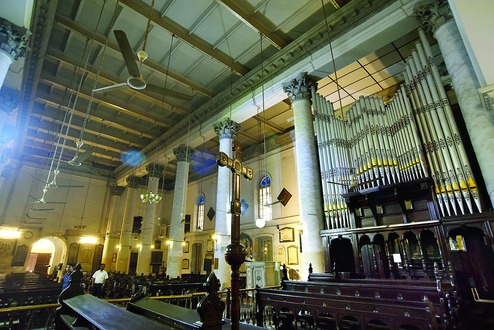
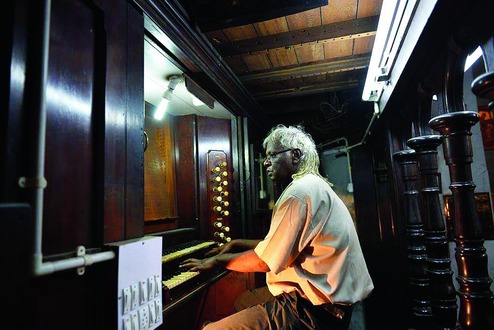
The sonorous ebb and flow of pipe organ notes won’t fill St John’s Church this Friday. Johnny Purty, the dreadlocked wizard of the keys whose music churchgoers say elevated the soul, died on Tuesday aged 57.
Johnny had been an unmissable presence during Sunday prayers at the church for years, his back to the congregation but his music always upfront in its purpose. On Fridays and Saturdays, he would play almost all day. Over the years, he became as famous as the grand instrument he played.
Noel Ronnie Purty, Johnny’s brother, told Metro on Thursday that his sibling inherited his love of the organ from their father, who had also played the instrument in a church. An alumnus of Assembly of God Church School and St Xavier’s College, Johnny was wedded to music and so remained a bachelor in life.
“He had a cardiac arrest around 3.45pm. A doctor was called and he pronounced Johnny dead,” Noel said.
A memorial service for Johnny was held at Wesleyan Church on Thursday, from where his family and friends proceeded to the Bhowanipore cemetery for the funeral.
“The hall was packed today. He was a master at playing the organ,” said Peter Hyrapiet, a close friend of Johnny.
The pipe organ at St John’s Church on Council House Street was installed in the early nineteenth century and remains the grandest in Calcutta. “I have seen Johnny play even when there was none in the church. He used to play the whole day because he loved doing so,” said Subhadip Mukherjee, a friend and member of the Church of North India (CNI) that runs St John’s.
A college teacher who had visited St John’s last winter with her colleagues remembers the warmth with which Johnny greeted them. “He escorted us in. As we went around the church, Johnny started to play the organ. He seemed so happy just playing for us. It’s shocking to hear that he is no more,” she said.
At least five churches in Calcutta have pipe organs but regulars say that the one at St John’s is the grandest in terms of the quality of sound. Johnny’s finesse had as much to do with it as the maintenance that is put in to keep the instrument in shape.
Johnny also played the pipe organ at Wesleyan Church on Sudder Street for two decades. He had been playing there before he first touched the instrument at St John’s.
Unlike a piano, playing the pipe organ requires the use of both hands and feet. “The chords are played using the feet while the lead is played using the hands,” said a church member.
Mukherjee, whose blog Indian Vagabond has a detailed guide to St John’s Church, explained that the instrument has “stops” on either side of the seat that are adjusted to produce the sound the musician desires.
Johnny knew how to adjust these to produce the right music at the right moment, he said.
While a pipe organ player sits with his back to the audience, there is usually a mirror in front that enables the person to see the congregation and play to it.
Johnny’s death means St John’s Church will have to look for a musician to take his seat. “We are looking for a new player as quickly as possible,” said Pradeep Kumar Nanda, the vicar at St John’s.
The church, whose construction started in the late eighteenth century, stands on land gifted by Maharaja Nabo Kishen Bahadur of Sovabazar.
source: http://www.telegraphindia.com / The Telegraph,Calcutta,India / Home> Calcutta / by Subhajoy Roy / March 16th, 2018
For barons, business blends with nostalgia
Darjeeling:
The Hill Business Summit provided many industrialists with a rare platform to trace their roots to the region and promise projects.
Rudra Chatterjee, the managing director of Luxmi Group which owns the Makaibari tea garden in Kurseong, urged hill residents to keep welcoming investors and tourists.
“The people here are brave, loyal and hardworking. A time comes when a region changes and this is the time. We need to keep coming back, peace must be maintained and we must keep inviting investors to the region,” said Chatterjee.
He promised to open more Makaibari kiosks in the hills to employ the children of garden workers and rolled out plans for a sports and hospitality project.
The boss of Keventer Agro, one of the biggest food processing chains in Bengal that started from Darjeeling, promised to “correct” a gap. “After four decades, we have come back to the birth of Keventer. I don’t know why we never thought of coming to Darjeeling to look into our roots. Keventer has a food-processing unit in every district of Bengal but not in Darjeeling. I am here to correct this,” a nostalgic Mayank Jalan, Keventer’s MD, said
Jalan promised to “figure out” what the firm needs to do in Darjeeling within the next 24 months. Keventer’s in Darjeeling is famous for its breakfast, although the restaurant is no longer associated with Jalan’s company but owned by a local entrepreneur, Robin Jha.
Chandrajit Banerjee, director-general of trade body CII, recounted his family ties with Darjeeling. “It is such a great place to come back after nearly 37 years. It feels special because my grandfather started a business here and my father cultivated it before leaving for Calcutta,” said Banerjee before announcing a series of initiatives that the CII intends to take up in the hills.
For Harsh Neotia, it has been a wait of over a decade. “For the past 13-14 years, I have been visiting north Bengal and I always aspired to do something in Darjeeling. It is one of the most astounding places but for one reason or another, we could not do (invest in projects),” said Neotia.
Neotia’s group is developing two properties, at Ghoom and Makaibari.
“Two hospitality units are coming up at an investment of Rs 150 crore each. The Makaibari project is likely to be completed by 2019 and the first phase of Ghoom by 2020,” said Neotia, who also expressed a desire to explore opportunities in the hills’ education sector.
source: http://www.telegraphindia.com / The Telegraph,Calcutta,India / Home> West Bengal / by Vivek Chhetri / March 14th, 2018
Homegrown math scores in tiki-taka tracking
ISI team develops algorithms that promise higher accuracy than the competition

Dunlop:
Advanced algorithms developed by a team of scientists at the Indian Statistical Institute (ISI), Calcutta, promise to do for ball tracking in football what tiki-taka has done for FC Barcelona.
Dipti Prasad Mukherjee of the institute’s electronics and communication sciences unit and PhD candidates Saikat Sarkar and Samriddha Sanyal have come out with a high-precision automated system using algorithms that “balance prior constraints continuously against the evidence garnered from sequences of images”.
The system, based on computer vision, aims to track and accurately calculate ball possession by a team during a game. According to Samriddha, it is at least 7.2 per cent better compared to competing approaches to ball tracking.
Samriddha had published a paper titled “On the (soccer) ball” with Mukherjee and Arnab Kundu in 2016.
“The problem of tracking the ball is when there is a sudden change in speed and orientation of the ball,” he said.
In a given video, the prior constraints would be the ball positions in previous frames. The paper proposes a particle filter-based algorithm that tracks the ball when it changes direction suddenly or travels at high speed.
“Our tracking algorithm has shown excellent results even for partial occlusion (blockage), which is a major concern in soccer videos,” Samriddha said.
Tracking a ball when it is being kicked or passed quickly from player to player like in tiki-taka remains a challenge for broadcasters.
Saikat, who is working on calculating ball possession, said: “Till now, the chess-clock method is used to measure ball possession. The other measure for ball possession is to count the number of passes. The ratio of the number of passes by a team divided by the total number of passes in a match closely correlates with ball possession stats.”
FIFA uses data from Deltatre, a sports media company that uses the chess clock method. In the Premier League, ball possession is measured on the basis of data from Opta Sports.
Deltatre has individuals using the three buttons of a chess clock to measure when the ball is with Team A, Team B or not in play. Opta uses a software overlaid on live feeds to track the number of passes.
The team at ISI uses raw broadcast video, measuring ball possession with close to 80 per cent accuracy.
source: http://www.telegraphindia.com / The Telegraph,Calcutta,India / Home> Calcutta / by Anasuya Basu / March 14th, 2018
13
12
Rajarhat, the new motown of Calcutta
New Town:
Rajarhat is becoming the new motown of the city with major dealers opening state-of-the-art facilities.
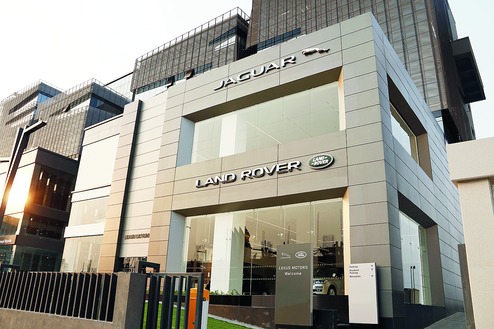
The motown is adjacent to Ecopark in Action Area II of New Town, with sprawling outlets of Eastern Honda, Lexus Motors, Renault, Hyundai and Maruti. The latest in line is the Jaguar Land Rover showroom in the auto mall.
The state government allotted seven acres to auto dealers in 2006.
“Each of the dealers received an acre each,” Vinod Agarwal of Lexus Motors, who has shifted his premium dealership Jaguar Land Rover from AJC Bose Road to the auto mall in New Town, said.
Agarwal, who runs a Renault and the Tata Motors passenger cars and commercial vehicles dealerships in the city, has set aside space for all the three in the mall.
Bengal Hyundai has taken up another portion of the auto mall, while the Maruti Regional Office, which is currently on Camac Street, is due to shift to the new address at Rajarhat some time soon.
It will have a Volvo dealership, along with Austin, the oldest dealership in the city, as neighbours.
Toyota, BMW, Kia Motors are apparently looking at motown addresses.
Much like its Vasant Kunj headquarters in Delhi, Maruti will have its regional office in New Town with the display area in the building.
“It’s a four-storey building with a lot of space. Some floors will be reserved display our cars. We will shift there some time soon,” a Maruti source said.
One of the city dealers said the average space for a showroom is not more than 15,000sq ft. Here, there would be much more space with more cars on display.
Sanjay Patodia of Austin is now busy completing Austin Towers, a building with 1,26,000sq ft carpet area. “I have not yet decided which dealerships will be housed there,” Patodia who has automobile sales outlets in Chowringhee, Patuli, Baruipur and Howrah said.
Asked about the footfall in Rajarhat, Patodia, a seasoned player in the auto sector, said: “Once Rajarhat develops fully, people will come in. It will get customers from VIP Road, Jessore Road, too.”
Agarwal has already experienced a rise in footfall in his showrooms.
“There is so much space here with test drive facilities and everything. It is difficult to run dealerships in the heart of the city,” Agarwal said.
The state-of-the-art JLR showroom is spread over more than 20,000sq m with 11 cars on display.
“The entire range of Jaguar and Land Rover models are on display here,” he said.
source: http://www.telegraphindia.com / The Telegraph,Calcutta,India / Home> Calcutta / by Anasuya Basu / March 11th, 2018