Former ZSI director passes away at 81

Kolkata :

Former director of Zoological Survey of India (ZSI) Asish Kumar Ghosh passed away on Monday morning at the age of 81. He was battling throat cancer.

The first Environment Monitoring Wing in ZSI (Kolkata and Chennai) was started under his leadership in the early 1980s. Ghosh was also the founder-director of Centre for Environment & Development in Kolkata, which conducted several seminal studies on the city’s environment.

A Fulbright scholar and Rockefeller Foundation grantee, Ghosh studied in University of Calcutta and University of Wisconsin, Madison, USA. He had written extensively on biodiversity conservation, natural resource management, and on environment and development. Between 1992 and 1996, Ghosh led the Indian delegation to Ramsar Convention on international wetlands in Japan, besides representing the country in several other international meets.

Ghosh also served as guest faculty in many reputed institutes. He had mentored many environment scientists and environmentalists.

Environmental activist Bonani Kakkar said, “Ghosh had the courage to submit an affidavit supporting the public in the wetlands case while still in office. His death is a terrible loss to those who care for our environment and the city.”

source: http://www.timesofindia.indiatimes.com / The Times of India / News> City News> Kolkata News / TNN / April 03rd, 2018

A biopic on Bengal’s bravest freedom fighter Dinesh Gupta

His directorial debut ‘Sahaj Paather Gappo’ has given Manas Mukul Pal the much-needed boost to start his career. His first film became a box office hit last year receiving rave reviews from both the audience and critics.

Now the talented filmmaker is all set for his next venture which is reportedly a biopic on freedom fighter Dinesh Gupta. The film will begin right from his college days and follow his indomitable works and actions as Bengal’s one of the bravest freedom fighters.

Not just Dinesh, the story of Binay and Badal will find their place in the upcoming biopic. The famous Writers Building attack by Binay-Badal-Dinesh will also be covered. It’s certainly great news for Bengali cine lovers. After a long time, we will see a historical biopic. Interestingly, earlier this year rumours suggested Dev will also make a film on Binay-Badal-Dinesh.

Dinesh Gupta was born on December 6, 1911 in Josholong of Munshiganj District, now in Bangladesh. While studying in Dhaka College, he joined Bengal Volunteers, a group founded by Subhas Chandra Bose in 1928. Soon the Bengal Volunteers turned out to be a more active revolutionary association and started liquidating infamous British police officers. Dinesh was only 19 when he was hanged for anti-government activities and murder on 7 July 1931 at Alipore Jail.

As per industry sources, the camera will roll on for this biopic from October. The film will be shot in Kolkata, Midnapore, and Bangladesh.

source: http://www.timesofindia.indiatimes.com / The Times of India / Home> News> Entertainment> Bengali> Movies / News / TNN / April 03rd, 2018

There’s Didi. There’s Dada. Between them, there’s a Ditch

Bengal has talented sportswomen aplenty but why is they do not have their deserved place on the sporting map of India? Moumita Chaudhuri goes looking for answers
.
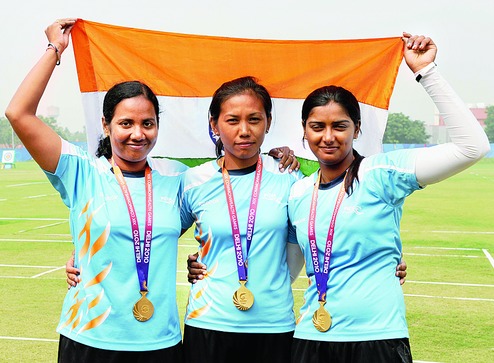
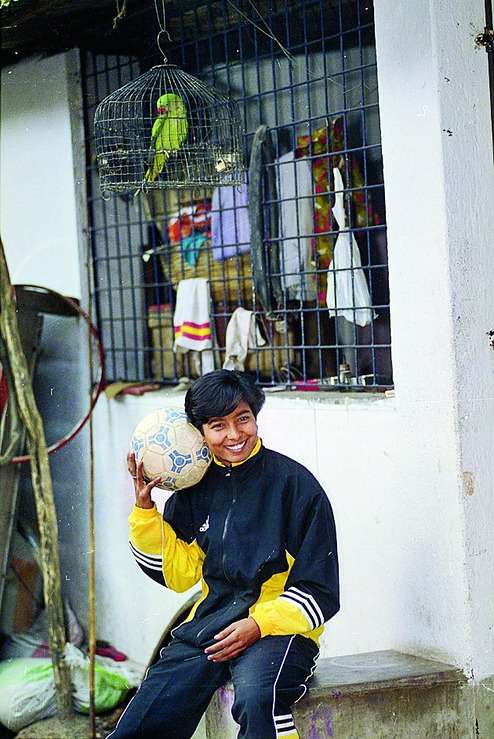
FOULED: (From top) Archer Dola Banerjee (left) with Bombayla Devi Laishram and Deepika Kumari after winning gold in the 2010 Commonwealth Games; a file picture of current football coach Sujata Kar; Kar’s ward Rojina Khatun

A 17-year-old was returning from a neighbourhood function with her mother when they stopped at a grocery shop. The small television set was telecasting a weightlifting competition. Mother and daughter watched a young woman struggling to lift a bar with weights on either side. As other bystanders watched in awe and cheered, the mother wondered what the big deal was. After all, her daughter would routinely lift heavy sacks of grain by way of running errands for their neighbours in Habibpur village of Bengal’s Nadia district. “Some of the elderly people would ask me to lug a sack or two to the storeroom on the second or third floor for a rupee or two. Sometimes they would shoo me away after the work was done,” says Rakhi Halder, weightlifter from Bengal.

Egged on by her mother, Rakhi signed up for formal training at the local club – a single-storey structure with a big hall, some equipment and a tin roof. She says, “They had a couple of weights and the only ones who ever practised were men.” When the trainer asked her to lift a 40-kilo weight, she did so effortlessly. And that is how, within five days of signing up as a weightlifter, when she could barely tell a “clean and jerk” from a “snatch”, Rakhi participated in a state-level competition and won it too. A year later, in 2012, she won the Oceania Commonwealth Junior Championship in Australia.

Since then, Rakhi has gone on to break Karnam Malleswari’s record in the 33rd Women’s Senior National Weightlifting Championships in Mangalore, Karnataka. She had trained to participate in the Commonwealth Games in Gold Coast, Australia, that begin this week, but owing to some procedural issues was not selected. She now has her hopes pinned on the 2018 Asian Games scheduled for September in Jakarta.

But the larger dream she nurtures is to train at least six students before she retires from the sport. As of now, she has one student who has won a gold medal at the 2017 state-level meet. Rakhi and her husband – he is also her coach – Naveen Kumar, are currently employed as Group C staff with the Eastern Railways. They dip into their earnings for Rakhi’s training as well as that of her student. She says impassionedly, “I want weightlifting to stay alive in Bengal.”

Bengal’s sportswomen have always done her proud, be it in swimming, table tennis, football, archery, volleyball or cricket. Bula Chowdhury crossed the English Channel in 1989, Dola Banerjee has a world record in archery, Sujata Kar played in the Indian football team, Poulomi Ghatak is creating new records in table tennis, Mehuli Ghosh just won two bronzes at the ISSF World Cup… But there is a common refrain – the state government has done very little for its sportswomen in terms of infrastructure, funding and support. In fact, they have, most often than not, owed their sporting success to their peculiar life situations and a history of hardship.

But post success, after travelling the country and a fair bit of the world, these women have realised that there is no merit in waiting around for more such happy accidents. To raise generations of sporting talent, there must be a plan and there must be investment – emotional, physical and financial.

We are at Rakhi’s two-room Railways quarters discussing all this. The living room has been converted into her practice area. The bar and weights are kept in neat stacks, the floor mats are spread out evenly and on one side is a single bed. It is her day off and she has been trying her hand at making idlis – her husband, who is from Telangana, has taught her how to.

Rakhi continues her tale. She was strong and sturdy from childhood. “I’d sometimes plough the field with my father, pick up a calf in my arms and cuddle it. I did not find physical labour exhausting,” she says. When her mother took her for formal training to the village club, she went without boots or belt.

“At that time we had no money. My father had been in coma for two years and my mother was working as a domestic help. The trainer at the club was too kind to ask me to pay an admission fee. He told me I could pay Rs 51 as guru dakshina whenever I could afford it,” says Rakhi.

Indeed. That a lot of Bengal’s sporting talent at all makes it to the big arena owes itself to individual goodwill.

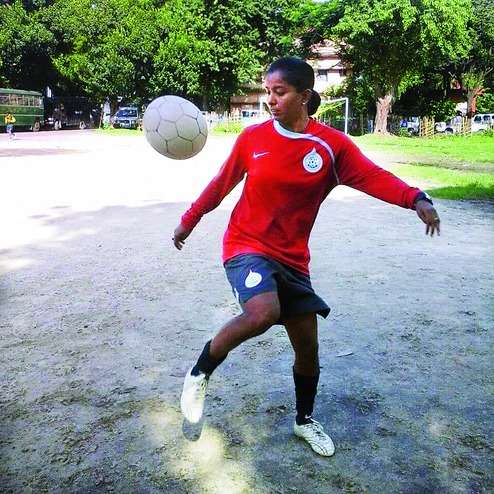
Former captain of the Indian women’s football team, Sujata Kar, has a day job with the West Bengal Police but she is now a full-time coach. When we enter her fourth-floor flat at the police quarters in south Calcutta, she is sitting on the floor applying ice pack on the foot of a young woman in jersey and shorts. Two others of the same age come out from one of the bedrooms. Rojina Khatun, Barnali Tara and Devlina Roy are all Sujata’s students and live with her right through the football season. Most of them are from interior Bengal and come from impoverished families. Rojina’s father used to work in a jute mill before it shut down. Devlina’s father is a farmer. Barnali’s father is a vendor, he sells bananas. Says Sujata, “They cannot do the daily commute and play – it is exhausting. I take care of their diet. My mother cooks for them.”

Sujata herself had to struggle much before she could play. She was 15 when she convinced her father, an odd jobs man, to allow her to play football. She had borrowed a jersey and shorts from her brother who was a footballer himself but had to give it up after he suffered an irreversible injury. “My mother sold our brass gamla, or tub, to buy me a pair of boots,” she says.

Her father gave her a month to prove herself. “I used to walk down from my home in Kalikapur to the Jadavpur University football ground – five kilometres – and at times to the Sirity football ground near Tollygunge – another 10 kilometres – for practice. I could not afford to pay the Rs 2 bus fare every day.” It is this empathy that seems to fuel her deep investment and engagement with these young footballers.

She tells us that football holds little future for women. “East Bengal and Mohun Bagan dissolved their women’s teams in 2008. Right now, all they have is the I-League. Match fee is Rs 5,000 per person, which is neither here nor there. What about the future of these girls?”

Former cricketer with Team India and currently Bengal’s minister of state for sports, Laxmi Ratan Shukla, lists all that has been done to encourage sportswomen in the state. He talks about an archery academy in Jhargram, cricket academies, swimming clubs… He says, “We have given Rs 5 lakh to local associations who prepare players for the Olympics. Another Rs 2 lakh has been given to the sporting clubs for development of infrastructure.”

That brings to mind something Olympic gold medal winner Abhinav Bindra once tweeted. He said, “Each medal costs the UK £5.5 million (Rs 46 crore). That’s the sort of investment needed. Let’s not expect much until we put systems in place at home.” That was in 2016.

Swimmer Bula Chowdhury knows full well there are things closer home that are more difficult to achieve. She has not been able to open a swimming academy to date. ” Kono support nei… There is no support,” she says, then adds, “Maharashtra, Kerala and West Bengal used to dominate swimming competitions, but now it is Bangalore. It has the best infrastructure in the country to train swimmers. But we have not graduated beyond those ponds that existed when we trained in the 1970s.”

What Dola says about archers is not very different from Bula’s account. According to her, while international level recurve sets start at Rs 1.5 lakh, many archers in Bengal practise with bamboo bow and arrows even today. There are about three to four archery clubs but none is in good condition. The then bleeds into the now. It seems to matter less what time or what sport we are talking about. The sense is, if it is Bengal, then someone has pressed the pause button on sports.

Sujata is realistic, hopes her students will at least land a job in the sports quota. But who’s to explain to the young ‘uns that their fledgling passion in all likelihood won’t ever find a bigger playing field?

“I want to play,” says Rojina. “I want to play before the whole world.”

source: http://www.telegraphindia.com / The Telegraph,Calcutta,India / Home> West Bengal / Moumita Chaudhuri / April 01st, 2018
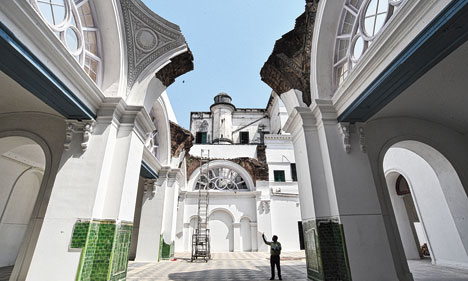
Glass-top gallery at Currency Building

The courtyard of the 185-year-old Currency Building
Dalhousie is being restored by the Archaeological Survey of India. The remnant of the dome to the left was in a state similar to the one on the right and has now been restored.
The green tiles (above) with nettle patterns have developed cracks in some places and a few have broken edges. A technique called lime punning, which involves application of a mixture of lime and sand, is being used to prevent water from seeping into the inner side of the tiles and conserve them. / Pictures for all above by Sanjoy Chattopadhyaya

Calcutta:

The large courtyard of the more than 150-year-old Currency Building, designed in Italian style, will soon be turned into an exhibition hall for the National Gallery of Modern Art with a glass roof over the remnants of demolished domes overhead.

The flat toughened glass ceiling will allow sunlight to stream in and keep the view of the domes unhindered.

Conservation and restoration work is underway at the protected monument, which is under the custody of the Archaeological Survey of India (ASI). The first and second floors of the building’s west wing, facing Dalhousie Square, will also be handed over to the National Gallery of Modern Art (NGMA).

The building was “founded” in 1833, according to the ASI website. “It initially housed Agra Bank and was named Currency Building when the government took over a large portion for its currency department,” the website states.

The building had been in use till 1994. The Central Public Works Department (CPWD), which was in charge of the building, started demolishing the structure in 1996.

In the book White and Black, Soumitra Das writes that the destruction was stopped after the Calcutta Municipal Corporation (CMC) and Intach (Indian National Trust for Art and Cultural Heritage) intervened. The ASI was given custody of the building in 2005. But the three massive central domes had been pulled down by then.

Architects and engineers are now conserving the tiles on the walls of the courtyard and restoring the hollow walls on the first and second floors.

Some tiles with nettle designs have developed cracks while a few others are damaged along the edges. Instead of restoring the tiles, which would involve filling the gaps with similar tiles, the ASI has decided to conserve them using a technique called lime punning (see caption).

“Lime punning will prevent water from seeping into the inner side of the tiles and restrict further decay,” said Sudipta Sen, a junior conservation architect in the project.

Post restoration, only the west wing of the building will be handed over to NGMA, which plans to use the space for an exhibition hall and a full branch office.

“An office in Calcutta would help researchers as they would be able to approach the city office for help instead of going to Delhi,” said Adwaita Charan Gadanayak, the director general of NGMA.

“We expect to get the space within three months. The ASI is working very fast. Once we get the space, we will use some of it for permanent display of paintings and artefacts and the rest for exhibitions,” Gadanayak said.

“A memorandum of understanding was signed in 2015 and work was carried out in phases. Recently, we have quickened our pace and hope to hand over the space to NGMA soon,” said G. Maheshwari, the superintending archaeologist of ASI’s Calcutta circle.

The first and second floors of the west wing are also being done up. Each of the floors has three rooms and a 40-metre-long hall. Together, the two floors hold 12,055 sq ft of space.

The east wing has offices of the ASI and National Monuments Authority.

source: http://www.telegraphindia.com / The Telegraph,Calcutta,India / Home> Calcutta / by Subhajoy Roy / April 01st, 2018

Antarctica scholar was from Purulia

Purulia:

A Purulia youth engaged in researching Antartica’s climate died at the world’s southern tip.

Suvojit Sen (23) was part of the 37th Indian Scientific Expedition to Antartica, a project his family said sees few applicants owing to the risks it involves.

Brother Subhankar was informed of his death on March 27; the family is unaware of when his body will reach them.

Goa-based National Centre for Antarctic and Ocean Research (NCAOR), where Suvojit was employed, said in a release: “He met with an accident during convoy operations at Ice Shelf and suffered major trauma late March 26. He was immediately rushed towards the expedition vessel and doctors joined with medical help. Unfortunately, attempts to revive him went in vain.”

The convoy operation was heading from the Indian Research Base, Maitri, to Ice Shelf, a distance of approximately 80 km.

Subhankar finally told father Dilip Sen and mother Mukta of Suvojit’s death on Thursday. They were shell-shocked and unable to speak when TOI visited their home in Purulia’s Dulmi-Nadhia locality.

Suvojit graduated from JK College in Purulia. His outstanding Geology scores in 2014 helped him get into IIT Bhubaneswar for his Masters.

Suvojit applied for the 37th ISEA project last year and was selected. He left home on October 19, 2017.

Subhankar said: “Suvojit would call us from Antartica regularly and tell us of his experiences amid ice and snow. He was very happy with his work and the opportunity to have a unique experience so early in his career. Suvojit was staying with his colleagues at a base camp named Maitri. He would tell us it felt like being in a completely different world.”

The family said that during his last call on March 24, Suvojit said his project was nearing completion and that he would be returning home before his 24th birthday on April 13 and be around for Subhankar’s wedding on April 26.

source: http://www.timesofindia.indiatimes.com / The Times of India / Home> News> City News> Kolkata News / TNN / March 30th, 2018

Makaibari ‘crown’ for workers

Planter Rajah Banerjee to ‘gift’ his shares

Makaibari tea packets kept in a room at the garden

Makaibari (Kurseong):

The “Rajah” of Makaibari tea has decided to “gift” his crown to workers.

Swaraj Kumar Banerjee, more famous as Rajah Banerjee, said on Thursday he would “gift” his 12 per cent shares in the marquee estate to the workers.

Barely a fortnight ago on March 16, Rajah had declared that he would exit Makaibari by selling his 12 per cent share to the management of the garden led by the Calcutta-based Luxmi Group.

That announcement had come exactly a year after Rajah’s bungalow at Makaibari was gutted in a fire, hastening the 70-year-old’s plans to hang up his planter’s boots.
If the decision is approved under corporate laws, this will possibly be the first time in the history of Darjeeling tea that the owner of a garden will give up his shares for the workers.

“I will gift my 12 per cent share to the workers,” Rajah told a meeting in the garden on Thursday, stressing his aim was to empower the 600-odd workers.

Sources in the Luxmi Group in Calcutta welcomed the move “as long as it is permissible under the Companies Act”. “We have no problem if he wants to give away his shares. It is a welcome gesture. We have to see if this is permissible under the Companies Act,” a source said.

Industry observers said, however, that the share transfer could turn risky, especially in years of poor earnings. “If the garden does not make enough profits and distributes dividends, workers may feel let down and this could be a tricky situation,” one observer said.

Rajah had forged a “strategic tie-up” with the Luxmi Group in 2013 and retained the 12 per cent stake in the estate that his family had been running since taking it over in 1859.

Members of the Makaibari Joint Committee, which represents the workers, on Thursday expressed “gratitude” for the “gift”. Rajah made it clear, though, that “the management representative on the panel will not be entitled to the shares”.

Additional reporting by Sambit Saha in Calcutta

source: http://www.telegraphindia.com / The Telegraph,Calcutta,India / Home> West Bengal / by Vivek Chhetri / March 30th, 2018

All credit to her

Picture by B. Halder

The second edition of The Telegraph She Awards, presented by IIHM in association with Senco Gold & Diamonds and StarOm Realty, celebrated the achievements of seven extraordinary women from Bengal at JW Marriott on Thursday evening.

The winners were selected by a jury comprising US consul-general Craig L. Hall, danseuse Tanusree Shankar and actress Koel Mallick. Arundhati Bhattacharya, the former chairperson of State Bank of India, was inducted into The Telegraph She Awards Hall of Fame.

“If you really want to do something and find it interesting, you will always find a way of learning what you need to learn. So one needs to be learning throughout life,” said Bhattacharya, after receiving the award from filmmaker Aniruddha Roy Chowdhury and fashion designer Anamika Khanna.

source: http://www.telegraphindia.com / The Telegraph,Calcutta,India / Home> Calcutta / March 30th, 2018

100 years on, the chants ring out at Yule House

A Good Friday tradition among workers from Odisha continues at former colonial firm

This Good Friday, the headquarters of the 154-year old Andrew Yule Company resonated with verses from the Bhagavat Gita along with a puja for Lord Jagannath.

A practice started by the Odisha employees of this erstwhile colonial managing agency, under the patronage of Scotsman David Yule has continued uninterrupted through the ups and downs of the company and marks its 100th year in 2018.

Heritage building

Yule House, the headquarters of AY, which managed cotton and jute mills, tea gardens, coal companies, railways and a printing press, with over 80,000 on its rolls in its heyday, is listed as a heritage building in the heart of Kolkata’s business district.

The company was set up in 1863 when Andrew Yule, a strapping Scottish entrepreneur arrived in Calcutta, the then imperial capital of India. He founded a company as a managing agency at a time when railways, telegraph and postal services were making a beginning in the country.

George Yule, Andrew ‘s elder brother took over the reins in 1875. David Yule assumed AY’s control, after his uncle’s death and by 1902, Andrew Yule managed over 30 businesses including a printing press and even a zamindari in Midnapore district, where it promoted agriculture, forestry , fisheries, roads schools, and healthcare facilities.

Among its many employees were several from Odisha. Says septuagenarian Praful Das from Kendrapara, a special invitee to the centenary celebrations: “ Four generations of our family have been working here and since those days, people of all faith have been participating in this puja…It was a small affair then… it has grown in pomp now.”

Fluctuating fortunes

AY’s fortunes dived with the abolition of the managing agency system in 1969 and nationalisation of the coal and the insurance industry. The process of government acquisition ended with AY becoming a public sector enterprise.

However, the puja tradition goes on. Bijoy Panda a third generation employee, explained that the priest comes from Puri carrying a bit of the flag that flies atop the Puri Jagannath Temple and some special offerings from the Temple. The first invite is sent to the titular King of Puri.

source: http://www.thehindu.com / The Hindu / Home> News> Cities> Kolkata / by Indrani Dutta / Kolkata – March 30th, 2018

Calcutta boy Ramit Tandon is fast climbing up the squash charts

Ramit Tandon at The Saturday Club. Picture: Arnab Mondal

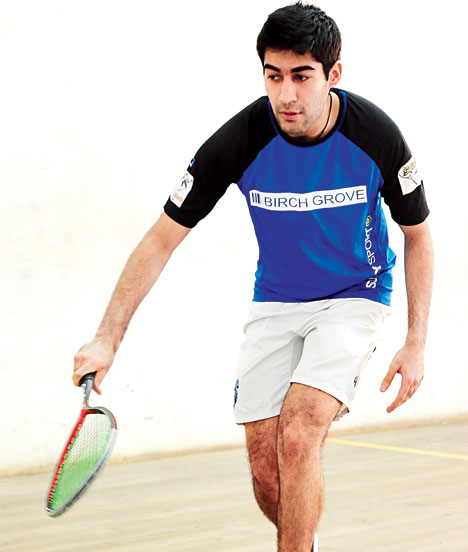
There is something earnest about Ramit Tandon that strikes you instantly. Genial, confident and candid, the 25-year-old started playing squash full-time in September last year and has quickly moved up to become world number 65. Before he left for a training camp to Chennai ahead of the Commonwealth Games next month, t2 caught up with the boy from Lord Sinha Road.

How excited are you about the Commonwealth Games?

I am not feeling the butterflies yet! Once I get to the village and I see the other athletes… maybe then it will hit me. I haven’t processed the thought of being in Australia. I am happy to be home for 10 days with my family. The last week or so, I have been pushing myself hard. Also, squash is such an individual sport, you always enjoy being part of a team. That energy, where you have other people supporting you, means more than being on your own. I am trying not to stress too much. Of course, we will give our best. It is the biggest event for us this year.

When did you start playing squash?

My dad (Raman Tandon, The Saturday Club president) used to play squash. So, I followed him to the club and slowly got interested. By the time I was eight or nine, I started playing.

What’s great about the game?

Well, now my life revolves around squash. The last 10-15 years have been only squash. It’s been a big part of my life. The reason I like it is, it’s fast… in an hour you know the result. It’s a lot of fast thinking. My personality is similar. It’s taught me a lot of life lessons. There are so many different aspects of the game that have to be right to get to the end result.

Take us through your career till now…

I was a top-ranked junior in India from 2010-2012. I moved to the US for my education and graduated from Columbia University, with statistics. I was one of the best college squash players over there. At that point I wasn’t sure if I would play professionally because it is a hard sport to jump into. Cricket and tennis were more out there, more popular. It was a risk and I wanted to hedge myself before taking a risk. I felt I needed to finish my education first.
I worked in finance in New York for two years. Hedge fund job vs professional squash player… pick one… it’s a no-brainer. I mean I really wanted to play squash, but also I wanted to experience the work environment. While I worked there, I kept playing in a few tournaments here and there and got a few good results. The people I met at the hedge fund, like my CEO, were very supportive of my decision to go give it a shot. So, September 2017 I decided that I was going to start playing full-time. I am based in New York and Calcutta and I shuttle. I started off as 400 or something in the world and now I am 65.

Wow!

I have the belief. I am happy about the fact that I moved so quickly. When you start doing something full-time, there is a different sort of pressure to it. It’s hard when you’ve been sitting at the desk for two years crunching numbers.

What was the turning point?

So, Ali Farag, who is the current world number three, I beat him in a tournament in the US while working. I was ranked almost 500 in the world.

I would train quite a bit during the weekends and about three times during the week. Ramy Ashour, who is like the Roger Federer of squash, moved to New York and we became very close and we would train together on a daily basis. When I started working, I would train three-four times a week with him. Training with him gave me a lot of confidence. I think he was a big reason I was able to maintain my game while working.

People started talking after I beat Ali Farag. The buzz around me… people at work would be like… ‘Why don’t you go and play?’ But for me, it was very risky. Also, you are more comfortable on court when you know you have a job and you are not worried about winning or losing… you don’t have to worry about paying rent. I enjoyed that mindset. But then a lot of people around me started telling me… and I started to believe in it as well. I had a few more events which went well.
Then in a game, I lost to this guy who was among the top 20 in the world. I lost to him in five games. That’s when I realised that I was losing out on match experience. I was playing one or two tournaments a year, which wasn’t enough to compete at that level. I was enjoying my job, but I realised that squash gave me more happiness.

How has life changed?

It’s been a change of lifestyle for me. From sitting at my desk for eight to 10 hours a day to hitting the gym in the morning… then squash… then fitness again.

So, a much healthier lifestyle…

I don’t think it’s healthy (smiles). People think an athlete’s life is very healthy, it is not. It’s torture for the body. I can sense it… when I am hating the work I am doing, the tournaments go well after that. If I am enjoying the preparations and not pushing myself hard enough, my tournament doesn’t go well. In six months, I have realised that. We overdo it for sure and you need to because the competition is so high.

A lot of the hard training is based around the physical stuff and that’s the hard part. At night you are sleepless because you’ve been through so much. If you are a professional, there is no day off. At this level, no coach can tell you X amount of work is ideal for you. As a player, you’ve got to figure it out… how hard you can be pushed, when you need to slow down.

In the first phase, I went for a lot of tournaments where I overdid it. I realised I wasn’t as fresh as I should be. Sometimes, I didn’t train that hard. It’s all about finding that balance. In matches too, it is a fine line… when to be aggressive, when to stay calm. I am still learning every day. The first few months was just about finding a routine. Now, I think I have just stabilised into a routine. The challenge has been to get used to all the physical work, the travelling and finding the exact balance… which I am still figuring out.

What is your workout routine like?

I play for about a couple of hours in the morning, followed by a fitness session… could be gym or sprinting for another hour or two hours. Gym is at The Saturday Club… I work with Anwar Wahhab. He has been with me since I was eight or nine. By the time I am out, it is 1pm-2pm. Then it is time for lunch and then I am back training around 4pm. In the evening it is mostly skill and then maybe a relaxation session… swimming. I am back home by 8pm-8.30pm.

You need a strong core to prevent injuries. My sport requires a lot of speed and agility. It is all about developing strength without getting too bulky. For me, it is a lot of leg work and a lot of core work. I do sprinting sessions for the cardio. I do agility and footwork sessions for the quick turnings. I enjoy this the most. I do swimming mostly as recovery and cardio.

Have you picked up anything from Ramy Ashour?

He is very unique. Most of it is the mental side. I want to go into a match feeling how you go to office. On match days, I still wake up feeling it is an event, a festival. And that is never good.

What is your bigger goal?

By this year end, I would like to get into the 30s. I am happy with the progress so far. I feel I can still do better.

So, you are not easily happy?

I am not. I don’t know if it is a good thing or a bad thing. (Smiles)

KNOW RAMIT

Joined PSA World Tour in September 2017
Current world rank: 65
Was the ‘top male player’ of the Indian team that finished 2nd at the U-21 World Cup in 2012
Won 2 PSA world titles in 2017
Won 6 junior national titles
Captain, Indian junior team (2010-2012)
Asian Junior team championship winner and individual championship runner-up
I unwind: By following the markets!
Music fave: Marshmello.
Fave actors: Shah Rukh Khan, Leonardo DiCaprio.
Fave actress: Deepika Padukone, and Alia Bhatt because she watched my match in Bombay.

source: http://www.telegraphindia.com / The Telegraph,Calcutta,India / Home> Lifestyle / by Saionee Chakraborty / March 27th, 2018

Medal sweep for city rowers

8 girls from 3 varsities bag 4 golds

Rabindra Sarobar:

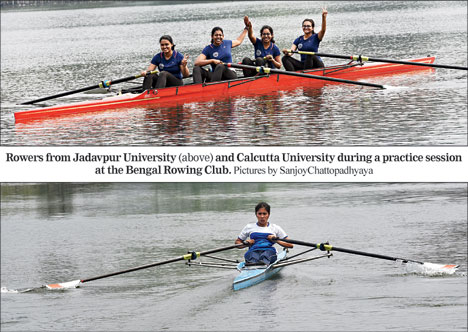
Three hours of paddling before class and three hours in the evening, year after year, brought gold and silver for eight city girls representing their universities at a rowing championship in Chandigarh last week.

Teams from Jadavpur University (JU), Calcutta University (CU) and Maulana Abul Kalam Azad Open University of Technology (MAKAUT) bagged golds in four categories – 2,000m fours, 500m and 2,000m heavyweight single scull and 2,000m lightweight – besides two silver and three bronze medals.

Rowing rivalry between university teams has a rich history, the most famous being The Boat Race – an annual contest between rowing crews from Oxford and Cambridge universities on the Thames.

The boat races on Sukhna Lake in Chandigarh earlier this month lived up to the legendary competitive spirit of the London races. One of the closest races was the 2,000m heavyweight women’s fours, in which the JU team finished just 1.5 seconds ahead of Punjab University.

“It was a wonderful feeling to beat the Punjab University team. It’s basically the same girls who participate in the national and the inter-university championships. They are a very strong team and we have a rivalry going. So, the win was special,” said Semanti Choudhury, who is doing her MSc in economics at JU.

Semanti and her team mates, as well as the girls from CU and MAKAUT start rowing in the Dhakuria Lakes at 5.30 every morning. The morning practice session goes on till 8.30am. In the evenings, they practise in boats or work out on rowing simulators at a rowing club.

The girls happily turn away from hanging out with friends as it interferes with their training schedule. “It’s easily 9.30pm by the time I can open my books. I study till midnight and the next morning I am at the club for practice,” Shramana Saha, a first-year English honours student at JU and part of the winning team in Chandigarh. “I have no social life and all my friends have come to accept that. Staying up late is not an option either.”

The other two girls in the the team were the Brahmachari sisters – Shreyaa and Shweta.

Aishwarya Krishnan, a BCom student of St Xavier’s College who won a gold in 2,000m, a silver in 500m lightweight single scull and a bronze, will soon start preparing for the National Games to be held in Goa in November.

For Mayurakshi Mukherjee, a student of electronics and communication engineering student at the Heritage Institute of Technology under MAKAUT, it has always been motivating to get recognition for the hard work put in.

“We practise hard all year, through rain and shine,” said the winner of a bronze for India in 2015. She won the 2,000m and 500m golds in the single scull heavyweight category in Chandigarh.

source: http://www.telegraphindia.com / The Telegraph,Calcutta,India / Home> Calcutta / by Rita Basu / March 27th, 2018