Film on rickshawala’s Ladakh feat feted

Kolkata :

Satyen Das was busy picking up passengers on his rickshaw at Geetanjali Metro station in Naktala when he got to know a documentary film—‘Ladakh Chale Rickshawala’ — on his rickshaw journey from Kolkata to Ladakh had won the Best Exploration/Adventure Film at the 65th National Film Awards announced in New Delhi on Friday.

By afternoon, when he got the news, the 44-year-old had already earned Rs 150, but he was more excited about the award. It’s his love for adventure that gave him the courage to fight all odds to complete the treacherous journey, says Das.

It turned out to be a life-changing moment for Das, when Indrani Chakraborty, a television producer from Naktala, hailed his rickshaw in 2014. During the short journey, she learnt that Das was planning to leave for Ladakh soon. He fished out old pictures of him visiting Puri and some places in north India on his rickshaw and showed it to her. At that moment, Indrani decided to shoot his journey to Ladakh and turn it into a film.

“I didn’t have the money to follow Satyen Das on his entire journey to Ladakh, so taught him to shoot on a handycam. It was tough when the handycam stopped working after he crossed Benaras and someone from my team had to rush to where he was and get it repaired. Two of my associates and I met him on the final leg of his trip in Ladakh,” says Indrani.

Das credits Indrani for helping him in completing the journey and doesn’t forget to thank some of his regular passengers and members of Naktala Agrani Sangha, a club in his neighbourhood.

“I drove my wife and daughter to Puri and north India and was inspired to take my rickshaw to Khardung La mountain pass, the world’s highest motorable road, 39 km Leh. I got help from Indranidi, a few of my passengers and members of Naktala Agrani Sangha. There were many challenges; every day, someone or the other would ask me to return to Kolkata. ‘You can go till Srinagar, not beyond,’ they told me. But I didn’t budge,” recalls Das.

For Das, food was as big an issue as the lack of oxygen and the inclement weather. “I carried basic ingredients like rice and potatoes. I would either have aloo chokha-bhaat or instant noodles; it was more of a fight for survival,” he says.

But the toughest part of his journey came when he reached Zoji La pass. “The roads were rough and there was no way that I could carry my belongings on the rickshaw and cover the 8-km stretch. I would offload everything on the road drive the rickshaw for a few metres and return to carry the things on my shoulder. It took an entire day to cross that stretch, but I didn’t stop. I wanted to create a record of sorts by reaching Khardung La.”

Das, who shot his journey on a handycam, was joined by a three-member camera team in Ladakh. “From thereon, there was no looking back. I returned to Ladakh again in 2017, this time with the message of fighting global warming. I sprinkled 5,000 date seeds along the way.”

His rickshaw has been put on display at the university campus set up by Sonam Wangchuk in Ladakh. Indrani, who helmed the documentary film, said even though the journey took two-and-a-half years to complete, it took her three years to finish this 64-minute film. She approached Films Division, which has taken the project under its wing.

source: http://www.timesofindia.indiatimes.com / The Times of India / Home> News> City News> Kolkata News / by Zinia Sen / April 04th, 2018
How Salt Lake was born

Birthday special

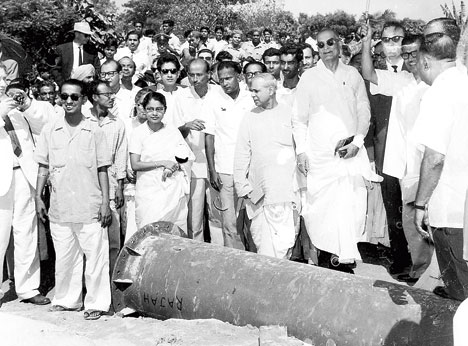
Chief minister Bidhan Chandra Roy and Ajay Mukherjee inaugurating the Salt Lake reclamation scheme on April 16, 1962. A Telegraph file picture

It has been 22 years since he retired as administrator of Salt Lake Reclamation and Development Project, having handed over the reins of the township to the newly formed Bidhannagar Municipality the year before, but Pran Kishore Chatterjee still has data related to the formative years of Salt Lake at his fingertips.

Seated in his AD Block home, the 80-year-old reminisces about the time when chief minister Bidhan Chandra Roy visualised founding the Calcutta Eastern Garden Suburb. “The city was bound on the west by the river, the southern fringes were becoming refugee colonies which would have been tough to dislodge. So the east was the only direction to expand. He had once travelled by launch till the house of Hem Chandra Naskar (former Calcutta mayor) near Mahisbathan and I have heard it was during that voyage that the idea came to him.”

The idea was to reclaim about 6 sq miles of the marshland by dredging the bed of river Hooghly and pumping in the slush. An estimated 124 crore cubic feet of earth would be needed to raise the area to +12. This was a unit followed by the public works department to determine how much higher the land level of a place would be compared to the Hooghly water level. “Salt Lake was originally a low-lying saucer-shaped area, where the waste of Dum Dum Park and Bangur would be drained. That also helped pisciculture practised here. The area was now to be raised to a level high enough to ensure that it would never suffer inundation. That is why Sector I and most parts of Sector II have no need for drainage pumping. Water naturally gravitates to Kestopur Canal. A drainage pumping station was built much later for Sector III opposite Nicco Park when the area was found to be too far from Kestopur Canal. The Eastern Drainage Canal was excavated for the purpose.”

The dredging started on April 16, 1962 and 11 floating units (two dredgers, two tug pusher boats, two bergs and two survey launches and three boosting stations) were deployed.

A survey had earlier been done on the Hooghly to check where the riverbed level was highest. A shoal at Ghushuri, near Chitpore Lockgate, was deemed the closest. That is where the dredging started. Using a booster pump, the slush was sent to Ultadanga, near Golaghata. The soil would be dumped at the site while the water would be drained into Kestopur Canal.

By 1967, about 90-95 per cent dredging was done. By then, the young engineer had participated in the government’s Re 1 lottery for distribution of plots in 1965 and got three cottahs at Rs 2,750 per cottah. “We used to stay in Jodhpur Park then. Since there was no transport, the Salt Lake Project ran a bus from Ultadanga crossing just to show prospective buyers how the area was developing. Still there was little interest as people thought houses built on a bed of sand would sink.”

One day, he brought his wife and father-in-law to show the plot. “A few houses dotted the expanse amid dense overgrowths of bulrushes. There was not a single tree in sight. The wind blew sand into the eyes and nostrils. I still remember my father-in-law’s sombre face when he set foot here.”

The Chatterjees did move into their newly built house in 1979 and stayed for two-three years before he was transferred. They settled permanently in 1988. He took over as administrator the year after. The Bidhannagar Notified Area Authority came into being in 1990.

Pran Kishore Chatterjee at his AD Block residence on Wednesday. (Sudeshna Banerjee)

“Initially when we were planting trees, we avoided fruit-bearing trees so that there would be no disputes over the fruits. But that kept the birds away. So we changed our decision and planted mango, wood-apple, jamun later.” Another lesson learnt along the way was keeping space for cooperatives and not just individual plots. “That is why you see all the cooperative complexes in Sector III which was the last to come up.”

Three types of roads were planned — arterial, spinal and local i.e. inside blocks varying in width from 48.46m to 9.14m. Interestingly, First Avenue is not the widest because it was never meant to be the primary gateway it has become.

“Second Avenue was supposed to be the arterial road. But when dredging started the familes that stayed in the area relocated to the highland which later became Duttabad slum. We never bothered about them then as we could carry out our work. But later when their presence blocked the exit from Second Avenue to the Bypass, an alternative exit had to be found in CA Block.”

He takes a lot of pride in pointing out that 23 per cent space was kept for roads. “At that time, the figure was barely 7 per cent for Calcutta.”

And though New Town was born long after his retirement, he likes to believe he made a contribution there too. “Gautam Deb (then the chairman of Hidco and the housing minister) had sought my advice. I told him not to repeat the mistake made with Salt Lake where no one from outside could make out how the township was developing. I asked him to first curve out a road to the airport through the project area so that people could see the development being undertaken,” he smiles.

DID YOU KNOW?

Originally 15sq km of marshy land was supposed to be reclaimed. But there was hue and cry about drainage getting clogged so Nalban and Chinta Singh Bheri were left out and the remaining 12.35sq km was reclaimed.

source: http://www.telegraphindia.com / The Telegraph,Calcutta,India / Home> Calcutta / by Sudeshna Banerjee / April 13th, 2018

Textiles ministry pitches for GI tag for more Bengali sarees

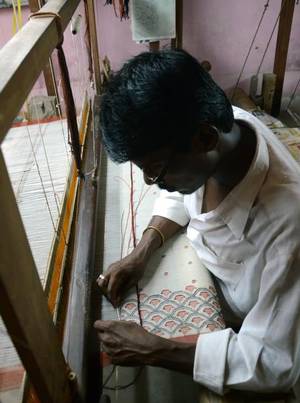
The Bengali Jamdani does not have a GI tag yet. Here, a weaver at the pit loom works on a Jamdani print at a factory in Kana, West Bengal. File photo. | Photo Credit: Sushanta Patronobish

So far, only three types of sarees from West Bengal — Baluchari, Santipur and Dhaniakhali have obtained the GI tags.

The textiles committee of the Union Ministry of Textiles has asked the various weaving communities of West Bengal to apply for the Geographical Indication (GI) tag for Intellectual Property Rights (IPR) protection.

So far, only three types of sarees from West Bengal — Baluchari, Santipur and Dhaniakhali have obtained the GI tags.

“We are asking the different weaving communities of West Bengal to go for GI registration. Some of them are the weavers of Bengali Jamdani, Begumpuri and Bengali Tangail sarees which have huge export markets,” deputy director of the Textiles Committee of the textiles ministry T.K. Rout told PTI.

The weavers of scarves and stoles of Fulia should also apply for GI registration, he said.

Mr. Rout said that once these weaving communities get the GI tag, their IPR would be protected and legal action could be initiated against those who were not bonafide claimaints of these textile products. “Even the export markets of these products would be protected,” he said.

“GI is IPR which provides protection to the products which have origins in a particular geographical location and different from patents and trademarks,” Mr. Rout added

It also gives protection to those weaving communities from counterfeit claims by others, he said adding that the ministry was working to facilitate this process.

As of date, 270 products of the country had been registered under the GI Act, out of which 151 of those belong to the textiles and handicrafts segment.

source: http://www.thehindu.com / The Hindu / Home> News> Cities> Kolkata / by PTI / Kolkata – March 16th, 2018

Calcutta boy’s haveli hotel in Bikaner

Forefather’s legacy reinvented with honesty of heritage

Golpark:

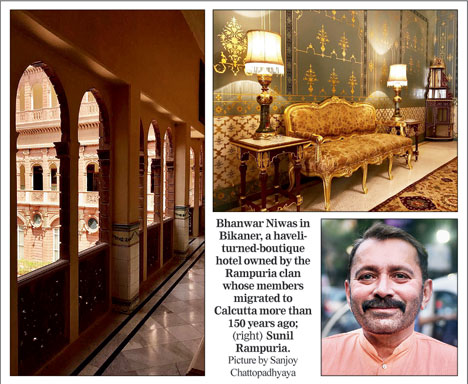
A Calcuttan whose forefathers had migrated to the city from Rajasthan more than 150 years ago has returned to his roots to turn an ancestral haveli into a boutique hotel.

Bhanwar Niwas, one of the famous mansions owned by the Rampuria clan, stands in the old walled city of Bikaner. The haveli had been built in the late 1920s by Seth Bhanwarlal Rampuria, heir to a textile and real estate fortune in Calcutta. It became a boutique hotel in 1993 at the initiative of Bhanwarlal’s grandson, 61-year-old Sunil Rampuria.

Sunil, an alumnus of La Martiniere for Boys and St Xavier’s College, is now based in Bikaner but keeps visiting Calcutta, which he calls “home” and where his parents and in-laws remain.

“The Calcutta I grew up in has made me the person I am. The city is steeped in tradition but that has not stopped it from being liberal. Calcutta moulds you,” Sunil said.

He remembers going to a kindergarten school on Royd Street that used to be run by a Spanish woman and an Iraqi man. “I always wondered why their surnames were different. Back then, living in was not a common thing,” he quipped.

Sunil had sold a house in Vizag, where he had worked in a construction company for several years, to fund the facelift of Bhanwar Niwas.

Although the property is more than 90 years old, it did not need much renovation. The architecture of the three-storey mansion is a mix of Indian and European styles with a majestic facade and a sprawling courtyard in the middle. Multiple staircases and large rooms complete the heritage look.

“People from my native place came to work in Calcutta and eventually settled down. But there were relatives back home. They built large houses because they were a status symbol,” Sunil told Metro before returning to Bikaner last weekend.

Several bhujia makers in the city trace their roots to Bikaner. The Rampurias are one of the oldest among these clans with several havelis spread among Sunil’s distant relatives.

His great grandmother lived there until 1988. Sunil left Calcutta in 1992 when he was 27 and started the project the same year. He was married with three children and his parents were apprehensive about the decision because of the risks.
In Bikaner, people were surprised that Sunil was reversing a trend. While his forefathers had migrated from a provincial town to a booming business centre, he was returning from Calcutta.

Before the hotel opened, Sunil made changes like carving attached bathrooms out of the large rooms. He did the stencil-painted wallpapers himself.

The hotel has done well over the years. “I don’t have go to Delhi to solicit business,” Sunil said.

Bhanwar Niwas offers a wholesome period experience in its own way. It is located in the middle of a locality and guests can see people celebrate local festivals. There are no TVs in the rooms because Sunil wanted to be “faithful to the period when the mansion was built”.

It is hard to miss the connection with the Best Exotic Marigold Hotel, the 2012 film about a young Sonny Kapoor (played by Dev Patel) who wants to realise his father’s dream of restoring a grand hotel in Jaipur.

Sunil downplays the comparison, but is proud that his eldest son Prashant now looks after Bhanwar Niwas.

Calcutta is dotted with centuries-old buildings that are caught in the conservation conundrum.

A little over a month ago, the Calcutta Municipal Corporation allowed the building that housed the old Kenilworth Hotel to be demolished by its present owners after downgrading its heritage status. Heritage conservationists alleged a builder-official nexus.

Metro reported last week that Tripura House, the stately Ballygunge Circular Road mansion, will have a residential highrise share a portion of its 100-cottah compound after the West Bengal Heritage Commission gave its nod to a project rejected by the civic body.

Heritage has to be relevant to make conservation viable, Aishwarya Tipnis, an architect working on French heritage structures in Chandernagore, said in a lecture at the Indian Museum last Wednesday. “Conservation is no rocket science. It is far from a NASA code that can’t be cracked,” she said.

Sunil seems to have cracked the code.

source: http://www.telegraphindia.com / The Telegraph,Calcutta,India / Home> Calcutta / by Debraj Mitra / April 12th, 2018

Shooting silver and a promise to ‘sir’

Coach relives olympic medal miss in ward’s Commonwealth shoot-off

Mehuli Ghosh after shooting a bullseye to tie with the eventual winner, Martina Lindsay Veloso of Singapore. (Reuters)

Calcutta:

The shot at gold in the women’s 10m air rifle event at the Commonwealth Games was down to two competitors. Martina Lindsay Veloso of Singapore had just scored 10.4 in her final shot and nothing less than a bullseye would give her rival a chance. Mehuli Ghosh hit exactly that: a 10.9.

The crowd erupted as Mehuli pumped a fist, kept her rifle down, took off her blinder and stepped back from her position. Thousands of miles away, in New Town, her coach Joydeep Karmakar yelled at the TV: ” Hoyni (It’s not over)!”

Martina and Mehuli were tied at 247.2, a new Games record, and the gold was to be decided by a shoot-off.

Joydeep, who himself missed an Olympic medal at the London Games by a whisker, knew it would be tough for his ward. “It’s not easy to quickly regain position. The body has to be aligned with the target and weight distributed between outstretched legs for perfect balance. This is achieved over several shots,” he told Metro within minutes of Mehuli finishing second.

When she called, the first word Mehuli uttered to her coach was “sorry”.

“She told me, ‘ Jani tumi rege gyachho (I know you are upset)’. I told her I was about to break the TV,” Joydeep said.

Mehuli had been misled by her name overtaking Martina’s on the scoreboard. “She missed the rank ‘1’ against both names and the term ‘s-off’ to the right,” Joydeep said.

Mehuli scored 9.9 to Martina’s 10.3 in the shoot-off. “If only I were there, I would have shouted out to her about the tie,” the disappointed coach said.

But he had regained his composure quickly enough not to make his ward feel any more miserable about missing the gold. “What happened was because of inexperience. She is just 17. Girls her age chat and have fun after school while she is hard at practice,” he said. “Mehuli has promised me she will make up for the loss.”

As the nation woke up to the Baidyabati girl’s feat, mother Mitali spoke of the two-hour journey, with four changes of transport, she makes almost daily to reach Joydeep’s academy at The Newtown School.

“This has been her routine since she was 14,” she said.

To let her focus on shooting, Mitali had even allowed her daughter to skip the board exam this year.

source: http://www.telegraphindia.com / The Telegraph,Calcutta,India / Home> Calcutta / by Sudeshna Banerjee / April 10th, 2018

Leander Paes — Timeless wonder

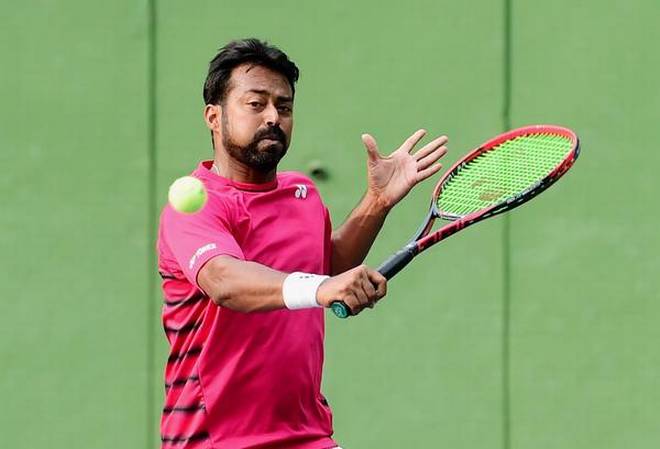
Leander Paes. | Photo Credit: PTI

A look at the career highs of Leander Paes.

1990: Starts his Davis Cup career at the age of 16, with Zeeshan Ali his first doubles partner.

1991: Wins junior titles at the US Open and Wimbledon to become Junior World number 1.

1995: Ranked No. 130, manages to beat World No.7 Goran Ivanisevic in a five-setter on grass in the Davis Cup.

1996: At the Atlanta Olympics, beats Fernando Meligeni to win India’s first individual bronze in 44 years.

1998: Bags the Newport ATP title and beats Pete Sampras at New Haven.

1999: Along with Mahesh Bhupathi reaches the finals of all four Grand Slams, winning Wimbledon and French Open. Reaches the No.1 ranking in doubles.

2000: Given the honour of carrying the Indian flag at the Sydney Olympics.

2003: Wins the mixed doubles events at the Australian Open and Wimbledon partnering the legendary Martina Navratilova.

2006: Leads the Indian tennis contingent at the Doha Asian Games. Bags two golds with Mahesh Bhupathi and Sania Mirza.

2013: Clinches the US Open doubles title with Radek Stepanek to become the oldest male Grand Slam winner at 40. Bestowed the country’s third-highest civilian award, the Padma Bhushan.

2016: Secures his 42nd Davis Cup doubles win (partner Rohan Bopanna) with a victory over South Korea. Ties with Italian Nicola Pietrangeli for the all-time record.

2018: Claims a record-breaking 43rd Davis Cup doubles win in the Asia Oceania Group I tie against China. Paes also has the most number of wins (doubles and singles combined) among active players at 91.

source: http://www.thehindu.com / The Hindu / Home> Sport> Tennis / April 08th, 2018

Meet the RJ who is making it fashionable to speak Santali

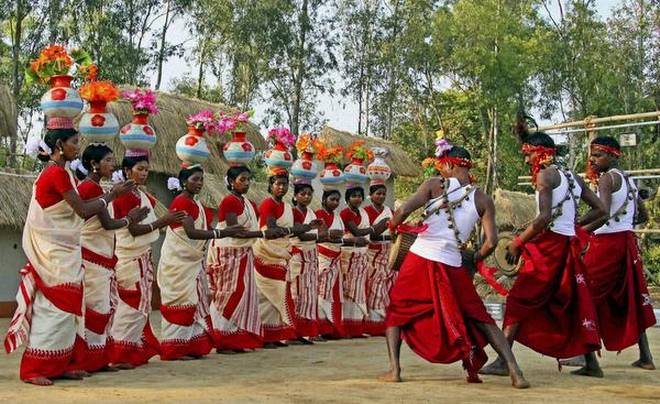
Santal people performing a traditional dance. | Photo Credit: PTI

While Bengal has more than two million Santali speakers, the number is dwindling
The onset of spring has dressed Jhargram, the district on the western corner of West Bengal, in the flaming colours of the palash flower. The flowers of the mahua tree are also scattered everywhere; women are collecting them in buckets to brew wine as the sun dips into the horizon. The radio is on to keep them company, tuned in to Radio Milan, 90.4 FM where RJ Shikha Mandi is hosting a programme called ‘Johar Jhargram’ (Greetings, Jhargram), which focuses on Santali language and culture.

A man, speaking in Bengali, calls in with a request for a Santali song. The RJ urges him to speak in Santali since, it turns out, the caller is Santali. The man says he understands Santali but can’t speak it properly. Mandi’s enthusiastic voice asserts that it’s better to speak broken Santali than not to speak it at all. It’s their mother tongue after all.

Santals are the largest tribal community in Bengal, which has more than two million Santali speakers. The language was included as an official language in the eighth schedule of the Constitution in 2003, but only a few schools in Bengal use it as the medium of instruction.

Best interests
The Bengali-speaking population of Jhargram also tends to look down upon the language and the community. “We speak Santali among ourselves. The Bengalis here don’t know our language, and it’s in our interest to learn to speak Bengali — most businesses here are owned by Bengalis,” says Shibu Soren of Kalaboni village near Jhargram town, taking a sip of mahua wine.

Given such realities, it is not surprising that the number of Santali speakers is dwindling. Outside Bengal, Santali is spoken in Jharkhand, Bihar, Odisha, and some parts of Tripura.

It’s in this milieu that the twenty-four-year old Mandi of Radio Milan has been trying to make Santali fashionable. From the Santali community herself, Mandi has lived most of her life in Kolkata, but returned to Jhargram after completing her studies to become an RJ. In the few months of its existence, the programme she hosts, ‘Johar Jhargram’, has become hugely popular, crossing the boundaries of Jhargram to reach Kolkata, which may be only five hours away but far removed culturally and linguistically. People also tune in to ‘Johar Jhargram’ from different parts of India, Canada and the U.K. on a mobile app.

Mandi says it’s her bitterness at being seen as ‘inferior’ by her Bengali classmates in her Kolkata school that inspired her to take up the cause of Santali.

“I was often dismissed as a tribal, and for slipping into Santali in school. I made it a rule to never speak Santali outside the four walls of home.”

Shikha Mandi | Photo Credit: Ashok Nath Dey

Mandi was born in Belpahari, 40 km from Jhargram, and sent to Kolkata for schooling when she was four. In Jhargram, regular classes would have been impossible. Part of the Red Corridor, the area has seen a lot of Maoist violence in the last two decades.

Mandi’s two-hour radio pragramme, which airs between 4:00 and 6:00 pm from Monday to Saturday, takes up different issues relevant to the community — from education and child labour to traditional harvest festivals.

Songs are played in between; listeners call in and participate, sometimes in Bengali, but Mandi responds in Santali. Mandi’s accent is itself imbued with traces of Bengali, but she has been reading and writing Santali and talking to native speakers to improve her skills. “But in truth,” she says, “no one now knows the language as well as our grandparents do.”

Most parents, in fact, discourage their children from speaking Santali because only Bengali and English can fetch them jobs.

Quiet optimism
Arun Kumar Ghosh teaches at Burdwan University. He has been working on Santali language for three decades now. “It is one of the world’s oldest languages,” he says, “and, interestingly, it still preserves linguistic features that are as old as 150 years.” There is a growing interest in the world outside the Santali community to study the language and absorb the culture, but the community is hesitant to let this happen. “The low literacy within the community is a major cause behind this unwillingness,” says Ghosh.

But the younger generation is slowly beginning to embrace the mother tongue. Usha Soren from Kalaboni tells me while cleaning her courtyard that she sends her son to a Santali language teacher twice a week so that he learns to write in the Ol Chiki script.

Young people like Mandi want to learn about their history and culture in Santali rather than in Bengali. They want to learn to be a Santal in Santali language. Ghosh is optimistic that programmes like ‘Johar Jhargram’, which bring entertainment and information in Santali, can go a long way towards mainstreaming the language.

A journalist based in Uttarakhand, the writer explores the lives of those who walk mountains.

source: http://www.thehindu.com / The Hindu / Home> Inside India> Society / by Arpita Chakrabarty / April 07th, 2018

Chess competition with peace as top prize

The exhibition match at St Lawrence School on Friday. Picture by Sanjoy Chattopadhyaya

Ballygunge:

An online chess challenge for students of Jesuit schools across four continents was launched at St Lawrence School on Friday with a face-off between two grandmasters and a grand prize to checkmate all prizes: global peace.

Around 20 students from schools in the US, Europe and South America have already registered for the event, scheduled to start in mid-April.

The tournament, called Chess ‘n’ Mate, will be played in a league format with each player guaranteed more than one match. The draw will be such that players from countries that traditionally have had strained relations will be clubbed together so that they get to know each other and become friends.

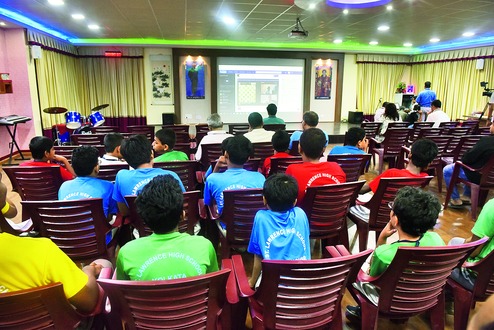
“What happens after the game is just as important as competing. There will be the usual prizes for the winners of the tournament, of course, but what sets us apart is the concept. Competitors will have to coin slogans after each match and the five best lines on the theme “Peace through sport” will be rewarded,” said Rahul Mukherji of the St Lawrence Old Boys’ Association, which is organising the tournament in collaboration with the school.

Jesuits are members of the Society of Jesus, a Roman Catholic order of priests founded by St Ignatius Loyola, St Francis Xavier and others in 1534. They run schools in 160 countries.

The three exhibition matches on Friday were between Grandmaster and former women’s world champion, Alexandra Kosteniuk, who was in Paris, and Grandmaster Dibyendu Barua, who made his moves sitting inside the Fr Wavreil Hall at St Lawrence School.

Barua won one of the matches and Kosteniuk the other two.

The matches were streamed live and the recording would be used to promote the online tournament.

Speaking on Skype later, Kosteniuk, who is an ambassador for an organisation called Peace and Sport, told the students to spread the word. “Let’s work towards a day when there are no wars… Battles should be fought only on the chessboard,” she said.

Students from Lithuania, Brazil, the US, Albania, Spain and India have registered for the challenge.

source: http://www.telegraphindia.com / The Telegraph,Calcutta,India / Home> Calcutta / by Rith Basu / April 07th, 2018

Kolkata girl nominated for global sci-fi award

Kolkata :

Writer, editor and Jadavpur University alumna Mimi Mondal has been nominated for the 2018 Hugo Awards for co-editing her first science fiction book — the anthology ‘Luminescent Threads’. The 30-year-old, who hails from Kolkata,is the first from the city to be nominated for the top honour in science fiction. Previous Hugo nominees include names like Arthur C Clarke, Isaac Asimov and Neil Gaiman. Her fellow nominee in the Best Related Works category is the late Ursula K Le Guin.

“I am not an outlier genius. I am completely homegrown and following the path of my elders. Growing up in Kolkata, I read very little purely generic science fiction. And honestly, I taught myself English from a dictionary so I didn’t see people like myself in the worlds written by white, male writers. What I did grow up reading, and this is where we Bengalis have an advantage, was a lot of Dakshinaranjan Mitra Majumdar, Satyajit Ray, Premendra Mitra, Rabindranath Tagore, Narayan Gangopadhyay, Lila Majumdar and Sunil Gangopadhyay… I read them all,” says Mondal, who lives in New York now.

The writer in her emerged in her teens when Mondal studied at Nava Nalanda and then at Calcutta International School. Mondal’s inner editor is unforgiving of her earliest poetry, which she says was ‘of a somewhat middling quality’. “Then I discovered Marquez and Rushdie and Kolkata writer Samit Basu. These completely blew open my mind,” she said.

“I come from a background which made every success in life feel like a little ‘whoop’ to me because nobody in my family had done anything like that. I felt like that when I got into the English department of Jadavpur University in 2007. I don’t think I have stopped,” she says.

Mondal was the Octavia Butler Memorial Scholar at science fiction writing workshop Clarion West in 2015. In strange poetic justice, it is Octavia Butler to whom Mondal’s co-edited anthology pays tribute. “Butler was a number of firsts — the first major African American, queer, woman author of the genre. ‘Luminescent Threads’ is a book about celebrating the triumph of diversity,” Mondal says.

Diversity and inclusion of diverse people remain the writer’s chief concern. Mondal finds herself asserting her Dalit identity to a Western readership “which does not even know what Dalit means”. “I didn’t write from a Dalit sensibility until a few months ago. I am still teaching myself the process. I represent my community by declaring I am Dalit in my author bios and everywhere else.”

source: http://www.timesofindia.indiatimes.com / The Times of India / News> City News> Kolkata News / TNN / April 06th, 2018

Architect helps crack conservation code

Calcutta:

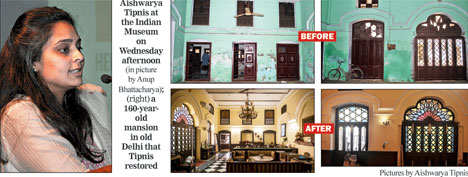
A young architect working on heritage structures in Chandernagore busted several myths about conservation of old buildings at a lecture at the Indian Museum on Wednesday afternoon.

“Conservation is no rocket science. It is far from a Nasa code that can’t be cracked,” said Aishwarya Tipnis.

An alumnus of the School of Planning and Architecture in New Delhi, Tipnis won the Chevalier des Artes et des Lettres, France’s top cultural award, this January for her “outstanding commitment” to the preservation of French heritage in Chandernagore, where she has been working for eight years.

The 37-year-old debunked the common perception that conservation is opposed to development, stressing that it is in fact a part of it.

The lecture, titled Why Does Heritage Conservation Even Matter To Anyone, took the audience through a presentation that told the story of Tipnis’s first big project – the restoration of a 160-year-old mansion in old Delhi, which started in 2010.

The current owner of Seth Ram Lal Khemka Haveli at Kashmere Gate in Shahjahanabad, Deoki Nandan Bagla, wanted to spruce up the house before his sons’ marriage. The three-storeyed house had been home to Bagla’s grandparents since 1920. Lack of renovation had created large cracks on floors and walls and several doors and windows were missing.

It was one of the first private conservation projects in the capital and went on to become a torchbearer for conservation of several old mansions. But the journey wasn’t smooth. The first challenge came from the client himself. Bagla wanted to turn it into a contemporary home. “What is restoration? Make the haveli modern,” he told Tipnis.

But Tipnis managed to convince him that compromising on the house’s principle architectural and aesthetic values was not a smart choice. “I told him everybody had a fancy home. But a palatial mansion was rare. He could show it off as a status symbol to the families of prospective brides.”

The finer details of the conservation were not as important to Bagla as his family’s pride. The point Tipnis drove home was that “architects have to get off their high horses” and connect with people.

One of the key aspects of traditional architecture was lime mortar plastering instead of cement. It led to setting up a lime mortar chukki in the courtyard of the mansion. After several failed experiments – with everything from urad dal and gur to methi seeds – a traditional lime plaster was ready to be caked on the walls.

The project also proved that conservation did not need to be an extremely expensive affair and jugaad could go a long way in bringing down the costs. Instead of using imported beams, Tipnis and her team used stainless steel beams made in Bagla’s factory.

The main lesson of the project was that heritage must continue to be relevant for conservation. “The day it loses relevance, no amount of legislation can preserve it,” said Tipnis.

source: http://www.telegraphindia.com / The Telegraph,Calcutta,India / Home> Calcutta / by Debraj Mitra / April 05th, 2018