The communist who was not a bhadralok

Kolkata:

Veteran Marxist thinker and former state finance minister in the Jyoti Basu government (1977-86) Ashok Mitra died at a private nursing home on Tuesday morning. He was 90.

A man of letters, Mitra represented the rare breed of Marxists who left his cushy job as the chief economic adviser (CEA) to the government of India in 1972 and cut his teeth on Left politics as the finance minister of the first Left Front government in 1977. He was the pioneer of the alternative development model in Bengal. The senior economist leaves behind a rich legacy of debates and discourse over Centre-state relations that have come in handy for states now to expand federalism in terms of economic and political powers. Mitra, unlike his successor Asim Dasgupta, was not very keen on adopting uniform tax rates across the country. He believed it was an infringement of the state’s domain.

Uncompromising as he was with the dirt and filth of running the administration, quite evident from his famous “I-am-not-a-bhadralok-I-am-a-communist” remark over removing senior bureaucrat and Basu-loyalist S M Murshed from the post of power commissioner, the economist was slowly getting bitter with his own government till he put in his papers as the minister in January 1986, following differences with Basu. He also resigned from the CPM at the same time — just a month after he was inducted into the party state committee.

However, the separation couldn’t make a dent on Mitra’s unflinching commitment to Left ideology. All his life, the scholar kept writing against the “anti-poor policies” of the successive Congress governments at the Centre and was one of the fierce critics of globalization. A few years later, in 1993, CPM nominated Mitra to the Rajya Sabha where he made significant contribution, particularly on economic issues. He was the first to take note of the rightward shift in India’s economy following the appointment of Manmohan Singh in the Narasimha Rao government in 2007.

A brilliant author and regular contributor to magazines and newspapers, Mitra had a great command over both in Bengali and English. Apart from books like “Calcutta Diary” or “From the Ramparts”, Mitra wrote quite a few books in Bengali, including “Kabita Theke Michhile”, “Nastikatar Baire”, “Akatha Kukatha” and the much-acclaimed memoir “Apila Chapila” that deals with issue ranging from politics to literature. His collection of essays, “Taal Betaal”, won the Sahitya Akademi award in 1996.

The veteran Marxist was getting upset with the Left Front government over its tryst with private capital in Singur and couldn’t come to terms with the ways of CPM, particularly in Bengal, even after the government was voted out of power in 2011.

Former Lok Sabha Speaker Somnath Chatterjee offered glowing tributes to Mitra. “He was not only a brilliant economist, but a person who upheld the cause of the downtrodden till his last. I admired his erudition, his writing skills and his superb literary sense. I recall the days when I was a member of the State Administrative Reforms Committee formed by the Jyoti Basu government of which Ashok Mitra was the chairman. The committee had several meetings where members gave their opinions. Mitra didn’t depend on anyone in compiling the views and wrote the entire report on his own within a short time,” Chatterjee said.

Chief minister Mamata Banerjee condoled the passing away of the veteran Marxist.

source: http://www.timesofindia.indiatimes.com / The Times of India / Home> News> City News> Kolkata News / TNN / May 03rd, 2018

Landmark nuggets in 75th year

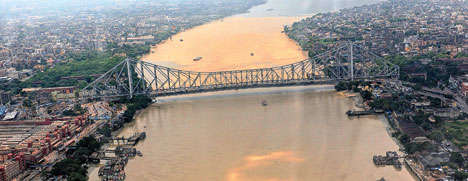
Desi steel for Howrah Bridge

• When Howrah bridge was built in the late 1930s, nearly 90 per cent of its steel was made in India.

• When Vidyasagar Setu was built in the 1980s, all the steel was imported.

• The 705m-long Howrah bridge was built in 41 months. The 823m-long Vidyasagar Setu took 14 years to be built.

Calcutta:

These and more such nuggets of information about the two bridges across the Hooghly were shared at the Bengal Chamber of Commerce and Industry on Wednesday during a lecture on the completion of the Howrah bridge’s 75 years.

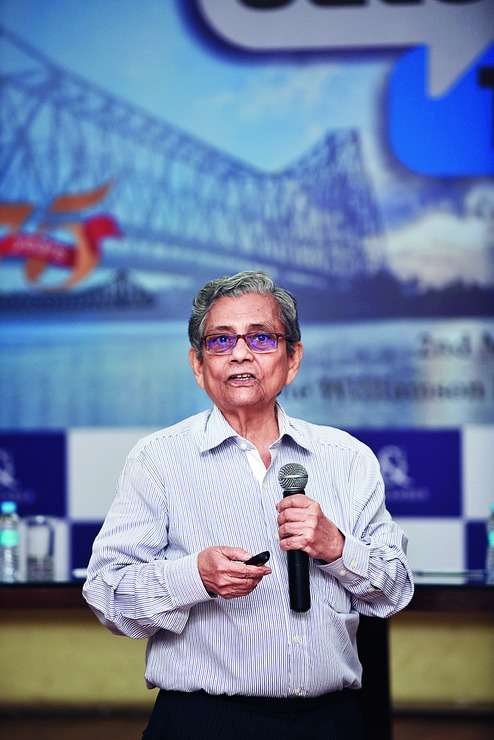
Amitabha Ghosal, an engineer who was part of the team that built Vidyasagar Setu, spoke about the history of the Howrah bridge and its engineering.

Ghosal began by saying why the Howrah bridge was built. Traffic to and from Howrah station had been slowly but gradually on the rise. A pontoon bridge that stood over the Hooghly and connected Calcutta and Howrah had to be lifted whenever a large ship came under it.

“River traffic was then more important than road traffic, which was however increasing. So a need was felt to build a bridge,” said Ghosal, who studied the design, construction and tendering of the Howrah bridge while working on Vidyasagar Setu.

There had been talk about building a bridge since 1900 but the actual planning didn’t begin till 1921. World War I was one of the reasons for the delay.

Amitabha Ghosal at the Bengal Chamber of Commerce and Industry.
(Sanjoy Chattopadhyaya)

The pontoon bridge was commissioned in 1874 for 25 years, but remained in use till 1943, when the Howrah bridge was commissioned. Construction began in November 1938 and carried on till March 1942.

Four companies from England, Scotland, Germany and India had placed bids in a global tender floated for the construction of the Howrah bridge. The German company was rejected because World War II was brewing.

Cleveland Bridge of England won the bid but British-owned Indian company opposed it. “It was a tiff between the British in India and the British in England. The British in India managed to convince the authorities that the entire work cannot be given to an England-based company,” said Ghosal.

A compromise was worked out. The Indian company – BBJ Construction Company Limited, a consortium of Braithwaite, Burn and Jessop – was asked to make the steel. Most of the steel – 23,500 tonnes out of 26,500 tonnes – was manufactured and supplied by Tata Iron and Steel Company (Tisco), now Tata Steel.

The foundation of the bridge was built by the Indian-owned Hindustan Construction Company, which is now building the Parama flyover in Calcutta.

source: http://www.telegraphindia.com / The Telegraph,Calcutta,India / Home> Calcutta / by Subhajoy Roy / May 03rd, 2018

‘Logged out’ of school at 10, boy turns IITian at 19

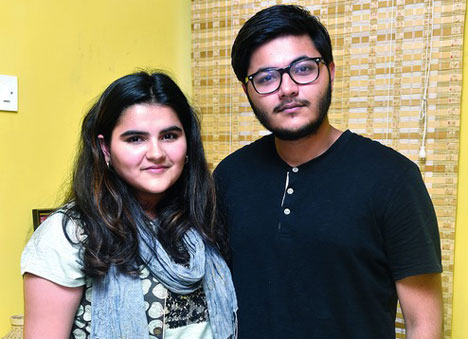
Nirmaan J. Sarkar with sister Sohana at their father’s office in New Town. Pictures by Sanjoy Chattopadhyaya

New Town:

A 19-year-old Calcutta boy who had been pulled out of school by his father when in Class V has made it to IIT Kharagpur without a conventional education in between.

Nirmaan J. Sarkar, a second-year student of agriculture and food engineering, believes that being homeschooled since the age of 10 suited his later goal of cracking IIT-JEE to study in his father’s alma mater. He revelled in the freedom of learning at home and focusing on what he liked even as his sister Sohana pined for the structure and company that school provided.

The siblings’ father, Sourabh J. Sarkar, had had a normal schooling and taken the usual long, hard route to IIT. But he was disillusioned with the education his children were getting and wanted to free them from what Nirmaan now calls “the cage”. The decision to “log out of the system” came after much disagreement at home.

Sohana, for one, did not take kindly to being told she would not go to school again. For some time, she was even ashamed of it.

Nirmaan showed no such withdrawal symptoms. “After I quit school, I started learning programming in my father’s office from his technology team…I also learnt things from the Internet,” he recounted.

It wasn’t always homeschooling and no play. Nirmaan would visit the Sports Authority of India complex every day for basketball, was part of the orchestra at the Calcutta School of Music and also learnt to play the tabla.

Realising his son’s proficiency in mathematics, Sourabh hired a tutor in the subject who would come home to teach Nirmaan for 10 hours on some days. At the age of 15, Nirmaan was sent to a coaching institute started by three IITians.

“By then, I wasn’t interested in going to any other college. I was fascinated by IIT Kharagpur, having heard from my father and tutors about the campus culture there. I wanted to experience that,” he said.

While Nirmaan’s progress through homeschooling and private coaching was an affirmation that the method was working, his parents grappled with the thought that he and his sister still needed a group environment.

According to Sourabh, who lives in New Town, the challenge was to provide his children with peers representing a certain diversity “because life is not made up of a group of people of your age only”.

Sourabh J. Sarkar

He and his wife Reena conducted a talent hunt to identify children from remote villages with different talents so that they could come and stay with them. The group was required to follow a routine, which included making breakfast and wearing uniform.

“We selected 30 underprivileged children with different talents like theatre, music, yoga and dance. We told their parents that their children could stay with us and we would help them get better at what they do,” Reena said.

Sohana, who will appear for the Class X examination through the National Institute of Open Schooling next year, appeared to miss school less after that. She started learning dance and is now also pursuing art.

After Nirmaan went to IIT Kharagpur, the thought of putting Sohana in a formal school did cross Reena’s mind but she ultimately decided against it. “Schooling would take away a lot of the things my daughter is doing,” she said.

Like her brother, Sohana has a clear goal. She wants to study fashion, albeit without going to college. “I don’t need to go to college to do what I want to do. I can do internships…. They teach circles and squares and I don’t want to do that. Now, I don’t lie to anyone that I go to school,” she said.

Sourabh refuses to label the education his children has had as homeschooling. “I think the term homeschooling is misleading for this set of children. The decision was to log out of the system. And when we decided that, I had no clue what the alternate system would be,” he said.

For Nirmaan, graduating from IIT won’t be the end of the road in terms of learning. “I don’t think just getting into IIT labels me as a success story. A real measure of the success will be what I learnt in the seven years I was out of school and studying at home. IIT isn’t the one big success in my life,” he said.

Father Sourabh gives himself “only 20 out of 100” for doing what he has for his children. “Till this day, I don’t think we have been successful in giving them the ideal option that I would have wanted,” he said.

source: http://www.telegraphindia.com / The Telegraph,Calcutta,India / Home> Calcutta / by Jhinuk Mazumdar / May 01st, 2018

1.5-million-year-old tools found in Museum vault

Indian Museum is pushing back the history it has been narrating thus far. It has ‘excavated’ Paleolithic stone age tools, some of which are up to 1.5 million year old, from its own sub-terranian store and will put them on display at a new pre-historic gallery that will open next month

Kolkata :

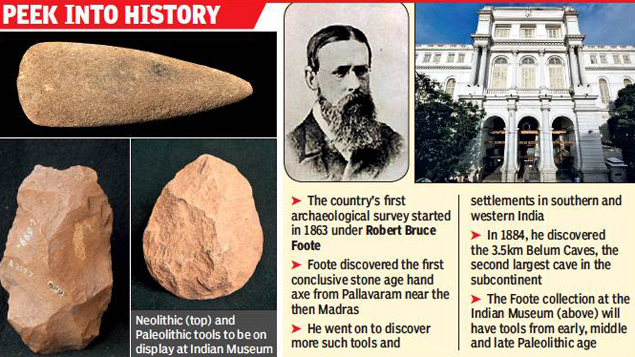
Indian Museum is pushing back the history it has been narrating thus far. It has ‘excavated’ Paleolithic stone age tools, some of which are up to 1.5-million year old, from its own sub-terranian store and will put them on display at a new pre-historic gallery that will open next month.

The collection, handed over to the museum in the 19th century by geologist-cum-archeologist Robert Bruce Foote, had been gathering dust in the underground store till they was re-discovered recently. Foote is considered the father of Indian pre-history and was the director general of Geological Survey of India.

Museum officials stumbled upon the collection of 100-plus tools that were discovered by Foote in south India. The oldest among them were unearthed in Atiram Pakkam, an area in Pallavaram, Chennai. These finds were named Atiram Pakkam tools.

“The Bruce Foote Collection is indeed the oldest collection of human tools anywhere in India. This treasure trove has never been viewed since it was brought to the museum. The inventory has swelled for 200 years without proper cataloguing. We are now sorting and classifying the collections scientifically,” said Indian Museum director Rajesh Purohit.

About 40 stone tools comprising of hand axes, scrappers, cleavers and arrow heads, mostly made of quartzite, will be brought out from that collection and displayed in the new gallery that will replace the Harappa gallery which had been till now the starting point of history at Indian Museum. The Harappa gallery has remained shut to public for nearly 15 years. Handpicked items from the Indus Valley Civilisation will also be exhibited at the new gallery.

The focus though will no longer be on Harappa and Mohenjo Daro, because these are both in Pakistan today and a large number of excavations on the Indian side around a circumference of 1.22 lakh sq km have revealed footprints of contemporary civilisations. “We can build our own history around these sites that have been unearthed in Haryana, Gujarat and Rajasthan. While in the earlier case, the civilisation developed along the Indus, on the Indian side the civilisations sprung up along Ravi, Chenab, Beas, Sutlej, Jhelum, Saraswati, Hakra and Ghaggar,” Purohit explained.

While Lothal (Gujarat) and Kalibangan (Rajasthan) excavations are well-known, other explorations in Rakhigarhi, Krunal, Birhana, Banawali and Firmana that have happened later and have led to discovery of thousands of archaeological remains like pottery, figurines and seals will now be part of the new gallery.

source: http://www.timesofindia.indiatimes.com / The Times of India / Home> News> City News> Kolkata News / by Jhimli Mukherjee Pandey / TNN / April 15th, 2018

Gate-way to a new Calcutta

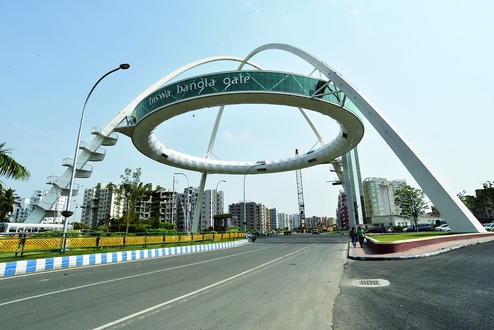
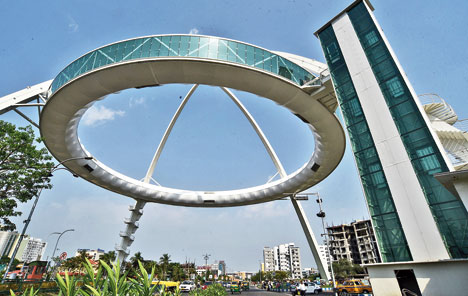
Kolkata Gate, a steel-and-glass structure with giant arches at the Rabindra Tirtha crossing of New Town, is almost ready. The two steel arches that criss-cross each other 55m above the ground can be spotted from several kilometres away.

A circular viewing gallery made of steel and toughened glass has been set up at 25m above the ground level. The 10ft-wide and 60m-long gallery has been constructed by interlinking four prefabricated structures that resemble aerobridges. These structures in turn are welded and attached to the steel arches at designated points. The facade is made of toughened glass with laminated silicone sheets that can withstand gale-force winds, hailstorms and extreme heat.

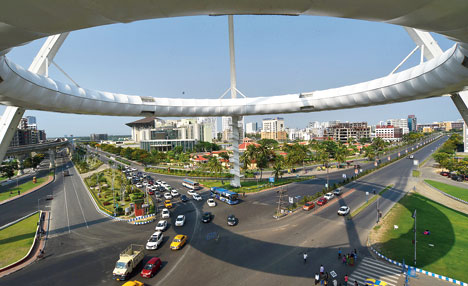
A bird’s-eye view of New Town clicked from a landing a few feet below the viewing gallery of the Kolkata Gate. The view from the gallery will be unhindered as nothing taller than the gate will come up in the area, New Town being a planned city and with pre-determined floor levels for every plot.

Programmable LED lights and flashers have been placed along the length of the steel arches to give it a snazzy look at night. The viewing gallery will have a snacks counter during the day and a fine-dining restaurant after 7pm. At night, only diners will be allowed inside the gallery that will offer a panoramic view of the township. The walls of the gallery have been painted with murals with an entire wall dedicated to the schemes and achievements of the state government.

“The restaurant will offer a one-of-a-kind experience. It will be unlike any other in the city and will offer cuisines from across the world,” said Debashis Sen, the chairman of Hidco. It is likely to open doors in June, officials said.

Two lifts with a glass facade made of toughened glass similar to that used in the viewing gallery will take visitors up to the gallery. The lifts are equipped with telephones at every level so that the operators can get in touch with visitors in case of an emergency. Hidco is mulling a Rs 30 fee per person for a visit to the gallery. Diners at the restaurant won’t need to pay the fee.

source: http://www.telegraphindia.com / The Telegraph,Calcutta,India / Home> Calcutta / by Snehal Sengupta / Photos by Sanjoy Chattopadhyaya / April 30th, 2018

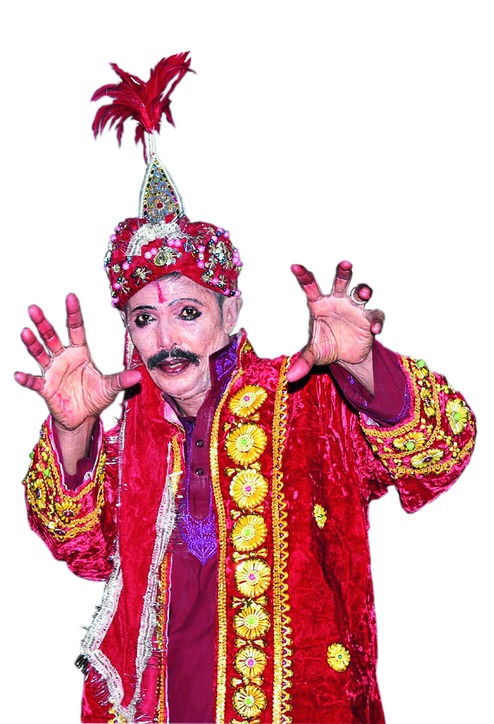
A trick in time past

Magicians tell Uddalak Mukherjee why the fun has gone out of their craft

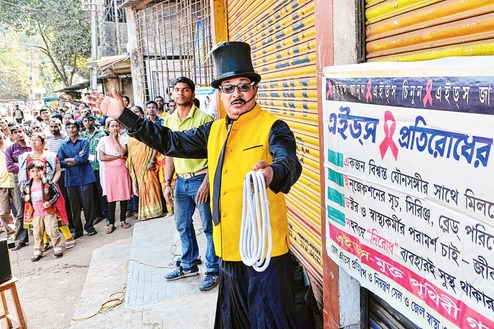
Gillee, Gillee, Gone! Most magicians today are happy to replicate popular tricks without innovating

Dipak Roychowdhury’s life had changed one evening in 1983. Roychowdhury, a magician – he had learnt the ropes from the legendary Gautam Guha, who had taught the tricks of the trade to even Satyajit Ray – was scheduled to perform at an event organised by the Communist Party of India (Marxist). The problem was that P. Ramamurthi, the veteran Marxist, was expected to speak before Roychowdhury’s performance. The magician, he was a young man then, feared that the crowd would leave with the politburo member. But the crowd, a packed house at Rabindra Sadan, chose to stay. Since that day, Roychowdhury – he now teaches magic to children in a school in Brahmapur – spent 12 years travelling all over Bengal with his bag of tricks. He still loves talking about that evening in 1983.

Sanjoy Chatterjee’s life, on the other hand, had been changed by a book. Chatterjee had bought Ganapati Chakraborty’s Jadu Bidya for four-and-a-half rupees almost three decades ago. The book, a sort of a Bible for amateur magicians, was Chatterjee’s key to a magical kingdom that he has called home since.

The Magic Mela organised by the Federation of Indian Magic Associates (Fima), now in its fourth edition, had brought together young and old performers like Chatterjee and Roychowdhury at Calcutta’s Mohorkunja ground recently. A motley crowd hung around savouring not just the acts performed by magicians – they had gathered for the occasion from near and far – but also the merchandise that was on show.

Chatterjee and Roychowdhury shared their stories and their views on the art of magic at Fima’s tiny office at the venue. The Magic Mela, held between March 28 and 30 this year, is an initiative that seeks to provide a durable platform for magicians all over the country to reach out to a wider audience and a market. According to Chatterjee, Fima has enlisted almost 950 performers in its ranks. Hearteningly, it also accommodates affiliates that are integral to magic’s ecosystem. For instance, at the Magic Mela, one also came across Samdari Lashkar, whose family firm has been supplying magic equipment for over three generations to almost 48 countries.

The conversation with the artists mostly centred on the changes that magic has had to endure as a profession. Some of these transformations are encouraging. Chatterjee talked about the support from the government. The venue for the Magic Mela had been provided free of cost. He added that there has been some progress in talks with a telecommunications giant to build a magic academy in New Town, Rajarhat. There has also been noticeable improvement in the quality of props – without these a magician would be crippled on stage.

But some of the other challenges, Chatterjee said, merit concern. Even though magic as a profession has become far more accessible, there has been a precipitous decline in the spirit of individual innovation. Most magicians seem to be content with replicating popular tricks without adding new dimensions to them. Funds remain short, perennially. Magicians, especially underprivileged performers who ply their trade in, say, local trains, lack medical insurance. There is also an acute need for pension for aged artistes. But the biggest threat – Chatterjee mentioned this more than once during the interview – comes from new-age technology. The digital media, no less mighty a sorcerer, is weaning children, magic’s most trusted patrons, away.

Roychowdhury, however, confided that he has a trick up his sleeve to bring children back to magic – education. As a teacher, he insists that budding magicians would first have to learn the trick of striking a chord with spectators. Magic, in his opinion, should transcend the trappings of illusion. It should, instead, function as a tool that helps the audience relate to their own lives.

Evidently, Roychowdhury views magic not merely as a livelihood. Magic’s philosophical dimensions consume him. For instance, he talked animatedly about the decline in the purity of form in magic. This he attributed to the increasing commercialisation of the craft. Incidentally, Roychowdhury’s reservations had been echoed by Ray in his short story, Dui Magician, where Tripuracharan Mallick, an advocate of magic as an aesthetic sensibility, accuses his ward, Surapati Mondal, of falling prey to the lure of razzle-dazzle.

Roychowdhury also described the relationship between the performer and his audience as one of power and asymmetry. Perhaps he was referring to the magicians’ temporary hold over the patrons.

So does he miss it now? The thrill of putting a spell on an audience?

The crowd outside the Fima office was leaving as the first day of the Mela was coming to a close. Roychowdhury heard the question, took sometime to reflect, and then answered in a rather quiet tone: “I miss the sight of a packed hall the most.”

source: http://www.telegraphindia.com / The Telegraph,Calcutta,India / Home> Calcutta / by Uddalak Mukherjee / April 21st, 2018

Kolkata youngsters script success story in UPSC exams

Kolkata :

Several aspirants from Kolkata cracked the civil services final exam, the results of which were declared on Friday. Among the successful candidates were Azar Zia, who ranked 97th, Shekhar Kumar Chaudhary, who bagged the 216th position and Purnava Ganguly 498th.

Son of a retired state civil servant, Tiljala resident Zia was confident of clearing the exam in his third attempt. “The first time I took the exam in 2015, I was unprepared, and during the next attempt in 2016, I was down with chikungunya. This time I prepared well,” said the St James’ School alumnus. Finishing plus-two in 2005, Zia scored over 90% in both ICSE and ISC. “I did my BTech in electronics and communication engineering from a private engineering college in Kolkata. Though I got placed, I didn’t take up a job immediately. I studied for CAT in 2009. I pursued MBA from FMS Delhi and in 2012, landed a job in a corporate biggie. But I quit in 2015 and from 2016, started preparing for UPSC,” he said.

What made him shift to civil service? “After three years in the corporate sector, I realized money was not my motivation. I wanted to contribute to society,” Zia said. He studied at a residential campus in Delhi for UPSC. “I was mostly dependent on online material.” The two main areas Zia wants to focus on are alleviation of poverty and uplift of kids through education.

Shekhar Kumar Chaudhary cracked UPSC even last year and is now undergoing IPS training at Hyderabad. He did his MTech from IIT-Delhi in communication engineering, before studying physics at Presidency College and BTech at Rajabazar Science College. “Earlier, I worked as a state civil service cadre in the commercial tax department.

After I cracked UPSC last year, I joined IPS. But since my rank is better now, I will probably move to a different service,” said the Teghoria resident. “I will work to help generate more employment.”

For Purnava Ganguly, success came at the fifth attempt. “I went to Patha Bhavan, after which I graduated in civil engineering from JU in 2010. I did my Masters in international business from Delhi School of Economics. I currently work at a central government undertaking at Jharsuguda, Odisha.” Ganguly expects to get through IRS or Indian Audit and Account service. “I am also interested in Indian Trade Service,” he said, adding his parents living in Garia were happy with his performance.

“My advise to youngsters is get into civil services. The more aspirants we have, the better for Bengal,” said Jyotirmoy Pal Chaudhuri, who runs a civil service coaching school here.

source: http://www.timesofindia.indiatimes.com / The Times of India / Home> News> City News> Kolkata News> Schools & Colleges / by Somdatta Basu / TNN / April 29th, 2018

Hidden collections

Did you know that the City of Joy is also a city of museums? We’re not talking about the most obvious ones, but several that are tucked in forgotten corners, waiting for the elusive visitor to drop in. In fact, many of these museums provide a wealth of material for those who are interested, but lose out because few people know they exist. Utsav Basu does the rounds of a few of Kolkata’s lesser-known museums

Sabarna Sangrahashala

Located in Barisha, Sabarna Sangrahashala is a museum on the Sabarna Roy Choudhury family and the city of Kolkata. Developed by the Sabarna Roy Choudhury Paribar Parishad in 2005, the museum mainly caters to young students and researchers who wish to learn more about the history of the City of Joy. The museum – or rather a collection by the family trust – possesses rare documents and articles, including ‘kabilatipatras’ dating back to the 18th and 19th centuries. Among them is an important artefact which bears the signature of Kavi Rama Prasad Sen dated 1794. The highlight of the museum is the historic judgment of the Calcutta High Court in the Kolkata birthday case and the expert committee report on the matter, which states that Job Charnock was not the founder of Calcutta (Kolkata), nor is August 24 the city’s birthday.

Other articles include a huge earthen rice pot dating to 1840 with can carry 240kg of grain, a metal hookah from 1878, a metal candelabra from 1795, grinding wheels from 1845 and a wooden table used by Antony Firingee’s grandfather, John Firingee, from 1680.

Timings 10am-12pm and 5pm-7pm every day except Thursday
Entry free

Gurusaday Museum

Tucked away in a corner of Joka, Gurusaday Museum, run by Bengal Bratachari Society, is a house of folk art forms conceptualised by civil servant, folklorist, and writer Gurusaday Dutt. A deep interest in Bengal’s folk art led Dutt to collect around 2,325 specimens of various art forms of Bengal. These artefacts were later housed in a museum, which was thrown open to the public in 1963 by Humayun Kabir, the then Union minister of education. The museum now reels under financial crunch, after the Centre, in a notification, asked it to run on its own. The museum authorities claim this is a breach of agreement between the President of India and the Bengal Bratachari Society of May 23, 1984. Before the recent turn of events, it was funded by the Ministry of Textiles.
From specimens of Bengal’s ‘kanthas’ to ‘patachitras’, the museum is a paradise of eclectic artefacts that range from clay dolls to sandesh chhach (sweet moulds) and Dutt’s personal belongings. A few interesting things include ornaments made of paddy, archaeological specimens from the 1st and 2nd centuries BC, dokra crafts and manuscripts of undivided Bengal.

Timings 11am to 5pm (Tuesday-Sunday) Entry 10; IRs 2 (students); 50 (foreigners)

Raja Rammohun Roy Memorial Museum

Located on Raja Rammohun Roy Sarani near the Amherst Street crossing, the nearly 200-year-old house owned by Raja Rammohun’s family houses a history that talks about his life and work. Through various documentations, the museum talks about his ideological battles with his father, compatriots and with a few British officials.

Though the museum does not have any of the real documents or objects used by Roy, a beautiful recreation of the period talks about his life. There are, however, a few original documents such as the original cover of the ‘Tuhfatu’l-Muwahhidin’ (A Gift to Deists), which was a frontal attack launched by Roy against idolatry and superstition plaguing Hinduism in the 18th and 19th centuries, the cover page of the first sermon of the Brahmo Samaj, and photocopies of a few letters written by Roy to various luminaries of the day.

Started in 2000 as a permanent exhibition, the museum slowly took shape through donations from many quarters and the tireless efforts of teachers and professors of Raja Rammohun Roy College. The museum, like any other lesser-known museums of the city, reels under a financial crunch and is thus not being able to expand and house many other artefacts related to the reformer.

Timings: 11am to 4.30pm, all days except Mondays Entry 10;50 for photography

State Archaeological Museum

Located near the Behala tram depot, the State Archaeological Museum, under the state government, is divided into six departments – Site and Sights, Early Historic Period, Sculptures of Bengal, Paintings of Bengal, Metal Sculptures gallery and the Nandadirghi Vihara: Jagjivanpur.

Inaugurated in 1980 by then chief minister Jyoti Basu, the museum has a collection of rare tools of the Early, Middle and Late Stone Ages from Susunia (Bankura) and other sites, proto-historic antiquities from Pandu Rajar Dhibi (Burdwan), sculptures, stone and stucco from the Gupta, Maurya, Shunga, Kushana, Pala and Medieval times.
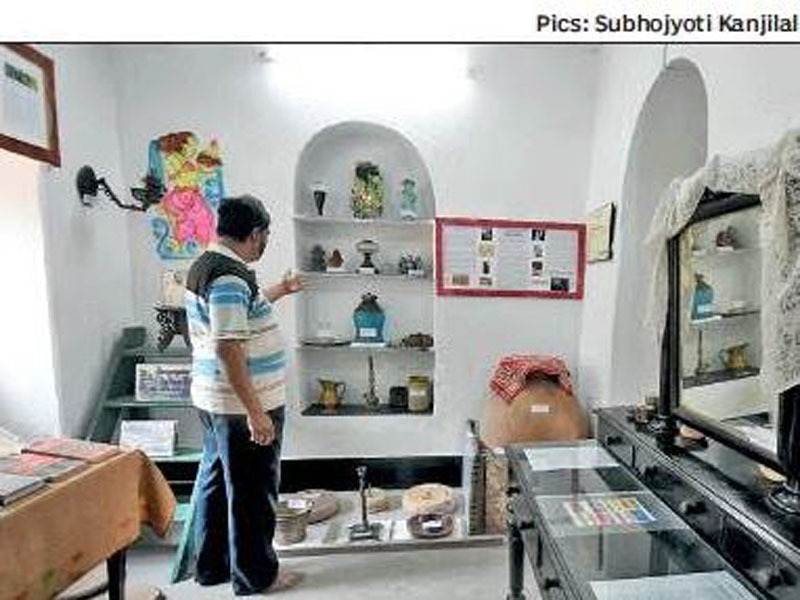
The painting section of the museum boasts Mughal miniatures, paintings on wooden planks, Kalighat patachitras and watercolours. Primarily painted by court painters of different rulers, the section also has paintings that tell stories.

The main attraction of the museum, however, is the Nandadirghi Vihara: Jagjivanpur section, which documents the 1992 excavation activities at the site in Malda. The section doesn’t have all the real artefacts found in the excavation, but has flawless replicas, apart from a few real exhibits. It also has a model of the excavation site in Malda.

Timings 11am-4.30pm (Wednesday to Sunday) Entry Rs 5

Cultural Research Institute

Barely a two-minute walk from the Kankurgachi crossing, beside the Bureau of Indian Standards building is the Ambedkar Bhawan Cultural Research Institute, which houses a museum divided into four sections. Run by the state government, the museum was earlier at the New Secretariat building. In 1980, it was shifted to Ambedkar Bhawan.
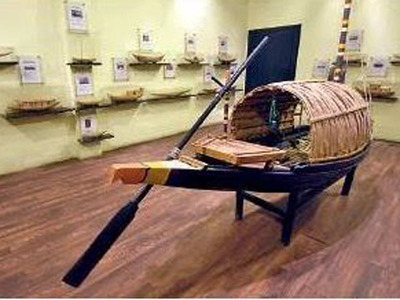
The cultural institute, through the four sections – Ethnographic, Puppet, Kantha and Boat – has an interesting collection that talks about Bengal and its varied cultural background.

The ethnographic section displays baskets of several tribes, tribal musical instruments, Birbhum paintings, masks and other artefacts that talk about Bengal’s ethnic milieu at length. The puppet section breaks the popular belief that Rajasthan is the only land from where puppetry originated. This section has a collection of puppets that were used to tell stories of Dakshin Rai and Bon Bibi and that of other kings who ruled Bengal and their valour. The Kantha section is also quite interesting. This section displays some of the finest examples of kantha.

The main attraction is the boat museum, which boasts a collection of around 40 models of several boats of Bengal, used for various purposes. This section is a virtual boat-ride through a wave of stories. Through detailed descriptions about the type of boats used for specific reasons, the narratives also throw light on the areas of Bengal where the boats were used or made.

Timings 10am-5.30pm (Monday to Friday)

Entry Free

Acharya Bhawan

The museum on Acharya Jagadish Chandra Bose at his house built in 1902, beside the Bose Institute on APC Road, houses furniture used by Bose and his wife, the original instruments used by him for his various scientific experiments and his personal belongings. A request to the trustees can also take you to the attic room where Bose used to carry out his experiments.

Restored by INTACH and looked after by the Sir J C Bose Trust, Acharya Bhawan has not been changed a bit from its original glory. The trust has arduously taken the task of keeping intact the feel of the house as it was more than 100 years ago.

A section of the museum has the original chairs and the table which Bose exclusively used while interacting with his friend, Rabindranath Tagore. The museum also has the dark room and the observatory used by Bose for his experiments.

Timings 2pm-4pm (Wednesday and Friday) Entry | Free

source: http://www.timesofindia.indiatimes.com / The Times of India / Home> City News> Kolkata News / Utsav Basu / TNN / April 28th, 2018
Fighting fire, girl invades male bastion

Tanya Sanyal

Kolkata :

Years before she was selected to train as the first woman firefighter at the Airports Authority of India (AAI), a chemistry teacher had given Tanya Sanyal the moniker birangana meaning ‘brave woman’. Tanya’s elder sister Tanima had always known her to be fearless.

“One evening at the chemistry class, the girls suddenly screamed and scrambled up on to the chairs. I realised it was a cockroach that had caused the panic. I caught it and threw it out of the window. The teacher was shocked and named me Birangana,” recounted the Dum Dum girl who suddenly finds herself in the limelight in an allmale profession.

Good at classical dance and painting, Tanya wasn’t aware of where she was headed till she bumped upon the AAI advertisement that changed the course of her life.

“I had a desire to do something different, but didn’t know what till this opportunity came by. The exam went off well. On Panchami, a letter arrived stating that I had qualified and had to report to Bhubaneswar for physical fitness and medical tests. Thrilled, I forgot about Durga Puja and began to train for the fitness exam,” she narrated.

She passed the test, that included a 100-metre sprint within 20 seconds, lifting 40kg and climbing up a rope.

Currently undergoing training in Delhi, Tanya is enjoying the course. “Since I am the first woman, everyone is very supportive and encouraging. I consider myself extremely lucky,” said Tanya.

She is aware of the challenges that the job entails. Tanya says the biggest thrill in the job is the lightning speed with which the team has to head into a crisis. “At an airport, there is the criticality of time. The Rosenberg tenders have to move out within 90 seconds. If a plane catches fire, it must be doused within 2 minutes and 18 seconds. For that is as much one can get before the fuel tank catches fire and explodes,” she explained excitedly.

She can’t wait till June 9 when she gradutes and is given the first posting at an airport.

source: http://www.timesofindia.indiatimes.com / The Times of India / Home> News> City News> Kolkata News> Civic Issues / by Subhro Niyogi / TNN / April 26th, 2018

Prep for German Olympiad with soap and song

Modern High girls to represent India in contest with learners from 72 countries

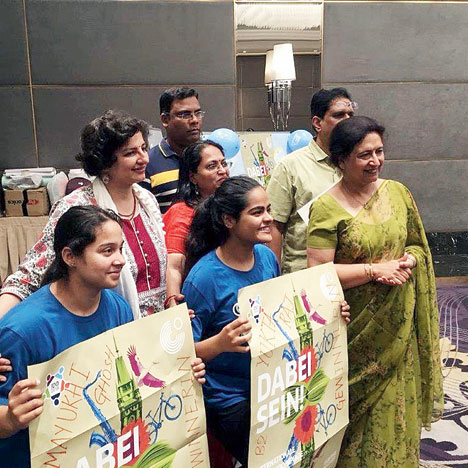
Mayukhi Ghosh and (right) Yukta Raj, who will represent India at the International German Olympiad this July

Ballygunge:

Two students from Modern High School for Girls have German television soaps and pop music to thank for topping a national-level language competition and earning the opportunity to represent India at the International German Olympiad in Freiburg this July.

Yukta Raj, a student of Class XII, and Mayukhi Ghosh, who is in Class X, have been learning German for many years. But the fluency they needed to compete with other learners in a language Olympiad came as much from following popular culture as from classroom lessons.

“I started watching German TV shows like Jojo sucht das Gluck and Tyrkisch fur Anfanger to prepare for the competition. It was basically learning while enjoying oneself,” said Yukta, who is the president of her school’s Deutschind club.

For Mayukhi, who inherited her love of German from her mother, pop music has been an unlikely learning tool. Her favourites include the rapper Cro and fellow artiste Namika.

Mayukhi was in Class I when she heard her mother speak a smattering of German and tried to emulate her. A decade later, it is the teenager who insists that her mother converse with her in the language and “keeps correcting her”.

“My mother is not fluent now for lack of practice. I ask her to randomly have a conversation with me in German,” Mayukhi said.

She and Yukta see the chance to compete with learners from 72 countries in the IDO – Internationale Deutscholympiade as an extension of their future plans. Both girls are looking at Germany as an option for their undergraduate studies. Yukta is fascinated by German “discipline” while Mayukhi loves the concept of artists’ colonies, of which that country has several.

For now, Yukta and her junior teammate are focused on enhancing their ability to not just speak and write German but also think in that language. “It’s started happening a lot. Since I started practising for the Olympiad, thinking in German has become a habit,” said Yukta.

Bina Ghosh, who teaches German at Modern High, said inter-school events and an exchange programme with a school in Germany had helped increase her students’ proficiency. “Even communicating over WhatsApp and Skype helps,” she said.

source: http://www.telegraphindia.com / The Telegraph,Calcutta,India / Home> Calcutta / by Jhinak Mazumdar / April 25th, 2018