Magic memoirs: A son pens his tribute

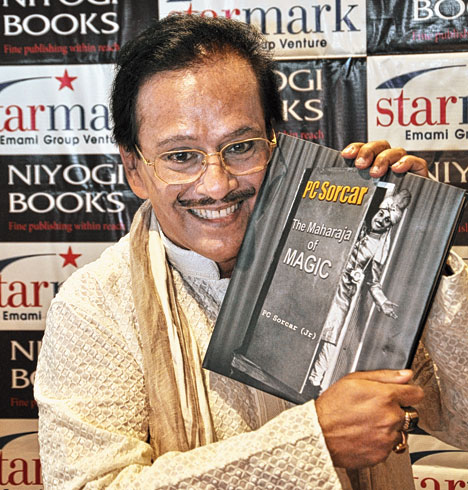
P.C. Sorcar (Jr) at the launch of a memoir of his father on Friday. (Anup Bhattacharya)

Calcutta:

On April 9, 1956, a live telecast of a magic show in London seemed to have gone awfully wrong. The scheduled 15-minute slot on BBC was almost over but the assistant cut in half by the turbaned Indian magician was not coming back to life.

As the channel switched to the news bulletin, viewers jammed the studio lines with calls, convinced that the woman had been murdered. Such was the furore that the event made the next day’s headlines, with interviews of the assistant, alive and well.

“It had all been part of a grand plan. He had deliberately instructed the lady assistant to lie unresponsive… at the critical moment… This man was Protul Chandra Sorcar. He was also my father,” the writer of a book titled PC Sorcar: The Maharaja of Magic describes the incident.

A memoir of the illustrious father Protul Chandra Sorcar penned by his torch-bearer and son Prodip Chandra Sorcar or P.C. Sorcar (Jr) was launched on Friday at Starmark. It is replete with anecdotes that demonstrate how the senior Sorcar single-handedly revived a dying Indian art and went on to be hailed by the International Brotherhood of Magicians in 1948 as “The World’s Greatest Magician”.

The book is also a storehouse of photographs, publicity material, newspaper clippings and cartoons on the phenomenon that was P.C. Sorcar. His reception in the 35 nations where he performed is nothing short of spectacular. If The Sunday Times carried a photo of him reading the newspaper blindfolded, one of Japan’s top newspapers The Yomiuri Shimbun ran the headline on an article on him “Invaluable Living Asset From India Brings Black Art” while The Australian Women’s Weekly did a full page feature on him when he was touring the continent in 1958.

“The book was five years in the making,” said Bikash D. Niyogi, the managing director of the publisher Niyogi Books.

At the launch of the book on Friday, Sorcar (Jr) revealed that his grandfather was bitterly against his son taking up magic as a profession. “‘Do not do public shows. Society is not ready. You will be taken as a dabbler in hocus pocus,’ he kept telling his son. He wanted him to become an engineer instead,” said Sorcar (Jr).

In a way, he was right. “Even after my father’s body was flown in from Japan where he suddenly passed away in January 1971, people gathered outside our house at night expecting him to return, much like he would at the end of his disappearing tricks, appearing from a distant corner with the shout ‘I am here’. People were so gullible that they could not distinguish between his stage persona and the person he was in real life.”

Sorcar, as a child, had an opposite problem. He took the sombre man keeping a strict eye over his son and the smiling magician on stage as different people. The book is a testimony as to how the two avatars of PC Sorcar come together in the eyes of a fellow magician who is also his son.

source: http://www.telegraphindia.com / The Telegraph,Calcutta,India / Home> Calcutta / by Sudeshna Banerjee / May 12th, 2018
Second life for folk museum

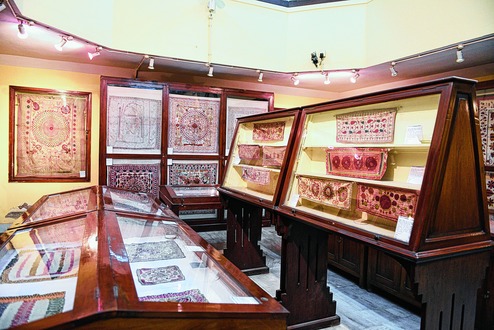
A view of the kantha gallery at Gurusaday Museum

Calcutta:

Free entry from 10am to 7pm, selfies with exhibits, mementoes inspired by artefacts and more kept Gurusaday Museum abuzz with activity on Thursday, the private collector’s 136th birth anniversary.

The museum in Joka, a treasure trove of kanthawork, patachitra, dokra and other artefacts, fell on hard times after the central government stopped funding it in December last year.

A sustained social media campaign by two research scholars, an archaeologist and an anthropologist has given the museum a fresh lease of life. The campaign to Save Bengal’s Folk History is aimed at reviving the cash-strapped museum and attracting more visitors.

The efforts bore fruit as hundreds of visitors, including schoolchildren, dropped in at the museum on Thursday.

Banners with the slogan Love the Museum welcomed all visitors. Food stalls, cultural programmes and merchandise on sale kept the visitors happy. They were also invited to take selfies with any exhibit of their choice.

“We are just trying to jazz up the birth anniversary celebrations and make the museum more attractive. People should be aware of the rich treasure it houses,” said Malavika Banerjee, the director of Kolkata Literary Meet and Byloom and one of the players in the museum’s revival.

Banerjee first visited the museum 15 years ago and was taken aback by all the folk art lying in oblivion. Some of the artefacts at the museum date back to the 10th century.

Research scholars Shrutakriti Dutta and Sujaan Mukherjee, archaeologist Tathagata Neogi and anthropologist Chelsea McGill, along with Banerjee, ran an online campaign and uploaded a campaign video on YouTube to spread the word.

“We want to start a crowdfunding effort to save the museum and help it sustain itself. We want to work in tandem with the staff and authorities here,” Dutta said.

The museum’s 13-member staff have not received their salaries for over seven months, said the museum’s executive secretary and curator, Bijan Mondal. “Today we have seen many firsts, including the selfie fest. A celebration of this scale till 7pm would have been unthinkable before,” he said.

The celebrations culminated in a discussion on The Life of Our Heritage that had panellists – Jayanta Sengupta, the secretary-curator of Victoria Memorial Hall; Bappaditya Biswas, the creative partner of Byloom; and Snehangshu Sekhar Das, designer at the Regional Design and Technical Development Centre, office of the development commissioner (handicrafts), ministry of textiles – offering suggestions on how to make the museum attractive.

Sengupta spoke about how a museum must be more than just a silent custodian of the past. “It has to reach out to people through smart storytelling,” he said. His advice: Organise workshops, reach out through the social media, engage the audience through proactive and interactive smart thinking, improve display and hook kids with the help of audio-visual clips.

The Victoria Memorial curator offered to hold an exhibition of items from Gurusaday Museum on the Victoria grounds. “We can help restore some collectibles,” he said.

Devsaday Dutt, grandson of Gurusaday Dutt, welcomed the idea. “The museum should be of a seat of knowledge. There are 275 paintings of Abanindranath Tagore and several Jamini Roys here. The storytelling in kantha artworks here will entice anybody,” he said.

source: http://www.telegraphindia.com / The Telegraph,Calcutta,India / Home> Calcutta / by Chandreyee Ghose / May 11th, 2018

Music, folklore and life lessons from Sonajhuri, a hamlet in Bengal

The rhythmic hum became clearer the deeper I ventured into the forest. The man, wearing a saffron kurta over a white dhoti, seemed to be the least bothered by the visitors that his music was drawing. Seated on a mat spread over the red earth of the forest clearing, he carefully plucked the strings of the ektara and filled the air with his soulful voice. The movement of the beaded malas dangling from his neck complimented his head movement whenever he caught a high-pitched note.

It was hard to imagine, that in just a few hours, the imperturbable forest clearing would be buzzing with exuberance. The spirit of the weekly market held every Saturday, popularly known as Shonibarer Haat, would permeate through the meshwork of the sonajhuri or acacia trees. Sonajhuri, the place in the Khoai region of Bengal, lovingly named after the trees, would come alive.

During lunch at the resort, authentic Bengali food — shukto, alu posto, maacher kalia and chutney — kept piling on my plate, the way food accumulates during religious rituals.

As the afternoon progressed, the bauls arrived with their own entourage and took over the concourse with furious musical fervour. The harmonium, tabla and flutes accompanied the primary musical instrument used by the bauls — the ektara. Plucking the solitary string of an ektara, the bards continued reciting melodious folklore in Bengali. With hands thrown up in the air, the visitors danced — men and women, young and old alike. The pounding footsteps of the tourists stormed up red dust clouds. The performers don’t demand any monetary compensation in return; visitors are free to leave on the baul’s mat whatever they wish.

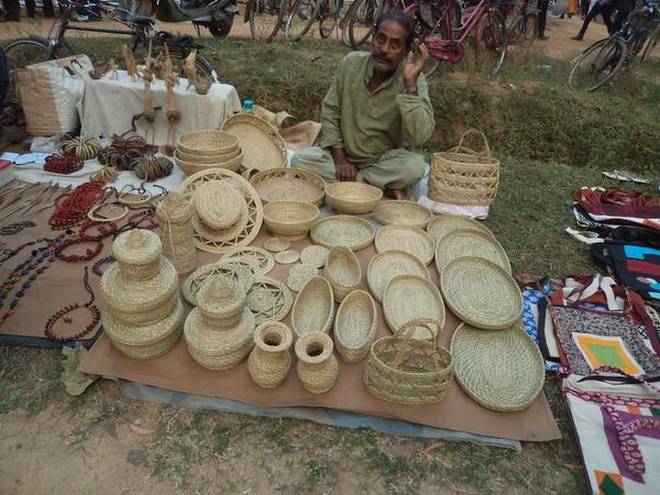
The weekly market was an exhibit of authentic craftsmanship, which belongs to the State of Bengal. Junk jewellery, saris and other clothing, bags, footwear, paintings, wood products, bamboo, cane, jute and terracotta products for kitchen use and home decor, were on display over rugs under the shade of trees. The handicrafts found in this part of the world are iconic to the region of Bolpur. Most of the sellers here are the artisans themselves. Unfortunately, many still struggle to make ends meet. I got a miniature ektara for myself.

Next morning, I walked through the maze of sonajhuri trees to Bonerpukur Adivasi Gram. Little mud huts with drooping ceilings of hay lined the dirt path. A few had relief work mimicking their own village life engraved on their hut walls. When plush bungalows peeked through the foliage of the trees, I knew the rustic village had ended to make space for farmhouses of the rich.

‘Fun on one bank, Fun-eral on the other.’

The greatest irony of life was scribbled on a board on the Kopai riverside. A battery-operated rickshaw, known in this part of the world as ‘toto’, brought me here. A timid silence prevailed all around, only to be broken by the voice of the solo mystic minstrel. On the other bank, village women were fetching pails of water. The baul started playing as I was exploring the riverside. He struck a chord on his ektara, with lyrics describing the beauty of life and the importance of living in the moment. As he was doing so, I stepped on some consumed pyre material.

That day on the river bank, something changed in me as I encountered the transient nature of life. The solitary string of the ektara holds it together. When the string breaks, the instrument dies. Just like the ektara, we have just one chance at life.

source: http://www.thehindu.com / The Hindu / Home> Life & Style> Travel / by Tania Banerjee / May 09th, 2018

Kolkata youth now a London councillor

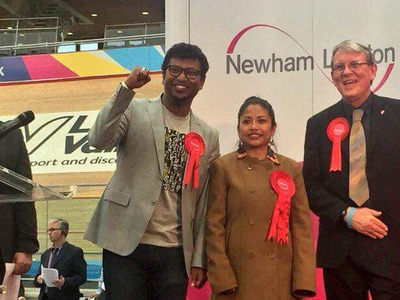
Rohit K Dasgupta (L)

Kolkata :

Rohit K Dasgupta, 30, has become the first Bengali from India to be elected as councillor in the London Borough of Newham. An alumnus of St James’ School and Jadavpur University, Dasgupta had joined UK politics in 2009, when he shifted to London to pursue his masters in English.

Last year, Dasgupta had unsuccessfully contested as the Labour Party’s parliamentary candidate for East Hampshire against the Theresa May government. This year, he won with 70% votes.

His parents — Mukut and Joyasree — are ecstatic. “My mother said my hard work paid off. My parents were up all night waiting for the results. They will have a celebration dinner,” Dasgupta said. After results, Dasgupta partied with all the Labour activists who contributed to his win.

Though he comes from a Left political tradition, none of Dasgupta’s parents have been involved in active politics. “I joined the Labour Party as I thought Gordon Brown was a fantastic leader and deserved to remain UK’s PM,” he explained. As for contemporary Indian politics, Dasgupta is against the “kind of Hindutva nationalism being espoused by the BJP”. “I was born in a secular country and to see that secularism being eroded makes me angry. I’m glad Bengal is one of the few states that has remained immune to Hindutva politics,” he said.

However, the recent Metro incident at Dum Dum — where his parents live — has left him ashamed. “Kolkata has been a bastion of liberal values compared to many other Indian cities. Moral policing is unacceptable. Showing affection should not be something we should be ashamed of or be censured for,” he said.

He will now he busy balancing his academic job at the Loughborough University and responsibilities as a councillor. Both jobs, he said, complement each other. As an elected representative, his priority is to expand “the equalities agenda of the council, repair and maintain all council homes and increase crime prevention”. Housing, he pointed out, is a big issue in Newham. “I’d like to see our council build more affordable homes for everyone,” he said.

Looking forward to strengthening the connection between Kolkata and London, he said, “Newham also has a sizeable number of Indian and Bangladeshi communities. There is opportunity for all kinds of cultural exchange with Kolkata and also learning good practices from each other.”

source: http://www.timesofindia.indiatimes.com / The Times of India / Home> City News> Kolkata News / by Priyanka Dasgupta / TNN / May 06th, 2018

BL Block resident new India disabled cricket team coach

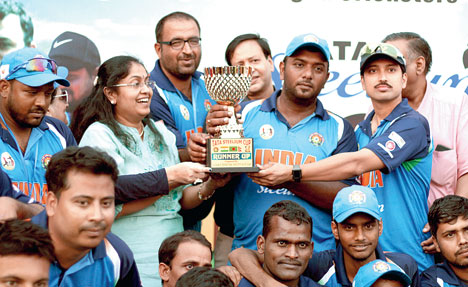
Team India with the runners-up trophy in Behala

A Salt Lake resident has been appointed coach of the Indian cricket team. No, he is not replacing Ravi Shastri. Aparup Chakraborty of BL Block is now the coach of the physically challenged national squad.

“I have taken over from the second week of April,” says the former captain of the national indoor cricket team.

The team played the first tournament under his guidance in the Tata Steelium Cup, a T-20 tri-series held in the Eastern Railway Sports Complex, Behala.

“The cricket rules are the same as what you are used to seeing. The only exception is runners are allowed for up to three players per team,” explains Aparup.

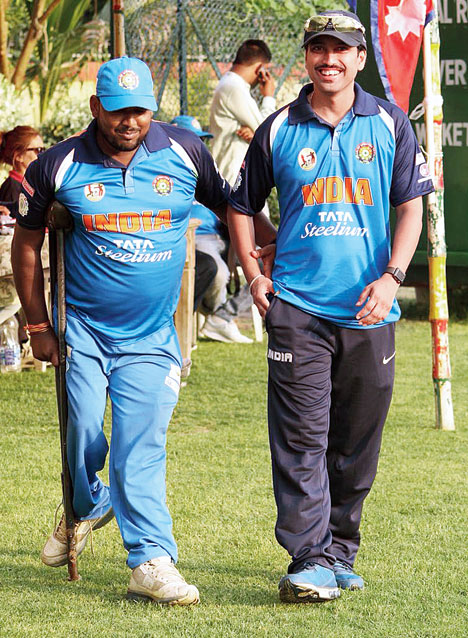
Even then, he received a jolt when he first walked into the players dressing room. “We are used to seeing bats and pads strewn about on the floor. Here there were artificial legs too. Before taking the field, the leg amputees take that one step extra — putting the leg on before padding up. That sight was testimony to the challenges they overcme just to reach the cricket field.”

Aparup Chakraborty walks into the filed with a differently-abled player

The 35-year-old coach is full of admiration for the level of competitiveness he witnessed on the field in his maiden assignment. “We have a 6ft tall bowler called Mandeep Singh who has a hand missing from the left wrist. But he bowls right-handed at 130 kmph. The Bangladesh skipper fields with a crutch. Yet when a ball was speeding past him he threw his crutch aside and dived to save the boundary. As it would have taken him time to get up, another fielder who was able of feet came running to pick up the ball.”

India lost the final to Bangladesh but Aparup is counting the positives from the tournament.

“Unlike in India, disabled cricket in Bangladesh gets infrastructural support from their cricket board and financial aid from their government. Their openers are among the top five players internationally. Here we function under Disabled Sporting Society but there is talk of the Board of Cricket Control in India taking over as the Lodha Commission report recommends that. But there is good talent in the team which we can harvest.”

He is looking forward to scouting for more talent across the country through tournaments. “India and England have bid for the right to host the disabled cricket World Cup in 2019. I hope to have a strong contingent by then.”

source: http://www.telegraphindia.com / The Telegraph,Calcutta,India / by Sudehsna Banerjee / May 04th, 2018