Museums that encapsulate magic of Bengal and Calcutta
Michael Feiner, the German consul general, with members of Unique Legacies of Bengal (BAUL) at Gurusaday Museum in Joka on Sunday. Pictures by Gautam Bose
Calcutta:
A museum dedicated to the folk arts and crafts of Bengal, another housing a treasure trove of artefacts excavated till 2005 and a third that narrates the story of the ubiquitous tram. Three of Calcutta’s lesser-known attractions, all of them possible to visit in a day, were on Sunday part of a heritage tour taken by the German consul general Michael Feiner.
Metro tagged along to capture highlights of the visit to the Gurusaday Museum in Joka, the State Archaeological Museum in Behala and the tram museum in Esplanade.
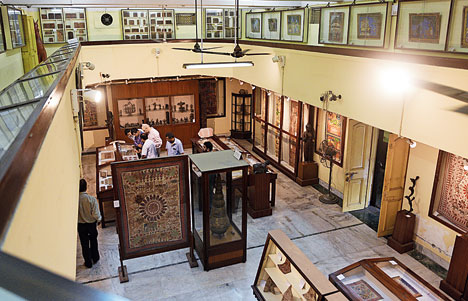
Gurusaday Museum, Joka
This museum located near the Joka crossing on Diamond Harbour Road houses paintings, kantha embroidery and musical instruments, among others.
Colourful scroll paintings ( patachitra) that narrate tales like Gourangalila and Manasamangal adorn the walls . There are also square paintings that depict ordinary people living ordinary lives as well as gods and goddesses. One such painting shows a rural market scene with some people dressed in proper clothes while others are clad only in a dhoti, creating an image of social contrast.
Tribal musical instruments like dhamsa, madal, shinga and damru are also on display in the museum.
The majority of the pieces are from the collection of Gurusaday Dutt, an Indian Civil Service officer who gathered those during his stints as collector in various districts of undivided Bengal. Many others have made donations to the museum.
One of the more striking pieces is the Crowned Buddha. “We are used to seeing figures of a bare-headed Buddha. A figure of Buddha with a crown on his head and jewellery around his neck and arms is rare,” said Dipak Barapanda, the assistant curator of the museum.
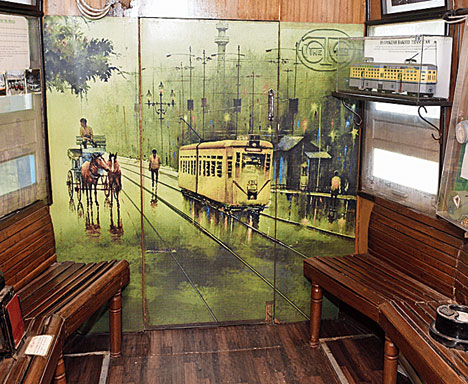
Smaranika, the tram museum at the Esplanade tram depot
The stone sculpture dates back to the 10th Century.
The museum has been in the news, albeit for the wrong reason, since the Union ministry of textiles informed the authorities that it could not fund maintenance forever. In a letter last November, the ministry asked the museum to find a sustainable revenue model to keep the show going.
About 800 exhibits are currently on display and another 4000 are languishing in the storeroom for paucity of space.
State Archaeological Museum, Behala
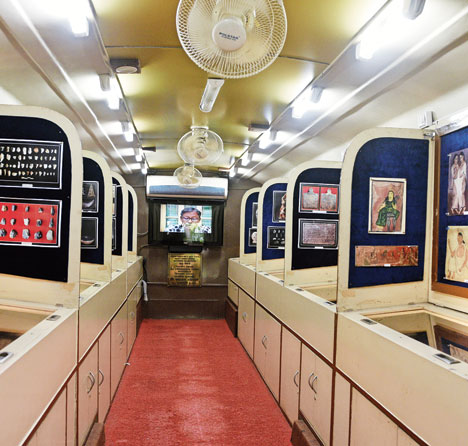
Tucked away behind a pavement full of hawkers in Behala is the richness of a heritage often overlooked. Several galleries in this museum are dedicated to paintings and artefacts found during excavation of historical sites.
Very few seem to know that artefacts excavated in 2005 at Jagjivanpur, a site in Malda, are on display here. “This site was excavated between 1996 and 2005,” said Sumita Guha Roy, the assistant curator and an employee of the museum since 1992.
How Jagjivanpur was discovered is an interesting story in itself. “In 1987, a man digging his field found a bronze plate,” Guha Roy recounted. “Archaeologists later deciphered the text on the plate and found that it was a land grant made by King Mahendrapala to his senapati (commander) to build a Buddhist monastery there.”
This was the first clue to the treasure trove hidden underground. A plaque inside the gallery mentions that excavation began in 1992, but had to be stalled for some years to rehabilitate people living there.
In one gallery, a painting from the late 18th Century shows the intermingling of people from different stratas of society. This one came from Nashipur in Murshidabad.
“The painting shows a medieval king and a Vaishnava saint standing in front of Lord Krishna with folded hands,” said Sayak Ghosh, a member of the Bespoken Architectural and Unique Legacies of Bengal (BAUL), the group that had organised the Sunday tour with the German consul general.
Smaranika, the tram museum in Esplanade
The inside of a van that travels to the districts to make people aware of Bengal’s history, heritage and culture. Schools and individuals can contact that State Archaeological Museum to book a visit to their neighbourhood
A tram of 1938 vintage at the Esplanade depot has been turned into a museum-cum-cafeteria with 16 seats. The rear bogie of the tram is where the museum is. It contains replicas of a tramcar that was once used to water and clean roads, besides a trolley bus. Tram tickets used during various periods are also on display.
Trolley buses had wheels like buses, but they drew electricity from overhead electric cables meant for trams.
The visit took consul general Feiner back to Germany, where trams still run. “Around 50 cities of Germany like Berlin, Stuttgart and Munich have streetcars. In Germany, streetcars get priority over other traffic,” he said.
At the cafeteria, which is open from 1pm to 8pm, a montage of films shot inside trams between 1931 and 2012 runs on loop on a television screen.
Feiner, who has lived in Calcutta for 10 months, offered a suggestion to promote tourism within Calcutta. “I think there should be a website with comprehensive information on the museums and heritage of Calcutta. There are a lot of ways to promote tourism and this can be a start,” he said.
source: http://www.telegraphindia.com / The Telegraph,Calcutta,India / Home> Calcutta / by Subhajoy Roy / July 09th, 2018
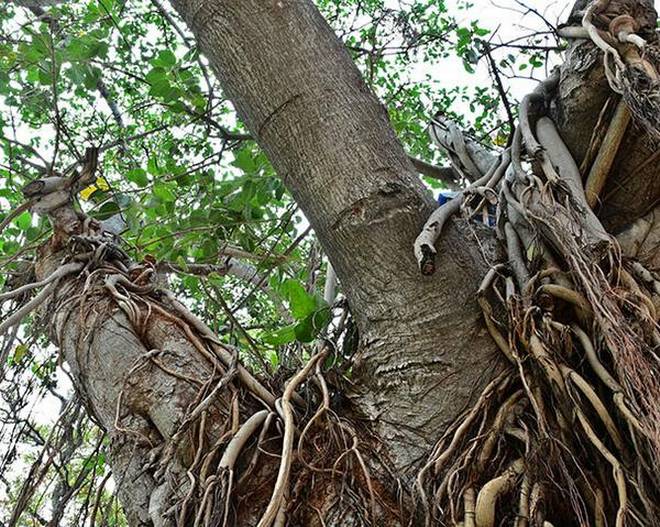
In 1979, Dr. T.M. Das of Calcutta University estimated the value of a tree to be $2,00,000 | Photo Credit: S. SIVA SARAVANAN
Hundred trees remove 53 tons of carbon dioxide and 430 pounds of other air pollutants per year. They also catch about 1,40,000 gallons of rainwater per year.
Officials in Delhi wish to fell about 17,000 fully grown trees in some parts of the city to make space for building housing colonies. And to “pacify” people who object to this tree destruction, they say that for every tree that will be felled, they will plant 10 saplings. Interesting — the minister knows it; the National Building Construction Corporation (NBCC) knows it and we all known it — that this is a stupid answer. “What you lose today, I will make up” (20 years from now? and if the saplings survive?) And this is not just in Delhi. Government and city planners in several other states do the same. This attitude shows not just ignorance but arrogance, disregard for trees and their value. It is time planners wake up and understand the value — economic, ecological, health-related and sociological — that trees offer.
Value of a tree
Way back in 1979, Dr. T.M. Das of Calcutta University estimated that the monetary value of a tree, during a life span of 50 years, amounted to about $2,00,000 (at 1979 rates). This was based on the amount of oxygen it produces, the fruit or the biomass and the timber it offers when felled and so on. For every 1 gram that a tree accumulates as it grows, it generates about 2.66 grams of oxygen. Dr Nancy Beckham of Australia, in her paper, “Trees: finding their true value”, points out that “trees and plants silently carry out their daily routine years after years, stabilizing the soil, recycling nutrients, cooling the air, modifying wind turbulence, intercepting the rain, absorbing toxins, reducing fuel costs, neutralizing sewage, increasing property values, promoting tourism, encouraging recreation, reducing stress and improving personal health as well as providing food, medicine and accommodation for other living things”. (Link: ).
The Department of Environmental Conservation of New York State, USA offers numbers in this connection (see ), along with references to scientific papers which estimate these numbers. It points out that (1) healthy trees mean healthy people: 100 trees remove 53 tons of CO2 and 430 pounds of other air pollutants per year; (2) healthy trees mean healthy communities: tree-filled neighbourhoods lower the levels of domestic violence and are safer and move sociable; (3) healthy trees mean healthy environment — 100 mature trees catch about 1,40,000 gallons of rain water per year; (4) healthy trees mean home-owner savings — strategically placed trees save up to 56% of air conditioning costs; evergreens that block winter winds can save 3% on heating; (5) healthy trees means better business — in tree-lined commercial districts, shoppers report more frequent shopping and spend 12% more for goods, and (6) healthy trees means higher property values.
The minister and the NBCC officials are smart people and they surely know all these facts. Yet for them, a mature tree is “dead urban space” and clearing 17,000 trees means real estate for building houses, colonies and shopping malls in a city that is gasping for clean air. (Delhi Greens, an NGO, estimated in 2013 that a healthy tree is worth Rs. 24 lakh a year, just with respect to its oxygen producing capacity). And for them a sapling occupies (today) about a hundredth (or even less) space. But where will they plant the saplings — where the trees were? How will they survive if construction starts already? Clearly the officials’ attitude is: ‘well, we will be gone (transferred/ retired) and do not need to answer’. What Gurgaon was then, and is now, makes the point.
Admire trees, don’t axe them
In stark contrast to their cruel attitude towards trees stand the examples of Sunderlal Bahuguna’s “chipko” movement, Saalumarada Thimmakka of Karnataka who has planted 398 banyan trees — each representing her own child, and Majid Khan and the team of biologists and horticulturists who are offering “intensive care” (injecting insecticide mix in to the phloem of each branch) to a 700 years old “pillalamarri” banyan tree near Mahabubnagar, Telangana, spanning a 4–acre canopy , which is being eaten up by termites, and bringing it back to life. (See: https://www.thehindu.com/news/national/telangana/a-tree-in-intensive-care/article24241462.ece). Should it have been cut and the 4 acre space used as real estate?
Obviously trees offer emotional, even spiritual solace. Indian history is replete with examples — Lord Buddha, Emperor Ashoka, and the Tamil King Pari Vallal who left his chariot near a plant to help it spread its branches.
Should not Delhi then think of building houses and colonies elsewhere in the suburbs, saving these 17,000 trees? Or if at all it has to do it in Delhi, think new thoughts, but without cutting the trees (or at best sacrificing the smallest possible number)? This impossible-sounding scheme offers challenges to architects. Indeed, high rise apartments have been built elsewhere, saving trees and even including them as part of the building. Some examples are seen in Italy, Turkey and Brazil.
India has been blessed with creative architects, both Indian and foreign, who have built houses and campuses, totally in harmony with the surroundings. The Indian Institute of Architects has about 20,000 members, we have about 80 institutions that teach architecture. Why not throw a challenge to them to come up with the best plan, offer a handsome award to the most suited and creative one, and use it to build the colony?
dbala@lvpei.org
source: http://www.thehindu.com / The Hindu / Home> Science / by D. Balasubramanian / July 07th, 2018
Nabaneeta Dev Sen has become the first woman president of the Presidency Alumni Association since its inception in 1951.
Dev Sen was officially anointed at a meeting at the association’s office on the Presidency campus on Friday.
“We have had 20 presidents before her. She happens to be the first woman,” said secretary Bivas Chaudhuri.
Dev Sen had filed her nomination for membership in the association’s executive council and was inducted as one of the 29 members at the association’s annual general meeting on June 23. “The executive council unanimously named her the next president,” Chaudhuri said.
Presidents have a tenure of one year. The 30th member of the council is the ex-officio chief patron, who is the university’s vice-chancellor.
Asked what role she would like the alumni association to play, Dev Sen replied: ” These are tough times. Let us see what can be done.”
source: http://www.telegraphindia.com / The Telegraph,Calcutta,India / Home> Calcutta / by The Telegraph Special Correspondent / July 07th, 2018
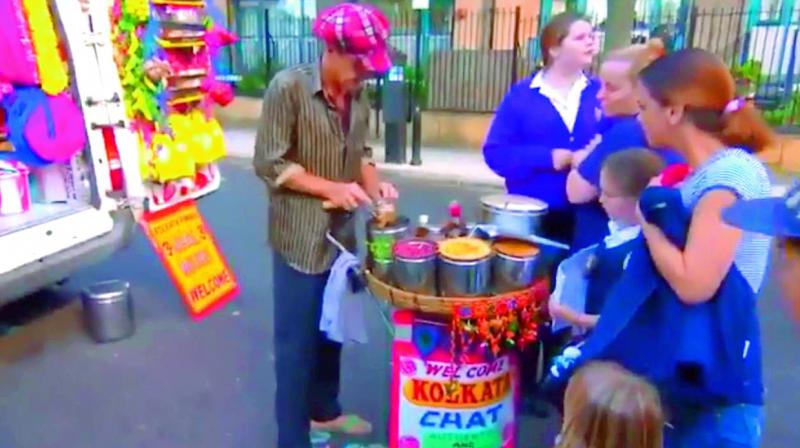
For decades now jhalmuri, spicy puffed rice, has ruled the streets of Kolkata.
Chef Angus Denoon serving jhalmuri in London.
For decades now jhalmuri, spicy puffed rice, has ruled the streets of Kolkata. Having been a part of 10 Foods Around the World to Try Before You Die (published by Huffington in 2012), jhalmuri has now found many new admirers on the streets of London.
Well-known industrialist Harsh Goenka recently put up a video on his Twitter account of an English chef selling jhalmuri in London. “Jhalmuri is my all time favourite snack. Jhalmuriwalas dot the streets and lanes of Kolkata, and each neighbourhood proudly boasts of their ‘guy’ being the best. Funny that a mix of simple ingredients can demand such finesse. Now delighted to see it available in London (sic),” he tweeted. What’s interesting is that many foreigners can be seen enjoying the Indian street food in the video.
The chef, who is seen making jhalmuri in the video, is a British chef Angus Denoon, and has been selling jhalmuri on the streets of London for almost a decade since he first tasted it on the streets of Kolkata.
Jhalmuri makes for a perfect rainy season snack. Try this easy-breezy recipe and enjoy it with a cup of adrak ki chai.
Jhalmuri
Ingredients
(serves 4)
250 gm murmura
1 spicy mixture (farsaan) with peanuts
¼ cup onion, finely chopped
2 green chillies, finely chopped
1 potato, boiled and diced into small pieces
¼ cucumber, finely chopped
1 tomato, finely chopped
Juice of one lemon
2 tsp coriander leaves, finely chopped
½ tsp mustard oil, to drizzle for jhalmuri masala
¼ tsp amchoor powder
½ inch roasted cinnamon
1 roasted green cardomom
2 roasted cloves
½ tsp salt
1 roasted dried red chilli
¼ tsp roasted coriander seeds
¼ tsp roasted jeera
(Grind them together. Quantity needed — 1 tablespoon)
Method
Mix all the ingredients of jhalmuri, except the lemon juice and coriander leaves. Sprinkle the jhalmuri masala and then mix some lemon juice. Garnish with coriander leaves and serve.
Purabi Sarkar, home chef
source: http://www.deccanchronicle.com / Deccan Chronicle / Home> Lifestyle> Food and Recipes / Deccan Chronicle / July 05th, 2018
William Brooke O’Shaughnessy’s investigations at a Calcutta hospital into the potential of medical marijuana were the first in modern medicine.
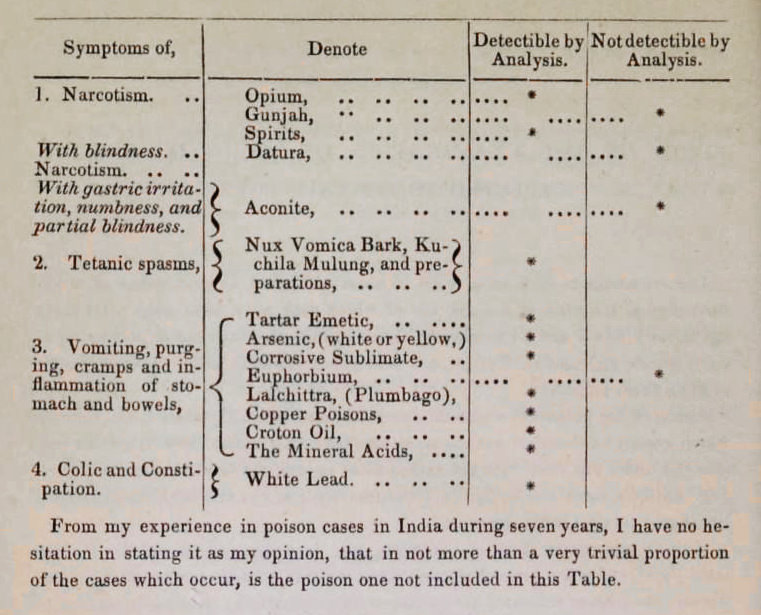
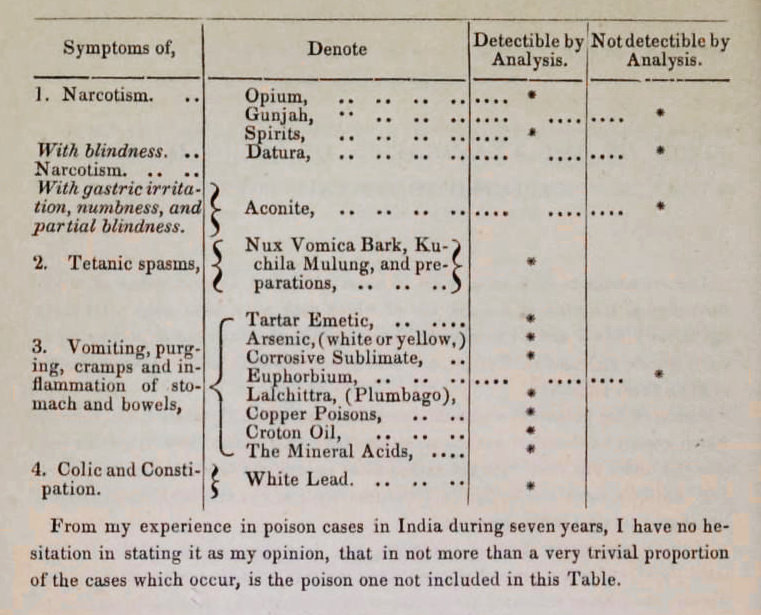
A table from O’Shaughnessy’s 1841 report. Credit: Report on the investigation of cases of real and supposed poisoning
In 1833, a twenty-four-year-old Edinburgh graduate arrived in India, an Assistant Surgeon in the East India Company. He had failed to acquire a license under the London College of Physicians and Surgeons, but had already established himself as an exciting young medical researcher, authoring an important paper on cholera following an outbreak in Europe. This man was William Brooke O’Shaughnessy, an Irish physician who would – over the next few years working in India – make significant contributions to the history of research in electricity, telegraphy, pottery, and, his primary discipline, medicine
The colonial peripheries had no shortage of impressive polymaths, but what sets O’Shaughnessy apart is the manner in which, while conducting research in his many areas of interest, he not only tapped into elaborate local knowledge networks and structures but also rigorously documented them, thoroughly crediting his sources both bibliographic and human. O’Shaughnessy also stands out on account of what was, arguably, his most significant contribution to medicine: the claim that cannabis could be used as a medicinal drug.
As an intoxicant cannabis was fairly common in India, as O’Shaughnessy noted, but he demonstrated its potential use in a medical context, particularly as an anaesthetic. The papers on his experiments with the plant were published in the Journal of the Asiatic Society of Bengal in late 1839 — and were also read in front of the Medical and Physical Society of Calcutta in October of that year. In them, we find detailed records of his prescient experiments and a fine example of his unique style of research.
His first series of cannabis experiments were conducted on an unfortunate menagerie of animals (amongst others, fish, vultures, and storks) and also, perhaps not without controversy today, a few children — all subjected to various preparations and extracts of Cannabis Indica. The first experiment, for instance, involved administering “ten grains of Nipalese [sic] Churrus, dissolved in spirit” to a “middling sized dog”. O’Shaughnessy’s breathless notes read: “In about half an hour he became stupid and sleepy, dozing at intervals, starting up, wagging his tail as if extremely contented, he ate some food greedily, on being called to he staggered to and fro, and his face assumed a look of utter and helpless drunkenness.”
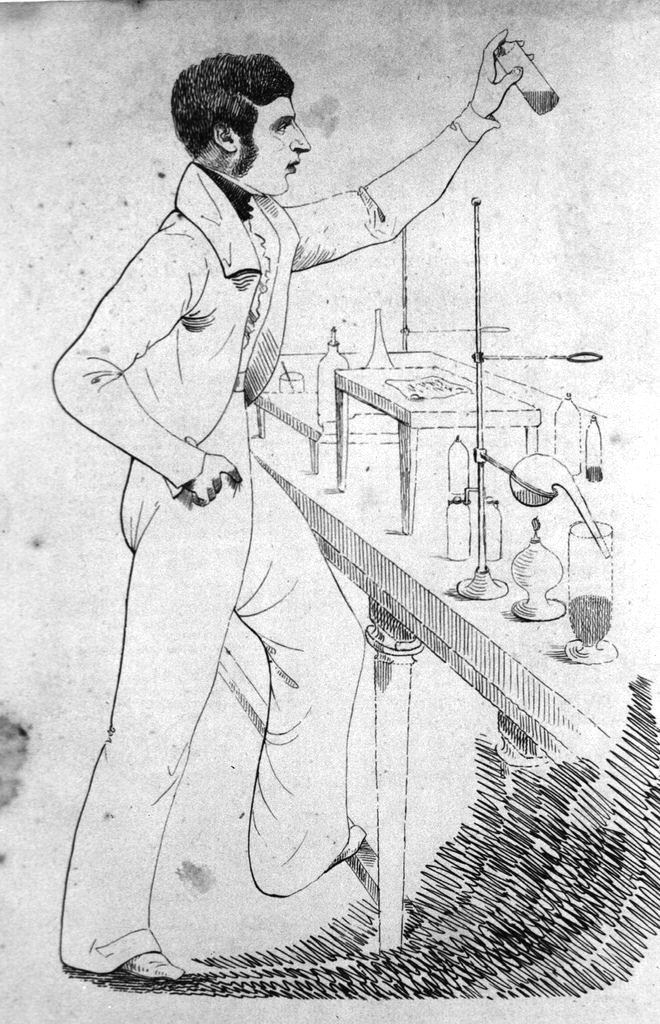
Illustration of W. B. O’Shaughnessy at work in the laboratory, artist and date unknown. Credit: US National Library of Medicine
O’Shaughnessy then proceeds to try variants of these initial treatments on a number of maladies. He describes the effect on four cases of patients suffering from rheumatism, a case of hydrophobia, on cholera and tetanus, before issuing a warning about the delirium that may be occasioned by inappropriate dosage. Some of the reports wouldn’t be out of place as descriptions of a merry stoner’s night in (minus the video games). One rheumatism sufferer, to whom “half a grain of Hemp resin was given in a little spirit … became talkative and musical, told several stories, and sang songs to a circle of highly delighted auditors, ate the dinner of two persons …, sought also for other luxuries I can scarcely venture to allude to, and finally fell soundly asleep, and so continued till the following morning”. Perhaps not unsurprisingly the next day the patient “begged hard for a repetition of the medicine”.
Elsewhere O’Shaughnessy describes a somewhat surreal episode in which a rheumatism patient administered with cannabis enters a state of “catalepsy”, whereupon his rigid limbs could be moved only with the help of medical staff, who could place them in “every imaginable attitude” where they would remain “no matter how contrary to the natural influence of gravity” — all the while the patient remaining completely “insensible”. The commotion of events ended up rousing a second patient, similarly dosed, who became “vastly amused at the statuelike attitudes” he witnessed, and then proceeded, after a sudden “loud peal of laughter” to exclaim that “four spirits were springing with his bed into the air”. After a subsequent “uncontrollable” fit of the giggles this second patient then took up the strange condition of the first, his arms and legs “remain[ing] in any desired position”. Despite the slightly chaotic scenes, within a day or so both patients were much relieved of their rheumatism, and in three days completely cured.
Interestingly, it is while recording a failed treatment of hydrophobia that O’Shaughnessy notes one of the fundamental arguments for this medicine: even if it failed at curing the actual root of the illness, “at least one advantage was gained from the use of the remedy — the awful malady was stripped of its horrors”. If the illness was terminal, at least cannabis could enable the physician to “strew the path to the tomb with flowers”.
The argument is not unfamiliar today, and indeed, in a prescient echo of more recent advocates of cannabis’ legalisation, O’Shaughnessy also downplays the drug’s supposed negative effects compared to other certain popular legal narcotics.
As to the evil sequelae so unanimously dwelt on by all writers, these did not appear to me so numerous, so immediate, or so formidable, as many which may be clearly traced to over-indulgence in other powerful stimulants or narcotics, viz. alcohol, opium, or tobacco.
The interest of O’Shaughnessy’s medical students was also clearly piqued. He reports that several ended up experimenting on themselves and describes in detail one particular auto-experiment by a “retiring lad of excellent habits” which, twenty minutes after ingestion, led to the “most amusing effects I ever witnessed”.
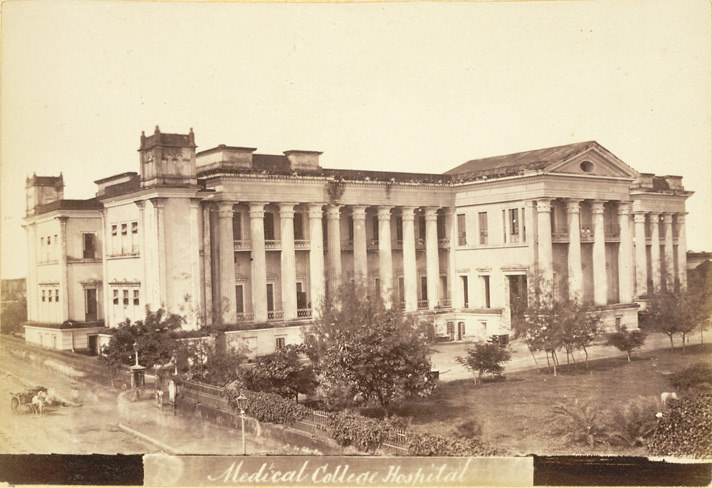
Photograph from 1878 of the Medical College Hospital, Calcutta, where O’Shaughnessy worked, although this picture shows a building completed in 1852, by which time he was working on the telegraph system. Credit: Wikimedia Commons
I found him enacting the part of a Raja giving orders to his courtiers; he could recognize none of his fellow students or acquaintances; all to his mind seemed as altered as his own condition; he spoke of many years having passed since his student’s days; described his teachers and friends with a piquancy which a dramatist would envy; detailed the adventures of an imaginary series of years, his travels, his attainment of wealth and power. He entered on discussions on religious, scientific, and political topics, with astonishing eloquence, and disclosed an extent of knowledge, reading, and a ready apposite wit, which those who knew him best were altogether unprepared for. For three hours and upwards he maintained the character he at first assumed, and with a degree of ease and dignity perfectly becoming his high situation. A scene more interesting it would be difficult to imagine. It terminated nearly as rapidly as it commenced, and no headache, sickness, or other unpleasant symptom followed the innocent excess.
In and amongst these colourful accounts, O’Shaughnessy’s paper is peppered with references to other instances in which his fellow medical men had employed the administration of cannabis to alleviate patients’ symptoms. The list includes his cousin Richard O’Shaughnessy, Dr Bain of the Police Hospital, Mr O’Brien of the Native Medical Hospital, and not least, James Esdaile (another Edinburgh student, best known for his experiments with mesmerism at the Hooghly Imambarah College, which he recorded in his 1851 book Mesmerism in India). The historian Shrimoy Roy Chaudhury feels that it was the “conquest of pain in surgery” that granted British medicine historical credibility in India. Hemp played a key role in this. And veterinary science got involved as well — among notable experimenters in this field being the firm Hughes and Templar, who claimed to have cured three out of “five cases of horses suffering from tetanus” with the hemp resin.
Before setting out the details of his experiments, O’Shaughnessy offers a background to the drug in four sections: its botanical character, popular uses, historical details, and medicinal properties. But he does all this with a little help from his friends: some regular and some, as that other great “generalist” Sherlock Holmes would call them, irregular. The network, as the following series of annotations to O’Shaughnessy’s article will demonstrate, is an incredibly wide and diverse one.
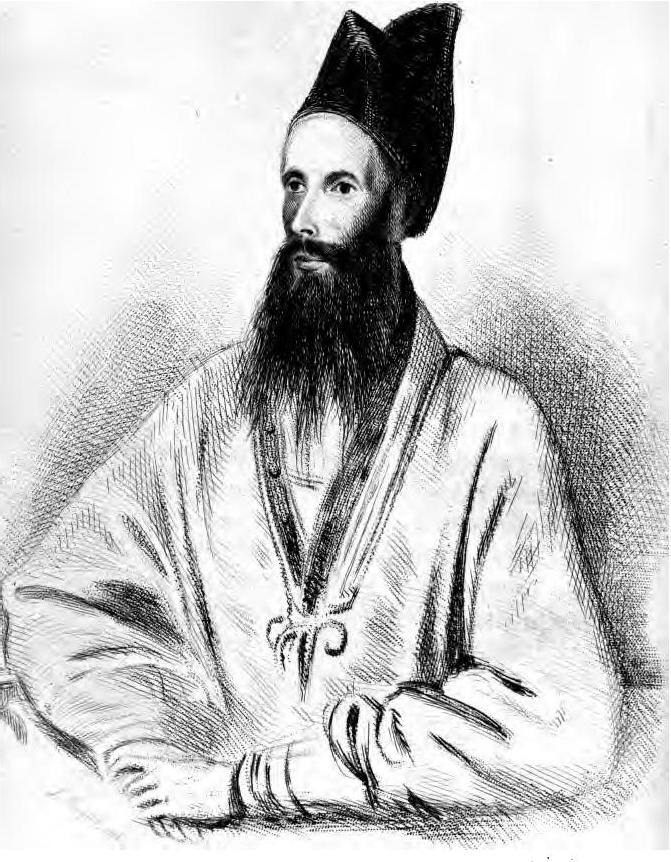
For the historical and statistical data he thanks the following: “the distinguished traveller the Syed Keramut Ali, Mootawulee [guardian] of the Hooghly Imambarrah”, “Hakim Mirza Abdul Razes of Teheran”, Pandit Madhusudan Gupta, “the celebrated Kamalakantha Vidyalanka [sic], the Pandit of the Asiatic Society”, and Mr DaCosta.
Portrait of Syed Keramut Ali, featured in Arthur Conolly’s Journey to the North of India (1838). Credit: Journey to the North of India
Syed Keramut Ali, former Great Game “Newswriter” under Arthur Conolly in Kandahar, helped O’Shaughnessy with Persian references and a few manuscripts. Additional translation help may have also come from “Mr Da Costa”, which is presumably Lewis Da Costa, a polyglot and a prolific translator serving as Assistant Persian Translator to the Government of India in the 1840s. O’Shaughnessy wished also to appeal to Hindu authorities and the most obvious names listed in this regard are Madhusudan Gupta – celebrated as the first Indian to dissect a cadaver (though recent histories have justifiably questioned this claim) – and Kamalakantha Vidyalanka, who was appointed teacher of Rhetoric at the Sanksrit College and became part of the British judicial system as a pundit.
Vidyalanka appears to have had no direct link with medicine but provides O’Shaughnessy with a number of obscure Sanskrit references to the use of hemp, including a prohibition for Brahmins in particular found in the texts of Manu.
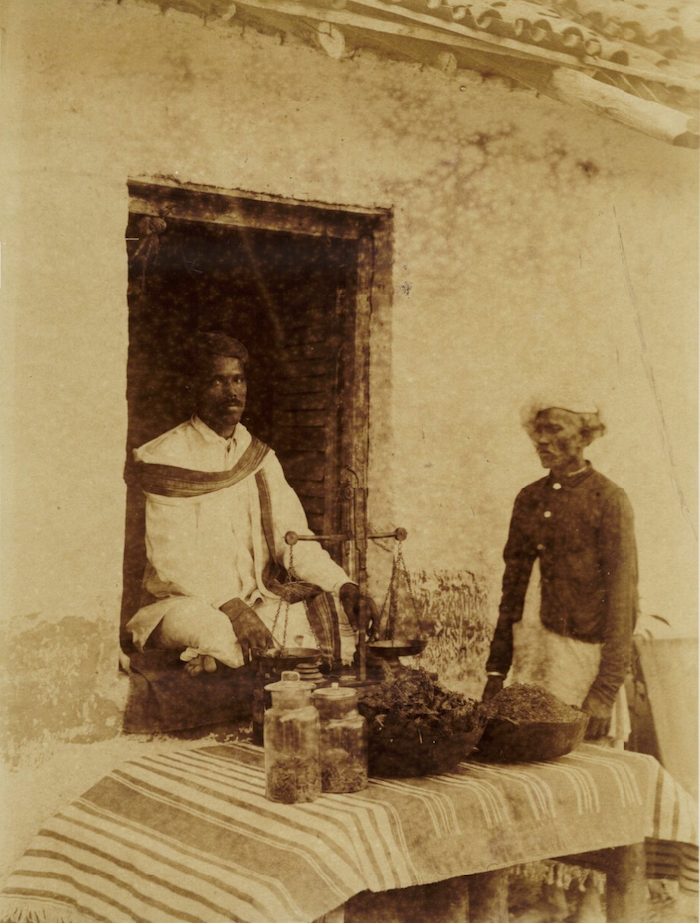
While reaching out to his scholarly friends on the one hand, O’Shaughnessy also sought advice from the Deputy Superintendent of Police, Mr McCann, on official surveys regarding the consumption of “gunjah”. But if he wanted to know about the daily lives of his consumers, he needed someone “irregular”. For such purposes he tapped into the experience of one Ameer, “the proprietor of a celebrated place of resort for Hemp devotees in Calcutta, and who is considered the best artist in his profession.” For understandable reasons, that is all we ever learn regarding the identity of Ameer.
It is perhaps thanks to Ameer, that O’Shaughnessy’s report is so able to display an exceptionally close knowledge of the uses of the various extracts. While Sidhee, Subjee and Bang (“used with water as a drink”) is “chiefly used by the Mahomedans of the better classes”, Sidhee (“ground, mixed with black pepper, and a quart of cold water”) is the “favourite beverage of the Hindus who practice this vice”. Gunjah, on the other hand, is “used for smoking alone”, and one rupee weight mixed with dried tobacco, “suffices for three persons”, although you find “four or five persons usually join in the debauch”. The demography is curious, especially in the case of Majoon, (a hemp confection which is “a compound of sugar, butter, flour, milk, and Sidhee or Bang”) which is consumed by all classes, “including the lower Portuguese or ‘Kala Feringhees,’ and especially their females”.
Photograph of “a hemp drug shop” in Khandesh, with “bhang, ganja, & majum” for sale, featured as part of the Report of the Indian Hemp Drugs Commission, 1893-1894. Credit: Medical History of British India, Disease Prevention and Public Health
For interested parties let it be known, O’Shaughnessy has provided ample details to try out your own nineteenth-century recipes. He distinguishes between each type of extract and offers specific descriptions of how they are prepared, although the one which he recommends in greatest detail is meant for medicinal use only. Inadvertently he also maps availability of the finest quality of each kind — sourcing his churrus as he did from Nepal, thanks to Dr. A. Campbell of the Bengal Medical Service, a man with the dubious distinction of changing the course of Darjeeling’s history when as Superintendent he oversaw a huge population rise between 1839 and 1849. The first part of the article also offers a rare glimpse into the contemporary consumption habits — an account that differs in tone and content from the usual official surveys.
If we discard the binary model often used to understand the exchange of knowledge (scientific, legal, or otherwise) between the colonial centres and peripheries, and turn to the idea of networks (as the historian Kapil Raj, for instance, has done), we realize that the networks that produce knowledge are much more complex than they appear at first glance. In W. B. O’Shaughnessy we have someone who is rigorous in noting down all the different sources of information that he taps into, and we realize that, upon closer inspection, even the nodes of a network give way to many other interconnected webs.
In the thirty-one-page Report on the Investigation of Cases of Real and Supposed Poisoning (1841), found in the National Library of India (Kolkata), we see our doctor sitting in the centre of another web of intrigue. After a call out, people sent O’Shaughnessy items ranging from “the remains of a chapattee, which is said to have been the cause of death of Dasi Bania” to “a stomach…and the small intestines with the contents thereof, all stated to have been removed from the body of a man” found dead in the Native Hospital.
O’Shaughnessy, who was Chemical Examiner to the Government, received mails from persons in different posts in the British government from all over Bengal. He would send back his reports with details of his chemical analysis, opining whether there may have been foul play. He often struggled with forms of poison (often with the common bish which is available at any Calcutta market) that were not yet recognized by Western medicine.
Table from O’Shaughnessy’s Report On The Investigation Of Cases Of Real And Supposed Poisoning (1841). Credit: Report on the investigation of cases of real and supposed poisoning.
O’Shaughnessy’s language seems to anticipate at times the medico-forensic phrasings of Conan Doyle’s Dr. Watson. He begins Case 12 thus:
These are by far the most interesting cases which I have ever met with. The respectability of the individuals implicated; the extraordinary period which elapsed during which the bodies were exposed, without coffins, to the destroying influences of the heat and rains of Bengal; the curious changes which the poison underwent…constitute an array of circumstances scarcely surpassed in medico-legal interest by any but those of the celebrated Laffarge trial.
This was not his first encounter with the science of criminal activity. In 1830, a young O’Shaughnessy arrived in London, struggling to find permanent employment. Soon after, urged by the editor of The Lancet, he published an article on “Poisoned Confectionary”, the result of an extensive study. Along with a Dr. Green, he purchased “at several shops, different specimens of coloured confectionary, and of colourless articles wrapped in stained paper.” Each colour was analyzed rigorously. The yellow, for instance, was understood to be a result of adulterating the candies with either “gamboges, massicot, Naples yellow, the chromate of lead, or vegetable lakes.” A report on the study was published in an 1831 issue of The Medico-chirurgical Review and Journal of Practical Medicine, in which the writer remarks: “Dr. O’Shaughnessy is evidently a clever chemist, and his industry appears equal to his talent in the department of human knowledge”.
The Journal of the Asiatic Society of Bengal published in the span of a few months two other experiments performed by O’Shaughnessy. In 1839 he reports on his use of the Galvanic battery for the “successful destruction of the wreck of the Equitable at Fultah Reach”, where the Sydney-bound ship “leaden with wheat, rice, rum, &c.,” had touched on the sand below and turned over “in six to seven fathoms of water”. The first one, however, anticipates his later work on telegraphy — a form of communication that would be taken seriously only after 1847, with Lord Dalhousie’s appointment as governor general.
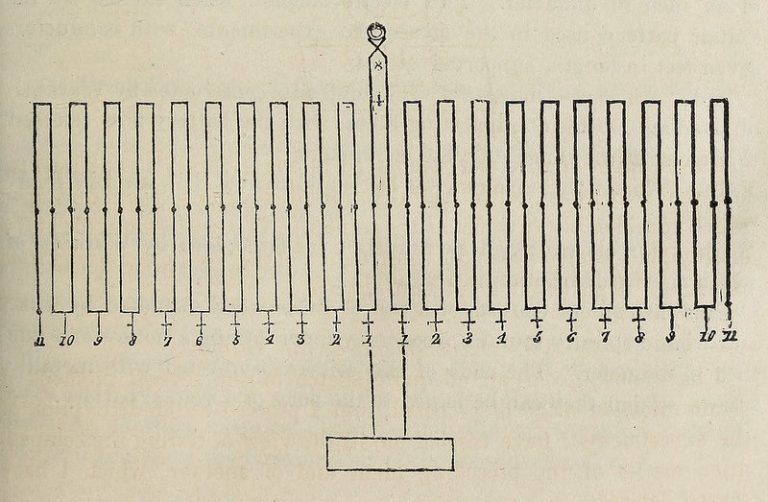
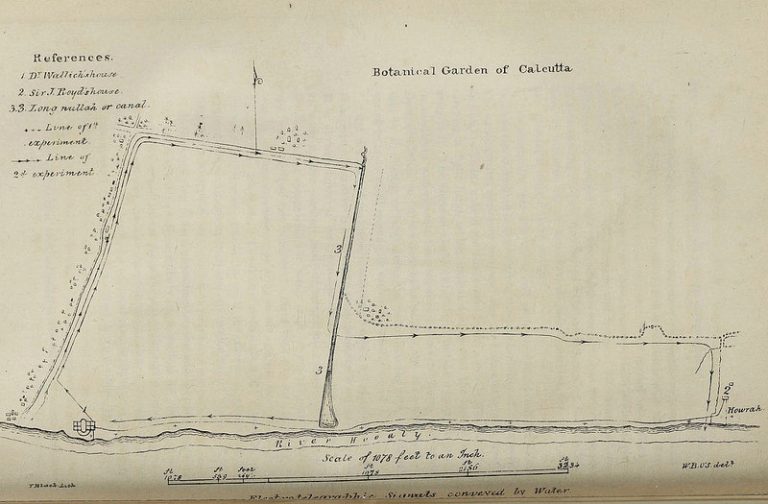
At the Botanical Gardens in Shibpur (he already had cordial relations with the persons in charge, such as Nathaniel Wallich), he experimented with the first telegraph circuit. After laying the cables, the two ends starting and ending where he positioned himself, he used to a pair of modified watches “of the cheapest kind”. (This is before his visit to England where he learnt of the Morse.) “Round the second hand was placed a card dial laid off with three concentric circles divided each into twenty parts.” He omitted “vowels and superfluous letters” (reminiscent of today’s SMS truncations), and using this he successfully sent across messages. Each signal took about three minutes to transmit, and both watches were “then allowed to run to No. 1 or zero, and stopped”.
Diagram of the telegraph system, featured in O’Shaughnessy’s “Memoranda relative to experiments on the communication of Telegraphic Signals by induced electricity”. Credit: Journal Of The Asiatic Society Of Bengal (1839).Map of the botanical garden showing the route of the telegraph, featured in O’Shaughnessy’s “Memoranda relative to experiments on the communication of Telegraphic Signals by induced electricity”. Credit: Journal Of The Asiatic Society Of Bengal (1839)
It is in his work on the telegraph system – and particularly his role in rebuilding it after it was largely destroyed in the Indian Rebellion of 1857 – that we can see more clearly the dubious nexus between such scientific projects and the endeavours of colonialism, a connection made more explicit at moments of political crisis. As far as O’Shaughnessy’s contribution to medicine is concerned, its correlation with colonial power is perhaps not as obvious. Yet it does contribute, even if unintentionally to the larger discourse of knowledge/power, relating to what Shiv Visvanathan and Ashis Nandy call the “industrial grid”.
Western medicine, through sheer claim of objectivity, marginalised, traditional, and subsequently, “folk medicine”, while at the same time deriving its legitimacy on foreign soil from references to indigenous texts and social practices, through Sanskrit and Perso-Arabic scholars and local practitioners. In this regard O’Shaughnessy was no exception. Rather than thinking only of centres (individual or institutional) of knowledge production in the colonies, we’d do better than to focus more on the complexity of networks and exchanges – the go-betweens, as Kapil Raj calls them – who played such a key role in the production of the colonial sciences. It is here, in light of such an approach, that the detailed notes left behind by William Brooke O’Shaughnessy prove so invaluable, offering a rare and honest glimpse into how such networks functioned.
Sujaan Mukherjee is a Sylff PhD researcher at the Department of English, Jadavpur University. For his PhD he is looking at the role of urban memory in the formation of Kolkata, although his academic interests include physical cultures, Modernism and feminisms. Between 2015 and 2016 Sujaan was an archival fellow with the India Foundation for the Arts, researching visual representations of Calcutta particularly in tourism documents.
This article was originally published in The Public Domain Review and has been republished under a Creative Commons BY-SA 3.0 license.
source: http://www.thewire.in / The Wire / Home> History> The Sciences / by Sujaan Mukherjee / June 26th, 2018
Alipore resident feels no-plastic is matter of practice
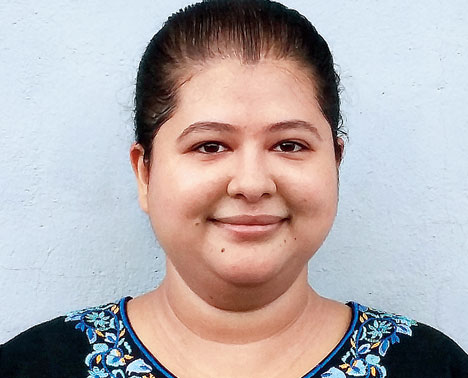
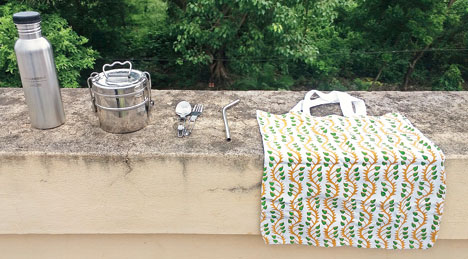
Alipore resident Rakhi Chakraborty suggests the use of (in picture below) cloth bags, metal water bottles, straws and spoons instead of plastic goods and steel tiffin carriers instead of plastic containers
Calcutta:
She is a zero waster – she doesn’t generate any garbage.
In her blog, zerowasteindian.com, she introduces herself as “a zero waster in progress” who “forayed into sustainable living” in 2017 and today pretty much generates zero to little waste.
Rakhi Chakraborty, an online journalist, is on a journey to a zero-waste life and is trying to spread awareness about the environment.
Rakhi was as alarmed as any other millennial about rising temperatures, plastic preponderance and all that’s associated with global warming.
She found in a recent study that humans have generated 8.3 billion tonnes of plastic since the 1950s. And a majority of that is dumped in landfills and oceans, contaminating water sources.
So, she decided to do her bit to undo the damage, one step at a time, believing in “the cumulative power of small positive change”.
In late 2016 she came across Lauren Singer’s blog, trashisfortossers.com, and found it “extremely empowering”. “Generally, as a citizen public policy is out of your control. Singer’s blog taught me to tackle my environment anxiety,” Rakhi, an Alipore Road resident, said.
She follows Bea Johnson and her prescription to lead a garbage-free life.
Apart from Singer’s blog, what spurred her towards a zero-garbage life was her polycystic ovary syndrome and an alarming bisphenol A (BPA) level.
Bisphenol A is an industrial chemical found in common plastic household items.
“It was then that the idea of zero waste made a personal connection with me because it would not only benefit the planet but also me,” she said.
An urban middle-class Indian generates 400-800g of trash every day on average.
“Plastic use has increased drastically over the past two decades. But it is entirely possible to live a life without plastic,” she said.
A zero waste guru, Bea Johnson has inspired thousands of people, including Lauren Singer, author of the zero waste blog Trash is for Tossers, to adopt a zero-waste lifestyle. The New York Times has hailed her as “the priestess of waste-free living”
“I started slowly… I banned plastic bags, water bottles… replaced them with cloth bags and glass bottles.”
Rakhi used to order takeaways that came in plastic boxes, along with plastic cutlery. “I started ordering food a lot less and even if I did I used my own container.”
But the more pervasive toxins came from detergents, dishwashers, beauty products, and even toothpastes.
Harmful toxins pass through clothes and directly into the body as well because of the presence of chemicals like parabens, sodium lauryl sulphate and triclosan in these products.
So, Rakhi has started using reetha (soapnuts), an all-purpose cleaner. “You can use reetha to wash your clothes, clean your utensils… to shampoo your hair. I use organic soap and tooth powder.”
One day she googled the composition of her toothpaste and it “blew” her mind, she said. It is not possible to find substitutes for all industrial product in India, but she follows the thumb rule in Ayurveda – if you can’t eat it, you can’t put it on your body, she said.
The journey to zero plastic hasn’t been easy but it is “pretty doable”, Rakhi, who writes it all in her blog, said. “It’s just a matter of practice and habit. Of course, there is a learning curve to everything.”
source: http://www.telegraphindia.com / The Telegraph,Calcutta,India / Home> Calcutta / by Anasuya Basu / July 03rd, 2018
A wheelchair that can climb stairs, a medicine dispenser that sends out reminders to users, and a walking stick that helps people with visual impairment mavigate with the help of audio messages. These were among 30 innovations that students at 24 institutions in eastern India demonstrated at a CII meet on innovation and startups in the city.
Conscious of the difficulty that the elderly and infirm experience in climbing stairs, students at JIS College of Engineering presented a wheelchair designed to climb stairs, with the help of three sets of wheels that work in tandem. Another innovation was Urja, a multi-purpose electric source, presented by Anish Kumar Sarangi from Silicon Institute of Technology, Bhubaneswar. The device can be used as a portable power source, a high-frequency mosquito repellent, a passive water filter, an LED light and a USB port, from which mobiles can be charged or USB fans can be operated. “Nearly two out of every 10 people in Asia and almost 300 million people in India do not have access to electricity. The challenge is to bring power to them.” Sarangi said.
“CII has formed innovation clubs at different colleges. Commercially viable projects are selected by the jury. Those projects, along with their prototypes, are displayed and some of them adapted in industries. We focus on four main fields: agriculture, education, finance and health,” said Dipankar Chakrabarti, co-chairman, CII Eastern Region Startup & Innovation Taskforce.
Students at Sudhir Chandra Sur Degree Engineering College have created an automatic medicine dispenser for which an app has been developed. Once the medicine schedules are fed into the dispenser the machine can deliver tablets or syrup at the correct time.
Among the other innovations was a solar AC proposed by Narula Institute of Technology. Its students have also proposed smart gloves that can translate gestures into speech to facilitate easier communication by people with speech impairment.
Jadavpur University students have proposed a light, portable, durable and fire-proof cabin that can be used by armed forces at the border.
MCKV Institute of Engineering presented a walking stick and a safety app that gets triggered when a ring worn by the user comes in contact with the mobile. The stick is fitted with GPS and guides the user —a visually impaired person—with audio directions.
Software Technology Parks of India additional director and officer in-charge Manjit Nayak felt most proposals had the potential to be developed into products. “A Class XII student from Bihar came up with a wireless device with which one can remotely control a tractor,” he said.
source: http://www.timesofindia.indiatimes.com / The Times of India / Home> News> City News> Kolkata News> Schools & Colleges / TNN / July 03rd, 2018
If there was no Chinese community in Calcutta, there would have been no rickshaw, no Darjeeling tea and no noodles for us.
But the Chinese – missionaries, migrants, journalists and government emissaries – also left their written impressions of the city.
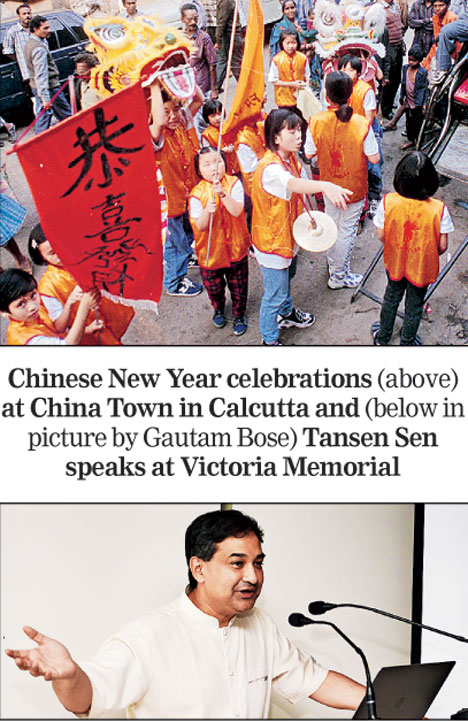
“The Chinese formed the largest migrant group from outside South Asia in the city. There were those who came to look for jobs and those who got smuggled in,” Tansen Sen said.
“It was the site of opium export and of financial transactions in the late 19th and early 20th century. The Mahabodhi Society here was a transit point between Sri Lanka and Thailand, China and Tibet. Many walked from Kalimpong to Lhasa, carrying necessary commodities. All this shows how important Calcutta was to the Chinese.” The professor of history and director, Center for Global Asia of New York University, Shanghai, was speaking on Chinese encounters with colonial and post-colonial Calcutta at Victoria Memorial on Thursday.
Governor General Warren Hastings initiated exchanges with China in the Qing dynasty. He sent a diplomatic mission to Tibet in 1774-75 and granted land near Budge Budge to Tong Atchew, the first Chinese trader to Calcutta, to set up a sugar mill in exchange of tea. British records show how Chinese labourers, especially carpenters, began to grow in popularity.
If Atchew did not document his impressions, Huang Maocai, sent by the governor of Sichuan in 1879, did. “His job was to check if the British planned to attack China and he created maps of the entire region from Sichuan to Bengal. He was fascinated with the railways and the telegraph as well as streetlights and tap water.”
But Kang Youwei, who visited Calcutta twice in the first decade of the 20th centure and stayed at the Grand Hotel, found the streets “filthy like those in Beijing”.
By the time Kang comes, there were three Chinese settlements in Calcutta – Bowbazar, Tangra and Budge Budge. Sen stressed that it would be wrong to lump the community together. “Bowbazar, housing the Cantonese, was a relatively open community. Tangra, housing the Hakkas, was gated. They did not like each other.”
The next major visitor, Tan Yunshan, the founder-director of Cheena Bhavana, Visva-Bharati, described China Town as an unhygienic place of criminal activities, opium dens and “where Chinese women showcase their small feet”, an euphemism for prostitution.
“But those who lived here regarded the place differently, like Kwai-Yun Li. Daughter of Hakka parents who migrated here in the 1920s and owned three shoe stores, she grew up in Chhatawala Gali and then Tangra, and was friendly with Bengali and other communities.”
But the political changes in 1949, when the Kuomintang lost the civil war in China and India recognised the People’s Republic of China (PRC) government, impacted the local Chinese populace.
The rise of communism or the “godless regime” impacted David and Mary Lamb, Chinese Christian missionaries who not only had to quit Shanghai but were also precariously placed in Calcutta as the Bengal government was supportive of PRC. The Lambs founded the Ling Liang Chinese Church and Grace Ling Liang English School in Tangra.
But worse was to come in 1962 with the war. As Kwai-Yun Li, who migrated to Canada and wrote of her Chinatown experience, told this correspondent during her Calcutta visit in 2008: “Fear was in the air…fear of being deported or put into Deoli.”
Deoli, in Rajasthan, is where a British detention camp for World War II Japanese prisoners had been reopened “to lodge Chinese-Indians”. Sen says those who had opted for PRC passports in 1949 were the first to be targeted. Many who were deported to China were settled in villages in Guanxi, Guangdong and Yunnan. “They still maintain Indian traditions like wearing sari and celebrating Diwali.”
The Chinese writings, Sen pointed out, present a perspective different from British writings and deserve to be read to understand the cosmopolitan nature of Calcutta.
source: http://www.telegraphindia.com / The Telegraph,Calcutta,India / Home> Calcutta / by Sudeshna Banerjee / July 01st, 2018
Swachchhasila Basu visits Michael Madhusudan Dutt’s Bengali debut stage on the poet-playwright’s 145th death anniversary
DUTT ADDRESS: Belgachia Rajbari
A two-storey structure off north Calcutta’s Belgachia Road nudges curiosity. The portico cuts though the building like a tunnel. Trees grow on the walls, their aerial roots weaving a veil over it. The pink ground floor walls are peeling like scabs, the upper floor is unpainted. The bricks that seal the arched spaces to the right of the portico talk of secrets buried. The red doors to the left are not welcoming either. And yet, once, the doors of this very house had been thrown open to Bengal’s cultural elite.
The Belgachia Rajbari hosted, among other things, the first performance of Michael Madhusudan Dutt’s Sarmistha, the first original play in Bengali.
According to the Mahabharata, Sarmistha is the second consort of prince Yayati. Says 83-year-old Nityapriya Ghosh, “It was 1859. While translating Ramnarayan Tarakanath’s Sanskrit play Ratnavali into English, Dutt realised there were no original plays in Bengali. Encouraged by friends and patrons, among them the rajas of Paikpara and Jyotindramohan Tagore, he wrote this five-act play.”
This was supposed to be the most productive phase of Dutt’s literary life. In a letter from 1859, written to a friend whom he refers to “as one of the best dogs in creation” he writes, ” Sermista [the English translation by Dutt himself is spelt thus] has turned out to be a most delightful girl… Jyotindra says it is the best drama in the language.”
Ghosh, who used to live in Belgachia Villa – a government housing that came up in a portion of the Rajbari estate – says that around 1836, Prince Dwarkanath, entrepreneur and grandfather of Rabindranath Tagore, bought the estate and a single-storey house and converted it into this palace. In Bonedi Kolkatar Gharbari, Debasish Bandyopadhyay writes that Dwar-kanath had spent over Rs 2 lakh on the estate makeover.
“The who’s who of society would look forward to an invitation to the innumerable parties he threw here,” says 88-year-old Deboprosad Majumdar, who has done much research on the region.
Later, Dwarkanath’s son, Debendranath, auctioned the property. Its new owners, the Singhas of Kandi in Murshidabad, who were the rajas of Paikpara, got it for Rs 54,000.
Paikpara is adjacent to Belgachia.
In Calcutta – The Living City, writer Tapati Guha Thakurta talks about the drawing room of the palace being full of European style furniture, art and sculptures.
Ghosh’s daughter, Sahana, recalls playing with her friends in the palace gardens till the early 1970s, while attending mothers would sit around on marble chairs fixed to the ground, around a marble table, chatting, knitting and soaking up the winter sun.
At that time, the then owners lived in a second house further down, across a large water body known as the Motijheel. Sahana says, “It extended quite a bit across the estate even in the 1970s. An uncle used to take us bird-watching there.” The jheel has vanished in places today and what remains of it are unrelated ponds and garbage dumps.
Theatre artiste Ditipriya Bandopadhyay, who got a chance to enter the palace building recently – she was shooting for a TV serial – says, “I saw some black-and-white photographs. They were captioned but the writing was so blurred that there was no telling what was what.”
Sarmistha opens in the Himalayas. Dutt writes in yet another letter: “Everyone says it is superior to that [Ratnavali] book; as for the Bengali original, the only fault found with it is that the language is a little too high… This I need scarcely tell you, is nothing; for if the book is destined to occupy a permanent place in the literature of the country, it will not be condemned on this head.”
source: http://www.telegraphindia.com / The Telegraph,Calcutta,India / Home> Calcutta / by Swachchhasila Basu / July 01st, 2018
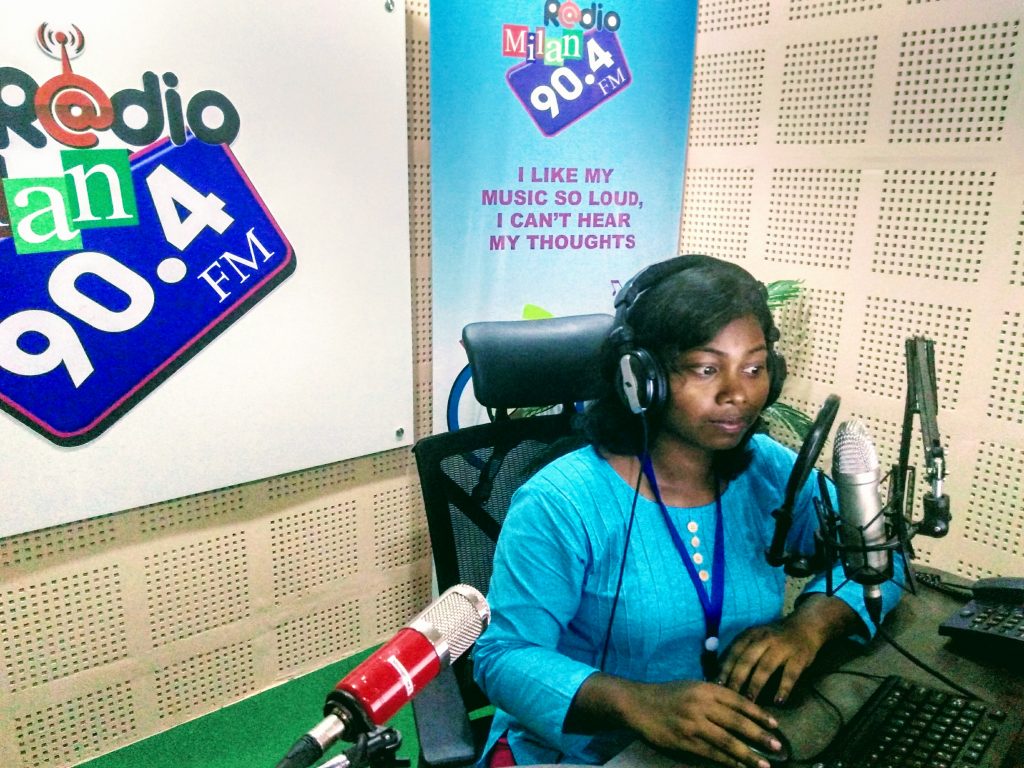
Shikha Mandi, who hosts a show about the coming-of-age of tribals in India in fluent Santhali, also wants more indigenous voices to be heard in the public domain.
Shikha Mandi. Credit: Priyadarshini Sen
Perched on the hot seat, her fingers manoeuvring the keys of a mixer console like an artist wielding her brush, 24-year-old Shikha Mandi cuts an arresting frame. The radio jockey punctuates her chat show, Johar Jhargram – about the coming-of-age of tribals in India in fluent Santhali (the language spoken by over six million indigenous people across South Asia) – with mellifluous strains of village songs.
Her story is even more interesting. The daughter of a small farmer from West Midnapore, Mandi worked her way up from the paddy fields of Jhargram’s Belpahari village where she was born, to the coveted mechanical engineering school at Kolkata’s Industrial Training Institute. And now, as one of India’s first tribal radio jockeys, she’s quite the talk of the town.
RJ Shikha commands the attention of hundreds of listeners through Radio Milan – a small community radio station in West Bengal’s Jhargram district – about 170 km west of Kolkata. The radio waves bearing her unusual Santhal imprint ripple through the Jhargram and Kharagpur districts. More fans across India and abroad tune in to her programme online. Her followers on social media are also growing. Not only does Mandi want tribal culture to be understood across India, she also wants to pioneer its representation through popular media. “There’s almost no knowledge of tribal life and its idiosyncrasies. I want more indigenous voices to be heard in the public domain,” she says.
To forefront tribal culture and ethos, Mandi holds her own at Radio Milan – her “working playground,” as she calls it. Here, she writes her own script, mashes up tunes, readies playlists and rustles up ideas for shows on socially relevant issues. “There’s a lot of independence at work, and I’m encouraged by my colleagues to think out of the box,” she says.
Her colleagues at Radio Milan, which was set up last November by Milan Chakraborty, a Kolkata-based entrepreneur, are supportive of her work. “Shikha impressed us with her determination, diligence and language proficiency,” says Tanmay Dutta, a well-heeled radio jockey from Siliguri, who trains young talent. “There are few people in India who understand the Santhali Ol Chiki script and can translate it. Not too many books or academic resources are available, either. So Shikha works hard on her research.”
But the journey to the hot seat hasn’t been an easy one for Mandi. At the age of three, she was sent to live with her uncle in Kolkata so she could receive a quality education. There were reported incidents of Maoist activity in the Jhargram region, which added to their insecurity. “My parents thought it wasn’t safe for me to live in our village. But in Kolkata, despite having a loving family, I felt a sense of uprootedness,” says Mandi.
At school, the young girl would get taunted for her Santhal leanings and demeanour. But that made her more determined to stay true to her roots. “The older I got, the more connected I felt to my tribal mores,” she says. So, Mandi would tune in to Santhal shows on Doordarshan; sing indigenous songs and recite Santhali poetry at social gatherings. Instead of settling into city life completely, she held on to her tribal identity and nursed the dream of going back to Jhargram.
The move back to Jhargram was in some ways fated. Just as Mandi was preparing to take an apprenticeship test at a Kolkata-based shipbuilding and engineering company, she got an interview call from Radio Milan last November. After scouring several resumes, the hiring team cast its eye on Mandi. “We felt Shikha is deeply embedded in the tribal culture. Her ability to identify issues facing indigenous people, and making them accessible through popular media set her apart from other applicants,” says Chakraborty.
Even though Mandi had no formal training in radio or anchoring, she won the hiring team over with her persuasion skills. Soon after getting selected, the 24-year-old moved back to her beloved hometown.
But the transition wasn’t easy. Years of living in Kolkata had taken the sheen off Mandi’s proficiency in Santhali. She had to make herself acquainted with tribal customs, rituals and devotional songs for her show Johar Jhargram. She also spent nights poring over books given to her by four Midnapore-based professors who knew the Ol Chiki script well, including the bi-monthly magazine Sagen Saota. “Going on air was a nerve-wracking experience, and I would have my script open in front of me every day,” says Mandi.
The content-mastering challenge aside, Mandi also had technical challenges to overcome. The 24-year-old was made to undergo training in script-writing, voice tone and modulation, studio sound and audience engagement. “I had no idea about the technical side of radio production, and was literally thrown into the deep end in order to figure things out,” she says.
But Mandi’s love for all things Santhal made these challenges surmountable. Today, she’s a purist in her approach to showmanship. “There’s not a speck of Hindi or Bengali in my show, and I can rustle up and rehearse a script, three hours prior to my programme,” she says with a wry smile.
The young RJ’s command of Santhali and understanding of tribal culture has also made her more experimental. Nowadays, she goes to different villages in Bengal to identify new trends, and ways to build a support-base in indigenous communities. “Instead of just sitting in my studio and doing my research, I like to be in touch with real people and real issues,” she says.
Mandi’s innovative approach has struck a chord with the Santhal people. Priyanka Hembrom, a 17-year-old ardent fan from the Jaigeria village in Jhargram district, says she too wants to be a radio jockey, and entertain and inform an audience. “Shikha brings important issues such as underage marriages in tribal communities to the fore. She adds a touch of humour to all her shows, which makes her stand apart from others,” says Hembrom.
Mandi’s out-of-the-box thinking also gets reflected in her special shows ahead of tribal festivals. Her programme – the ‘Wonders of Waiting’ was a big success, says one of her colleagues. “The act of waiting is pregnant with hope. Those who work on the borders, wait to be united with their families; children living abroad wait to go back home. Shikha wanted to underline the value of time in the act of waiting. Isn’t that an interesting idea?”
Perhaps for Mandi, too, patient waiting has given her career an impetus, and her life meaning. More advertisers are now buying slots during her show. The Santhali programme has been extended by a couple of hours, and there are plans to bring in more tribal artistes to improve people’s understanding of indigenous communities.
“The fact that I’m doing what I love, for the people I love, in the place I love the most is my biggest success. I’m not looking back,” says Mandi.
Priyadarshini Sen is an independent journalist based in New Delhi. She writes for various India and US-based media outlets.
source: http://www.thewire.in / The Wire / Home> Culture / by Priyadarshini Sen / June 13th, 2018