Here lies Hindoo Stuart: Inside the 250-year-old Park Street cemetery
The Park Street cemetery, which is now 250 years old, is home to stories of Kolkata’s past and present.
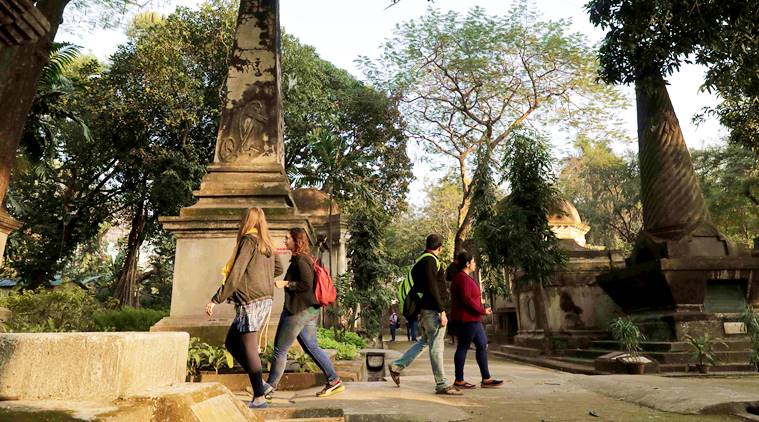
In the 250 years of its existence, the Park Street cemetery in Kolkata has seen its share of stolen kisses and frantic lovers, both gay and straight. In Vikram Seth’s 1993 novel, Suitable Boy, Lata takes a leisurely through the Park Street cemetery along with a friend, Amit. They visit the tomb of Rose Aylmer, a Welsh girl who sailed to India with an aunt in 1798, and died of cholera two years later. Famous British poet Walter Savage Landor, a suitor of Rose, immortalised her in a poem Rose Aylmer. Amit and Lata recite the poem together at the spot.
Not far from the bustle of one of Kolkata’s busiest streets, is the South Park Street Cemetery, with two functional old iron gates at the entrance. Inside, rows of obelisks and gazebos spread out on both sides in no particular order. A marble plaque on the left pillar declares that the cemetery opened in 1769 and closed in 1790, but historians will tell you that burials continued into the 1830s.
The cemetery is the final resting place of many like Rose Aylmer. As Souvik Mukherjee, assistant professor of English, Presidency University points out, most Europeans who would land in the muggy, mosquito-ridden city, would last only “two monsoons”. “They would almost always fall prey to malaria,” says Mukherjee, who specialises in the cemeteries of Bengal. The truncated pillars that dot the cemetery signify lives lost too soon. “You will find graves of many, many children here,” says Mukherjee.
According to Susan Hosking’s book, The Great Burial Ground at Chowringhee: Reflections on the South Park Street Cemetery in Kolkata, this is one of the oldest non-church cemeteries in the world. Hosking says that by the mid-18th century, the old Christian burial grounds in the ruins of the first Fort William, established in 1665, had become inadequate. Eight acres of relatively high ground in an uneven and swampy area were marked out for a new cemetery on what was then the southern outskirt of the town.
The oldest tomb in the cemetery, according to Mukherjee, is that of Mrs Sarah Pearson, who died on September 8, 1768. Very little is known of the oldest resident of the place but tomes have been written on the one who has the most prominent tomb of the cemetery — a blindingly white structure in a maze of greys. The tomb of Sir William Jones, renowned philologist and founder of Asiatic Society of Bengal, finds pride of place bang in the middle of the cemetery.
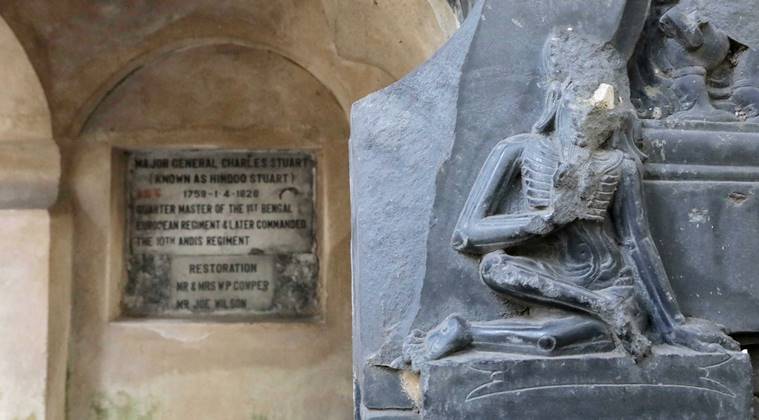
It is definitely not the most beautiful structure in the premises. That distinction belongs to the tomb of Charles Stuart (1758- 1828) or as the officer of the East India Company was popularly known, Hindoo Stuart. A beautiful synthesis of Hindu, European and Islamic styles, the tomb looks like an exotic guest in a genteel gathering. “He was one of the few British officers to embrace Indian culture,” says Mukherjee. CP Hodson’s biography of Stuart mentions that he “had studied the language, manners and customs of the natives of this country with much enthusiasm, his intimacy with them … obtained for him the name of Hindoo Stuart.”
However, in 1984, this very tomb almost fell prey to the greed of realtors. “The cemetery continues to exist thanks to a legal intervention by the Calcutta High Court. An order was issued stopping a well known family business from turning the cemetery into an arts centre. The demolition work had already begun and the damage can still be seen. Innumerable graves have been lost, replaced by strewn rubble and a multi-storey car park. The tomb of Charles Stuart was demolished, later restored, and the demolition of DeRozio’s grave had begun. Justice Bagbati Banerjee saved the South Park Street Cemetery,” says Anthony Khatchaturian writer, guide and Kolkata Heritage activist.
Deepanjan Ghosh, who runs an exhaustive blog on forgotten chapters of the city’s history, says one of the most interesting personalities to be buried in the cemetery is Elizabeth Jane Barwell, popularly known as Miss Sanderson. The “celebrated Miss Sanderson”, daughter of a colonel in East India Company’s army, was widely known as the most beautiful girl in Calcutta when she arrived. She was also notoriously mischievous. “A popular story about her is that she told 16 of her suitors that she would be going to a ball in a Parisian dress and it would be marvellous if they wore a similar costume of pea-green, with pink silk trimmings. All of the men turned up in the exact same ridiculous outfit!” says Ghosh.
Not very far away from her tomb is the modest one of Henry Louis Vivian Derozio (died 1831), the revolutionary thinker and poet who, in many ways, shaped the then Bengali intelligentsia. At the age of 18, he got the post of a lecturer in English literature and history at the Hindu College. He was considered to be a rabble-rouser by the orthodox, Hindu-dominated management of the college as he encouraged his students to question social evils. Eventually, he was expelled. His untimely death soon followed. But his legacy lived on. “His grave is the most visited one in the cemetery,” says Ghosh.
Not surprisingly, the cemetery has inspired its share of ghost stories. There were rumours of a priest in white cassock haunting the premises. Mukherjee dismisses it with a simple, irrefutable logic. “Priests in India wear black cassocks,” he says.
source:http://www.indianexpress.com / The Indian Express / Home> Eye / by Premankur Biswas / January 28th, 2018
31 c
31 b
31 a
30
29
28
Medical care for a low, flat fee of Rs 10
A Calcutta doctor who spends his Sundays running a clinic in a remote village asks why others don’t do so too.
Samantak Das
On the first Sunday of every month, Dr Santanu Banerjee, MD, gets up at 4:30 in the morning and sets off for a small village some 300 kilometres from Calcutta. I’ve known Santanu for some years now, as a neighbour who is also my physician, and as a keen participant in our para’s various activities, especially during the festive season. A few months ago, after he had completed my check-up, we got to chatting about healthcare issues and he told me how surprised he had been to discover the high prevalence of so-called ‘diseases of affluence’, associated with sedentary urban lifestyles, among the labouring poor in rural Bengal. When I asked, somewhat sceptically, where he got this information from, he invited me to visit the health centre that he runs in his ancestral village and take a look for myself. So, on the first Sunday of this October, I did.
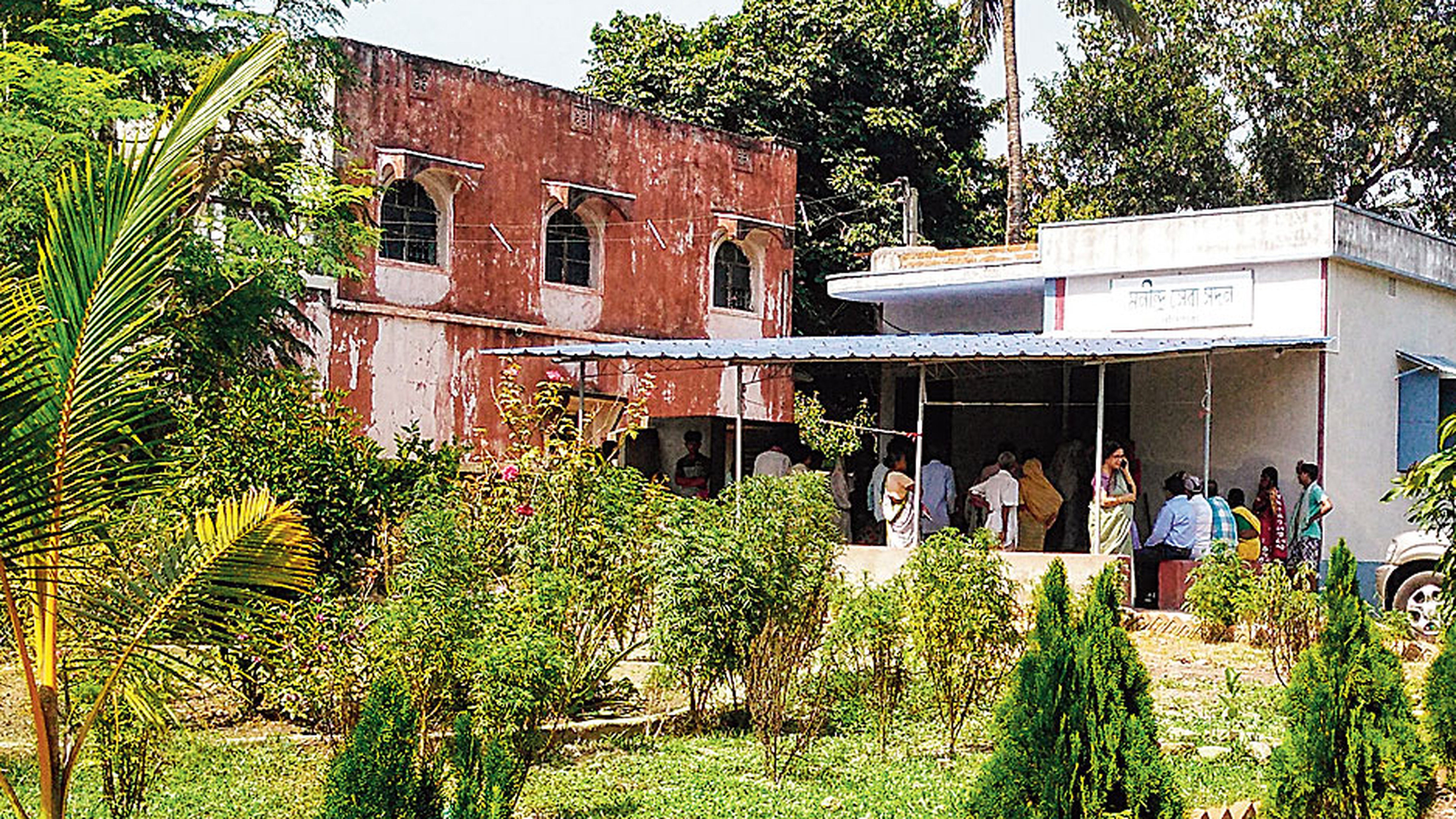
We reached Manihara village, just beyond the Bankura-Purulia border, a little before noon, and went straight to the Manindra Seva Sadan, named after one of Santanu’s ancestors. The spacious three-room centre is located on a largish plot of land, with a beautiful garden and immaculate lawns — Santanu tells me that it belongs jointly to several members of his extended family, but had been lying unused until he decided to set up the centre. He took a loan from his mother, cleared and cleaned the land, and constructed the neat, single-storey structure that stands there now.
Outside the building, under a large permanent awning, villagers wait, patiently, for the daktarbabu to come. On arrival, Santanu’s team swings into smooth, practiced action. Of the three rooms, the first — which runs the length of the building — is where patients have their names, blood pressure and pulse rates noted, and are given a number (depending on their place in the queue) on a slip of paper; as they pass through the long room, they can get a battery of tests done, if needed, on a device that Santanu calls his “lab in a box”. Once all this is completed, they line up to enter the doctor’s chamber in the next room, where one of Santanu’s assistants notes down their details on a laptop. After Santanu examines them and writes out his prescriptions, they move to the adjoining room, where medicines are distributed. On the day of my visit, Santanu’s wife, Kokila, a doctor with an MD in microbiology, was assisting Santanu’s father, a retired engineer, in the medicine room. Patients leave only after collecting a month’s worth of medicines. Some will come back to the centre in a week’s time, and report their condition to Santanu via video-conferencing — he is available online between 9:00 and 11:00 am every Sunday — and some of them will return on the first Sunday of the following month. The cost for all this is the ten rupees patients pay when they register; there are no other charges.
The day I was there, over 200 people had registered to be examined. There was a low buzz around the centre, interspersed with the occasional shout, as a patient’s name was called out, or someone asked someone else not to shove others in the queue. The noise level went up several-fold as patients jostled in line, assistants shouted to patients to register their names, have their pressure noted, and so on and so forth. In the midst of all this, Santanu sat like the calm eye in the centre of a mild storm, radiating cheerful good humour as he spoke to patients in his soft, measured tones and wrote down their prescriptions. Santanu has a mild, friendly manner, and is unfailingly polite even to the most vociferous of his patients. When his assistants raise their voices, mostly in order to ask patients to maintain quiet (“Have you come to a doctor, or to a fish market?”), he remains composed. He also has a sly sense of humour and a ready smile that puts even the most grim-faced individual instantly at ease. He tells a patient, with a broad grin, that he will kill himself if she can prove she actually did take the medicines he’d prescribed last month. After much hemming and hawing, she admits that she “might have missed” a couple of doses.
Of course, many of his patients have seen him before, and he seems (at least to my untutored self) to recall every detail of their various ailments. Interspersed with talk of symptoms, diagnostic tests, medicines and so on, he exchanges pleasantries with his patients — telling someone she’s fine, reassuring another that he needn’t worry, the usual doctor’s prattle: but, sometimes, he turns to me and says, half in jest and half in despair, “Tell me, how on earth do these people get these diseases, here, of all places?” He seems to be especially puzzled by the high incidence of diabetes among his patients, including in some who are in their early thirties, as well as other diseases of the leisured, particularly hypertension. “Look at her. Not an extra ounce on her and yet she has a blood sugar reading of 210! How do you explain this?” There is speculation in the medical community that undernutrition in infancy could be a likely cause even though official statistics do not seem to bear this out. This is something that needs to be investigated thoroughly because the health of thousands is at stake. Over 33 per cent of his patients have diabetes and 40 per cent suffer from high blood pressure. He has the details of all the patients he has treated since he set up the clinic three years ago but wants to know more about the prevalence of illness in the area. “I would like to make a database of every individual and their ailments in the 30-odd adjoining villages. Once I know this, we can do more to alleviate or, best of all, prevent them.” He would also like to bring every woman, child, and man in the area under a health insurance scheme.
When I leave the centre, it is past 4:00 pm, but Santanu is still inside, talking, smiling, examining, prescribing. He will stay back tonight, along with his wife and two kids, for tomorrow they will distribute saris among the women of Manihara for the festive season. His parents will help him, as will his paternal uncle and aunt, who still live in the village.
As I speed towards the bright lights and loud noise of the city, I glance back at the endless expanse of undulating green, dotted with clumps of kaash flowers, harbingers of the season of festive joy, and I wonder: what makes a man like Santanu Banerjee do this month after month, year after year, almost single-handedly, with scarce resources and at considerable cost to himself in terms of time, effort and energy? By my reckoning, it costs Santanu some thirty to forty thousand rupees every time he visits the health centre, but when I put this to him later he only smiles at me. Does he receive any money from funding agencies? No. Do many other doctors go with him to the centre? Again that smile. Yes, he agrees, he couldn’t have done it without strong family support. But why does he do this, I persist. He looks up, quizzically, “Shouldn’t you be asking me why others don’t do it as well?” I have no answer. Santanu says he can’t really explain why he started doing this work and refuses to accept the usual explanations about giving back to society, extending a helping hand to people, and so on. Instead, he tells me a story. “One night, as I was peeling open sealed boxes of medicines and arranging the strips into smaller bundles, my fingers started to bleed. And instead of feeling upset or angry, I felt this joy radiating through me. That was my epiphany. That’s when I knew this was the right thing to do.”
Samantak Das is professor of Comparative Literature, Jadavpur University, and has been working as a volunteer for a rural development NGO for the last 30 years.
source: http://www.telegraphindia.com / The Telegraph,Calcutta, India / Home> Opinion / by Samantak Das / October 26th, 2018