French heritage seal on Chandernagore buildings

The Registry Office, Chandernagore College and Sacred Heart Church are declared as heritage structures
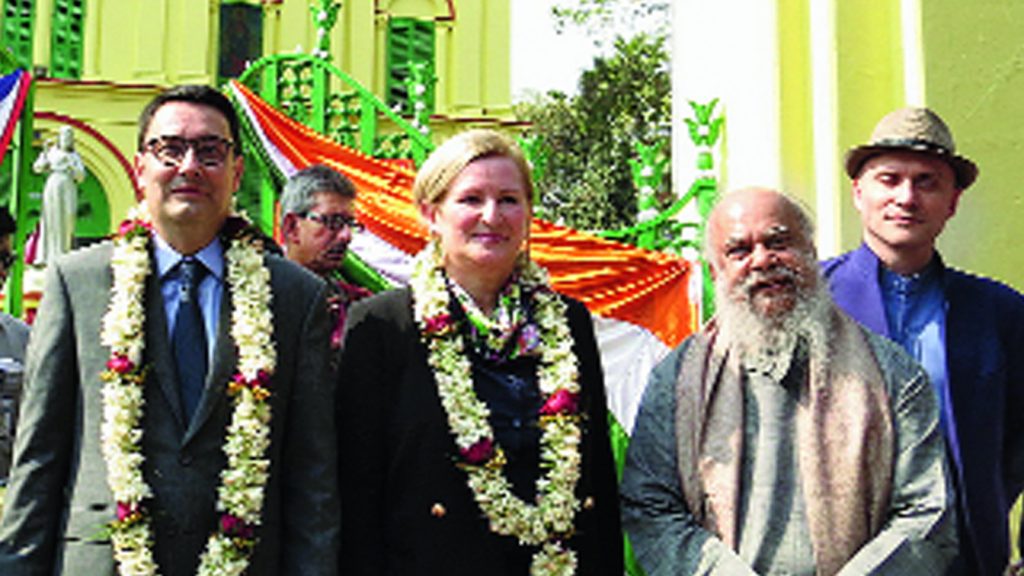

(From left) French ambassador Alexandre Ziegler; consul general Virginie Corteval; Shuvaprasanna, chairman, West Bengal Heritage Commission; and Fabrice Plancon, director, Alliance Francaise du Bengale at Sacred Heart Church on WednesdayPicture by Sudeshna Banerjee

French ambassador Alexandre Ziegler unveiled plaques declaring three buildings in Chandernagore heritage structures on Wednesday.

He was accompanied by members of the West Bengal Heritage Commission.

“The French consulate in Calcutta had sent a proposal for enlistment of 14 buildings in Chandernagore as heritage structures in 2017. Acting on it, the commission has made the declaration for eight buildings. Plaques will be laid today on three of them,” commission chairman Shuvaprasanna said at a programme at the start of the tour at Institut de Chandernagore.

The blue enamel plaques reminded the ambassador of the street name signage in France. “They are very French,” he smiled, unveiling one at the first stop on the tour — the Registry Office and French Court.

The derelict structure rich in history at the starting point on the Strand, facing the river, has been saved from demolition after the petition from the French.

It was also the focal point of a workshop called House of the Moon during Bonjour India, the French festival in India, in 2017, for which students of design from India and France co-created and collaborated to develop an intervention in Chandernagore.

Once restored, Ziegler envisions it as a focal point of tourist interest, with a coffee house and an information centre.
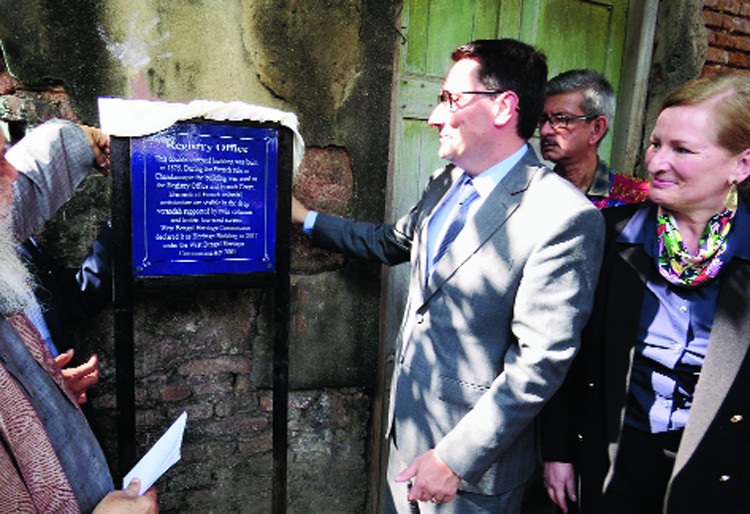

Ziegler unveils the plaque declaring the Registry Office a heritage structure.

But he insisted that the day’s exercise was not just about restoring history. “It’s about what you can do with heritage while looking at the future. It is much more than architecture, for our vision involves economic revitalisation of the town. We will be working on giving ownership to the whole community by working with students and children, and making Chandernagore the focal point of our common history and bilateral relations.”
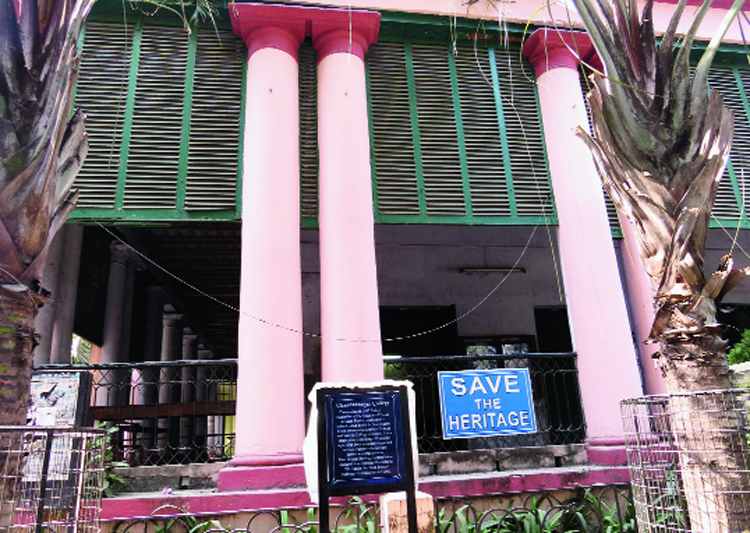

The heritage structure plaque at Chandernagore College.Pictures by Sudeshna Banerjee

The other two buildings where plaques were unveiled are Chandernagore College and Sacred Heart Church.

The college, originally established as St Mary’s Institution by the French Catholic Missionary, Rev. Magloire Barthet in 1862, had received an affiliation to Calcutta University as a First Arts Level College in 1891.

The principal, Debasish Sarkar, had a piece of good news to share with the ambassador — the college had just been granted Rs 1.68 crore for the upkeep of the building by the higher education department.

“This is a memorable day for Chandernagore. The laying of the plaques invests the buildings with importance and insures their future. It also gives the young generation something to take pride in,” said Basabi Pal, the head of the college’s French department, which is the oldest in Bengal. The department now grants even postgraduate degrees.

Father Orson Welles received the ambassador at Sacred Heart Church, which dates back to 1875.

The consul general of France in Calcutta, Virginie Corteval, and district magistrate J.P. Meena were present at the programme.

A team of technical experts will visit Chandernagore “by the summer” to help with the restoration, the ambassador said.

source: http://www.telegraphindia.com / The Telegraph, Online Edition / Home> Heritage / by The Telegraph – Special Correspondent in Chandernagore / February 07th, 2019
Sabyasachi Bhattacharya, one of the country’s leading historians, passes away in Kolkata

A prolific writer, Bhattacharya stepped out from the strict confines of his specialisation in economic history and provided an all-encompassing view of modern India, placing it in the context of world history.

Sabyasachi Bhattacharya (1938-2019), one of the foremost historians of modern India, died in Kolkata on Monday. He was 81 and suffering from cancer of the spinal cord for well over a year.

A prolific writer, he enjoyed a stature similar to historians Romila Thapar, K N Panicker and Sumit Sarkar. He made lasting contribution for his study of the working of the colonial regime and various economic aspects in colonial and post-colonial India.

On Monday historians recalled how, Bhattacharya, suffering from cancer, did not spare himself the rigour of editing a three volume Comprehensive History of Modern Bengal (1700-1950), to be published by Asiatic Society. As many as 65 scholars from India and abroad contributed to this book that has been sent to the press.

Despite illness, he remained intellectually active throughout 2017 and 2018 and his last book, ‘Archiving the British Raj: History of the Archival Policy of the Government of India, with Selected Documents, 1858–1947’, was published in November 2018.

The disciplined approach marked Bhattacharya’s academic journey down the years.

His monumental work, ‘Financial Foundations Of the British Raj: Ideas And Interests In The Reconstruction Of Indian Public Finance (1858-1872)’, which was first published in 1971 and has run into its seventh edition, is considered a classic. ‘The Colonial State: Theory and Practice’ is another of his esteemed books.

Bhattacharya initially earned his repute as a historian with his seminal works on economic history of India under the colonial rule, based on archival research, and later also worked on political and cultural-intellectual history of Independent India.

Historians also valued his journey from the strict confines of the area of specialisation — economic history — to providing an all-encompassing view of India, placing it in the context of world history for colonial and post-colonial periods.

Bhattacharya was also reputed as a teacher and administrator. He had served as the vice-chancellor of Visva-Bharati University (1991-1995) and Chairman of the Indian Council of Historical Research (2007-2011), besides teaching history at Jawaharlal Nehru University (1976-2003) (JNU).

He played a pivotal role behind the foundation of Centre for Historical Studies at JNU.

Bhattacharya also held teaching and research positions at St. Antony’s College (University of Oxford), University of Chicago and El Colegio de Mexico.

Besides having written more than three dozen books, he was the chief editor of Indian Historical Review and the general editor of Towards Freedom, a series on the movement for Independence in India published by Oxford University Press in collaboration with ICHR.

‘Essays in Modern Indian Economic History’ (2015) and ‘Towards a New History of Work’ (2017), two books he edited during the last phase of his life, continued with the same mission of chronicling the country’s economic history.

He also co-edited ‘Workers in the Informal Sector: studies in labour history, 1800-2000’ (2005), ‘The Vernacularization of Labour Politics’ (2016) and ‘The Past of the Outcast: Reading in Dalit History’ (2017).

Among his works on India’s cultural and intellectual history are ‘The Mahatma and the Poet’ (2011), ‘Vande Mataram: A Biography of a Song’ (2013), ‘The Idea of Civilization in the Indian Nationalist Discourse (2011)’, ‘Cultural unity of India’ (2013), and ‘Rabindranath Tagore: An Interpretation’ (2016).

He is survived by his wife, Malabika and daughter, Ashidhara Das. His last rites will be performed on Wednesday.

source: http://www.hindustantimes.com / Hindustan Times / Home> Kolkata / by HT Correspondent, Kolkata / January 08th, 2019

The only Greek of Calcutta

Sister Nectaria Paridisi of the Greek Orthodox Church is the only Greek left in the city


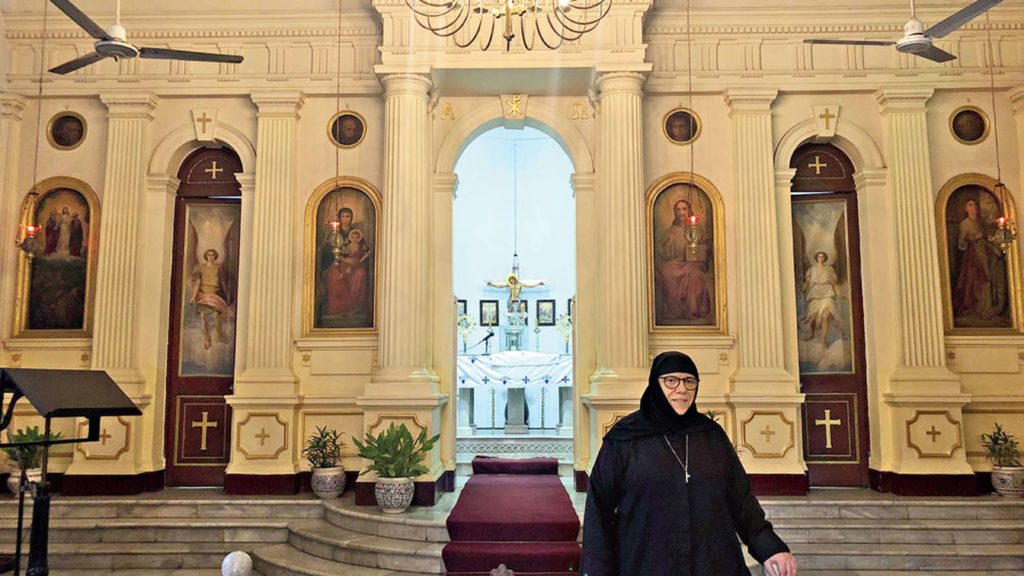
Ground reality: Sister Nectaria at the Greek Orthodox ChurchManasi Shah

Sister Nectaria Paridisi sips on her Darjeeling tea. She is sitting in the lounge on the ground floor of the Greek Orthodox Church in Kalighat in south Calcutta and talking animatedly about a whole lot of things — the church, the state government’s lack of interest in the heritage property and its history, the uncaring locals. The room is full of antique furniture, framed photographs of bishops and Greek inscriptions. Flags of Greece, India and the bygone Byzantine Empire stand in different corners of the room. Our host is Father Raphael, a priest at the church. And the nun, Sister Nectaria, is the only Greek resident left in Calcutta.

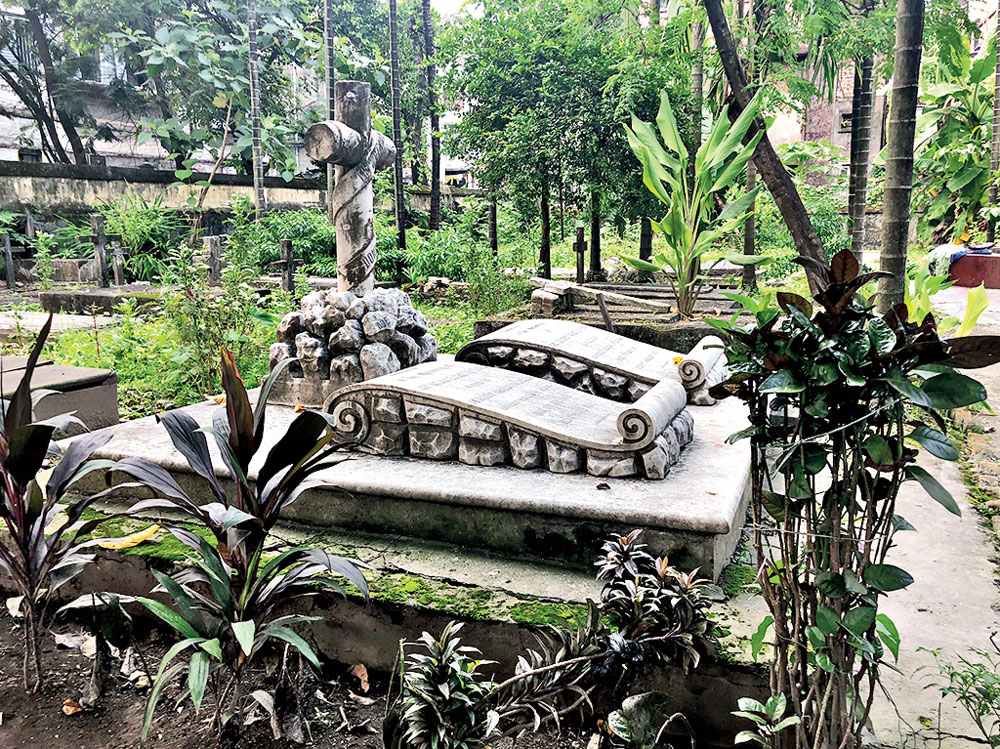
To trace the beginning of Calcutta’s Greek association, however, we have to trek to Phoolbagan in the eastern part of the city. It is not difficult to miss the plaque at the entrance to the Greek cemetery. For one, the compound itself is surrounded by a gaggle of residential buildings and then there is the flurry of activity from the ongoing expansion work of the Kolkata Metro. Unlike some of the other cemeteries of the city, such as South Park Cemetery or the Scottish Cemetery, this one is smaller and way less verdant.

The caretaker, Basanta Das, says there are more than 200 graves here. Das, whose father and grandfather have also been caretakers here, says, “Not all the graves have bodies. Some of them are just epitaphs and tombstones.” Most of the graves have inscriptions in Greek. One such reads: “In the memory of Mavrody Athanass Mitchoo who died on December 9, 1855.” But the oldest grave is of Alexander Argeery, who died on August 5, 1777.

“From the 17th century, Calcutta was home to a Greek community,” says Sister Nectaria. In his book, Calcutta Old And New, H.E.A. Cotton writes: “The Greeks, like the Armenians, owe their association with Calcutta to the allurements of commerce.” According to Cotton, the first Greek settler of note in Calcutta was Hadjee Alexias Argyree, a native of Philippopolis, who came to Bengal in 1750 and earned his living as an interpreter.

In fact, it was Argyree who founded the first Orthodox Church of Calcutta. The story goes that in 1770, he set sail from Calcutta for Mocha and Jeddah. But his vessel was hit by a severe storm and was close to sinking. A devout, Argyree promised the gods that if he survived the peril he would found a church in Calcutta for its Greek inhabitants. True to his word, upon return to the city, he obtained relevant permissions and started to move on the purchase of a property. But then, he died in 1777.

Three years later the church came up. Writes Cotton, “…his family contributed a considerable sum, the remainder being made up by voluntary contributions, Warren Hastings heading the subscription list with 2,000 rupees.” Sister Nectaria confirms that the first Greek church to be built in Calcutta was indeed at Amratollah Street (in central Calcutta) and it had a cemetery adjoining it.

The first minister of the church was Father Parthenio, a native of Corfu, who settled in Bengal in 1775 and who is said to have sat for the figure of Jesus in German neoclassical artist Johann Zoffany’s painting, Last Supper.

The Greeks of Calcutta were a wealthy and powerful community. This is borne out by some of the epitaphs. One of them reads: “In the memory of Sir Gregory Charles Paul, Advocate General of Bengal, died on January 1, 1900.” Another grave belongs to Mavrodi Athanass Mitchoo, a planter.

According to Sister Nectaria, in 1922 another wave of Greeks fled their homeland. “A major reason was the genocide that happened at that time. Calcutta was an important port those days and so many came to Calcutta,” she says. The long and short of it, the Greek community continued to flourish till 1947 and, thereafter, began its denouement. Says Sister Nectaria, “Greeks started to leave India and move to London, Johannesburg, some moved back to Greece even.”

In 1924, the Amratollah property on which the Greek church stood was sold. Says Sister Nectaria, “The church authorities bought the Kalighat property and decided to move the cemetery out of town.” [At that time, Phoolbagan was not part of the city.]

The entrance to the Kalighat church building has two plaques on either side. The inscriptions are in Greek. Sister Nectaria translates it: “It is in memory of the Greeks who donated generously to build the first church in Amratollah… Their bodies are buried but their names will remain alive for generations.”


A tombstone in the cemetery at Phoolbagan / Manasi Shah

With the Greeks moving out, the church became non-functional and was finally locked down in 1972. And then, in 1991, it was reopened on the initiative of the Greek embassy. At the time, Sister Nectaria, who was posted in South Korea, was asked to come and take care of the church. Father Ignatios was in charge of the church. He also established the Philanthropic Society of the Orthodox Church.

According to the nun, the years of neglect had literally eaten into the church building. The whole place had been taken over by termites. She says, “It was just black. And I started cleaning through the layers of dirt. The termites had eaten all the ornaments of the Lord, the clothes, the books and even the wall clock.”

Sitting in the church that afternoon, it was difficult to imagine that scene. The wooden altar is now beautifully polished and has intricate panels and paintings related to the life of Christ, Virgin Mary, archangels Gabriel and Michael with their swords drawn out.

Calcutta is now emptied of its Greek populace. The church is frequented by local Christians and Sunday services are held regularly in Bengali. “Many Hindus also just come to pray. Sometimes I see Krishna monks, who come, sit, pray and leave silently,” says Sister Nectaria.

If she resents anything it is the attitude of the people in the neighbourhood. Breaking his silence for a change, Father Raphael says, “This is a Grade 1 heritage building [as declared by the Kolkata Municipal Corporation] and still we have to struggle for its maintenance.”

Sister Nectaria elaborates, “The local people force the guard to open the gates and act like this is their property. During Durga Puja, they put lights around the church. It is not as if we are against Durga Puja, but it is about the whole attitude. Whenever there is a festival, they block the church entrance and dump chairs, lights and sound equipment in the church premises as if it were a store room. And when I oppose, they call me an outsider.”

These days, Sister Nectaria visits the church only every other week. She remains busy in Bakeswar on the southern reaches of the city, where she is in charge of two orphanages under the Greek Church. Then there is the St. Ignatius High School, which is also under her supervision. And does she feel like an outsider?

She smiles, “Now? I am now half Indian.”

source: http://www.telegraphindia.com / The Telegraph, Online edition / Calcutta / Home> Heritage / by Manasi Shah / February 02nd, 2019