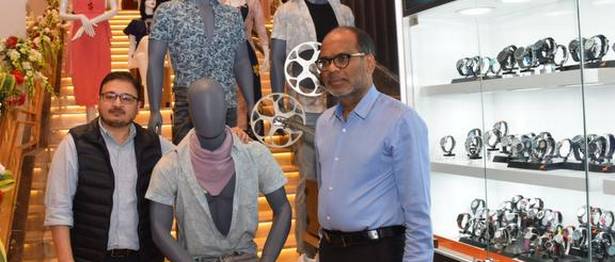
Future Lifestyle Fashions CEO Vishnu Prasad (right) and Future Retail CEO-East Zone Manish Agarwal – Debasish Bhaduri
It was in 1934 that American film production company Metro-Goldwyn-Mayer decided to set up a cinema hall in Calcutta to promote its films. The hall was inaugurated in 1935. Famous as an elite British city, the then Calcutta was a large market for Hollywood films.
Eighty-five years later, the iconic cinema hall on Chowringhee Road has made way for Future Group’s first ever movie themed ‘Central’ store.
The fashion and lifestyle retail store will play old Hollywood, Hindi and Bengali hits. These classics were big draws at the ‘Metro cinema’. The screenings are likely to start in April.
According to Vishnu Prasad, CEO, Future Lifestyle Fashions (which owns Central), the company is preparing a list of classics that have been screened. Plans are afoot to bring in the yesteryear stars who featured in these films. Over each week, a film will be played.
First thematic store
“This will be our first thematic store. In fact, Metro Central will be a filmi store. Going forward we may look to host theme-based movie screenings at the store. The idea is to bring alive a lost heritage of the city,” Prasad told BusinessLine.
Metro Central, as it is called, is expected to rake in ₹100 crore by FY20 with apparel sales accounting for nearly 70 per cent of it.
Down memory lane
Metro Cinema’s distinctive art deco structure has, over the years, defined the culture of the city. Initially, it screened only films produced by MGM. Gradually, Hollywood films made way for Hindi cinema and an occasional Bengali film.
The two-storied structure was designed by Thomas Lamb, a Scottish architect settled in the US who built several movie theatres around the world. MGM commissioned him to build two theatres in India. Metro Calcutta’s famous cousin in Mumbai was built in 1938.
Prasad points out that “special care” was taken at the time of renovation so that the art-deco façade, waterfall-style columns and grand staircase within were retained. The company has spent ₹22-25 crore on renovating the heritage structure that will have 55,000 sq ft of space.
Sources say the group had held talks for the renovation and reuse of Grace cinema, too, but issues such as structural stability of the building put things on the backburner.
source: http://www.thehindubusinessline.com / Business Line / Home> Variety / by Abhishek Law / Kolkata / February 15th, 2019
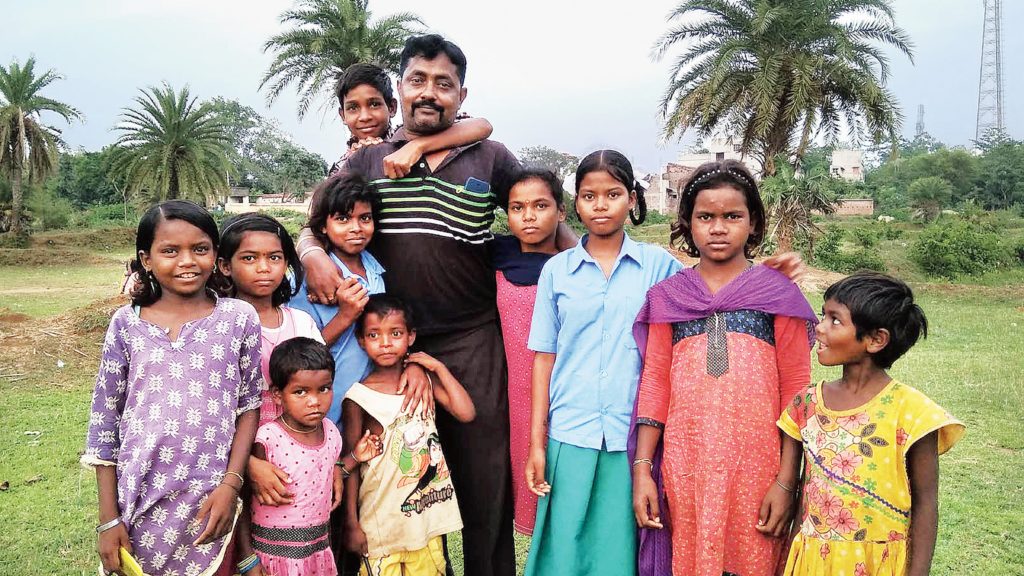
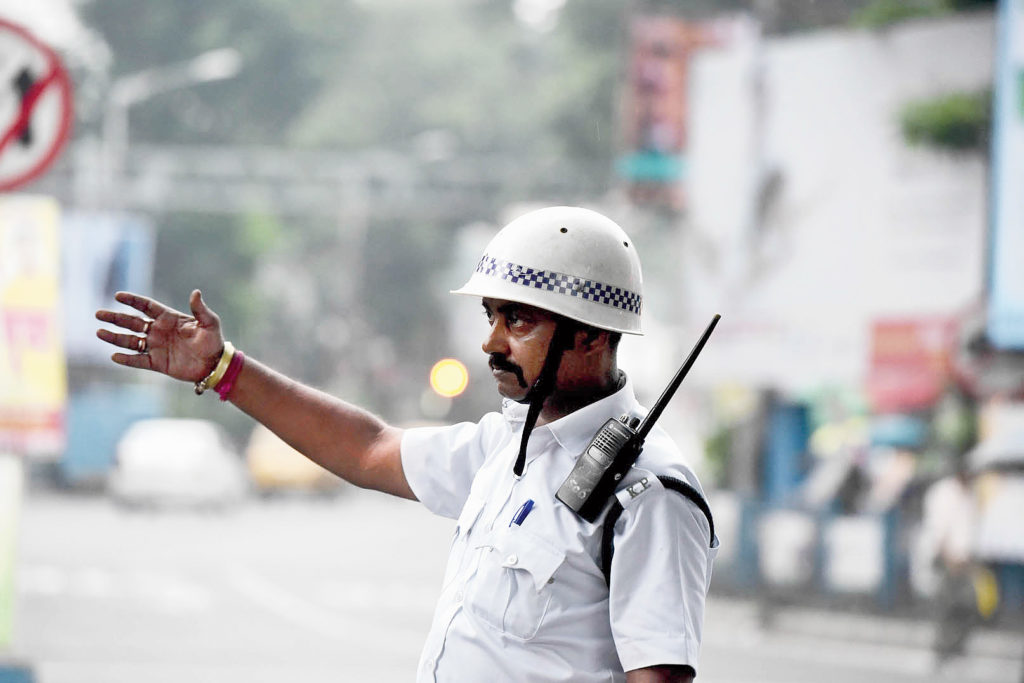
Arup Mukherjee, a constable of the South Traffic Guard, with some of the students of the school that he started with his savings in 2011 at Puncha village of Purulia district. / The Telegraph
A Calcutta police constable who as a child had made a promise to himself to help the poor now sets aside Rs 20,000 from his salary of Rs 37,000 each month to run a school for abandoned and underprivileged children.
When 43-year-old Arup Mukherjee is not managing traffic at a busy intersection, he is busy pursuing his mission to rescue and rehabilitate abandoned children and convince impoverished and unlettered parents to send their daughters and sons to school.
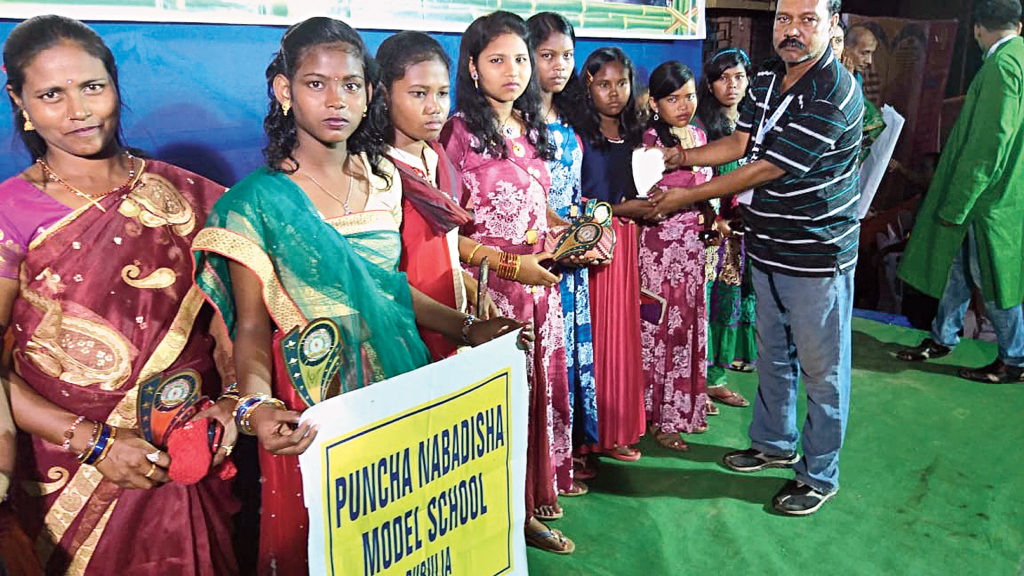
Some of these children were in New Alipore on Monday to inaugurate a Kali Puja, escorted by the Samaritan who works tirelessly to dispel the darkness in their lives.
Mukherjee’s zeal to rescue and educate children from the Sabar tribe of Purulia originated from a childhood curiosity about the persecution faced by a community counted among the poorest of the poor.
“I have witnessed since childhood people belonging to the Sabar tribe being blamed for theft or any other crime in the areas they inhabit. I have seen them being mistreated and ostracised and not given jobs, resulting in some resorting to crime. When I asked my grandfather about it, he told me this was because they were not educated and hence unable to find employment,” he told Metro.
Some students of the school after inaugurating a Kali Puja in New Alipore on Monday. / The Telegraph
Mukherjee, who was six years old at the time, never forgot what his grandfather told him or the promise he had made to himself. In 1999, he joined Calcutta police and started saving immediately for what would go on to become the fuel for his existence.
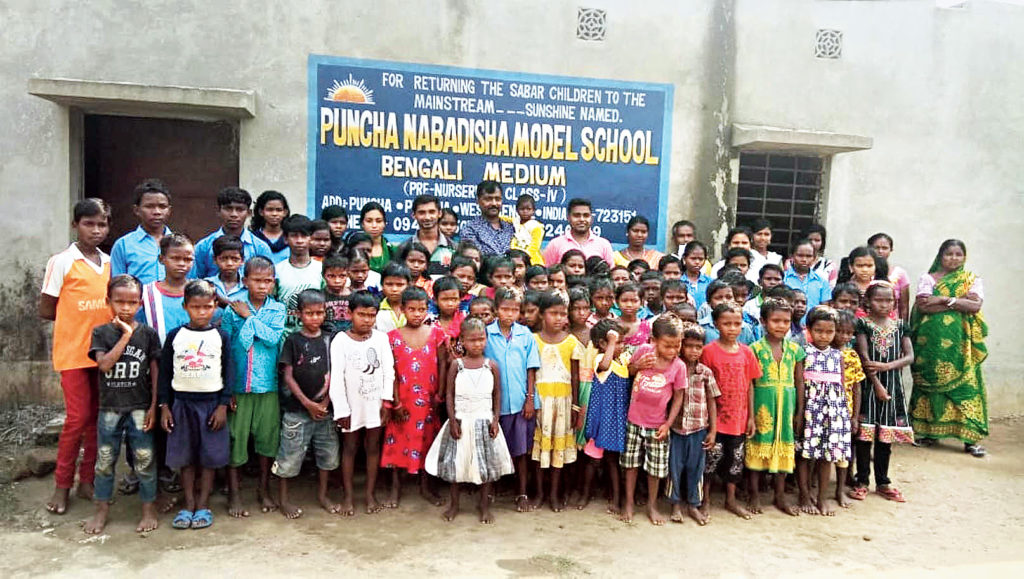
Puncha Nabadisha Model School became a reality in 2011, putting this unassuming constable of the South Traffic Guard on a path few like him would dare to tread. “I remember what my grandfather told me when I had spoken to him about what I wanted to do. He asked me to grow up, start earning a living and then think of doing something for the Sabar children,” Mukherjee recalled.
The initial corpus of Rs 2.5 lakh for the school in Puncha village of Purulia district, around 280km from Calcutta, came entirely from Mukherjee’s savings. He also took a bank loan of Rs 1 lakh and another Rs 50,000 from his mother to build five rooms with an asbestos roof on a plot donated by a friend of his father.
Starting with 15 children, Puncha Nabadisha Model School has grown into an institution that provides education to 112 children aged between 4 and 15.
It wasn’t easy in the beginning for Mukherjee to convince the Sabar tribe that he wanted their good. “They started trusting me after realising I did not have any motive. I would tell them, “Send your children to study if you do not want your plight to be like yours’. That struck a chord,” he said.
An incident three years ago highlights the despair and desperation that Mukherjee occasionally encounters. “I was visiting this village in Purulia when the strong smell of kerosene hit my nose outside a tribal house. A mother had wrapped three of her children, the youngest barely a year old, in a blanket and sprinkled kerosene on them to do the unthinkable. I went into the hut and held the mother by her hand. She said her children were asking for food and she didn’t have any to feed them,” he said.
Mukherjee took the three children under his care and their mother hasn’t met them since. The eldest of the siblings is now in Class III and the second one in Class II.
According to Mukherjee, who received a special honour at The Telegraph School Awards for Excellence 2018 in August, the courage to accomplish what he does comes from being a policeman.
Many among the Sabar community depend on him not only to give their children an education but also bail them out whenever they are unfairly accused of a crime. “Someone might be innocent but how to prove it when you can’t comprehend the law? They now have the confidence to speak up because they know that if they are right, I will help them,” Mukherjee said. “Most of them no longer resort to crime to feed their families.”
Around 20,000 members of the Sabar tribe are spread across five blocks of Purulia district. The children who go to Mukherjee’s school are provided food and a place to stay in. After Class IV, schooling continues in the secondary and high schools in that area.
Students and staff of Puncha Nabadisha Model School outside the school building. / The Telegraph
Puncha Nabadisha Model School needs Rs 45,000-50,000 a month to function, but Mukherjee does not believe in going around with a begging bowl. He accepts only voluntary donations. “I do not want to force people to help my children, neither do I want them to think that I am collecting funds for my own needs. People see the work that is done and offer help, which I accept,” he said.
Constable Arup Mukherjee manages traffic at an intersection in the city. / The Telegraph
Mukherjee is the father of twins, both students of Class XI, but it is the responsibility of being “Baba” to his extended family of 112 children that keeps him going. “My family does not make any demands of me. They are not upset that I don’t spend my entire income on them. They are rather proud of me,” he said.
source: http://www.telegraphindia.com / The Telegraph, online edition / Home> West Bengal / by Jhinuk Mazumdar and Pranab Mondal in Calcutta / November 07th, 2018
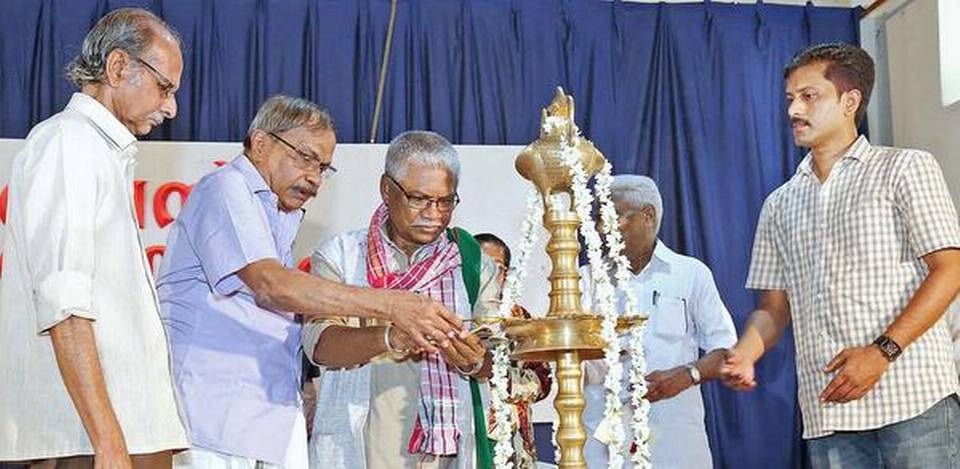
Bengali writer Manoranjan Byapari inaugurating the Thunchan Literary Festival at Thunchan Paramba, Tirur, on Friday.
This year’s Thunchan Literary Festival began at Thunchan Paramba, Tirur, on Friday. Inaugurating the festival, well-known Bengali writer Manoranjan Byapari described his life’s journey from being a shepherd to accidentally meeting Jnanpith laureate Mahasweta Devi while riding an autorickshaw.
He said that he had entered into writing much later in life. It was his incarceration that helped him find an interest in reading books. His writings in Bengali are considered one of the strongest in Indian Dalit literature.
Thunchan Memorial Trust chairman and Jnanpith laureate M.T. Vasudevan Nair presided over the function.
Arts festival
Mr. Nair released the Thunchan history penned by K. Sreekumar by giving a copy to Artist Namboothiri. Mr. Namboothiri inaugurated a book festival being held as part of the literary festival.
Poet V. Madhusoodanan Nair delivered the Thunchan Memorial Lecture on poetry and tradition. Writers Chathanath Achuthanunni, Manambur Rajanbabu, and V. Appu Master spoke.
Actor V.K. Sreeraman inaugurated the Thunchan Arts Festival.
Poet Alankode Leelakrishnan spoke.
source: http://www.thehindu.com / The Hindu / Home> News> States> Kerala / by Staff Reporter / Malappuram – February 15th, 2019
Expert coming from Japan today to help with the gardens, one of which was set up by the poet’s son
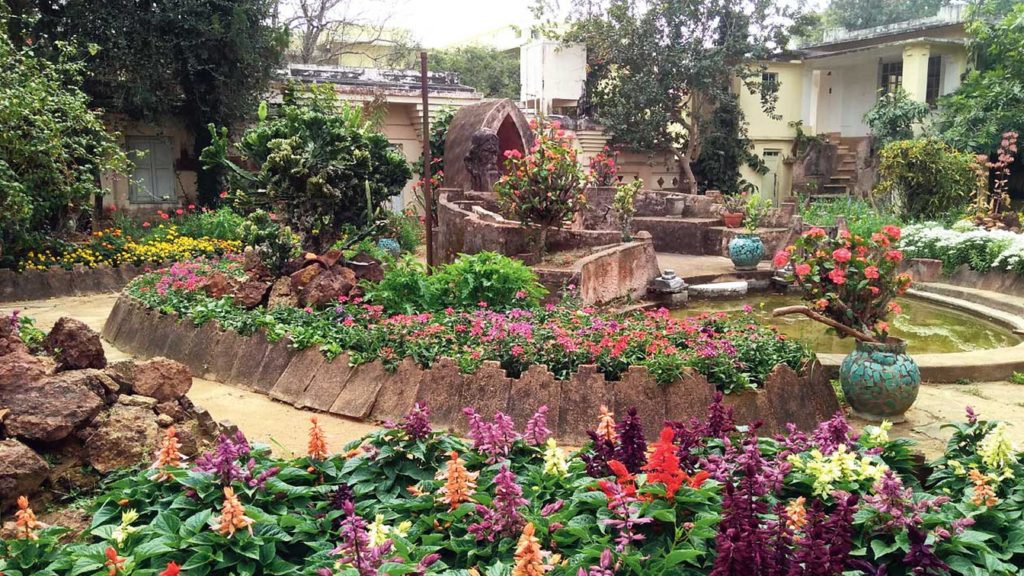
The Japanese garden next to Udayan house at Visva-Bharati.Picture by Indrajit Roy Picture by Indrajit Roy
Visva-Bharati has decided to restore three Japanese gardens on the campus — one of them set up by Rabindranath Tagore’s son, Rathindranath — by an expert from Japan soon.
The Japanese department of Visva-Bharati has appealed to the consul general of Japan in Calcutta, Masayuki Taga, to arrange for an expert gardener who can help the university restore the gardens in keeping with Japanese culture.
Gita A Keeni, the head of Japanese department, told The Telegraph: “We wanted to restore our Japanese gardens but we had no expert gardener. So, we requested the consul general of Japan in Calcutta who has helped us get the expert. The expert in Japanese garden, Fumio Thukamoto, will visit the campus on February 11 for two days.”
Visva-Bharati sources said there were three Japanese gardens on the campus — one is beside Udayan house in Uttarayan complex, the second garden is at Nippon Bhavana and third near the Nandan gallery of Kala Bhavana.
The Japanese garden beside Udayan, where the poet stayed for a log period of time, was designed by Rathindranath Tagore in the 1930s. The gardens at Nippon Bhavana was designed by the then Japanese language professor Saini Makino and the garden near Nandan gallery was designed by a group of scholars from Japan.
Nilanjan Banerjee, the special officer of Rabindra Bhavana and a scholar in the Japanese department, said: “We did not get any expert on Japanese gardens earlier. As a result, the gardens were not being restored for a long time. The oldest Japanese garden is in the Uttarayan complex. We are happy as now the gardens will be restored properly under guidance of an expert gardener.”
Rabindranath went to Japan five times between 1916 and 1929 and saw the culture and rituals of Japan, including the concept of gardening in that country.
In his travelogue, Japan Jatri, Tagore wrote: “The Japanese know what a garden should be. Merely piling up earth and planting shrubs in geometrical patterns is not enough as you will know if you have ever been to a Japanese garden.”
Visva-Bharati sources said during his maiden visit to Japan, the poet had stayed at a beautiful garden-house, which was the residence of a Japanese silk merchant and art lover Tomitaro Hara.
“Tagore was so influenced by the culture and gardens, the Ikebana (Japanese art of flower arrangement) and the Chado (Japanese tea ceremony) that he had wished to bring an entire Japanese house to Santiniketan,” said Banerjee, the special officer of Rabindra Bhavana.
source: http://www.telegraphindia.com / The Telegraph, online editon / by Snehamoy Chakraborty in Shantiniketan / February 11th, 2019
A flesh-and-blood Minto and his wife were in Calcutta on Saturday, retracing the steps of his ancestors who lived here over a century ago
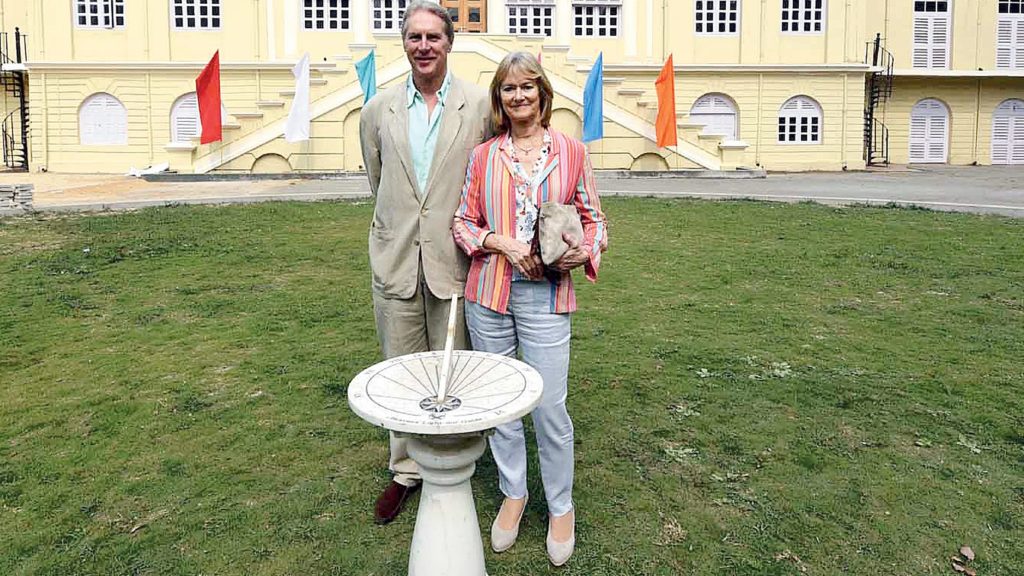
Gilbert Timothy George Lariston Elliot-Murray-Kynynmound, the seventh Earl of Minto, with his wife Diana Barbara Trafford in front of the Old Government House in Barrackpore on Saturday. / Pradip Sanyal
Minto, to most Calcuttans, is a bus stop scrawled in black on an yellow band across the sides of ramshackle minibuses. For some, it is the patch of green in front of Belle Vue Clinic named after the governor general of India.
But a flesh-and-blood Minto and his wife were in Calcutta on Saturday, retracing the steps of his ancestors who lived here over a century ago.
Gilbert Timothy George Lariston Elliot-Murray-Kynynmound, the seventh Earl of Minto, visited the summer residence of the governors general of India where the first Earl of Minto (governor general of India, 1807-1813) and the fourth Earl of Minto (governor general and viceroy of India, 1905-1910) are said to have spent many a happy weekend, “arriving on Fridays and leaving only on Monday mornings”.
“I can absolutely see why they built the summer residence right next to the river. It gives a real atmosphere of India, and I just spent a magical time there,” Minto told Metro after touring the Old Government House in Barrackpore.
“The entire purpose of this time was to visit Calcutta,” said Minto, on his second visit to India but “the very first to Calcutta”. He is scheduled to travel to Goa and Hyderabad before leaving for London.
Minto’s earlier stops in the city included Victoria Memorial Hall and the Raj Bhavan, where he saw a photograph of Lord Minto’s appointment as governor general in 1807.
“There was a lot of talk about India at home and the country was remembered with much affection,” said the current Lord Minto, pausing before his ancestor’s statue on horseback at Latbagan. “My great grandparents made many good friends in India and were in touch with them all their lives.”
With Minto on this trip are his wife Diana Barbara Trafford and author and family friend Anabel Loyd.
“The Government House designed by Captain Thomas Anbury in 1813 was used as a country residence for the British Governor-Generals,” according to the British Library online gallery.
Lord and Lady Minto at (in the background) Lady Canning’s tomb. / Pradip Sanyal
The present Lord Minto in the Westside Gallery where seized arms from the pre-and post-Independence era are displayed. / Pradip Sanyal
Lord Wellesley, who took over the commander-in-chief’s residence in 1801 in Barrackpore, commenced the building of a summer residence for the future governors general of India. He got the gardens landscaped in “English style” and added an aviary and a menagerie, both of which are in a shambles. However, only the first storey was built before Wellesley was recalled to England.
Wellesley’s dream house was added to and expanded in bits and parts by the governors general who lived there. Sir George Barlow, acting governor general, converted each corner of the verandah into a small room. In 1814-15, the building was expanded by the Marquis of Hastings who added a new storey, side wings, a portico and the Upper Entrance Hall. Lord Auckland (1835-1842) added the balcony on the western side, Lord Lytton (1876-1880) replaced the unseemly iron staircase on the southern front, Lord Ripon (1886-1884) installed a wooden porch in front while Lord Minto (1905-1910) electrified the building, laid the floor in the drawing room and redecorated the house.
The house was taken over by the Bengal government and turned into a police academy and police hospital in 1948. The hospital was later shifted out.
The current renovation and conservation of Old Government House, now Swami Vivekananda State Police Academy, has been undertaken at the initiative of Soumen Mitra, the additional director-general of police (training). “Work is on, it will take a long time to finish,” said Mitra, as he took the Mintos around.
Strolling through the lofty rooms, both the Lord and the Lady marvelled at the architecture and the ventilators that naturally cooled the rooms with the river breeze passing through the shafts and lofty windows. They were accompanied by G.M. Kapur of Intach.
Barrackpore, a cantonment area, was built at the bend of the Hooghly river, 20km north of Calcutta, and offered a splendid vista, making it the perfect “weekend retreat”.
The couple from Minto, Roxburghshire, also stopped by the Minto Fountain, a marble fountain added to the sprawling acres by Lord Minto. “The fountain was designed by Lady Minto who inaugurated it before leaving for England in 1910,” said Mitra, who found it dysfunctional and buried under a pile of rubbish.
The Mintos were taken to Flagstaff House, the current residence of the Governor. They strolled around the garden, peered at the old lighthouse, stood before Fourth Earl of Minto’s statue, inspected a series of Raj statues shifted from Calcutta to the statuary and stopped at the restored cenotaph built by the First Earl of Minto in commemoration of officers who fell in the battles of Java and Mauritius and Gwalior.
In front of Minto fountain, which was designed by Lady Minto and inaugurated by her before she left for England. / Pradip Sanyal
source: http://www.telegraphindia.com / The Telegraph, Online edition / Home> People / by Anasuya Basu in Calcutta / February 10th, 2019
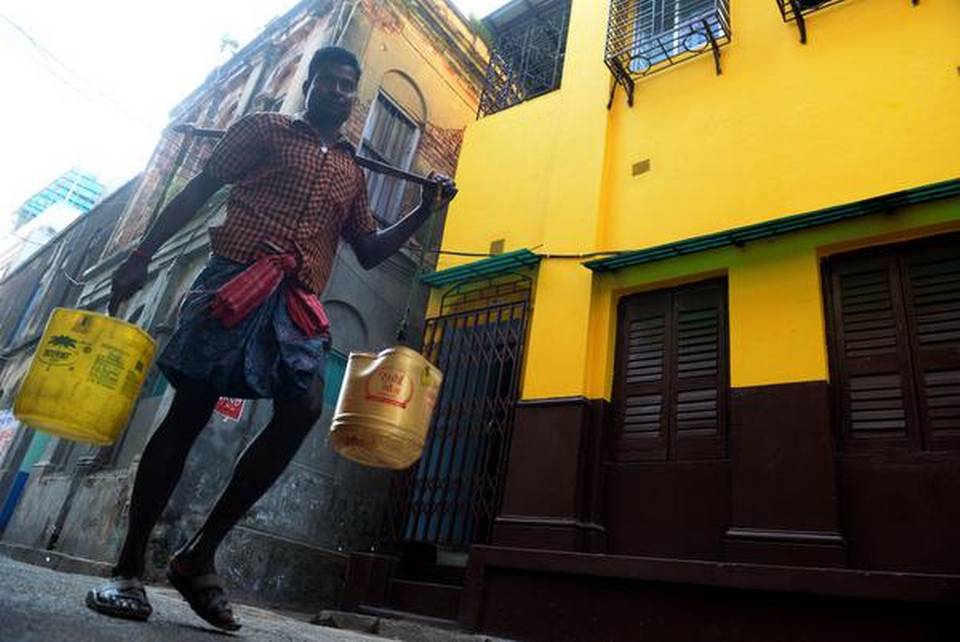
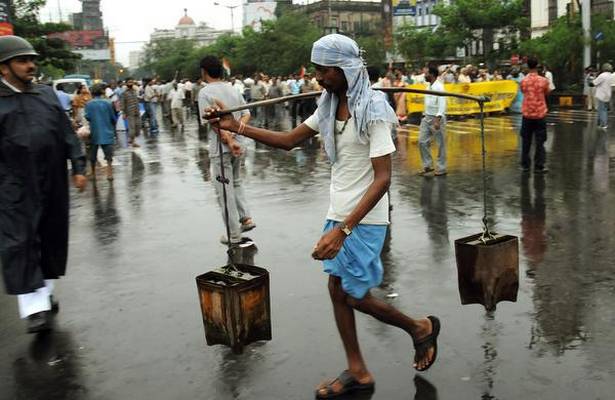
Bhadis make their way through Kolkata’s streets, carrying two plastic cans of water on an eight-foot-long bamboo pole balanced on their shoulders. | Photo Credit: Debajyoti Sarkar
The circadian rhythms of a bhadi’s life are dictated not by sunrise and sunset, but by the Kolkata Municipal Corporation
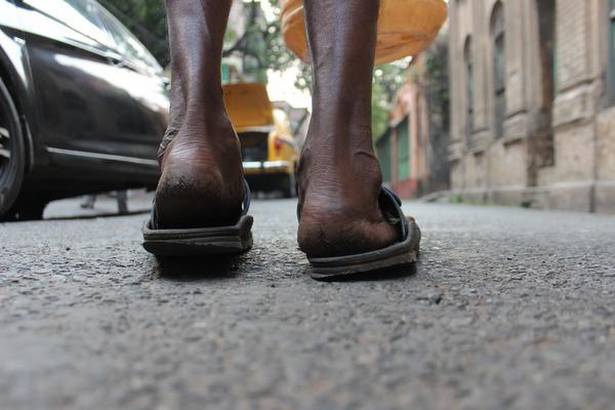
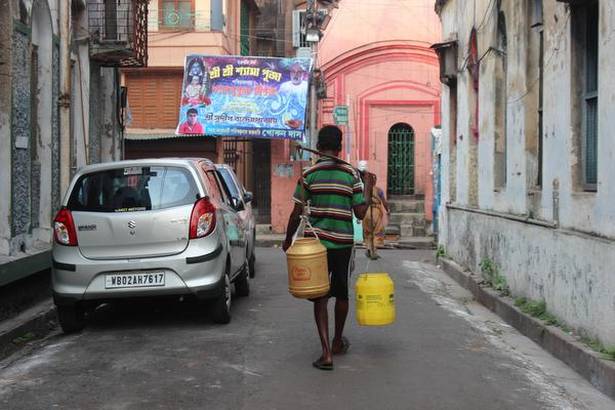
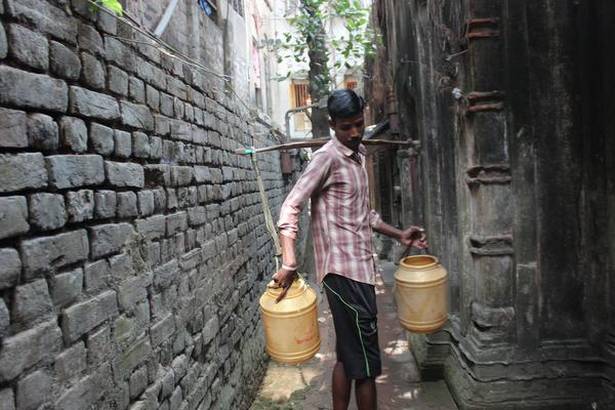
The frayed soles of his black rubber sandals scraping against the gravel, his body canted forward for balance, his steps quickened by the burden he carries, Chintamani Palai makes his way through Kolkata’s Shyampukur Street where houses look like boxes jostling for space. At either end of the eight-foot bamboo pole he carries on his shoulders hang two large, fluorescent yellow, plastic jerrycans filled with water that sloshes with every step.
It is Palai’s 21st trip of the day, between the municipal tap at the end of the street and back to the various homes, where he sells the water at ₹2 per can of 15 litres.
“I don’t need water today,” says Arup Ghose, a resident.
“You don’t? Ah! But I have brought it for you. I don’t like to throw away the water. Don’t give me money.”
“Okay. Fill the tank then.”
The numbers of bhadis in Kolkata are declining: from thousands even a decade ago they are down to a few hundreds now. | Photo Credit: Arpita Chakrabarty
Palai removes his sandals, climbs up two floors to the terrace, and upends his two cans into a plastic tank. He is now back on the street, his stooped shoulders a visible imprint of his profession, on his way to fill the cans again.
Palai moved to Kolkata from his hometown in Odisha 33 years ago. He is a bhadi – literally, one who carries the load.
Where are the jobs?
Odia bhadis have quenched thirsty Bengali homes for as long as one can recall. Palai’s father was a bhadi; so were his grandfather and great-grandfather. The work they do doesn’t count as registered employment — this is ‘make-work,’ necessitated by migration, unemployment and water scarcity. Back home in Odisha’s Bhadrak district, Palai could not find a stable job that would provide for the 22 members of his family. His family owns half an acre of land; his three brothers work intermittently as farm labourers, construction workers and dairy farmers. “Most of the work is seasonal, so we can’t depend on it throughout the year,” says Palai.
And so, able-bodied men like Palai have been migrating to eastern India’s biggest metropolis to look for work for decades now. Those without specific skills like cooking or plumbing end up as bhadis. But paradoxically, even though unemployment and migration is on the rise, the numbers of bhadis in Kolkata are declining: from thousands even a decade ago they are down to a few hundreds now.
“It’s a strenuous job,” says Palai. “Those of us who were trained by our fathers and grandfathers continue to work, but the young people don’t want to be bhadis anymore. They want easy, light jobs.”
***
Palai left Odisha when he was just 12. “It was the year Indira Gandhi was killed. The political atmosphere in Kolkata was volatile. So I ran back home, and returned to Kolkata a year later. I finally began working as a bhadi in 1985.” His smile is broad, his teeth are stained from the paan he chews incessantly, mostly to dull the ache of hunger and fatigue.
The circadian rhythms of a bhadi’s life are dictated not by sunrise and sunset, but by the Kolkata Municipal Corporation. The corporation releases water to the taps between 5 a.m. and 9.30 a.m., then again between 3 p.m. and 6 p.m.. In hours in between, he fills water from tubewells in the area and delivers it to those who need extra water, or who prefer tubewell water to tap water for washing. By noon, he has already ferried 990 litres of water, criss-crossing the lanes of north Kolkata. “I never counted this, all my life,” laughs Palai. “Today, when I keep a count with you, it seems quite a job.”
In the few hours that I shadow him, plotting his back and forth trips on Google Maps, I find that he has walked 5.11 km. In this time he has refilled his jerrycans 43 times, stopped at 26 homes, climbed three or more flights of stairs several times over.
The work they do doesn’t count as registered employment — this is ‘make-work,’ necessitated by migration | Photo Credit: Arpita Chakrabarty
He squeezes in a couple of hours for lunch. It’s usually rice and fish curry. Outside the small, square single room that he shares with another bhadi and two jhalmuriwalas (men who sell the spicy, puffed rice street food), all from Odisha, pieces of rui fish are being fried on a kerosene stove. Inside, the men are busy chopping potatoes for the fish curry. Another bhadi, back from work, is crushing poppy seeds on a sil batta, working it into a creamy paste that will go into the curry.
Jhalmuri brothers
“We cook and eat together,” says Palai. “This is our bonding time. We talk, make fun of each other. There is no time for any of this in the evening — by the time the jhalmuriwalas return home, it’s close to midnight, and we are asleep.” After a short siesta, Palai is back at the taps. Now there aren’t as many people as there were in the morning, but Palai is still impatient; he has dozens of homes to deliver to before the water is shut off at 6 p.m.
“I have a client whose landlord doesn’t provide any water,” says Palai, chewing paan as he waits in line at the tap. “So I supply them 90 litres of water two times a day.” Most of his regulars are inherited — his father once delivered water to them — and so this equation is much more than transactional: both bhadi and customer have built up a relationship neither wants to forego.
“We have piped water in our house,” says Archana Dasgupa, a septuagenarian who lives on Shyampakur Street. “But Palai is more than a bhadi to us; his grandfather delivered water to my father-in-law in the 1940s. He’s now a part of our family.”
In a city whose young have been migrating out in increasing numbers, Palai and his peers are valuable resources for the ageing population left behind: Kolkata has the biggest 60-plus population of any city in the country, and it also has the least number of 20 to 30 year-olds among all the metros. “Without our children, we depend on men like Palai for other regular jobs too, like buying groceries, cleaning the house, fetching water from the Ganges for the puja, and so on,” says Dasgupta.
The price of delivery has increased from 20 paise per can in the 1980s to ₹2 in 2018. But, says Palai, he doesn’t charge everyone the same price. The West Bengal State Cooperative Bank, where he delivers, pays him a modest salary of ₹3,200 per month. “I started with ₹20 when I joined the bank in the 1980s.” Palai’s family has been delivering water ever since the branch was established 50 years ago.
Odia bhadis have quenched thirsty Bengali homes for as long as one can recall | Photo Credit: Arpita Chakrabarty
After filling, carrying, emptying, refilling, and carrying water on his shoulders every day of the week, Palai earns ₹9,000 a month. “There are days when somebody’s water pump breaks down, and I fetch water for them till they repair it. I supply water for weddings. My earnings rise at such times.” He sends half his earnings home to the village. He is not unhappy, but his legs have begun to hurt more often, so he has begun to take painkillers.
He may well be the last bhadi in his family. “I want my son to study hard and get a proper job. I tell him, become something else. If you live as a bhadi, you die a bhadi.”
***
The Hooghly River flows west of Kolkata; there’s a huge groundwater reserve. The city’s eastern fringes are covered with wetlands that naturally treat waste water into raw water for fisheries and agriculture. Two decades ago, only a handful of houses in the city had piped water supply. Bhadis formed the water army who supplied water for drinking and washing across households. “There was an acute water crisis in those days, and it was the bhadis who brought water to our homes, like they do now.”
Manual support
Today, the demand for bhadis is lower. Five water treatment plants have boosted water supply to Kolkata’s homes. But the city now grapples with depleting groundwater. As independent houses turn into multistoreyed apartments pumping their own water from large tubewells, they deplete the city’s natural groundwater reservoirs.
In some places, the corporation does not supply water at the right pressure for it to be piped to above-ground storage tanks. Says Arunabha Majumdar, Chairman, Indian Water Works Association, “The residents then depend on the manual support system, the bhadis, to fetch water.”
Like 77-year-old Shyamal Mitra. “Every summer we face an intense water crisis. The piped corporation water is not regular. The supply pipeline has no pressure and water cannot be pumped up to the first and second floors,” says Mitra.
A floating population of six million per day — greater than the city’s resident population of 4.4 million — also depends on public water taps. The city, within the municipal corporation limits, draws 300 gallons of drinking water a day from 18,000 water taps, 12,000 hand tubewells and 400 tubewells.
High levels of arsenic have been found in the groundwater in various parts of Kolkata. The prolonged water depletion raises the risk of contamination, especially in the areas that are heavily dependent on groundwater, forcing them to turn to bottled water and the service of the bhadis.
Corporation tap water has been found to be safer than the packaged water sold in the city, and to contain more minerals and to be less acidic.
Since bhadis fetch water from Corporation taps, they are still getting takers.
***
Pitabas Parida has been supplying water for just two years in the Bagbazar area. Parida, who belongs to Odisha’s Jujpur district, has travelled to all major metros looking for work. He worked in a fibre factory in Bengaluru, made milk packets in Chennai, shaped iron rods in Hyderabad, and worked as a farm labourer back home, before coming to Kolkata.
He has no house in the city. Parida and another bhadi live in a dilapidated Shiv temple in Bagbazar. It is surrounded by high-rises and wild shrubs have taken over its crumbling walls. The duo’s belongings — some clothes, two mobile phones, two chargers, and two thin mattresses — take up a corner of the temple. Parida eats at a local dhaba and uses public toilets.
Around the temple are water cans of all sizes. It is wise to keep them there because no one will steal from the house of god. Parida, 38, a frail man whose bony face is his most striking feature, delivers water to 30 houses every day.
“Why do you this job?” I asked him.
“Back home there’s nothing I can do for a livelihood. Besides, Kolkata is close to home. This is my life,” he said.
Men like Palai and Parida make up Kolkata’s invisible water distribution system. It is hard labour for little money, but it is all they know.
This essay is from a National Geographic Society and Out of Eden Walk journalism workshop.)
The Uttarakhand-based writer explores the lives of those who walk mountains.
source: http://www.thehindu.com / The Hindu / Home> Society> Cover Story / by Arpita Chakrabarty / February 09th, 2019
Many on Twitter identified the head priestess as Nandini Bhowmick, who apart from being a woman priestess is also a drama enthusiast and professor of Sanskrit.
Many on Twitter identified the head priestess as Nandini Bhowmick, who apart from being a woman priestess is also a drama enthusiast and professor of Sanskrit.
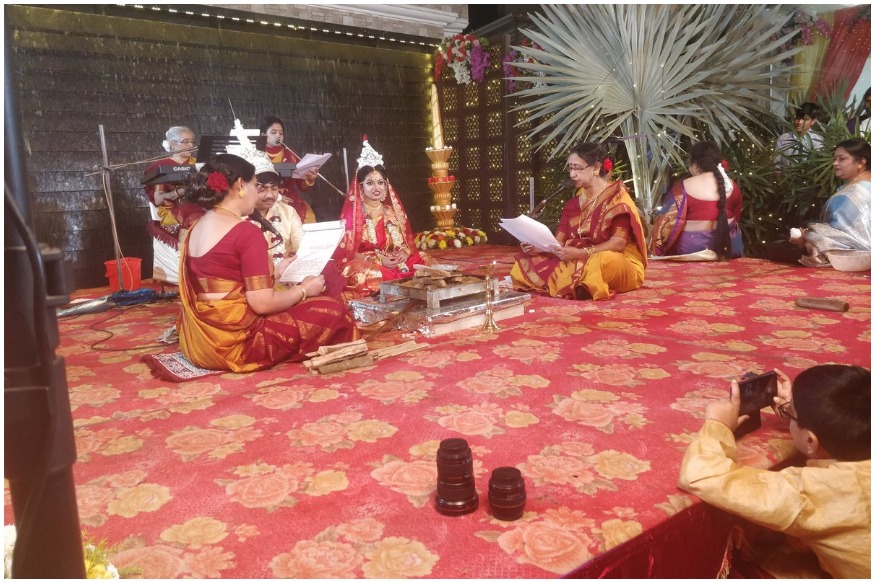
Weddings are auspicious events. But it is rare that wedding is touted as progressive. That’s just what happened recently at a wedding ceremony in Kolkata which was conducted by four women priests.
And the women pundits were not even the only thing special about the wedding. In a yet more progressive move, the father of the bride refused to perform the ‘kanyadaan’, the act of ‘giving away’ one’s daughter as gift to her husband and in-laws.
Instead, the father read out a speech at the wedding, adding that his daughter was not property to give away.
One of the guests present at the wedding shared an update regarding the same on Twitter. she wrote, I’m at a wedding with female pandits. They introduce the bride as the daughter of and (mom first!!!)”. She further added, “The bride’s dad gave a speech saying he wasn’t doing ‘kanyadaan’ because his daughter wasn’t property to give away. I’m so impressed “.
Many on Twitter identified the head priestess as Nandini Bhowmick, who apart from being a woman priestess is also a drama enthusiast and professor of Sanskrit. She is well known in Kolkata for performing weddings without the ‘kanyadaan’ ritual. In a 2018 interview to New Indian Express, Bhowmick had said that she did not perform ‘kanyadaan’ as she thought it was a regressive custom.
Though many on social media objected to the idea of the father foregoing the ritual, with some accusing the family of ‘mocking’ Hindu traditions, others held that the move was progressive. In fact, this is not the first time that a family has decided to ignore or modify the ‘kanyadaan’ ritual, traditionally performed by fathers.
In 2017, a Nagpur couple made the headlines for having a wedding sans the patriarchal custom. Even last year, the image of a single mother from Chennai performing ‘kanyadaan’ for her daughter at her wedding went viral.
The conversation about letting the custom be edited out of weddings invokes strong reactions from many on social media, especially those adhering to the Hindu right.
Last year, a tweet by Bangladeshi writer Taslima Nasreen went viral. In it she questioned the custom and asked why there was no ritual called ‘Putradaan’, alleging that the custom treated women like objects.
This book offers insights into a chapter of Calcutta’s history that is frightening and inspiring at the same time. David Lockwood takes readers back to 1942 when the city was bombed by the Japanese air force. An excerpt:
December 20, 1942, was a Sunday. On that day, Calcutta’s ‘Oldest Nationalist Daily’ (according to the masthead), the Amrita Bazar Patrika, reported that in Burma there was a possibility of ‘the end of defensive warfare on this frontier [by the Allies] and the beginning of a war of attack.’ Meanwhile, in the Don-Volga area, ‘the Soviet ring is drawing tighter around the enemy.’ Despite this optimistic note, the paper reflected evidence of wartime stringencies. The Imperial Tobacco Company appealed to its customers to accept cigarettes without packets in order to alleviate the paper shortage. The Government denied a shortage of rice. Women were told that they were ‘the Inner Wall of Defence’ and as such they should join the Women’s Auxiliary Corps (India). Indian political problems were also evident in the shape of the continuing Quit India campaign. An attack on a police station, bombs in Baroda and acid attacks on the police were reported.
The Calcutta races, however, went ahead as normal and were graced by the presence of the Marchioness of Linlithgow, His Excellency the Governor of Bengal, and Lady Mary Herbert. There was cricket on Saturday and Sunday and a tennis carnival to look forward to on Thursday. Cinemas catering to English speakers were featuring Chaplin in Goldrush, Robert Taylor in Her Cardboard Lover, and Abbott and Costello in Pardon My Sarong. The paper reported an increase in the production of Indian films for ‘the surging crowds during yuletide hungry for entertainment.’
That night Calcutta was bombed by the Japanese air force. The structural damage was minimal, but the panic that ensued was widespread. Large numbers of Calcutta residents fled. Fear was exacerbated by indications that neither the Government of India nor the Government of Bengal nor the Calcutta municipality were prepared for the defence of the city.
The air raid took place in a context of overwhelming Japanese military success and territorial expansion. The British — the assumed defenders of India — had been pushed out of Malaya, Singapore, Hong Kong and Burma. In late 1942, it was widely expected, in India and beyond, that a Japanese move into northern India was inevitable, imminent—and perhaps unstoppable.
Calcutta served as an industrial centre, a port and a transit point for troops moving up to fight the Japanese in Malaya and then in Burma. It was a city of considerable strategic importance to the Allies. Once Burma fell, Calcutta was the mainstay of the Allies’ Asian front. Consequently, it was a Japanese target. As Prasad points out, ‘Their air force was also well poised…to inflict continuous and heavy raids on Calcutta and the industrial area in the eastern regions. The official reaction to these first raids on the city was very much along the ‘we can take it’ and ‘business as usual’ line, modelled no doubt on the (officially) stoic British reaction to the Blitz. The Governor of Bengal, Sir John Herbert, telegrammed the Viceroy after the first raid that despite two deaths and fourteen injuries, there had been ‘No noticeable effect on morale.’ Later the Chief Secretary related that ‘ARP Services are in general reported to have done excellent work,’ demonstrated by the fact that ‘defections were very few.’ The Viceroy was moved to tell Calcutta’s citizens:
Yours is the first capital city in India to suffer in this war a baptism of fire and her citizens have provided an admirable example of steadiness and fortitude. Well done Calcutta.
The English press was, if anything, even more relaxed. The European-owned Statesman declared that the first raid was ‘a small affair and, if the city has to be raided, it can be described as a very suitable introduction.’ Even the Amrita Bazar Patrika reported that ‘Little damage was done and no nervousness was shown by the townspeople.’
Down amongst the townspeople, however, things were not quite so sanguine. After the first raid, ‘nervousness’ broke out on a wide scale. According to Joydeep Sircar, the raid was a ‘devastating blow to the morale of the inhabitants.’ Sircar suggests that ‘one and-a-half million people’ fled, causing a breakdown in ‘the civil services.’ There was a widespread feeling that ‘The Government had not prepared for the eventuality and seemed overwhelmed by developments in Southeast Asia.’
In the ensuing days and weeks, some signs of defence began to appear: A number of Hurricane aircraft were moved to Calcutta; emergency airfields were constructed, including one in the centre of the city between Chowringhee and the Maidan; slit trenches were dug in the same area. But following the December 1942 raids, many of Calcutta’s citizens were not concerned with defence. They were more interested in flight.
On December 23, Governor Herbert reported to the Viceroy that there had been a ‘considerable exodus of people from Calcutta though not yet amounting to a panic rush.’ Workers had ‘wholly disappeared from the dock area’ and morale was deteriorating — though ‘nothing like a landslide’. The post-bombing exodus took up the full capacity of the railways. Special trains were laid on to cope with the numbers attempting to leave the city. On December 27, ‘measures were taken to clear crowds of refugees collected at railway stations along the evacuation routes.’ The British authorities estimated that some 2,50,000 people left the city by road and another 1,00,000 by rail. Katyun Randhawa, a Calcutta schoolgirl, remembered the exodus and the railway stations ‘packed with people trying to get out’—some permanently. ‘Some of our street hawkers also disappeared,’ she relates, ‘—we never saw our bread delivery man again.’
Not unnaturally, those who felt the most vulnerable —from working-class suburbs, industrial establishments and around the docks — were those most inclined to leave. The Bengal Government Labour Commissioner put a brave face on the situation on the Monday morning after the first raid: ‘There was full attendance this morning in mills and in engineering firms. In fact, some engineering firms reported better attendance than on normal Monday mornings.’ The docks presented a different picture. The Chief Secretary reported that boatmen, port employees and contract labour (including coal coolies) all evacuated. Workers from outside Calcutta ‘left in large numbers on foot both by way of the Grand Trunk Road and the Orissa Trunk Road.’ He estimated their number at 2–3,00,000. Severe labour shortages ensued. The workers that remained took the opportunity of pressing their demands on the employers. There was an increase in strikes in Calcutta after the raids. The Australian war correspondent, Wilfred Burchett, was present in the Calcutta Port Commissioner’s office after one of the December raids, when the latter was confronted by a deputation of wharf labourers. They told him:
We don’t mind staying and working, even if they do bomb us, but we want food in our bellies and decent shelters. At present we’ve got neither.
The Scavengers’ Union demanded wage increases and free accommodation as ‘a large number of sweepers had already left the city and many would go away in the near future.’ The wharf labourers’ demand for shelters reflected, again, the feeling in the city and in the province—and perhaps across India as a whole—that the Government had not prepared well enough for the possibility of war and was not doing enough about it now that it had arrived. In the aftermath of the raids, Sudata Debchaudhury argues, ‘[t]he Government had practically collapsed.’ This may be overstating the case, but at the time the Amrita Bazar Patrika was complaining that the Government of Bengal had done nothing to organise an orderly evacuation, or to provide the evacuees with alternative means of livelihood, shelter and conveyance. Confidence in the authorities could not have been strengthened by the fact that during the December raids about 10 per cent of ‘the lower ranks of the Calcutta Police’ themselves abandoned their posts and fled.
Widespread fear of air raids and even invasion had taken hold in India well before December 1942, and this laid the basis for the civilian exodus from Calcutta. In the early part of the year, the example of Burma was there for all to contemplate. The Government should have known what to expect. On the basis of Burma’s experience of attack from the air, the Government of India’s Civil Defence Department sent out a circular, Lessons learned during air raids, to all Provincial Governments in August 1942.
Excerpted with permission from David Lockwood’s Calcutta Under Fire, Rupa Publications India, Rs 295