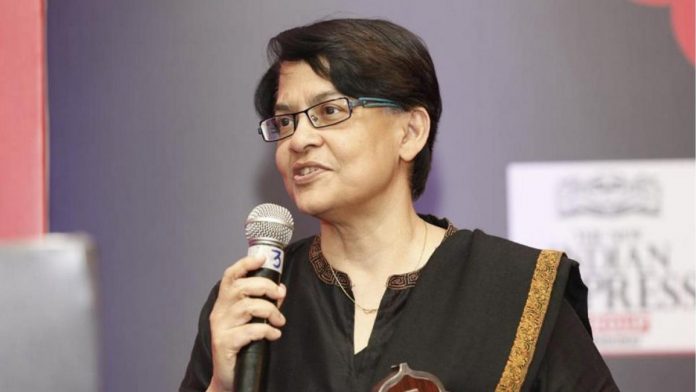
Chandrima Shaha, the president-elect of the Indian National Science Academy, says she will take initiatives to combat pseudoscience.
New Delhi:
As a young scientist, Chandrima Shaha often “felt invisible” when she sat among her male colleagues. Only a few acknowledged her presence. But little did it deter this feisty woman from fighting her way through gender biases and achieve heights that only some dare to reach.
From being a vice-captain of West Bengal’s first women’s cricket team to becoming the first woman cricket commentator for All India Radio, Shaha has added another first to her illustrious career. The president-elect of the Indian National Science Academy (INSA) will be the first woman to hold the post. Her appointment was announced last week.
“Women have to first believe in themselves in order to take over leadership positions. I have been elected by a council consisting of mostly male members,” Shaha tells ThePrint.
With a scientific career spanning more than three decades, Shaha, 66, now looks forward to becoming the face of Indian science.
Along with the newly-elected council of 30 other members, Shaha will assume her new office from 1 January, 2020. During her stint at the INSA, she wants to encourage collaborations between scientists of different fields so that problems can be solved using a multi-disciplinary approach.
To get people more interested in science, Shaha wants to increase the outreach of scientific communities. She pointed out how various government initiatives have given a push towards innovations but the learning system is not designed to encourage research.
Also on her agenda is a push to combating pseudoscience.
Love for adventure
Born on 14 October, 1952 to a photographer father and an artist mother, Shaha credits her parents for inculcating in her a scientific temperament and “streak for adventure” from a very young age.
Her father, Shambhu Shaha, was especially known for the photographs he took of Rabindranath Tagore in the last years of the Nobel laureate’s life.
“My father could not pursue a career in science but he always wanted me to do it. He would bring books from the British Council office and also talk to me about the universe,” Shaha recalls.
She fondly remembers her father gifting her a simple telescope one day. “I kept looking at the stars. At times, I felt very strange thinking how vast the universe was. I thought I was going to be an astronomer,” says Shaha.
But it was an antique microscope that eventually helped Shaha find her calling. She used to collect water from different sources near her house and observed these samples under the microscope. “That really made me transform into a biologist,” she says.
“My mother, Karuna Shaha, was a painter and probably a feminist even before the concept was even born,” Shaha adds.
Karuna was one of the first women students at the Government College of Art and Crafts in Calcutta and also among the first women artists who insisted on claiming professional space in their own right.
Karuna’s biography In Her Own Right: Remembering the Artist Karuna Shaha, written by Tapati Guha-Thakurta, says the artist is best known for her studies of the female nude. For Karuna, it became the prime symbol of artistic freedom and a shedding of inhibitions.
“My mother went to jail during for pulling down the British flag. She was very adventurous. I probably got this zeal for adventure from her,” said Shaha.
To understand cells
Shaha graduated with a Master’s degree from the University of Calcutta and completed her doctoral research in 1980 from the Indian Institute of Chemical Biology.
For her post doctoral work, she went to the University of Kansas Medical Centre (1980-1982). From 1983-1984, she was at the Population Council, New York City. Shaha joined the National Institute of Immunology in New Delhi in 1984 as a scientist.
The main focus of Shaha’s research is understanding the mechanisms that cause cell death. “Cell death is something very fundamental to our bodies. If you can identify the mechanism behind cell death you can also develop drugs to counter various diseases. Cell death pathways have been used very successfully to make cancer drugs,” she explains.
Shaha has extensively worked with ‘Leishmania’ parasite — which causes Kala Azar — and has authored over 80 research papers.
“The excitement of looking at the core of your life — cell — was clearly something that inspired me. I used to sit with the microscope for hours, staring at cells. It was that sheer excitement of looking at life that inspired me,” she says.
Passion for photography
Growing up, Shaha did not let any stereotypical expectations stop her from reaching places she always wanted to go. During her time at the Calcutta University, Bengal was in the middle of the historic Naxal movement. The unrest in the early 1970s meant colleges were frequently closed. It took two extra years for her to complete her under-graduation.
“I got interested in photography because of my father. I took the camera and went to different kinds of places where women wouldn’t usually go. I just hopped on to buses and went to different villages to photograph,” she said.
Shaha had also been the vice-captain of West Bengal’s first women’s cricket team for three years.
Fight against gender bias
“Initially, when we started our careers, nobody would shake hands with women scientists,” Shaha recalls, adding they would be completely “ignored” by her male colleagues.
Even scientists married to career women would greet everyone else but not their female colleagues, she says.
Shaha, however, never thought of giving up her career. “I was internally driven. I knew this (gender bias) wouldn’t stop anywhere. I always thought that I have to keep going forward. I am doing that even now.”
She, however, thinks “attitudes” are changing and the society is on a “self correcting mode”. “I think diversity in science is very important — both men and women need to participate in research. Women, by nature, are more sincere and particular about things. They must participate in a larger way towards the country’s scientific endeavour.”
Plans for INSA
Shaha believes the country’s scientific community is extremely talented. Given the limited amount of funding that is available, Indian researchers have made remarkable achievements, she says.
She also thinks scientists need to reach out to the people in local languages for better understanding of issues.
When Shaha became the director of the National Institute of Immunology (NII) in 2012, she initiated a programme called ‘Science Setu’, as part of which scientists would go and teach undergraduates. The students were also invited to visit the NII laboratories.
As the president-elect of INSA, Shaha now hopes to take similar initiatives at a much larger scale to effectively combat pseudoscience.
“What needs to be inculcated in schools and among public too is the fact that while ancient texts can tell us about cures to various things, in science — where things have to be proven via experiments — we have to provide evidence,” she says.
source: http://www.theprint.in / The Print / Home> Science / by Mohana Basu / August 10th, 2019