Bengal insititute develops robotic device that can collect samples of COVID-19 suspects
The device will help the frontline healthcare workers in delivering services while maintaining social distancing, reducing the chance of them getting infected.
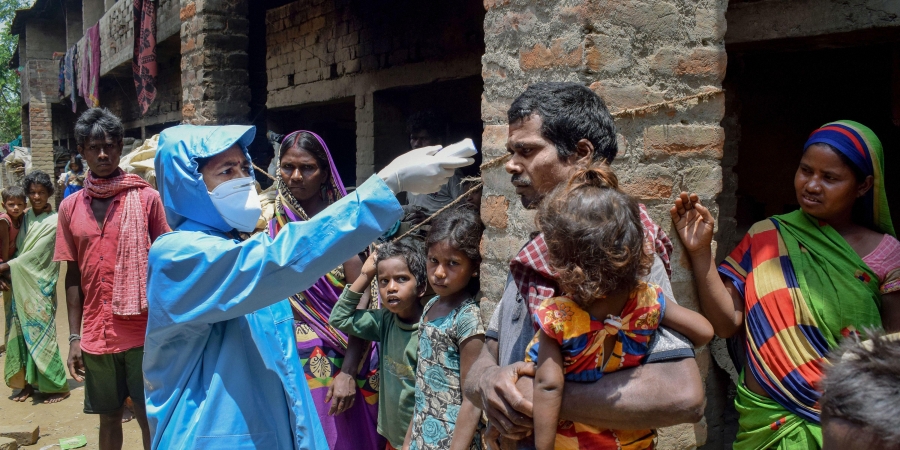
rus in Nadia district Tuesday April 28 2020. (Photo | PTI)
‘
Kolkata :
The CSIR-CMERI in Durgapur has developed a low-cost robotic device that can be used for collecting samples of people having symptoms of coronavirus, besides treating COVID-19 patients.
The ”Hospital Care Assistive Robotic Device” will be very helpful for the frontline healthcare workers who are treating COVID-19 patients, said professor Harish Hirani, director of CSIR-CMERI (Central Mechanical Engineering Research Institute).
It will help them in delivering services while maintaining social distancing, reducing the chance of them getting infected, he said.
The cost of the device is less than Rs 5 lakh and the weight is not more than 80 kg, making it easy to use and affordable for healthcare facilities, Hirani said.
The device, which has a video call facility, can also be used in providing food to the patients.
The device can be navigated through automatic and manual modes and needs to be monitored by a nursing booth with a control station.
“It will be able to transport food items, medicines, testing equipment, files, personal protective equipment in a comprehensive sterilised environment,” Hirani said.
A spokesperson of the institute said the device can function in a range of 0.5 km and has a battery life of four hours.
“The clinical trial of the device has been successful. We will be ready if healthcare facilities and governments show interest,” he said.
source : http://www.newindianexpress.com / The New Indian Express / Home> Cities> Kolkat a/ by PTI / April 29th, 2020
28
27
26
25
British officer with Calcutta ties raises £15m
‘You’ve all got to remember that we will get through it in the end’
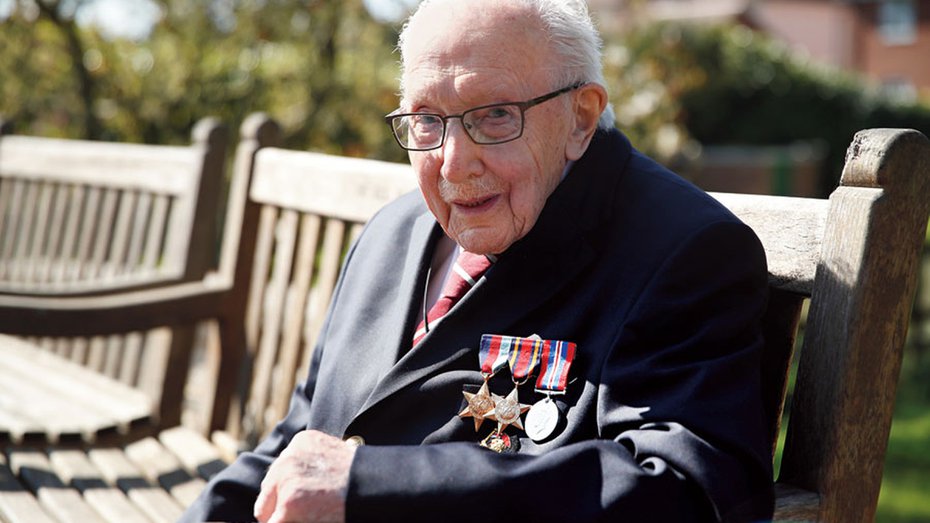
Captain Tom Moore, a former British army officer who served in Calcutta during World War II, had intended to raise £1,000 for the NHS by marking his 100th birthday on April 30 by doing 100 laps of the 25-metre loop in the garden of his home in Marston Moretaine, Bedfordshire, in 10-lap segments.
But by the time Moore, aided by his walking frame, had completed his mission on Thursday morning, donations from 620,000 people in 53 countries had taken the total on his fundraising page to over £15m — a record for a single campaign on “JustGiving”.
It is all a long time since his days in India. Moore was conscripted into the British Army in June 1940 when he was 20, and began his military career in Otley, West Yorkshire, where he joined the 8th Battalion, the Duke of Wellington’s Regiment under Lieutenant Lord George Saville.
This might explain why, when donations hit £10 million late on Wednesday night, Moore tweeted “Virtutis Fortuna Comes” — the Latin motto of the Duke of Wellington which means “fortune is the companion of virtue”.
In October 1941, his unit was posted to Bombay, with the sea voyage, via Cape Town, taking six weeks. He took a train to Poona and joined the 50th Indian Tank Brigade, where he was asked by his commander to start a motorcycling course for the Brigade because of his expertise in the sport.
He was next ordered to move to his base in Calcutta — the journey during the monsoons took three weeks — and later took part in two exercises in the Arakan before moving to Rangoon.
After all in his background, he probably thought his walk in England, even at 99, was a bit of a doddle.
Still, among those who applauded his fundraising achievement was Ben Stokes, Wisden’s cricketer of the year, who said: “The funds you have raised for the real heroes (in the NHS) are just sensational.”
Chancellor Rishi Sunak said Moore’s “extraordinary” efforts “goes to show the British spirit is as strong as it’s ever been”, while the health secretary Matt Hancock remarked, “This is an awful crisis, but there are some little shafts of light…. He’s served his country in the past and he’s serving his country now, both raising that money for the NHS, but also cheering us all up.”
From his home, Michael Ball, a well-known singer, offered a rousing rendition of You’ll Never Walk Alone.
As the sprightly dressed 99-year-old, with his medals gleaming in the spring sunshine, finished his mission, there were TV cameras and journalists to record the occasion plus four soldiers from the Yorkshire Regiment to give him a ceremonial salute.
An emotional Captain Moore, then revealed that he had postponed his 100th birthday party and that after a short rest he would resume his walk.
He added an uplifting message to people in Britain and beyond: “You’ve all got to remember that we will get through it in the end, it will all be right but it might take time. All the people are finding it difficult at the moment, but the sun will shine again and the clouds will go away.”
He said that NHS workers on the frontline “deserve everything we can give them”, and that “I’ve always been one for having a future, I always think things will be good. We’ve fought so many battles and we’ve always won and we’re going to win again.”
www.telegraphindia.com / The Telegraph, online edition / Home> World / by Amit Roy in London / April 17th, 2020
Forgotten hero of a forgotten battle
A 36-year old schoolmaster and his disciples, challenged the tyranny of the British Raj, and for a few glorious days, threw off the yoke of imperial servitude.
Chennai :
A 36-year old schoolmaster and his disciples, challenged the tyranny of the British Raj, and for a few glorious days, threw off the yoke of imperial servitude. They paid a heavy price. But a tinder had been struck, and a group of young Bengali men and women had briefly managed to attack and capture British strongholds. I am referring to the little-known saga of the Chittagong Armoury Raid and the ensuing Battle of Jalalabad Hills, led by ‘Masterda’ Surya Kumar Sen, former president of the Indian National Congress’ Chittagong branch.
My grandfather Suresh Chandra Dey was one of the 65 members of the Chittangong branch of the Indian Republic Army, who raided the local armoury and cut off the communication systems to isolate the important port city. A few days later, a regiment of more than 20,000 British troops struck back. During this fierce battle, my grandfather was shot. He managed to survive the injury and was helped by his comrade Shanti Nag, who carried him down the hill to safety.
Dey was eventually arrested and jailed without a trial, incarcerated as a political prisoner. When his tormentors could not extract information from him through coercion and torture, they tried bribing him, offering to send him to England and fund his higher studies as a barrister.
He did not give in and was eventually released and placed under house arrest. So much so, when my grandfather wed my grandmother Kironmoyee Dey, it was in the presence of British soldiers. He then made his way westward, and eventually founded a the first Sreeleathers store in Jamshedpur in 1952.
My grandfather had chosen to dedicate his life to the idea of an independent India. But the pocket of earth on which he and his comrades bled into was cleaved away at partition, first as East Pakistan and then as Bangladesh.
It falls upon all of us to remember our forebears, and cherish the country that was founded on the blood sacrifice of so many forgotten heroes.
source: http://www.newindianexpress.com / The New Indian Express / Home> Cities> Chennai / by Rijuta Dey Bera / Express News Service / April 23rd, 2020
IIT Kharagpur builds disinfection tunnel for campus visitors in coronavirus time
While passing through the tunnel, a visitor is sprayed with a disinfectant solution coming out of a high-pressure air compressor.

The Indian Institute of Technology Kharagpur has set up a disinfection tunnel for sanitizing visitors to the campus during the ongoing lockdown triggered by the coronavirus outbreak, an official said on Saturday.
The tunnel has been installed at the sole entry point of the campus for essential services staff such those involved in cleaning operations and once the lockdown is lifted, it can be of use to screen visitors until the threat of COVID-19 is gone, he said.
While passing through the tunnel, a visitor is sprayed with a disinfectant solution coming out of a high-pressure air compressor.
The system to automate the process of disinfecting visitors was developed by Prof Mihir Sarangi, Associate Professor Mechanical Engineering, along with faculty and staff members from various departments.
“The output material is like mist and highly effective as it covers a larger surface area unlike liquid disinfectant.
Also, it does not need any drainage,” Sarangi said, This mechanism is, however, a supplement for hand washing or the need to wear face masks in public. Hand wash stations have been placed just outside the disinfection tunnel, he said.
The product prototype has been built indigenously at the IIT Kharagpur in less than a week while the campus is under lockdown.
The prototype is now fully operational at IIT Kharagpur and is used for all people entering the campus.
The commercial model for the product has been estimated to be available for Rs 4 Lakh.
IIT KGP Director Prof Virendra K Tewari said such technologies can be quickly built and employed at any location which has a daily influx of essential service providers.
“Our campus is like a mini township which, in the current situation, requires automation of hygiene and safety protocols for essential service providers who are coming out of their homes every day to serve at the campus and also the campus community who are interacting with these visitors,” he said.
Tewari said more such innovations to assist Indias fight against COVID-19 are underway. PTI SUS NN NN
source: http://www.hindustantimes.com / Hindustan Times / Home> Education / by Press Trust of India, Kolkata / April 18th, 2020
Feed the Need: This group of friends in Kolkata has fed over 1000 families amid lockdown
In Kolkata, a group of six friends have come together to feed villagers in the state.
Kolkata :
The unprecedented lockdown in a bid to prevent the spread of coronavirus in India, has given rise to a humanitarian crisis, where thousands are going to sleep every night without a morsel of food in their stomach. Amidst the crisis, several good samaritans have come forward to do their bit to help the starving souls.
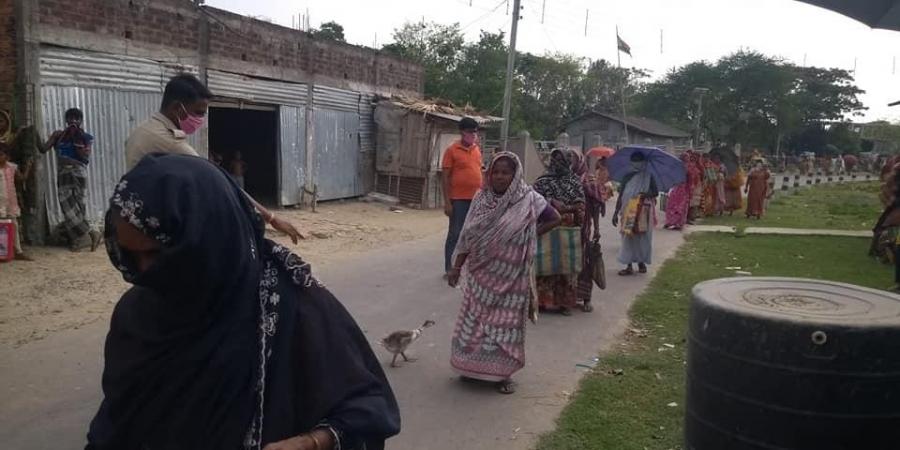
In Kolkata, a group of six friends have come together to feed villagers in the state. The group has so far raised more than Rs 4,000,00 through donations from their friends and colleagues and fed 1200 families in West Bengal.
Ritambar Das, Arijit Roy Chowdhury, Preetom Bhattacharya, Abhijit Sarkar, Sukanya Dutta and Rovers Chatterjee with the help of their friends from other cities in India, US and UK have been delivering ration to families in four villages which are completely cut off from the cities amid lockdown.
Three kilograms of rice, one kilogram of potato and some lentils go into a bag that is then distributed among the villagers. So far the group has managed to help people in Mallickpur, Joytola, Piyali and Betberia. From procuring the ration to distribution, these six people have been doing it all on their own with the help of local police.
“We decided to take this initiative after one of Rritambar’s employees asked for financial support for the people of his village. But for him, it was not possible to take the responsibility of the entire village. So he pitched the idea to some of us and we decided pool money and help them,” said one of the members of the team.
This group of young professionals have also started a Facebook page ‘Feed the Need- by willing souls’ to spread the word and collect funds. The members of the group added that it’s a close circuit network but they are deliberating the option of crowdfunding.
“We initially had a target to collect Rs 15,000 so that we could feed at least 150 families.Our friends passed on the information to their friends who started donating. We coordinate everything through a WhatsApp group. We add every donor to the group to keep them updated,” he added.
The group recently held a ‘thanksgiving’ event in South Kolkata for the essential service providers(police, delivery agents, et al) where they were given snacks and energy drinks.
“We have been distributing these rations on our own with the support from the local police. However, we have decided to engage daily wage labourers in distributing work so that we can pay them a fee to sustain themselves,” a member added.
We are not doing any religion-based distribution, the group maintains adding that it is imperative to look beyond such petty issues and help everyone who is less fortunate.
The group is scheduled to distribute more rations among the families of three more villages in South 24 Parganas district.
source: http://www.newindianexpress.com / The New Indian Express / Home> Good News / by Alisha Rahman Sarkar / Online Desk / April 19th, 2020