A Burning, the breakaway novel that everyone is talking about and its Indian-origin author

How New Yorker Megha Majumdar went from being ‘not good in English’ Kolkata girl to talk-of-the-town debut novelist.
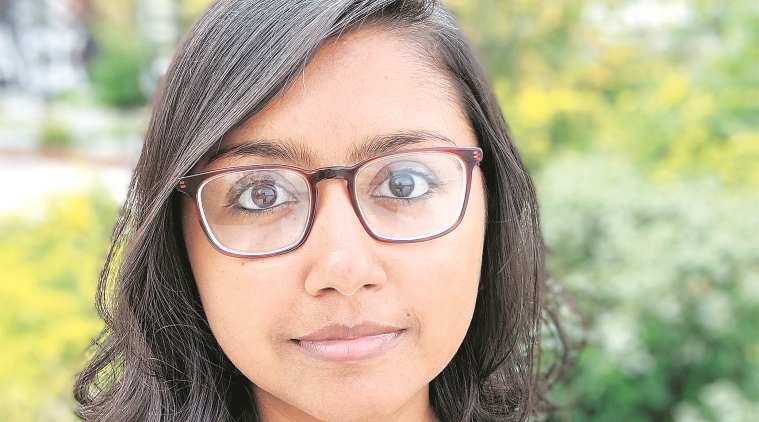
Majumdar grew up in the communist party-governed Kolkata in the Nineties, when the country was waking up to the charms of liberalisation.

Days before Safoora Zargar, the Jamia Millia Islamia student in jail for protesting against the Citizenship (Amendment) Act , is denied bail for a third time, and while protests against the murder of George Floyd, an African-American man, are spreading across the USA, I am on a video call with Megha Majumdar. The buzz around the 32-year-old New Yorker’s debut novel, A Burning (Rs 599, Penguin Hamish Hamilton), that releases tomorrow, has been dizzying long before its publication. Generous blurbs by Amitav Ghosh and Yaa Gyasi have lauded the book as a zeitgeist of our times; James Wood of The New Yorker remarked on its “extraordinary directness and openness to life” that lays out a patchwork of inequalities in which we might recognise the patterns of our communal lives.

Yet, there’s a strangeness to this time in which fiction’s grip over reality has begun to appear jaded. As an incessant stream of horrors in our sociopolitical lives inures some to its potency and wears others out with outrage, nothing, it seems, can be more aberrant than the present. “This is a difficult, fatiguing time across the world,” acknowledges Majumdar, “So much of this moment here in the US is about historical reckoning. And, of course, I have been following the trajectory of the right wing in India. Scholars and journalists have made the connection between Hindu nationalism and white supremacy. In my book, I wanted to write about people. I wanted to write about how people dream and strive and laugh under oppressive systems.”

A Burning is a quiet, searing study of the underclass and the aspiring middle class in India, whose tentative stake in the capitalist economy is complicated by the many tyrannies of gender, religion and class endemic to society. When Jivan, a Muslim girl from a Kolkata slum, one of Majumdar’s three protagonists, reacts to hate posts against her community on Facebook  after a suspected terror attack, with anger and sorrow, but also with a bit of bravura, one knows there will be consequences. “If the police didn’t help ordinary people like you and me, if the police watched them die, doesn’t that mean that the government is also a terrorist?” she writes on Facebook. Retribution is swift — the police come for her soon after. Her social-media friendship with a stranger linked to the case is documented as her complicity and her presence at the railway station on the fateful evening that a train is torched, leaving nearly a 100 dead, as evidence. In one swift action, Majumdar takes readers to the heart of New India, where personal and political ambitions are served or upended by a growing Hindu nationalist churn.

A Burning pulsates with the cadences of everyday life, the ebb and flow of ambitions, aspirations, disparities and disappointments.

Majumdar’s assured narrative is propelled forward by two other characters linked to Jivan — PT Sir, the physical-education instructor in the school where she was an EWS student, who is drawn to the local right-wing political party, and, Lovely, a transgender woman, whom Jivan taught English, and who dreams of becoming an actor. “I wanted to explore specific questions with each of my characters. Jivan works hard to achieve her goals, which are pretty straightforward — she wants to rise to the middle class. She wants to own a smartphone and work at a mall. Unfortunately for her, she is caught in an oppressive system in which you can do everything right and still be thwarted. With PT Sir, I wanted to examine what a small taste of power could do for a middle-class man like him. What would he surrender, whom would he betray?” says Majumdar, who works as an editor in an indie publishing house, Catapult.

Majumdar grew up in the communist party-governed Kolkata in the Nineties, when the country was waking up to the charms of liberalisation. Change was also afoot in India’s political narrative. In December 1992, kar sevaks aligned to the VHP and BJP would demolish the Babri Masjid in Ayodhya, Uttar Pradesh, that would set off a chain of reactions across the country. Majumdar doesn’t elaborate on when she became politically conscious. “We watched the news that our parents did. We were aware of what was happening around us,” she says. She would leave the city for the US in 2006 to study social anthropology at Harvard University and to graduate school at Johns Hopkins afterwards. But she would carry with her the minutiae of life on the city’s streets.

A Burning pulsates with the cadences of everyday life, the ebb and flow of ambitions, aspirations, disparities and disappointments. As an editor, Majumdar has been familiar with the publishing process, but the book’s reception in the US — touted as one of the best literary debuts of the year — did catch her by surprise. “I’ve been grateful for the positive early attention,” says Majumdar, who has begun work on her second book.

Her editorial expertise shows up in the craft of the novel, in the teasers she throws in by way of episodic interludes, in the cinematic pace with which she alternates between the narrative voices. A Burning is a novel firmly of the here and now, but Majumdar packs in layers of history in her idiosyncratic use of the English language. In West Bengal, the Left-front government had abolished the teaching of English at the primary level in government and government-aided schools in the state since 1981.

It would be brought back to primary classes nearly two decades later, but entire generations grew up with a shaky hold over the language. Overnight, Kolkata would see a proliferation of tuition classes offering lessons in English. Majumdar remembers attending one as a child. In the first year that her parents applied to put her in primary school, she didn’t make it anywhere — “My English wasn’t very good,” she says. So, she was enrolled for English tuitions. The next year, she joined a private school. It was the beginning of a deeper engagement with the language. “A lot of my childhood was spent in public libraries and in second-hand bookstalls, borrowing all kinds of books to read,” she says.

The subtlety with which Majumdar moulds language to the spirit of the city and its inmates rings out best in the voice of her most endearing character, Lovely, who speaks in broken pidgin English that fits into the nooks and crannies of her life. Lovely’s vitality relies on visceral experiences acquired during her travels through the city, and minute observations that make up for a lack of formal education. It is here, in the authenticity of the polyphonic voices that people her fictional landscape, that Majumdar’s novel soars.

Like Deepa Anappara’s Djinn Patrol on the Purple Line earlier this year, the exhilarating response to A Burning in the West owes a hat tip to ticking all the boxes that make the India story familiar — jagged inequality, religious roil and irrepressible hope. “I wanted the book to be legible and inviting for those who have never been to India and do not follow Indian news, as well as to those who have lived in India all their lives. I wanted the book to be an act of invitation, to open imaginative doors to the many different, complex stories that one might follow,” she says.

source: http://www.indianexpress.com / The Indian Express / Home> Books & Literature / by Paromita Chakrabarti / June 14th, 2020


Raj Mahtani’s Paris in Calcutta jewellery collection: Celebratory union of the world’s most iconic cities

Paris in Calcutta equates the beauty of the two cities by drawing parallels between the ambience, the architecture, the grunge, the art and the heritage.

A neckpeice from the collection

When Raj Mahtani showcased his creations along with couturier Anamika Khanna at Paris Fashion Week in 2008, it could well have been a prophetic moment for the first Indian jeweller to have done so on that esteemed international platform. More than a decade later, as his house of couture jewels enters its 20th year, the Kolkata-based master jewellery designer is ready to floor connoisseurs with a collection that brings together the cultures and concepts of Kolkata and Paris in a celebratory union.

Raj Mahtani

Paris in Calcutta equates the beauty of the two cities by drawing parallels between the ambience, the architecture, the grunge, the art and the heritage. The ornaments and adornments belie the conventional Indian wedding jewellery narrative to suit a more global context deriving from the European vocabulary of opulence in a modern format.

Known for creating concept luxury jewellery that marries the core of a Mughal sensibility (as well as Ottoman influences) to a more Western canvas, Mahtani has always strived to elevate the art of Indian jewellery to suit a modern palate. His penchant for creating statement neckpieces saw him present some of the most eye-popping polki and jadau collars, body corsets and scarfs along with Khanna’s clothes at the Paris Fashion Week that year. Courting immense critical acclaim and commercial laurels, Mahtani soon recognised the potential of his craft in India. The modern Indian woman, with an evolved, bold outlook and a confident sartorial sense was ready for the avant garde in bijouterie.

Thus, Mahtani started his fascinating journey that broke the traditional concepts of wedding and occasion wear. While drama is one element that marks his pieces, subtle elegance is another leitmotif. But no matter how simple the pieces were, they always sprung surprises of technique or execution (a diamond caterpillar necklace reflects the art of dynamism in diamonds, a gold choker that resembles crochet lace). The Paris in Calcutta collection, too, features some remarkable statement pieces that look extravagant, yet create a narrative of versatility and viability.

Bold, handcrafted pieces that take the onlooker’s breath away, each piece is a marvel in intricacy and artisanship that Satramdas Dhalamal, the family of jewellers that Mahtani is from, is legendary for.


Entering its 140th year, the designer has big plans for the mothership as well as his label in 2020. “These are pieces constructed in a manner so that they can be broken down into smaller pieces. We want patrons to wear them regularly instead of storing them away in lockers. These are jewels to be loved and worn again and again,” says Mahtani showing us a layered polki necklace that can be worn in six ways. And a curling wrist cuff encrusted with sapphires and diamonds that opens up to form a scintillating hasli.

“When we think of an Indian bride, the entire look had become too straight-jacketed. I wanted to break that notion. This is wedding jewellery for the bride who is a global citizen. She travels, she takes in the sights, sounds and cultures of a world village. She deserves jewellery that is so much more—demure, elegant, yet wow. Because simple needn’t be boring,” says Mahtani sitting amidst a veritable selection of jewellery.

The need to push the envelope in the field of wedding jewellery arose when Mahtani lived and worked in Europe in the 1990s, taking in how tastes and preferences in fashion were changing internationally. “The modern woman does not want to look like a bag of jewels. It’s one striking piece—a ring, an earring, a cuff, or a necklace—that does the trick. The definition of refinement and the context of couture jewellery has seen a sharp curve, bordering on boho-chic, functionality and the element of drama,” says the jeweller.


Indeed, if you’re looking for sheer, dramatic elegance, the Paris in Calcutta collection is right up your street.

source: http://www.newindianexpress.com / The New Indian Express / Home> Magazine / by Sharmi Adhikari / January 25th, 2020

A model, an emcee, and a school principal

Yes, that’s Jessica Gomes Surana

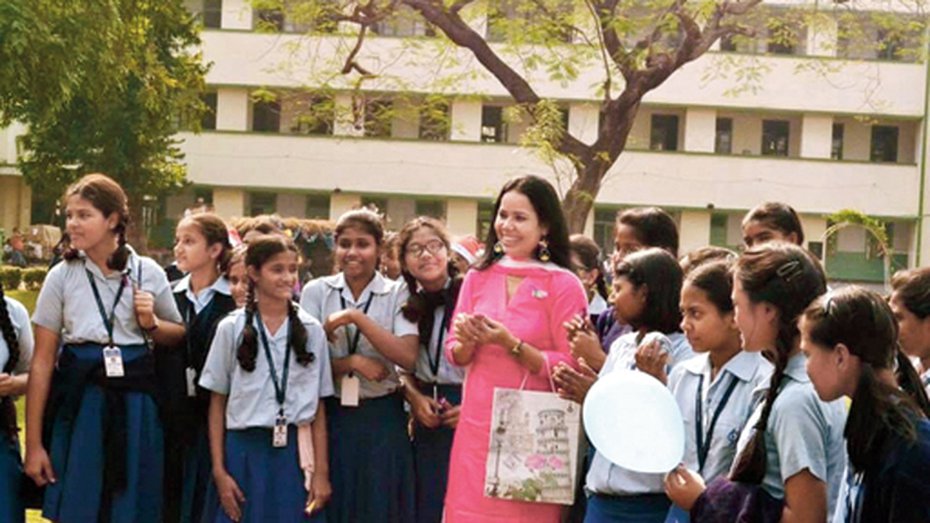
Jessica Gomes Surana with the students of Loreto Convent Entally, in her “favourite picture”!Rashbehari Das

A regular face on the Calcutta ramp for almost 15 years, Jessica Gomes Surana has transitioned beautifully into an academician in the role of the principal of Loreto Convent Entally. Teaching has always had a special place in her heart, be it as the tuition teacher during her college days to a fashion choreographer later on. A celebrated emcee, Jessica who studied at St. Teresa’s Secondary School, Loreto House, Loreto College (BSc), Ballygunge Science College (MSc in geography) and is a BEd from St. Xavier’s College, has juggled her career and academics deftly. As she enters her fifth year as the Loreto Convent Entally principal, she chats with us on the milestone and more.

How did you celebrate this feat during the lockdown?

Thank you for coming on board to celebrate the most wonderful journey of my life. May 2 is truly a life-changing date — a day when I stepped into a whole new world. I was all excited to be in school this year as I would be entering my fifth year as principal, but then came the lockdown. I began the day by thanking the almighty God and asked him to give me the strength to continue to contribute to the empowerment of children. I sent gratitude messages to my mentors, my staff members and my husband. We had a special lunch with the family.

Can you take us through the journey? How has life changed? What have been the learnings?

It all began with a phone call on November 23, 2015, while I was shopping in New Delhi for the party month that lay ahead. I heard the voice of my favourite English teacher (Plus-II level) on the other side. I was not too sure whether the voice was inaudible or rather the surprise question had numbed my being. ‘Jessica, I was wondering if you would be interested in taking up the position of a principal in one of the branches of our Loreto schools?’ I stared into space and it took me a few minutes to reply, rather sheepishly, ‘Miss can I call you back tomorrow as I am in the market and it is a little noisy here?’

At this point of time, I was teaching at South City International School and had had a one-year stint at La Martiniere For Boys prior to this and then this HUGE opportunity coming my way made me pinch myself to believe that it was actually true and not a dream. It then took a few months to roll through a series of interviews, which were rather unnerving not because the questions were tough but only because the interviewers were my principal of my schooldays and other senior sisters and members of the institution. And then came the big question — when would you like to take up the responsibility of being a principal of one of our schools ? This was simply unbelievable — miracles do happen and one had just happened to me.

I took over as the principal of Loreto Convent Entally on May 2, 2016 and life has never been the same since then. In the first year, it was more about observing and finding ground for myself in this 175-year-old institution. In the second year, it was more about planning and in the next two years execution of my ideas and innovations began. Educating myself was of paramount importance. I was very fortunate to have two wonderful mentors, Sister Antoinette Rodrigues and Sister Tina Farias (secretary of the managing committee of Loreto Convent Entally), who handheld me along this journey and strengthened me every single day.

This four-year journey has brought about a positive change in my life. Being a model, you tend to be self-centred… but being a principal makes you selfless.

I have become more sensitive and do not judge people at the drop of a hat. I have learnt how to respond rather than react to situations. I have been blessed with the gifts of wisdom, discernment, understanding and knowledge to do what is right. I have come to believe that respect for ourselves guides our morals; respect for others our manners. Every relationship today holds more value than what it did earlier.

I have become a woman of prayer with a higher understanding of the presence of God in our lives.

Did you always want to be a part of education?

Yes, as a little girl I draped my mum’s dupatta as a sari and imagined myself as a teacher amongst my cousins. I began giving tuitions from my first year in college and continued throughout my modelling career. I was always passionate about teaching. I still continue to take classes in geography for Class X and XII.

How did you juggle your academics and a full-fledged modelling career and later on the role of an emcee?

I began modelling towards the end of my first year in college. It was challenging as I wanted to excel in academics (which I did) as well as pursue my modelling career. I have always been disciplined and dedicated and that has helped me. I have been a multitasker from the very beginning. Be it college, tuition and modelling together or university, tuition, modelling and emceeing, or even teaching, tuitions, modelling, emceeing and choreography… I have always converted my day into 48 hours.

How?! Some time-management tips please!

Plan your day well in advance. While planning, do remember to keep small key holes in case of sudden changes, so you will not have to scrap the whole plan. Flexibility is a must to create a little movement whenever necessary.

Try and schedule your work in such a way that it does not take a toll on you. After a heavy day of meetings and classes, you can relax with some physical activity… a swim or a yoga session.

Your daily timetable should develop into a weekly one where you are able to even catch a movie or meet up with friends or even dance away.

What has been the easiest part of the transition and the most difficult?

The easiest part was my connection with the children. Initially, they were more in awe and glamour-struck but with the passage of time they looked at me as a role model and someone they could trust. The most difficult part was to make people believe that a model could be positioned at the helm of an educational institution by pure merit. But I guess that is quite understandable as no other model has ever merged the two parallel lines.

It’s only been four years and I have been able to somewhat change that perception. Today, people take me seriously and wait to hear my opinion and that has made me believe that nothing is impossible, your hard work and dedication is what brings you success.

How do you choose assignments now?

Today, my first priority is my school and my children. I choose assignments based on my availability and also my long- standing relationships with the brands that I have worked with over the years, ABP being one of them. I am very selective today. The event needs to be worth my time.

What is a typical day in your life like?

My day begins at 5am with a little bit of yoga, followed by preparation of breakfast and tiffin boxes. The car rolls out of the building at 6.45am, dropping off my little girl and then my boy and finally me. Believe me, half my energy has already been expended by then! School is done by 4.30pm and we are off for swimming to de-stress. Then comes study time followed by me whipping up some tasty dinner for the family. By 10pm, it’s time to relax and get ready for the next day. On an event day, post-school I race off to the venue. While driving there, all kids’ activities are coordinated. I usually use my travel time in visiting my social media pages to keep myself updated. Sundays are most hectic as the household chores seem never-ending and the kids’ extracurricular activities interweave themselves, adding to the load.

What do you do to keep fit ?

Having a fitness expert as your husband (Neeraj Surana) at least helps you believe that you are fit if nothing else! On a serious note, a little yoga for keeping my mind stable coupled with a half-hour swim five days a week in summer, which converts to walks during the rest of the year, keeps me going. Lately, I have been trying out intermittent fasting, which seems to be doing good as my overeating is in check. But, by and large I am constantly on the move.

What would be your tips for models about having a back-up plan in place?

A back-up plan is something I strongly advise. There is no substitute to education, so please go ahead and pursue higher education. I do not buy that lame excuse that modelling does not give you time, you have all the time in the world. Work towards an alternative career as modelling is a temporary profession and very few can successfully diversify from there into acting, emceeing, choreography…. This will keep you disciplined, grounded and most importantly, mentally stable. It helps to keep your dignity intact and gives you the power to choose your own assignments and also demand your worthy professional fee. Most importantly, it empowers you in more ways than you can imagine. I really find it strange and immature to see some of my seniors and contemporaries still behave like as if they are in their 20s. I guess they would have fared better in life if they had a back-up plan.

A special word for your support system…

I truly believe, “Teamwork is the fuel that allows common people to attain uncommon results”. I consider myself blessed to have a husband who has been beside me for almost 20 years as a friend, critic, well-wisher and a wonderful human being. He has given me the space to grow and spread my wings. My two little kids who adjust to all my erratic timings and my mum-in-law who fills in for me on the home front. My siblings who take pride in all my achievements and never hesitate in telling me to slow down and get some ‘me time’.

On the work front, a very supportive Loreto Education Board and the Loreto sisters whom I am ever grateful to. A special note of gratitude to Sister Anita Braganza (president of Loreto, South Asia) who saw potential in me and gifted me this most enriching experience.

source: http://www.telegraphindia.com / The Telegraph, online edition / Home> People / by Saionee Chakraborty / May 12th, 2020

Films speak a universal language: Bengali director whose Malayalam film made it to Cannes market

After three silent films, Bengali filmmaker Aneek Chaudhuri has helmed a Malayalam film — a first for someone from Bengal. The film is now part of Cannes 2020 and will be screened later this month.

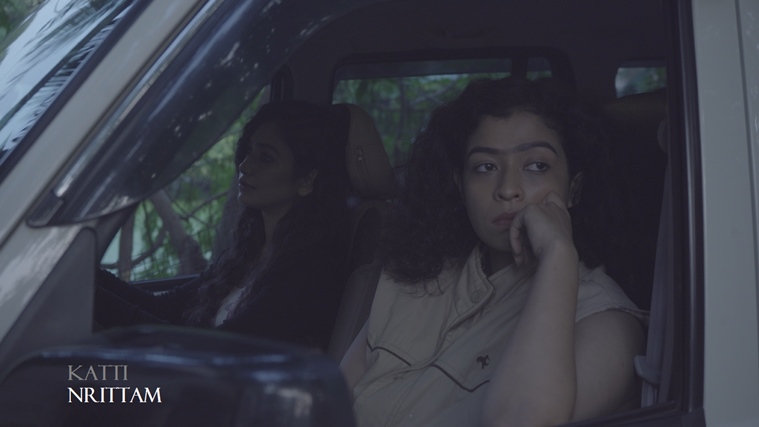
Aneek Choudhuri’s Malayalam film Katti Nrittam is part of the Cannes Film Festival 2020 lineup.

Art transcends barriers. So, it should come as no surprise when a Bengali decides to make a film in Malayalam. However, for Kolkata-based filmmaker Aneek Chaudhuri — whose Malayalam film Katti Nrittam is part of the Marché du Film at the Cannes Film Festival 2020 — it’s the one question he gets asked all the time.

“Films speak a universal language,” said Chaudhuri, 28. It’s a fitting answer from someone who first forayed into cinema with silent films. A film in Malayalam then — a language he doesn’t speak himself — is a natural progression. “I believe that cinema should not have any kind of language barrier,” he said.

Katti Nrittam — a thriller about a failed Kathakali dancer who turns into a psychopathic killer — made a mark earlier too, when its script was included in OSCARS’ Margaret Herrick Library in California— regarded as one of the finest film-related libraries in the world.

In its 73rd edition, the Cannes Film Festival, which is scrapping its physical event for a series of virtual screenings on account of the COVID-19 pandemic, will launch the Marché du Film or the festival’s Film Market online to support industry professionals around the globe. Katti Nrittam is one among the many being screened during the five-day virtual event between June 22 and 26.

Chaudhuri’s previous films — The Wife’s Letter (2016), White (2018), and Cactus (2018) — were also screened at Cannes. However, it is for the first time he won’t be there in Paris to present his film.

First Malayalam film from Bengal

While Katti Nrittam, meaning the Knife Dance, is a modern-day adaptation of ‘The Mahabharata’, the film also draws inspiration from O. Henry’s short story ‘The Cactus’ (1902).

Starring Rahul Sreenivasan, Rukmini Sircar, Sabuj Bardhhan, Anuska Chakraborty and Aritra Sengupta in major roles — it’s the first Malayalam film by someone from Bengal.

“Malayalam Cinema is indeed the best form of Indian Cinema these days,” said Chaudhuri, explaining his choice of language in an email interview. “They have found a way to integrate mainstream and parallel cinema.” However, it was his trip to Kerala’s Kalamandalam in 2018 that further sparked his interest in Malayalam arts and culture.

(Read this story in Malayalam)

The film, which took almost a year to finish as Chaudhuri started to work on the script in early 2019, was primarily shot in Kolkata. The only difficulty was finding locations that resemble Kerala closely. So would it not have been easier to shoot in Kerala itself then? “Yes I could have but that would mean I need to drop out a lot of technicians from Calcutta without whom I cannot work. They wait for me to make a film so that they can work in terms of creative liberty I provide them,” he said.

A modern day Mahabharata

In Katti Nrittam, Chaudhuri uses the graceful Kathakali dance of Kerala to articulate a story of violence. “When I had decided to adapt Mahabharata on-screen, I had to make the killings classy and beautiful and I thought of nothing but this dance form,” he said.

In the film, Arjuna is portrayed through a Kathakali dancer. “After studying the patterns of murderers like Ted Bundy, I believe that for them, killing was a form of art,” said Chaudhuri, “We had to beautify the process of killing.”

In his modern-day interpretation of the epic, Chaudhuri tries to do what otherwise is a taboo: highlight the darker sides of the divine. Answering if the epic — which he dubbed one-dimensional — is still relevant, he said, “Sometimes the interpretation of an epic is directly proportional to the times we are living in.”

‘People expect a change’

Katti Nrittam is expected to have a commercial release in 2020.

Winning many accolades and awards in the last couple of years, Chaudhuri’s films often put women at the centre. His last directorial work Cactus portrayed Jesus Christ as a woman and White was a poignant silent film about rape.

Katti Nrittam is no different: while the film narrates a complex tale of a quadrilateral love based on Henry’s novel, the gender roles have been reversed.

Talking about his women-centric films, the filmmaker, admitted that he is inspired “a lot” by women. “I would try to look out for feminist dimensions in every character I read or create, because women are so damn interesting,” he said, “They can do everything and that too, successfully. And I strongly believe that the world was created from a woman’s point of view that’s why we are still safe; they are the most able and organised people, I must say.”

Chaudhuri’s film has been received positively in Kerala — “But back home, people think that I am in too much of a hurry,” he said.

“In Bengal, you don’t get the space to film alternative stuff. People might be in the legacy of auteur, but most of them in the current scenario are not original and inclined toward earning rather than creating. Now, that is alarming, isn’t it?” said Chaudhuri.

However, it is in his audiences that he has hope. While Katti Nrittam is expected to have a commercial release in 2020, Chaudhuri has spent the lockdown working on a feature-length film titled The Symphony of Pansies with a Lebanese artist Stephanie Bou Chedid. “And if all goes well, something big in 2021,” he said, without divulging further details. “People expect a change.”

source: http://www.indianexpress.com / The Indian Express / Home> Entertainment> Malayalam / by Shreya Das / June 03rd, 2020

‘Calcutta Nights’ book review: A City Lost in Time

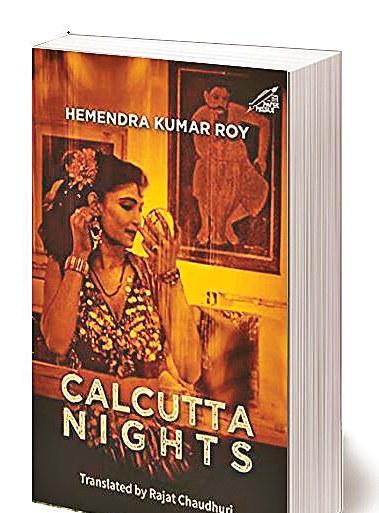
Calcutta Nights (Raater Kolkata) is the real-life story of the enigmatic `Meghnad Gupta’—the pseudonym assumed by Bengali fiction writer Hemendra Kumar Roy.

For representative purposes

Calcutta Nights (Raater Kolkata) is the real-life story of the enigmatic `Meghnad Gupta’—the pseudonym assumed by Bengali fiction writer Hemendra Kumar Roy. A 100 years later, his Bengali book shows today’s readers the dark secrets of another age, another time courtesy an excellent translation by Rajat Chaudhari.For those coming in late, it’s worthwhile remembering that the 1920s were turbulent times in the City of Joy—still the capital of British India. You would have found the place bursting at the seams, as it were, with people from all over the globe drawn to that great metropolis like moths to a flame.

In flocked hustlers, healers and wheeler-dealers and often staid businessmen too. All of them were bonded together with one common desire: the pursuit of sin and pleasure. Indians from the remote corners of the country arrived in droves. Some mingled with locals, settled down, picking up manners and carefree lifestyles of the Bengali.

Calcutta Nights
By: Hemendra Kumar Roy
Publisher: Niyogi Books
Pages: 131 / Price: `295

Many struggled to keep their regional identities even as Calcutta ended being a kaleidoscope with its rainbow canvas splashed with more shades than one could bother to count. Remember that Calcutta Nights was written in times very different from ours. To the reader of today, some of the stances could be rather out of sync or jarring unless you see them as the potholes of history.

Suspend your disbelief. Leave it a while to rest, come meet Matal Hari, the legendary lady of Calcutta who we are told is ‘not at all good to look at, but she makes pots of money from singing and squanders it all away.’ She has a strange whimsicalness. As soon as she receives a payment, she shuts down her business for a few days and goes around town in a merry-making spree with a group of women known to her.

The merry-making continues as long as the money lasts; she doesn’t usually invite male friends in this merriment. The Ferris Wheel spins night and day. She drinks, and smokes weed and opium to settle down with her companions almost ostentatiously in a big room, as the hotel resounds to the racket of feminine voices.

The hotel owner is as pleased as punch with the arrival of a high-spending and low-maintenance customer like Matal Hari. He has no doubt that all the food would be consumed that day, as he quickly goes upstairs and smiling widely says, ‘What would you like to have dear Hari, order it!’This crisp read reveals the darkest secrets—warts and all—of the city of palaces as it was a 100 years ago.

source: http://www.newindianexpress.com / The New Indian Express / Home> Magazine / by Ganesh Saili / April 04th, 2020

Cinematographer Baidyanath Basak passes away

Some of Baidyanath Basak’s notable Bengali films include Manjari Opera, Kokhono Megh, Sabar Uparey, Trijama , Pathey Holo Deri, Nayika Sangbad, Ekti Raat, Putrabadhu, Deya Neya and Kakababu Here Gelen.

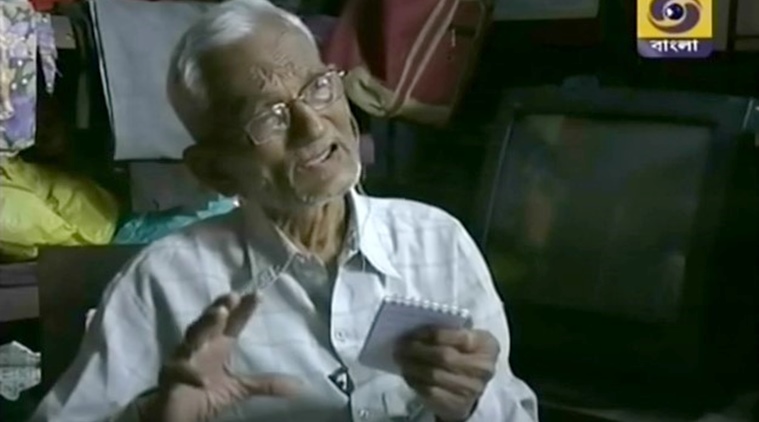
Baidyanath Basak passed away on Thursday. (Photo: Doordarshan/Screengrab)

Cinematographer Baidyanath Basak passed away on Thursday in Kolkata.

His son Sanjay Basak confirmed the news to indianexpress.com . He said, “My father was living with me in Kolkata. He was not keeping well for the last few months. A couple of days back his health deteriorated and we tried taking him to a hospital. But because of coronavirus crisis, no hospital was admitting my father. He finally passed away yesterday between 3 and 3:30 pm.”

Baidyanath Basak made his Bollywood debut as an assistant cameraman with Raj Kapoor  directorial Boot Polish (1954). After not being able to find enough work in Mumbai, he shifted back to Kolkata.

Once back in Kolkata, Uttam Kumar played a very important role in his career. Basak shot the maximum number of films with Uttam. He also worked with actors like Suchitra Sen, Moon Moon Sen, Ashok Kumar, Tunuja, Tapas Paul and Soumitra Chatterjee.

Some of his notable Bengali films include Manjari Opera (1964), Kokhono Megh (1968), Sabar Uparey (1955), Trijama (1956), Pathey Holo Deri (1957), Nayika Sangbad (1967), Ekti Raat (1956), Putrabadhu (1998), Deya Neya (1963) and Kakababu Here Gelen? (1995).

source: http://www.indianexpress.com / The Indian Express / Home> Entertainment> Regional / by Komal RJ Panchal and Sana Farzeen / Mumbai – June 05th, 2020

Calcutta University’s digital collection goes online

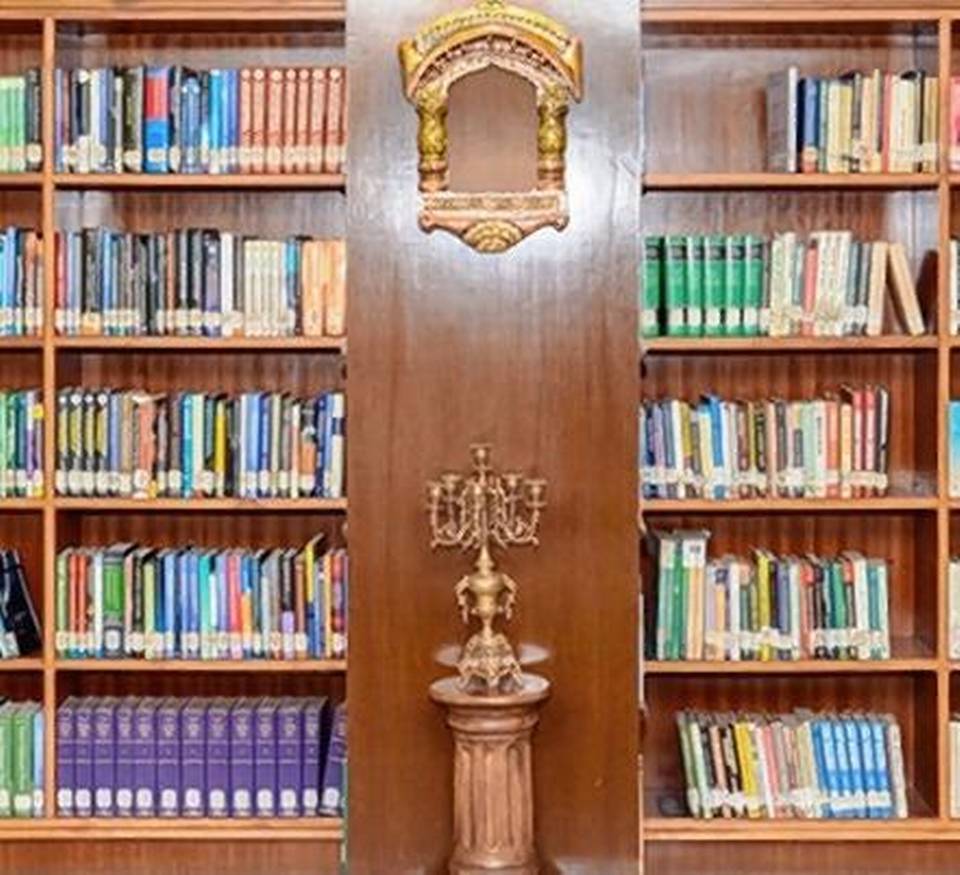
Books at the University of Calcutta library are not accessible at the moment.

Now anybody, anywhere in the world, can access countless articles, journals and dissertations

In what can be seen as a sign of the times to come, when social distancing may just become the new normal, the University of Calcutta has placed the entire digital collection of its library online so that physical visits are no longer necessitated and the world at large benefits from it.

The decision of the University, set up in 1857, has placed in public domain countless articles, journals and dissertations, including issues of The Calcutta Review dating back to 1844 and Tagore Law Lectures dating back to 1870. Now anybody, anywhere in the world, can access them any time.

“We are living through a time of great uncertainty, owing to the global coronavirus pandemic. To cope with regulations of social distancing and lockdown, our teachers have initiated online teaching. They have also been regularly uploading study materials on the university website. In this spirit of online education, the university has also decided to open up free access to its digital collections. These would be accessible through the university website, www.culibrary.ac.in,” Vice-Chancellor Sonali Chakravarti Banerjee said in a circular.

Two major reasons

“There are two major reasons underlying our decision. The first is our responsibility to our students and our faculty, whose education and research have been obstructed by the prohibition on physical access to the library collections.

“The second is our responsibility, as a public institution, to the citizenry as well as the world at large,” Ms. Chakravarti Banerjee said.

“Education is a public good; and the necessity and value of academic research increases, more than ever, if our society is to recover from the crisis.

“As a public university, we feel that it is our responsibility to make our digital collections part of a global academic commons, to facilitate the pursuit of knowledge beyond borders,” she said.

Till now, the library facilities and resources, including digital collections, were primarily accessible to users within the university campus.

Now, the digitised collection of full-text materials has been made accessible for free reading — from any part of the world.

“The University of Calcutta feels honoured to contribute to the communing of cultural-educational resources; and thus to strengthen the global networks of cooperation and solidarity through which alone we shall be able to recover as a planetary community,” the Vice-Chancellor said.

According to a senior university official, this decision to make the library’s digital content public, even though prompted by the pandemic and subsequent lockdown, would, in all probability, continue to hold good even after the lockdown is lifted.

source: http://www.thehindu.com / The Hindu / Home> Life & Style / by Bishwanath Ghosh / Kolkata – May 06th, 2020

Pankaj Mullick’s grandson reveals some legacy gems

Anecdotes and songs punctuating a virtual tribute to commemorate the music legend’s 115th birth anniversary

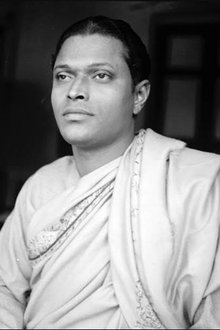
Pankaj Mullick / Parimal Goswami

In 1922, a 17-year-old set to tune Rabindranath Tagore’s poem Shesh Kheya. He sang it at college functions and other cultural events. When word reached Jorasanko, the Tagore family abode in north Calcutta, the composer was summoned by the poet himself. That day the youth had started to sing and soon enough Tagore slipped into a trance. It was his habit whenever he was writing or composing or when in deep thought. But the young man had no way of knowing any of this. Confused and somewhat awkward at this effect his composition had, he quietly slipped out of the room mid-song.

The young man’s name was Pankaj Kumar Mullick. And these anecdotes and songs punctuated the virtual tribute organised by Intach’s Calcutta chapter and the Pankaj Mullick Music and Art Foundation on May 10 to commemorate the music legend’s 115th birth anniversary.

Mullick’s grandson, Rajib Gupta, did the talking; his wife, Jhinuk, sang a selection of Mullick’s compositions.

Gupta continued, “Dadu met Tagore again 15 years later. By this time he was a music director. He had already worked in films such as Chandidas (1932) and Kapal Kundala (1933) and he needed Gurudev’s permission to use Shesh Kheya in Pramathesh Barua’s film Mukti (1937).” When they met, Tagore inquired softly, “Why did you run away the last time we met?”

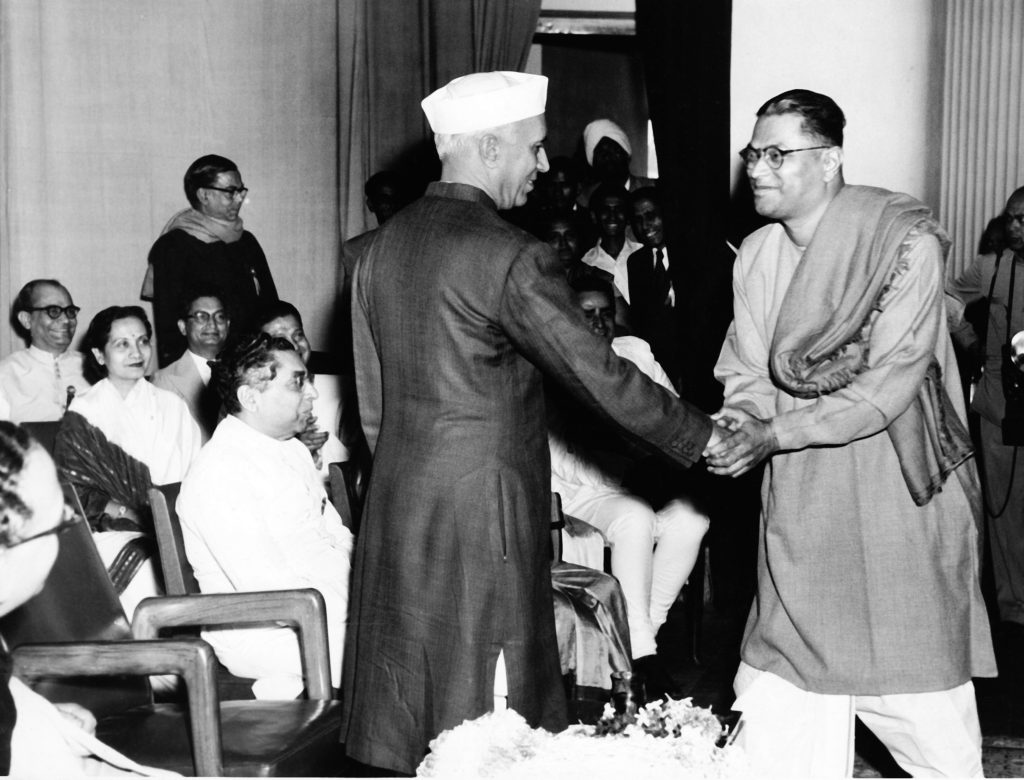
Melody maker: Pankaj Mullick; with Jawaharlal Nehru in 1955 at a seminar / Courtesy, Rajib Gupta

This time, Tagore heard the entire song and was overwhelmed. He granted Mullick permission to use the song. Should you run a YouTube search, the scene will surface on your screen. The silver waters, empty, but for a single vessel. The horizon, obviously flushed even in a black-and-white print, with the coconut palm leaning against it. And the sun dipping low into the river. The song is picturised on Mullick — it was his debut as an actor — but it is his voice more than his screen presence that can hold audiences across generations captive. The lines go — Diner sheshe ghumer deshe ghomta pora oi chaya/Bhulalo re bhulalo mor pran/O parete sonar kule andharmule kon maya/Geye gelo kaj bhangano gaan… At day-end in the land of slumber, a veiled shadow/Casts on me a spell sublime/On the other side, by the golden shore, lives what credo?/It pierces all worldly chores with a melody divine.

Insistent though neither plaintive nor resigned, Mullick’s music and rendition add another dimension to Tagore’s words.

Mukti is a tumultuous relationship saga. In the end, the man dies and the estranged wife survives. When Mullick narrated the script to Tagore, the elder apparently remarked, “It seems the protagonist of your story is in search of mukti… freedom.”

When Barua learnt about this exchange, he promptly christened his production Mukti.

Pankaj Mullick in the 1937 film, Mukti, with Pramathesh Barua / Courtesy, Rajib Gupta

Rajib does not tell a linear tale. He does not need to. His memory drive is teeming with gems and he can pick and choose, polish and cast aside as he pleases. The cast from his anecdotes is delightfully star-studded.

He talks about the camaraderie between Mullick and singer-actor-superstar K.L. Saigal.

Saigal acted in a couple of Bengali films produced by New Theatres. In one such, he was required to sing a Rabindrasangeet — Tomar binay gaan chhilo. But there was a slight problem — Saigal didn’t speak any Bengali. Those days not only was it uncommon to have a “non-Bengali” sing Rabindrasangeet, culture vigilantes too were not entirely encouraging. The way out was to have Saigal copy Mullick “pronunciation by pronunciation, timbre by timbre”. Rajib’s narration trails off and Jhinuk strategically breaks into song.

Next comes the tale of Mullick wanting to have the Calcutta Philharmonic Orchestra play to his rendition of yet another Rabindrasangeet, Pran chay chokkhu na chay, and the keepers of tradition refusing to have any of it. By this time Tagore had passed away. Finally, Mullick did a Hindi translation and thus was born the popular Pran chahe nayan na chahe. Jhinuk breaks into song again.

Sepia-tinted times are not free of complexities. Mullick joined New Theatres around the same time as the famed composer, Raichand Boral, in 1931. The two worked as joint music directors for six years. Despite the collaboration, as Rajib points out, a lot of their films did not have Mullick’s name in the final list of credits. It seems Mullick, who was at that time the breadwinner of a joint family of 60, did not wish to jeopardise his position by picking a quarrel with the studio bosses. But the old wound obviously was never quite forgotten. It merely turned into one of those legacy aches that will roll from generation to generation.

After Mukti, Mullick was set free from a spell of ignominy. He learnt Rabindrasangeet, sang them on the Broadcasting Company Ltd, the colonial predecessor of the All India Radio (AIR), and was the first to use them in films. “Dadu had the songs translated into several Indian languages including Hindi, Gujarati, Tamil and Telugu,” says Rajib, whose narration picks up pace and one can almost sense the busy hum from Mullick’s heyday.

The rundown in no particular order. Helming the popular radio programme, Sangeet Shikkhar Ashar, for 47 years. Being honorary advisor to the folk entertainment section of the government of West Bengal, appointed by chief minister Bidhan Chandra Ray himself. Travelling across India with a variety of productions showcasing Bengal’s folk heritage. Composing Mahishasuramardini.

Member of the Calcutta Municipal Corporation’s mayor-in-council, Debashish Kumar, joins the virtual adda and elaborates on Mahishasuramardini — the programme aired by the Broadcasting Company Ltd at the crack of dawn on Mahalaya.

Mahisasuramardini had more than one creator. There was playwright Bani Kumar, who had scripted it all; Birendra Krishna Bhadra, who did the Chandipath, or invocation of the goddess, and was also the compere; and Pankaj Mullick, who set it all to tune.

Rajib does not forget to mention how one year it was ditched for a programme by Mullick’s protégé Hemanta Mukhopadhyay. He says with restrained pride, “But there was a public uproar and the broadcasters were forced to air the original thereafter, year upon year, beginning with that very year on the day of Mahasashthi.”

Rajib’s narration changes tack when he talks about his grandfather’s work in films. The 1930s spool rolls. Heady years. After a character role in Mukti, the lead role in Aandhi (1940). Thereafter, Doctor the same year. Rajib keeps it real, quotes Tapan Sinha who is believed to have said, “Pankaj Mullick was a decent actor.”

The actual glory, the out-of-the-ordinary stories, have to do with Mullick’s career as composer. How O.P. Nayyar said to Ameen Sayani that as a six-year-old he was inspired by New Theatre’s Pankaj Mullick to take up singing. How Mullick introduced playback singing in Indian films. How he introduced Western musical elements in popular Indian music — fundamentals of harmonisation, interlude music, counter melody. He discovered the horse-beat rhythm, the train rhythm. “You know A.R. Rahman’s Chhaiyaan chhaiyaan? That train rhythm Dadu was the first to use in Doctor.”

And the legacy chugs along…

source: http://www.telegraphindia.com / The Telegraph, online edition / Home> Culture / by Anasuya Basu / May 24th, 2020

Rediscovering the Parsis of Calcutta

New Delhi (IANS) :

It began with author Prochy N. Mehta”s grandchildren being barred from Kolkata”s sole fire temple and culminated in a meticulously researched book on the role of prominent Parsis and the community at large in various aspects of the city”s growth in diverse areas over the years.

“My grandchildren were going to the only fire temple in Kolkata (the Late D.B. Mehta”s Zoroastrian Anjuman Atash Adaran) with us. In 2015, the newly appointed Head Priest phoned and requested us not to bring my daughter Sanaya”s children to the fire temple. On asking why, I was told that the (temple”s) Trust Deed is sacrosanct,” Mehta, author of “Pioneering Parsis Of Calcutta” (Niyogi Books), told IANS in an email interview.

“This started my search into the past. The Trust Deed is dated 1915, but no one today has any recall of us Parsis of that time, of the community in Calcutta, and what they fought for and believed in,” Mehta, one of just 420 Parsis in Kolkata, said. The community has seen zero growth in the last three years as there have been no births.

“Sanaya is married to a non-Parsi. Her children were visiting the fire temple till 2015 We have an Originating Summons in the Calcutta High Court asking for interpretation of the Trust Deed. That is why I studied the Trust Deed and unearthed information. We can now interpret the Deed with this new information. The fire temple trustees are not opposed to it.

“Every family in Calcutta has children who have intermarried. In the last three years, all marriages are intermarriage. They do not want to take a decision in case people point fingers at them saying it”s being done as they are in a similar situation. If the court rules that would decide the issue (but the case is still pending),” Mehta explained.

Mehta elaborates on the issue in the Preface.

“I had no illusions. What I was taking on is what every religion faces at some state: the fear of change. Any change from the norm upsets someone of the other. Sometimes, change comes about because there are enough people to force the change through. Sometimes, the silent majority want the change but do not have the time, means or patience to make it come about. I felt I had all three. More importantly, I wouldn”t allow my daughter”s children to be treated any differently than the children of my son,” Mehta writes.

This initial curiosity turned into a voyage of discovery, which changed her perception of her community and awoke in her an intense pride in the Parsi stalwarts of yesteryear. Mehta”s meticulous research reaped rich dividends as she slowly dusted off the cobwebs of history that revealed the pioneering Parsis” arduous journey to Kolkata, their forward thinking, their broad-minded approach, their willingness to give and to improve the lives of all around them.

These extraordinary Parsi men and women played a prominent role in society by taking upon themselves the responsibility of helping one and all, regardless of class, caste, creed, or colour. Their ability in business and faith in the future was matchless. These early Parsis were not afraid of taking on the establishment and fought publicly to resolve disputes where the orthodox members were unwilling to give the reformists their way.

“I try to trace the history of the Parsis, as there is no recorded history of the Parsis in India, except for a poem the Kissa-e-Sanjan written in 1599 by a priest, Boman Kekobad,” Mehta told IANS.

“An interesting fact is that we had forgotten our religion till Changa Asha (the leader of the Parsis in Navsri) found a group of Parsis in about 1490 living amongst the Hindus as a tribe following Hindu customs and way of life. Till today, the World Zoroastrian Organisation is finding such co-religionists living in poverty in the villages of Gujarat and seeks to rehabilitate them.,” Mehta elaborated.

To turn to the pioneers, the book says Rustumji Banaji may have been the most prominent man in Bengal in the 1800s; owner of Kidderpore and Salkia docks, master ship builder, pioneer in banking, insurance, social service, social reform, and shipping. But alas, forgotten today.

Many of the pioneer Parsis of Bombay had their early roots in Kolkata: Sir Jamshedji Jeejeebhoy; Nusserwanji Cowasji Petit; Dinshaw Petit; Framji Banaji (brother of Rustumji Banaji); the Wadia family of shipbuilders; Meherwanji Mehta, father of Phirozshaw Mehta; Khurshedji Cama; Dadabhoy Navroji; Jamshedji Madan (father of Indian cinema); and Dorab Mehta (Meherwanji”s brother), who had done extensive charitable work for the city of Navsari.

Then there were the nationally famous Parsis who belonged to Calcutta, but were forgotten by us. D.N. Wadia, the world famous geologist; Erach Bhiwandiwala, the artist; A.C. Ardeshir and his famous horse, Ethics; and Dr Irach Taraporewala, who translated the Gathas and wrote the Divine Songs of Zarathusthra.

And then there was the Tata family connected through marriage with the (DB) Mehta family. Jamshedji and Dhunjibhoy Mehta met at Dadabhai Navroji”s home in England, where they purchased machinery for their cotton mills, Empress Mills, Nagpur, and Empress of India Mills at Srirampur. Dhunjibhoy”s grandson, Phiroze Sethna, and Jamshedji”s son, Ratan, married the daughters of Ardesher Sett, Navaz, and Banoo. This must have sealed the bond of friendship among the families, the book says.

(Vishnu Makhijani can be reached at vishnu.makhijani@ians.in)

–IANS

vm/rt

source: http://www.outlookindia.com / Outlook / Home> The News Scroll / by IANS / May13th, 2020