03
02
01 Jul
Covid-19: Mamata Banerjee extends free ration scheme in Bengal till 2021 after PM’s announcement
In his address to the nation, Prime Minister Narendra Modi reiterated the need to remain safe by adopting physical distancing measures.
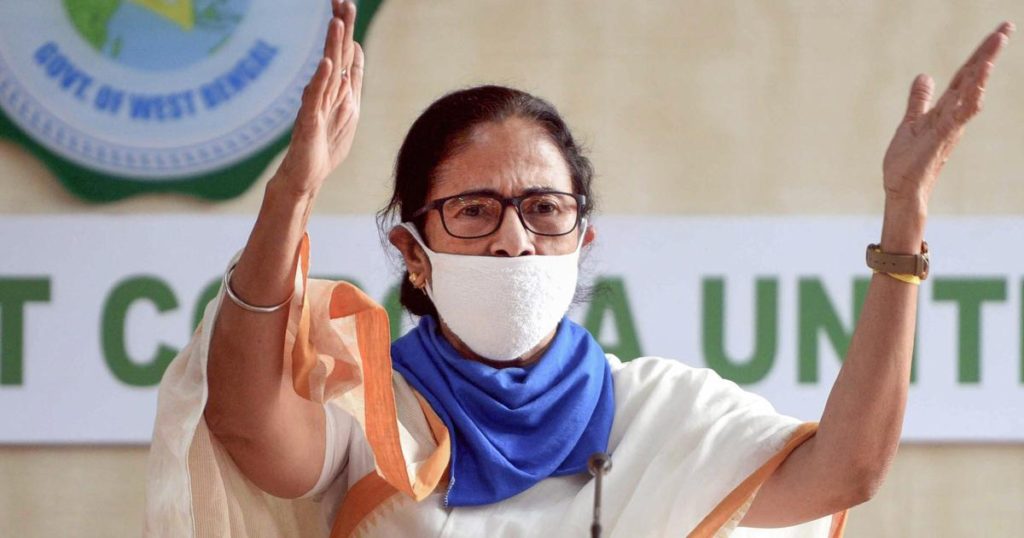
Prime Minister Narendra Modi on Tuesday announced that the free grain distribution scheme under the Pradhan Mantri Garib Kalyan Yojana will be extended by five months till the end of November. Modi made the announcement during his sixth address to the nation since the coronavirus pandemic began. Soon after this, West Bengal Chief Minister Mamata Banerjee extended the free distribution of grains till June 2021 in the state.
Modi observed that even though India’s mortality rate is one of the lowest in the world, people have become negligent in following physical distancing norms and wearing mask since the restrictions were relaxed.
India recorded 18,522 new coronavirus cases on Tuesday, taking the overall count to 5,66,840, according to the figures by the health ministry. The toll from the disease rose by 418 to 16,893. Over 3.3 lakh people have recovered so far.
The global coronavirus tally has crossed the one crore-mark, with 1,02,74,274 cases so far. The toll has risen to 5.04 lakh, according to the John Hopkins University .
source: http://www.scroll.in / Scroll.in / Home> The Latest> Live / by Scroll Staff / June 30th, 2020
Kolkata Boy Forms A Part Of Research Team Featured In Prestigious ‘Nature’ Journal
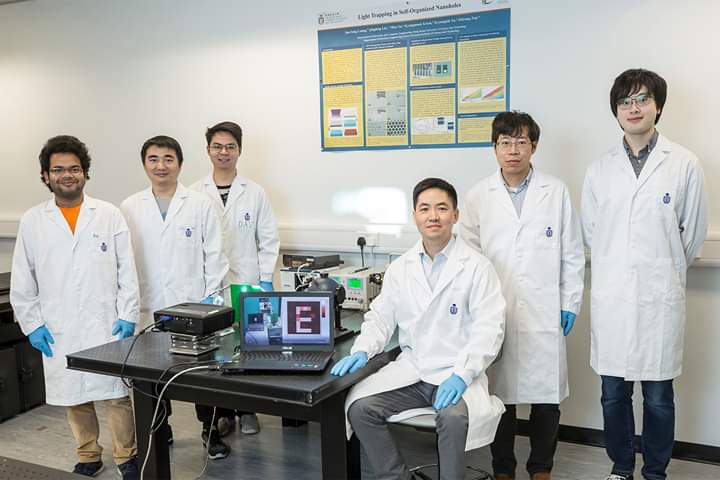
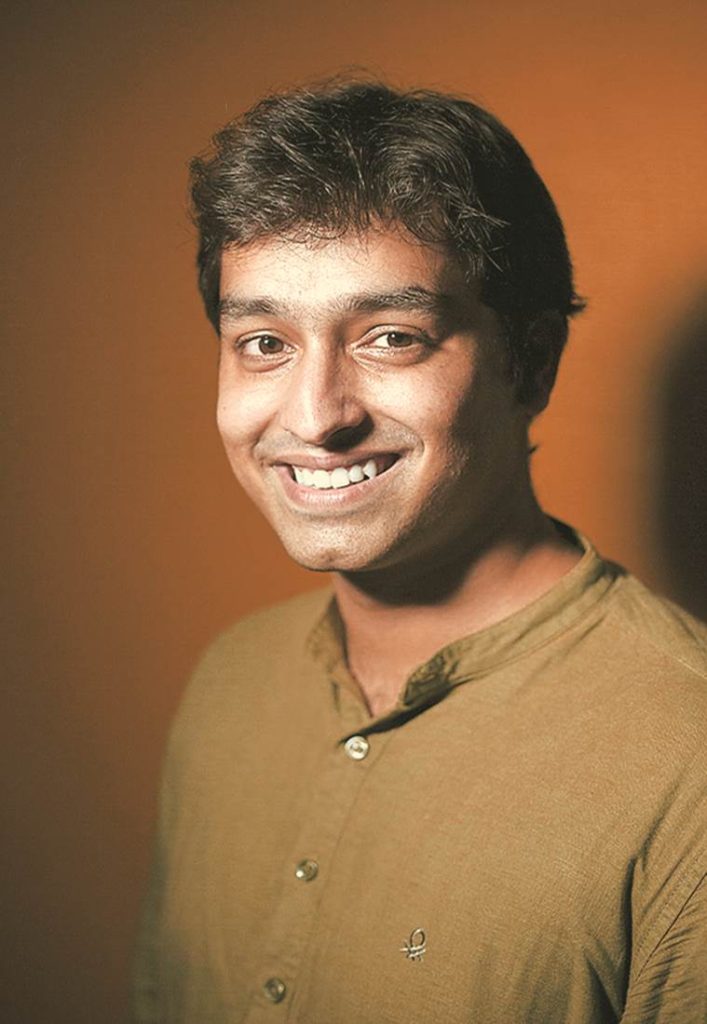
Proud to state that Alumnus of Heritage Institute of Technology, Swapnadeep Poddar had been a part of the great Research team on ‘Super Human Biometrical Eye with a Hemispherical pervoskite nanowire array retina’, at The Hong Kong University of Science and Technology under the leadership of Professor FAN Zhiyong.
Recently the research team and their research was being featured in prestigious science journal ‘Nature’.
The article link https://www.nature.com/articles/s41586-020-2285-x
Swapnadeep completed his B. tech in Electonics and Communication engineering from Heritage in 2016 and now pursuing his PhD at The Hong Kong University of Science and Technology….
Now this biometric human eye will give a pathbreaking development in science and technology. India shines with Swapnadeep now.
source: http://www.youthkiawaaz.com / Youth Ki Awaaz / Home / by Partha Sarathi Bhowal / June 29th, 2020
Two Indian films around border make heads turn at Cannes
A border demarcates. It also seams two Indian WIP projects – Dostojee and The Borderlands – presented as part of ‘Goes to Cannes’ at the prestigious film festival.
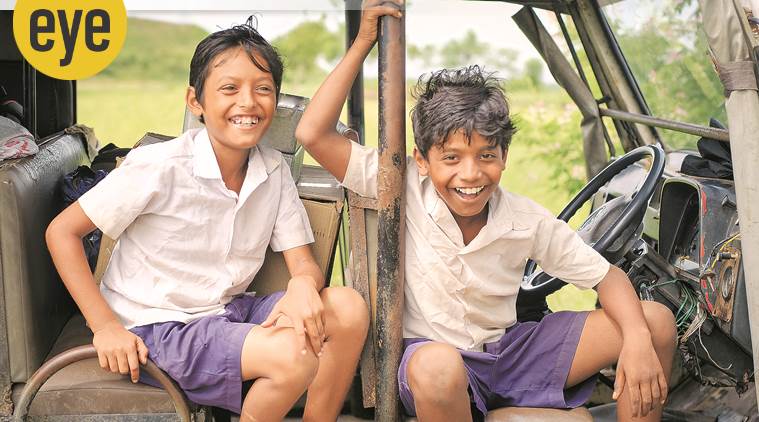
The Bengali landscape is resplendent in the trailer of Prasun Chatterjee’s debut feature Dostojee (Two Friends), and its cinematography “sumptuous”, as the American magazine Variety noted. Vast, rainwashed stretches of paddy fields along river Padma and the glint in the eyes of the two young protagonists, reminiscent of another Bengali village boy, Apu, from Satyajit Ray’s Pather Panchali (1955). First-time cinematographer Tuhin Biswas, a still photographer and primary-school teacher in West Bengal’s Nadia district, was unsure about the video format, until Chatterjee told him, “This is photography too, just think of these as 24 stills per second.”
The location is the remote, no-man’s-land near Domkal (in Murshidabad) — the last subdivision on the Indian side. The Padma river separates it from Bangladesh’s Rajshahi. The backdrop is an early-’90s Bengal, touched by the communal violence that followed the Babri Masjid demolition and the ’92 Bombay blasts, but Dostojee speaks of the friendship between two boys from different faiths, living in a border village. In one scene, as their torn kite flies into Bangladesh, and as Palash says he will move with his fearful mother to the Hindu-majority Nadia when he grows up, one wonders if, when the time comes, Safikul will recall his words to his dostojee (best friend): “bhoy ki, aami toh aachhi (have no fears, I’m here with you)”. “I wanted to show anger and love through the eyes of children. What they witness is my subject of inquiry, too,” says Chatterjee, 34, who grew up in Kolkata’s Dum Dum and dropped out of Physics (Hons) at Calcutta University to make films.
For over two years, hestayed with and trained 150 locals as his cast and crew. One afternoon, when he was packing to return to Kolkata, an angry nine-year-old came banging on his door. The boy, Arif Sheikh, whose friend Asik Sheikh was cast as Palash, said, “Ekhane cinema’r jonno baccha leya hoye? Boite lyen amake, Deb er moto koyee debo (Are children being cast in films? Take me, I’ll act like the Bengali hero Deb),” guffaws Chatterjee who, bowled over by his confidence, cast Arif as the other lead, Safikul. Another time, the crew landed up to find one of them with a Neymar hairdo (the 2018 FIFA football world cup was on) and had to wait for “his hair to grow back” to start the shoot.
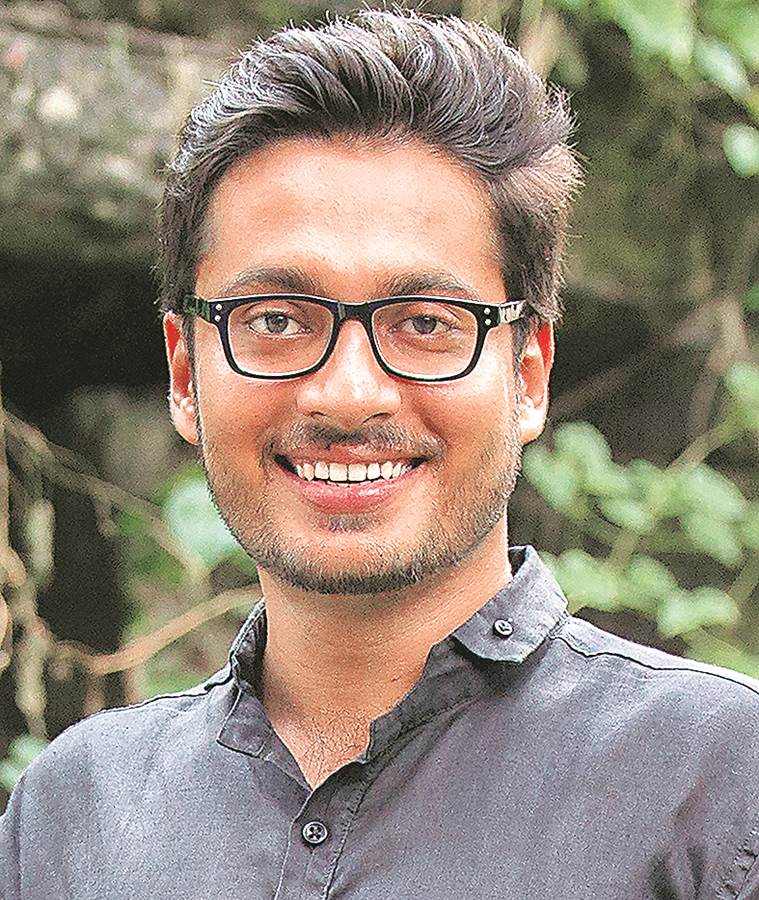
For Chatterjee, who traces his roots to Bangladesh, the pull of these border people has always been great – more than even cinema which he calls “tucchho (trivial)” in front of their lives. “Your work should make the provincial man – the labourer, the farmer –win at the end, or even if he dies, show that there is a flicker of hope for their lot,” says the filmmaker, who is inspired by Ritwik Ghatak’s ideology and Ray’s craft.
From paper to screen, it’s been a seven-year journey since 2013. The film’s working title Dharmik, used while crowdfunding,was changed for a film by that name already existed.Co-producers Prosenjit Ranjan Nath and Soumya Mukhopadhyay came on board in 2017, and Taiwan’s Ivy Yu-Hua Shen after NFDC Film Bazaar selected Dostojee in November in its Recommends section. NFDC sent it, among five films, to ‘Goes to Cannes’: 20 work-in-progress (WIP) films from across the world, whose pitches were made to global buyers and distributors at the Marché du Film from June 22-26 – the only segment of the Cannes Film Festival that took place online this year.
There, Asia’s leading film project market Hong Kong – Asia Film Financing Forum (HAF) picked up the Bengali feature Dostojee (feature) and two Indian documentaries, including Samarth Mahajan’s The Borderlands – the only three from South Asia – among its 22 shortlisted projects for its WIP programme in August. HAF presented The Borderlands – the only Indian documentary in ‘Goes to Cannes’ official selection – at Marché du Film.
The sense of invisibility runs deep in villages and towns along the borders. Mahajan, 29, recounts how, when in 2015 his town Dinanagar, 10 miles from the India-Pakistan border in Punjab, faced a terrorist attack, his mother sounded excited over the phone — Dinanagar had made national news and relatives had woken up to her existence.
“Most of the stories that we hear about border areas create a specific image of army men and terrorists but no common people. I come from a border area and have lived through experiences which don’t fit these general perceptions of borders,” says Mahajan, who while growing up would often see people visiting Dera Baba Nanak, near his town, to see – through binoculars – Pakistan’s Gurdwara Kartarpur Sahib.
The graduate from Indian Institute of Technology, Kharagpur, gave up his cushy FMCG job in Kolkata to make documentaries. He moved to Mumbai in 2015, where he met his IIT-K batchmate Ashay Gangwar and began collaborating. Gangwar was the cinematographer for Mahajan’s first documentary on fireflies of Maharashtra’s Purushwadi, Kazwa — A Million Lanterns (2016), his company Camera and Shorts produced Mahajan’s The Unreserved (2017), on the India seen on the General coaches of trains, which won the National Award for ‘Best On Location Sound Recordist’, and, with the media company All Things Small, co-produced the crowdfunded Borderlands.
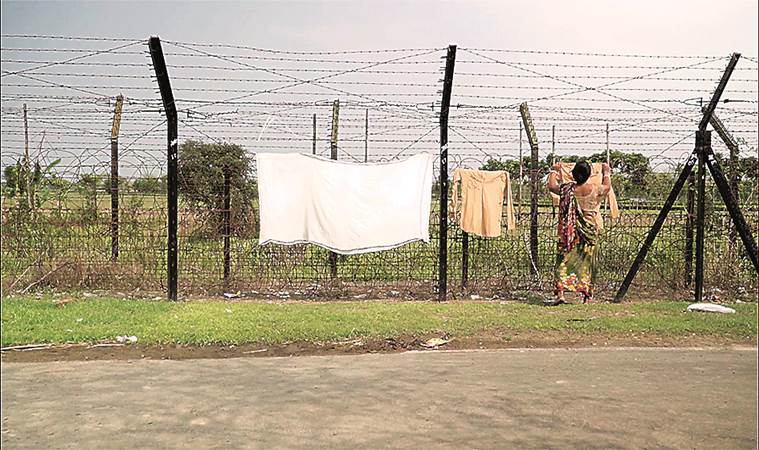
For his latest, Mahajan, along with cinematographer Omkar Divekar and associate director Nupur Agrawal, took a four-part journey to different borders: Pakistan, Bangladesh, China -Myanmar, Nepal and Bhutan. He learnt that borders have their own ecosystem. How civilians cooperate with the Nepalese army to nab human traffickers. What happens when a tiger, from Arunachal Pradesh’s Dibang Valley wildlife sanctuary, crosses over into China? “The mountainous China-India border, the LAC, doesn’t have border pillars. A shaman told us that if a tiger gets killed (by neighbouring tribes or Tibetans living across the border), his tribe observes penitence for five days: no alcohol, no sex, etc. They mourn the environment,” says Mahajan. How a Pakistani Hindu refugee in Rajasthan “studying to be a doctor, has to unlearn the Arab script and learn Devanagari. Her dream got complicated because of crossing the border.”
His film will explore these, along with heartwarming tales of common people along the borders. How the Bengalis on either side dry their clothes on the fence, and exchange gifts on Bengali New Year. “There are two Indias. One is upper-class privileged and the other we have stopped engaging with. At this point in India’s history, we need to hear stories of people from the grassroots. To explore life beyond the domain of violence and politics. For military valour stories, there are already films like Border (1997), LOC: Kargil (2003), Lakshya (2004),” he says.
source: http://www.indianexpress.com / The Indian Express / Home> Eye / by Tanushree Ghosh / New Delhi / June 28th, 2020
St Xavier’s alumni help for 500 families
Camp held near Kakdwip
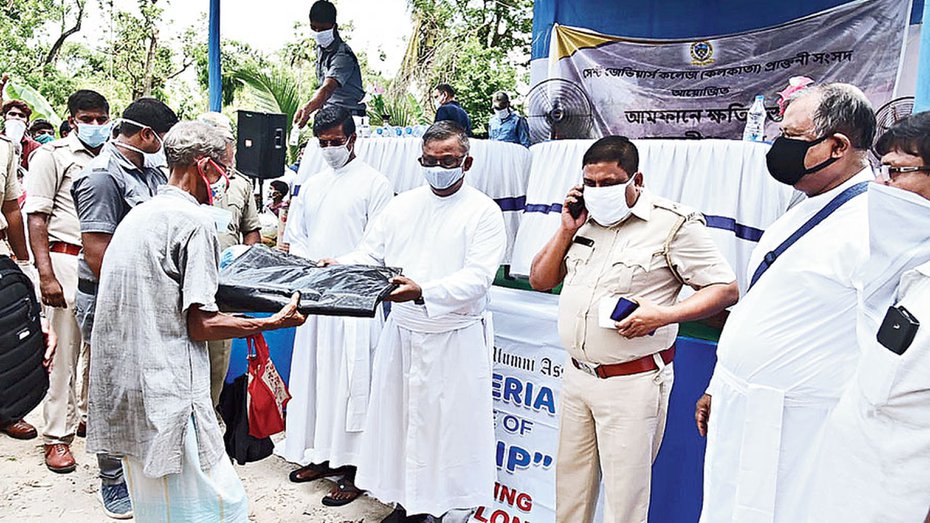
Five hundred families in the interiors of South 24-Parganas, reeling under the double blows of Covid-19 curbs and Cyclone Amphan, on Wednesday got food and other relief material that would keep them going for the next few days.
The distribution camp was organised at Kharimutha village, around 7km from Kakdwip town, by St Xavier’s College (Calcutta) Alumni Association. A group of Jesuit priests, led by Father Dominic Savio, the principal of the college, went to the village to distribute the materials along with volunteers of the former students’ association.
The recipients were residents of Kharimutha and two nearby villages, Mollar Chowk and Pukurberia. Five hundred people had turned up, each representing a family. The camp was organised with the help of local police.
“We, the Jesuits, believe in sharing,” Father Savio said.
Each family got a kit that included rice, potato, dal, soyabean, edible oil, puffed rice and biscuit. Each kit also included sanitary napkins, hand sanitisers and tarpaulin sheets.
The residents of these villages were already robbed of their livelihood by the lockdown and the storm could not have hit them at a worse time.
“Most of them depend on fishing and farming of betel leaves. The storm not only damaged their homes but also ravaged the farm lands,” said Sudip Singh, the officer-in-charge of Kakdwip police station who coordinated with the association to organise to camp.
The former students of the Park Street college have come up with a series of campaigns in the aftermath of the lockdown and the storm to help the people. “It is our duty to stand by them at this trying time,” Father Savio said on Wednesday.
“We will do our best to help people in need,” said Sanjib Koner, secretary of the former students’ association.
source: http://www.telegraphindia.com / The Telegraph, online edition / Home> Calcutta / by Special Correspondent in Calcutta / June 26th, 2020
26
In a digital world, Kolkata’s standalone only-books store spreads joy
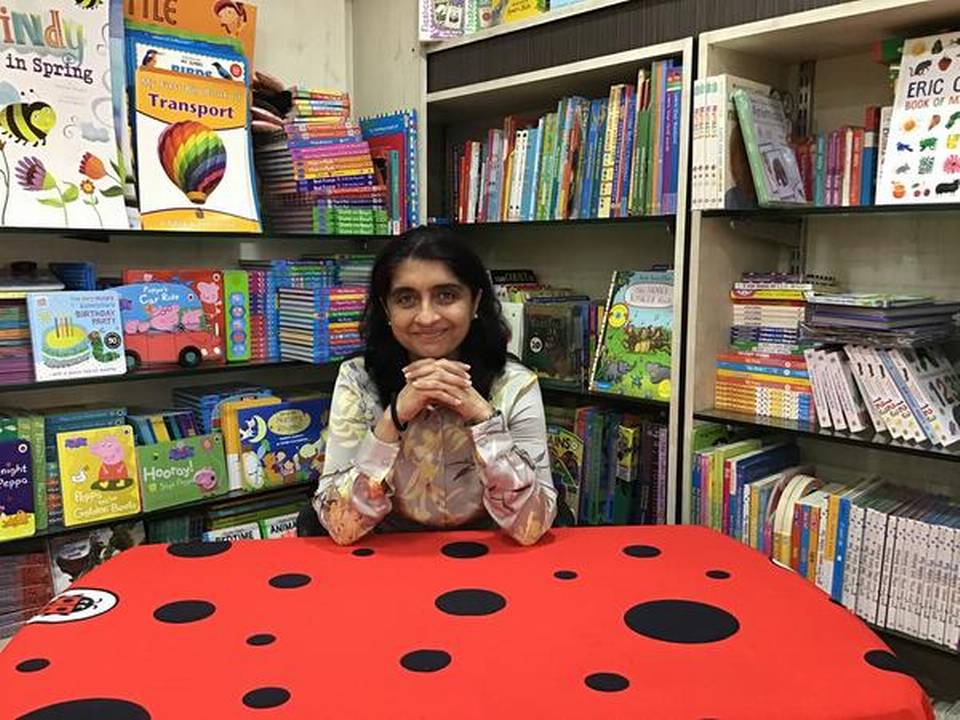
Mayura Misra, who had books delivered even during lockdown, says booksellers are the ones with a heart and soul
Back in the early 1990s, when the term ‘online’ still belonged to the future, renowned Kolkata cardiologist Professor Sital Ghosh was sitting with a patient at the Kothari Heart Research Centre. The doctor was pretty much sure that the patient needed a surgery, but he wanted to reconfirm his diagnosis and for that he needed the latest issue of the British Medical Journal.
So while the patient waited, the doctor too impatiently waited, for his copy, which had just arrived from London and was now on its way, being carried to him by the subscription agent. The agent — a young woman barely into her twenties — was still catching her breath when the doctor grabbed the copy from her, went through the relevant portion, and ordered the patient to be wheeled into the operation theatre.
“Now when I recall the incident, it feels straight out of a movie,” says Mayura Misra, now 50, who is today better known as the owner of a standalone bookstore called Storyteller, located on the city’s EM Bypass. It’s possibly the only old-fashioned standalone bookstore in Kolkata, certainly one that doesn’t also sell toys and games, and certainly one that’s run by a proprietor who’s passionate about the printed word.
Another age
Ms. Mishra grew up in the tea gardens of north Bengal; her father was employed there and she went to school in Kurseong. Her mother, she says, was one of the few to be hand-picked by Jawaharlal Nehru himself as air-hostesses for Air India. After school, Ms. Mishra joined college in what was then Calcutta, where she settled once she got married.
“My father-in-law didn’t want me to sit at home. My uncle, at the time, ran the Oxford Subscription Agency on Park Street. So I joined his firm on a salary of ₹3,000 and took over his Calcutta operations,” she says.
About a year later, having learnt the ropes, she became an independent subscription agent, renting a godown on Theatre Road to stock new arrivals. Back then, when the concepts of online subscription and online edition were still in the realm of imagination, one had to rely solely on subscription agents to import and hand-deliver journals published abroad. Ms. Mishra would personally carry copies — of The British Medical Journal, The Journal of American Medical Association, Chemical Abstracts, Biological Abstracts, Golf Digest, Architectural Digest, National Geographic, among others — to institutions and individuals.
Soon she was reaching out to libraries of schools, importing books for children. “No one was specialising in children’s books at the time. Kids had to wait for an aunt to come from the U.K. or the U.S. to bring them books,” she says. By now she had purchased a dupleix apartment on Theatre Road, and a portion of the house served as the godown.
Working in lockdown
Today, she lives on EM Bypass, and the ground floor of her house serves as Storyteller, the bookshop she opened in 2012. “During the lockdown, we did a lot of online sessions with authors, especially children’s authors. We also started delivering across Kolkata in April — we were probably the first to resume delivery of books in India. Our staff stayed in the store — we provided them boarding and lodging — and the books were sanitised before they were dispatched through Swiggy. Now we are open for browsing,” says Ms. Mishra.
She sums up: “The temptation has always been there to stock toys and games, but if I do that I won’t be able to concentrate on good books. Mine is not a profession you can take lightly. A lot of hard work goes in selling printed matter in this digital world. Booksellers are the ones with a heart and soul.”
source: http://www.thehindu.com / The Hindu / Home> News> Cities> Kolkata / by Bishwanath Ghosh / Kolkata – June 24th, 2020