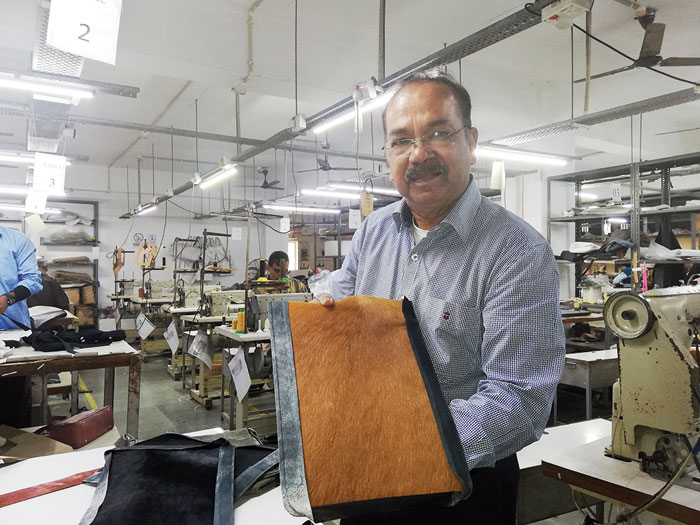
Nandi calls himself a first-generation tanner, but sitting in the hall of his factory, it occurs that that is just a technicality.
Tan man : Tapan Nandi in his workshop / Moumita Chaudhuri
There is a misconception that it was the Muslims who dominated the tanning industry, he says. It is difficult to tell his age from either appearance or agility, but from time to time Tapan Nandi scratches his head and wrings his hands to recall the names of people and events. He continues, “It was rather the Chinese refugees (read immigrants) who had the technical knowhow of this business.”
Nandi calls himself a first-generation tanner, but sitting in the hall of his factory in Bantala on the southeastern fringes of Calcutta, it occurs that that is just a technicality.
The hall has been divided into two units. To the right, there are open shelves with ladies’ handbags, wallets, key-holders and whatnot on display. And to the left, there is a table stacked with files and papers. That is Nandi’s workstation. On the floor, there are some wooden crates. “Those have come back from an exhibition in the US,” says Nandi. Indeed, it is perhaps more accurate to call him a leather enthusiast than a tanner.
Nandi joined the trade in the 1970s. He is almost apologetic for not having a hard luck story to share. His manner is affable and he is very literal and clinical. “It was not due to any financial problem that I started my career early. Neither was it because I was not interested in academics. I was a good student,” he clarifies. Hard luck or no, it is a story of a stray passion, of starting out from a small room in north Calcutta with three labourers and getting here, a full- fledged factory for leather goods with a workforce of 600-plus.
He returns to Topic 1, continues to foreground that tanning was not a Muslim-only industry in the 1950s and 60s. He talks about the owner of Canton Tannery, Michael Lin, who taught him the basics. According to Nandi, Canton Tannery was the oldest tannery of Calcutta and one Sanjay Sen was one of the pioneers of the leather industry. Marwari businessman Shyam Murarka set up the city’s first modern tannery in Kidderpore.
But Muslims did play a large part in the industry, as they were in control of the raw material, which in this case is the skin of the animal. Nandi talks about Gulab Nami, a small-scale manufacturer who taught him how to craft leather. He says, “Muslims were otherwise low on entrepreneurship and also on the technology aspect. The labourers were Hindus, Bengali and Bihari, but not Muslims. And what the Muslims mainly sold were goatskins. Cow and buffalo hides were available in China Town. He says, “In fact, 90 per cent of the cow hide I used to purchase was from the Chinese. Those days cow hides were available at Rs 2 or Rs 3 per square feet.”
A revolting smell hangs about the Bantala leather complex. But Nandi does not seem to notice. He talks animatedly about giveaways that distinguish good hide from bad hide — mosquito or bug bites leave marks that will show only after the first stage of tanning. “Also, it is very important to know where and under what condition the animal has been reared. This is something only a butcher knows,” he adds.
He goes on about the technique of rubbing salt on raw hide to keep the hair intact. The need for it — “If the hair is gone, the skin will go bad.” The process thereafter — “Soak it in limewater to get the hair off and dip in water to wash off the lime. A few more steps and the leather is put out to dry.” He seems to have a chemist’s precision. But of course, he replies, he has a degree in chemistry.
As he climbs down the stairs he talks about the future of the industry, the pollution and the environmental hazards. “I can work for another 10 to 15 years,” he claims and walks swiftly down the corridor, way ahead of everyone else.
source: http://www.telegraphindia.com / The Telegraph, online edition / Home> Culture> People / by Moumita Chaudhuri / March 14th, 2020
The Nizam’s Roll is one of India’s great dishes but it never gets the recognition it deserves
Kebabs rolled in paratha with onions is a fantastic dish that needs to be popularised and preserved (Shutterstock)
Over the last two decades, more and more restaurants have switched to wraps over sandwiches. You would think that Indians, with our tradition of rotis, would be perfect for this trend. But it is Central America that has taken the lead. The pattern for most wraps closely follows the Mexican taco in terms of style and construction.
I find this odd. Why shouldn’t India, land of the flatbread, have a place in this wrap boom? A few months ago, Gaggan Anand opened Ms. Maria & Mr. Singh, a Mexican-Indian restaurant in Bangkok. Gaggan recognised the similarity between Mexican tortillas and our breads. So his food plays on the similarities, especially in the wraps he serves.
This is great but it still intrigues me that our rotis have been excluded from this boom. I can think of only one exception: the kathi kebab roll.
I had never heard of the dish, till I moved to Calcutta in 1986. Nobody called it a kathi kebab in Calcutta. Instead, it was called the Nizam’s Roll. I stayed at the Oberoi Grand when I first arrived and I found a place called New Nizam’s, opposite the hotel, that served rolls.
I was alone in Calcutta, so there were many evenings when I would stroll across and watch them make the rolls. From what I remember, the cook heated a massive tawa and then put a half-ready paratha on it. As the paratha heated up, he broke an egg on the paratha and cooked it on both sides. Then he took ready-made kebabs, heated them on an empty portion of the tawa before placing them in the centre of a paratha. He added onions, which had been sliced long, and a little chutney, before rolling up the paratha so that it became a cylinder. He wrapped the cylinder in paper and gave it to you to take away.
Mexico-style wraps are super popular in Central America ( Shutterstock )
I was so hooked on the rolls that I began ordering them for lunch in my office. Except that the ‘bearer’ (the Calcutta term for what we used to call a peon in Mumbai in that era) said he had never heard of New Nizam’s. He insisted on going to what he said was the only real Nizam’s. The rolls were great so I didn’t really care where he got them from.
But I was intrigued enough to go to what was called “the real Nizam’s”. The first thing I saw was a sign that read “We have no branches”. So okay, “New Nizam’s” may have had nothing to do with the original.
The ‘real Nizam’s’ guy told me that they had invented the dish and that their version was special because a) it used charcoal-grilled kebabs, which others did not and b) it was made on an ancient tawa. (I was never able to establish how old the tawa actually was.)
I did some digging. As far as anyone in Calcutta could tell, the dish had really been invented at Nizam’s. That’s why it was called a Nizam’s Roll. Most non-Bengali meat dishes in Calcutta are always attributed to Wajid Ali Shah (the man who put the potato in biryani if Bengalis are to be believed) but this one, everyone agreed, had been created by Nizam’s around 50 years ago. (That would have made it the 1930s or so.)
As time went on and the dish began to spread out of Calcutta, I discovered that it was called a Kathi Kebab Roll. Ah, I said to myself, the fact that it has a name means that it exists elsewhere in India. But nobody would claim ownership of the KathiKebab Roll. No Delhi chef. No Lucknow chef. No Hyderabad chef.
But kathi kebab? Where did that name come from? The guys at Nizam’s had an explanation. They said that kathi referred to the sticks on which they would skewer the kebabs before cooking. Jealous people who did not want to give Nizam’s the credit, they said darkly, called Nizam’s Rolls, Kathi Kebab Rolls.
Indian sandwiches only became popular in the 1960s and 1970s ( Shutterstock )
I have no idea if the kathi-wallahs had such evil motives but it is true that fewer and fewer people call them Nizam’s Rolls now – even in Calcutta. I was there a few months ago and everyone just called them ‘rolls’ and directed me to various newer restaurants and outlets.
At the same time, there are restaurants that serve rolls and call themselves ‘Nizam’s’ all over India. Are they related to the Calcutta original or are they, like “New Nizam’s”, not quite the real thing? I have no idea.
But in my view, and I said so in one of the very first Rude Food columns I ever wrote, the roll is the great Calcutta dish. The puchka comes close (but there are other contenders in Lucknow, Mumbai and Benaras). Otherwise, if you want to search for Calcutta’s unique contribution to Indian cuisine, you’ll be reduced to discussing rasgullas and ras malai.
When I first wrote about the roll, I complained that it was not widely available outside of Calcutta. In the 15 years or so since that article appeared, that has changed. You get rolls everywhere from Delhi to Dubai to Nagpur to New York. The roll has finally been given its rightful status as a great Indian dish.
Gaggan Anand serves wraps at his Mexican-Indian restaurant in Bangkok
But the questions that started me off on this chain of thought remain. Why is the roll the one famous Indian wrap? Why don’t we have more wraps in any of our cuisines? We have all the ingredients – from the breads (rotis, parathas, makki rotis etc.) and delicious fillings. And yet, even as the world has embraced wraps, India never gets a look in.
I asked chef Manjit Gill, my guru in matters relating to the history of Indian food, if he could think of any other Indian wraps. He couldn’t. I asked then if he had heard of kathi kebabs outside of Calcutta. Manjit said he hadn’t. As far as he knew the kathi kebab was a Calcutta dish.
I then asked Manjit the big question. Why doesn’t Indian cuisine have more wraps?
I liked Manjit’s answer. Wraps are meant to be eaten on the go. In India, we rarely ever eat standing up, let alone on the go. We are not a fast food culture. We like to sit down and eat our meals. Many of us would prefer to eat the kebabs and the parathas separately, rather than combine them and wrap them in paper. For most of our existence, we have been the ultimate slow food nation.
Pav-bhaji was invented in the 1960s for traders at the old Cotton Exchange ( Shutterstock )
I reckon that till the 20th century, India was a country where nothing in the kitchen was done fast; all food was slow food. Even chaat, which is eaten standing, is serious food. You can’t really walk around while eating a golgappa as you can while eating a sandwich or a wrap.
The Nizam’s Roll is usually dated to the mid-1930s, which, I suspect, is when things began to change.
Pav–bhaji was invented in the 1960s for traders at the old Cotton Exchange who would stay up till early in the morning to see the New York cotton prices. It is not a cold dish. It has to be cooked on the spot. But they did eat it standing up and for many of the Gujarati bania traders, it was the only time they ate bread.
Indian sandwiches only became popular in the 1960s and 1970s. The Bombay sandwich (freshly made but cold), which you could eat on the run is really a ’70s phenomenon.
The vada-pav is essentially a Maharashtrian hamburger ( Shutterstock )
So is vada-pav. Both seized upon the industrialisation of baking and the availability of cheap (and fairly disgusting) bread to create new dishes. Both have Western antecedents. The sandwich is not Indian, by definition, and the vada-pav is essentially a Maharashtrian hamburger.
So, what happens in the 21st century? Now that we have lost out in the global wrap movement, will India just follow the rest of the world and make fast food based on hamburgers, pizzas and sandwiches (all suitably Indianised)?
Sadly, I think that we are headed in that direction. So, value the roll. It is a great dish.
And one that’s truly Indian.
From HT Brunch, July 12, 2020
Follow @HTBrunch on Twitter
Connect with us on facebook.com/hindustantimesbrunch
source: http://www.hindustantimes.com / Hindustan Times / Home> Brunch / by Vir Sanghvi , Hindustan Times / July 12th, 2020
“He wanted to provide the best quality food at the cheapest price,” said daughter Sohini Basu
Arnab Basu, the man who created Mio Amore / sourced by the Telegraph
Arnab Basu, the owner of popular confectionery brands Mio Amore and Winkies, died on July 2 at a city hospital. According to family sources, he was battling liver cancer.
A resident of The Residency in City Centre, Basu was 65 and is survived by his wife, son and daughter.
Basu, who started as a bank employee and then ran a bakery in Saudi Arabia with a friend, founded Switz Foods in 1989. Two years later, he would open his factory in Kasba Industrial Estate.
He arranged with a Mumbai company to bring the brand Monginis to eastern India, taking it in a new direction. The chain, that started with a shop in Dhakuria in 1992, expanded to over 300 outlets in Bengal and Odisha, including 220 in Calcutta.
In 2010, he entered a joint venture with Bauli of Italy to start production of croissants. He launched the brand Winkies to enter the packaged confectionery business in 2012. Soon after, he decided to set up his own brand and thus was born Mio Amore in 2015. Within two years, turnover soared over Rs 500 crore.
“He wanted to provide the best quality food at the cheapest price,” said daughter Sohini Basu, who owns the popular cafe and cake shop Mrs Magpie. “My father was happy that one of his children got into cakes,” she added. Basu’s son is a London-based banker.
source: http://www.telegraphindia.com / The Telegraph, online edition / Home> West Bengal> Calcutta / by The Telegraph, Special Correspondent / July 10th, 2020