What the heart hears, the hand will tell

A 34-year-old Beleghata resident’s journey as a percussionist, a field still intrinsically attributed to males
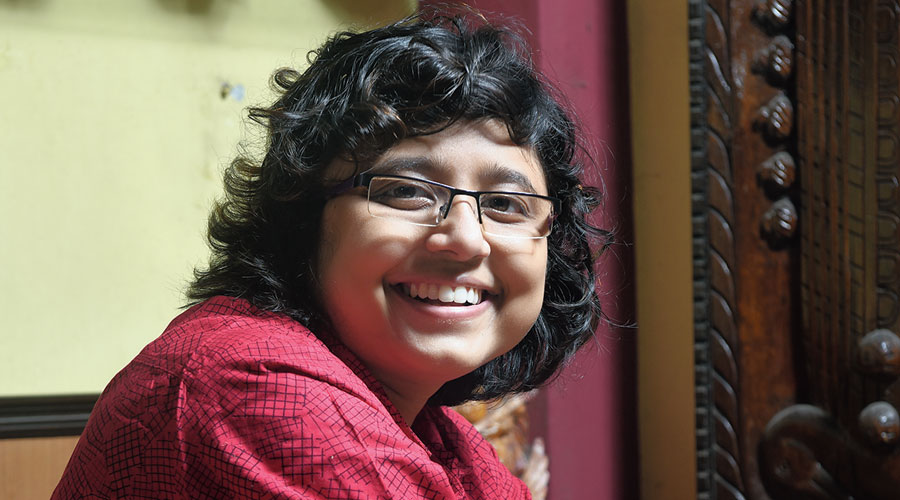
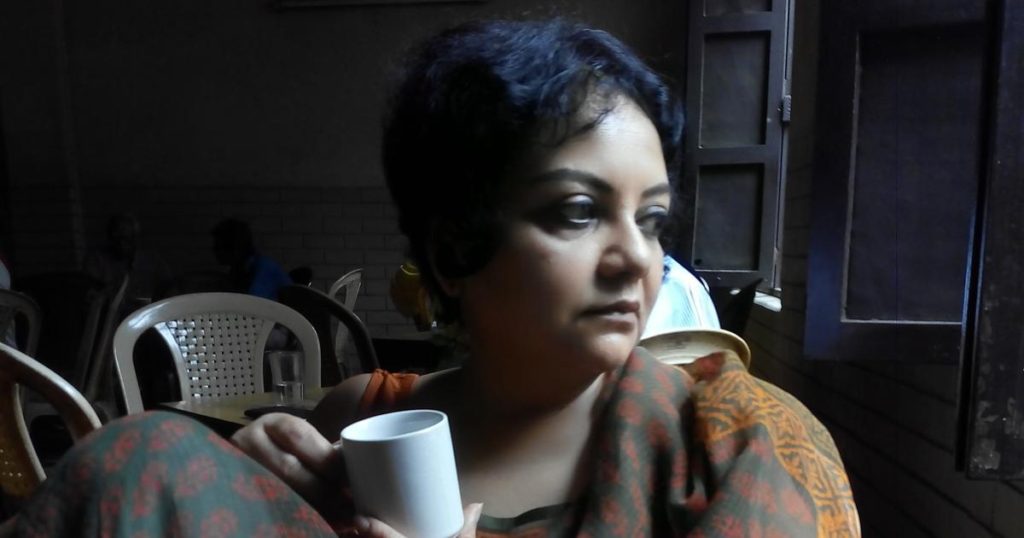
Rimpa Siva at her Beleghata home / Shubhendu Chaki

Women are still a rare sight in a few places. One such spot is the one behind the tabla.

Women vocalists have earned their place on the classical music stage. But not so much as percussionists. Something about beating a surface with force strong enough to produce a sound, perhaps, is still considered an intrinsically male activity. (In older times, the beating of drums announced war, certainly a predominantly male activity.)

Rimpa Siva, however, began to play the tabla when she was about four. “I just took to it,” she says.

Now 34, the Beleghata resident is a star. She has performed in many places in India and abroad, solo, or with the biggest names in Indian classical music, and has received many awards. Numerous videos of her performances and interviews pop up on the Net, as do write-ups and at least two short films on her, one made by a French crew.

If she is still described as a leading “woman tabla player”, and if this description sounds discriminatory, even anachronistic, Rimpa brushes it aside.

To her the reference to her as a woman performer means quite the opposite. “I think it is an acknowledgment of the fact women are becoming visible as tabla players,” says Rimpa. She believes in this. But one suspects that how she is described does not really matter to her.

Very early, she surrendered her life to the tabla.

She grew up to the sound of music at her home, the top floor of the three-storey Beleghata house that belongs to her family, where she has been confined for the six months of the lockdown. Her father, Swapan Siva, a tabla player also well-known in the city as a tabla teacher. Their surname, unusual for a Bengali family, comes from the fact that a Shivalinga had been dug up on their property in Kumilla, in former East Bengal, where the family originally comes from.

Swapan was a student of Keramatullah Khan, the doyen of the Farrukhabad gharana, who lived in Ripon Street. At the beginning Swapan had thought he would encourage his daughter towards singing.

But Rimpa’s obvious talent on the tabla decided things easily. She was stunning from the start. Swapan took over her training and she became his most distinguished pupil. “My father has been my guru,” says Rimpa. She has a broad smile that lights up her face.

Her journey began early. “I performed at the Salt Lake Music Festival held at Rabindra Sadan when I was around eight. When I was about 12, I went on the ITC tour of Mumbai, Delhi and Jaipur,” says Rimpa.

Spotted by the best musicians in the country, including tabla maestro Zakir Hussain, she would soon embark on a life that would be a mad flurry of performances, travel and awards, not something every child experiences.

The French film, made in 1999, and called ‘Rimpa Siva: Princess of Tabla’, was made when she was 13. The film shows her as a student of Beleghata Deshabandhu Giris’ High School. She goes through school as if in a haze; her fingers drum on the desktop as the class is in progress. School education took a backseat. “But my school was very supportive. It postponed the selections before the class X board examination for me.” In 1997, she had toured US and Europe.

In 2004, she accompanied Pandit Hariprasad Chaurasia as the main tabla player on his US tour. In 2006, she accompanied Pandit Jasraj on another US tour. She won the President’s Award in 2007 and the Sangeet Natak Akademi award in 2017. The years in between are crowded with performances and cities, which can run into pages.

“In 1997, in San Francisco, Ali Akbar Khan himself attended my performance at the Ali Akbar College of Music. He blessed me and said that I should keep a lemon and chilli in my pocket to ward off evil,” says Rimpa. She seems quite unfazed by her achievements, but also exudes a quiet confidence. She also holds an M.A. degree from Rabindra Bharati University in Instrumental Music. 

The specialities of her gharana include kaida, rela, tukra and gat, words that have entered the Bengali language from music to indicate style or attitude. She practises for three to four hours every day. Her solo performances can last up to two hours.

The lockdown makes her feel claustrophobic. It has practically stopped performance art. “I haven’t performed in six months,” she says. “Of late, I would be even travelling every month within the country, and sometimes two times abroad in a year.”

But nothing really comes between Rimpa and her music. “I live for the tabla. Everything in my life happens around the tabla. It does not matter where I am performing, with whom. When I am playing, I transcend everything,” she says.

“At that moment, I only feel peace and joy. Those who feel music know that peace and joy.”

On stage, she appears to go into a trance, lost in the music. She also looks dressed like a typical male tabla player, in a high-collar kurta, and together with her hair, she almost suggests Zakir Hussain. That is a coincidence, she says. “I can’t play the tabla in a woman’s clothes. They are not comfortable.”

She adds that she always had short hair and never cared for anything “girlie”. She did not time for friendship either.

Rimpa is also not sure about the role marriage can play in a woman’s life if she is a musician.

She feels that a lot of young Indians are showing interest in classical music now. She mentions Aban Mistry and Anuradha Pal as her illustrious predecessors in tabla, as women, and also does not shy away from suggesting that she is a role model for girls who want to take up the tabla, whether they will still be called “woman musicians” or not.

She seems to say gender is not an impediment, but you have to strike out on your own.

“Remember, girls can play the tabla,” she says.

source: http://www.telegraphindia.com / The Telegraph, Online / Home> West Bengal> Calcutta / by Chandrima Bhattacharya / September 28th, 2020
Call of duty: Bengal doc works round-the-clock to reach out to vulnerable people in remote regions

Kajiram Murmu, the block medical officer, belongs to a tribal community and is posted in Bengal’s most backward zone. He leads a team of four doctors and oversees the treatment of 250 patients daily.

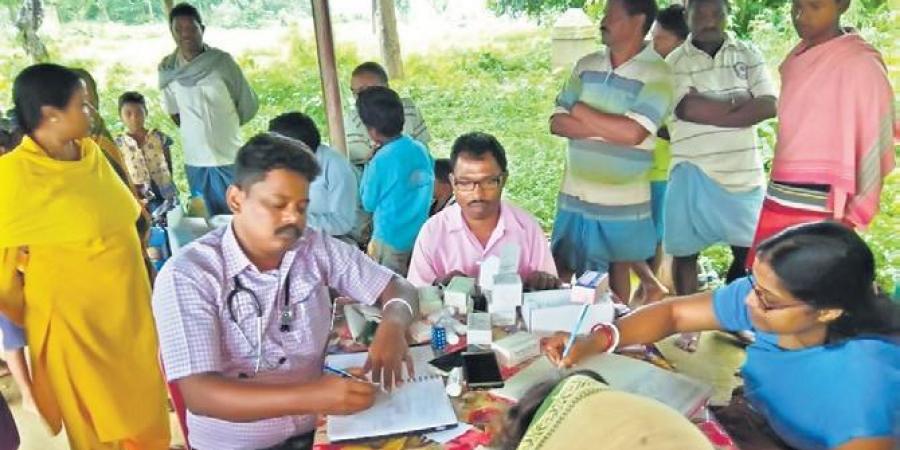
Kajiram Murmu at a camp for villagers in Purulia;

It is 8 pm— time for most residents of Purulia’s Bandwan block, located along the West Bengal- Jharkhand border, to go to sleep after the day’s hard work.

But Kajiram Murmu, the block medical officer, isn’t through with his work. Murmu attends to sick children, women and the elderly who can’t make it to the block health centre.

He belongs to a tribal community and is posted in an area known as Bengal’s most backward zone. Murmu leads a team of four doctors and oversees the treatment of around 250 patients who turn up at the block health centre every day.

After that, he sets out to remote villages located in the dense forests of Bengal to reach out to those who cannot afford public transport fare or they simply don’t have any transport. “Malaria, tuberculosis and diarrhoea are the common diseases in this region.

“Additional precautions and long-term medication are required as part of the treatment. Other than meeting new patients, I also follow up on those who visit the health centre,” says Murmu. According to the 2011 census, Bandwan has a total population of over 94,000, of which around 89,000 live in rural pockets. 51.86% are from the scheduled tribes.

The zone has an almost equal male-female ratio. Those who are not involved in cultivation work as agricultural labourers, forming over 60% of the population, depend on forests for their livelihood.

“Malnutrition is a major issue. Malnourished tuberculosis patients show a delayed recovery and higher mortality than well-nourished patients,” says Murmu, who was posted at Bandwan over two years ago.

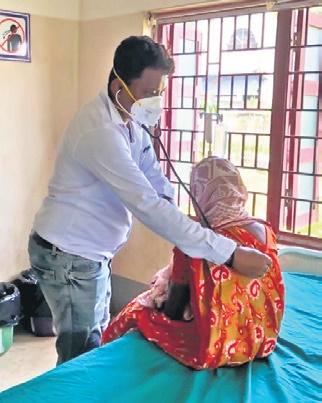
checking up on woman at a health centre | EXPRESS

Murmu says he has to persuade the tribals to use mosquito nets to avoid malaria. Murmu realized that prescribing medicines at the block health centre would not be enough.

“We conduct overnight camps for two days in remote villages. We teach them how to use bleaching powder during the monsoon season. Besides, we make them aware of how to use water purification tablets to avoid diarrhea.”

Thakurmani Murmu of Duarsini village, the last hamlet located in Bengal along its border with Jharkhand, says she would never forget the night when Murmu turned up at her doorstep a year ago.

“My eight-year-old granddaughter was suffering from fever and was vomiting. She had become too weak. The doctor treated her. He also taught us various dos and don’ts.”

Subhash Tudu’s 12-year old son was suffering from tuberculosis. “We took him to the hospital and doctor examined him. Before discharging him, he advised us about various precautions. The doctor-babu started visiting my house regularly to inquire about my son’s health. My son got a new life because of him,” Tudu said.

source: http://www.newindianexpress.com / The New Indian Express / Home> Good News / by Pranab Mondal / Express News Service / September 27th, 2020

New Town cafe sets sail in ship container

Police camp, roadside cafes set up to attract customers and make the place less desertedT

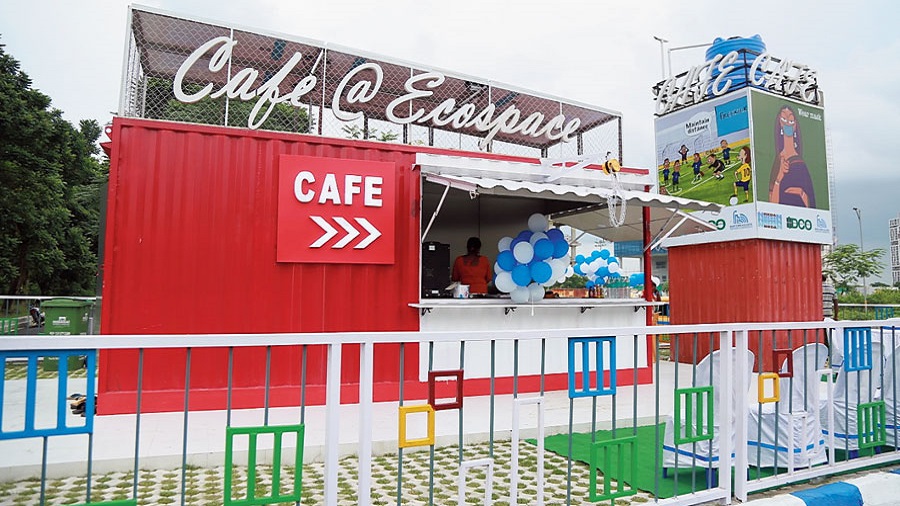
The cafe housed inside a recycled ship container in New Town all set for the opening on Tuesday / Sourced by the Telegraph

One can barely guess that a piping hot cafe next to the Eco Space Island in New Town is brewing inside a discarded ship container.


But look closely and you notice that the brightly painted exterior is made of — not cement but — metal. The kitchen is compact, rectangular-shaped and that its “windows” are but cut out of the metal walls.  

Cafe@Ecospace is located inside a recycled ship container. Rather, the kitchen is inside the container and chairs have been laid out outside for customers to sit on.

The project is an initiative by New Town Kolkata Development Authority (NKDA). “This stretch of road from Eco Space to Elita Garden Vista or Avenida complex had become unsafe with even a case of snatching having taken place a couple of years ago,” explained Debashis Sen, chairman, NKDA. “Thereafter a police camp has come up nearby, streetlights have been added and as a strategy we have decided to set up roadside cafes that will attract customers and make the place less deserted.”

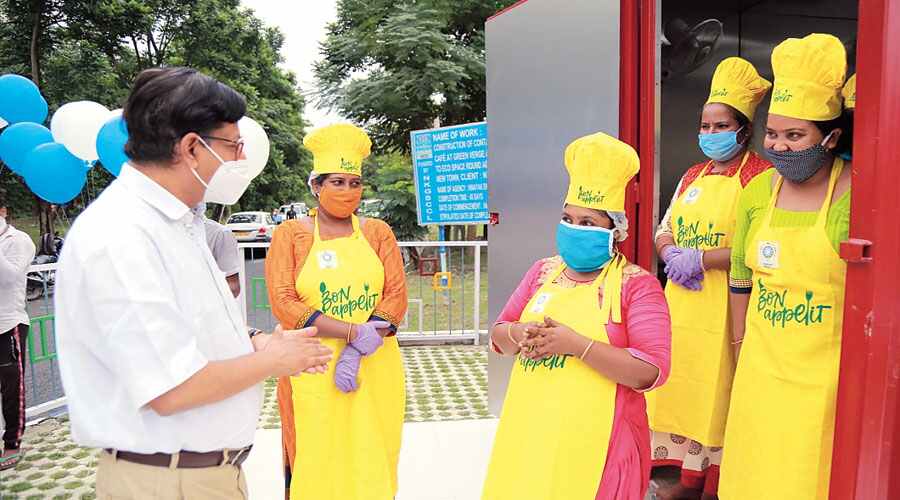
Debashis Sen interacts with members of the women’s self-help group Rabindra Swanibhor Gosthi t the opening / Sourced by the Telegraph

To run the cafe, the authorities narrowed in on a women’s self-help group called Rabindra Swanirbhar Gosthi. “These women have been successfully running a food joint called Jagarani for three years opposite Eco Space and shall now run this cafe as well,” said Sen.

The women are excited about the venture. “We shall serve soups, sandwiches, rolls, chowmein, momos and more,” smiled Mahasinara Begum from behind her mask.

“At Jagarini, we would cook for 250 people a day but due to the pandemic very few people are coming now. Nonetheless we are supplying food to a safe house in New Town and doing home delivery. We realise that customers at the cafe will be scanty to start with but we are hopeful in the long run,” said Sabina Bibi, a resident of Rajarhat.

Their sandwiches are priced upwards of Rs 30, chowmein Rs 25 and lassi Rs 30.  

As for the container, Sen said they went with the idea as they advocate recycling. “Since the metallic roof would get terribly hot in summer we built a shed atop and have added solar panels there. The women are also cooking with electric means instead of LPG,” he said.

The ladies are quite satisfied with their 20ftx8ft container kitchen, induction cooker and microwave. “This is more eco-friendly and is easier to clean than when using gas cylinders,” said Manoshi Maity, another member of the self-help group.

saltlake@abpmail.com

source: http://www.telegraphindia.com / The Telegraph Online / Home> West Bengal> Calcutta / by Brinda Sarkar / September 18th, 2020

Fish farming: Push to use biofloc technology

Kolkata:

The state Panchayats and Rural Development department is laying special emphasis on fish farming through biofloc technology with the objective of livelihood support amidst the COVID -19 pandemic situation.

West Bengal Comprehensive Area Development Corporation (CADC) under the aegis of the department which is executing and pushing for biofloc to be adopted by the SHG groups across the state has set the ball rolling by setting up an infrastructure of fish cultivation through biofloc at its own office at Mrittika in Salt Lake. It is expected to be readied by this week.

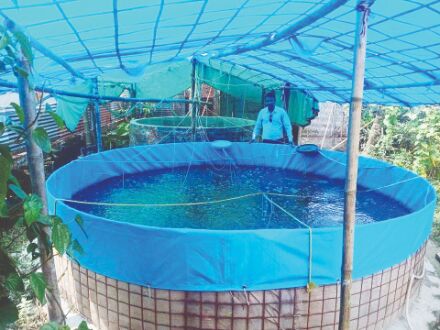
“Biofloc is a technology using which one can produce fishes significantly in large quantities (in a small volume of water) as compared to the traditional form of aquaculture in large ponds. It is easy to monitor the fish movement, their behaviour and abnormalities as they will remain within a tank which in turn will facilitate taking the corrective measures immediately, ” said a senior official of CADC.

Probiotic and molluscs are used to eliminate chances of food particles and excreta of the fishes in polluting the water . These components produce planktons and prevent the production of ammonium nitrate which is toxic for the fishes. An aerator is used to add oxygen to the water.

“We will be creating a biofloc model in each of our 23 projects in the state and accordingly training will be provided. The seeds will also be supplied by us. The interested SHGs will bear have to bear the other costs. However the scheme can also be taken up under MGNREGA in which the government will bear the entire cost, ” said the official.

The technique is already being practised at Tamluk in East Midnapore, Ayodha Hills in Purulia and in some semi arid zones in Murshidabad, Jhargram and Birbhum.

Air-breathing fish rearing in cement tank by 60 farmers in Kolaghat has already seen success. Every 8 feet by 6 ft tank were provided with 500 seeds on an average each costing Re 1. In three to four months each tank produces 25 kg on an average (koi, singi, magur, ) whose average price is Rs 250 to 300 per kg. The income from each tank is around Rs 7000 a month so for 60 tanks the income is Rs 42,0000.

A wide variety of fishes can be cultivated through this technology like Koi, Magur, Singi, Telapiya, Pabda and even prawn.

source: http://www.millenniumpost.in / Millennium Post / Home> Kolkata / by Soumitra Nandi / September 21st, 2020

Poet Hoshang Merchant reads and annotates academic Brinda Bose’s collection of Calcutta poems

How does a poet read poetry?

Brinda Bose

there was a time when all of poetry was a
wild and endless epiphany

before recollections rolled
anger roiled and ardour spent

retreading bookstreet now where time is
liquid and burning
drowning infusions sugarblack
melting argument


smoking love 

calcutta, crow III

Well-known academic Brinda Bose has published her 21 poems in a chapbook, collected over a small lifetime during the first part of this year’s pandemic lockdown.

The early poems bear an uncomfortable resemblance to TS Eliot; by the third poem in the collection Calcutta, Crow and other fragments she finds her voice in the poem about her ageing parents:

whoever knew
that such an ageless street as this
the ageing might reclaim
hunting still

for themselves, for others, for books, coffee,
grass, frenzy and rapture
restless poems that spiral up and down
those grimy stairs
vomiting fear and tenderness
fervent, insomniac —

calcutta, crow III

By the way, she mischievously informs us that around her ageing parent’s eyes are crowsfeet.

tracking bruises that broke and made you

fingering lightly
all the laughter that birthed the crowsfeet
at the corners of your eyes.

After the early four Crow poems – more indebted to Sylvia Plath than Ted Hughes – she gives us four idiosyncratically titled poems on months, a kind of truncated barah maasa, viz “november: water”, “december: tree”, “january: gravestone” and “february: pocket”.

there’s something solitary about november
like dark smudges on still water

like waiting for a friend to return from the
river of summer
(or is it from some mountain fall)
not knowing that a prewinter bite has swallowed him whole

he’s left behind
in the chair that he would sink into
a hole
shaped like his laughing mouth

 — november: water

Or the sound of you, ringing lightly in my ear at an odd moment of afternoon when I tossed my head for the comfort of earrings swinging against my neck. A low sound it was, almost a memory of a whisper unheard. And then you fell out silently like a word unspoken and I flailed a cupped hand under my ear, my palm curved to catch a shooting star. 

— february: pocket

A poem of unrequited young love captures a sensibility that is disappearing:

you said my eyes were like cactus flowers
… you said you’d wade into my cactus flower
eyes
slain again and again by pleasure and
surprise

that was a poem I wrote in youth.

there were no flowers that were my eyes.
there was no you.
there were only wanton pauper-poems
careening about
till
the pennies ran out 

— reprise

Then come the two prose poems collected under “words that bleed and fly 1 and 2”. The second one, “aubade”, is worth the whole collection. It is dedicated to another Bangla woman writer, Taslima Nasreen, a woman people equally love and hate for her personality and her poetry. The central metaphor of this poem addressed to a bidrohi Third World poet is a white cotton saree which is a battle flag, and which just as well could be used to herald a truce in the culture wars. The submerged metaphor is a refugee clothes bundle flung across a barbed wire fence at a border where it is impaled.

so you may land there but you shall not forget the words you left behind you in the lands you call your own, many cities that you had to leave one by one dhaka calcutta delhi trailing garlands of poems and prose and loves and conversations and writing, always writing. where can you go, where must you go, light and heavy on wings of words sharing stories and wine and the nostalgia of white. white summer sarees left behind at home…but wait, was that home?

…lives old and new are rolled up and hurled at the barbed wire fencing to pierce holes and squeeze dreams that are dead and dying through them like camels through eyes of needles

…just as you begin to believe that the roots are taking hold you must pack up your sarees and your stories in a weary suitcase and fly away again… the words find you again and again and tear into you and out of you and speed away to slam into other faces and names and tongues. to beat and flay and form fresh flags

of words, just like all your white summer sarees waiting to be worn and crushed and soiled with and poetry, splendidly done and undone in beauty, sadness and rage

words that bleed and fly 2: aubade

In my opinion, this poem is worth the value of the entire collection. Women, gays and poets, when most poets are all three, are left to mourn unrequited love. Bose acquits herself in the task most unsentimentally and in a modern idiom. At the same time she touches her readers deeply:

a dream implodes like a fat gooseberry in the mouth

invocation 1

And this is the whole of “invocation 3”:

passion is both enraged and tender
it’s where the shadow falls that
slays or spares that is all

invocation 3

The last poem, “poetry. still.”, talks about the two of you.

I take it to be a domestic setting in which a poet reconciles to everyday life inside the home and surrounding it even as she listens to “a snatch of voice” carrying her to a (fading) place where she wants to be, when

blood, skin, stone and bone batter
homes and hills, roads and trees, rivers and seas.

Bose has heard whispers in an adjacent room, freedom and commitment are not watertight compartments. They feed into each other – “Les Vases communicants” as the surrealist André Breton put it, “Nirvana’s in Samsara” as our rishis tell us. So though there is a steady acceptance of life and its domestic realities there is an emerging into the writerly life…The poem, and the collection, ends with an extended mutating image of liquid red, flowing like scarlet fruit juice from the mouth in an exultation of drinking. There is rebellion yet in colour, and there is poetry, say its last lines:

cries and whispers
gutted in a red room. the colour spills out
of the door and runs like a river down the
road outside your home into the
neighbour’s house like the juice of a
crushed pomegranate cruising down a chin
poetry. still.

Calcutta, Crow and Other Fragments, by Brinda Bose, Hawakal Publishers.

source: http://www.scroll.in / Scroll.in / Home> Uses of Poetry / by Hoshang Merchant / September 18th, 2020