A Calcutta physicist’s mathematical formulation served as an elegant basis for research by laureate Roger Penrose
RRR Roger Penrose in Calcutta in January 2011 / File picture
Amalkumar Raychaudhuri, a young teacher at Calcutta’s Ashutosh College in 1955, had developed a mathematical formulation that served as an elegant basis for the research by British physicist Roger Penrose a decade later that brought him the Nobel Prize on Tuesday.
The Calcutta physicist’s formulation, known as the Raychaudhuri equation, sought to quantify certain but tricky aspects of geometry with widespread use in Albert Einstein’s general theory of relativity, essentially a geometric description of distortions and bends in space and time.
Penrose teamed up with the celebrated late British physicist Stephen Hawking and used the Raychaudhuri equation for a mathematical description of black holes — objects with such intense gravitational pulls that not even light escapes them — and singularities, extreme situations where laws of nature break down.
It is for these singularity theorems that the Nobel committee awarded Penrose the prize, citing that he showed that “…at their heart, black holes hide a singularity in which all known laws of nature cease”.
Without Raychaudhuri’s formalism, and Hawking’s early work connecting it to black holes, this work of Penrose may have not happened at all.
When I was a student at Oxford in the mid-eighties, Penrose and Hawking had still been working on some aspects of these ideas. Penrose, as a mathematics professor, had also been working on various other forms of mathematics.
I once knocked on the door of Penrose, together with one of his students, to ask whether I could attend his course on Spinors, the theory of which he was then developing. He had company, but in addition to saying yes, he asked where I was from. When I mentioned I had come from Presidency College in Calcutta, he asked whether I was related to THE Raychaudhuri.
I nodded, and said that while he was no relation, he was of course the head of my undergraduate department, and that Amalkumar Raychaudhuri had indeed taught us mathematical physics in the first year, and electromagnetism in the second. On the side, he had taught us general relativity, which wasn’t in our syllabus.
The other person in the room, who introduced himself as Stephen Hawking (in his own voice still), said that I had been fortunate to have been taught by AKR himself, and that they hoped to meet him one day.
Later on, of course, as a PhD student in Cambridge, I attended several courses given by Hawking, and I continued to meet Penrose, including several times in Pune.
Lord Martin Rees, another of my gurus from Cambridge, has rightly said today: “There would be a consensus that Penrose and Hawking have done more than anyone else since Einstein to deepen our knowledge of gravity. Sadly, this Nobel award was too much delayed to allow Hawking to share the credit.”
Somak Raychaudhury is the director of the Inter-University Centre for Astronomy and Astrophysics, Pune
source: http://www.telegraphindia.com / The Telegraph Online / Home> India / by Somak Raychaudhury, Pune / October 07th, 2020
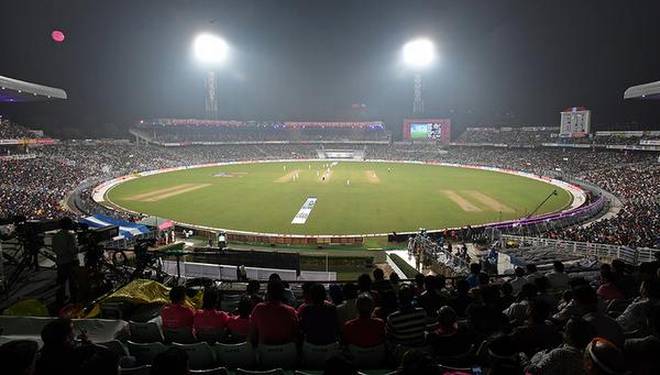
Historical venue: Eden Gardens came about after two attempts to have a ground failed. | Photo Credit: The Hindu
Cricket enthusiasts in the 19th century got little support from the colonial Army,
Kolkata’s Eden Gardens, India’s oldest cricketing ground, came about as the third-time-lucky effort of fans in 1864, after two attempts to have a good venue for the sport failed, because it was seen as an encroachment, and due to objections raised by the British Army at Fort William.
That story emerges from colonial documents at the Directorate of State Archives, West Bengal with other interesting facts on the history of cricket in India. A documentary has been made on this piece of sporting history. The first cricket club outside Britain was the Calcutta Cricket Club founded in 1792, and the first match was played 12 years later between the Etonians, senior civil servants and other company officials.
Sumit Ghosh, the Archivist at the State Archives, says the match was played in front of Government House which is the Raj Bhawan of the present day on January 18 and 19, 1804. “In 1825 the club got a plot of land on the Maidan between Government House and Fort William to be used as a cricket ground,” he told The Hindu.
In 1841, the club was permitted to enclose the ground with a fence. But the Army at Fort William, described the club as an “encroacher” and in 1853, the Chief Magistrate of Calcutta wrote to Cecil Beadon, Secretary to the Government of Bengal, on this act of “forceful occupation”.
Mr. Ghosh says Cricket Club of Calcutta authorities then looked for an alternative ground and at ₹1,000, found a new one, fenced it and made it playable. To their dismay they realised that a new road into Fort William was being built, which would cut into the ground. The Club officials appealed but their pleas were rejected.
The road to Eden Gardens is traced in a documentary titled Edener Itikatha (History of Eden Gardens) by Mr. Ghosh. “There is so much of recorded history but so little known to common people walking past these grounds. It is important that people know that in the mid-19th century, the vast Maidan was also used as pasture,” he adds. The Archives say Matabooddin Sirkar, a native took the land on lease for one year from February 1, 1854 to January 31, 1855 at a rent of ₹500. That contract allowed horse, cow, goat, sheep, donkey to graze, but not pig and buffalo.
Archivist Sarmistha De, who has worked on the area, says“State Archives from the mid-19th century show that Maidan was a zone of contention between the British military and British civil society. While the military thought it should mainly be for their purposes and monitoring of Fort William area, another section was actively considering it as a recreation zone with cricket as a part of that”.
After two failed attempts, in 1864, land was laid out for a ground for Calcutta Cricket Club in the extended part of Eden Gardens.
Eden Gardens made its first appearance during the time of Governor-General Lord Auckland (1836-42). Originally ‘The Auckland Circus Gardens’, the area south of Baboo Ghat changed to ‘Eden Gardens’. The Archives say Baboo Rajchunder Doss, husband of Rani Rashmoni gifted this land after Lord Auckland and his sisters Emily Eden and Fanny Eden helped him save his third daughter from a deadly disease. Eden Gardens, many believe, may be commemorating the Eden family.
“In 1868 there was a proposal for a new building of the Calcutta Cricket club ground but it was not sanctioned by the Government. The construction of a pavilion was sanctioned by the Government of India in their Military Department’s letter no. 699, dated the on April 19, 1871,” Mr. Ghosh says. The conditions imposed were club being at any time required to do so promptly remove the erection without any compensation.
“Now many people know that in 1856, a Pagoda was set up in the gardens and which has been a principal interest of the gardens. The Pagoda was built in Prome in the year 1852 by Ma Kin, wife of Moung Honon, Governor of Prome, Burma. The Pagoda was taken to Calcutta in 1854 by the order of Lord Dalhousie,” Mr. Ghosh said, adding that Pagoda still stands towards the northern part of the stadium.
source: http://www.thehindu.com / The Hindu / Home> News> Cities> Kolkata / by Shiv Sahay Singh / Kolkata – September 27th, 2020
Two Bengali musicians from Calcutta, one Israeli sax player in Berlin and a Russian contrabassist in New Delhi got together, the outcome is the hauntingly beautiful Detour aheadS
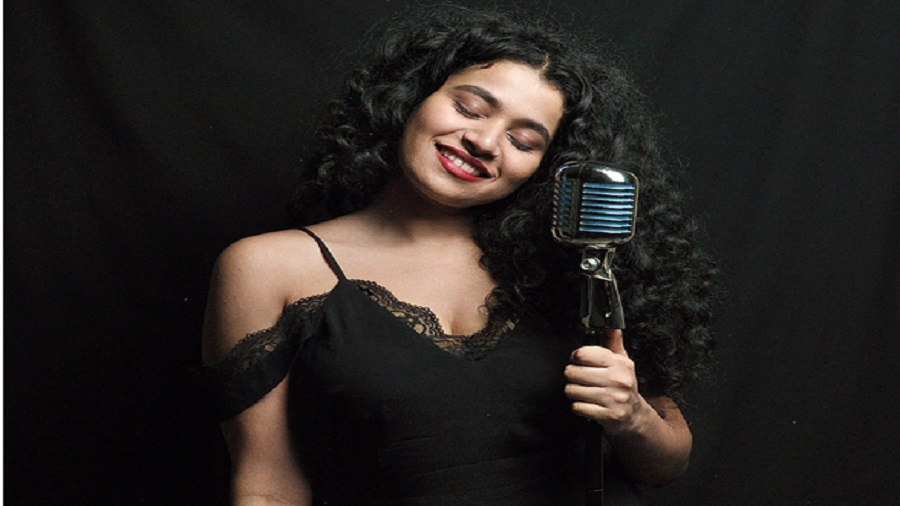
Shooting the music video I had an idea on how to go about it . I had a dark backdrop and my studio lights set-up and then I set up the camera on a tripod and shot in multiple takes and from different angles. I wanted to keep the look classic and retro. So I went with a long black dress with lace trims wore my hair the way it is, naturally curly, and went for a dark red lip and a smokey eye. It was fun dressing up for the video, definitely an experience ! — vocalist Rupsha Sen / Sourced by the Telegraph
Vocalist Rupsha Sen heard the classic Detour Ahead for the first time in April 2020. “I was transported to that special place where powerful art can take us sometimes,” she says. Soon Rupsha got together with musicians Soham Dey, Omri Abramov, Ekaterina Aristova to work on a version of the song. On September 19, the music video for Detour Ahead dropped and has met with heartwarming feedback. A chat with Rupsha…
What was the starting point for this collab?
As the pandemic hit, we were forced to retire to our homes, lock our doors and ride out the storm. Subsequently, all establishments were shut down along with venues that hosted live music in the city and thus we were all forced to stay apart and put a halt to rehearsing and performing live music. This birthed the surge of virtual performances and collaborations including ours. Although some of us knew of each other distantly, Soham, Omri, Ekaterina and I officially met online and came together for this collaboration based on our shared love for this genre of music.
Why pick this song to perform?
Firstly, because it’s a gorgeous jazz standard that all four of us love. Secondly, it is harmonically rich, evocative and beautifully structured with such simple yet poignant lyrics and lastly, it is not very often performed or covered, which makes it an interesting choice.
Do you remember the first time you had listened to this tune?
I actually heard this song for the first time back in April 2020 when Soham posted a rendition of it online and I was immediately hooked. This made me look up the different versions available online, such as Mark Murphy, Ella Fitzgerald, Kurt Elling but I have to say the version I ended up channelling for this collaboration and also my favourite is the rendition by Sarah Vaughan. It’s hauntingly beautiful.
It’s safe to say that when I heard the song for the first time I was moved and could feel exactly what Sarah was singing about — comparing love’s progress to a motor trip… of course credit for the lyrics goes to the composers of the song — Herb Ellis, Johnny Frigo and Lou Carter.
I remember Soham telling us about his memories of how he listened to the song on his long bus rides back and forth from his work in 2016 and how this song was a constant companion to him at that time.
Music definitely has the power to evoke all kinds of emotions in us, including nostalgia, which is beautiful in a melancholic way.
How did you put together the group and why pick them?
The line-up of this collaboration includes Omri Abramov, an incredible saxophone and EWI (electronic wind instrument) player originating from Israel, currently residing in Berlin; the wonderful Ekaterina Aristova on contrabass hailing from Russia, currently living in New Delhi; Soham Dey, a talented singer and guitar player from Calcutta, and of course me on vocals. Omri, Soham and I had already collaborated on a song before and we had a wonderful experience working together so it was a no-brainer really that we wanted to work together again, which manifested in the form of this collaboration after we decided to bring in Ekaterina on double bass, as we really felt the song needed the sound of a double bass to make it wholesome. We had a particular vision and sound in mind for this collaboration and we were fortunate enough to be able to bring together the people who we thought would help us get as close to that as possible.
How did you record the song? How did you rehearse for it?
The song was recorded in parts as we were all situated in different parts of the world. Having the benefit of living in the same city, Soham and I recorded the guitar and vocal tracks at Blooperhouse Studios, after which we sent the track to Ekaterina over at Delhi.
She was able to record her parts with the help of her friends at Chizai who have a studio set-up.
Lastly the track was sent to Omri, who has a studio of his own where he was able to work on the piece and come up with a combination of saxophone and EWI, which he used to simulate sounds of the clarinet, cello, violin and viola, giving the song a beautiful bed of sound to flourish on.
We were not able to rehearse together but we listened to different versions of the song to familiarise ourselves with the essence of it and came up with a way of how we wanted to approach it and also discussed all of it together so that we were all on the same page about the final piece.
How did you shoot the video? Did you have a theme for it?
Again as we were all in different locations we all had to shoot it ourselves from our respective homes/studios. It was definitely not easy and involved a number of challenges. I’m grateful to each and everyone for taking the trouble to follow the guidelines we had discussed, not only for the musical part of it but also for the video. It was also definitely an uphill task to edit the video but thankfully it all came together in the end. The theme I had envisioned for the video was always something that had a distinctly noir feel to it, so that is what we discussed and that is what we all tried to achieve.
You must have heard/watched some inspiring lockdown collaborations in the last few months. Which were your favourites?
Yes, this lockdown has definitely inspired some great collaborations, the ones that come to mind are definitely an online concert that I watched by Bireli Lagrene Trio comprising Bireli Lagrene and Adrien Moignard on guitar and William Brunard on contrabass. It was a bevy of amazing musicians creating magic together and was absolutely a treat for the ears… loved it completely.
Apart from that I have been following some Brazilian and French artistes on Instagram who have been dishing out some beautiful collaborations, namely Vanessa Moreno and Camille Bertault. From India I enjoyed a number of collaborations by the Delhi-based band The Revisit Project. I’ve been following their work online and through the pandemic they have been doing some great work and are also about to release a new album, which is a testament to their hard work.
How important a role did music play in your life in the last few months?
I felt like a teenager again, listening to music all day, watching incredible musicians come live and host free concerts, watching musicians collaborate with one another to make beautiful music.
Music has always played an incredibly important role in my life and it did more so in these last couple of months as when you take everything else away only the most important things remain.
source: http://www.telegraphindia.com / The Telegraph Online / Home> Arts / by Arindam Chatterjee / September 27th, 2020
From October 1, the West Bengal Transport Department (WBTD) commences a 90-minute Heritage River Cruise that starts from the Millennium Park Jetty. | Photo Credit: Special arrangement
Affordable 90-minute guided experience guide launched by Bengal Transport Department on October 1
It is along the bends of the river Hooghly that the city of Kolkata grew from three villages to a bustling metropolis. Now a cruise on the Hooghly will take people past the different ghats of the river, providing a peek into the history of the metropolis.
From October 1, the West Bengal Transport Department (WBTD) commences a 90-minute Heritage River Cruise that starts from the Millennium Park Jetty.
Sailing upstream and downstream, the vessel will pass beneath the majestic Howrah Bridge, and go past ghats such as the Armenian ghat, Nimtala ghat and Mayer ghat. Each ghat on the bank of the river has a bit of history attached to it.
For instance, the Armenian ghat was built back in 1734 by Manvel Hazaar Maliyan, a trader of Armenian origin. The ferry ghat stands testimony to Kolkata’s cosmopolitan culture in the colonial times, and the Armenian community’s contribution to the city.
There is also the Mayer ghat (the mother’s ghat), which draws its name from Maa Sarada Devi, wife of Ramakrishna Paramhamsa. She would visit the ghat daily, and stayed near it from May 1909 to July 1920.
Similarly, the Nimtala ghat is a historical landmark where the cremation of Rabindranath Tagore and other important cultural icons was performed. The famous Bhootnath temple is located here.
The cruise’s itinerary also includes Chandpal ghat, located just on the northern side of Babughat, the very place where Lord Cornwallis, the first Governor General of India, landed on September 12, 1786. Guides on board the cruise will tell people about the ghats, and visitors will also be provided with complimentary cruise heritage navigation brochures.
Officials of the Transport Department said that tickets have been kept affordable at ₹39 for the entire cruise to attract more people. “The idea is to make the heritage river cruise experience affordable, and popular among the youth,” said the Managing Director of WBTD Rajanvir Singh Kapur.
Following physical distancing norms, as of now, not more than 150 people will be allowed on each trip.
Attempts have been made in the past to boost waterfront tourism in the city by State governments and different agencies. About 17 km of the Hooghly river’s waterfront lies within the metropolitan corporation’s boundaries, of which about a 10 km length of riverfront, from Taktaghat in south Kashipur and Pramanik ghat in the north, represent the most active and vibrant portion of Kolkata’s diverse engagements with the river. There are dozens of ghats on both banks of the river that not only provide a rich slice of history but are associated with the way of life of the city’s people.
source: http://www.thehindu.com / The Hindu / Home> News> Cities> Kolkata / by Shiv Sahay Singh / Kolkata – October 01st, 2020
Time travel: A tramcar transformed into an air-conditioned service. The route will cover College Street
A book-laden air-conditioned tram offers a glimpse of the city’s academic corner
The Kolkata tram may be a pale shadow of its glorious days, but it is still an iconic image of the city. College Street happens to be the prestigious address of some of the oldest educational institutions in the country, and also boasts rows of bookshops on either side.
Now, a tram is set to recreate the academic ambience. It is built like a library and will roll down College Street, giving passengers a glimpse of the University of Calcutta, Presidency University and the hundreds of book stalls.
From Thursday, people can ride the tram library, an air-conditioned car converted into a library on wheels. It will make six trips on the recently restored Esplanade-Shyambazar route.
West Bengal Transport Corporation (WBTC), which oversees India’s only functional tramway, has introduced the service to rekindle the love for trams and reading. The initiative brings together unique aspects of the city’s cultural heritage: trams, which form an intrinsic part of the colonial legacy and its love for books on College Street, which is called ‘Boi Para’ (street of books) by many. While the first trams were launched in 1873, and were electrified in 1900, educational institutions on College Street like the Presidency .
Attracting students
“The idea is to make the tram the mode of choice for Kolkata’s students once again,” said Rajanvir Singh Kapur, MD of WBTC. In addition to the titles housed within, the tram library will provide readers access to online books. There will be no additional charge, the ticket provides passengers access. There will be 25 stops along the 5 km route, five of them on College Street.
The library is just a beginning this winter, says an official. It could be the venue of book launches and book readings this season. Kolkata hosts a number of literary festivals and there is a search on for new venues. There are plans to have a Literary Festival around the tram library in the next two months, in November 2020.
Cyclone Amphan, which battered the city on May 20 severely damaged tram infrastructure. After restoration, four routes have been opened. The library will be on the fifth route.
source: http://www.thehindu.com / The Hindu / Home> News> States> Other States / by Shiv Sahay Singh / Kolkata – September 24th, 2020
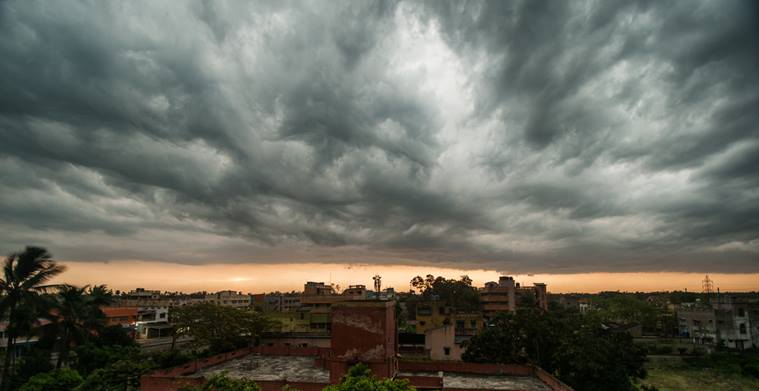
The Kolkata Cloud Chasers are a group of eight members who chase storms, by photographing and documenting extreme weather conditions in eastern India.
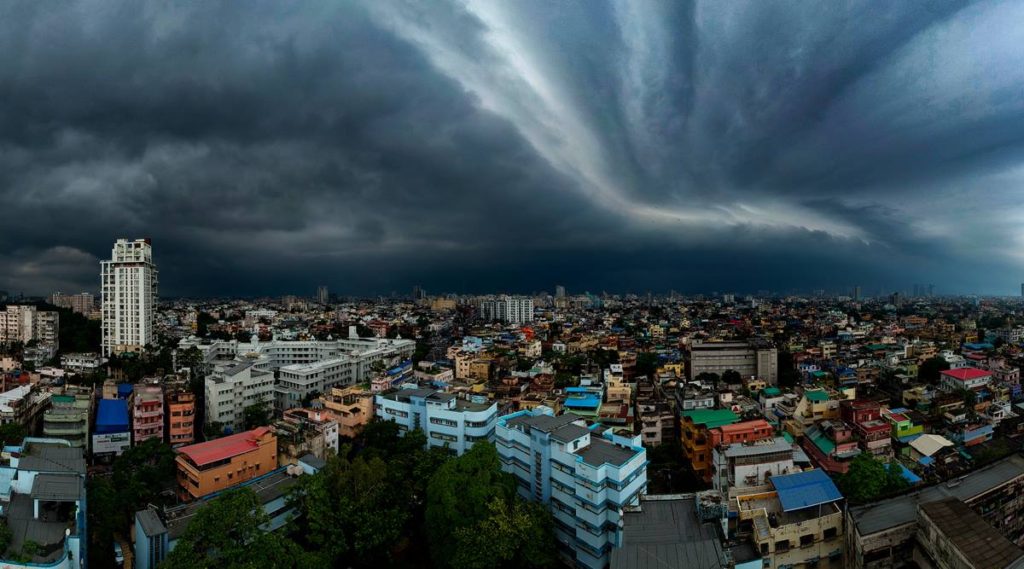
Kolkata on a cloudy evening during the Covid-19 lockdown. Photo credit: Debarshi Duttagupta; call sign: Roadrunner, Kolkata Cloud Chasers.
When Cyclone Bulbul arrived last November, it was one of the most severe tropical cyclonic storms to have struck the state of West Bengal and Bangladesh in more than a century. Hours before the cyclone made landfall, Chirasree Chakraborty, 47, and Joyjeet Mukherjee, 49, headed down to Henry Island, approximately 130 kilometres south of Kolkata, one of the few places where the arriving storm’s impact was going to be most severe.
“We are the only people who go towards the storm when everyone else stays inside,” says Mukherjee. Both are a part of the Kolkata Cloud Chasers, a group of eight who photograph and document extreme weather conditions in eastern India — they chase storms.
According to the group, they are the only collective engaged in this kind of photography in the country.
A recreational activity still in its infancy in India, storm chasing has been practised since at least the 1950s in western countries. The American Meteorological Society defines a storm chaser as someone who “intercepts, by car, van, or truck, severe convective storms for sport or for scientific research”
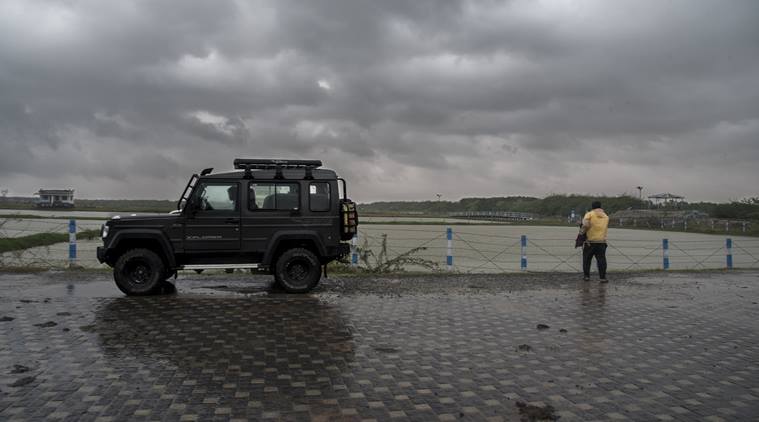
A member of the Kolkata Cloud Chasers surveys the weather conditions during the arrival of Cyclone Bulbul in November 2019 with a 4×4 parked nearby. (Photo: Kolkata Cloud Chasers)
“Storm chasing is not a recognised profession in India and so we all do other jobs,” says Chakraborty. By day, she works as a publicist, but after work hours, she finds herself tracking extreme weather conditions in the West Bengal region, and a similar scenario plays out in the case of the other members of the group.
The story of Kolkata Cloud Chasers started sometime in 2005 when some of the earliest members of the group met on Orkut, the social networking site, over their shared interest in photography. By 2009, when several Android applications became easily accessible to Indian users, including weather applications like AccuWeather, it became easier to experiment with photographing a wider range of weather conditions.
“During kalboishakhi (Nor’westers) and storms, we used to give alerts on our personal Facebook page,” recalls Chakraborty. By 2014, more members with a shared interest in weather photography joined the group, and the present team was formed.
There are many who photograph sunsets or cloud formations, and weather conditions if they chance upon a storm, but tracking it is different, explains Mukherjee. What this group does is essentially visually documenting West Bengal’s weather conditions by tracing its arrival and path. “In West Bengal, there hasn’t been much documentation of weather patterns,” says Chakraborty.
Cloud formations can be very large, spread across several kilometers and are visible from long distances. (Photo: Suman Kumar Ghosh; call sign: Goodboy, Kolkata Cloud Chasers)
Chasing storms is a three-step process that starts with tracking developing weather conditions and patterns. For that, the group starts with scanning weather apps for formations, including those by India’s meteorological department. “Before 2015, we only had the Met department’s app, but since then, many new applications have come in,” says Mukherjee. In the initial years, says Chakraborty, the group also found assistance from a former Met department employee who taught them more about understanding how to read meteorological data and weather patterns.
The next step is spotting, where the group goes out into the field searching for the cloud formations or storms that they are chasing. “Clouds are huge—they can be 18 kms tall and can be seen from long distances,” says Chakraborty. The last step involves navigation, where they “intercept” the storm or clouds by taking photos, videos and, most recently, using drones for images.
While the group tries to photograph as many diverse weather conditions as they can, they try to stick to government regulations and advisories. This past May, when Cyclone Amphan arrived in West Bengal, it coincided with the coronavirus lockdown imposed by the Indian government. Unable to venture out, the group photographed the cyclonic storm from the confines of their rooftop terraces and windows instead. Similarly, last summer when Cyclonic Storm Fani made landfall in Odisha, says Mukherjee, the government had restricted travel to the cities of Bhubaneswar and Puri, that prevented the group from travelling to the neighbouring state.
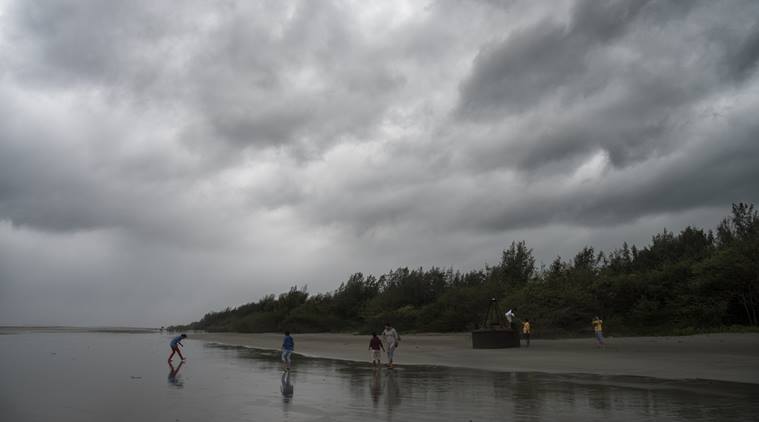
A group of children play on a beach in West Bengal just as Cyclonic Storm Bulbul is about to make landfall in 2019. (Photo: Joyjeet Mukherjee; call sign: Boltanator, Kolkata Cloud Chasers)
Having known each other for as long as they have makes extreme weather photography easier, believes Chakroborty. “We have known each other since 2005 and we have a good relationship,” she says of the group members, a characteristic that is more necessary than people realise. The challenging circumstances and the unpredictable nature of the weather conditions make it necessary for the members to be able to trust and rely on each other for assistance and coordination when they are out facing storms.
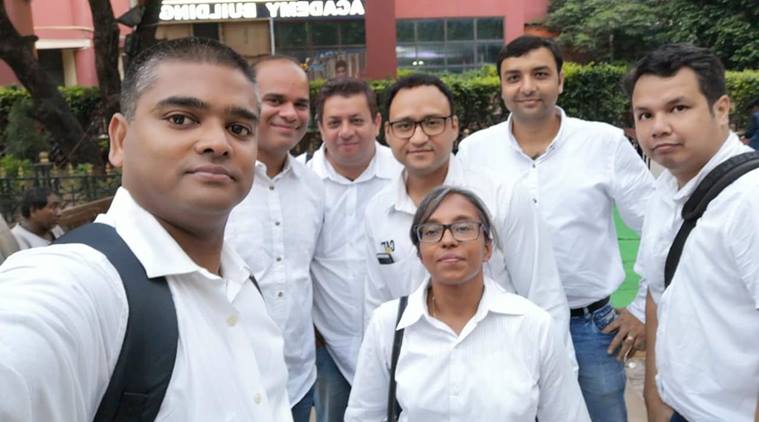
(From left to right) The team of Kolkata Cloud Chasers: Debarshi Duttagupta, Abhishek Saigal, Joyjeet Mukherjee, Krishnendu Chakraborty, Chrisaree Chakraborty, Suman Kumar Ghosh, Diganta Gogoi. Team member Indranil Kar is not present in this photograph. (Photo: Kolkata Cloud Chasers)
While audiences only see as much as photographs and videos allow them to of extreme video photography, the circumstances in which the group sets out for documentation is only understood when the group explains the backstory of each photograph. “There is extreme risk involved in doing this. Our families understand and they know that we won’t take unnecessary risks. So they have faith,” laughs Chakraborty.
The members set out in their vehicles, 4x4s, known as ‘SCIFs’ or ‘Storm Cloud Intercept Four-wheelers’—a name that the group gave to the cars they use—customised with recovery straps, hi-lift jacks, additional lights, and citizens band radios, a land mobile radio system that allows person-to-person bidirectional voice communication over short distances.
Additional equipment include DSLR cameras, iPads, GPS receivers, General Mobile Radio Service (also known as Walkie Talkies) and GoPro and DJI Osmo pocket cameras for vlogging. For drone footage, the group turns to the DJI Spark, a mini drone, and the DJI Mavic Air, a portable, foldable drone, with the equipment having been funded by the group members themselves.
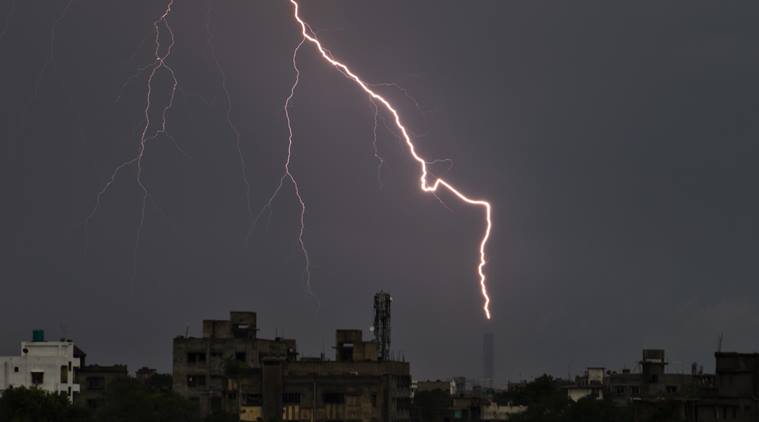
A bolt of lightning across flashes across the Kolkata skyline. (Photo: Abhishek Saigal; call sign: Thunderman, Kolkata Storm Chasers)
The group members all come with their own call signs, names that they go by during radio communication when they’re out on the field. While Chakraborty goes by the call sign of ‘Phoenix’, Mukherjee answers to ‘Boltonator’, a spin on the term lightning bolts.
Extreme weather conditions aren’t the only challenges that the storm chasers battle. Since much of this kind of photography occurs outside the city limits or away from densely populated areas, reassuring locals is also a part of the group’s job. “Sometimes people think we are there to seize or assess land and belong to private companies or the government,” says Mukherjee of confrontations that have on occasion, led to clashes with suspicious locals.
Despite all the tracking and planning involved, it’s not possible to accurately predict the path that a storm will take, requiring contingency planning. Chakraborty remembers an incident from last year when she travelled to North Bengal to photograph a blizzard. “It’s called a northern disturbance and I was there for three days to catch the storm.” When she went out to photograph the blizzard, she only had a small shed for cover, making it difficult to stay outside for long. “The snow was too much.”
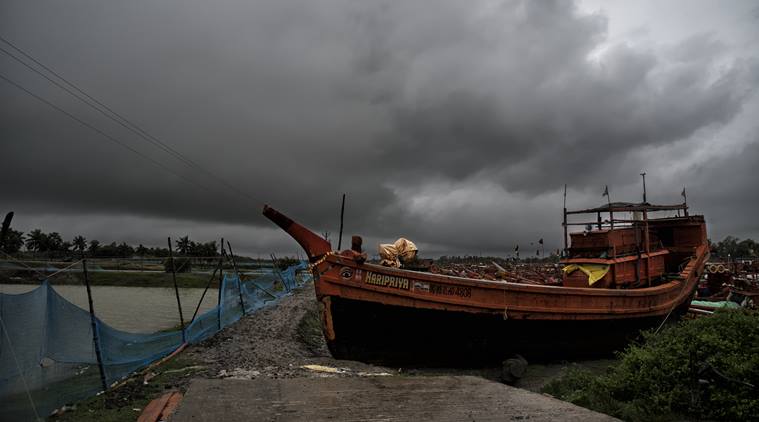
A fishing boat lies docked during Cyclone Bulbul in West Bengal in 2019. (Photo: Chirasree Chakraborty; call sign: Phoenix, Kolkata Cloud Chasers)
For Chakraborty however, nothing has surpassed the experience of photographing Cyclone Bulbul last year in her almost 10 years of photographing extreme weather. “We got the first visual of Bulbul when we saw the outer ring. We had planned on leaving at 1 p.m. but suddenly the storm came closer. Rain and gusting increased. It was the craziest experience.”
“People don’t know what a storm actually looks like,” says Mukherjee. The nature of extreme weather photography is such that it is as much about experiencing the conditions as it is about documenting it, the members say. Sometimes, the group ends up not taking too many photos and just witnesses the natural spectacle unfolding in front of them. While following a storm requires its own planning, the group also has to devise ways to escape it.
Chirasree Chakraborty uses a DSLR to photograph Sandakphu, the highest peak in West Bengal, along the Indo-Nepal border. (Photo: Kolkata Cloud Chasers)
Chakraborty believes that storm chasing isn’t only about extreme weather photography, but it is also about understanding how to respect the might of the natural phenomenon that they are experiencing. “It is our passion and if we don’t get to do it, we will stop breathing.”
source: http://www.indianexpress.com / The Indian Express / Home> Cities> Kolkata / by Neha Banka / Kolkata – September 30th, 2020