Spunk and sacrifice – Awarded for excellence, courage and more

SnehaKOLKATA29aug2014

Sneha Mukherjee has a plastic sphere where her right would have been and minus power in her left eye but the only “favour” the 12-year-old takes in class is to sit in the front row.

Sneha underwent an eye surgery for removal of tumour when she was just 11 months old and had since had no vision in her right eye.

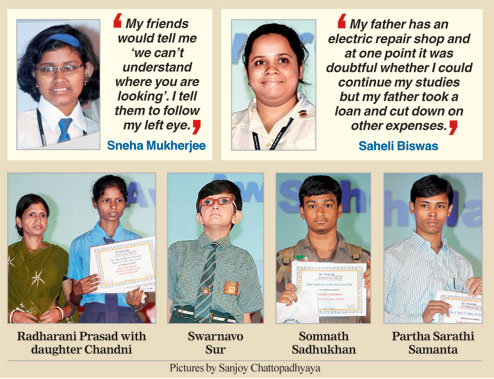
That has not impaired her spirit and Sneha, who has a ready response for any insensitive remark about her eye implant. “My friends would tell me ‘we can’t understand where you are looking’. I tell them to follow my left eye,” said the Class VII student of St. Joseph’s Convent in Chandernagore and winner of The Surrendra Paul Memorial Award for Courage at Peerless presents The Telegraph School Awards for Excellence 2014, in association with Parle-G and powered by Adamas University.

If Sneha has always been encouraged by mother Lopamudra not to take any favours, other parents have made sacrifices — big and small — for their children’s education.

Radharani Prasad has to work as a domestic help as her husband is confined to bed by paralysis but that didn’t stop her for admitting daughter Chandni to Gurukul Vidyamandir Higher Secondary School after she scored 75 per cent in ICSE. Chandni received The Telegraph Education Foundation Scholarship.

“The school did give us concession but despite that I had to pay about Rs 15,000 for her admission after taking loan. I haven’t been able to pay her monthly fee so far,” said Radharani, who shared The Abhirup Bhadra Memorial “Thank You Baba-Ma” Award with Balaka and Swarup Sur, parents of Swarnavo, a kindergarten student at Assembly of Angels Secondary School, Barrackpore.

Swarnavo had a hernia surgery when he was 10 months old and an eye surgery when he was three. “He is extremely regular in school and I do not have to give him any special attention,” said the proud mother.

It was for Subir and Swarnali Biswas (who received The Abhirup Bhadra Memorial “Thank You Baba-Ma” Award) that their daughter Saheli (who received The Telegraph Education Foundation Scholarship) could continue her studies.

“My father has an electric repair shop and at one point it was doubtful whether I could continue my studies but my father took a loan and cut down on other expenses,” said the student of Class XI.

The spunky Somnath Sadhukhan, who received The Faith in Astha Scholarship, studies geography honours at Surendranath College while his mother sells pens and stationery in and around Shyambazar.

Rudrangshu Mukherjee, the managing trustee of The Telegraph Education Foundation, had one thought on Saturday for the students. “When you become somebody eminent, somebody successful… just turn back and reflect on those who need to be educated, those who need your support… “Please grow with The Telegraph Education Foundation, the best is yet to be because the best is in your hands.”

Barry O’ Brien, the convener of The Telegraph School Awards for Excellence, shared how students and teachers have often told him how moved they are by the stories of courage and resilience.

“Don’t just be moved. Don’t just take a handkerchief out of your pocket and wipe your tears. Do something small, very small, it could be anything. Try to reach out to somebody,” was O’Brien’s advice,

Delhi Public School Megacity and Sunita Sen, the principal of Ballygunge Shiksha Sadan, did just that, responding on the spot to a request to fund a laptop for Partha Sarathi Samanta, the son of a guard who is studying MTech at the Indian Institute of Engineering Science and Technology. They chipped in with Rs 40,000 for the recipient of The Club Friday Scholarship.

source: http://www.telegraphindia.com / The Telegraph, Calcutta / Front Page> Calcutta> Story / by Jhinuk Mazumdar / Tuesday – August 26th, 2014
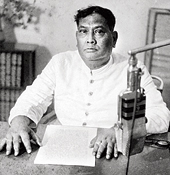
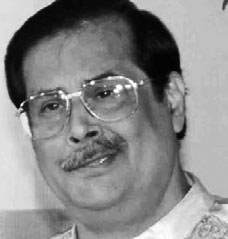
FORSAKEN BY HISTORY – Fazlul Huq’s actions directed history at many levels

First Person Singular – A.M.

FazlulHuqMPOs29aug2014

The significance of the year 1937 as a major milestone in the colonial history of India is often either brushed aside or missed altogether. The British parliament had, a couple of years ago, passed the new Government of India Act promising Indians limited self-governance and suggesting a federal structure of administration for the Indian empire. Provincial elections were ordered in 1937 all over ‘British India’ so that people’s representatives, though elected on the basis of restricted franchise, could still wield some power. The Indian National Congress, despite its reservations over the provision of the act, participated in the polls and, as was only to be expected, had a cakewalk victory in most of the ‘general’ constituencies everywhere; it also succeeded in electing its candidates from an impressive number of constituencies reserved for the scheduled castes and tribes. The All India Muslim League, presided over by Mohammed Ali Jinnah, did much below its expectations. Even in the provinces where Muslims constituted a clear majority of the electorate, its performance was none too impressive. In Punjab, it was defeated by the Unionist Party put together by Sikander Hyat Khan, representing the landowning interests, who became the prime minister (this was the nomenclature used in the 1935 Act) of the province. In Bengal, A.K. Fazlul Huq’s Krishak Praja Party prevailed over the League in a majority of the constituencies reserved for the Muslim community. His party lacked an overall majority in the provincial assembly; it nonetheless emerged as the largest single party. The Indian National Congress claimed the second place, the Muslim League was a not too impressive third. In Sind, it was a rag-bag coalition of regional parties which formed the provincial government, the Muslim League was isolated. In the North-West Frontier Province, given the popularity of Khan Abdul Gaffar Khan and his brother, Khan Sahib, the Congress did tremendously well; it won seats which fell short of a majority by just one; the Muslim League failed in its mission to capture the province. It was only the Indian National Congress in the rest of the country, including the United Provinces, the Central Provinces, Bihar, Assam, Orissa, as well as the Madras and Bombay Presidencies.

Jawaharlal Nehru was the Congress’s president that year. At his direction, the Congress set down two conditions for joining a coalition with others for forming a government in a province where it would be unable to form a ministry on its own: (a) the Congress would not enter into alliance with any ‘communal party’ and (b) even where it chose to form a coalition with another party to form the government in any province, the prime minister must be only from the Congress; it would supposedly be demeaning for the great national party to take orders from a prime minister who belonged to a nondescript political formation.

What was ironical was that in its anxiety to keep the Muslim League out of power in the NWFP, the Congress did not hesitate to breach immediately the first of these conditions and agreed to accommodate the sole Hindu Mahasabha legislator in the state assembly, Mehr Chand Khanna, in the ministry it formed. When it came to Bengal, the party’s high command, so-called, was adamant in sticking to principles. Fazlul Huq, having successfully snubbed the Muslim League in the just-held polls, was most reluctant to have any truck with the League and was keen to have the Congress as his partner. He sent a formal proposal to the Congress authorities inviting the party to form a coalition with the KPP and join the ministry he would form as the province’s prime minister. Sarat Chandra Bose, elected leader of the Congress in the Bengal assembly, was eager to respond affirmatively to Fazlul Huq’s invitation. His request to do so was contemptuously turned down by the high command. Poor Fazlul Huq had no alternative but to approach his erstwhile sworn enemy, the League, to join his ministry. The League responded with great alacrity; the KPP-Muslim League coalition regime took charge of the provincial administration in Bengal. The course of history changed in Bengal from that point onwards.

Fazlul Huq’s KPP had a clear-cut programme to protect the interests of the rural masses. Once installed in office, Fazlul Huq wasted no time in implementing the pledged promises to relieve the peasantry of the burden of unbridled exploitation by big landlords and loan sharks. A legislation imposed ceilings on land cess charged by intermediaries. Of far greater relevance was the introduction of a separate legislation concerning rural indebtedness. It either considerably reduced or even squashed altogether the burden of land cess charged by intermediaries in the recovery of past loans. Fazlul Huq did not quite stop here. He decided to set up a commission — the Floud Commission — to introduce major land reform all over the province. A further measure, perhaps of equal, if not greater, significance, was an order which, taking into account the denominational distribution of the province’s population, reserved 54 per cent of job opportunities in the provincial government henceforth for members of the Muslim community.

This series of measures had a tremendous impact on all sections of the Muslims in Bengal whose support for Fazlul Huq soared. The reaction of Hindus and the Indian National Congress was, perhaps not totally surprisingly, to the contrary. The prospect of losing the opportunity of making easy money by increasing exploitation of the rural poor disturbed the thinking process of the Hindu gentry and middle-class Hindus; the additional, very real, possibility of shrinkage in opportunities to enter government service further alienated them from Fazlul Huq and his administration.

Ignoring advice for restraint, the Congress launched a virulent campaign depicting Huq as an arch communalist. It was conveniently forgotten that, barely a couple of years ago, the same Fazlul Huq had made the Congress happy by taming the League in the polls. The news media in Calcutta, both English and Bengali, owned by Hindu fat cats, were full of reports, often concocted, of how much sections of the Hindu community were suffering in different parts of the province under the tyranny unleashed by the coalition government. Fazlul Huq withstood the calamity for a while. He was a man of emotions though. At one point he decided that enough was enough, if he was dubbed communal for being a friend of the poor, he would rather turn into a full-fledged communalist. He liquidated his own party and joined the Muslim League, along with the bulk of the KPP legislators. He, so to say, handed on a platter the crucial province of Bengal, with its huge density of Muslim population, to Mohammed Ali Jinnah.

The rest of the story is well known. Huq was persuaded to move at the League’s annual session in 1940 the resolution demanding the creation of Pakistan. The League reaped what Huq’s KPP had sown in Bengal. Muslim masses all over the country were bowled over by reports of what the League had supposedly done for poverty-stricken Muslims in the eastern province. Their loyalties got swiftly transferred to the League. Jinnah begun to roar like a real lion. Pressure was unbearable on Muslim politicians who till then had kept their distance from the League. Sikander Hyat Khan could read the signs, and capitulated in Punjab and joined the League too. It was the same story in the rest of the country. Only Abdul Gaffar Khan’s NWFP refused to bend all the way.

Since at heart Fazlul Huq, besides abhorring Jinnah’s overwhelming ways, could not reconcile himself to the League’s exceedingly aggressive communal stances, he soon fell out with the League leadership. He tried to form an alternative government in Bengal by parting with the League. Most of his former supporters were, however, no longer with him. Even so, Huq succeeded in scraping together a majority in the provincial assembly with the help of Sarat Chandra Bose, who too had now broken with the Congress following Subhas Chandra Bose’s expulsion. What raised a furore was Huq’s seeking and receiving support from the Hindu Mahasabha leader, Shyama Prasad Mookherjee. This latest move by Fazlul Huq unnerved the British rulers. They had been happy when he merged his party with the Muslim League, which kept the Congress out of power in Bengal. The Congress was turning increasingly hostile. Mahatma Gandhi was threatening to launch the Quit India Movement, and the spreading influence of the League was considered a good antidote by the foreign masters. That apart, the Second World War was reaching a critical stage. Subhas Chandra Bose had disappeared from the country and had surfaced in Berlin. And now his elder brother, Sarat Bose, was Fazlul Huq’s choice for the post of home minister in the new ministry he was proposing to form. This could not be allowed to happen, for the home department handled many sensitive and confidential matters. Sarat Bose was arrested under the Defence of India Act before he could be sworn in. A shaky new ministry anyway took office with Huq as prime minister. It did not last long because of more desertions by his past followers who did not like his associating with Mookherjee. Huq’s self-styled Progressive Coalition government soon collapsed and the Muslim League got back to power. Huq was by now a totally isolated figure; his soliciting the support of the Hindu Mahasabha leader added grist to the anti-Huq propaganda by the League, which succeeded in establishing absolute control over the Muslims in Bengal. It was equally true elsewhere in the country. In the provincial elections held in 1946 after the war was over, barring the NWFP, it was the Muslim League, and only the Muslim League, triumphing in nearly all the constituencies reserved for Muslims. The country got partitioned barely a year later. The League was almost a non-entity in 1937; it could divide the country exactly a decade later.

The Congress could infringe its principles in the NWFP in 1937, but would not do so in Bengal; it instead, made a gift of Fazlul Huq to the Muslim League. This individual, Huq, in that sense played the most important role in settling the destiny of the sub-continent. He is nevertheless a forgotten person as much in India as in Pakistan. What is even more astonishing, his name is barely mentioned these days in Bangladesh too. What remains under layers of oblivion is the fact that the Bangladeshi national ethos was created by the emergence of a self-assured Muslim middle class in Bengal, which in turn was the direct consequence of the measures introduced by Fazlul Huq on assumption of office in 1937. The reforms initiated by Huq emancipated an impressive percentage of the rural as well as urban Muslim masses, offering them opportunities to get educated, provided them with jobs, and thereby created a substantive middle class full of pride and self-confidence. It is this class which, in spite of its mistrust of the Bengali Hindu exploiters, had a deep attachment for their mother tongue, Bengali, in spite of its Hindu roots. The constituents of this class had been shapers of mass opinion in East Pakistan, and have continued in that role in Bangladesh. The national consciousness built around pride for their own language would not accept their mother tongue to be treated with contempt in Pakistan, where they — Bangladeshis — made up the nation’s majority. Resistance grew and grew and was compounded by rising resentment against the oppressive domination of their land and people by West Pakistanis both in civil as well as military administration. The parentage of this Bangladeshi national ethos belongs to Fazlul Huq. History however is habituated to bypass those who create history.

source: http://www.telegraphindia.com / The Telegraph, Calcutta / Front Page> Opinion> Story / Tuesday – August 26th, 2014

Coconut Board of India starts residential training camp for farmers

Raiganj :

With an objective to make the farmers interested for the start of the coconut cultivation, the officials of Coconut Board of India started six days professional and residential training camp for the farmers in the office of Comprehensive Agricultural Development Corporation at Kaliyaganj of North Dinajpur district since today.

Forty farmers including some women from different blocks of the district are receiving this training here.

The Deputy Director of Coconut Board of India Mr Khakan Debnath reportedly inaugurated this training today.

The officials of district horticulture and officials of CADC organized this training.

Deputy Director of Coconut Board of India Mr Khakan Debnath said: Farmers had an idea that sea side was only ideal field for coconut cultivation.

But recently we prepared a high breed coconut plant which is ideal for cultivation in the soil of North Bengal districts.

So we invited the farmers to get training and start coconut cultivation on profession ways in North Dinajpur district.

Such coconut saplings will be available from the office of CADC in Kaliyaganj.

After five years the plant will bear fruit. If the farmers cultivate on the baisis of professional ways ,then government will provide them special subsidy.

The farmers will get atleast Rs 1000 from each tree in a year.

The Horticulture Officer of North Dinajpur Mr Samarendranath Khara said: We are helping the Coconut Board of India to conduct this training for the rise of coconut cultivation in our district.

Through a projector skin they are demonstrating the farmers about the way of nurturing coconut plants.

The farmers are being taught about the using of manure to the trees, its lookafter and the way of climbing the trees with a modern machine. We hope that such camp will create an interest among the farmers for cultivation of coconut in our district.

source: http://www.thestatesman.net / The Statesman / Home> Bengal / Statesman News Service / Raigang – August 25th, 2014

Kolkata Vocalist Gets Pandit Rajguru Award

Dharwad :

Classical singer Padmashri Pt Ajoy Chakraborty of Kolkata has been conferred the Pt Basavaraj Rajguru National Award-2014.

Pt Ajoy Chakraborty
Pt Ajoy Chakraborty

Dr Ravikiran Nakod (tabla) of Dharwad and Apoorva Gokhale of Mumbai (vocal) were honoured with annual youth award given by the Swarsamrat Pt Basavaraj Rajaguru National Memorial Trust here on Monday.
While the national award carries a cash prize of `1 lakh, youth awardees were given `25,000 each.

Deputy Commissioner P Rajendra Cholan presented the awards.

Chakraborty saluted the musicians and artistes of the region and said he was blessed by an award from the land which has produced many luminaries in the field of arts, music and culture.

Later, he enthralled the audience with his vocal rendition in Rag Bhairav. Pt Raghunath Nakod (Tabla) and Dr Panchakshari Hiremath (Harmonium) accompanied him. Apoorva Gokhale and Dr Ravikiran Nakod also performed.

The award ceremony scheduled on August 24, was postponed to Monday following the death of Jnanpith awardee U R Ananthmurthy.

source: http://www.newindianexpress.com / The New Indian Express / Home> States> Karnataka / by Express News Service / August 26th, 2014

All women police team for making Kolkata safe

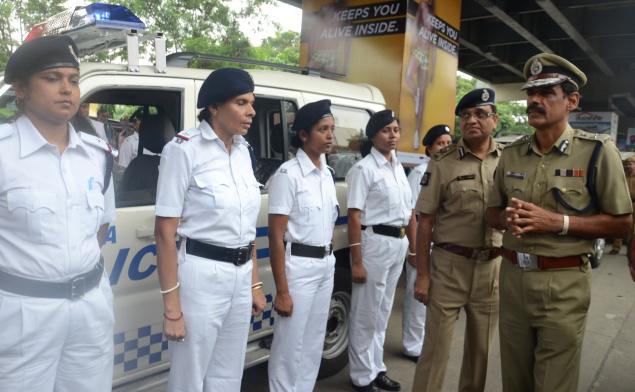
Kolkata Police Commissioner inaugurating a mobile police van that will have only women personnel, on Thursday. Photo: Sushanta Patronobish / The Hindu

In an effort to encourage women to approach the police, Kolkata Police Commissioner of Police Surajit Kar Purkayastha on Wednesday inaugurated Reinforce City Patrol, where patrolling vehicles will have only women cops. This comes at a time when a number of sexual assault and rape cases are being reported in the State and city. West Bengal ranked third in the 2013 Crime in India report by the National Crime records Bureau.

Headed by Deputy Commissioner of Police, Women Police, Headquarter, Debasree Roy, three vehicles were launched initially which will be manning three spots in the city — J.L. Nehru Road crossing, south Kolkata’s Rashbihari Road and Akashvani Bhawan in central Kolkata.

The women police personnel will be working in two shifts, from 6.30 a.m. to 12.30 p.m. and from 12.30 p.m. to 8.30 p.m., Ms. Roy said.

source: http://www.thehindu.com / The Hindu / Home> News> Cities> Kolkata / Staff Reporter / Kolkata – August 21st, 2014

‘Smart’ New Town to grow vertically

Kolkata :

The government plans to develop smart cities and townships across the state with high-density vertical buildings and adequate green area.

The New Town Kolkata Development Authority (NKDA) has already started following the model for Rajarhat New Town. An NKDA official said they are trying to showcase New Town as the Singapore of Kolkata and the authorities were putting stress on optimum utilization of space by going vertical when it comes to real estate development.

The state government has already come up with a new urban policy that relaxes floor area ratio (FAR) to make way for buildings with larger space. According to the policy, 15% additional FAR will be allowed for mass housing, IT complexes and mega commercial housing complexes.

The Mamata Banerjee government has already identified 10 areas to develop smart cities. These are Rajarhat New Town, Raghunathpur, Jaigaon, Sagar, Kalyani, Baruipur, Durgapur, Bolpur, Debanandapur and Fulbari.

The areas have been identified on the basis of the pace of urbanization and geographical location. Rajarhat New Town is leading the way with NKDA developing it as the first green smart city of the state.

“The model that the authorities have started to follow is to have high-density buildings that will go vertical for optimum utilization of space,” an urban development official said, adding that there were about 25% green areas throughout New Town.

There has been a 31% increase in urban population between 2001 and 2011. Urban development and planning officials will conduct surveys in the areas where the state plans to develop smart cities.

NKDA has already allowed non-residential plot owners to get additional FAR if their plots fall within 250 metres of the Metro route that is coming up near the central business district.

In New Town, residential plots are now being allowed for commercial use subject to certain terms and conditions. The authorities have listed 30 non-polluting commercial activities that a lessee could take up in the residential areas.

The state government is also working on plans to approve housing projects faster.

source: http://www.timesofindia.indiatimes.com / The Times of India / Home> City> Kolkata / by Suman Chakraborti, TNN / August 24th, 2014

Everyman’s quest

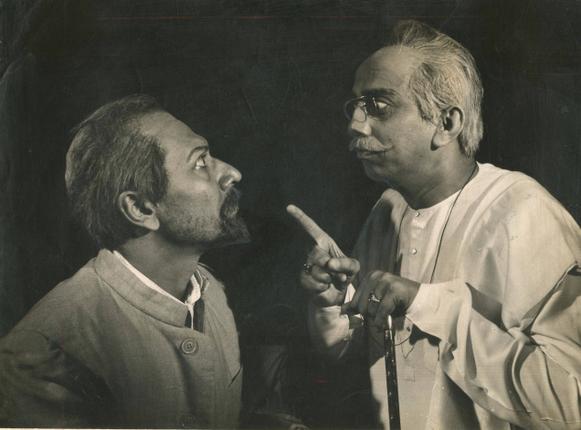
Sombhu Mitra and Amar Ganguly in Bohurupee's "Dasachakra" / The Hindu Archives
Sombhu Mitra and Amar Ganguly in Bohurupee’s “Dasachakra” / The Hindu Archives

As a festival commemorating Sombhu Mitra’s birth centenary gets underway in the Capital, former associates of the iconic theatre artist speak about his contribution.

Sombhu Mitra, in his acceptance speech for the Magsaysay Award, spoke of the artistic urge in human beings that separated them from other species: “…it is in the nature of man that he is compulsively driven to overcome the dictates of mere convenience. In the early days of civilization, as he needed to draw water, he invented the urn. The urn was filled, but not his heart. So he began now to decorate it with colour, geometric patterns, and his imagination. What an incomprehensible and strange craving!”

Perhaps it was this belief, and a recognition of his own “incomprehensible and strange craving” that led him to break away from the idealistic and message driven plays of the Indian People’s Theatre Association, and in 1948, to found Bohurupee along with Bijon Bhattacharya and other associates in Calcutta.

Bohurupee was a pioneering theatre group as it represented the individual artistic quest, perhaps what could be called the middle ground between commercial theatre and those productions whose underlying aim was to raise awareness among the masses.

“For him theatre was high art,” feels Raka Chakravarty, who from childhood had a chance to observe the philosophy and working style of the icon. “It was not to be used like street theatre or for propaganda. It was pure art, and for that of course he selected the best of plays.”

Raka’s father, eminent journalist Prithvis Chakravarti, is credited with bringing Bohurupee to Delhi for the first time. The occasion was the National Theatre Festival held at the All India Fine Arts and Crafts Society (AIFACS) in 1956, and Chakravarty was one of the event’s main movers. “In fact this was the inaugural event of AIFACS,” recalls Raka.

There was another significance to the occasion. Charles Fabri, the highly influential critic whose writings in newspapers including The Statesman moulded public opinion nationally and internationally, was convinced that contemporary Indian theatre had no identity of its own and the productions being done were either mythological or historical plays or merely adaptations of Western theatre. On the other hand, Bengali artists and thinkers were sure that the works of Rabindranath Tagore, imbued with the spirit of India, were not stageable. Mitra’s path-breaking production of Tagore’s “Rakta Karabi” demolished both these notions. Chakravarti and Fabri had laid a wager, says Raka, and Fabri had to accept the worth of Indian theatre when “Rakta Karabi” was presented by Bohurupee at the 1956 festival.

Bohurupee performed two productions, “Rakta Karabi” and “Chhenra Taar”, and both were so excellent it was difficult for the jury to decide which should be given the top prize, she notes.

Well known theatre director Kirti Jain, former Director of the National School of Drama, also looked to ‘Sombhu da’ as an avuncular figure. She too grew up in the benevolent ambience of friendship shared by her parents — Nemichandra Jain and Rekha Jain — with Sombhu da and his wife the celebrated actress Tripti Mitra.

Conversations between Kirti’s father and Mitra would range from philosophy to mathematics, language and semiotics to politics. “He could create in you a curiosity about so many things. That kind of range I saw in my father too,” she says. “I found that very fascinating. It was more than theatre; it was a whole way of life. And that entire generation had it, though of course Sambhu da was special.”

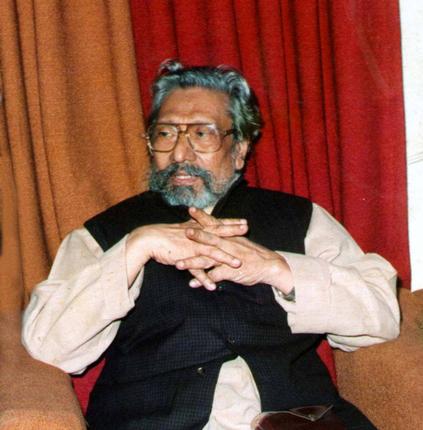
Sombhu Mitra (August 22, 1915 – May 19, 1997) / Special Arrangement / The Hindu

On her own interactions with Mitra, she says, “For me, it was like hero worship, someone you could look up to in theatre. It was nice to have that access to him through my parents.”

Her last interaction with him was a professional one, where she interviewed him for a film. “That interview wasn’t as warm as I had expected,” she recalls. Since at home, “it was always laughing and talking, and food, and making fun of the food, and all that happens in a home,” she had thought that her involvement in the interview would ensure a measure of informality, but this did not happen. “Maybe because he wanted it to be formal,” she muses.

But the reason could also have been his fierce conviction regarding his work. Raka too knew the difference between Mitra’s personal and directorial personas. The Chakravartys would spend summer vacations in Kolkata, and regular visits to Bohurupee to listen to play readings were a memorable feature of these holidays. “He (Mitra) was a family friend and one was not in awe of him,” notes Raka, “but there, he was like an emperor!”

Averee Chaurey, who acted under Mitra’s direction in significant roles as a youngster in Kolkata, while referring to him as “amazing,” admits that he was “aloof, not paternal”, and “never allowed anybody else to direct.” Mitra had “a great intellect and could recite a hundred poems at a time,” says Averee.

Punctuality was non-negotiable. Anyone who came even five minutes late would not be allowed into the rehearsal. Kumar Roy, who took over the reigns after Mitra left Bohurupee, was “paternal”, she adds. However, the group continued to follow Mitra’s philosophy. “We had body movement and voice training, we learnt the harmonium and singing and poetry recitation.”

If the discipline Mitra inculcated has remained to this day in the theatre artists he moulded, he also brought out unexpected talents. Rekha Jain was married as a child to Nemichandra Jain. Joining IPTA, Calcutta, with her husband, she found herself for the first time expected to sing and dance and act. Her first role was in the Hindi version of “Navanna”.

“My father had translated it (into Hindi) and Sombhu da was directing it. My mother was from a very conservative family. She had to play the role of a woman who because of poverty takes to prostitution. She used to tell us about how Sombhu da got her out of that embarrassment.”

Mitra was also a formidable actor. Kirti recalls seeing him as Chanakya in “Mudrarakshas”. There was excitement around the production as he was returning to the stage after a gap. The audience had yet to settle down when the play started. “Sombhu da was speaking. And suddenly he stopped, and looked from one end of the auditorium to the other, and there was pin drop silence!”

Such was the command of the man who was among the pioneers of group theatre in India, who believed in stories of the common people, for the common people.

Impresario India presents “Salute to you, O Creative Genius” . August 22, India Habitat Centre, 7 p.m.; August 23 & 24, Azad Bhawan, Indian Council for Cultural Relations, 6 p.m.; August 27, India International Centre, 6.30 p.m.

For enquires, call 9811763534, 98111209

source: http://www.thehindu.com / The Hindu / Home> Features> Friday Review / by Anjana Rajan / New Delhi – August 21st, 2014

Bahar Dutt’s ‘Green Wars’ in Kolkata

Kolkata :

It’s all right to brag about India evolving as the next super power, but what about its impact on wildlife. For once, why can’t we prioritise GEP (gross environment product) over GDP? Bahar Dutt, author of Green Wars, made the audience sit up and deliberate on the questions during her engaging conversation with British Council director Sujata Sen on Tuesday evening.

At the launch of Dutt’s maiden literary attempt in Kolkata, the Green Oscar recipient, whose environment investigations for a television channel stalled an illegal shopping mall project on the Yamuna river bed, an illegal mine coming up on the Goan forest land and an airport on wetlands that were home to Sarus cranes in Uttar Pradesh, pertinently wondered aloud: Whose development is it, anyway?

“When we say development, it’s this brutal development that we are going through where we need to find out if the development is reaching the people living close to those resources,” said Dutt, giving a presentation on her experience as wildlife conservationist to find out how this conflict between a modernizing economy and saving the planet can be resolved. “That is why I have called my book, ‘Green Wars’,” explained Dutt, after Nayantara Pal Chowdhury, president of the Indo-British Scholars’ Association introduced her to the august gathering at the British Council.

“It doesn’t read like a first book,” said Sen, initiating the dialogue with Dutt. “One just gets hooked on to reading this book. It’s very personal, but for every personal encounter, she takes you to the larger views. It’s so captivating …”

The British Council director made the most intriguing query. What made Dutt write the book? “For a television story, you spend 48 hours trekking through the forests, waiting for the animal that might never show up (supposing it’s a tiger). Then your story comes down to two minutes. So I thought, in the humdrum of television reporting, how to get to the depth of the problem. You could say, ‘Green Wars’ is a back-story to my stories,” Dutt said, recalling: “I can’t say I was involved in the prevention of illegal mining in Goa. But in one of the chapters I have written about the incident where we were physically assaulted by the mining mafia, they tried to snatch our camera.”

Dutt, who had told her television editor in no certain terms that: “I don’t want to do cute-cuddly stories on wildlife, but the politics of it”, would take down notes after every reportage – perhaps to relive those exhilarating moments of her confrontations with gharials and the grand old organg-utan and similar creatures facing an uneasy future in ‘Green Wars’ someday. Moving away from charismatic mega fauna, the book focuses on lesser known species, she has focussed on special like Hoolock gibbons (she helped one find his mate). One of the chapters deals extensively with the ‘Himalayan Tsunami’ in Uttarakhand and why it happened.

For the past one year, she has spent hours in rigorous research to come up with data analysis like India losing 333 acres of forest every day to large development projects like dams, roads and mining. Calling to save all that is precious in a ‘development without brakes’ model of economy, she said, “Indians get rich their lifestyles are getting more and more carbon intensive.”

source: http://www.timesofindia.indiatimes.com / The Times of India / Home> City> Kolkata / by Ajanta Chakraborty, TNN / August 21st, 2014

A treasure trove of unheard melodies

Kolkata :

For lovers of the golden voice of Debabrata ‘George’ Biswas, this is akin to finding hidden treasure. Previously unreleased songs of the Rabindrasangeet legend was launched in two CDs — ‘Joto Suniyechilam Gaan’ and ‘Gaaner Tori Dilem Khule’. The songs in the first album are from author Pramathanath Bishi’s personal collection while those in the second were recorded from an Akashbani programme in 1961. Dey’s Publishing launched a book on Biswas to mark the occasion.

“Pramathanath Bishi was devoted to Biswas’s voice and regularly visited him at his home. In 1972, he requested the master to let him record his songs for his personal collection. Biswas then recorded 40-odd songs. Bishi’s daughter Chirasree and son Kanishka have allowed us to release the songs. These were in a very good condition. We simply transferred them from analog to digital and did some noise filtering,” said professor Sukanta Datta, who had seen Biswas from close quarters for years.

“In our search for unreleased songs, we found Pradip Deb, before migrating to the US, had developed a habit of recording Akashbani programmes. In 1961, he had taped one such programme by Biswas. It was an amazing collection, sung by the master in his prime. When we approached Deb, he agreed to let them be released,” added Datta. Debabrata Biswas Smaran Committee had organized the event.

At Sisir Mancha, the auditorium was overcrowded with admirers, mostly senior citizens, jostling for space to drink in every moment. The seats ran out in a blink and the jostling intensified. Temper flew as anyone trying to elbow his way ahead was rebuked sharply from others around. Among those seated, they were intent on catching every word being spoken from the dais and hissed at anyone who spoiled the moment by talking or taking calls. And the event saw admirers from all walks of life thronging to get hold of the CDs.

Tridib Chatterjee, general secretary of the Publishers and Booksellers Guild, was among the audience. “For my generation, George Biswas is the first and last word in music. I have extensively listened to all his songs, or so I thought till now. One of the songs — ‘Nach Shyama Tale Tale’ — I had earlier heard in the voice of Sagar Sen and later, Swagatalaxmi. Again, two songs — ‘Pothe Chole Jete Jete’ and ‘Pother Sesh Kothay’ — I had heard them in Hemanta Mukherjee’s voice but never did I dream that I’ll get to hear them Biswas’s golden voice as well,” he gushed.

Subal Saha, a retired caretaker of Rabindra Sadan, had seen many of Biswas’s concerts and had hosted him on all those occasions. “I saw him first in 1971, and several times more later on. When I heard a new CD will be launched, I had to come. For me, it’s like travelling back in time,” he said.

source: http://www.timesofindia.indiatimes.com / The Times of India / Home> City> Kolkata / TNN / August 23rd, 2014

Untold stories of a green warrior

Kolkata :

It’s all right to brag about India evolving as the next super power, but what about its impact on wildlife? Why can’t we prioritize GEP (gross environment product) over GDP? Many such questions raised by Bahar Dutt, author of ‘Green Wars’, at an engaging conversation with British Council director Sujata Sen made the audience sit up and give them a serious thought.

At the launch of Dutt’s maiden literary attempt in Kolkata recently, the Green Oscar recipient, whose environment investigations for a television channel stalled an illegal shopping mall project on the Yamuna river bed or an airport on wetlands that were home to Sarus cranes in Uttar Pradesh, pertinently wondered aloud: Whose development is it, anyway?

“When we say development, it’s this brutal development that we are going through where we need to find out if the development is reaching the people living close to those resources,” said Dutt. “That is why I have named my book ‘Green Wars’,” she explained, after Nayantara Pal Chowdhury, president of the Indo-British Scholars’ Association, introduced her to the gathering at the British Council.

“It doesn’t read like a first book,” said Sen, initiating the dialogue with Dutt. “One just gets hooked on to reading this book. It’s very personal, but for every personal encounter, she takes you to the larger views. It’s so captivating.”

The British Council director made the most intriguing query. What made Dutt write the book? “For a television story, you spend 48 hours trekking through the forests, waiting for the animal that might never show up. Then your story comes down to two minutes. So I thought, in the humdrum of television reporting, how to get to the depth of the problem. You could say, ‘Green Wars’ is the back-story to my stories,” Dutt said, recalling: “I can’t say I was involved in the prevention of illegal mining in Goa. But in one of the chapters I have written about the incident where we were physically assaulted by the mining mafia, they tried to snatch our camera.”

Dutt, who had told her TV editor: “I don’t want to do cute-cuddly stories on wildlife, but the politics of it”, would take down notes after every reportage – perhaps to relive those exhilarating moments of her confrontations with wild animals in ‘Green Wars’ someday.

source: http://www.timesofindia.indiatimes.com / The Times of India / Home> City> Kolkata / TNN / August 22nd, 2014