80 years that are lighter than roses

Kolkata :

The ‘Teen Bhubaner Pare’ pair of 1969 showed their chemistry is intact even in 2015 when the graceful Tanuja met the evergreen Soumitra to wish him on his 81st on Monday.

When Soumitra’s Chatterjee’s daughter Poulami pointed out that their ethnic attires complemented each other, Tanuja responded: “It’s unintentionally coordinated. We’re the best,” giving the original Feluda a playful nudge.

And it was not just the chemistry, but the energy too that had a renewed vigour to it. As the camera flashes threatened not to cease in the greenroom, Tanuja exclaimed: “So many people! If we do a movie together now it’ll be an instant hit.”

Soumitra, ‘Pulu’ to Tanuja, nodded vigorously. “Yes, we must do another film as the lead pair.” When someone asked how he was enjoying his birthday, he said: “I’m not enjoying it at all. I haven’t had the chance to eat, sleep or bathe.”

Tanuja said: “May you live a 100 years.” He replied: “But that would be too painful.” Soumitra had high fever and had to take paracetamol tablets through the day.

But once they hit the stage for a conversation moderated by poet Srijato, the warmth that could be felt wasn’t because of a virus. The moderator asked him whether having nothing left to unveil on his life was a curse or boon, Soumitra said: “If you spend so many decades under public glare, you have to forego a private life. But such long stints also produce friends, like I have one in Tanuja. Not because we have worked in many films together, but more like things happen in home. You strike a certain understanding. Now the industry has changed a lot. Back then, it was so homely that if I had a headache, she would say ‘shhh’ and take out an ointment to rub on my temple.”

When Srijato asked her about her bond with the Chatterjee family, Tanuja said: “How to explain… When I met Pulu he didn’t feel like a stranger.” Srijato interjected: “Did you know he still has a cheque signed by you with him?” Tanuja was astounded. “You mean you didn’t encash it?”

Soumitra explained: “She had a plan to launch Kajol in a film that also featured me. She had even given me a cheque in advance. But the film didn’t happen.” Tanuja repeated: “You seriously didn’t encash it?”

The real impatient, inspired Soumitra came out when he was asked: “Despite so much success how are you still not complacent?” “I’m unsatisfied by nature. Even if I like my work in a particular field, it is so short-lived that it’s negligible. My icon is Rabindranath Tagore, the most successful of them all. He achieved everything, but didn’t sit back in complacence. He had grievances and they reflected in his art. With such an example before me, how can I be satisfied!” he said.

Tanuja said she feels the same way but this was a lesson she “learned anew this evening”. She elaborated: “When someone asks me: ‘What’s your best film?’ I say: ‘I haven’t done it yet.’ I love your attitude.”

Despite a sore throat, Soumitra recited one of his poems selected by Srijato and went on to recite one more. A book on him by Tapan Sinha Foundation was launched on the occasion while theatre group Mukhomukhi felicitated Tanuja. Sketch artist Ekta Bhattacharjee was invited to present her hand-drawn portrait to Soumitra while veteran artist Rabin Mandal presented him with a book on his artwork recently published by Delhi Art Gallery.

And the moment the audience cheered the most? When the onscreen pair hugged. Before signing off, Soumitra had one last witty bomb to drop. “Back in the greenroom, a person came up and presented me with a bouquet of roses. He said there were 80 of them. I realised that 80 years were not as heavy as that many flowers.”

source: http://www.timesofindia.indiatimes.com / The Times of India / Home> City> Kolkata / by Shounak Ghosal, TNN / January 20th, 2015
Officers awarded during investiture ceremony in Kolkata

Kolkata :

At the investiture ceremony held at Fort William in Kolkata on the occasion of the 67th Army Day recently, 23 Army personnel and an Air Force officer were awarded gallantry and distinguished services awards. The awards were presented by Lt Gen MMS Rai, GOC-in-C, Eastern Command at the Albert Ekka Auditorium. Several units were also awarded Unit Citations and Appreciations.

“Fourteen Army personnel received Sena Medals (Gallantry) for their courage and bravery during counter-insurgency operations in the North East. The citations were sagas of valour of these brave men effectively eliminating terrorists with professional elan, indomitable courage with disregard for their personal safety. They achieved this using minimum force to ensure safety of innocent citizens ensuring negligible collateral damage. Two Sena Medals (Distinguished), two Bars to Vishisht Seva Medal (VSM) and five VSMs were also awarded to personnel for their commendable performance,” an officer said.

Lt Gen Raman Dhawan, GOC, Bengal Area and Gp Capt Tarun Kumar Singha, CPRO, Ministry of Defence in Kolkata were conferred Bars to their VSMs. This signifies that they are being awarded the VSM twice.

source: http://www.timesofindia.indiatimes.com / The Times of India / Home> City> Kolkata / by Jayanta Gupta, TNN / January 20th, 2015

First batch of military nurses from Kolkata commissioned

Kolkata :

The first batch of 18 nursing cadets from the College of Nursing, Command Hospital, Eastern Command, Kolkata, were commissioned as lieutenants into the Military Nursing Service on Wednesday. Among those present were Maj Gen A K Nagpal, MG (Med), HQ, Eastern Command and Maj Gen Deepak Kalra, Commandant, Command Hospital, Eastern Command.

“Lt Sushila Bishnoi was awarded the gold medal for securing first position in the University exams and was also adjudged best all-rounder. Lt Priyadarshni Kumari bagged the silver medal for standing second in the batch while Lt Isha Sharma was awarded the silver medal for best clinical nurse. In his address to the nursing officers, Gen Nagpal, spoke about the responsibilities of a nursing officer as being both challenging and rewarding. They have the role of nursing soldiers and their families in the armed forces hospitals across the country in times of peace and war, as well as abroad over land, air and sea, he said,” an officer said.

The School of Nursing was established at the Command Hospital in 1973. It was converted to the College of Nursing in 2010 and conducts BSc (N) programme of four-year duration. Recently, a two-year post graduate programme was also introduced at the college.

source: http://www.timesofindia.indiatimes.com / The Times of India / Home> City> Kolkata / by Jayanta Gupta, TNN / January 14th, 2015

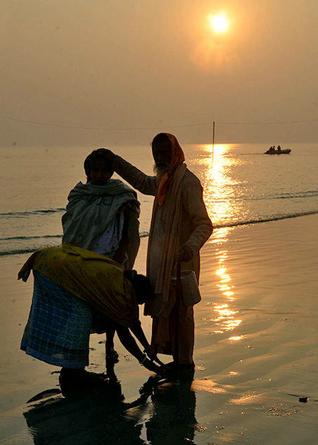
A festival adds to the woes of Sagar

A sadhu blesses two women at Sagar island on Monday. Photo: Sushanta Patronobish

Devotees gathering for Makar Sankranti almost thrice the island’s population

In the next few days, lakhs of devotees will descend on the Sagar Island in the Sunderbans archipelago of West Bengal to take a holy dip, where the Hooghly river enters the Bay of Bengal, on the occasion of Makar Sankranti. They are unaware of the festival’s environmental impact on the island.

Sagar is the largest island in the Indian Sunderbans system, boasting an area of 251 square km and a population of 2.10 lakh as per the 2011 census. Despite its size, the erosion of certain parts owing to the rising sea level is causing its residents concern.

In July 2014, at least 10 villages were submerged in high tide, and this exposed the vulnerability of the island, like the other smaller islands of the unique ecosystem.

While State government officials admit that no detailed environmental assessment has been done in the recent past, some recent studies show that on the one hand, the issue of pollution has not been addressed and on the other, the island’s tourism potential has not been tapped.

Experts say the number of devotees gathering on a particular beach during the Mela is five to six lakhs, almost three times the island’s population.

At least two recent papers, produced by researchers of the School of Oceanographic Studies (SOS), Jadavpur University, have looked at the issue of sustainability of the Mela and the island’s tourism potential.

‘Impact of Gangasagar Mela on Sustainability of Sagar Island,’ published in 2012 in the International Journal of Research in Chemistry and Environment, pointed to an increase in fecal coliform bacteria in the surface water of the beach used by the pilgrims. The paper said the inhabitants of the island living near the Mela ground complained of obnoxious smell and communicable diseases.

“The authority needs to limit the gathering according to the… capacity of the Gangasagar Mela ground which depends on infrastructure such as housing, latrine, toilet and bathing ghat [so as] to minimise pollution,” said the paper authored by Tuhin Ghosh of the SOS and Rituparna Hazra and Rajarshi Mitra.

Another paper published by Prof. Ghosh and others at International Journal of Innovative Research & Development in 2014 looks at the tourism potential of the island under the Global Sustainable Tourism Criteria.

source: http://www.thehindu.com / The Hindu / Home> News> Cities> Kolkata / by Shiv Sahay Singh / Sagar (South 24 Parganas) / January 13th, 2015

Hazarduari gets ‘Adarsh’ tag from ASI

Kolkata :

Hazarduari Palace in Murshidabad has been declared an Adarsh Monument by the Archaeological Survey of India (ASI) along with three others in eastern India.

The other three monuments are Vaishali-Kolhua in Bihar, Rang Ghar in Assam’s Sibsagar and the Konark Sun Temple in Odisha. These
will be in the focus of international tourism promotion plan developed by the central government.

ASI has selected only 25 out of 3,680 protected monuments under the Adarsh Samarak Yojona. The list was made on the basis of the number of tourists these monuments attract annually. The list includes some of the biggest crowd-pullers like Taj Mahal, Khajuraho, Qutab complex and Red Fort.

All of them can be of great interest to international tourists, believes the ministry of culture. “Keeping that in mind, we are developing amenities of international standards, including washrooms, drinking water, signs, cafeterias, audio-visual centres, Wi-Fi connectivity, interpretation centres and encroachment-free areas,” said ASI regional director (eastern region) P K Mishra.

But more than anything else, security will be enhanced. The Centre is thinking of introducing the ‘tourism police’ force that is quite common across the world.

Hazarduari Palace, earlier known as Bara Kothi, is located on the campus of Kila Nizamat in Murshidabad, on the banks of the Bhagirathi. It was built in the early 19th century by Duncan MacLeod under the reign of Nawab Nazim Humayun Jah of Bengal, Bihar and Orissa (1824-1838). In 1985, the palace was handed over to ASI. Kila Nizamat or Nizamat Kila was the old fort of Murshidabad which was demolished to build this grand palace.

Built in the 13th century, the Konark Sun Temple is shaped like a chariot of the Sun God with 12 pairs of ornamented wheels dragged by seven horses.

Rong Ghor, meaning ‘House of Entertainment’, is a two-storied building that used to serve as the royal sports pavilion. Ahom kings and nobles used to watch buffalo fights and other sports at Rupahi Pathar in Rangpur, particularly during the Rangali Bihu. Said to be one of the oldest surviving amphitheaters in Asia, the building was constructed during the reign of Swargadeo Pramatta Singha in 1744-1750.

Kolhua in Vaishali is where the Buddha is said to have preached his last sermon. To commemorate the event, emperor Ashoka erected one of his famous lion pillars here in the third century BC. A hundred years after the Buddha’s death, Vaishali hosted the second great Buddhist council. Two stupas were erected to commemorate it.

Jainism, too, has its origins in Vaishali. In 527 BC, Lord Mahavir was born on the outskirts of the city and lived in Vaishali till he was 22. Vaishali remains an important pilgrimage centre for both Buddhists and Jains.

source: http://www.timesofindia.indiatimes.com / The Times of India / Home> City> Kolkata / by Krishnendu Bandyopadhyay, TNN / January 11th, 2015

Country’s highest zoo attempts to save high altitude herbivores from extinction

The initiative taken by Darjeeling’s Padmaja Naidu Himalayan Zoological Park (PNHZP) in conserving high altitude herbivores that have been on the path of extinction, has served to stem the rapid decline in their numbers.

Some of the animals that have been included in the conservation programme of PNHZP, the countries highest altitude zoo located at over 7,000 ft, are the Blue Sheep, the Himalayan Tahr, the Himalayan Goral and the Markhor.

All the four herbivores have been placed in the Schedule I of the Wildlife Protection Act, 1972, which denotes that the species are ‘threatened’.

The conservation of these animals is also crucial for the Himalayan ecosystem.

“All the four herbivores are the main prey of the much endangered Snow leopard. A decrease in their numbers will naturally affect the existence of the elusive mountain cat,” Upashna Rai, the biologist in the PNHZP told The Hindu. Conserving these herbivores serves the dual purpose of protecting the snow leopard as well. The PNHZP is also involved in the global conservation and breeding programme of the snow leopard.

The Darjeeling Zoo has taken the initiative of breeding these high altitude herbivores and is also involving the other high altitude zoos in breeding and conservation of the species.

It has provided to each of the main zoos of Sikkim and Nainital one pair of the Blue Sheep and the Himalayan Goral as a part of an exchange programme.

In the PNHZP there are 11 Blue sheep (seven males, four females) eight Himalayan Tahrs ( three males, five females) 11 Himalayan Gorals (eight males, three females) and eight Markhors (three males, five females). Interestingly Markhor, an endangered species of goat, is the national animal of Pakistan.

“Our immediate goal is to distribute the species to the high altitude zoos of Sikkim, Nainital and Shimla. We are also testing the genetic purity of the animals before introducing new breeding lines,” A K Jha, the director of the PNHZP told The Hindu.

Dr Jha said that the conservation of the herbivores was aimed at having a healthy population of the animals in the zoos in case the species get extinct in the wild.

source: http://www.thehindu.com / The Hindu / Home> News> Cities> Kolkata / by Shiv Sahay Singh / Kolkata – January 11th, 2015

Feminist Jasodhara passes away

Eminent Leftist feminist Jasodhara Bagchi breathed her last here on Friday morning. She was 77.

She suffered a cardiac arrest and multiple organ failure, her daughter Tista Bagchi told The Hindu .

Educated at the city’s Presidency University, Oxford University and Cambridge University, she taught English briefly at the Lady Brabourne College here. From 1964, she spent a major part of her life teaching English at Jadavpur University and went to become the founder-director of the School of Women’s Studies there. Although Ms.Bagchi retired in 1997, she continued to teach at the School of Women’s Studies as an emeritus professor till her death.

Married to renowned economist Amiya Bagchi, she was the former chairperson of the West Bengal Commission for Women. She wrote extensively on social and women’s issues and has been vocal in supporting women movements.

source: http://www.thehindu.com / The Hindu / Home> News> Cities> Kolkata / by Special Correspondent / Kolkata – January 10th, 2015

School adopts US model to inspire kids in science

Kolkata :

Bengal is going to get its first STEM-based school in Barrackpore, some 25km from Kolkata, to encourage more children to take up science and arrest the decline in interest in engineering.

STEM — an acronym for ‘science, technology, engineering and mathematics’ — is a US-based teaching method that aims to inspire kids to become engineers rather than dreading the sciences and mathematics as many do now. STEM World School- the Barrackpore school, for instance, will have a STEM laboratory where attendance will be compulsory. The lab can accommodate 30 students at a time.

The STEM World School in Barrackpore will be affiliated to ICSE. Admissions for playgroup to Class VI will start from the 2015-2016 session, say officials.

The emphasis on science comes at a time when projections of a nationwide shortfall of technocrats threaten to hold back India’s progress.

“A recent study by Defence Research and Development Organisation revealed that just 4 out of 1,000 students in India opt for science, technology or research as their career. In contrast, this figure is 110 in Japan, 76 in Germany and 46 in Korea, indicating the dearth of young talent in these vital areas in our country. Because of this, India is at risk of a huge economic crisis, despite being the youngest country demographically,” said Paddy Sharma, a board member of the school. “The main objective in setting up a STEM school in Kolkata is to create critical thinkers, increase science literacy and give rise to the next generation of innovators,” said Hilda Peacock, former principal of La Martiniere for Girls, who is one of the advisors.

According to a survey, India will be facing a shortfall of 1.5 to 2.2 million engineers by 2020, Sharma added.

“Innovation leads to new products and processes that sustain economy. Innovation and science literacy depend on a solid knowledge base in STEM areas. We just need to remind kids that this kind of learning can be fun. We need to introduce children to the basic concepts of science, engineering, technology and mathematics in junior grades and continue with these programmes through high school,” she said. Michael Glanton, Democratic member of Georgia House of Representatives, USA, is one of the advisors.

source: http://www.timesofindia.indiatimes.com / The Times of India / Home> City> Kolkata / by Somdatta Basu, TNN / January 11th, 2015

Bringing smiles to a thousand lips

Kolkata :

About 25 years ago, a surgeon at the state-run SSKM Hospital, Sankar Chatterjee, had applied stitches on the scalp of a Congress leader, a woman who was to create history in Bengal by single-handedly dislodging the Left Front from power.

Today, Chatterjee has created a sort of record by himself. As a project director of Smile Train programme, he has performed cleft lip and cleft palate surgeries on 1,000 underprivileged children in Tripura and Assam over the last six years.

“On August 16, 1990, I was on duty at SSKM Hospital when Mamata Banerjee was wheeled in with two deep injuries on her scalp. She had fended off a third blow with her left arm and fractured it. I was called in to repair the injuries to her scalp as a micro-surgeon. I applied 18 stitches on her scalp under local anesthesia. She didn’t even wince when I applied local anesthesia for the stitches,” Chatterjee recalled.

He took early retirement from state health service and became a part of Smile Train in 2008. He was assigned two hospitals at Agartala and Silchar where cleft surgeries were to be conducted free of cost.

“In Agartala and Silchar, my experience have been heartwarming. The smiles on the faces of the children after they see their ‘new’ faces on mirrors are worth dying for. I still remember a 14-year-old girl from Silchar who turned up a month after her surgery. She told me: ‘Daktarbabu, ami jiboney prothom baar lipstick lagiyechhi (Doctor, I have applied lipstick for the first time in my life).’ I was overwhelmed,” Chatterjee added.

Chatterjee completed his 100th cleft lip surgery in Silchar around the time when the film “Smile Pinki” bagged an Academy Award in 2008.

source: http://www.timesofindia.indiatimes.com / The Times of India / Home> City> Kolkata / by Jayanta Gupta, TNN / January 11th, 2015

Anthology on Jesuit Fathers’ contribution

The Goethals Indian Library and Research Centre of St. Xavier’s College has published a book on the lives of the Jesuits who lived and worked in India, especially in Bengal, since the early 19th century.

The anthology was released by Father P. Franck Janin, Jesuit Provincial, South Belgian Province and Luxembourg, at Dhyan Ashram in Joka on Sunday.

Edited by Father Albert Huart and Father J. Felix Raj, Discovery of Bengal: The Jesuit Design marks the 200th year of the Restoration of the Society of Jesus. The book records the academic, social, cultural and spiritual contributions of the Jesuit fathers in shaping the moral growth of the race and the country.

Among the Jesuits who feature in the book are Fathers Henry Depelchin, Achille Verstraeten, Paul Joris, Cardinal Lawrence Picachy, Camille Bouche and Andre Bruylants.

“They attracted heartsby the qualities they displayed and posterity retains them as lessons of life learnt forever. Even after 200 years, their words and works reach those for whom they were intended – the inhabitants of The Kingdom of God. These men of moral might were armed with supreme sense of sacrifice and were gifted with grace and the zeal to establish ‘Good News of God’ and the promise of justice for humanity,” said Felix Raj, the principal of St. Xavier’s College.

“Humility, fortitude, power of prayer and passion for performing God’s will on earth endowed these Samaritans with the benediction that brought the light of the Lord to the masses of Bengal. This collection scripts the eternal immortal lives of the Jesuits who are today and forever in fellowship with us and with God.”

Copies of the anthology are available from the Goethals library at the college.

source: http://www.telegraphindia.com / The Telegraph, Calcutta / Front Page> Calcutta> Story / by Staff Reporter / Monday – December 29th, 2014