Rare oil art by Tagore, other masters restored

Kolkata:

Seventy-two rare oil paintings by Rabindranath Tagore and other masters of the Bengal School that were lying in the strongroom of Rabindra Bharati University have been restored. The university authorities are also planning a public display of these paintings.

Most of these paintings by Tagore, his relatives, students and other legendary painters of the Santiniketan Kala Bhavan were in possession of the Jorasanko Thakurbari and were handed over to RBU when the house was converted into a state university in 1956. Some of these belonged to the Tagore family at Pathuriaghata.

After the Rabindra Bharati Museum was set up on the Jorasanko campus of RBU, several paintings by Tagore and his nephews, Abanindranath and Gaganendranath, and other family members were put up for display. But most of these were pencil sketches, water colour, crayons and pastels.

The Tagores were not known to have a great penchant for oil paintings, except when they were painting portraits or self portraits, feel scholars.

This makes ‘The Three Witches’ particularly so important. This is one of those rarest Tagore oil paintings, which has always generated a lot of interest among the scholars. However, it was never made available for public viewing. This, scholars say, is the most valuable painting in the collection, not only because it is a Tagore original but also because it was influenced by Shakespeare’s Macbeth. It is a dark painting showing three hooded women stirring the potion inside the cauldron. The three women are seen in moonlight and the suggestion of magic comes from a spark near the cauldron, deftly created by the light and shade used by the artist.

A portrait of Tagore by his grandnephew Subhogendranath Tagore was also restored. It’s a mammoth oil on canvas, that has been done by putting together geometric shapes. You have to move away from the painting to understand the pattern. “Today you have the concept of pixels in your camera. This painting, made more than 100 years ago, gives a perfect idea of pixel,” explained Indrani Ghosh, curator of the museum.

There are also some rare oil paintings by JP Ganguly, who also belonged to the Tagore family (he was Tagore’s elder brother’s daughter’s son) and Ramendranath Chakraborty, one of the most accomplished students of Kala Bhavan, Santiniketan.

It took two years for painting conservationists at the National Research Laboratory for Conservation of Cultural Properties (Lucknow) under the ministry of Culture to complete the job.

There were layers of dust all over the paintings, which were also torn in many places; in some the canvases had come out of the frames.

RBU is planning to hold a public viewing of all the 72 paintings at the ICCR.

source: http://www.timesofindia.indiatimes.com / The Times of India / News Home> City> Kolkata / by Jhimli Mukherjee Pandey, TNN / April 08th, 2016

Belle Vue to set up 2 new hospitals and nursing college

Kolkata :

With an investment of Rs 500 crore, the super-speciality Belle Vue Clinic is building another 400-bedded hospital, an eye hospital and a nursing college in Rajarhat.

“We have got two plots of two acres each in Rajarhat area where we will be expanding. Funds to the tune of Rs 500 crore have already been allocated for the new facilities,” hospital CEO P Tondon told reporters here today.

He said the 400-bedded super speciality hospital will have different departments but it will specialise in trauma care.

“Trauma care is a very difficult subject and everybody doesn’t want to venture into it,” he said adding that the construction work will begin from January next year.

The new hospital as well as the eye hospital will be ready by 2020, the official said.

On another two acre plot they will set up a nursing school, accredited by the Nursing Council of India, where 400 students will be trained in nursing skills.

“There is a lot of shortage for nurses. We are also seeking permission from the state government to allow us train male nurses as well. Lot of patients want male nurses and so there is a big shortage in the market,” Tondon said.

The nursing school will offer courses in General Nursing & Midwifery (GNM) and a BSc in nursing. Both courses are of three year duration.

Belle Vue has now got recognition from the National Accreditation Board of Hospitals & Healthcare Providers (NABH).

Their existing setup in south Kolkata has 287 beds at present which will be expanded to 357 in a year’s time.

“We are always short of beds. Lot of patients under the West Bengal health scheme also come to us and so we are adding two new floors in the building to have 70 extra beds,” the hospital head said. NIK NN

source: http://www.timesofindia.indiatimes.com / The Times of India / News Home> City> Kolkata / PTI / April 08th, 2016

Ramanna dead

N. Ramanna, a former Karnataka and Bengal footballer, passed away in Kolkata on Tuesday.

He was 77 and came from a family of footballers: one brother, N. Papanna was an India international while another, N. Rajanna, also played for Karnataka.

Originally from Mysore, Ramanna represented Karnataka in the 1962 Santhosh Trophy.

He moved to Kolkata soon after, where he played for East Bengal and Mohammedan Sporting. He also represented Bengal in the Santhosh Trophy. Ramanna settled down in Kolkata after retirement.

His death was condoled by the KSFA and the BDFA.

source: http://www.thehindu.com / The Hindu / Home> Sport / Bengaluru – April 06th, 2016

Indo-Danish collaboration revives St Olav’s from ruins

Serampore:

The bells will again chime, the ancient clock tick and hymns resonate through the air as the 210-year-old St Olav’s Church is Serampore rises like a phoenix from the ruins.

St Olav’s Church of Fredricksnagore, as the Danes called Serampore, is being restored back to its former glory, with the first service being slated for April 16.

After decades, people will pray inside the 210-year-old church that has risen like phyoenix, not from ashes, but from ruins. St Olav’s of Fredricksnagore (as the Danes called Serampore) has been restored back to its former glory.

If the former Danish colony, which administered Serampore from 1755 to 1845, boasted of a landmark, it was St Olav’s, which was built from 1800 and opened to the public in 1806. Now, it is an example of one of the most successful conservation projects in the country.

A part of the “Serampore Initiative”-launched by the National Museum of Denmark (NMD) in 2008 with the revival plans for the former Danish colony monuments-the restoration of the church began in January 2015.

The Danes started building the church in 1800 and finally opened it in 1806., as a relic of the time when the Danish ruled Serampore.

From a distance, the church’s magnificence is not quite visible. But as one walks into the narrow alley, the majestic steeple of St Olav’s church which would be the identity of the Danish settlement on the banks of the Hooghly centuries ago-towers over. The clock in the tower is getting the finishing touches, symbolic of the eras gone by, and the ones to come.

But the grandeur of the project-now touted as a major collaboration India-Denmark collaboration-can be truly perceived only after entering the compound.

Bente Wolff, curator of NMD, to attend the historic moment of reviving the church, sounded excited: “The church looks new, not in the flashy sense, but in its authenticity. Very high standards of international restoration protocol are maintained. We are proud of the fruits of our hard labour.”

She recalled how Danish historian Simon Rasting and architect Flemming Aalund had meticulously conducted the pre-project social survey, hunting through archives in India and Denmark for original designs and photographs as part of the scientific analysis.

“Doing this in our own country would have been easier, but we loved the challenge and how all the stakeholders, especially the locals, helped us achieve this,” said Rastin, adding the project would not have been possible without the craftsmanship of Aalund and conservation architect Manish Chakraborti, chief conservation architect for the project and director of historic buildings conservation firm Continuity.

“St Olav’s can serve as a model for conservation projects,” said Chakraborti. “The restoration was carried out after thorough research.” for adopting an appropriate strategy executed with utmost care.”

Ashis Mukherjee, proprietor of Mascon, who is executing the project, said, “The greatness of the project lay in the filigree work, strictly carried out with lime and mortar.” Everything, from piecing together the almost-shattered marble tablet of J S Hohlenberg to recreating the timber of the roof-it collapsed in 2003 -that has been replaced with steel beams, polishing the church bells with ‘Frederiksvaerk 1802’ inscribed on them to restoring the original Burma teak furniture, is noteworthy.

History of St.Olav’s Church

‘Governor’ Ole Bie – born in Norway, buried in Serampore , Between 1755 and 1845 Serampore was administered by Denmark under the name Frederiksnagore. Until 1814 Denmark and Norway formed one kingdom

The longest sitting head of Serampore’s Danish government was the Norwegian Ole (Olav) Bie. During his service from 1776 to 1805 Serampore grew nto a prosperous town. In 1800 Ole Bie began the construction of a Lutheran church for Serampore’s Protestant citizens.

Originally planned as a simple three-aisle building with a flat roof, the church was later enlarged with an open portico in front, and a vestry and a spiral staircase behind the altar.

The church was completed in 1806, but Bie died in 1805 and never saw the final result.

An epitaph honouring his achievements can be seen in the Church together with five other commemorative tablets. Olav was a Norwegian saint, but it is not known when the name St. Olav’s Church came into use.

source: http://www.timesofindia.indiatimes.com / The Times of India / News Home> City> Kolkata / by Ajanta Chakraborty / TNN / April 07th, 2016

Scientists develop green technology for water purification

Kolkata (IANS):

Indian scientists have developed an eco-friendly nanotechnology for water-softening applications that could be used in civic water treatment plants for generating potable water, said the official of a technical institute.

The team from Institute of Advance Study in Science & Technology (IASST) in Assam’s Guwahati, crafted a biopolymer using a naturally occurring substance, called chitosan (obtained from the hard outer skeleton of shellfish, including crab, lobster, and shrimp) as a backbone for the carbon nanoparticles to sit on.

“In the biopolymer, nanoparticles are the functional parts of the technology. They remove calcium and magnesium components of water through ion exchange, the same process that is used by common water purifiers,” Devasish Chowdhury, associate professor, physical sciences division, IASST, told IANS.

“This material, we report, is the first of its kind with potential to act as a biodegradable and green material for water-softening applications,” he said.

Published online on March 30 in the joural Nanoscale, the work involved IASST’s Upama Baruah and Achyut Konwar.

While convention water-softening techniques use synthetic resins, Chowdhury said that the novel technology is biodegradable as well.

“We have applied it to pond water sample successfully. This could be used in civic water treatment plants since they do not have very effective water-softening methods and the resulting treated water is very crude,” he added.

source: http://www.timesofindia.indiatimes.com / The Times of India / News Home> City> Kolkata / IANS / April 03rd, 2016

Six Bengali shorts make it to Cannes Short Film Corner

Kolkata:

As many as six Bengali films have been shortlisted for the Cannes short film corner that will be held between May 11 and 22. They are among the 40 films from India to have been selected for the same section.

The selected short films are Anirban Guha’s ‘Elixir’, Abhiroop Basu’s ‘Afternoon With Julia’ (‘Cum Iulia Meridiem’), Aniket Chattopadhyay’s ‘Saubala’, Lubdhak Chatterjee’s ‘In A Free State’, Charles Kinnane’s ‘Generation Hope’ and Moumita Mondal’s ‘Adieu’.

Guha’s 35-minute film is about a journey that begins in a cafe. Basu’s film, starring Neha Panda and Samadrashi Dutta, is about a casual conversation between a young couple, while ‘Saubala’ is a fantasy drama that comes with the tagline – Rebirth of Shakuni. Mondal’s 12-minute ‘Adieu’ looks at a hospital ward through the eyes of a young boy admitted there. ‘In a Free State’ deals with the story of an aspiring filmmaker and an artist who paints amputated figures. They embark on a journey to explore the true essence of freedom when their choices are antagonistic to popular social norms.

While all these films are in Bengali, Kinnane’s 34-minute ‘Generation Hope’ has been made in Bengali, Creole and English. It was filmed at Mary’s Meals projects in Malawi, Haiti and India and shows what difference receiving a daily meal in school can make to children growing up in some of the world’s poorest communities.

An Economics masters from Kolkata’s Indian Statistical Institute, Guha works in a multinational bank. “I used to do theatre in school and college. Post that, I also did stage productions in Bangalore and Delhi. Eventually, I wanted to tell my story to more people and wanted to experiment further. That pulled me into filmmaking,” he said. His film stars Daminee Basu, Arindom Ghosh, Mahul Brahma and Dr Koushik Dutta.

Guha will be off to Cannes for the screening. Accompanying him will be wife Sinjini Sengupta, who wrote the story on which ‘Elixir’ is based. “When my husband decided to make a short film based on my story, the first question was finance. Some fixed deposits were dissolved. Good friends had volunteered to do their bit, too. Cast, crew, searches and many calls later, we found ourselves in Kolkata. Mine is basically a story of magic realism and a journey of the soul,” said Sinjini.

Basu claims he made ‘Afternoon With Julia’ keeping Cannes short film corner in mind. Samadarshi, who has already started receiving congratulatory messages, said, “Abhiroop is a young director, but I can say he is someone to watch out for. This film was part of his student project. I have watched some of his earlier works and they have a lot of promise.””After completing my schooling from South Point, I had studied commerce at St Xavier’s College. But I always wanted to make movies. My earlier films had gone to some festivals and won accolades there too. But none of that was in the league of Cannes,” Abhiroop said.

However, he won’t be making it to the French Festival. “For a middle class family, it isn’t easy to go to Cannes without any financial assistance. I am happy that my film is going. May be, some years later, I too will be able to make it to Cannes too,” he said.

But before that happens, Abhiroop will be off to Prague in September to study cinema at the Prague Film School.

source: http://www.timesofindia.indiatimes.com / The Times of India / News Home> City> Kolkata / Priyanka DasGupta / March 31st, 2016

Century Ply expands global footprint

Kolkata:

Century Plyboards, one of the leading plywood manufacturers in India and a growing mid-cap company in the bourses, is expanding its global footprint in an attempt to become an Indian multinational. The city-based plywood maker has set a target of $50 million (Rs 340 crore) turnover from its overseas operations in the next two years. Currently, the company has a turnover of close to Rs 1,600 crore.

Sajjan Bhajanka, chairman of Century Ply, told TOI that it is expecting $35 million turnover from its Singapore subsidiary and another $15 million would come from its Myanmar operations. Century Myanmar is a wholly owned subsidiary of Century Ply while the company has 51% stake in Century Singapore. Bhajanka said that the remaining 49% of Century Singapore is with a company called Viet Dutch, promoted by an NRI. “We shall cater to Laos, Vietnam and Indonesia through this Singapore firm. We are entering all these markets where Ajay Bhagat, an NRI, will be our partner,” he added.

Bhajanka pointed out that Century would initially invest $5 million for entering into these markets. “We shall use these companies to source raw materials for our Indian and global operations. This will help reduce cost,” he added.

According to the Century Ply chairman, the group is also firming up plans to set up a plywood factory in Laos. The investment in the project would be over $12 million. The group already has an overseas facility in Myanmar. “We have a big factory in Myanmar. This is the second highest exporting unit in that country,” he added.

Elaborating on the Indian operations, Bhajanka said it is setting up a medium density fibreboard (MDF) plant in Punjab with an investment of over Rs 400 crore. “This plant will be ready by mid-2017. We are also setting up a particle board unit near Chennai with an investment of Rs 60 crore. It will be ready in the next few months,” he added.

Besides MDF and particle board, Century is entering into new product lines like wood cement and wood plastic. “As far as wood cement is concerned, we shall initially import it from China and Thailand but we will take a call on manufacturing facility by next year,” he added. On BSE, the Century Ply scrip was hovering at Rs 160-165 range for the last few days.

source: http://www.timesofindia.indiatimes.com / The Times of India / News Home> City> Kolkata / by Udit Prasanna Mukherji / March 31st, 2016

Lessons of life on 22 yards – The bat stands for intellect and the ball weaknesses of the mind. Brinda Sarkar tunes in

If cricket is a religion, Sachin Tendulkar is God

More than Vedanta, cricket is a religion in India. It unites the country and Sachin Tendulkar is god,” began L. Ramaswamy, of the Vedanta Academy, as the audience broke into titters.

Ramaswamy was addressing a gathering at Bharatiya Vidya Bhavan and the audience comprised members of IIT Kharagpur Alumni Association, Salt Lake Chapter. The association was hosting the meet in collaboration with Bharatiya Vidya Bhavan and the topic for discussion was “Vedanta and cricket”.

Life, he said, is a lot like a game of cricket. “Cricket is a batsman-centric game. The batsman wants to score but every ball coming at him tries to get him out. The ball symbolises the weaknesses of the mind. The way the ball can be slow, fast, spin or swing the mind can be overcome by emotions like lust, anger, greed, jealousy etc and they can get us ‘out’,” Ramaswamy explained.

The batsman only has one weapon — the bat — which symbolises a person’s intellect. “The mind is like a river trying to overflow with emotions but if the banks (intellect) are strong the river will reach its destination as well as nourish the land it passes. But if the banks are weak the river will flow off course, flood and destroy wherever it flows.”

The cricket ground is like our life, he explained. For instance, the crease is our spiritual discipline and the fielders are the sense objects trying to get us “out”. This happens if we fall prey to the temptations of our sight, taste, touch etc. The runner is our only friend and this symbolises “satsang” or getting together for spiritual development. It is with the help of the runner that the batsman at first starts scoring singles. It is later, after he is set that he aims for fours and sixes to increase his run rate.

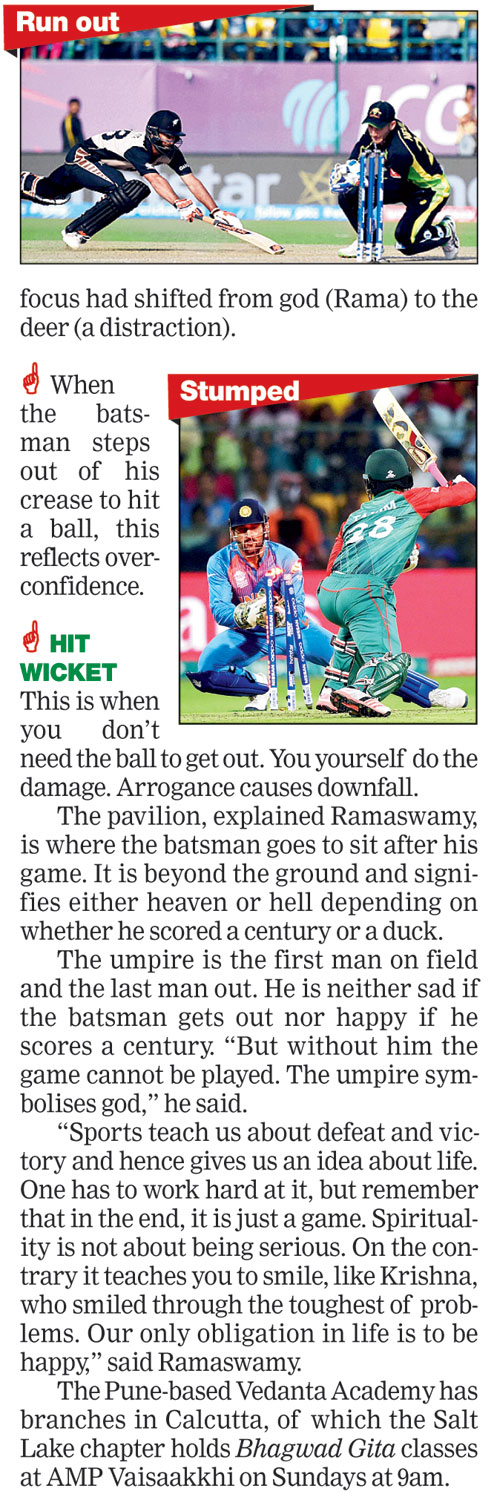
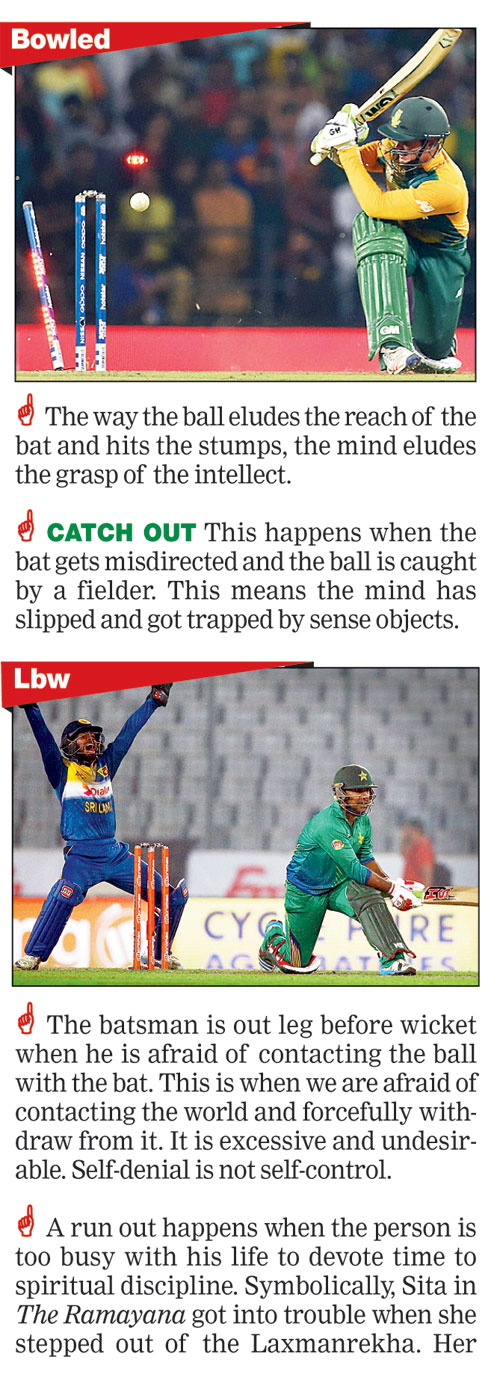
Ramaswamy then picked up every form of dismissal in cricket and found parallels with life —

Cricket01KOLKATA02apr2016

Cricket02KOLKATA02apr2016

source: http://www.telegraphindia.com / The Telegraph,Calcutta,India / Front Page> Salt Lake> Story / by Brinda Sarkar / Friday – April 01st, 2016

Pages from city’s past – Young Metro

The 88-page book with a black-and-white cover may not grab eyeballs, but flipping through it will make one realise what a treasure trove it is.

The first edition of Uttaradhikar, brought out by the Oriental Seminary archive, is not a mere school journal but a compilation of memoirs and tales about the city from a host of writers.

The bilingual publication edited by C.P. Ghoshal, a teacher at the school and in-charge of the archive, took around eight months to put together. “I wanted the contributors to write about Chitpore or their school memories or about the history of Calcutta in the 18th and 19th centuries. A publication by a school that goes back to 1829, should bring out the flavour of the various periods that it has been part of,” he said.

The book, being sold for Rs 50, has write-ups from current and ex-students as well as from historians and researchers. The English essays are by Subha Das Mollick, the founder-member of Bichitra Pathshala, and Mary Ann Dasgupta, an educationist.

Mollick writes about the Our Living Memory project that involved several schools in the city. The project attempted to link family history and collectibles to history textbooks and underline the latter’s relevance in today’s world. Dasgupta takes readers on a tour of St. Paul’s Cathedral and its relics.

Other contributors include historian Soumitra Srimani, researchers Simanti Sen and Rajat Kanti Sur and current student Ayan Ghosh.

There are six write-ups in Bengali – a heady mix of Calcutta in the 19th century, Chitpore’s culture, old boys’ memories and a current student’s journey. The book cover, designed by a former student, is a throwback to Chitpore’s popular woodcut printing.

The book was launched by former student and academician, Ashok Chowdhury, the current principal of the school, Diptiman Kundu, and Srimani at a cultural programme on the school premises.

source: http://www.telegraphindia.com / The Telegraph,Calcutta,India / Front Page> Calcutta> Story / by Chandreyee Ghose / Friday – April 01st, 2016

The call of tabla

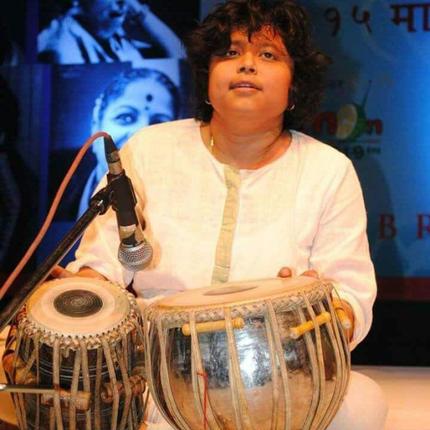
Tabla player Rimpa Siva.

Tabla artiste Rimpa Siva on her passion and why she has no role models.

Hyderabad :

At three, when most of her friends were busy playing with dolls, Rimpa Siva was mesmerised with the sounds of tabla that resonated at home. She would sit next to her father pandit Swapan Siva, a respected tabla artiste and guru in Kolkata as he taught his disciples. “Initially, my father thought I would either choose vocals or some other instrument but never imagined I would take to the tabla,” she reminisces. However, her teacher-father saw the lingering passion in the child and began with the basics of tabla. “He realised my ‘shaukh’ for tabla was not casual and felt if he tutored me, I would take it forward.”

With her father’s guidance, Rimpa Siva was hailed as a child prodigy and she gave a stage performance in Kolkata when she was just eight! She soon started giving performances in music festivals and concerts; a high point was her performance in USA when she was in Standard VI. It was followed by performances in Holland and UK.

As a teenager, did she miss out on going out with friends? “I never felt anything like that. Tabla mera sab kuch hai (It is everything in my life,” she states. Her passion and accomplishments earned laurels and a French documentary titled ‘Rimpa Siva Princess of Tabla’ was made in ’98. “The crew came to Kolkata and shot the documentary in 26 days. They showed my school, the environment, the time I spent for practice and training sessions with my father. The documentary showed how I spend my day,” she recalls with a smile.

Speaking about her riyaaz, Rimpa states, “There is no set time. Sometimes, I practice for three hours. When I play tabla, I am lost in it and do not know how much time I have spent. I guess it is the same in any creative field. When you are passionate, it becomes a part of your being,” she points out.

The 30–year–old says the audience is very appreciative of her tabla concerts. “Woman playing tabla is no big deal for the urban crowd,” she says and adds, “Tabla is not easy to learn. “There is no gender issue but playing tabla requires dexterity and concentration. In singing too, one has to sit for long hours and practice; so that is not an issue. Only thing is we play with the fingers and women’s fingers are delicate,” she explains.

Rimpa belongs to the Farukhabad gharana and delights in playing kaida, peshkar and gat. Her inspiration is her father but she has no role models. “One should strive to be unique and not try to be someone else. If you try to be someone else, that will be a copy,” she smiles.

All-woman band
Formed a year ago, Nari Shakti, an all-woman band is another significant feature of her artistic career. “I play the fusion tabla and there are women musicians playing instruments like Pakhawaj and sitar. I wanted to encourage women musicians to come forward. The response has been good. For this year’s Woman’s Day, we did a show for television in Kolkata on March 17,” she states. Among the tabla artistes across the country, Rimpa makes a mark as a woman tabla artiste. What is unique is the fact that she has carved a place for herself among the male tabla players across the country.

Rimpa adds how music has taught her the truth of life. “I have interacted and observed many people. I have realised that our hearts have to be pure with no malice. If you cause pain to others, that pain will come back to you. One should also never lie and hurt others.”

(Rimpa Siva was in Hyderabad recently for a performance at State Art Gallery as part of the National Exhibition of Contemporary Art 2016.)

source: http://www.thehindu.com / The Hindu / Home> Features> Friday Review / by Neeraja Murthy / Hyderabad – March 31st, 2016