Bob Dylan’s day in Kolkata for a wedding, a Baul for a friend

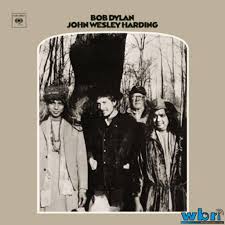
Purna Das Baul (extreme right) and brother Luxman Das Baul with Bob Dylan on the cover of the 1967 album 'John Wesley Harding'
Purna Das Baul (extreme right) and brother Luxman Das Baul with Bob Dylan on the cover of the 1967 album ‘John Wesley Harding’

Think Bob Dylan in a bright red kurta and white pyjamas as a guest at a Bengali wedding. Too far-fetched?

Not quite. While most of Dylan’s life has been an open book, a lesser-known fact is Dylan’s hush-hush visit to Kolkata in the winter of January 1990.

The world’s most legendary song smith flew down to the city to attend a marriage in the family of an old friend and music mate, Purna Das Baul. The baul singer, now 83, had introduced Dylan to the sounds of rural Bengal during his tour of the US in the late 60s. When his son Dibyendu was getting married, Dylan turned up for the event.

“He came to our house in Dhakuria and then travelled with me to the venue in Ballygunge,” recalls Dibyendu. But his visit did not last long. “An hour into the ceremony, people and media got whiff of Dylan being there and as more and more people started inquiring, he rushed out.” Not really in the mood to hand out autographs, “Please, I am here on a private visit… If you don’t mind, I need some rest,” he pleaded before delivering a firm “no” to a starstruck fan.

Purna Das’s association with him began in 1965 when Albert Grossman, Dylan’s manager, invited him to sing at a festival in San Francisco. Das toured and performed at several venues before Grossman took him to Bearsville, Dylan’s hometown.

“That was when our manager brought Dylan to meet us. He said to me that our singing goals were the same since we both sang about people, life and times. Then he gave himself the title `Baul of America’, he showed me his patchwork coat, a lot like guduri, the costume that some bauls wear,” reminisced Purna Das who has been hailed as “India’s Bob Dylan”.

It was the beginning of a long friend ship. “We toured and performed together between 1965 and 1967.”
Baul gaan hit a peak when Dylan rather niftily learnt to pluck the khamak and wield the ektara and jammed with the minstrel from Bengal.

Purna Das and his family were invitees to Dylan’s birthday party in 1978, for which Das compiled a CD of Bengali songs as a gift. “I’m so happy,” Das said about his Nobel. “He has served people with his songs like no other.” It’s difficult, if not impossible, to try and pin Bob Dylan down.

Ever since he burst onto the public consciousness almost six decades ago, he has been many, many people at different times, sometimes all at once, depending on whom you asked: poet, protest singer, reluctant star, desultory prophet, unwilling “voice of a generation”, elder statesman of rock music…. And, now, Nobel laureate.

Kolkata has, for years, loved -and lived -Dylan’s music. Whether it’s the casual listener who only knows the refrain of `Blowin’ in the Wind’ to the serious fan who can sing every verse of ‘Like A Rolling Stone’ without a peek at the lyrics and who can debate, for hours, the snarkiness quotient behind every extended second of “How does it feeeeeeeel”, there’s one of each variety, and possibly every sort in between in the city.

Which is why , perhaps, it is only natural for Dylan to always set off strong emotion and evoke wildly divergent comment. Purna Das Baul, who appears on the cover of Dylan’s 1967 album ‘John Wesley Harding’, is ecstatic with the news. “I am the happiest person in the world now,” says the 83-year-old. But he isn’t surprised. “I’ve seen him up close and personal, having stayed with him in the US back in the Sixties. He invited me and my brother [Luxman Das Baul, who also appears on the cover] when he opened his studio.And he was so fond of us that he put our photo on the album cover. I couldn’t have been happier had I won it myself. But I do feel he deserved it a long, long time ago,” he told TOI, voice quivering with emotion.

It’s exactly because there’ no definitive version of Dylan that he evokes so divergent reactions. To countless critics and fans alike, he has been a genre-changing singer; to others, he’s a brilliant poet who (sometimes) sings and (always) drawls unintelligibly. “I know this is heresy, but I have never been a fan of Bob Dylan’s voice,” says Trinamool MP Derek O’Brien. “His lyrics and poetry are far better than his singing. Getting the Nobel maybe confirms that he is a far better writer than a singer,” he feels. But then, Dylan has never “conformed” to a particular genre, even when he was part of a tradition.Back when he was a folk singer, no one had quite heard anything like him. When he shocked everyone by going electric at the 1965 Newport Folk Festival, Pete Seeger was so outraged that he said he would have cut the cables if he had an axe. Fans booed him. Coming at that time, when rock music was still in its infancy, those reactions were perhaps understandable, especially with the benefit of hindsight. But look closely, and Dylan was undoubtedly scripting the basic framework of modern rock. And this is something that longtime Dyan fan Anjan Dutt also acknowledges. “The moment Dylan entered the rock ‘n’ roll world, he was a protest singer, but he didn’t stop there,” says the singer-songwriter-filmmaker. “He made rock ‘n’ roll more intelligent. Else we wouldn’t have been able to break out of the `I-love-you-you-love-me’ mould.” “Dylan,” Dutt says, “ushered in a new era. His music was not only against war but any sort of inhumanity . The content of `Blowin’ in the Wind’ encompasses climate concerns and worldwide corruption. No band, even The Beatles, would have changed their sound had it not been for the Dylan effect.”

And the Dylan effect is palpable, from The Beatles to Dutt’s own music. “Songs like `Tambourine Man’ and `Like a Rolling Stone’ have had an indirect but distinct impact on my lyrics writing,” confessed Dutt, who believes Dylan’s Nobel was long-awaited, and that he deserves the award for “both peace and literature”.

Dylan belongs to the school of art that’s both “intelligent and sub stantial”, believes musician Amyt Dutta. “He deserves the award. It’s not only his lyrics and thoughts; as a musician, too, he is a legendary , genuine artist,” he feels.

“The award is his due,” believes “India’s Bob Dylan” Lou Majaw, the Shillong-based musician who performs tribute concerts at Shillong and Kolkata on Dylan’s birthday every year. ” Actually, it should have happened 20-30 years back. But better late than never,” he said.

The Dylan effect has been substantial also on those who grew up in the politically turbulent years in Bengal. “I was a student at Presidency between 1969 and 1972, which were tumultuous times,” said Anoop Sinha, a former IIM-Calcutta professor. “Everyone listened to Dylan then, even those who wouldn’t normally listen to English songs,” he recalled. “For us, Seeger’s `We Shall Overcome’ and Dylan’s `Blowin’ in the Wind’ were like anthems.”

Poet Shankha Ghosh would agree. “I was a huge fan of Dylan and liked both his music and lyrics. His winning the Nobel is wonderful news,” he told TOI.

source: http://www.timesofindia.indiatimes.com / The Times of India / News Home> Chennai News> Kolkata / by Mohua Das / TNN / October 14th, 2016
Bengal weaves to make it to UK’s Asia House show

bengalweaveskolk15oct2016

In a bid to showcase to the world the craftsmanship of traditional weaves and tribal work from Bengal and other parts of India, five Indian women running design houses in Britain’s capital have come together to organize an exhibition at London’s Asia House on Sunday.

A software consultant, Rajeswari Sengupta who works with weavers from tribal Bengal will display the products under her label, The Far East Studio.

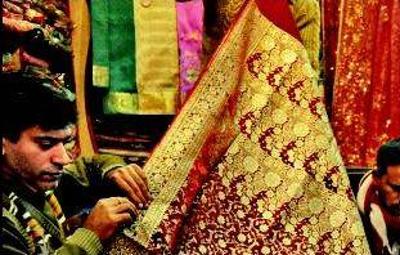
“We have been working with master artisans from different parts of Bengal to revive textile traditions. At the exhibition, I will have an entire collection of hand-woven jamdani from Bangladesh, hand-embroidered kantha, Tangail products for buyers in the UK. There will also be sarees in organic cotton and natural dye, besides other drapes, including silk, by national award-winning artisans,” said Sengupta.

The other designers at the show will be Jyoti Chandhok, who will bring chikankari works from Lucknow, Neetu Jalali who will showcase Kashmiri Pashmina, Josephine Nirmala who will come with her Rajasthani silver jewellery and Dimple Kalla, who will showcase hand-painted furniture.

Hailing from different parts of India, the five designers shifted to London almost a decade ago but they still swear by Indian handloom, jewellery and artefacts. Sengupta said, “The five of us are from different parts of India and we have managed to bring a piece of all the four corners of the country at this exhibition which will have works of weavers, embroiders and jewellery designers from the grassroots level.”

The group’s aim is to support and promote handwoven works. “The UK has seen a lot of big exhibitions where Indian products are showcased in abundance. But this might be the first initiative by Indian women to showcase the works of grassroots weavers and artisans,” Sengupta added.

Apart from the loyal Indian customer base, the exhibition is expected to have a good response from the English as well. “They are very interested in sarees and handwoven textiles. Even stoles, shawls from Kashmir, kantha dresses are quite a rage here. Through these expos, we are looking to create a platform for Indian weavers who can directly interact with buyers,” Sengupta added.

source: http://www.timesofindia.indiatimes.com / The Times of India / News Home> City News> Kolkata / Swasti Chatterjee / TNN / October 10th, 2016

WRITER’S BLOCK – Of love, lust, and death in Calcutta

Every time I visit Calcutta — I prefer to use the old name when I look back fondly at a recent visit — there is something I do without fail. I take a taxi to Kumartuli, where idol-makers are at work round the year, stroll through its lanes before walking along the river up to Baghbazar, where I get into a ferry bound for Howrah station. The boat, carrying anywhere between 100 to 200 passengers at any given time, goes under the iconic bridge to get to the station, where I walk around aimlessly for a while before taking the next boat back.

This is my way of paying tribute to Calcutta, my most favourite city in India, because it owes its existence to the river: it was near Baghbazar that Job Charnock dropped anchor in 1690, and soon Calcutta, the British city, came into being. The best part is it costs next to nothing: one-way fare, until recently, was five rupees, now it is six. The trip invariably takes place at dusk, and most of the time I have company.

So last week, before the roads could get clogged up by Durga Puja festivities, a friend and I arrived at Kumartuli in a yellow taxi to watch the Durga idols being carried away by parties of able-bodied men representing different neighbourhoods of the city. My friend watched the spectacle awestruck: she has lived in Calcutta for 20 years, but this was her first visit to Kumartuli, whereas I started exploring the city as recently as in 2011, and knew much of old Calcutta like the back of my hand.

Before she could take enough pictures her phone died, so I led her through the narrow lanes to the riverbank. We watched the sun — now a gentle orange ball — slowly lower itself behind the buildings on the opposite bank. Once it was no longer a circle but just an orange smudge, we sat on a concrete bench by the river. Conversation is meaningless at such an hour, in such a place — when the day slowly melts into night, and when the river that gave birth to Calcutta changes colours — all you can do is sit in silence and watch the spectacle unfold. But silence was impossible at the moment. We happened to share the long concrete bench with four other people — two men and two women. Since they had identical ID cards hanging from their necks, it was clear that they all worked for the same company. What was equally clear was that they had come on this outing as couples, but it was difficult to decide who was whose girlfriend. One moment it appeared that Ms. C was Mr. A’s partner, but the very next moment it seemed Ms. D was Mr. A’s girlfriend. And then suddenly Mr. B put his arm around Ms. D.

What aggravated my confusion was the conversation (it is so easy to eavesdrop on Bengalis) I could overhear: they were talking about hotels that asked no questions when a man checked in along with a woman — or a woman checked in along with a man.

“Next time you are in Pune, check into such-and-such hotel,” one of the men advised the rest of the gang.

“That hotel?” one of the women retorted, “but they asked me for my entire family history before I could check in.” “How silly of you,” the man rebuked her, “You could have just shown your ID card.”

Precisely at that moment, something came floating down the Hooghly and everybody’s attention turned to it. All along, things had been floating on the river: the ferries, the hyacinths, nobody gave a second glance. But right now, all eyes were fixed on that something — a human body, bloated and skinless — floating down the river.

Crows sat on the body as it glided downstream, pecking on whatever they thought was still edible. Suddenly, I found the silence I was looking for, as the men and women who flirted with lust now contemplated death.

source: http://www.thehindu.com / The Hindu / Home> Features> Metroplus> Society / by Bishwanath Ghosh / Chennai – October 14th, 2016

Threads from Bengal

sareeskolkata14oct2016

Rang Mahal brings to the city the creations of 250 weavers from Nadia

For 19 years now, even before the Durga Puja festivities die down, Sarmistha Das Biswas and her team at Rang Mahal have been getting ready for a hope-filled pre-Deepavali journey. For, they carry the creations of 250 weaver families from Nadia district in West Bengal, who’ve found favour with the Chennai sari-wearing audience.

“People here know the value of cotton,” smiles Sarmistha, who’s coordinating the exhibition, on at New Woodlands Hotel, R.K. Salai. She’s the fifth generation in a family of weavers, and says shows such as these are a great way to link the weaver and wearer. This time around, five weavers have joined the team, and will be at the venue, explaining their craft.

While keeping alive tradition, the team has also tried to fuse in contemporary thoughts — they blend cotton with organic bamboo and banana fibres to create a fabric that is ultra soft and breathes well.

Travelling has exposed the weavers to new thought processes and preferences too. Sarmistha says that most of them are not very educated, and have learnt spoken English from the Bengal Weavers Service Centre so that they can better interact with customers.

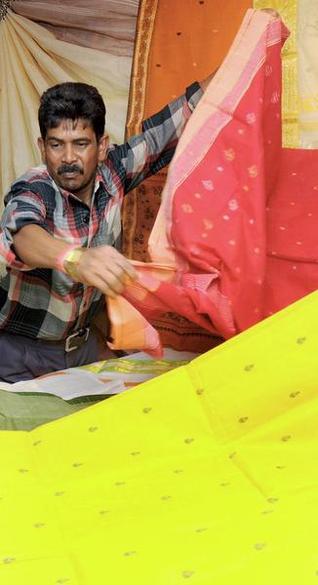
Among the specialities at the exhibition are nakshi tangail saris with colourful borders, hugely popular in Tamil Nadu; jamdani handloom weaves, with detailed work on the pallu; printed Santiniketan cottons; vanya resham or ahimsa silk; and hand-painted saris that replicate the paintings of Jamini Roy and Ganesh Pyne. The best part? All of them can be home-washed.

The weavers have worked for about four months to create this collection of 5,000-odd saris in 550 designs, and customise a colour palette that works well in Tamil Nadu.

“Usually, pastels with vibrant borders do very well here. So, we offer a mix of colour tones,” says Sarmistha. The weavers create patterns on their own, but also take feedback from designers who give them work. This way, their craft improves, she says.

The show is on till October 24 from 10 a.m. to 8 p.m. They accept only cash payments.

source: http://www.thehindu.com / The Hindu / Home> Features> Metroplus / Subha J Rao / Chennai – October 14th, 2016