CSIR develops ‘solar tree’ that can light 5 houses

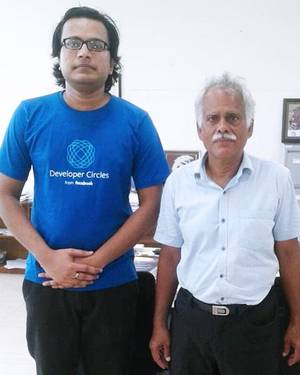
A CSIR laboratory in West Bengal has designed a ‘solar power tree’ that takes up only four square feet of space and produces about three kilowatts (kW) of power, enough to power about five households.

“The challenge was to come up with a design so as to generate more solar power in less land space,” Sibnath Maity, chief scientist at the Central Mechanical Engineering Research Institute (CMERI) in Durgapur, which developed the “tree”, told IANS.

“For one mW of power, one needs five acres of land. To generate 10,000 mW we would need 50,000 acres. Now this poses a dilemma in states like West Bengal and Bihar,” Mr. Maity said.

The “solar tree” was inaugurated on Tuesday by Union Science and Technology Minister Harsh Vardhan during his maiden visit to the CMERI, which is a constituent of the Council of Scientific and Industrial Research (CSIR).

Mr. Maity said one conventional solar photovoltaic system of five kW requires 400 square feet of area.

The three kW solar power tree resembles a tree with branches at different tiers and could be squeezed on rooftops and highways with a space requirement of around four square feet.

“The branches hold up the 30 photovoltaic panels and the system costs around Rs.3 lakh with battery back-up,” Mr. Maity said.

Two solar power trees would be installed at the office at Harsh Vardhan’s bungalow according to the Minister’s request, said Mr. Maity.

Harsh Vardhan also inaugurated the ‘Control Container’ developed by the CMERI for lake and sea trial of ‘Remotely Operated Vehicle (ROV)’.

“I happily took part in live demonstration of the tractors developed by CSIR-CMERI by being literally in the driver’s seat and actually driving one vehicle,” the Minister posted on his official facebook page.

“I lauded the contribution of the institute in Green Revolution with its immensely successful technological achievements — the ‘Swaraj Tractor’ followed by the ‘Sonalika’ and the ‘Krishi Shakti’ I also drove the ‘e-rickshaw’ developed by the institute with great enthusiasm,” Harsh Vardhan added. – IANS


“Challenge was to come up with a design to generate more solar power in less land space”

source: http://www.thehindu.com / The Hindu / Home> News> Cities> Kolkata / IANS / Kolkata – May 21st, 2016
Kolkata artist’s paintings stamp their authority in Germany

Kolkata :

German postal service Deutsche Post AG has issued two postage stamps featuring paintings by an artist from Kolkata.

Sudip Chatterjee, who passed out of the Indian College of Art & Draftsmanship in 1986 after graduating in science from University of Calcutta, was pleasantly surprised when he received a mail from the Deutsche Post headquarters in Bonn, seeking his approval to use two of his paintings in postal stamps. Each stamp is priced 1.45 euro.

Awarded senior fellowship by HRD ministry for 2016-18, Chatterjee was in Germany for an exhibition at Galerie Sabine Neubuhr from May 30 to June 19. He is again due to visit Germany next year for an exhibition at Gallerie Stauferland at Goppingen near Stuttgart from May 31 to June 17.

Chatterjee association with Germany goes back two decades. In 1998-99, he was an artist in residence at the Kuntseminar Freie Hochschule in Metzingen, Germany, and has done several shows in Stuttgart and Berlin, apart from Paris, Mumbai, Delhi and Kolkata.

His Paintings are part of the collection at the National Gallery of Modern Art, Roopankar Museum, Bharat Bhawan and other private and public collections in India, Germany, France, UK, Finland, Austria, Canada and the US.

source: http://www.timesofindia.indiatimes.com / The Times of India / News> City News> Kolkata News / TNN / December 28th, 2017

Drone duo soar in start-up dream Army and city police place orders

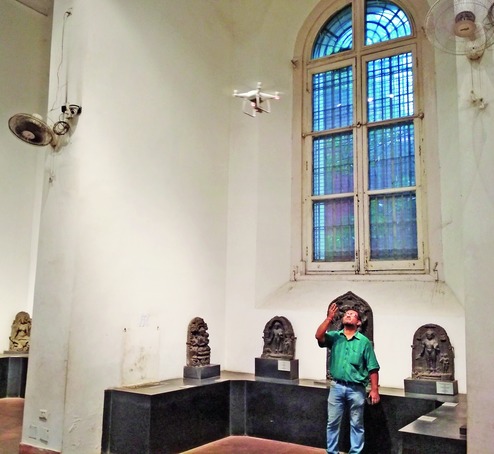
A drone from RC Hobbytech Solutions Pvt Ltd being tested at the Indian Museum

Calcutta:

A start-up born out of a career setback has started soaring on the rotor blades of drones.

RC Hobbytech Solutions Pvt Ltd, started by two friends, specialises in building unmanned aerial vehicles, commonly known as drones, and has already bagged orders from the Indian Army, the railways and Calcutta police, among others.

Flooded with contracts, the fledgling start-up is servicing these orders with a soft loan from IIM Calcutta, project-based finance from banks and the Rs 1.5 crore it won in a competition launched by Balmer Lawrie under the Startup India scheme in November.

For co-founder Biswajit Dey, a graduate in aeronautical engineering from St Peter’s University in Chennai, RC Hobbytech was a seed sown by the disappointment of missing out on a chance to join the Army Aviation Corps because of an accident that put him in hospital for three-and-a-half months.

A dejected Biswajit came to Calcutta to meet his school friend Ritesh Kanu, who had just graduated in business management from Techno India Salt Lake and was to appear for an interview at the RBI.

Ritesh didn’t go for the interview. Instead, he and Biswajit decided to launch their start-up.

“I liked making drones and fiddling with them while Ritesh was trained to market them. That made us a good team,” said Biswajit, who learnt the basics of drone technology in college. “There is a huge market for unmanned aerial vehicles in agriculture, surveillance and mining,” said Ritesh.

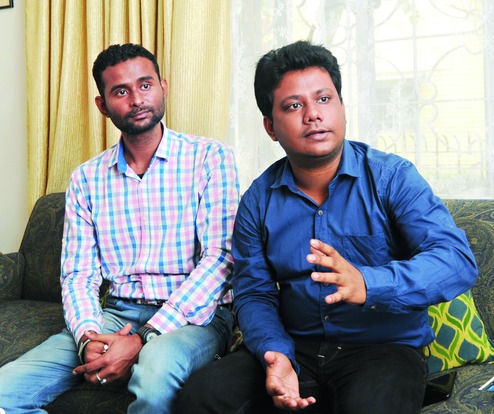
Co-founders of RC Hobbytech Solutions Pvt Ltd Biswajit Dey and (right) Ritesh Kanu.
Picture by Sanat Kr Sinha

RC Hobbytech is working on drone technology to replace the army’s system of detecting intruders along the country’s vast borders. “The army sets up poles with two free-hanging bottles to detect intruders. Whenever an infiltrator tries to cross a border fence, the bottles make a noise and alert the sentries at the forward post. They have electric fences but the wiring can be cut and the alarm system switched off,” Ritesh said.

The start-up’s Drones Tech Lab division has devised an Intruder Detection System based on GPS for the army. The system sends alerts to the forward post and control room in three seconds whenever an intruder is detected. The information includes the exact position of the suspected infiltrator.

“Our system is based on sensors and also sends messages over mobile phone, giving the correct location,” said Biswajit.

A pilot run of the system at Udhampur in Kashmir from March to April earned a letter of appreciation from the army, Biswajit said.

He is currently modifying the system to give it an industrial finish along with camouflage.

From a drone start-up, Biswajit and Ritesh are now a “solutions provider in surveillance industry, leveraging unmanned technology and integrating hardware, software and data analysis”.

They had started with a capital of Rs 4 lakh in 2014 and ended up burning the cash in a year. When their families started asking what they were up to, the duo stopped going home. They then floated a company called EduRade to teach drone technology in institutes and raise money. “It was in 2016 that we pitched for incubation at IIM Calcutta. We met Subhranghshu Sanyal, CEO of the IIMC Innovation Park, at an event and he liked our product. We were incubated in October 2016,” Biswajit recalled.

Sanyal is impressed with what the duo have done so far. “They are providing real-time solutions to problems that are quite risky for human beings to solve. Their work for the army takes risk away and improves accuracy, which is fantastic,” he said.

source: http://www.telegraphindia.com / The Telegraph, Calcutta,India / Home> Calcutta / by Anasuiya Basu / December 28th, 2017

City girl under Gopi’s wing

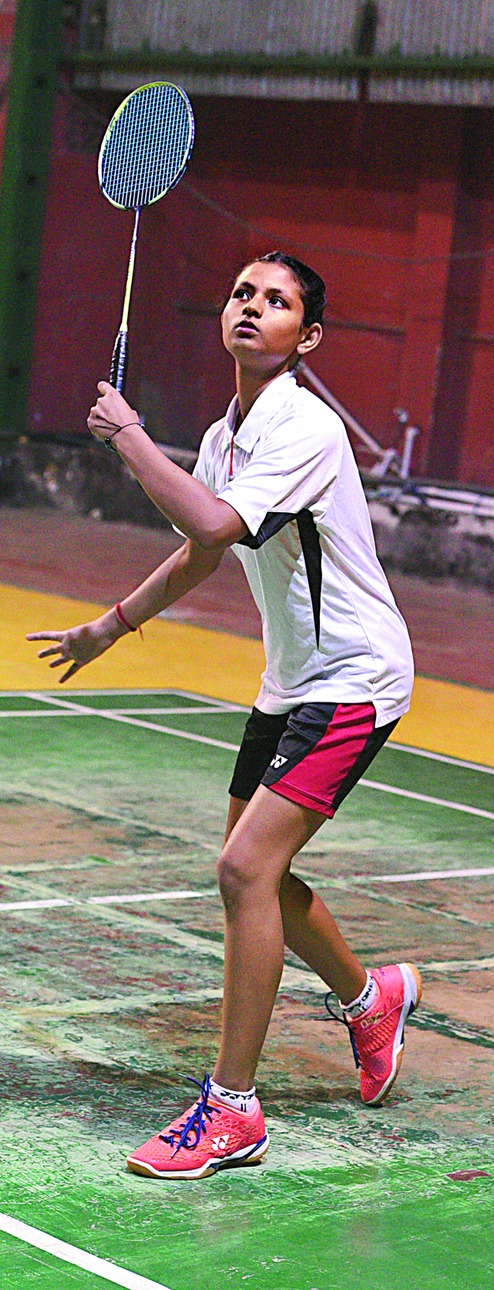
Shreya Tiwari at a practice session at Park Circus Byam Samiti. (Rashbehari Das)

Calcutta:

She is just 13 and has reached some milestones that teens at her age can hardly imagine.

Meet Shreya Tiwari, a Class VIII student of Indira Academy, who recently won an under-15 state badminton championship in Raiganj and reached semis of another under-15 state-level tournament in Durgapur. She has been training under Pullela Gopichand, the Dronacharya of Indian badminton for the past one and half years.

Shreya started playing the game six years ago as her father felt she must engage in a sport to stay fit. “Just a few days after she started training under coach Tapas Biswas at Park Circus Byam Samiti, the coach called me up and told me ‘she has a great potential, she will surely play for India’. Shreya also fell in love with the game soon after joining the coaching centre,” said Sanjay Tiwari, the father, who is the founder-principal of Indira Academy.

Shreya, a big fan of Srikanth Kidambi, started playing district-level tournaments in 2012 and just after a couple of years of playing at district level, she started playing at state and national level. “Shreya is very sincere and passionate about her game. She is a fast learner. She started winning state-level tournaments at the age of nine, which is really commendable,” said coach Biswas.

source: http://www.telegraphindia.com / The Telegraph, Calcutta,India / Home> Calcutta / by Ayan Paul / December 27th, 2017

Besties bring gold for Bengal Rowing duo may move out for better facilities

Shreya Iyer and (right) Aishwarya Krishnan

Rabindra Sarobar:

A pair of childhood best friends whose special bond extends to competitive rowing have just fulfilled their dream of becoming national champions.

Aishwarya Krishnan, 19, and Shreya Iyer, 20, together won Bengal’s only gold medal in the Senior National Championships in Pune from December 6 to 11. The duo defeated Chandigarh and Odisha in the 500m women’s double sculls with a timing of 1:43.5.

Metro had highlighted the girls’ journey through friendship and rowing on February 6 after they won a silver medal in the same event of the previous national championships.

“The Odisha team had Asian medallists. Beating them to win gold this time was extra special,” said Aishwarya, who is studying in St. Xavier’s College.

Since becoming partners in double sculls in 2015, the two of them have won several tournaments but losing to Odisha in the Bhopal championships had hurt.

The night before the rematch, Shreya lost count of the number of times she woke up. “I was super pumped up, all adrenaline!” Shreya, who is in Loreto College, recounted.

Aishwarya said her mind was blank. “I just wanted to give 100 per cent.”

On December 10, the Bengal duo led from start to finish. The celebrations were briefly halted by Aishwarya throwing up – she blames it on one egg too many for breakfast – but the pair later took the Bengal contingent out for a pizza lunch.

What clicks for the pair is their chemistry. “I can go all out for her and she for me. What you need in a team game comes to us naturally,” said Shreya, who also loves to play the violin.

Their next target? Doing well in 2000m events.

They are considering moving out of Bengal because it lacks a water strip for 2,000m practice.

source: http://www.telegraphindia.com / The Telegraph, Calcutta,India / Home> Calcutta / by Debraj Mitra / December 27th, 2017

IIM reunion kicks off

Joka:

The IIM Calcutta’s 1992 alumni returned to the campus on Saturday to relive their student days with batchmates Sonya Dutta Chowdhury and Swati Kaushal who chucked corporate careers to turn authors.

Each year, winter marks the homecoming of the batch that graduated from Joka 25 years ago. And the occasion is called “Reminiscence”.

The reunion started with a two-day carnival that would include a guided tour of the campus, a discussion with the director and dean, interaction with former professors and current students among others.

“I cannot imagine being a writer without my stint in the management school,” Kaushal told her batchmates. “Because I went to management school, worked with Nestle, interacted with advertising agencies, I was subjected to a lot of communication… that’s what brand management is about.”

Dutta Chowdhury said: “MBA teaches you a lot of communication, writing, analysis and storytelling.”

Instances of IIM graduates shunning corporate careers to turn authors is not new, though. Amish Tripathi, who was at IIM Calcutta to collect the distinguished alumnus award on November 14, is perhaps the most successful example with his Shiva trilogy.

source: http://www.telegraphindia.com / The Telegraph, Calcutta,India / Home> Calcutta / by Special Correspondent / December 24th, 2017

Docspeak on Hepatitis cure 12 weeks for treatment

Calcutta:

Hepatitis C is now curable with 12 weeks of treatment and the chances of developing liver cancer from Hepatitis B has gone down, a professor of medicine from Weill Cornell Medicine said here on Saturday.

The most common liver disease in the world now is non-alcoholic fatty liver disease that can develop because of obesity, excess fat and genetic factors, Patrick Basu said.

“There are medicines that can cure Hepatitis C in 12 weeks. Vaccines can reduce the chances of development of cancer from Hepatitis B. There is a lot of advancement in treatment of hepatitis,” Basu told Metro.

Basu was in Calcutta to speak at a seminar for doctors at the Belle Vue Clinic.

Both Hepatitis C and Hepatitis B are viral infections.

Hepatitis C is a blood-borne virus and modes of infection include unsafe injection practices, unsafe health care, and the transfusion of unscreened blood and blood products, according to the World Health Organisation.

Hepatitis B is a potentially life-threatening liver infection. The Hepatitis B virus is transmitted through contact with the blood or other body fluids of an infected person.

When non-alcoholic fatty liver disease worsens, it can cause cirrhosis, a doctor said. It is possible to reduce the amount of fat in liver if detected early. Ideally, the liver should have no or little fat, he said.

Arun Sen, a professor in the Texas A&M University, spoke of the benefits of telemedicine in Bengal where doctors are few in rural areas.

Saurabh Kole, in-charge of Belle Vue’s intensive care unit, said the hospital was trying to create an organised platform of doctors for telemedicine in the state.

source: http://www.telegraphindia.com / The Telegraph, Calcutta,India / Home> Calcutta / by Staff Reporter / December 24th, 2017

Diagnosing early-stage cervical cancer using artificial intelligence

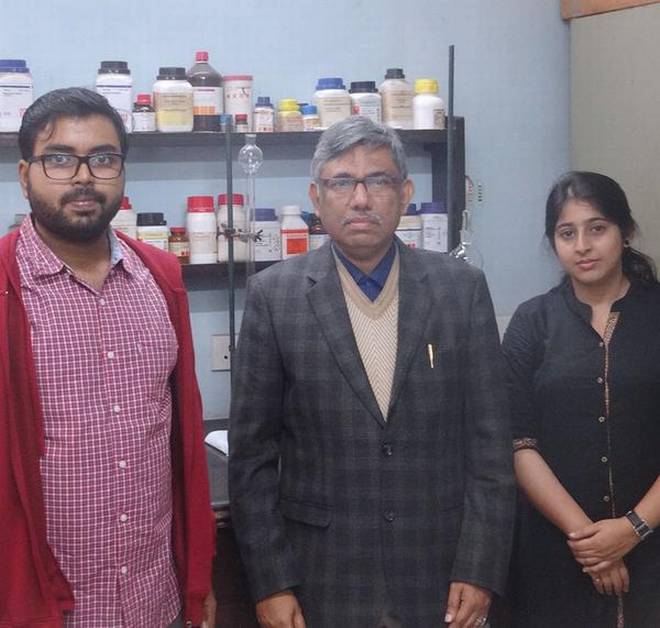
New approach: “The change in tissue morphology as the disease progresses can be picked up by light scattering,” say Prof. Prasanta K. Panigrahi (right) and Sabyasachi Mukhopadhyay

The AI identifies precancerous tissue, and also the stage of progression in minutes

The morphology of healthy and precancerous cervical tissue sites are quite different, and light that gets scattered from these tissues varies accordingly. Yet, it is difficult to discern with naked eyes the subtle differences in the scattered light characteristics of normal and precancerous tissue. Now, an artificial intelligence-based algorithm developed by a team of researchers from Indian Institute of Science Education and Research (IISER) Kolkata and Indian Institute of Technology Kanpur makes this possible.

The algorithm developed by the team not only differentiates normal and precancerous tissue but also makes it possible to tell different stages of progression of the disease within a few minutes and with accuracy exceeding 95%. This becomes possible as the refractive index of the tissue is different in the case of healthy and precancerous cells, and this keeps varying as the disease progresses.

“The microstructure of normal tissue is uniform but as disease progresses the tissue microstructure becomes complex and different. Based on this correlation, we created a novel light scattering-based method to identify these unique microstructures for detecting cancer progression,” says Sabyasachi Mukhopadhyay from IISER Kolkata and first author of a paper published in the Journal of Biomedical Optics.

Elaborating on this further, Prof. Prasanta K. Panigrahi from IISER Kolkata and corresponding author of the paper says: “The collagen network is more ordered in normal tissues but breaks down progressively as cancer progresses. This kind of change in tissue morphology can be picked up by light scattering.” White light spectroscopy (340-800nm) was used for the study.

Statistical biomarker

The change in scattered light as disease progresses is marked by a change in tissue refractive index. The team has quantified the changes in tissue refractive index using a statistical biomarker — multifractal detrended fluctuation analysis (MFDFA). The statistical biomarker has two parameters (Hurst exponent and width of singularity spectrum) that help in quantifying the spectroscopy dataset.

While MFDFA provides quantification of light scattered from the tissues, artificial intelligence-based algorithms such as hidden Markov model (HMM) and support vector machine (SVM) help in discriminating the data and classifying healthy and different grades of cancer tissues.

“The classification of healthy and precancerous cells becomes robust by converting the information obtained from the scattered light into characteristic tissue-specific signature. The signature captures the variations in tissue morphology,” says Prof. Panigrahi.

“The MFDFA-HMM integrated algorithm performed better than the MFDFA-SVM algorithm for detection of early-stage cancer,” says Mukhopadhyay. “The algorithms were tested on in vitro cancer samples.”

In vivo samples

The team is expanding the investigations to study in vivo samples for precancer detection. While the accuracy achieved using in vitro samples was over 95%, based on a study of a few in vivo samples the accuracy is over 90%.

“In the case of in vitro samples we were able to discriminate between grade 1 and grade 2 cancer,” says Prof. Nirmalya Ghosh from IISER Kolkata and one of the authors of the paper. “More testing is needed using in vivo samples.”

“Superficial cancers such as oral and cervical cancers can be studied using this technique. And by integrating it with an endoscopic probe that uses optical fibre to deliver white light and surrounding fibres to collect the scattered light we can study cancers inside the body,” says Prof. Ghosh.

source: http://www.thehindu.com / The Hindu / Home> Sci-Tech> Science / by R. Prasad / December 23rd, 2017

IACS develops hydrogel to remove toxic dyes and metal ions

Useful tool: “The hydrogel can be used by the industries for effective treatment before wastewater disposal,” says Prof. Arindam Banerjee (Centre)

It could begin absorbing dyes within 15 minutes, metals in about 6 hours

Scientists from Indian Association for Cultivation of Sciences (IACS), Kolkata, have developed a new gel that can remove toxic organic dyes and metal ions from waste water. They found the hydrogel began absorbing various commonly used dyes within 15 minutes. The dyes tested were malachite green, congo red, brilliant blue and rhodomine B. In the case of metals, the hydrogel was able to considerably remove commonly found ones such as cobalt and nickel from industrial effluents in about six hours.

Basic amino acids like leucine and phenylalanine were used to make the gel; the gel is biodegradable. It was stable at room temperature and remained as a gel for several months.

Effective treatment

The current methods used for treating wastewater — adsorption using activated carbon, chemical precipitation or electrochemical techniques — are largely ineffective due to incomplete removal or high energy requirements. In comparison, the new hydrogel-based material is able to remove the hazardous waste effectively as it has high water permeability, large surface area for adsorption and is also simple to use.

“We monitored the uptake capacity of the hydrogel using UV spectroscopy and found that within a few hours the gel absorbed the dyes and the waste water turned almost colourless. The hydrogel can absorb the wastes for up to 60 hours before reaching a saturation point. The gel was able to remove 78-92% of the dyes and more than 80% metals ions,” explains Nibedita Nandi, research scholar at IACS and first author of the paper published in Peptide Science.

Reusable resource

“The hydrogel can be washed with sodium bicarbonate and ethyl acetate and reused. As the dyes and metal ions are soluble in water they get washed out from the gel and the hydrogel can be used for up to four cycles. It can be used by the industries for effective treatment before wastewater disposal,” says Prof. Arindam Banerjee, senior professor at the Department of Biological Chemistry, IACS, and corresponding author of the paper.

The researchers say that the production of the gel can be scaled up to the desired volume for use in water treatment at industries.

source: http://www.thehindu.com / The Hindu / Home> Sci-Tech> Science / by Aswathi Pacha / December 23rd, 2017

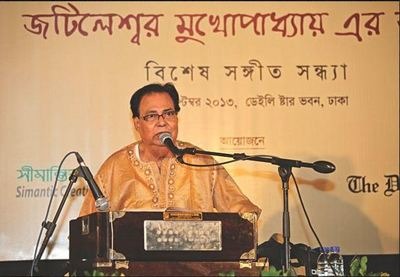
Bengal mourns the demise of veteran singer-composer-songwriter Jatileshwar Mukhopadhyay

Kolkata :

With the demise of Jatileshwar Mukhopadhyay, Bengal lost one of the most eminent personalities from the golden era of music who had the rare distinction of being a singer-composer-songwriter. Eighty three-year-old Mukhopadhyay succumbed to multi-organ dysfunction at a city nursing home on Thursday. He is survived by wife Sabita, daughter Subha and son Raja.

Born on December 13, 1934, at Chandernagore, Mukhopadhyay received his training under Satinath Mukhopadhay and Chinmoy Lahiri. Once he started working from the 60s, he created a niche for himself by writing the lyrics of 2000 songs and setting 1500 of them to music. Few know that he found inspiration in Mehndi Hassan’s ghazals.

While his own songs became popular, he churned out a number of hits when composing songs for Sandhya Mukherjee, Arati Mukhopadhyay, Haimanti Shukla, Banasree Sengupta, Pintu Bhattacharya, Sreeradha Bandopadhay and Pt Ajoy Chakraborty. Connoisseurs of modern Bengali songs remember his compositions like ‘E kon sokal rater cheyeo ondhokar’, ‘Keu bole falgun, keu bole polasher’, ‘Aamar swapan kinte pare’, ‘Aaami phoolke jedin dhore’, ‘Tomar songe dekha na hole’, ‘O sojon haay’ and ‘Amar onge jole’. His ‘Bodhua amar chokhe jol enechhe hai bina karone’ was a cult song and years later when Srikanto Acharya recorded it again, it generated equal interest among a new generation of listeners. Mukherjee had scored the music for Raja Sen’s ‘Damu’.

Tapan Basu, his disciple for over two decades, also highlighted his contribution as an author. “He has written Bengali essays and plays. ‘Krishnakumari Katha’ was a popular musical written by him. A lot of his research-based articles have been published as books. He also wrote in-depth articles on Begum Akhtar, Pankaj Mullick, Sudhin Dasgupta, Nachiketa Ghosh, among others,” Basu said.

Mukhopadhyay’s demise was deeply mourned by his music lovers. Composer Joy Sarkar described him as a most “underrated” talent who never got his due during his lifetime. Poet-and lyricist Srijato described Mukhopadhyay as a “smart” composer. “His compositions were smart, his lyrics had depth. He knew the art of expressing a lot while using few words. He is a perfect example of how to use knowledge with restraint,” Srijato said. Borrowing his own lyrics, noted elocutionist Urmimala Bose said: “Tomar songe dyakha na hole, bhalobashar deshta amar dyakha hoto na”.

His mortal remains will be kept at Rabindra Sadan on Friday to allow the people to pay their last respects before his final journey.

source: http://www.timesofindia.indiatimes.com / The Times of India / News> City News> Kolkata News / by Priyanka Dasgupta / TNN / December 22nd, 2017