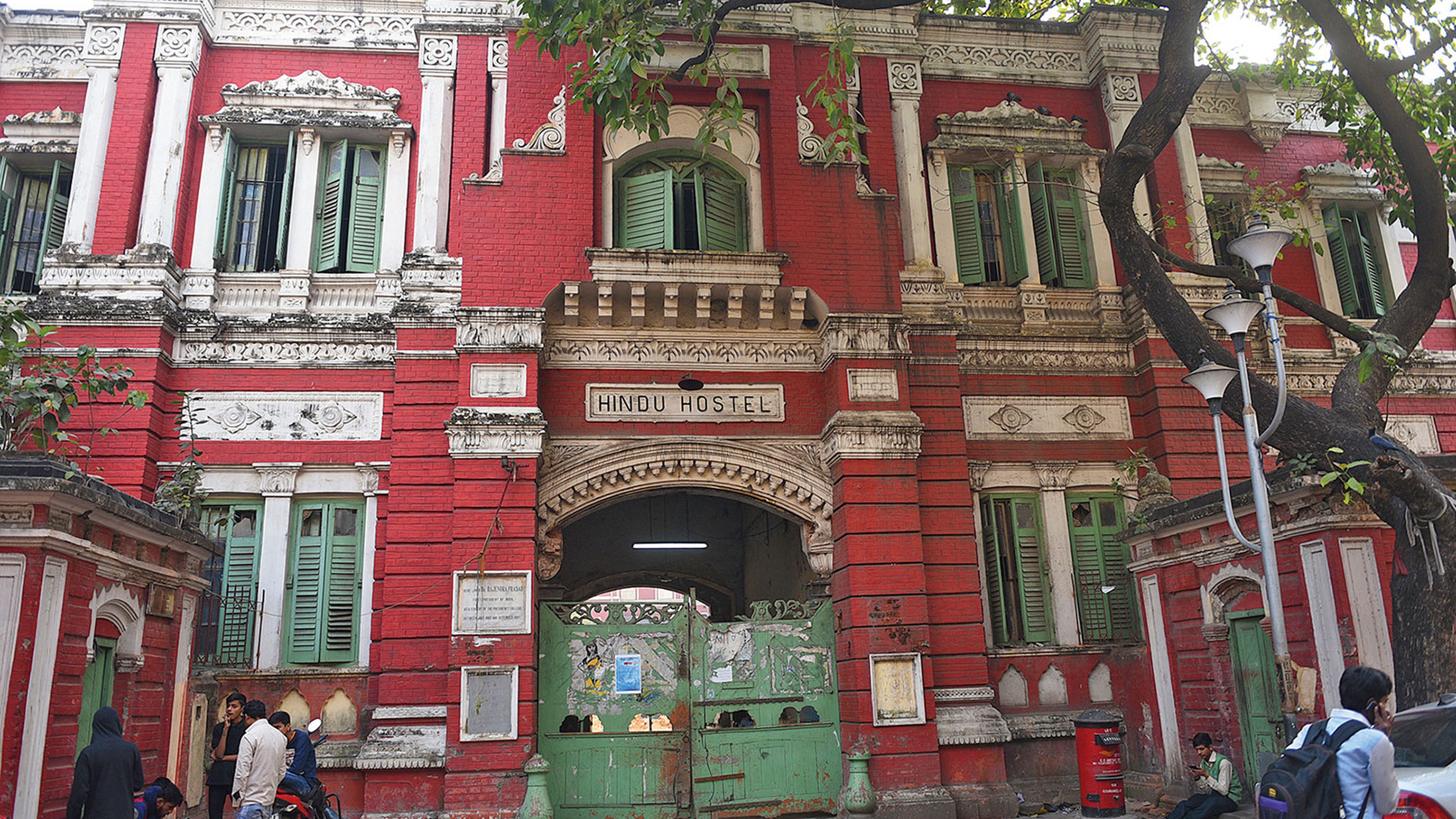
Here lived Dr Rajendra Prasad

At a time when Calcutta’s Hindu Hostel is the subject of controversy, Moumita Chaudhuri chronicles the good ol’ days
Hindu Hostel /
Telegraph file picture

In July 2015, Eden Hindu Hostel for male students of Calcutta’s Presidency University, Maulana Azad College, Sanskrit College and Goenka College of Commerce and Business was vacated for repair work. Three years on, it is yet to be reopened. On August 4, students launched a protracted protest. On September 11, the annual convocation had to be shifted after angry students locked the university premises. And Governor Keshari Nath Tripathi chose not to attend the off-campus abridged event.

In the heart of north Calcutta’s College Street area stands the red building with green fenestrations. A plaque outside it reads: Here lived Dr Rajendra Prasad first President of India as a student of the Presidency College between July 1902 and December 1907. Once you enter the premises, you realise Eden Hindu Hostel is not just one building. There is the main building that houses wards 1 and 2. Another to its east houses three more wards. Construction of a hostel for postgraduates began in 1988 and took seven years to complete. Many old boarders were shifted to this one.

Heritage conservationist and architect Partha Ranjan Das’s firm is overseeing the repair and restoration of a part of the hostel. Das says, “The older buildings take after early 19th century British colonial architecture. They display the soft style of the late Baroque era.” According to Das, when his firm assumed charge in 2015, it came to light that a lot of additions and alterations had been made. “Such interventions are not allowed while restoring a heritage building,” he says. “Additions were made to the original structure, which we have removed. The buildings cannot withstand extensions like these,” he adds.

The hostel was more than a boarding and lodging space for students. It was a place of bonhomie, politics and spirited debate. It was also a creative space. From the centenary publication of Presidency College, we learn that the hostel ran a bilingual magazine called Suhrid in 1894. There are references to an assembly of poets till the late 19th century. There was a keen rivalry between the wards, each of which ran its own manuscript magazine with names such as Sense and Nonsense and Highland Review. All the wards would come together for Saraswati Puja.

This is the space where friendships were struck and history was made. Scientist Meghnad Saha met freedom fighter Jatindranath Mukherjee aka Bagha Jatin here. Says Swapan Chakravorty, distinguished professor of Presidency University and former director-general of National Library, “Those days, caste seating was followed in the dining hall. Saha felt discriminated against and left the hostel in protest.” More stories. Nationalist and founder of the Congress, Surendranath Banerjee, was a student of Doveton College but would frequent the place. When deputy superintendent of police Basanta Kumar Chatterjee was murdered in 1916, the hostel was raided. No one could be nailed though. Much later, during the Naxalite movement, eight boarders were expelled. “A movement coagulated around this expulsion,” says Chakravorty.

Jyotirmoy Pal Chowdhury, director and chairman of the Institute for Civil Service Aspirants, stayed here in the 1950s. Those days, the boarding charge for a ground floor room was Rs 5, first floor and second floor room charges were Rs 7 and Rs 8, respectively. The monthly charge for food was Rs 32. (In 2015, the monthly charge including lunch and dinner was Rs 1,500.)

Pal Chowdhury talks about student politics and how any boarder contesting elections was sure to win. He recalls the time when college senior Amartya Sen asked him to contest elections. He talks about the canteen. How each of the five wards had a kitchen representative who would go grocery shopping, decide on the menu and arrange for a monthly feast. With relish he recalls the menu, obviously hungry for a taste of those times — “Pulao, luchi, two kinds of fish, mutton, doi-mishti and dilkhusha paan that was sold at the college gate.” He has his own hand-me-down hostel tales — “Scientist Satyen Bose would play football in the adjoining field. He used to be the goalkeeper.”

The condition of the hostel deteriorated in the 1990s. Debarshi Das, a professor of Economics at IIT Guwahati, was a boarder during those years. He recalls the thick walls, high ceilings, “big rooms” sans fans. He says, “We used to rent DC fans (AC fans were not easily available on rent). You had to stick carbon sticks that would not last long.”

Chakravorty says that by 2000 most government grants dried up. The here and now we piece together from students. Sayan Chakraborty, a final-year PG student, says, “The hostel was in very bad state when we vacated the rooms in 2015. There were 250 boarders staying in all 123 rooms. Each room was heavily partitioned with possibly Burma teak wooden panels.”

Das has not seen any Burma teak partition, only “low quality wooden panels”. He says, “Each room is as big as a big classroom with 15-foot high ceilings, and teak doors and windows. The staircase is all mahogany. We have tried to put back the heritage building with minimum intervention to its original structure. But we did not get the original plan of the heritage structure and so we had to use our judgment in some of the cases.”

Currently, the Eden Hindu Hostel stands heavily guarded. Students are continuing with their fast. Vice-chancellor Anuradha Lohia said earlier this month that it would take another 4-5 months to do what was not achieved in the last three years — make the place “habitable and safe”. Last week, however, after one of the fasting students had to be hospitalised, the state government ordered that Building 1 be readied by November 15 and the university comply with the set deadline.

Pal Chowdhury had told us of the climate and culture of Hindu Hostel from his times, “We did not believe in fighting. We believed in debate. We were the Argumentative Indians.”

Hindu History

A hostel for students coming to Calcutta was the brainchild of college teacher Pearycharan Sarkar

He set up a boarding house on Bowbazar Street in north Calcutta, followed by the first students’ hostel on the same street in 1861

It was for male Hindu students. The Baker Hostel which came up in the early 20th century took in Muslim students from Maulana Azad (then Islamia College)

In Calcutta in the Nineteenth Century: An Archival Exploration, Bidisha Chakraborty writes that more than a decade later, a piece of land was earmarked for the Eden Hindu Hostel

It was named after Lt General of Calcutta Ashley Eden, who led the campaign to raise funds

The ground floor came up in 1886. In 1898, the British Government took it over

In 1947-48, it was thrown open to students of other colleges too.

source: http://www.telegraphindia.com / The Telegraph,Calcutta,India /’ Home> Heritage / by Moumita Chaudhuri / October 07th, 2018
A Long Shot: Veteran cameraman who worked with Ritwik Ghatak, Satyajit Ray

When it comes to the film industry, some people routinely remain out of focus

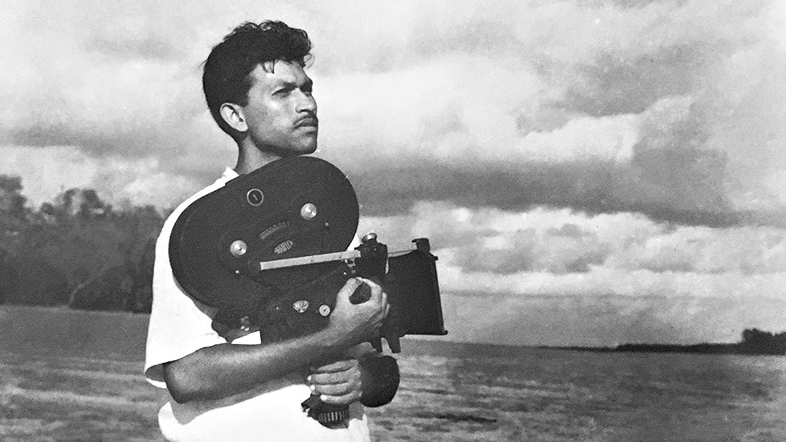
Lens craft: Gour Karmakar

The difference between good and genius often lies in the breach of sanity. Gour Karmakar comes across as an incredibly sane and rooted individual. The veteran cameraman, who has worked in the Bengali film industry and for a bit in Hindi films too — since the late 1950s — sits down to tell his story.

We are all agog with excitement. After all, here is a man who started out as a third assistant and worked his way right up. The 84-year-old has been part of the units of some great directors: Ritwik Ghatak, Tapan Sinha, Mrinal Sen, Satyajit Ray — “Only Samapti,” he clarifies. He has seen Uttam Kumar in action, Suchitra Sen too in Debi Choudhurani, Fariyad, Chhabi Biswas, Pahari Sanyal. His “boss” was the renowned cinematographer Dilip Ranjan Mukhopadhyay, whose works include Ghatak’s Komal Gandhar, Subarnarekha, Sinha’s Atithi, Sudhendu Roy’s Saudagar — “When Bachchan was not yet Bachchan,” Karmakar says. He assisted K.K. Mahajan in Basu Chatterjee’s Rajnigandha. These days, however, Karmakar attends memorial meets, pays visits to bedridden colleagues, attends felicitation ceremonies.

Somewhere near the beginning of our conversation, it becomes evident that our man has planned out his entire narration. At point X, a tea and samosa break. At point Y, he will bring out the cameraman’s logsheet. At point Z, the spools of film, the cinema booklets with the complete credit line. These props, if you will, have been chosen and carefully spaced out to keep his story in sharp focus.

He shows us a notebook with page upon page of numbers written out in a neat hand and an all-cap header that reads “Depth of Focus”. He worked meticulously on his camera skill to get it right — worked, took notes, observed, took more notes, compared results. “A roll of film was expensive then. One didn’t want to take lame shots and waste film. There was also the fear that the bossman would tick you off,” he says earnestly.

We try to pry Karmakar away from the focal length of it all, try to get him to tell us some of the stories. How he ditched the job at the Port Commission and started work as a third assistant — pushing the Vinten trolley and others, marking the spot where an actor or actress must stand in accordance with the way the lighting had been imagined, observing the camera caretakers, the focus poolers.

He sees our expression and throws in an explainer — “Those days, unlike these digital times, you couldn’t see the image on the monitor, which is why it was imperative that one developed a sense of measure and accuracy.”

Now he is in the throes of nostalgia and as it happens with every telling, more and more details come into the line of sight. Karmakar cannot pick and choose, that is not his craft, he is master of focus alone.

One moment he is in the present — “You would have read about Kalpana Lajmi’s death. The newspapers have not written about her first film, a documentary on director Dhiren Ganguly titled, DG. I was the cameraman.” The next minute he is back in the past, talking about how in all his time in the industry he has never seen another director like Ghatak. “He did his own framing,” he says. He is looking at us, talking to us, but it is evident he is back in that time. “Ritwikda called me Goura. He smoked a lot.” Jerky, disconnected frames. A lot of senior directors from that time eventually started to operate the camera themselves. Karmakar says with only as little disdain as his gentle persona will permit, “But I am sure they would have never been able to operate a Mitchell camera. We have worked with Mitchell, Arriflex, Beaulieu cameras.”

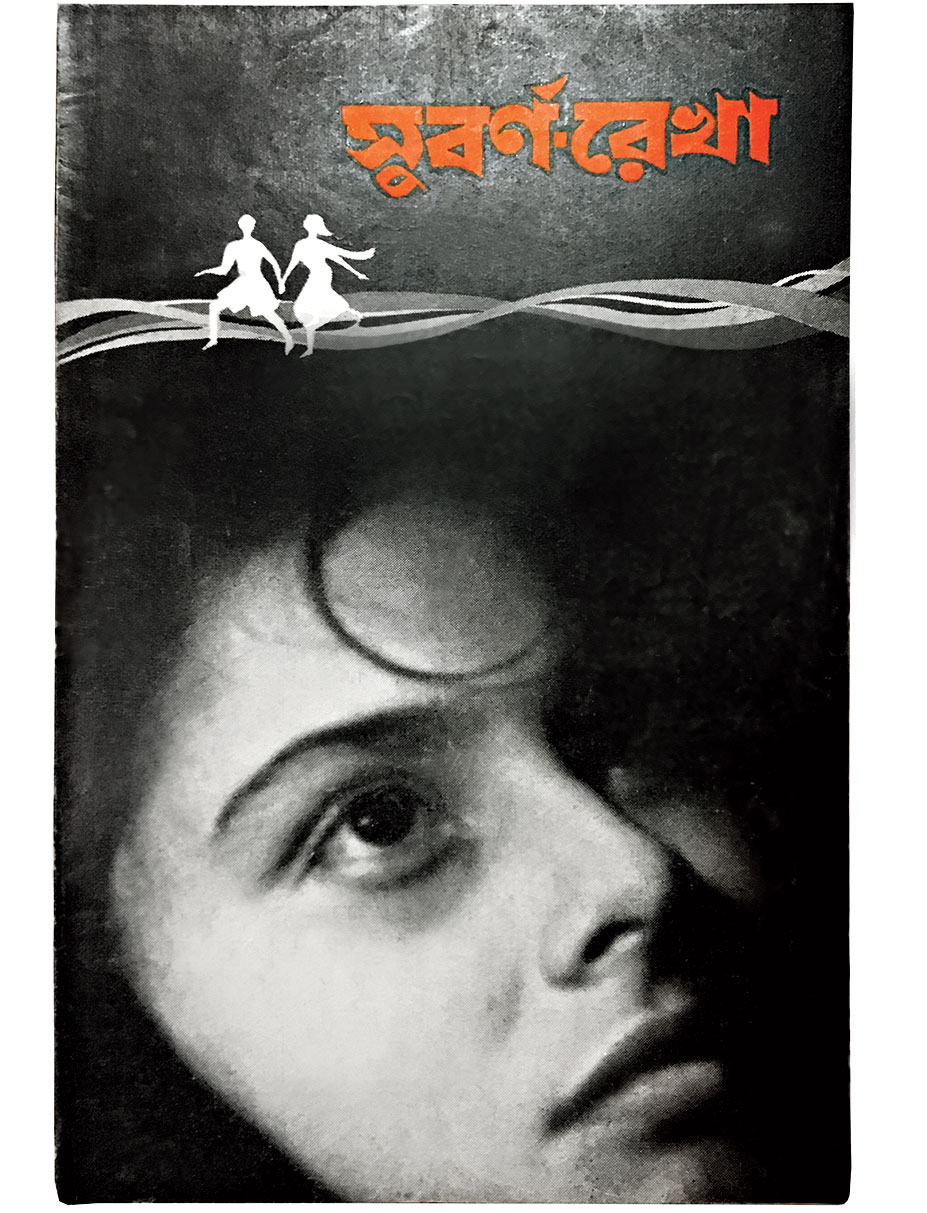
Booklet of Ritwik Ghatak’s Subarnarekha with Madhabi Mukherjee on the cover
Gour Karmakar

He talks about the weight of those cameras, stand et al. “Easily 60 kilos.” And the “association”, a reference to the Eastern India Cinematographers’ Association set up for technicians to share knowhow. He says how “senior artistes” co-operated without a murmur and make-up men had knowledge of lighting. He is crafting a portrait of an industry as a family.

Next, he brings out letters of appreciation from Ray, Sen, Sinha. Not to boast, for there is nothing of the show-off about him. He barely talks about the films wherein he was the cameraman — Saheb, Atmaja, Debi Garjan, etc. He has worked on documentaries — on Uday Shankar, Benaras, the Sundarbans, coal.

Among the letters is a long typed note from British photographer Denny Densham, who has worked with Karmakar in some documentaries. Karmakar caresses the paper, wipes a spontaneous tear and hands it to us. It reads, “It was a pleasure to view your rushes which contained nicely balanced compositions, and some first class close-ups. There was not a soft focus shot anywhere, the pans were smooth, and everything looked good, so pat yourself on the back for me.” It is dated 1981.

Karmakar murmurs, “The problem is no one now has an idea what our work then entailed. How invested we were in it all.” He adds, “I tell my daughter to look after all of this when I am gone. And then again I think, when I am gone, I will not care about all this anymore.”

source:http://www.telegraphindia.com / The Telegraph,Calcutta,India / Home> Culture / by Upala Sen / September 30th, 2018

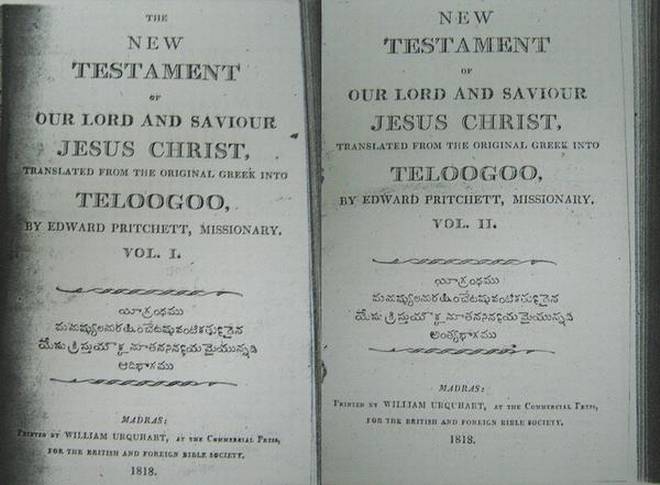
Telugu Bible turns 200

The cover page of the New Testament that was first translated and printed in Telugu in 1818. | Photo Credit: Special Arangment

It was translated in Vizag and West Bengal

On September 30, based on a resolution adopted by the United Nations, the world celebrates the International Translation Day (ITD). It is observed in honour of fifth century St. Jerome, a priest from northeastern Italy, who was the first to translate the Bible (New Testament) into Latin from Greek manuscripts. He also translated parts of the Hebrew Gospel into Greek.

The ITD has a unique connection with Visakhapatnam. The churches in the city will be celebrating this year the 200th year of the translation of Bible from original Greek to Telugu.

First attempt
The first attempt to translate the Bible (New Testament) was made by one Rev. Benjamin Schulz (1689-1760) some time in the mid-1760s, and the manuscripts were sent to Germany for printing, but it was not printed and the manuscripts were lost.

The second serious attempt was made simultaneously at Vizagapatam (as Visakhapatnam was then called) and Serampore, then unified Bengal, some time around 1805-1806.

Telugu Pandit’s role
In Serampore, the project of translation was led by Rev. William Carey of the Baptist Missionary Society. In Visakhapatnam, young Christian missionaries of London Missionary Society Rev. Augustus De Granges and Rev. George Cran took up the work of translating the Bible from original Greek to Telugu. The missionaries in Vizagapatnam were assisted by a local Telugu Pandit Anandarayar.

The untimely death of both Granges (1809) and Cran (1810), however, did not deter Anandarayar from pursuing the work of translation under the guidance of Rev. John Gordon and Rev. Edward Pritchett, said V. Edward Paul of INTACH.

“The first three gospels out of four translated in Vizagapatam were sent to Rev. Carey in Serampore and the translation work continued simultaneously at Serampore and Visakhapatnam. The full extent of translation was completed with the fourth gospel, letter and acts and sent to then Madras Presidency for expert opinion of Rev. Thompson and Mr. Campbell, a reputed Telugu scholar in the Presidency. It was certified and then printed in 1818, and that makes the translation 200 years old, as of today,” said Mr. Edward Paul. The Bible that was printed in 1818 in Madras Presidency is today considered the authentic Bible and has undergone several revisions.

source: http://www.thehindu.com / The Hindu / Home> News> States> Andhra Pradesh / by Sumit Bhattacharjee / Visakhapatnam – September 28th, 2018

Edit