11
10
09
08
07
The story of the fifth Bishop of Calcutta
When engineers chanced upon a vault in Calcutta’s St Paul’s Cathedral, they also unearthed a singular story of a singular man
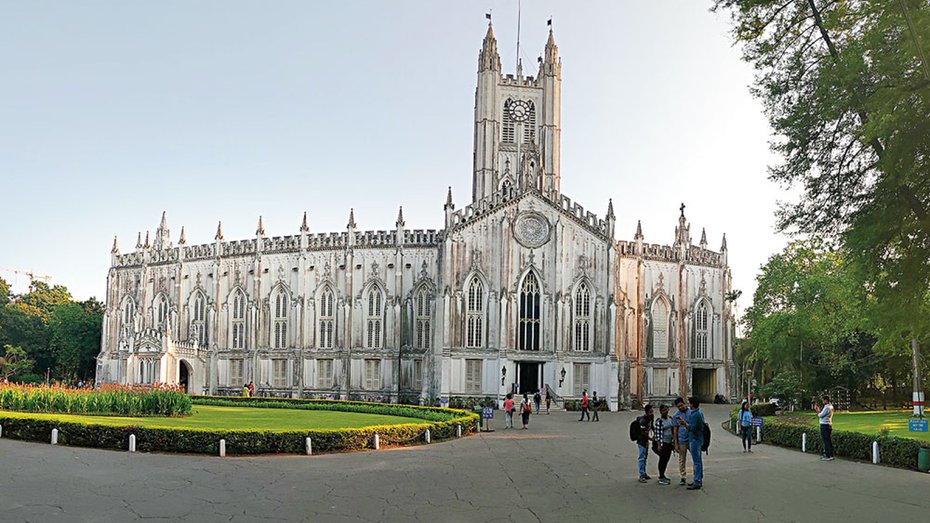
St Paul’s Cathedral in Calcutta / Picture by Pradip Sanyal
Sometime ago it was reported that the coffin of Daniel Wilson was found in a vault under the main altar of Calcutta’s St. Paul’s Cathedral. Wilson was the fifth Bishop of Calcutta and founder of St. Paul’s, which came up in 1847.
“This is not some out-of-the-box discovery. We were all aware that the coffin was kept there,” says an official from St. Paul’s Cathedral who does not want to be identified. He continues, “In fact, there is a small opening on the outer wall of the cathedral for ventilation. It was kept covered so that no stray dogs could go in. We could see the ornamentation on the coffin. The remains of the bishop were never missing. It was just that we had never gone down into the vault.”
It seems Wilson himself had made provision for the vault under the altar. “There is a reference to his musings in the book, The Final Report of St. Paul’s Cathedral, Calcutta, written by Archdeacon Pratt, who was a close associate,” says senior researcher Mary Ann Dasgupta.
St. Paul’s is said to be the first Anglican cathedral of the Victorian age. In his book, Splendours of the Raj: British Architecture in India, 1160-1947, Phillip Davies writes: “The building was constructed in a peculiar brick especially prepared for the purpose, which combined lightness with compressional strength; the dressings were of Chunar stone, and the whole edifice was covered inside and out with polished chunam.” Up the stairs of the cathedral and next to the main door is a marble bust. Would that be of Wilson? No, it belongs to Reginald Heber, who was Bishop of Calcutta in 1827.
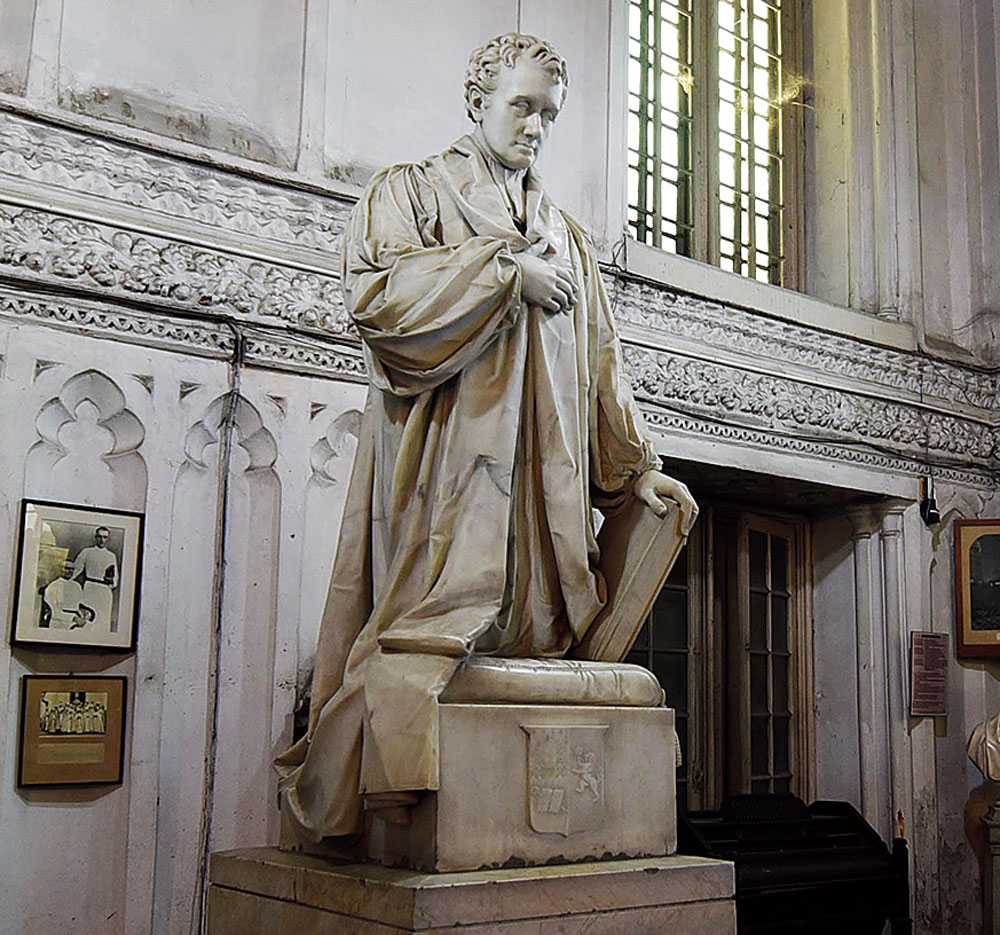
The bust of Reginald Heber in the cathedral / Picture by Pradip Sanyal
The story goes that when Heber’s bust was sent from England, Wilson couldn’t find a suitable space to display it. St. Paul’s hadn’t been built and St. John’s Church in BBD Bag, often referred to as the “old cathedral” in later years, was not spacious enough.
In a proposal written in 1839, Wilson wrote, “…subject of reproach, not only to the good taste, but to the piety of the greatest Empire in the Eastern world, that our Government House, our Mint, our Town Hall, our Custom House, our Bridges and even our Ghats… to say nothing of our official residences and private dwellings… should be upon a scale in some measure correspondent with the position we hold in India, whilst our Cathedral [St. John’s Church, built in 1787] is mean, inappropriate and incommodious…”
Heber’s bust became the peg on which Wilson put forth an application to the government for a site for a new cathedral. He wrote to Lord Auckland: “I beg permission to enquire of your Honour and the Government of India whether it would be possible to grant me a small angle of ground on the Esplanade near the Chowringhee Road for the purpose of erecting a Church.” Auckland gave consent and land and signed his missive “I am Your Lordship’s most truly Auckland”. That was May 1839. Eight years later, St. Paul’s Cathedral was ready.
Dasgupta is working on the history of St. Paul’s. She says, “It is not possible to explore the history of the cathedral without delving into the history of the man who founded it.” She has visited the library at Bishop’s College, St. Xavier’s College archives and the Asiatic Society.
Daniel Wilson was born in central England’s Spitalfields in 1778. The eldest son of a wealthy silk manufacturer, he was barely in his teens when he joined his uncle — an even wealthier silk manufacturer in London — as an apprentice. The young Wilson was, however, more inclined to religious studies than business. He pursued higher studies and eventually graduated from Oxford University and was ordained a priest in 1802.
Wilson was a vicar in north London when he accepted the call to become the Bishop of Calcutta. In Wilson’s biography, his son-in-law Josiah Bateman, writes: “In October 1797, Daniel Wilson felt his spirit stirred to go as a missionary to heathen lands; and in October 1832, he stood on the banks of the Hooghly as Bishop of Calcutta.”
From her explorings, Dasgupta has pieced together a portrait of Wilson. Wilson, the disciplined man. Wilson, who did not like wasting time. Says Dasgupta, “Most of the previous bishops of Calcutta did not survive for long, most probably due to the hectic schedules they had to follow. They used to go for long tours — Burma, China, Malaysia. Bishop Wilson did not do this at the onset. He waited for some time to adjust to the climes. He took care of his health.”
Bateman writes, “His personal habits at this time were very simple and regular. He rose early, and rode on a small black horse, brought from the Cape, which for a time, was able to take care both of itself and its master…”
We learn that he was a prolific letter writer and well-read in the classics.
“He had friends back in London with whom he would correspond,” says Dasgupta. In one letter to his children dated 1840, he wrote about the construction of the cathedral. It read, “Every morning I ride round on my horse and watch the different views which the Cathedral will present (sic).”
Besides being a devout Christian, Wilson was a dynamic man, full of energy. According to his biography, the jurisdiction of the Bishop of Calcutta in 1832 was far-reaching.
Bateman writes, “It was manifestly a burden too heavy to be borne. It must not be supposed that he found abundant records, well-defined duties; and established precedents… The Palace was a blank, the correspondence of his predecessors with the Government and clergy had disappeared, and the Registry contained little but a list of licensed chaplains.”
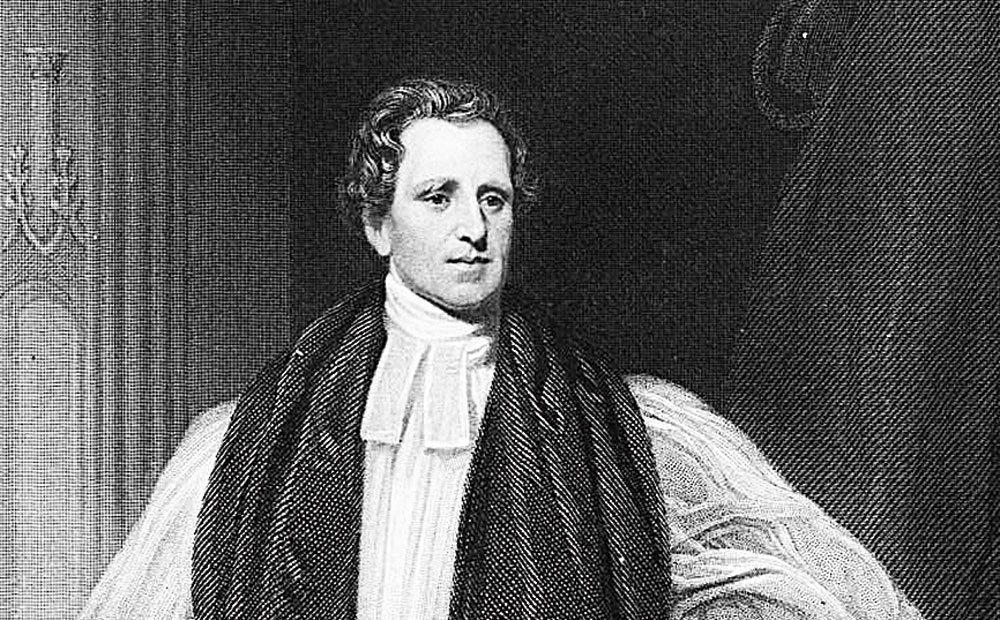
The coffin of Daniel Wilson was found recently at St Paul’s Cathedral in a vault under the main altar / Wikipedia
Bateman elaborates, “Sixty or seventy servants, turned loose into the house, and speaking an unknown tongue, had to be recognised and mastered. Guests were to be entertained, and sick friends watched over, nursed, and cheered. It will easily be imagined that some time elapsed ere light shone upon this darkness, and order issued from this chaos.”
Wilson loved good food and people and had a reputation of being a great host. Dasgupta has read his journal entries where he writes how “the wonderful young editor of Friend of India” had breakfast with him and so also “Mr Hunt, the great railway man” and Mr Wylie, “who is one of those noble, kind-hearted, thoroughly good men, of whom there are so few in the world”. Yet another entry reads, “This morning I had all my Cathedral clergy and their wives to breakfast… there were 46 present.”
But when engrossed in work, the same man did not like being disturbed and could be very impatient. Dasgupta says, “Before the visitor would settle down in his chair, Wilson would start up in a hurried but determined way and say, ‘Well, my dear friend, you must excuse me; good morning, good morning, here is your hat and here is your umbrella,’ and before the visitor left the room, he would again be buried in his books and papers. But he was always polite in his approach.”
The day Wilson formed the St. Paul’s Cathedral Committee, he also announced that he had signed his will. Dasgupta came across a photocopy of it. In it, he states that he has given Rs 1 lakh for the building of the cathedral and another lakh will be paid out after his death. He also bequeathed his grand collection of 8,000 books to the cathedral library.
He died in 1858. Fifteen years before that he had inspected the vault which was being built for him under the communion table. He wrote in his journal:
“I could not but think as I walked up and down the abode of death how soon I might be called to lay down my pastoral staff and rest in that bed or grave as to my mortal frame, till the Resurrection morn (sic).
source: http://www.telegraphindia.com / The Telegraph – online edition / Home> Heritage / by Moumita Chaudhuri / April 28th, 2019
05
Two decades of Sabyasachi
The designer rewinds with The Telegraph to pick 20 landmarks that made Sabyasachi the brand that it is today!
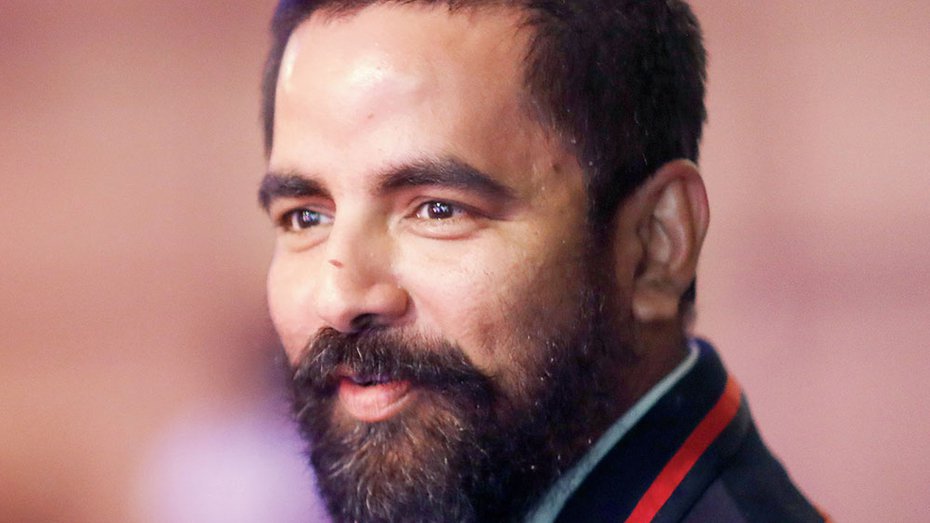
Sabyasachi Mukherji / Telegraph file picture
- Sabyasachi considers his graduation show at National Institute of Fashion Technology, Calcutta, as the first landmark of his career. The show had won him three awards — the Best Design Collection from NIFT Calcutta, the Ritu Kumar Award for Excellence in Textile, and the critic’s award in Confluence, which was the best among students from all the NIFTs. “That gave me my first foray into the fact that I could start becoming a designer, it gave me the confidence and the boost that I will not take up a job but start my own label. If those awards did not come my way I would probably be working in an export house now. It made me believe in myself,” says Sabya.
- The second was being adjudged best designer at a contest called Khadi Goes International, which won him a scholarship to go to London and an internship with the Victoria and Albert Museum. “It was my first trip outside India… I had never really been anywhere except for Delhi and Bombay. So it was my first international flight. I got a lot of independence, because you know, Bengali kids are very protected, in the middle class you don’t really go out that much, so I didn’t have much exposure. So it opened my eyes about possibilities that there exists a market outside India as well.”
- Sabya feels that his debut at Lakme India Fashion Week with his collection Kashgar Baazar in 2002 was the third and possibly the biggest landmark. “I became a star overnight. It put a lot of pressure on me. Because I did not even make it to Page 3, I made it to Page 1. I remember, The Telegraph coming up with the headline, ‘Fashion star rises from the east’. It came on the main newspaper, not in a supplement. It became a national news everywhere… I became a big star. It catapulted me into the brand that it is today.”
- His first Bollywood film, Sanjay Leela Bhansali’s Black, which won him his first ever national award for costumes, is very special to him. “When he (Bhansali) had first called me for the movie I did not even know who he was and what kind of films he made. I was a big fan of Mr Bachchan and the fact that I got to work with Rani Mukerji and Mr Bachchan in my first film was enormous.”
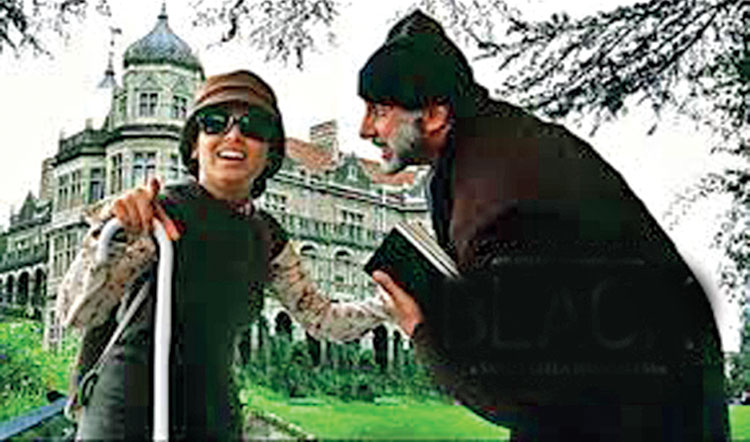
A scene from the film, Black
- Retailing from Espee, one of the first multi-designer fashion stores of Calcutta by Sangita Kejriwal and Purnima Chawla, holds a very special spot in Sabya’s heart. “I remember I used to cycle to Espee to see my clothes hanging; I could not believe that a store would actually put my clothes in their window.”
- Winning the Mercedes-Benz Asia Fashion Award in Singapore got him a ticket to Paris and the chance to intern with global fashion stalwarts Jean Paul Gaultier and Azzedine Alaia. “I came back feeling much more confident about my body of work.”
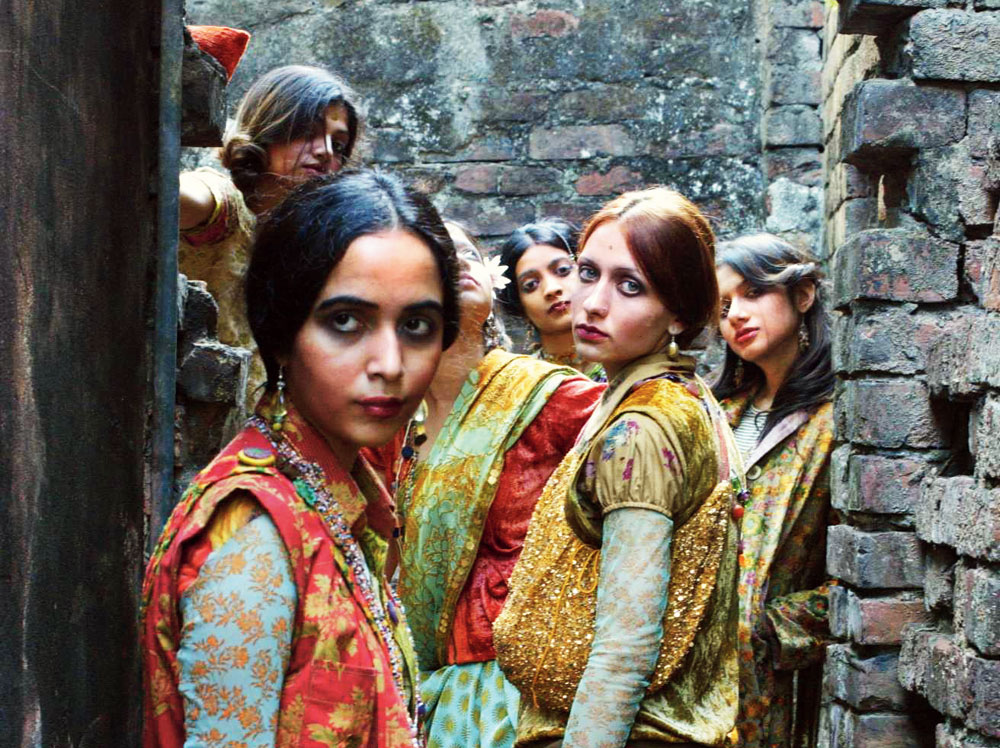
Sabya’s Spring/Summer 2005 collection Frog Princess / A Telegraph picture
- His Spring/Summer 2005 collection Frog Princess got him his first ever international store display — Browns in London. “Ms Burstein, who owns Browns, is considered to be a fashion legend. She was the first person to retail John Galliano, Alexander McQueen and all of these people, and legend has it that if Browns puts somebody in the window of the store during London Fashion Week, that person is supposed to be a huge star in the future. She put me on the same platform. I was in the window of Browns during London Fashion Week. Of course, I became a big star in India, I did not become a big star internationally, but she must have seen some potential.” Frog Princess opened many doors and he got a chance to showcase at his first ever international fashion week — Milan Fashion Week. His next collection after that was Snail in Autumn/Winter 2006, with which he had the opportunity of showing at New York Fashion Week.
- It was Chand Bibi in Autumn/Winter 2007 that saw Sabya flirt with a full Indian show. “Chand Bibi and much later Bridal Sutra were my first taste of how beautiful Indian clothes could be. Full Indian shows I did and I think they paved the way for the future of the brand. And if I were to give a collection for commercial success… Chand Bibi actually paved the way for the brand that Sabyasachi is today. It consolidated my position as an emerging bridal-wear designer.”
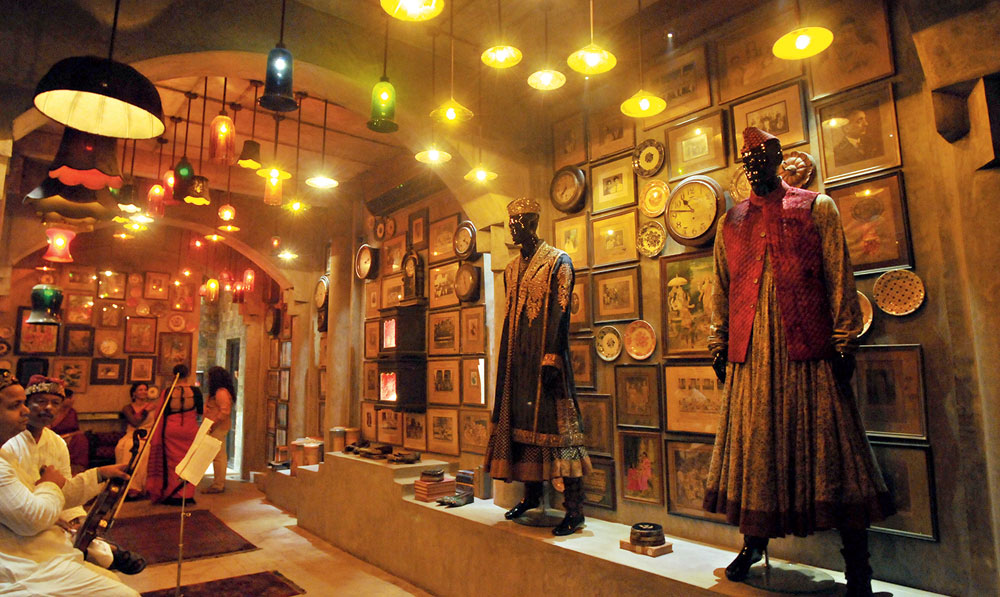
The Calcutta store was about 40 per cent retail and 60 per cent experience /
A Telegraph picture
- The next big landmark was Opium, which he had shown at the India Couture Week in Delhi and which got rave reviews everywhere. Till today, it is one of Sabya’s biggest commercial successes.
- A big feather in the cap of the brand was his collaborations — Christian Louboutin, Pottery Barn, Asian Paints, Forevermark — each of these have been very big landmarks for the brand. His collaboration Sabyasachi X L’Oreal Paris in 2018 was his foray into beauty.

Another huge collection was Big Love in 2015 / A Telegraph picture
- Another huge collection was Big Love in 2015, when the brand started flirting with modern Indian clothing. It was still lehngas and everything, but it was a modern concept, which is still continuing today. A big landmark for the brand was introducing the Royal Bengal Tiger logo and it started with Big Love. “I thought the brand was getting bigger and bigger and it was important to anchor the brand with a signage which could replace my name Sabyasachi. And the Royal Bengal Tiger was a beautiful logo and it has become a bestseller because we have started putting it into the waistbands of lehngas, on belts and bags. I think the logo would find many iterations in many things to come.”
- The brand’s first Cannes red-carpet appearance was with Aishwarya Rai Bachchan wearing a Sabyasachi sari. “That was my first red-carpet moment. She wore a sari of mine at Cannes and the kind of traffic it generated it has never generated that kind of traffic again.” His first public criticism was dressing up Vidya Balan for Cannes and Sabya considers that a landmark, too. “I learnt a very important lesson that when you are a very big brand the onus lies with the public too. So the people who praise you today are the ones who are going to criticise you tomorrow. You need to understand that people are going to criticise and you have got to respect that but you still got to move on and do what you want to do and not get shaken by public criticism. It made me stronger.”
- The first interior designing project that Sabya did was for Taj 51 Buckingham Gate in London. Sabya designed the hotel’s iconic Cinema Suites.
- A game-changer for the brand from the communication point of view was opening Sabyasachi Instagram and the first Instagram show that was Firdaus (2016). “I think I changed the format and a lot of big designers ever since have shifted away from doing fashion shows and switched to doing shows on Instagram. So we changed the way fashion communication was done in India.”
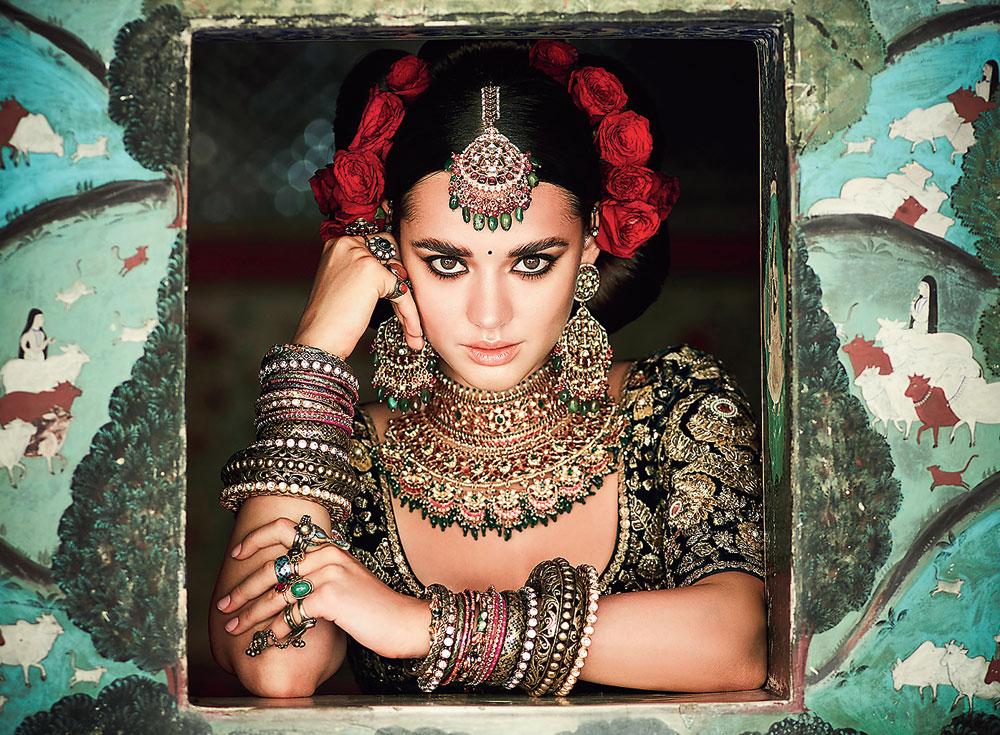
Sabya started his jewellery line in 2017 / The Telegraph picture
- Sabya started his jewellery line in 2017. “I have ambitions to make it India’s number one jewellery brand. I started it two-and-a-half years ago and it is already over-performing. There are conversations with big stores overseas to stock Sabyasachi jewellery.”
- The year of the big weddings in India saw Sabyasachi become the go-to name for weddings. In a span of a year he did the wardrobes for all the big weddings in India —Anushka Sharma, Deepika Padukone, Priyanka Chopra and then Isha Ambani and Shloka Mehta.
- One important personal landmark for Sabya was speaking at House of Commons and going to Buckingham Palace for dinner. “(The experience was) surreal! I had always seen Buckingham Palace from outside, to go inside… I remember I went with Manav (from his team), and Manav pressed his nose against the glass window and said ‘Oh so this is how it feels to look at people outside’. We could see all the people outside staring at the palace and we thought we could have been one of them.”
- His show Band Baajaa Bride has been one of the most popular programmes on Indian television. It ran for eight seasons and won numerous awards.
- His foray into the Far East with Lane Crawford and his White Wedding line with them was very important because “I want to own the wedding space not only in India but internationally as well”.
source: http://www.telegraphindia.com / The Telegraph, online edition / Home> Culture / by Smita Roy Chowdhury / April 27th, 2019