Help in increasing the supply to areas south of Bhowanipore that receive potable water from the Garden Reach plantTh
The plant can produce 185 million gallons of water every day, but there is only one 29 million gallon capacity reservoir to stock water / Representational images from Shutterstock
A 10 million gallon water reservoir was inaugurated adjacent to the Garden Reach waterworks on Wednesday.
The reservoir will help increase the supply to areas south of Bhowanipore that receive potable water from the Garden Reach plant.
The plant can produce 185 million gallons of water every day, but there is only one 29 million gallon capacity reservoir to stock water. The new reservoir will start functioning from Thursday; it will increase the storage capacity, a civic engineer said.
Rashbehari Avenue, Gariahat, Golpark, Ballygunge, and parts of Kasba and Jadavpur receive potable water from the Garden Reach waterworks. All these places will benefit, the engineer said. “We can now supply water more efficiently. The demand changes with season… the demand is more in the mornings. The additional water in the reservoir can be diverted to areas where demand is more.”
A reservoir is required to store the water that is produced during lean periods when the demand is less. “The demand is always less at night. But if we have more storage capacity, we can go on producing water at night that can then be thrust into the supply network in the morning. This will increase the pressure of the flow and take water to pockets that face water shortage now,” the engineer said.
Mainak Mukherjee, the chief engineer of the CMC’s water supply department, said the operation of the new reservoir would be completely automated. “There will be minimal human interference. Chances of errors will reduce because of automation. The system will give alerts in case there is any abnormality in any component and this will help address the problem faster.”
Firhad Hakim, the chairperson of CMC’s board of administrators, inaugurated the reservoir.
source: http://www.telegraphindia.com / The Telegraph Online /Home> West Bengal> Calcutta / by Subhajoy Roy / Calcutta / October 15th, 2020
Birth centenary of children’s museum founder Jugal Srimal
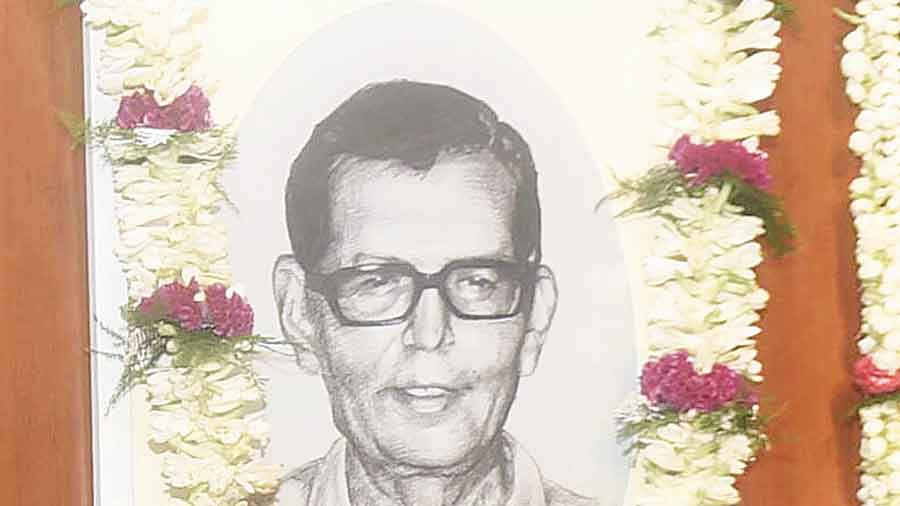
The portrait of Jugal Srimal that was unveiled on Friday / Bishwarup Dutta / Jhinuk Mazumdar / Calcutta
A girl in her early 20s seated on a wheelchair came to Nehru Children’s Museum in 1992 because she wanted to learn how to operate computers. She could not speak but had a compass fitted to her head and a book of letters on her lap, which she made use of to point out and express herself.
The person at the museum who was approached did not want to refuse her but was unsure whether they would be able to accommodate her. So she approached the director.
Founder Jugal Srimal took the girl to the class she wanted to go to and told the students that the “main objective” of Nehru Children’s Museum was “to build a beautiful society’, not to train them in operating a computer.
Members and staff of the museum paid tributes to Jugal Srimal, the founder-director of Nehru Children’s Museum, on Thursday on the occasion of his birth centenary.
“That society will be built by all of you. No matter whatever the challenges are for a beautiful society, each one of you has to hold hands…,” Sikha Mukherjee, the administrative secretary of the museum quoted Srimal as telling the class, back in 1992.
Memories and anecdotes were shared about Srimal, who was also the founder trustee of Tagore Foundation, a trust formed to promote Bengali culture.
Srimal got the land on Chowringhee Road, on which the museum stands, from the Bengal government in 1969. The museum was inaugurated on November 14, 1972.
The museum has clay models that narrate the stories of Ramayana and Mahabharata and costume dolls from over 96 countries, some of which were collected by Srimal. Various embassies have also presented dolls to Nehru Children’s Museum.
“There are over 1,000 dolls now, about 350 of which were collected during my father’s time,” said Srimal’s son Sudip, who is now director of the museum.
Jugal Srimal was born in an “aristocratic and cultured zamindar family” of Azimganj, Murshidabad, on October 8, 1919. “If my father would have been here today he would never have allowed us to celebrate this day. He was always against publicity…. For his centenary, we had planned a five-day programme with 1,200 invitees, but because of Covid-19 we had a small programme remembering him,” said Sudip Srimal.
From the oldest employee of the museum Ramendra Das to senior employee Dipti Biswas, each one had a story to share. Jugal Srimal’s work was not restricted to the museum but went much beyond that, said Prabal Dutta, joint director of the museum.
Dutta spoke about the founder-director’s reading habits. “He would not be able to go off to sleep at night without reading but he had noticed that the habit of reading was going away…. He thought that people were not interested in buying books or borrowing it from library, but if the books reached them the interest of reading would sustain. So he formed Tagore Mobile Library,” Dutta recalled. Jugal Srimal gave away his collection to the library.
Those who attended the programme said they were missing the children. The institute has 1,400 students learning various activities like song, dance, painting and drama.
On Thursday, a portrait of Jugal Srimal made by 20-year-old Sourav Saha, who has been learning painting in the museum since 2015, was unveiled by Rotarian R.K. Bubna.
A book titled “Shishuder ja prappo ta jeno tara paye”, written by the founder before in the 1940s, was released on Thursday. Granddaughter Indrani Sengupta, now the secretary of the museum, found it among his manuscripts.
“I was young and not ready to take the responsibility but he told me it was not about age but how I handled the responsibility,” said Sengupta.
“…Last eight months have been difficult but we have paid our permanent staff and used up our savings to tide over this period. We have appealed to our friends and well-wishers and many have responded,” said Sudip Srimal.
source: http://www.telegraphindia.com/ The Telegraph Online / Home> West Bengal> Calcutta / by Jhinuk Mazumbdar / Calcutta / October 10th, 2020
The septuagenarian suffered a cerebral attack recently and was undergoing treatmentK
Kishore Bhimani / Twitter / @t2telegraph
Veteran sports journalist and cricket commentator Kishore Bhimani died at the age of 74, family sources said on Thursday.
He is survived by his wife Rita and son Gautam who is also a well-known TV personality.
“He had suffered a cerebral attack a few days back and was undergoing treatment,” a family source said.
Bhimani was one of the most recognised English voices of the 1980s.
Following his death, a pall of gloom descended on the country’s sports fraternity, with tributes coming in from all quarters.
“RIP Kishore Bhimani..he was one of the good Old Fashioned Crkt writer who took Crkt writings like a player who takes to playing…Condolences to his Spouse Rita & Son Gautam.. GodBless All Always.. Fondly,” legendary Indian spinner Bishan Singh Bedi tweeted.
“Farewell Kishore Bhimani. Cricket journalist and a true lover of #Kolkata,” politician Derek O’Brien wrote on Twitter.
Bhimani was commentating when Sunil Gavaskar became the first player to reach 10,000 runs in Test cricket, during the drawn match against Pakistan in Ahmedabad in 1987.
One of the most sought-after Indian cricket writers who would be wooed by British publications in the 1980s, Bhimani was also on air during the final moments of the famous 1986 tied Test against Australia at Chepauk.
It is said that Imran Khan, during his captaincy days, was a regular at Bhimani’s residence whenever he was in Calcutta.
Bhimani had worked for Calcutta daily ‘The Statesman’, was a noted columnist and wrote ‘The Accidental Godman’.
He was the president of Calcutta Sports Journalists Club from 1978 to 1980.
source: http://www.telegraphindia.com / The Telegraph Online / Home> Sports / by The Telegraph Bureau & Agencies / Calcutta – October 15th, 2020
Veteran atomic scientist and former chairman of Atomic Energy Commission Dr. Sekhar Basu succumbed to COVID-19 early on Thursday at a private hospital here, a health department official said. He was 68.
“Dr. Basu was suffering from COVID-19 and other kidney ailments. He died at 4.50 a.m.,” the official told PTI.
A mechanical engineer, Dr. Basu is revered for his contributions to the country’s atomic energy programme. He was awarded Padma Shri in 2014.
He had also pioneered the highly complex reactor for India’s first nuclear-powered submarine INS Arihant.
source: http://www.thehindu.com / The Hindu / Home> News> Cities> Kolkata / by PTI / Kolkata – September 24th, 2020
The video streaming service has registered a growth in its subscriber base and international audience
While the pandemic has posed a challenge to the television and film industry, it has come as an opportunity for the Bengali online video streaming platform Hoichoi. The Bengali entertainment platform that completed three years of operation this September has registered an increase in revenue and revealed that 40% of the revenue comes from international subscribers.
Last week, the Bengali OTT (Over the Top) platform unveiled 25 web shows and two films — Kolkata Underground and Tiktiki — to be launched in the coming months.
Vishnu Mohta, co-founder of Hoichoi, told The Hindu that the platform has provided the Bengali diaspora an opportunity to connect to its roots through these productions.
“About 40% of our direct revenue is coming from international customers. We have subscribers in more than 100 countries including Japan, Sweden, Argentina, Iceland, where we did not think we would have much traffic,” he said. Mr. Mohta said that the OTT shows were a “ great way to connect” the Bengali community, as films and plays in the language may not be available in theatres in other countries.
Even since the lockdown, the platform has been showing a big spurt in growth on most matrices and the subscribers across all platforms are now 13 million. In recent months, it released nine world digital premiers of feature films and showcased the first direct-to-digital film release from eastern India.
Actors Swastika Mukherjee, Parambrata Chattopadhyay and Saswata Chatterjee and directors Srijit Mukherji and Mainak Bhaumik are some of the film personalities behind the programmes to be launched soon.
While the OTT platform celebrates different genres, thrillers and detective stories are high in demand. “The Bengali community always loves detective stories and thriller shows. Some of the most iconic characters like Feluda and Byomkesh have been detectives. This goes very well from an episodic point of view,” Mr Mohta added.
source: http://www.thehindu.com / The Hindu / Home> News> States> Other States / by Shiv Sahay Singh / Kolkata – September 24th, 2020
A state government agency delivering essential items has outsourced its entire operation to the women of Self Help Groups in various districts.
A state government agency has been promosing everything – from locally produced vegetables and select fruits to grocery, fish and meat products – at the doorstep. Freshly-cooked meals, too, are available. / Sourced by the Telegraph
A doorstep delivery of essential items for senior citizens during the lockdown has now turned into a full-fledged delivery system for the entire city and parts of Howrah.
A state government agency has been promising everything — from locally produced vegetables and select fruits to grocery, fish and meat products — at the doorstep.
The West Bengal Comprehensive Area Development Corporation has been delivering such items and more to people in Calcutta within hours of them placing orders on WhatsApp or on the department’s website.
The corporation is an autonomous organisation under the Panchayat and Rural Development Department.
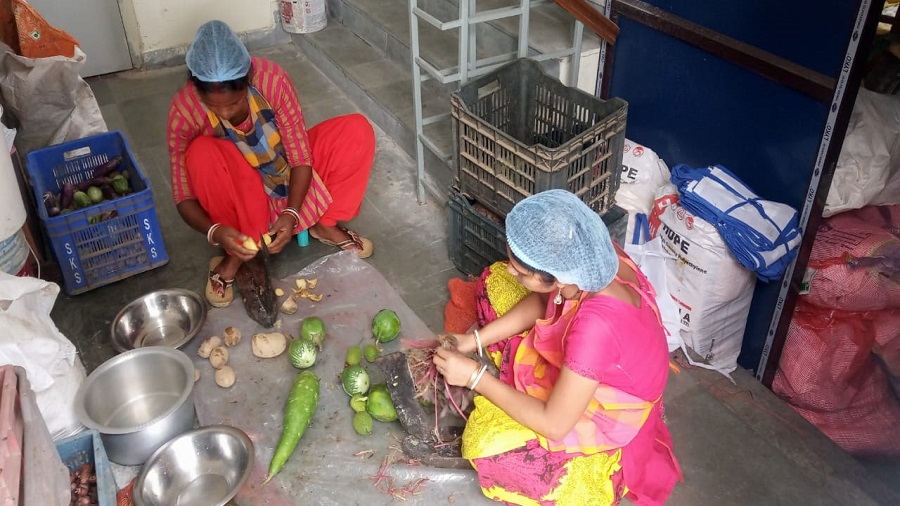
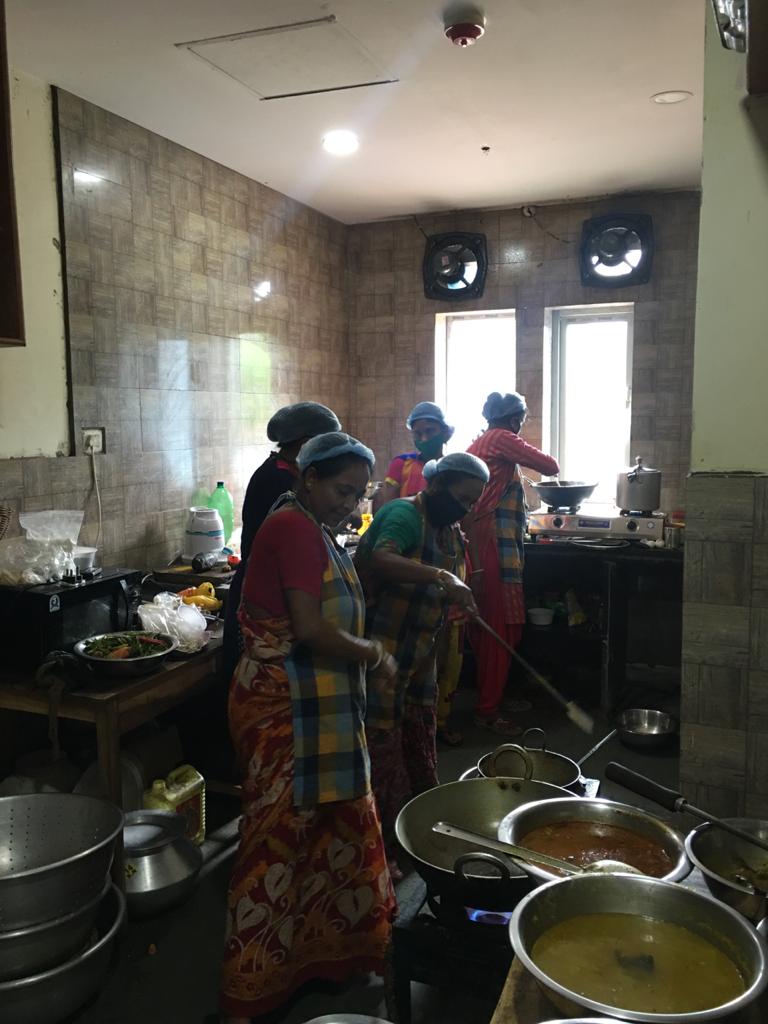
Freshly-cooked meals, too, are available. The entire operation has been outsourced to the women of Self Help Groups in various districts.
The corporation, which has been training members of Self Help Groups in agriculture, fishery and animal resource development, used to sell their produce in New Town before the pandemic struck. They sold at fairs and haats (Ahare Bangla and Saras), too.
The corporation started doorstep delivery for the elderly once the Centre announced the lockdown. A WhatsApp group was formed.
Also, the state government began an exercise to create a database of all senior citizens living on their own in Calcutta, Howrah and Salt Lake.
Orders are placed on the WhatsApp group or on the corporation’s website.
Women SHG members prepare meals at the CADC canteen for doorstep delivery. / Sourced by the Telegraph
The corporation started expanding from vegetables, essential items such as pulses, cereals, and oil, and fish and meat to cooked meals, moringa powder, Mecha sandesh (a GI product from Beliatore in Bankura), crabs, Kadaknath chicken and fresh hilsa.
Before Durga Puja, the corporation intends to introduce chicken dust, mango flake, and dried fruits.
Primarily, Self Help Groups were trained in pisciculture and rearing animal husbandry. “We are into research, output and production,” Soumyajit Das, special secretary, Panchayat and Rural Development, said.
Das personally responds to every WhatsApp order. “The initiative here is to empower women, the entire operation is run by women from Self Help Groups handpicked by us.”
Piu Bag from Birohi Mahila Samannay Samiti in the Haringhata Block has been supervising girls from her Self Help Group in the supply of vegetables to the corporation this month.
“We cultivate bottle gourds, ladies fingers, onions, cauliflowers… we have been supplying to the corporation after the lockdown. We are getting a better price here than elsewhere. My girls are helping out in the corporation canteen, too, and they get a monthly salary,” Bag said.
Salekha Khatun from Hariharpara in Murshidabad is part of Nil Akash Mahila Samannay Samiti, which supplies spices and pulses to the corporation. “We have leased out 50 bighas this time in the hope of getting more orders from the corporation.”’
The department is now trying to grow the produce locally and Self Help Groups are being trained in vertical gardening and maintaining bioflock ponds at Mrittika Bhavan, the corporation headquarters.
“We have noticed we need to produce locally to maintain quality. So, we are training them to grow here in Calcutta where they are supplying,” Das said.
All customers give their feedback on the WhatsApp group and every complaint is attended to.
Indranil Hazra from Belgachhia said: “A friend sent me the link to the WhatsApp group and I have been ordering since April. I am very impressed with the professional service as well as the range and quality of products.”
His neighbour Subhasree Banerjee, a Corona warrior, along with her husband, too, have benefitted from the service.
source: http://www.telegraphindia.com / The Telegraph Online / Home> West Bengal> Calcutta / by Anasuya Basu / Calcutta – October 11th, 2020
A demonstrative version of biofloc technology was inaugurated at Mrittika Bhavan on September 28P
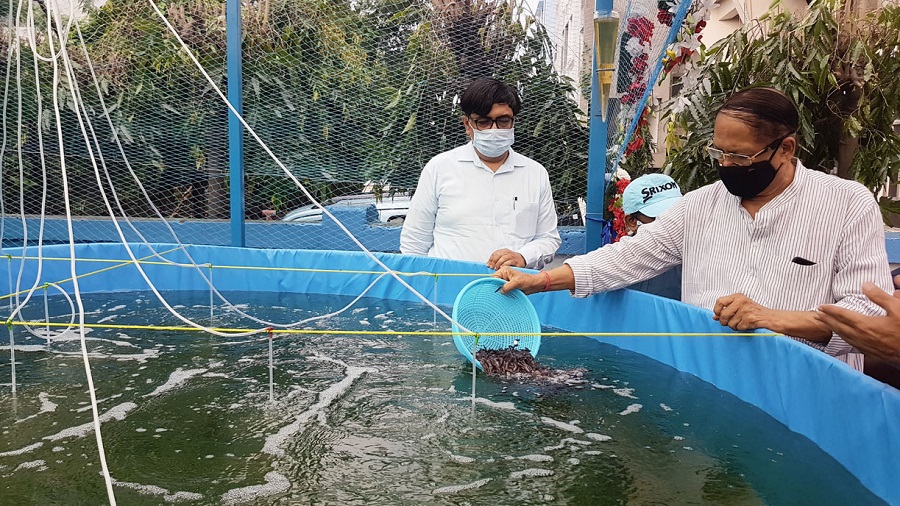
Panchayat and rural development minister Subrata Mukherjee releases fingerlings in the artificial pond in Mrittika Bhavan in DD Block recently / Brinda Sarkar
It doesn’t get any fresher than this. A new technology provides you the means to build an artificial pond in your house, garden or terrace where you could head to every morning and pick out any fish you want cooked for lunch.
A demonstrative version of biofloc technology was inaugurated at Mrittika Bhavan on September 28. The building in DD Block houses the state comprehensive area development corporation (CADC), under the panchayats and rural development department and inaugurating the facility was minister Subrata Mukherjee.
“This system can breed fish like Koi, Pabda, Singi, Magur and Golda Chingri that people love,” said Mukherjee. “It can come in handy at a time when prices of fish increase. While the system is fairly easy people rarely start something new by simply hearing about it. They want to see it in operation before adopting it and that’s why we have built this demo version. Anyone is free to come and learn about it from us and replicate it at home.”
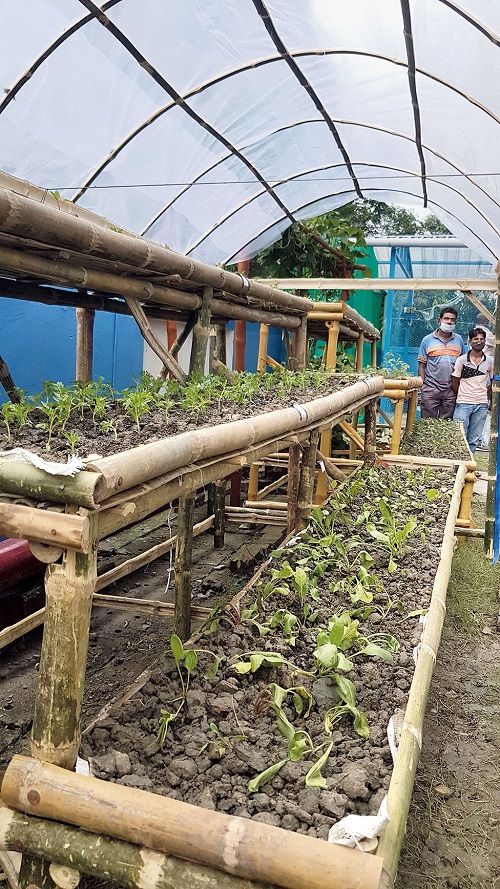
A kitchen garden which will produce spinach, brocolli, cabbage, lettuce etc on tiered bamboo shelves / Brinda Sarkar
Unlike an open pond, the biofloc tank doesn’t need acres of land. The one at Mrittika Bhawan is a round-shaped open-top tank with an iron net body and polymer sheet wrapped around it. Its base is connected to an underground water pump that will replenish water that gets evaporated and there are slim aerator pipes sending oxygen into the water for the fish to breathe. Its capacity is 10,000l.
“Biofloc is a relatively new technology developed in and for cold European countries where the rivers stay frozen for much of the year.
There they use thousands of biofloc tanks to farm fish,” said Soumyajit Das, special secretary to the panchayats and rural development department and administrative secretary of the CADC. “The technology has also seen success in Bangladesh.”
The water in the tank at Mrittika Bhavan is nourished with probiotics, bacteria and jaggery that will convert the droppings of the fish into their food. So one doesn’t even have to spend on food for the fish thereafter. Only the probiotic-solution needs to be added afresh every two months. Other than that it’s zero-maintenance,” he said.
Those interested in replicating this system are welcome to go and learn at the centre. “Households can install a 1,000l tank at a cost of about Rs 10,000,” said Das.
“The lockdown has proven how little of the city’s fish and agricultural demand is produced within it. If people can grow their own fish it would help them be self-sufficient to some extent,” Das said.
The minister released fingerlings into the water and the department expects the first batch of fish to be ready for sale by Diwali. The fish will be available at Mrittika Bhavan as well in vehicles that tour the township selling fish, meat and agricultural products sourced from farms.
The minister also inaugurated a kitchen garden section on the day, produce of which will be added to their cart. “Plants like spinach, broccoli, cabbage, lettuce, capsicum are being planted on ‘hanging seed beds’ which are three-tier bamboo shelves installed around the parking lot of the building.
source: http://www.telegraphindia.com / The Telegraph Online / Home> West Bengal> Calcutta / by Brinda Sarkar / October 09th, 2020