Monthly Archives: December 2020
04
Stadium in Bengal’s Barasat named after Maradona

The football legend had conducted a clinic for schoolchildren at that facility three years ago
A stadium near Barasat, where Diego Maradona was last seen in action in India, was on Friday named after the football legend.
During his last visit to Kolkata three years ago, Maradona had conducted a football clinic with school children at the Aditya School of Sports in Kadambgachi on the outskirts of Barasat, about 35 kilometres from here.
“The stadium has now been converted into a full-fledged cricket stadium and we have named it ‘Diego Maradona Aditya School of Sports Cricket Stadium’,” chairman of Aditya Group Anirban Aditya told PTI.
“This is the first-ever cricket stadium in the Argentine football legend’s name. We also have special Maradona memorabilia in the changing room. The seat and the cloth hanger that Maradona used would now be preserved with his autographed No. 10 jersey.”
Intense session
Maradona was last seen in action in India on December 12, 2017 when he turned up in shorts on a humid afternoon playing with 60-odd school kids. He was seen drenched in sweat, pouring water on his head during the gruelling session.
He also crooned Spanish songs and inaugurated a seven-a-side exhibition match featuring former India cricket captain Sourav Ganguly.
He was slated to feature in a match billed as ‘Diego vs Dada’ but by the time the match began, the 1986 World Cup-winning Argentine captain was completely drained out after the session with school kids.
Anirban said the stadium was built in four months and Maradona was the first sportsperson to step into it. “I remember taking Maradona from his hotel. He was tired but when he saw the crowd he became full of life. Initially, it was to be a 45-minute affair but it went on. He had promised he would be back and train the kids. So as a tribute to him we have named the stadium after him.”
Students heartbroken
Some of the students who had interacted with Maradona at the school were heartbroken.
“I had always heard of Maradona but never thought that we can touch him and play with the ‘God of Football’. It was completely magical.
“I will always remember the workshop that he took as the most remarkable event of my life, said 17-year-old Avita Sarkar of Aditya Academy Senior Secondary School.
“I was one of the lucky ones who got the football pass from Maradona. It was unbelievable,” said 18-year-old Aritra Sarkar.
Built on a 30-acre campus, the school conducted grass-roots programmes for Indian Super League franchise ATK Mohun Bagan.
source: http://www.thehindu.com / The Hindu / Home> News< Cities> Kolkata / by PTI / Kolkata – November 28th, 2020
Lalbazar in West Bengal is now art hub, thanks to artist Mrinal Mandal
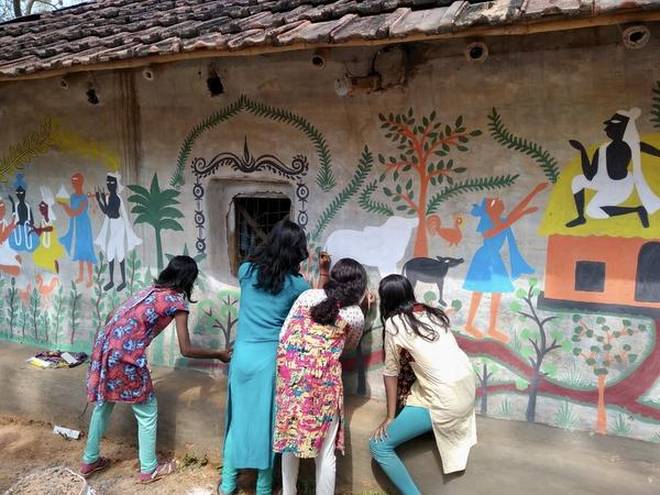
By settling there and teaching its people, he has demonstrated how art is capable of rescuing a neglected human settlement.
Two years ago, Kolkata-based artist Mrinal Mandal was so captivated by the charm of a tiny village — close to where West Bengal borders Jharkhand — that he decided to make the hamlet of some 80 people his second home. In doing so, he has demonstrated how art is capable of rescuing a human settlement from neglect and poverty.
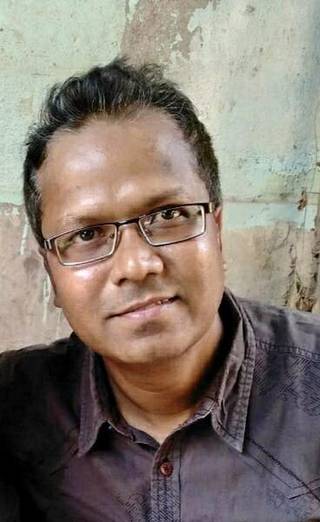
“I have been travelling in search of folk art from the time I graduated from the Government Arts College 20 years ago,” Mr. Mandal, 42, told The Hindu. “In 2018, I chanced upon this village, surrounded by forests, and I immediately took a liking for it. I decided to make it a beautiful village by teaching art to its people.”
Today, the residents of the village — officially called Lalbazar but christened Khwaabgram, or village of dreams, by one of the admirers of the project — earn a decent income by selling paintings and handicraft to tourists, whose increasing presence, in turn, has earned it the attention of the local authorities.
Tourists come to Khwaabgram, about 4 km from Jhargram, not just to buy handicraft but also to take a look at the village itself, where the walls of most houses are now themselves works of art.
“These people are from the Lodha tribe, once outlawed by the British. Traditionally, they are very shy people; if you built a house next to theirs, they would shift elsewhere. It wasn’t easy for me to make friends with them, until I began making drawings related to their life,” said Mr. Mandal, who lives in Jhargram and commutes to Khwaabgram on a daily basis.
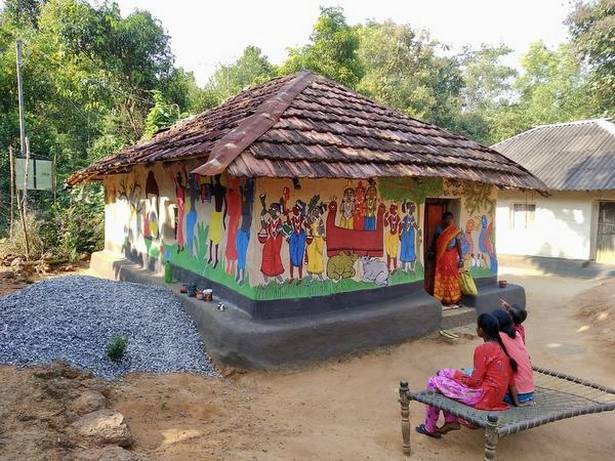
Until he arrived on the scene, the villagers mainly worked as labourers in nearby farms and some of them were small farmers themselves. Today, they are trained in kutum-katum (handicraft made from twigs and roots), kantha stitching, pottery and wall painting.
“All these years, I survived on whatever little I made from farming,” said Sashti Charan Ahir, 46, who, in spite of a physical handicap, is today successful as a kutum-katum artist. An art form introduced by Abanindranath Tagore, it means making use of found objects.
“Every morning, I go out to the forest to collect twigs and branches, then I roam around there for a while to get ideas — should I make a bird today or some animal? People visiting the nearby deer park now often come to our village to take a look and buy our products — that has indeed made our life better,” Mr. Ahir said.
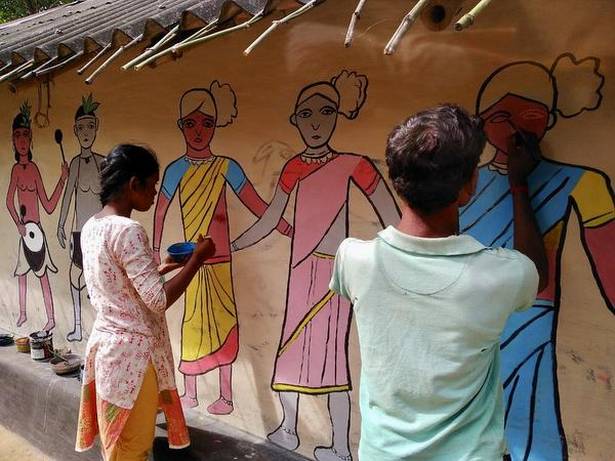
The public attention has led to improved conditions in the village, and what Mr. Ahir wants now is a school to be built there. “My daughter’s school is on the other side of the forest, and I spend a better part of the day taking her there and bringing her back. A school will really help — I believe they are considering the idea,” he said.
source: http://www.thehindu.com / The Hindu / Home> News> Cities> Kolkata / by Bishwanath Ghosh / Kolkata – November 30th, 2020
Joynagar Moa earns branding mojo
Manufacturers create product adhering to original recipe with distinctive aroma, feel and taste.
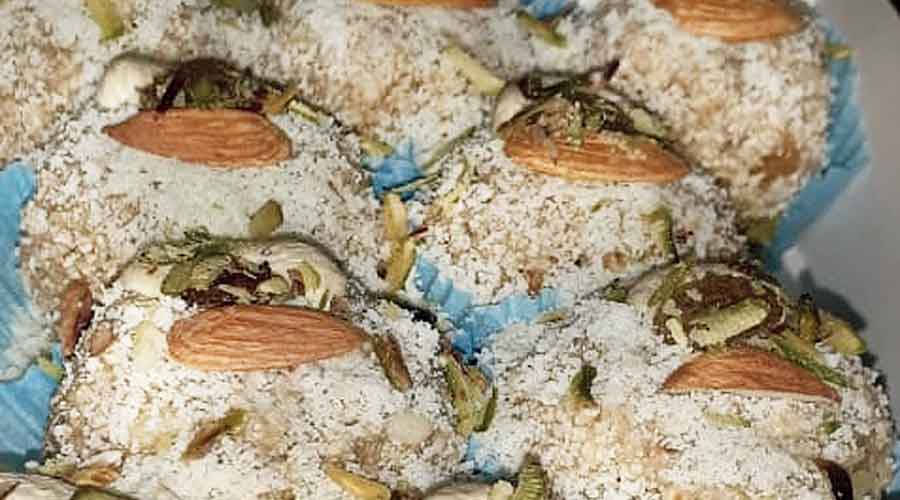
Joynagar Moa has managed to get for itself a logo that signifies its unique local identity and a recipe that defines what moa is supposed to be all about.
Six years back, in November 2014, the delicate sweet made of khoi (popped rice) had bagged a geographical indication tag for its uniqueness that would be only found across two blocks of Joynagar in South 24-Parganas.
Over the last few years a section of moa manufacturers have managed to do what rasogolla manufacturers are still struggling with the “Banglar Rasogolla” GI tag — create a product adhering to the original recipe that would offer a distinctive aroma and mouthfeel.
With these manufacturers finally ready with their produce, a unique brand of Joy-nagar’s Moa would sell this winter.
Over 20 such manufacturers from different parts of Joynagar — who have bagged the “authorised user certificate” — have come together and tied up with almost all the best selling mishti shops across Calcutta to sell Joynagar Moa, the authentic one.
“Anyone can challenge the manufacturer for the authenticity of the moa that will be sold in packs of six, 10 and 12 pieces,” said Ashok Kumar Kayal of Joynagar Moa Nirmankari Society, the one that had pitched for the GI tag with the Union ministry of commerce and industry. “It’s not easy producing this moa abiding by all the norms that have been laid down by the GI council. It’s a strict mix of human skill and hygiene while following the prescribed flow-chart.”
A moa to be truly of Joynagar has to be between 50 and 75 gram in dry weight and must be made from Kanakchur khoi and should have at least seven ingredients including nolen gur , ghee, cardamom, khoya kheer, sugar, dry grape and cashew nut.
“Anything else that sells as Joynagar Moa is not the one that has been certified by the GI council,” said Dhiman Das, director of KC Das Private Limited. “Some sweet-shop owners have come together to save this product in its original form and hence, this initiative to sell original moa.”
Dhiman was among the many who had fought for the “Banglar Rasogolla” GI tag certification that came in 2017 and has now created a platform of sweet sellers known
as Mishti Udyog, who would sell the branded moa from their outlets in Calcutta and beyond.
Just like the uniqueness of “Banglar Rasogolla” lies in being spongy, fluffy and its smooth texture “with less chewiness”, the speciality of Joynagar Moa is the Kanakchur khoi.
Kanakchur variety has a slender grain and is scented, short and bold, everything that makes it particularly suited for the uniqueness of Joynagar Moa.
The origin of Joynagar Moa dates back more than a century. The year 2004 was the centennial year of ‘Moa of Joynagar’.
Ashutosh Das, a resident of Das Para of Sreepur village in Joynagar had first started the moa industry in the Bengali in 1904. His son, Jawaharlal Das, used to visit the house of Rani Rashmoni at Janbazar carrying moa.
Over the years, moa found acceptance as a delicate sweet and gained popularity across the globe.
But the moa that would be sold across Calcutta or Bengal would not rarely meet the standards that were set down some six years back.
Why? Primarily because of the detailed process that would be involved in preparing an original moa was missing. Here is how the process goes.
Ten litres of nolen gur, for instance, would have to be boiled to get a litre of pure gur. Then comes preparing the khoi. There are male and female khoi. Female khoi, which are bigger in size, is not preferred for moa. They are separated out. Good male khoi are only mixed with hot nolen gur in a big iron pan.
Next the khoi has to be immersed in nolen gur. The stirring has to be done with a wooden ladle. It’s a long and tedious process.
Artisans would allow the mix to cool before using their cleaned hands to give the shape after smearing their palms with pure ghee.
Finally, flavouring agents are added. That would in-clude sugar, cashew nuts, cardamom, ghee and dry grapes. Average weight of each moa would be between 50 and 75 gram.
Know your sweet
Area: The area of production of Joynagar Moa lies between Joynagar Block I and Joynagar Block II of the Joynagar-Mazilpur municipal area, which is around 53km south of Calcutta in South 24-Parganas
Raw materials required: Khoi of Kanakchur paddy, nolen gur, ghee, cardamom, khoya kheer, sugar, dry grapes and cashew nuts.
Colour: Light yellowish.
Weight: Average weight of each Moa is between 50 and 75 gram.
source: http://www.telegraphindia.com / The Telegraph Online / Home> West Bengal> Calcutta / by Kinsuk Basu / Calcutta / November 29th, 2020