Monthly Archives: July 2019
13
12
Larger features of total solar eclipse match IISER Kolkata’s prediction
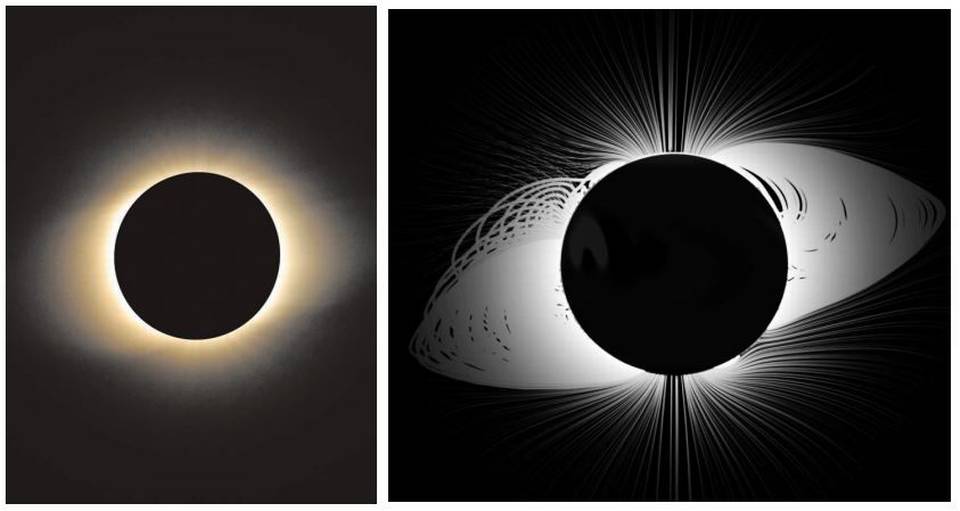
The team predicted the shape of the Sun’s atmosphere at the time of the eclipse using a two-step model
Scientists from the Indian Institute of Science Education and Research (IISER) Kolkata were in for a pleasant surprise as the total solar eclipse on July 2 proved their prediction correct in its major features. They joined solar physicsts from India and several international researchers who had gathered in Argentina to view the eclipse.
While their aim was to check whether their prediction of the shape of the corona had been realised, imaging the solar corona, or the Sun’s atmosphere was the motivation for many others. The corona can only be viewed during a total solar eclipse. This total solar eclipse was visible only within a narrow strip of land stretching over Chile and Argentina.
Dibyendu Nandi’s group, from IISER Kolkata, had used a two-step model to predict first the shape of the solar magnetic field on the day of the eclipse and then extrapolate it to describe what the corona would look like. “Our predictions of two cross-equatorial streamers, or bright petal like structures the Sun’s Corona were confirmed by the observations,” said Prof. Nandi in an email to The Hindu.
Space weather
The model built up by the IISER Kolkata team can be used to predict space weather. It will also be useful in analysing data from the proposed Indian space mission – Aditya-L1 – which is meant to study the Sun’s corona. “We now know the basic theoretical premise of our computational modelling is correct. This work has given us confidence to utilise similar theoretical models for supporting the interpretation of data from India’s Aditya-L1 solar space mission which is currently under development,” says Prof. Nandi.
The path of the eclipse was known well in advance and hence a professional meeting was planned for solar physicists about a year earlier.
“The local organisers looked at possible locations near San Juan (which is situated at the edge of the path). One needs to go to the central line for maximum duration of totality,” said Dipankar Banerjee, solar physicist from Indian Institute of Astrophysics who helped organise the meeting.
“Special permission was needed to reach this place; apparently tourists are not allowed to these locations,” he added in his email to The Hindu.
This eclipse offered an excellent opportunity to view and image the corona. Despite being hotter than the layers of the Sun that lie within, the corona has lower density of photons. For this reason, the inner layers of the Sun such as the photosphere outshine the corona, rendering it practically invisible. Except, that is, when the Moon totally occults the Sun. During a total solar eclipse, the Moon’s disc completely covers the region of the photosphere. This lends a moment of total darkness. But just before totality, light from the Sun reaches viewers, first as a brilliant spot of light known as the “diamond ring.” At this stage, you can see the chromosphere and solar prominences. The next instant, when the Moon’s disc covers the Sun, we see an uneven ring of light – the corona. This is seen only during the totality.
Details to be analysed
The broad features of the corona are as predicted by the IISER Kolkata team. “We have to perform a detailed analysis to ascertain which fine scale features of the corona we got right and what aspects we did not. For this we have to wait for technically processed images and other scientific observations acquired during the eclipse by teams from the US National Science Foundation, regional observatories in Chile and Argentina and space-based satellites,” explains Prof. Nandi.
Based on constraints set by these observations, the group plans to refine their models before translating these into operational space weather forecasting tools.
source: http://www.thehindu.com / The Hindu / Home> Sci-Tech> Science / by Shubashree Desikan / July 06th, 2019
Book on French connection
The revolution & its effect on the colonies
The fort of Bastille may have fallen in July 1789 but it was not until the British frigate La Vestale docked at Pondicherry in January 1790 that news of “the Paris Revolution” reached India.
The report was confirmed by the French barge Bienvenue which arrived soon after on February 22 from Port Louis, the capital of the Isle de France (now Mauritius).
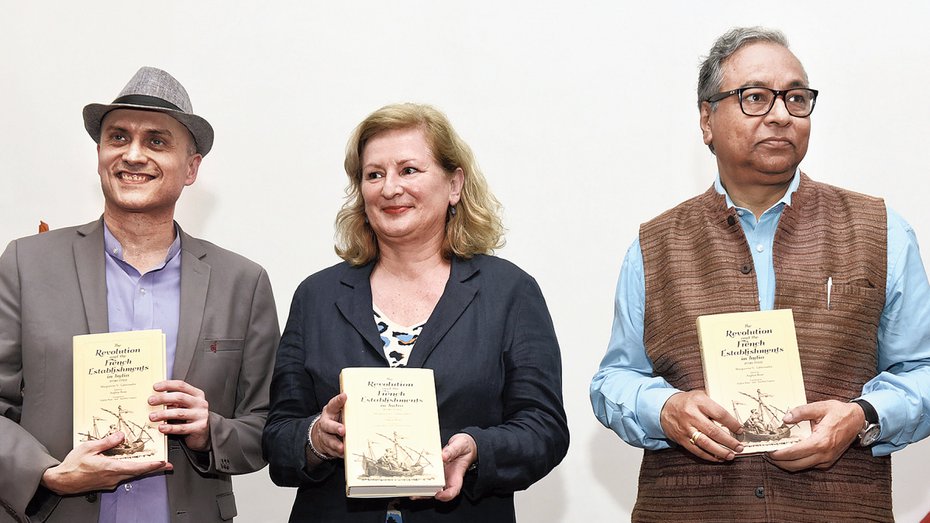
A translation of a book, The Revolution and the French Establishments in India 1790 -1793, that sheds light on the happenings in the French colonies in the post-Revolution phase was launched on Thursday.
“The book in French published in 1930 was written by Marguerite V. Labernadie, a doctoral student who discovered the administrative archives of the French colonies in India lying almost in ruins in Pondicherry. The book offers fascinating insights into the relation between French colonial establishments in India and the effect of the French Revolution on them,” said Arghya Bose, the editor of the book.
Bose, a Chandernagore boy, chanced upon a dusty copy of the book at Bibliotheque Nationale de France (BNF) when he was a student at Sciences Po in 2015.
On his return, he joined the Alliance Francaise du Bengale and met Sandhia Vasseur who had just joined as the librarian. “My grandparents on my mother’s side were French citizens of Indian lineage from Pondicherry. In 1947, when they were offered Indian citizenship, they refused and left for Cambodia, which was still a French colony. A war there in 1964 made them shift to France. I was interested in the Franco-Indian encounter as I have seen in my own family how important the French identity can be to people born in India. So when Arghya came up with the idea of translating the book I readily agreed. It was on Gallica, the BNF’s digital portal.”
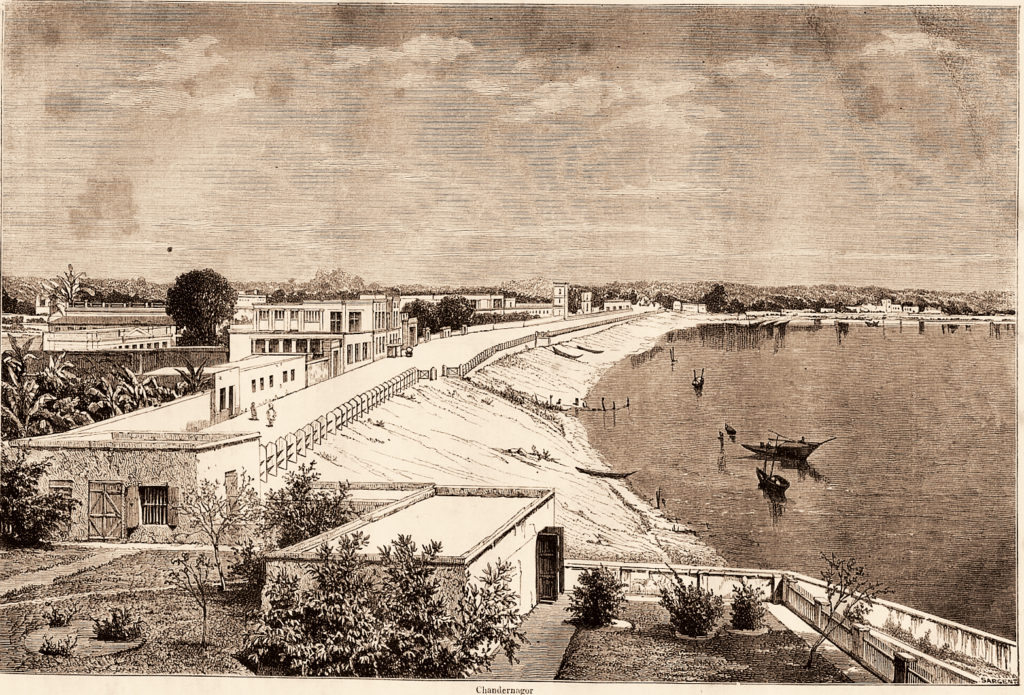
The news of the revolution triggered political unrest against the French East India Company. “France was not sending money or armaments. The Bienvenue had embarkment orders for the paltry European artillery and troops, leaving Pondicherry defenceless. Chandernagore too faced frequent sieges and humiliation by the British. So people met Chevalier de Fresne, the governor general of Mauritius and Pondicherry, with a host of demands. Constituent assemblies were formed and decrees passed as they tried to replicate what they heard had happened in Paris. Such was the eagerness to conform to the changing political structure in France that they sent expensive gifts to relatives back home, seeking volumes of the minutes of the National Assembly,” said Bose.
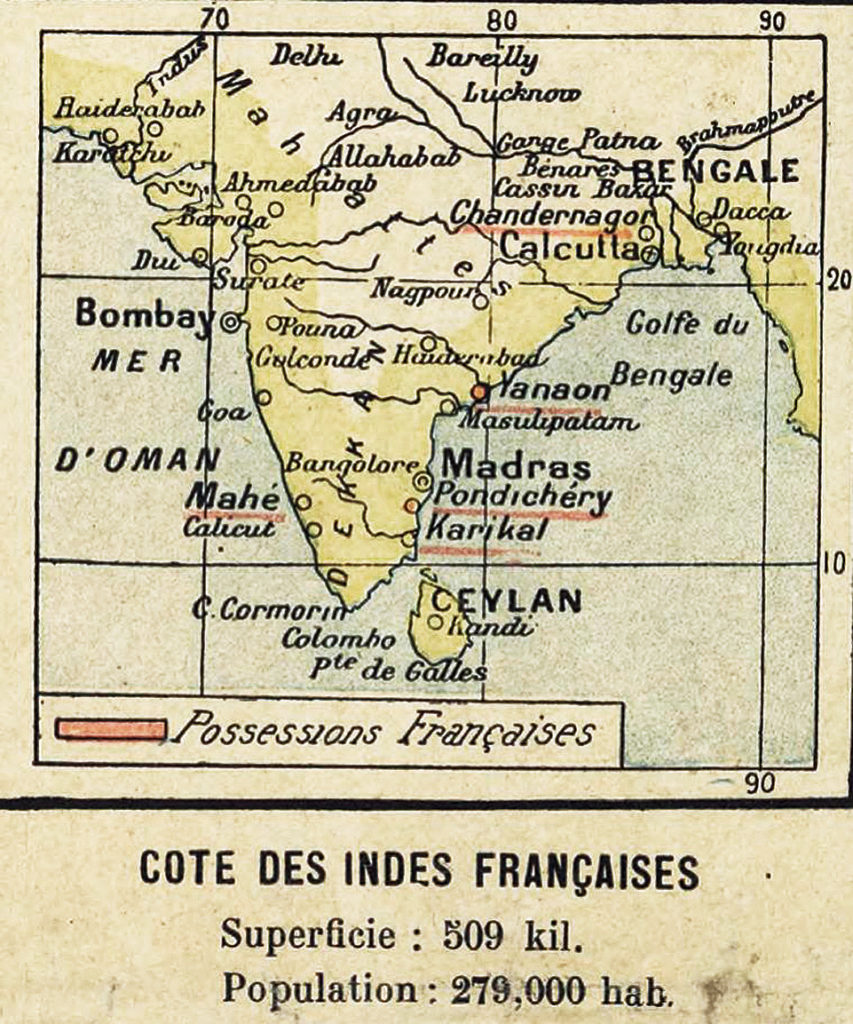
Another interesting aspect is the tussle between Chandernagore and Pondicherry. “While Pondicherry claimed administrative supremacy, Chandernagore, dealing especially in salt and salt petre, was the centre of trade. It paid enough revenue to the French government to offset deficits from the other Indian colonies Mahe, Karikal and Yanaon. They demanded control over the use of their revenue which Pondicherry refused.” The book ends with the British invasion and capture of the French colonies in India in 1793 as a fall-out of France going to war against England.
“The French colonies are not studied at length. Material available to Indian researchers on this subject is scarce. The book is a valuable addition to French colonial history in India,” said Jawhar Sircar, who was present at the launch.
source: http://www.telegraphindia.com / The Telegraph, online edition / Home> West Bengal / by Sudeshna Banerjee in Calcutta / July 08th, 2019