Monthly Archives: December 2018
05
04
Livelihood lost, yet in tune with dream
Konnagar boy strikes the right note after long struggle
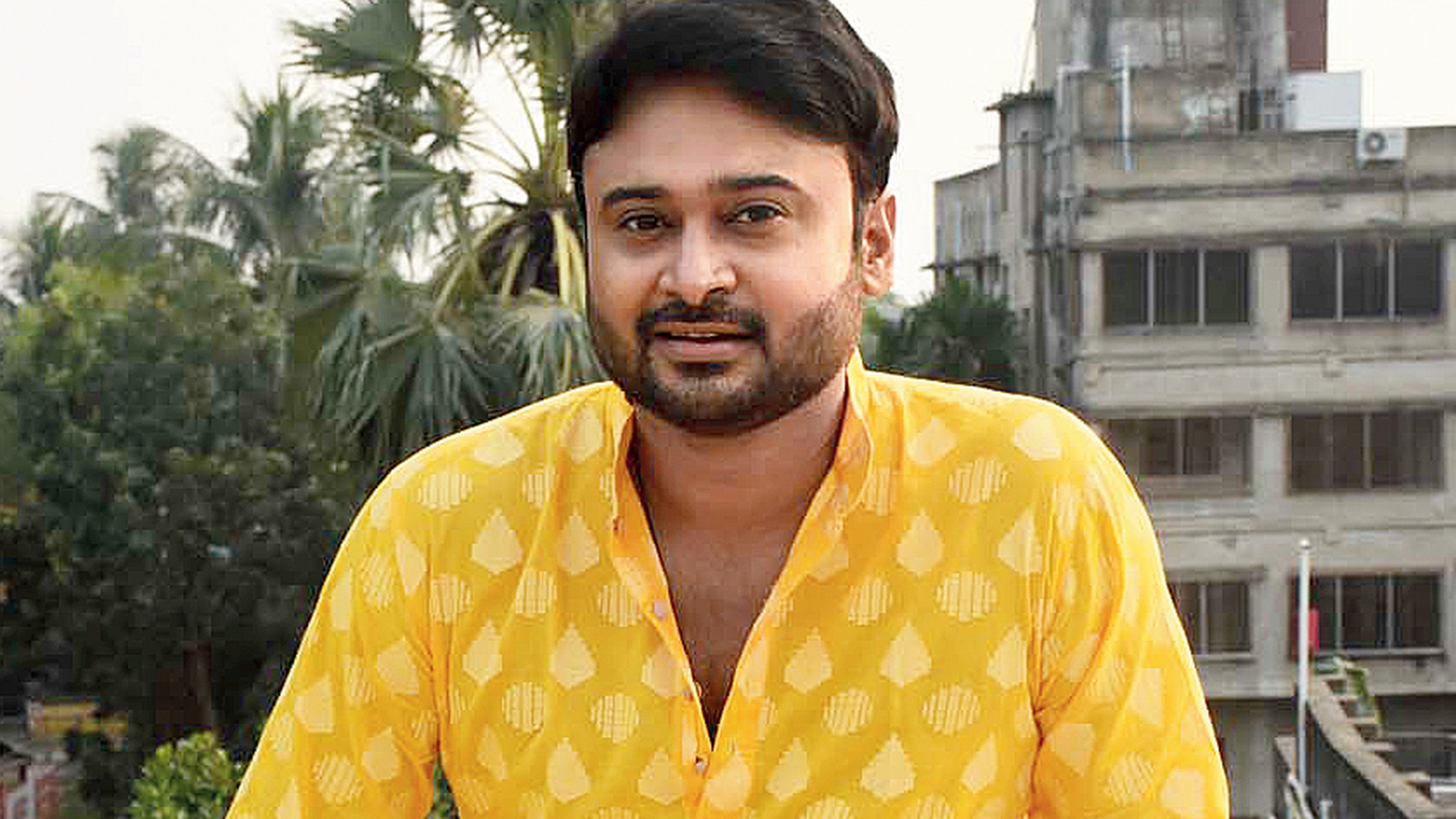
Picture by Shuvo Roychaudhury
A job lost gave him the determination to fulfil his musical dream.
Six years and much struggle later, a song written, composed and sung by Arnab Dutta has already got 128K hits on YouTube and thousands of likes on social media. He is the voice behind Tapur tupur, the lilting melody from the soon-to-be-released Rosogolla, a fictional biopic on Nabin Chandra Das, directed by Pavel and produced by Shiboprosad Mukherjee and Nandita Roy.
“Tapur tupur actually happened in 2016. I had met Pavel in Mumbai a long time back and two years ago, he asked me to write a romantic song for a film set in the 1850s and 1860s. I wrote the lyrics the day Mumbai got its first rain in 2016,” said the 34-year-old from Konnagar.
Arnab’s musical journey began, under his mother’s wings, when he was just three. In school, he was good in athletics and football but what endeared him to his friends was his singing.
Pursuing his passion as a career remained a distant dream as Arnab’s father, then a clerk in the land registration department of the state government, wanted him to study engineering, find a good job and help the family of four.
After passing out of Howrah Zilla School, Arnab took an education loan and studied BTech at BITM, Bolpur. “I was far from music in the first semester of college and it left me frustrated. I realised I couldn’t live without music. In my second semester, I came to know about the audition for a popular music reality show and decided to give it a try. The audition was in Jamshedpur and I put together some money to go there,” said Arnab, who stood first in the eastern-region audition and went to Mumbai for the finals, skipping an exam.
Arnab couldn’t qualify for the round of 32 but the loss made him more determined. “I lost but learnt a lot. I returned to Calcutta and got in touch with Jayanta Bose. I trained under him for the next four years. Whatever I’m today is because of him,” said the singer, who also took lessons from Sailen Ghosh and Kartik Das in his early years.
He tried his mettle in music reality shows twice more but was eliminated along the way. “I broke down in tears on the last occasion as I thought I had lost my last opportunity to make a career in music,” Arnab said.
Arnab still had his education loan to repay and he moved to Doha as a project engineer in 2009. “I stayed for the next two-and-a-half years but kept looking for an opportunity to return to India. All the while, I didn’t give up on my riyaaz.”
A new job in 2011 took Arnab to Bangalore but he moved to Mumbai the year after. “I was offered just Rs 10,000 but I wanted to go to Mumbai to try my luck,” Arnab said.
Seven months later, the company shut down and Arnab, whose father had retired by then, was left jobless. “It was the toughest period of my life. I lived in a small room in an under-construction building and ate bhog in a Jain temple once a day. I would spend all day making the rounds of the studios and managed to get some ad jingles in 2014,” Arnab recounted.
The break came the very next year with the title track of Sony Liv’s first web series in India, Love Bytes. Soon he caught the attention of Vikram Bhatt and sang four songs for his web series Maaya in 2017, followed by three songs, including Sunn le zara, in 1921 earlier this year.
“Even 10 years ago, I couldn’t imagine singing in a Tollywood or Bollywood film. It’s a dream come true for me,” said the Kishore Kumar fan. “I want to take Bengali music to the global stage.”
The Konnagar boy who loves his luchi-torkari has already taken his first step in that direction with Tapur tupur.
source: http://www.telegraphindia.com / The Telegraph Online edition / By Ayan Paul / December 03rd, 2018
A dodgy blurring of lines
Kolkata Centre for Creativity is a fabulous endeavour but it needs to curate its art more rigorously
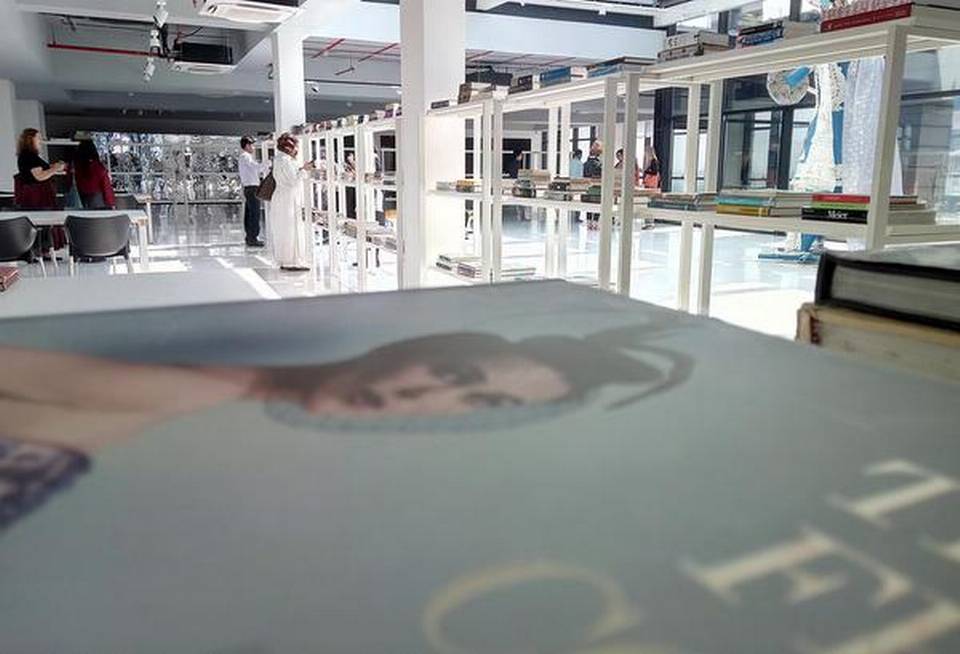
For an enthusiast, walking on to the fifth floor of the 70,000 sq. ft. Kolkata Centre for Creativity (KCC) is like stepping into art heaven. Clear glass skylight and walls pour warm November sunlight into a gleaming white quadrangle that’s dominated by an enormous bamboo-and-pith Ravana made by students the day before. On the sides are racks and racks of art books and material samples (like gold dust or polymer clay) of every conceivable kind.
At the far end are printers: a 3D printer that’s churning out an elephant in some kind of plastic, a large format digital printer, a laser cutter that’s etching out signages. All these resources will soon be available at a membership cost, say the organisers.
Glass, sunlight, space, white, and wood combine to make a wonderfully light and bright structure, one that glows and breathes, and is eminently suited to bring to life KCC’s aim — that of becoming an interactive, state-of-the-art, multi-disciplinary art centre. There’s a dance studio, auditorium, children’s art centre, conservation room and amphitheatre.
The ground floor has been set aside as 10,000 sq. ft. of exhibition space, the first floor showcases high-end artifacts and replicas sourced from around the world, while the second floor markets customised handicrafts (in a collaboration with designer Rajeev Sethi). In a nod to culinary art, a cafeteria specialises in signature vegetarian cuisine.
Two things are immediately clear: first that a lot of money and care has gone into the project, and second that Kolkata, and indeed every Indian city, urgently needs spaces like these. For this, the Kolkata-based Emami Group is to be congratulated.
Not so passé
What is less clear though is whether KCC itself understands what it wants to be. At the press conference held last week to inaugurate the centre — in its fabulous amphitheatre — words like museum, art centre, showroom, commerce, culture, spirituality were all thrown out easily and interchangeably, but the image that came through was that of KCC as high-end art and design shop. In coming days, it will become important for the centre to establish a distinct identity and stay true to it.
This is usually the task of the creative director and for KCC, that role is being played by Mumbai-based designer Pinakin Patel. At the press conference, Patel suggested that museums, and indeed art itself, has become passé. Statistics suggest otherwise: The Met saw 7 million visitors in 2017, while the Louvre saw 8 million, and the numbers are growing. The difference lies in how excitingly they curate and display their collections, unlike our own dusty, state-run storehouses.
Indeed, there are several exceptions to this now, both public and private, such as Mumbai’s Chhatrapati Shivaji, Delhi’s Kiran Nadar museum or Ahmedabad’s Calico Museum, which prove how well art can thrive, given funding, goodwill and discernment.
KCC’s gallery, Emami Art, was inaugurated with an exhibition of India’s early modernist and Renaissance man Dashrath Patel (1927-2010). Titled ‘School, A Retrospective’, there were around 92 pieces on show — his early oils, photographs and line drawings as well as some of the fabulous dinnerware he had designed as founder-secretary of Ahmedabad’s National Institute of Design. But disturbingly, the show also showcased pieces for sale made by the Dashrath Patel Studio in Alibaug, with no labelling to distinguish originals from reproductions.
Upon enquiry, an email stated that the gilded ceramic plates were produced in a kiln belonging to Dashrath’s friend, and the tapestries woven by artist Jayshree Poddar to Dashrath’s designs. But with dates, collaboration details and attributions missing across the show, it was impossible to tell if they were produced during the artist’s lifetime or are later reproductions. It was from the email that one discovered that the paper-on-plywood collages were sets of multiple replicas.
A wall panel said that works were “available for sale with an authenticity certificate from the Dashrath Patel Foundation,” but with no catalogued and printed records of the originals the artist left behind or the reproductions he sanctioned, there is a blurring of boundaries here.
Call for curation
These are early days, and KCC is, perhaps, still finding its feet. Which is why it was imperative that it find first-rate curators for its art shows at least. For example, names such as Nancy Adajania and Shanay Jhaveri come to mind for a Dashrath retrospective. Some will also remember the major retrospective of his work in 1998 at NGMA, Delhi, curated by Sadanand Menon.
Of course, Pinakin Patel was a friend of the artist and inherited the Dashrath Patel Museum in Alibaug, but that legacy comes also with a tremendous responsibility. And regardless of glib rationalising about removing boundaries between ‘high art’ and ‘low art’, it’s impossible to overlook the devaluation of an artist of Dashrath’s calibre which is the danger of a loose show like this.
Richa Agarwal, art collector, daughter-in-law of the Emami family, and CEO of Emami Art, said that besides the Rs. 70 crore spent on the complex, an unspecified corpus fund has also been set aside. This is excellent news for a fund-strapped art world; and part of an ongoing movement where corporate houses are entering the art museum space.
KCC is an ambitious project, and for fruition it has to go beyond showroom into committed, serious art shows, archiving, cataloguing, lectures, workshops and more, with at least some of the latter heavily subsidised.
The finest such centres achieve either basic financial viability or use philanthropy to prioritise edification over commerce. This could be fairly straightforward, but KCC muddies the waters somewhat by endlessly harping on art’s ‘spirituality’ and ‘soft power’ even as Pinakin’s concern is clear when he says that KCC must become “self-sufficient” and not “go begging” to the promoters.
One phrase repeatedly heard during the launch was the “playful blurring of boundaries between art and commerce”. One has nothing against commerce, it’s the playful blurring that is worrisome.
(The writer was in Kolkata at the invitation of Kolkata Centre for Creativity.)
A wonderful structure, that glows and breathes, and is eminently suited to bring to life KCC’s aim
source: http://www.thehindu.com / The Hindu / Home> Features> Sunday Magazine / by Vaishna Roy / December 02nd, 2018
The basti that has given golf 200 caddies
Madar Tala Colony in south Calcutta’s Tollygunge area is locally known as “Caddiebasti”
Manasi Shah
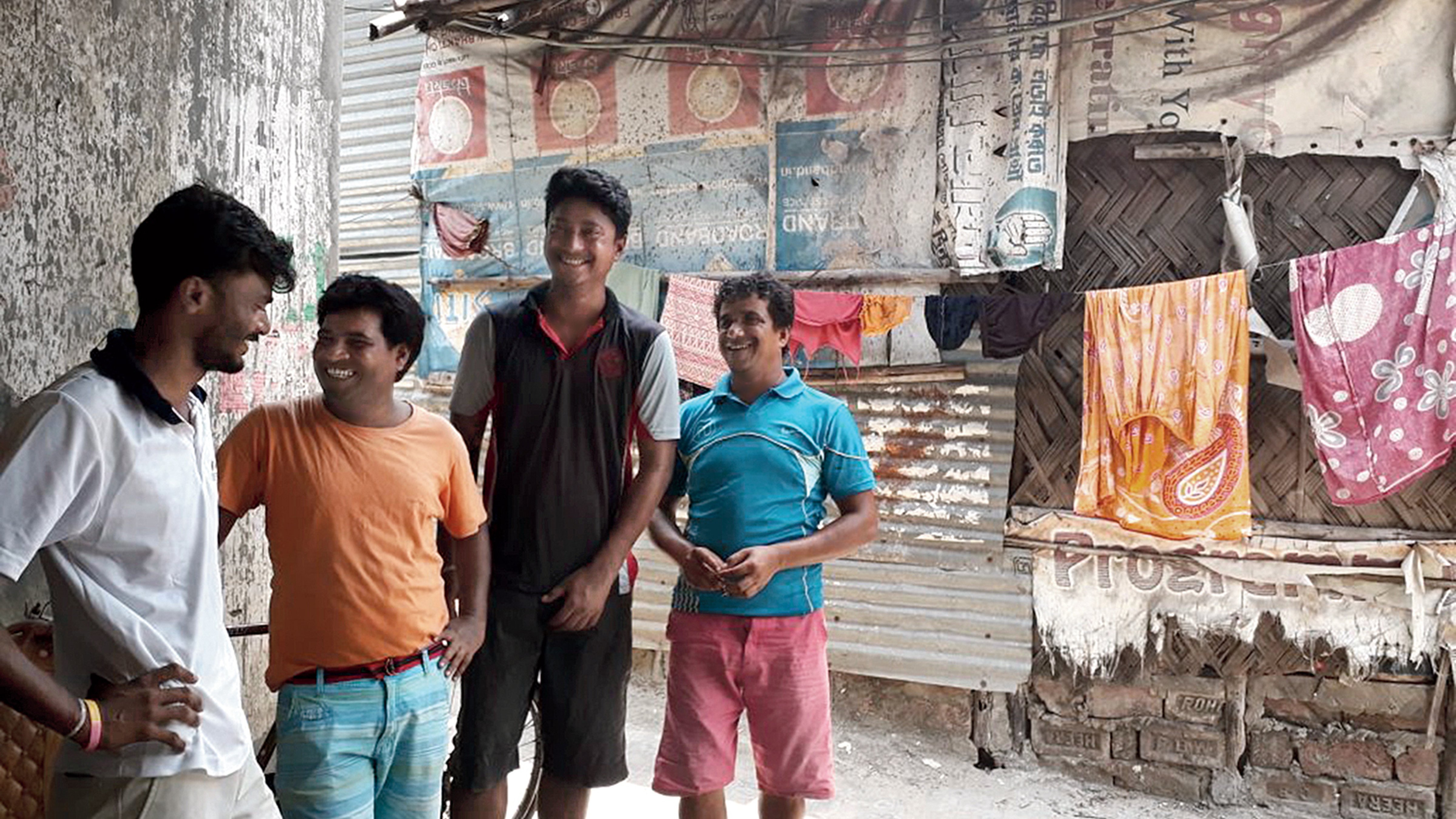
adar Tala Colony in south Calcutta’s Tollygunge area is not very far from the two biggest golf clubs of the city — Royal Calcutta Golf Club (RCGC) and Tollygunge Club. Within it is a basti or slum like any other. Vegetable vendor on one side, meat shop on the other, a pedlar on a cycle van selling rat poison, a tyre repair shop, row upon row of cellular houses, sagging clothes lines heavy with laundry.
Locally, this settlement is known as “Caddiebasti”. Caddie, as in the person who lugs a player’s bag and clubs during a game of golf, for a fee. “Two hundred caddies live here with their families,” says Mohammed Rajesh. He is 40-plus, started out in his pre-teens as a ball boy. His father was a caddie too and his grandfather as well.
It is 9am and he has just returned after caddying for his regular clients since 5 in the morning. Now he is sitting at the doorstep of his one-room residence. His smartphone is playing a Hindi film song from the 90s.
Rajesh says a caddie has “fixed” clients who pay him on a monthly basis. Temporary clients pay them according to club rules. The rates depend on expertise, though all training is largely informal, picked up from watching a father or an elder brother.
Rajesh talks about how RCGC organised classes for him and his colleagues last year. “It was about the rules of the game and etiquette. Then we had to take an exam, for which we were marked and, thereafter, assigned categories. Some of us were in category A and others in category B,” says Rajesh. “I am in A,” he adds after a moment’s hesitation and just then a pressure cooker at a neighbour’s goes off loudly, as if whistling in appreciation.
Sundar Kanti, 34, has recently been promoted to category A, but he has lost some clients — not everyone wants to pay extra bucks. But the caddies appear to be a united bunch. “If you pay less, no one will caddie for you,” Sundar threatens some invisible bad client, his tone near rebellious.
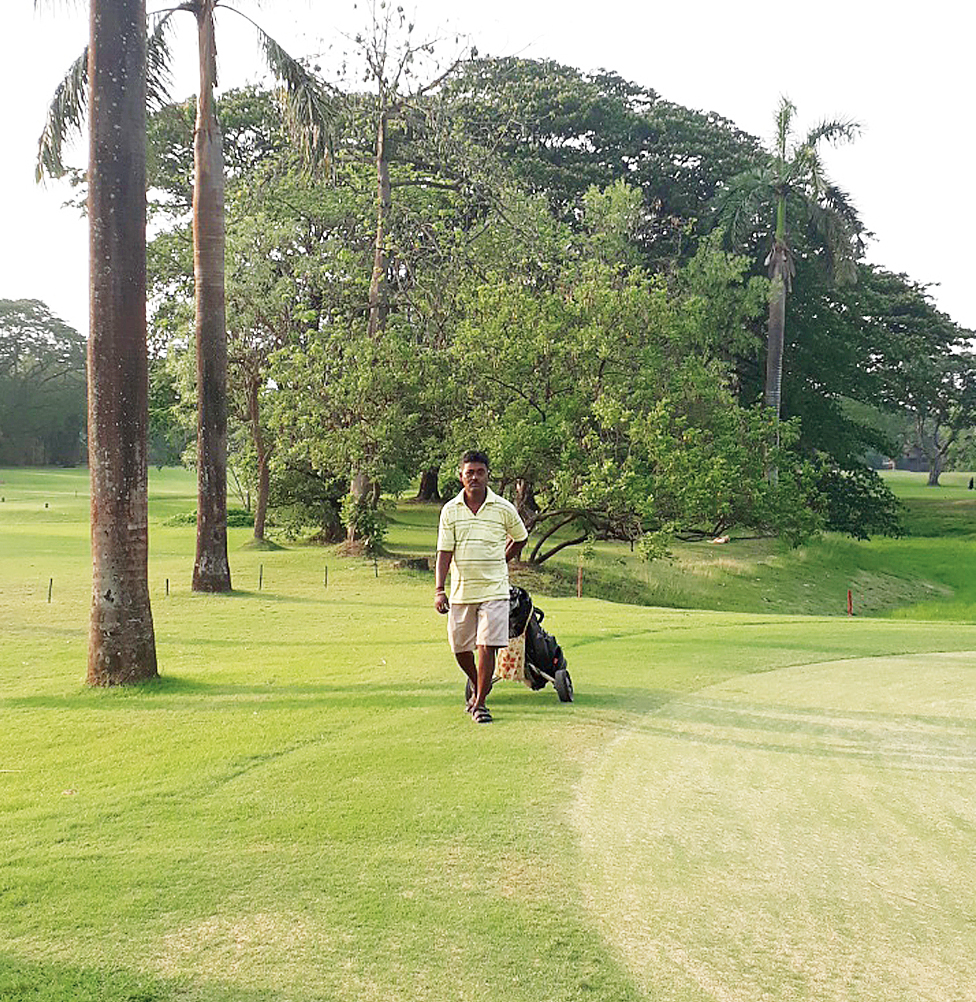
Pappu, reed thin, in his twenties — he refuses to share his last name — looks younger than Rajesh and Sundar. And though it is difficult to imagine him shouldering a burden of almost 12 kilos on his frail shoulders every day for many hours at a stretch, fact is he has been caddying for the last eight years. He has seven fixed clients, he boasts.
Manasi Shah
Fifty-year-old Sandip Dey seems to be sulking — whether that is his general demeanor or he is just tired, we cannot say. “A caddie has to fetch water for the saheb, clean the ball, hand him the club, hunt for the ball and fetch it,” he rattles off dispassionately.
The luxuriant golf course of RCGC is filled with cotton shrubs. There are cotton stubs, which can easily be mistaken for tiny golf balls. Sandip says, he is in this profession because he loves to play a shot or two. “Some clients let me,” he says, clenching and unclenching his fists. “Part of our job is also to humour clients,” interjects Goutam Hazra, 32. “It is a time-consuming sport and morales tend to wane,” he adds.
What about women caddies? Sheikh Halim, Raju Sardar and Sharif Ali, caddies all, break into a smirk as if it is a great joke. “There are no female caddies in India. But if you go to Thailand, America, you will find them,” 28-year-old Raju manages, in between giggles.
It is afternoon by now. The men of Caddiebasti are returning from “duty” in droves. They are dressed in tees, bermudas, some of them still have their caps on — all markers of the elite workspace they are part of and yet not quite part of. Some like Pappu will stray time and again — he says he tried his hand at various odd jobs — only to succumb to the lure of walking the green stretch.
Rajesh’s T-shirt reads “the Takeoff”. But his chatter and possibly dreams too don’t soar beyond golf. So what if his 12-year-old son is immune to golf’s magic? “You would have heard of Shiv Shankar Prasad Chawrasia,” he asks reverentially. Chawrasia is an Indian professional golfer; since 2008 he has won six Asian Tour events. Rajesh points eastwards and says, “He used to live there [in Bikramgarh] before he became so famous. His father was the greenskeeper at our club. And before he started to play, he was one of us, he used to work as a caddie.”
source: http://www.telegraphindia.com / The Telegraph Online Edition / Home> People / Manasi Shah – November 25th, 2018