Monthly Archives: November 2018

Badminton: How Subhankar Dey overcame India snub and loneliness in Europe to win SaarLorLux Open

Dey, who ran away from home to keep playing badminton and travels without a coach, defeated England’s Rajiv Ouseph in straight games in the final.

Sven Heise/Badminton Photo via Subhankar Dey

On the eve of the biggest final of his career, Subhankar Dey went out with his roommate to walk through a local fair in Saarbrucken, Germany, and kept telling himself that winning the SaarLorLux Open title was the last thing he has to worry about.

After all, the 25-year-old had never imagined playing in a Super 100 final, leave aside winning a title, when he ran away from his home in Kolkata eight years ago because he wanted to pursue the sport while his mother wanted him to take up the Food Corporation of India job offered to him.

But on Sunday, the world number 64 showed the temperament of a champion and the guile of a battle-hardened journeyman to upset fifth seed Rajiv Ouseph 21-11, 21-14 and clinch the biggest title of his career.

It had been a phenomenal week for Dey as he overcame former World and Olympic champion Lin Dan in the second round and saved two match points in the semi-finals against China’s Ren Pengbo before booking his spot in the final.

“My only dream was to become a professional badminton player and I had to struggle even for that,” said Dey, while trying to control his emotions. “But I am thankful to my parents and especially my elder sister who stood by me and this title is dedicated to them.”

He added, “Even after beating Lin Dan, all I told myself was that I am playing well and should make the most of it. So I prepared similarly for the next-round match and thankfully I played very well [against Toby Penty].”

Career struggles
To say that Dey’s journey from the cement courts of Kolkata to the podium in Saarbrucken was difficult would be an understatement.

After leaving home, the youngster trained for couple of years with Shrikant Vad at the Syed Modi Academy in Thane before hopping through various training centres in India, as some coaches had problems with his approach while others couldn’t accommodate him for long.

With his career going nowhere, a break to play in the Danish League for Greve Strands Club provided Dey with an opportunity to hone his skills further and also play more international tournaments thanks to his base in Europe.

“Yes, playing for a club in Europe helped me play more tournaments,” Dey said. “But it was difficult to live all by myself. There used to be no one to talk to and once after winning the Portugal Open title in 2017 I spent two days at the airport because I wanted to see people and interact with them.”

Dey, who lived with a family in Denmark that did not charge him money as their child also played in the same club, would spend all his prize money, his Railways salary and the funds given by his elder sister to play tournaments and record his own matches as he never had anyone to coach him there.

He also began following the European system of studying his opponent’s videos and planning his match strategy in the absence of a coach.

The changes brought the desired results as he won the Iceland International and Portugal International in 2017 and also reached the semi-finals of the Senior Nationals in Nagpur last year after beating 2017 Singapore Superseries champion B Sai Praneeth.

He was, however, still overlooked for the national camp probably because he had left it midway back in 2014 when he was sent to Bengaluru to train with Saina Nehwal, while the rest of the men’s shuttlers were practising at Hyderabad.

Opening an academy
Instead of getting demotivated by the snub, Dey worked towards starting his own academy in Kolkata to provide local players and even those in India who are overlooked by the big centres an opportunity to train with quality coaches.

While he was clear that he had many years of badminton left in him, he hired Indonesian coach Nur Mustaqim Chayo to work with the trainees. Dey himself has been training at the same centre for the past few months.

“I never got an opportunity to train at the national camps or the big centres like Gopichand Academy or Padukone Academy,” said the shuttler, who is supported by the Lakshya NGO. “I was even asked to leave a few academies, while I couldn’t settle in some. So I decided to start an academy of my own and I am happy to finally work with the coach on my game.”

The academy, managed by his elder cousin Somnath Kar, has allowed Dey to focus solely on his training and preparations. In the SaarLorLux Open final, he showcased his ability to read the game and make a solid game plan as he did not allow Ouseph to attack and use his height advantage. “I did a lot of homework and it paid off. I watched his games. I was patient and knew I had nothing to lose,” he said.

The title would have definitely helped him gain confidence that his chosen way of putting in the hard yards do deliver the goods.

source: http://www.scroll.in / Scroll.in / Home> Badminton / by Abhijeet Kulkarni / November 05th, 2018
Here lies Hindoo Stuart: Inside the 250-year-old Park Street cemetery

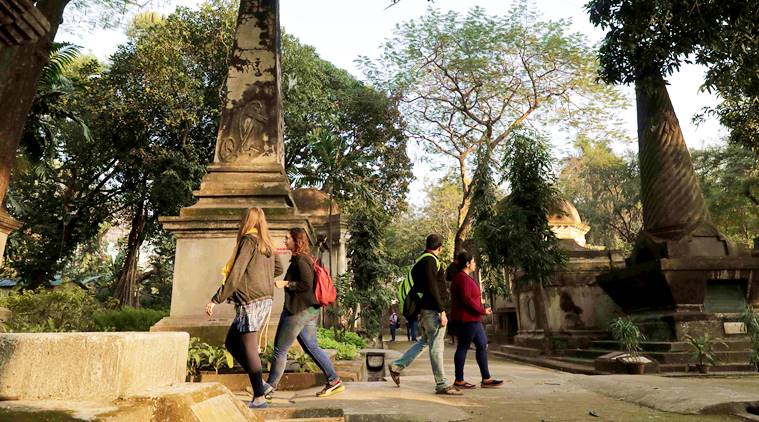
The Park Street cemetery, which is now 250 years old, is home to stories of Kolkata’s past and present.

South Park Street Cemetery , one of the oldest Christian cemeteries celebrates 250th birthday on Saturday, January 06, 2018.It is a consecrated Christian Cemetery with mortal remains underneath each of the 1600 plus vaults with remarkable Tombs . Locals , tourist ,as well as embassy people seen in the cemetery during the programme Express photo by Partha Paul.

In the 250 years of its existence, the Park Street cemetery in Kolkata has seen its share of stolen kisses and frantic lovers, both gay and straight. In Vikram Seth’s 1993 novel, Suitable Boy, Lata takes a leisurely through the Park Street cemetery along with a friend, Amit. They visit the tomb of Rose Aylmer, a Welsh girl who sailed to India with an aunt in 1798, and died of cholera two years later. Famous British poet Walter Savage Landor, a suitor of Rose, immortalised her in a poem Rose Aylmer. Amit and Lata recite the poem together at the spot.

Not far from the bustle of one of Kolkata’s busiest streets, is the South Park Street Cemetery, with two functional old iron gates at the entrance. Inside, rows of obelisks and gazebos spread out on both sides in no particular order. A marble plaque on the left pillar declares that the cemetery opened in 1769 and closed in 1790, but historians will tell you that burials continued into the 1830s.

The cemetery is the final resting place of many like Rose Aylmer. As Souvik Mukherjee, assistant professor of English, Presidency University points out, most Europeans who would land in the muggy, mosquito-ridden city, would last only “two monsoons”. “They would almost always fall prey to malaria,” says Mukherjee, who specialises in the cemeteries of Bengal. The truncated pillars that dot the cemetery signify lives lost too soon. “You will find graves of many, many children here,” says Mukherjee.

According to Susan Hosking’s book, The Great Burial Ground at Chowringhee: Reflections on the South Park Street Cemetery in Kolkata, this is one of the oldest non-church cemeteries in the world. Hosking says that by the mid-18th century, the old Christian burial grounds in the ruins of the first Fort William, established in 1665, had become inadequate. Eight acres of relatively high ground in an uneven and swampy area were marked out for a new cemetery on what was then the southern outskirt of the town.

The oldest tomb in the cemetery, according to Mukherjee, is that of Mrs Sarah Pearson, who died on September 8, 1768. Very little is known of the oldest resident of the place but tomes have been written on the one who has the most prominent tomb of the cemetery — a blindingly white structure in a maze of greys. The tomb of Sir William Jones, renowned philologist and founder of Asiatic Society of Bengal, finds pride of place bang in the middle of the cemetery.

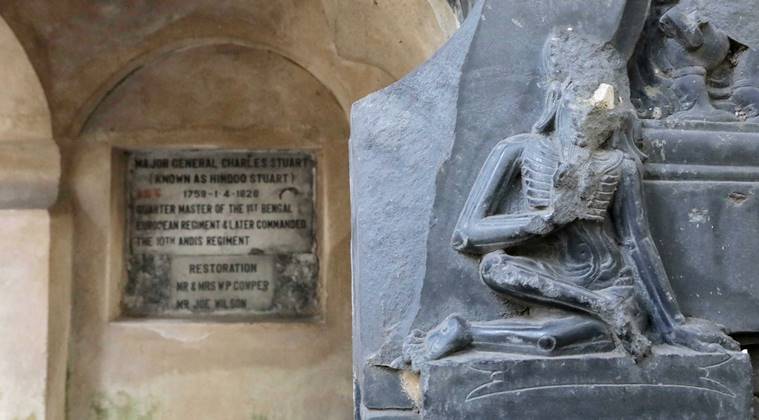
Major General Charles Stuart, known as Hindoo Stuart tomb at South Park Street Cemetery , one of the oldest Christian cemeteries celebrates 250th birthday on Saturday, January 06, 2018.It is a consecrated Christian Cemetery with mortal remains underneath each of the 1600 plus vaults with remarkable Tombs . Locals along as well as embassy people seen in the cemetery during the programme Express photo by Partha Paul.

It is definitely not the most beautiful structure in the premises. That distinction belongs to the tomb of Charles Stuart (1758- 1828) or as the officer of the East India Company was popularly known, Hindoo Stuart. A beautiful synthesis of Hindu, European and Islamic styles, the tomb looks like an exotic guest in a genteel gathering. “He was one of the few British officers to embrace Indian culture,” says Mukherjee. CP Hodson’s biography of Stuart mentions that he “had studied the language, manners and customs of the natives of this country with much enthusiasm, his intimacy with them … obtained for him the name of Hindoo Stuart.”

However, in 1984, this very tomb almost fell prey to the greed of realtors. “The cemetery continues to exist thanks to a legal intervention by the Calcutta High Court. An order was issued stopping a well known family business from turning the cemetery into an arts centre. The demolition work had already begun and the damage can still be seen. Innumerable graves have been lost, replaced by strewn rubble and a multi-storey car park. The tomb of Charles Stuart was demolished, later restored, and the demolition of DeRozio’s grave had begun. Justice Bagbati Banerjee saved the South Park Street Cemetery,” says Anthony Khatchaturian writer, guide and Kolkata Heritage activist.

Deepanjan Ghosh, who runs an exhaustive blog on forgotten chapters of the city’s history, says one of the most interesting personalities to be buried in the cemetery is Elizabeth Jane Barwell, popularly known as Miss Sanderson. The “celebrated Miss Sanderson”, daughter of a colonel in East India Company’s army, was widely known as the most beautiful girl in Calcutta when she arrived. She was also notoriously mischievous. “A popular story about her is that she told 16 of her suitors that she would be going to a ball in a Parisian dress and it would be marvellous if they wore a similar costume of pea-green, with pink silk trimmings. All of the men turned up in the exact same ridiculous outfit!” says Ghosh.

Not very far away from her tomb is the modest one of Henry Louis Vivian Derozio (died 1831), the revolutionary thinker and poet who, in many ways, shaped the then Bengali intelligentsia. At the age of 18, he got the post of a lecturer in English literature and history at the Hindu College. He was considered to be a rabble-rouser by the orthodox, Hindu-dominated management of the college as he encouraged his students to question social evils. Eventually, he was expelled. His untimely death soon followed. But his legacy lived on. “His grave is the most visited one in the cemetery,” says Ghosh.

Not surprisingly, the cemetery has inspired its share of ghost stories. There were rumours of a priest in white cassock haunting the premises. Mukherjee dismisses it with a simple, irrefutable logic. “Priests in India wear black cassocks,” he says.

source:http://www.indianexpress.com / The Indian Express / Home> Eye / by Premankur Biswas / January 28th, 2018