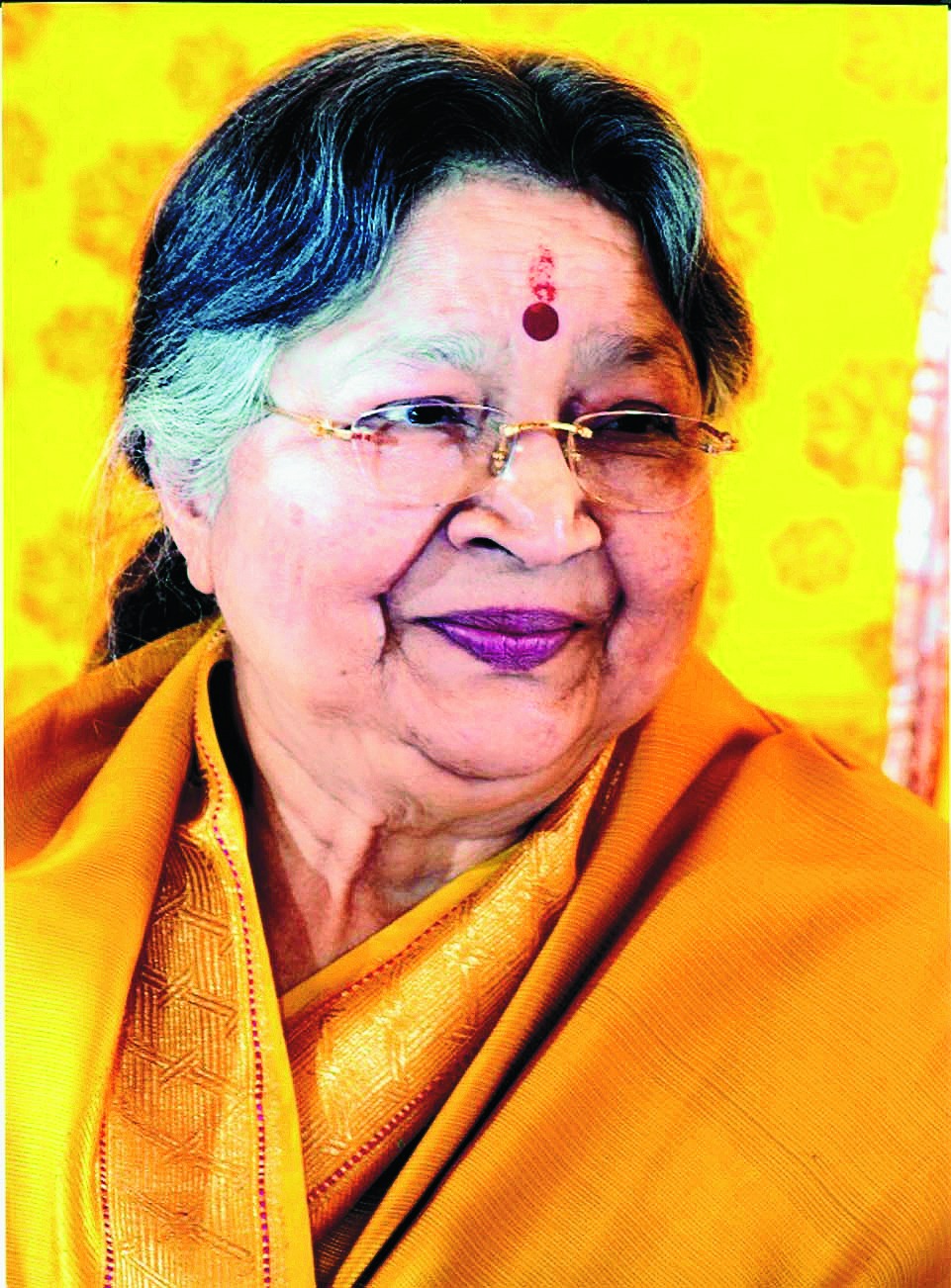
Sushila Goenka, the wife of industrialist Rama Prasad Goenka, passed away on Sunday evening. She was 82.
Her eldest son Harsh Vardhan Goenka, who is the chairman of the RPG Group, and younger son Sanjiv Goenka, the chairman of the RP-Sanjiv Goenka Group, were present along with their children and other family members during Sushila’s final moments.
R.P. Goenka’s brothers, Jagdish Prasad and Gouri Prasad, were also present.
Born in Calcutta on August 15, 1936, Sushila, a daughter of Ram Sundar Kanoria, got married in 1948. A devotee of Indian tradition and culture, she was known for her interest in Indian music and her intimate connection with musical legends like Lata Mangeshkar.
Sushila was a director of Saregama India Ltd. Along with her husband, she was instrumental in setting up the Mahalaxmi Temple on Diamond Harbour Road.
She was cremated at Keoratala on Monday morning in the presence of friends, family members, ministers, senior government officials and city-based industrialists.
source: http://www.telegraphindia.com / Telegraph,Calcutta,India / Home> Calcutta / by Special Correspondent / July 17th, 2018
From left) Filmmaker Suman Mukhopadhyay; BN Ramesh, additional director general and inspector general of police, West Bengal Human Rights Commission; Vishesh Gupta, the chairperson of Bharat Soka Gakkai; former Prasar Bharati CEO Jawhar Sircar; dancer Alokananda Roy and Rashi Ahuja, director and head of external relations, Bharat Soka Gakkai at the conference at Science City on Saturday. Picture by Bishwarup Dutta
Science City:
For 36 years, a Japanese man has been writing and sending a peace proposal to the United Nations. Even at 90, Daisaku Ikeda stays committed to his life-long effort to steer the world away from conflicts and build a humanistic society. He has managed to spread his belief across 192 countries, including India, through the Buddhist society of Soka Gakkai that he leads.
The Soka education system, rooted in the society’s values, encompasses kindergartens in six countries, elementary to graduate level schools in Japan and a liberal arts university in California. Born to a family of seaweed farmers, the Buddhist philosopher and peacemaker has also founded an art museum, a music concert association and institutes for peace and policy research in Japan and the US.
The organisation’s India arm Bharat SokaGakkai held a conference on Ikeda’s 36th peace proposal at Science City on Saturday. “Soka means value creation. There is a lot of synergy between our values and the UN’s agenda,” said Vishesh Gupta, the chairperson of Bharat Soka Gakkai.
The guests were welcomed by volunteers clapping in rhythmic unison.
“Art can’t teach anyone anything. It only makes the human soul receptive to the good. Neither does artistic vision fall from the sky. It is the result of practice,” said filmmaker Suman Mukhopadhyay. He went on to talk of the issues he has addressed through his work on the stage and in films. He is planning a film on Kashmir, titled Paradise in Flames.
Dancer Alokananda Roy shared her experience of working with prisoners. “When I walked into a prison, I did not expect to meet people with heart. But if you treat them as human, they also feel human. I have worked with juvenile offenders, too, who are traumatised by society’s finger-pointing.They made a mistake. It’s fair to give them a second chance,” she argued. Her new students, however, have not made any mistake. They are transgenders. “They do not deserve to be cast aside.”
B.N. Ramesh, additional director general and inspector general of police, West Bengal Human Rights Commission, spoke of his experience of tackling insurgency-hit states across the country and people he met along the way, like an 11-year-old stone pelter in Kashmir.
Former Prasar Bharati CEO Jawhar Sircar shared his experience of attending three Unesco conventions. On the agenda was restitution of cultural property, i.e. the question of returning cultural artefacts plundered from another nation. “Management of peace at the kitchen level calls for patience,” he said.
Using the acronym VUCA coined by the US army, which stands for volatility, uncertainty, complexity and ambiguity, he said: “That’s the world we face. Is peace worth discussing in such a world? But man’s capacity to destroy is equalled only by his capacity to save.”
He cited the genesis of a cross-cultural signal – the salutation. “When strangers met in the medieval times, it was customary to delink the right hand from the body to indicate that no weapon would be used. Warriors would also raise their visors to reveal their identity. The gesture was stylised over time.”
Sircar also mentioned the phenomenon of Mexican wave in sports stadiums. “It proves that there is dormant in man a capacity to act in unison, rising above identity and ideology thrust upon him,” he said.
source: http://www.telegraphindia.com / The Telegraph,Calcutta,India / Home> Calcutta / by Sudeshna Banerjee / July 16th, 2018
In 1780, an Irishman took on the British in Calcutta with a tell-all weekly that covered everything from corruption to politics
It was 1780. Great events were shaping and shaking the world. Four years earlier, in 1776, Britain had lost its first colony; a new nation was born, namely, the United States of America. And nine years, later, in 1789, the French revolution ushered in a new era of freedom and hope in Europe.
At a time when the western world was changing rapidly a new spirit was also taking shape in one of Britain’s eastern colonies. Calcutta, then capital of British India, though the East India Company ruled only a small part of India at that time, was witnessing developments that were new not only in India, but in all of Asia. As free thought and freedom of expression swept across the world, an Irishman called James Augustus Hicky gave Calcutta and India its first printed newspaper in 1780.
Taking on power
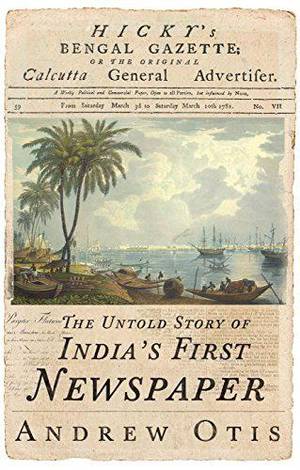
Hicky’s Bengal Gazette, according to the young American scholar Andrew Otis, was a four-page weekly newspaper priced at ₹1. And it took on the rich and mighty of British Calcutta. What did Hicky publish in the pages of his newspaper? “He tried to cover everything that might be important to Calcutta, devoting many sections to politics, world news and events in India.” Topics that featured regularly were poor quality of sanitation and lack of road maintenance. Houses of poor Indians had thatched roofs, prone to catching fire. The outbreak of fires was frequently reported in Hicky’s paper. Through the letters he solicited and published, the editor gave voice to Calcutta’s poor.
He attacked corruption in the East India Company and in high echelons of society. The Bengal Gazette reported that the Governor of Madras, Sir Thomas Rumbold, had been recalled to England to answer charges of corruption in front of Parliament. “Hicky sarcastically wrote,” Otis tells us, “Rumbold was a great man for only amassing a fortune of about 600,000 pounds while in India, much of it from bribes and extortion.”
Hicky did not spare any institution. He exposed the problems of low pay for soldiers in the subaltern ranks of the Company’s army. Failed wars of the Company also came under its gaze. The Company’s army suffered a crushing defeat in the Battle of Pollilur at the hands of Hyder Ali, then ruler of Mysore. As the news of the disaster trickled in, Hicky questioned why the British were fighting in India. He accused the Company of squandering the lives of its soldiers. He even praised the noble actions of Hyder Ali in his treatment of the captured soldiers of the Company.
But as Hicky continued his fearless mission against corruption, the powers of the day did not sit idle. A rival newspaper was born in Calcutta. The India Gazette of Messink and Reed differed from Hicky in every possible way. The two papers represented two sides of the political spectrum.
Tough rival
Hicky emphasised independence while the India Gazette made no secret that they had the support of Governor Warren Hastings. So much so that Hastings had given the facility of free postage to India Gazette. There were hardly any opinion columns in it, a clear sign of their obeisance to Hastings’s authority. And they did so for a good cause, that was monetary rewards. India Gazette became the Company’s de facto mouthpiece; the Company’s departments placed advertisements and notices in that paper.
Press freedom
But Hicky took on the might of the establishment. He alleged through his pieces in the paper how one Simeon Droz had sought a bribe from him and wanted to get favours for him from Marian Hastings, wife of Warren Hastings, in lieu of the bribe. Hastings fumed that someone could show such imprudence. He passed an order that the Post Office would no longer extend its facility to the Bengal Gazette.
Hicky fought back. He hired 20 hircirrahs (courier men) to deliver his newspaper, and his newspaper’s popularity soared. He continued his fight against the most powerful man of the day and his entourage.
Hastings hit back and the Chief Justice Elijah Impey decreed that Hicky be imprisoned on charges of libel. A grand jury sat to decide the fate of Hicky.
After a fierce courtroom battle, the jury acquitted him. Hicky won, Hastings lost. As Otis tells us, “He had proven that it was possible to protect the Press against the most powerful people in British India.”
There were still three more trials to come that tried to muffle the voice of Hicky. What happened; did freedom of the press triumph? For that you must turn to Otis’s book, as he sketches a riveting tale of the struggle of India’s first newspaper editor.
Hicky’s Bengal Gazette: The Untold Story of India’s First Newspaper; Andrew Otis, Westland/ Tranquebar, ₹899.
source: http://www.thehindu.com / The Hindu / Home> Books> Reviews / by Sunandan Roy Chowdhury / July 14th, 2018
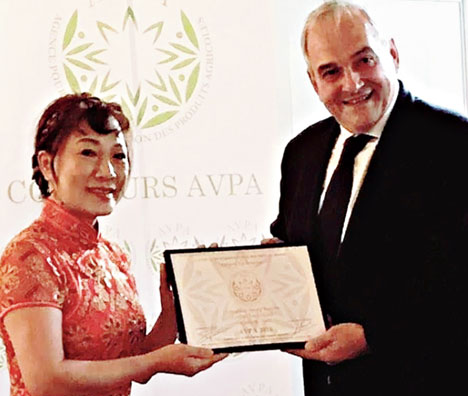
Athena Minami receives the award on behalf of Lochan Tea Limited in Paris
Siliguri:
A Siliguri tea firm has bagged an award in a Paris contest with its Darjeeling Tea picked the winner from an assortment of worldwide contenders.
Lochan Tea’s Giddapahar Spring Wonder drew rich pickings at the first edition of the “Teas of the World” International Contest, becoming the only Indian company among winners in various tea categories.
The contest was organised by Agence pour la Valoriasation des Produits Agricoles (Agency for the Valorisation of Agriculural Products orAVPA), and the awards were handed out in Paris on July 10.
“We were the sole Indian company that won an award in the contest. Some other varieties of Darjeeling teas were also put up at the event but those were by foreign importers,” said Rajeev Lochan of Lochan Tea.
Lochan had sent the samples from Giddapahar, a garden near Kurseong.
“It is called the Giddapahar Spring Wonder, one of the finest first flush muscatels. We have informed Sudhangshu Shaw, the garden owner, about the achievement,” Lochan said. The AVPA is a France NGO working in the field of agriculture.
source: http://www.telegraphindia.com / The Telegraph,Calcutta,India / Home> West Bengal / by Avijit Sinha / July 14th, 2018
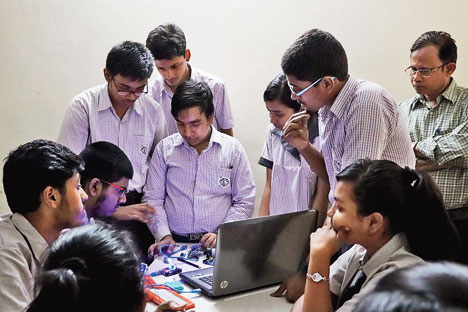
The teenagers from Bijoygarh Higher Secondary School for Girls had never seen a remote-controlled car before. Neither had they heard of artificial intelligence. So they were extremely happy unravelling the wonders of science in the Atal Tinkering Laboratories (ATL) of Salt Lake School.
ATL is an initiative under Atal Innovative Mission, programmed by Niti Aayog, or the National Institution for Transforming India, a policy thinktank of the central government. Under the scheme, the government provides selected schools with grants to set up science laboratories. The idea is to encourage entrepreneurship through self-employment and to develop scientific interest in students. Over 2,000 schools in India have established laboratories under this initiative, including 68 in West Bengal. Salt Lake School is one of them.
The ATL lab in our school was inaugurated in December by the vice chancellor of Jadavpur University, Suranjan Das. Since then, and even before that, 20 students of our school have been working hand-in-hand to create products of scientific importance with utmost precision and dedication.
For many months, ATL had been an intra-school platform, enlightening students on the importance of robotics, cloud computing, programming, coding, artificial intelligence and more.
Finally we opened doors to students of other schools, in observance of ATL Community Day, to commemorate the birth anniversary of B.R. Ambedkar. Our school worked with Maya Foundation, a non-profit NGO that works to create awareness regarding menstrual health of adolescent girls and for the downtrodden sections of rural Bengal. They helped us welcome 12 girls from Bijoygarh. Some students of Salt Lake Point School also attended the exhibition.
As head boy of our school, I watched over my juniors working hard to make the event a success. “Innovation for all” was our motto and we gave it our best shot. My juniors demonstrated remote-controlled cars, which can be used for fire detection, and if fitted with small cameras, can help in investigation purposes. The remote was a mobile phone, and many of the girls from Bijoygarh tried operating it themselves.
The sight of their excited faces at the sight of the moving car was perhaps my moment of the day.
Aditya Mitra, a budding scientist from our school, demonstrated his hand-made laptop. He had built it with spare parts of other electronic gadgets. “Khub bhalo,” was the general reaction from guests, when I asked them to comment on the expo. They interacted with our students and enquired about making the gadgets and the principles working behind them.
The students from Salt Lake Point School were curious and eager too. “There are so many things we didn’t know earlier,” said one of them. “It has been a wonderful experience, getting to see and learn so much.”
Our students, too, were happy to showcase their hard work and explain the intricacies of their machines.
The exhibition was preceded by the inauguration ceremony, attended by scientist Chittaranjan Sinha. Speaking to the students, he emphasised on the importance of scientific innovation and new thinking to sustain our environment and asked us to help society on a wider scale. He encouraged students by telling stories from the lives of Acharya P.C. Roy and Acharya J.C. Bose. “India today is in the grip of grave disarray with superstitious beliefs reigning. Only scientific and rational thinking can save the nation,” he said.
MLA Sujit Bose spent time with us too and congratulated the students and the management for organising the event. Our principal, Sugata D’Souza delivered the vote of thanks and emphasised that this ATL laboratory shall be the nucleus for the development of a scientific temper in students of schools in our region.
source: http://www.telegraphindia.com / The Telegraph,Calcutta,India / Home> Calcutta / by Ananyo Chakraborty, Salt Lake School / July 13th, 2018
Mamata hands over a job letter to one of the former KLO rebels. (Passang Yolmo)
Siliguri:
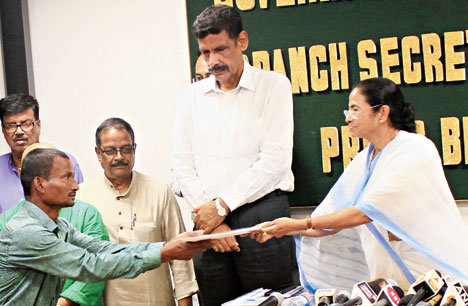
Thirty-six former militants of the Kamtapur Liberation Organisation (KLO) were on Thursday hired as home guard volunteers in the Mamata Banerjee government’s first initiative to rehabilitate the ex-rebels who wanted a separate state.
Mamata handed over job letters to the group, including Mihir Das and Madhusudan Das, once prominent faces of the KLO. The 36 – 21 from Alipurduar and 15 from Jalpaiguri – will be engaged in their districts.
The former rebels – most were arrested during Operation Flushout in 2003-04 by the Royal Bhutan Army – have been disgruntled and long demanded rehabilitation. “They have been provided jobs and will work for the interest of the society. The initiative was taken by the chief minister,” said Amitabha Maiti, the Jalpaiguri police chief.
The decision to address the grievances of those who had resorted to armed struggle demanding a separate Kamtapur state – most were from the Rajbangshi community – follows another important decision the chief minister took during her ongoing trip of north Bengal.
On Tuesday, she had announced the elevation of Bangshibadan Burman as the chairman of the West Bengal Rajbangshi Development and Cultural Board. Burman, board vice-chairman till then, is a top leader of the Greater Cooch Behar Peoples’ Association, also formed to demand a separate state.
A section of the former militants had shunned Trinamul and supported the BJP in the May rural polls in some pockets of Alipurduar. “This had helped the BJP score well in some areas, particularly in the Kumargram block that borders (BJP-ruled) Assam,” an observer said.
The former rebels expressed satisfaction. “We have been raising the demand for 15 years. Some others like us who have been left out should also be provided similar jobs or some other assistance,” said Mihir Das, who hails from Kumargram.
Additional reporting by Anirban Choudhury in Alipurduar
source: http://www.telegraphindia.com / The Telegraph,Calcutta,India / Home> West Bengal / by Avijit Sinha / July 13th, 2018
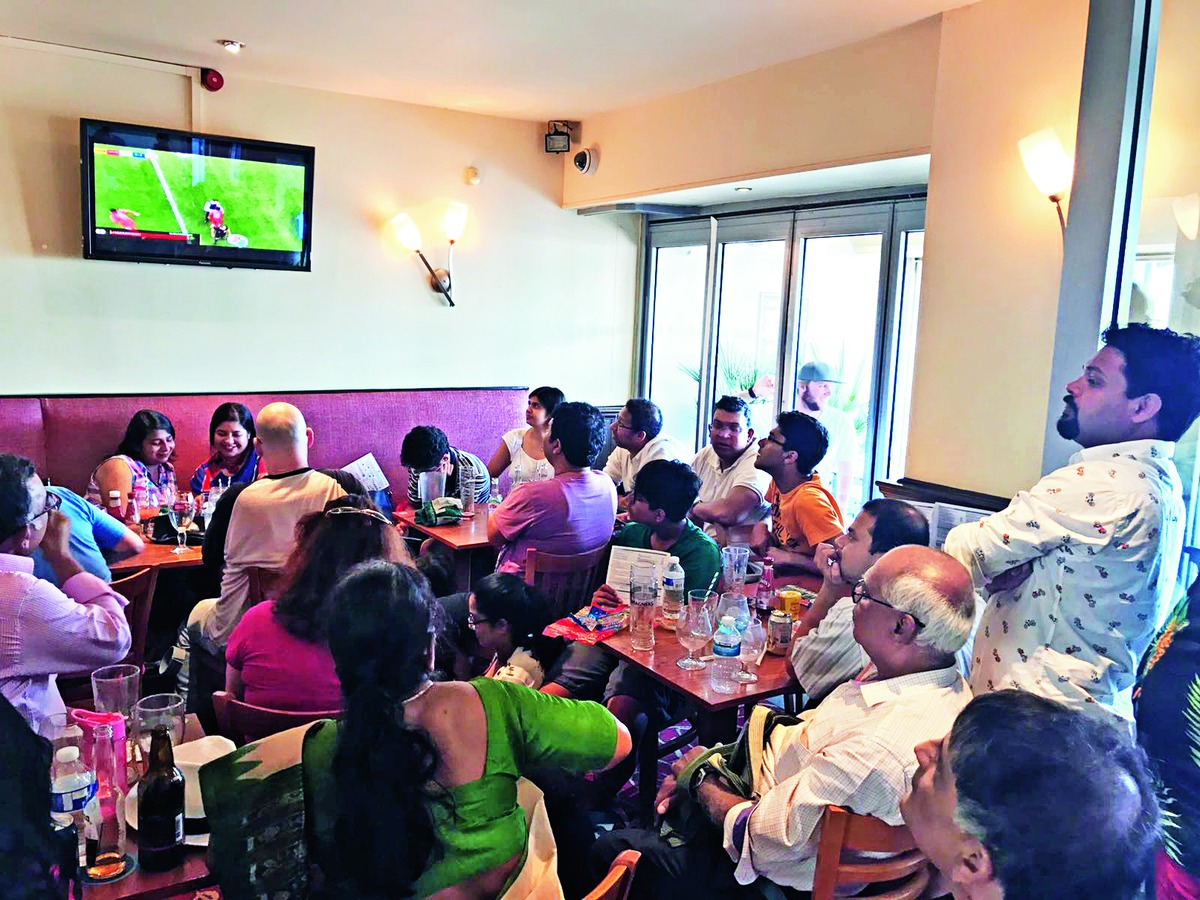
Bengalis from London gather at a Wetherspoons pub to cheer England in the quarter-final against Sweden
Calcutta:
It’s coming home… With old favourites Brazil and Argentina out of the World Cup, Bengalis in England are joining the rest of the country in chanting the choral lyric to the 1996 No. 1 single Three Lions (referring to the English football team’s logo).
“The lyrics are being put up as social media status, memes are getting forwarded on it…” said Sourav Niyogi, a resident of central London.
A video clip he forwarded to Metro had Jaya Bachchan beaming towards the door, silver tray and diya in hand, but instead of the title track of Kabhi Khushi Kabhie Gham there is the Three Lions chorus playing and in place of Shah Rukh Khan, it’s England captain Harry Kane running in with a FIFA World Cup cut-out.
“Streets are getting empty when England is playing. People are hanging flags from houses and cars. Yesterday, I saw a group break into the song at Liverpool Street station,” said Saikat Roy Chowdhury, an IT professional. “Till the other week, our WhatsApp group was divided into supporters of Brazil, Argentina and Germany. Now we are all united under St George’s Cross,” said the 42-year-old.
“Nobody expected England to go this far. This team has no superstar. People have been caught by surprise at how well they have done,” said Tushi Banerjee, a Lionel Messi fan who had “wanted him to go all the way”. Now she buys chart paper for her six-year-old son Ryan to prepare charts with scores of England’s matches.
Saikat and another 60-odd members of the Bengali community group London Sharad Utsav (LSU) had gone for a seaside picnic at Margate on Saturday. “We wrapped up quickly to watch England play at the local Wetherspoons pub.”
Suranjan Som, general secretary of LSU, explains: “Those who come from Calcutta tend to stick to their respective football loyalties – Brazil or Argentina – initially. But as they gradually get sucked into British life and the English Premier League, their loyalty starts shifting towards England. But this time there is no division.”
Prasenjit Bhatacharjee, who has put his sky-blue-and- white jersey away and taken out his England shirt, has started a winner prediction poll on Facebook. “Of course, England has got the most votes,” he laughed. “The average age of this team is only 26. Seventeen members of this squad were not even born when England last reached the semi-final in 1990.”
Indians of other communities are excited about the on-going cricket series. “But for Bengalis, the World Cup is a bigger talking point,” he said.
source: http://www.telegraphindia.com / The Telegraph,Calcutta,India / Home> Calcutta / by Sudeshna Banerjee / July 11th, 2018
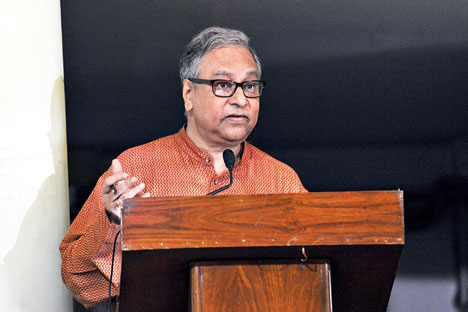
Jawhar Sircar delivers the Dr Biman Behari Memorial Lecture at Asiatic Society. Picture by Sanat Kumar Sinha
Park Street:
When Jawhar Sircar, the former Prasar Bharati CEO, took the stage at Asiatic Society to deliver the Dr Biman Behari Memorial Lecture on a topic drawn from Indian mythology, it was a deliberate act to lift what he described as the “academic apartheid with gods and demons”.
“The huge area of mythology and folklore is taken as nonsense by academics, thus leaving it to those who are deliberately misusing it to threaten the idea of India,” Sircar said.
Among those who deal in the area, Devdutt Pattanaik, he said, is too text-based in his interpretations. “At times he does refer to context but that pleases rather than disturbs the reader into challenging dangerous fundamentalism.”
Amish Tripathi, he said, builds modern myths on age-old ones that leaves the reader more firmly rooted in the imagined past. “The difference between myth and reality is fast disappearing in India.” Only a few bravehearts like D.D. Kosambi have explained “why colourful tales are needed to sugarcoat religious values”.
Elaborating on his theme ‘ Asuras in Indian tradition’, Sircar said his fascination with asuras was from a desire “to get their side of the story”.
He was using asuras, mentioned in the Mahabharat and the Puranas, as an umbrella under which to put all demonised anti-gods. “They are indigenous forces who stood in opposition to the emerging and dominating Sanskritic narrative.”
“The idea,” he said, “is to try to retrieve bits and pieces of the alternative narrative that was wiped off by priestly officialdom but survived through disjointed tales embedded within the mega narrative.”
Delving into the root of demonology, he pointed out that for ages Man knew certain deities were not benign. “But our binaries do not operate on the same plain (as the God vs Devil construct in the West). We have internalised much of the malevolent pantheon.”
An example of the process, he said, is Shani, who is still treated with suspicion and carries signatures of demonic worship. “You cannot place him indoors. Yet Brahmanism has managed to fit him within the system so that he does not run out of it and become the rallying point of dissonance.”
A difference between gods and demons, he said, is that one has to be worshipped and the other propitiated. Deities were metaphors for ethnic groups. “In pre-legislative times, policy-making depended on whose god one was able to foist upon the others in the pantheon.”
The expulsion or suppression of gods reflects social changes. “Of the ruling three in the Aryan narrative, Brahma was pensioned off to a temple in Pushkar and Indra was banished as a suffix to names. By this time, pastoral economy was on the upswing and Indra was pitted against Krishna.” The Govardhan mountain episode, with Krishna sheltering Vrindavan from the thunder of Indra, is iconic in the Krishna lore.
“Monotheism makes no compromise with the demonic. The devil had to be opposed to God. Christianity and Islam have kept the demon alive on a day-to-day basis as temptation, Sircar said, referring to rituals such as stoning of the devil at Mecca.
But in Hinduism, the asura is already defeated and his memory is celebrated in the burning of Ravan. “Over time, even figures in opposition were deified. Ravan, for example, was shown as a Shiva disciple.
“The story of India lies in this absorption and continuous process of accommodation.”
source: http://www.telegraphindia.com / The Telegraph,Calcutta,India / Home> Calcutta / by Sudeshna Banerjee / July 1oth, 2018
Museums that encapsulate magic of Bengal and Calcutta
Michael Feiner, the German consul general, with members of Unique Legacies of Bengal (BAUL) at Gurusaday Museum in Joka on Sunday. Pictures by Gautam Bose
Calcutta:
A museum dedicated to the folk arts and crafts of Bengal, another housing a treasure trove of artefacts excavated till 2005 and a third that narrates the story of the ubiquitous tram. Three of Calcutta’s lesser-known attractions, all of them possible to visit in a day, were on Sunday part of a heritage tour taken by the German consul general Michael Feiner.
Metro tagged along to capture highlights of the visit to the Gurusaday Museum in Joka, the State Archaeological Museum in Behala and the tram museum in Esplanade.
Gurusaday Museum, Joka
This museum located near the Joka crossing on Diamond Harbour Road houses paintings, kantha embroidery and musical instruments, among others.
Colourful scroll paintings ( patachitra) that narrate tales like Gourangalila and Manasamangal adorn the walls . There are also square paintings that depict ordinary people living ordinary lives as well as gods and goddesses. One such painting shows a rural market scene with some people dressed in proper clothes while others are clad only in a dhoti, creating an image of social contrast.
Tribal musical instruments like dhamsa, madal, shinga and damru are also on display in the museum.
The majority of the pieces are from the collection of Gurusaday Dutt, an Indian Civil Service officer who gathered those during his stints as collector in various districts of undivided Bengal. Many others have made donations to the museum.
One of the more striking pieces is the Crowned Buddha. “We are used to seeing figures of a bare-headed Buddha. A figure of Buddha with a crown on his head and jewellery around his neck and arms is rare,” said Dipak Barapanda, the assistant curator of the museum.
Smaranika, the tram museum at the Esplanade tram depot
The stone sculpture dates back to the 10th Century.
The museum has been in the news, albeit for the wrong reason, since the Union ministry of textiles informed the authorities that it could not fund maintenance forever. In a letter last November, the ministry asked the museum to find a sustainable revenue model to keep the show going.
About 800 exhibits are currently on display and another 4000 are languishing in the storeroom for paucity of space.
State Archaeological Museum, Behala
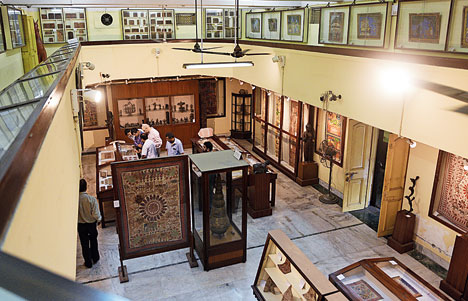
Tucked away behind a pavement full of hawkers in Behala is the richness of a heritage often overlooked. Several galleries in this museum are dedicated to paintings and artefacts found during excavation of historical sites.
Very few seem to know that artefacts excavated in 2005 at Jagjivanpur, a site in Malda, are on display here. “This site was excavated between 1996 and 2005,” said Sumita Guha Roy, the assistant curator and an employee of the museum since 1992.
How Jagjivanpur was discovered is an interesting story in itself. “In 1987, a man digging his field found a bronze plate,” Guha Roy recounted. “Archaeologists later deciphered the text on the plate and found that it was a land grant made by King Mahendrapala to his senapati (commander) to build a Buddhist monastery there.”
This was the first clue to the treasure trove hidden underground. A plaque inside the gallery mentions that excavation began in 1992, but had to be stalled for some years to rehabilitate people living there.
In one gallery, a painting from the late 18th Century shows the intermingling of people from different stratas of society. This one came from Nashipur in Murshidabad.
“The painting shows a medieval king and a Vaishnava saint standing in front of Lord Krishna with folded hands,” said Sayak Ghosh, a member of the Bespoken Architectural and Unique Legacies of Bengal (BAUL), the group that had organised the Sunday tour with the German consul general.
Smaranika, the tram museum in Esplanade
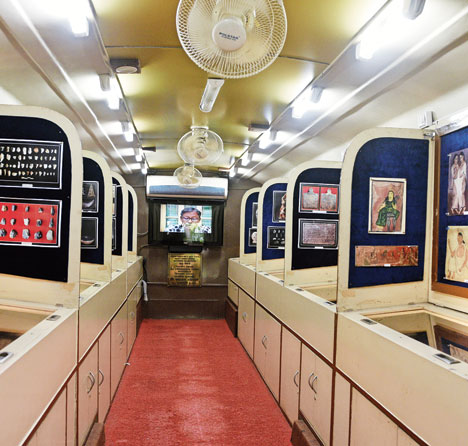
The inside of a van that travels to the districts to make people aware of Bengal’s history, heritage and culture. Schools and individuals can contact that State Archaeological Museum to book a visit to their neighbourhood
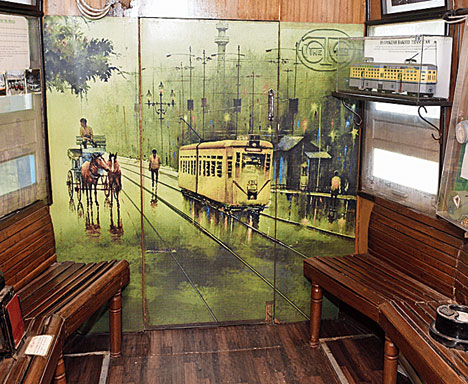
A tram of 1938 vintage at the Esplanade depot has been turned into a museum-cum-cafeteria with 16 seats. The rear bogie of the tram is where the museum is. It contains replicas of a tramcar that was once used to water and clean roads, besides a trolley bus. Tram tickets used during various periods are also on display.
Trolley buses had wheels like buses, but they drew electricity from overhead electric cables meant for trams.
The visit took consul general Feiner back to Germany, where trams still run. “Around 50 cities of Germany like Berlin, Stuttgart and Munich have streetcars. In Germany, streetcars get priority over other traffic,” he said.
At the cafeteria, which is open from 1pm to 8pm, a montage of films shot inside trams between 1931 and 2012 runs on loop on a television screen.
Feiner, who has lived in Calcutta for 10 months, offered a suggestion to promote tourism within Calcutta. “I think there should be a website with comprehensive information on the museums and heritage of Calcutta. There are a lot of ways to promote tourism and this can be a start,” he said.
source: http://www.telegraphindia.com / The Telegraph,Calcutta,India / Home> Calcutta / by Subhajoy Roy / July 09th, 2018
In 1979, Dr. T.M. Das of Calcutta University estimated the value of a tree to be $2,00,000 | Photo Credit: S. SIVA SARAVANAN
Hundred trees remove 53 tons of carbon dioxide and 430 pounds of other air pollutants per year. They also catch about 1,40,000 gallons of rainwater per year.
Officials in Delhi wish to fell about 17,000 fully grown trees in some parts of the city to make space for building housing colonies. And to “pacify” people who object to this tree destruction, they say that for every tree that will be felled, they will plant 10 saplings. Interesting — the minister knows it; the National Building Construction Corporation (NBCC) knows it and we all known it — that this is a stupid answer. “What you lose today, I will make up” (20 years from now? and if the saplings survive?) And this is not just in Delhi. Government and city planners in several other states do the same. This attitude shows not just ignorance but arrogance, disregard for trees and their value. It is time planners wake up and understand the value — economic, ecological, health-related and sociological — that trees offer.
Value of a tree
Way back in 1979, Dr. T.M. Das of Calcutta University estimated that the monetary value of a tree, during a life span of 50 years, amounted to about $2,00,000 (at 1979 rates). This was based on the amount of oxygen it produces, the fruit or the biomass and the timber it offers when felled and so on. For every 1 gram that a tree accumulates as it grows, it generates about 2.66 grams of oxygen. Dr Nancy Beckham of Australia, in her paper, “Trees: finding their true value”, points out that “trees and plants silently carry out their daily routine years after years, stabilizing the soil, recycling nutrients, cooling the air, modifying wind turbulence, intercepting the rain, absorbing toxins, reducing fuel costs, neutralizing sewage, increasing property values, promoting tourism, encouraging recreation, reducing stress and improving personal health as well as providing food, medicine and accommodation for other living things”. (Link: ).
The Department of Environmental Conservation of New York State, USA offers numbers in this connection (see ), along with references to scientific papers which estimate these numbers. It points out that (1) healthy trees mean healthy people: 100 trees remove 53 tons of CO2 and 430 pounds of other air pollutants per year; (2) healthy trees mean healthy communities: tree-filled neighbourhoods lower the levels of domestic violence and are safer and move sociable; (3) healthy trees mean healthy environment — 100 mature trees catch about 1,40,000 gallons of rain water per year; (4) healthy trees mean home-owner savings — strategically placed trees save up to 56% of air conditioning costs; evergreens that block winter winds can save 3% on heating; (5) healthy trees means better business — in tree-lined commercial districts, shoppers report more frequent shopping and spend 12% more for goods, and (6) healthy trees means higher property values.
The minister and the NBCC officials are smart people and they surely know all these facts. Yet for them, a mature tree is “dead urban space” and clearing 17,000 trees means real estate for building houses, colonies and shopping malls in a city that is gasping for clean air. (Delhi Greens, an NGO, estimated in 2013 that a healthy tree is worth Rs. 24 lakh a year, just with respect to its oxygen producing capacity). And for them a sapling occupies (today) about a hundredth (or even less) space. But where will they plant the saplings — where the trees were? How will they survive if construction starts already? Clearly the officials’ attitude is: ‘well, we will be gone (transferred/ retired) and do not need to answer’. What Gurgaon was then, and is now, makes the point.
Admire trees, don’t axe them
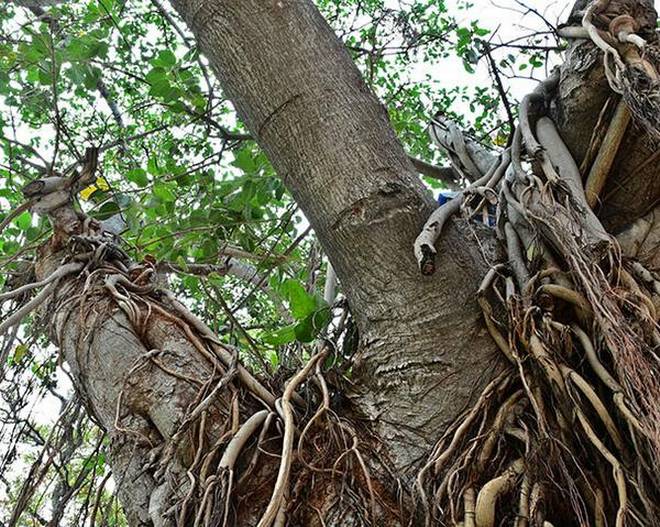
In stark contrast to their cruel attitude towards trees stand the examples of Sunderlal Bahuguna’s “chipko” movement, Saalumarada Thimmakka of Karnataka who has planted 398 banyan trees — each representing her own child, and Majid Khan and the team of biologists and horticulturists who are offering “intensive care” (injecting insecticide mix in to the phloem of each branch) to a 700 years old “pillalamarri” banyan tree near Mahabubnagar, Telangana, spanning a 4–acre canopy , which is being eaten up by termites, and bringing it back to life. (See: https://www.thehindu.com/news/national/telangana/a-tree-in-intensive-care/article24241462.ece). Should it have been cut and the 4 acre space used as real estate?
Obviously trees offer emotional, even spiritual solace. Indian history is replete with examples — Lord Buddha, Emperor Ashoka, and the Tamil King Pari Vallal who left his chariot near a plant to help it spread its branches.
Should not Delhi then think of building houses and colonies elsewhere in the suburbs, saving these 17,000 trees? Or if at all it has to do it in Delhi, think new thoughts, but without cutting the trees (or at best sacrificing the smallest possible number)? This impossible-sounding scheme offers challenges to architects. Indeed, high rise apartments have been built elsewhere, saving trees and even including them as part of the building. Some examples are seen in Italy, Turkey and Brazil.
India has been blessed with creative architects, both Indian and foreign, who have built houses and campuses, totally in harmony with the surroundings. The Indian Institute of Architects has about 20,000 members, we have about 80 institutions that teach architecture. Why not throw a challenge to them to come up with the best plan, offer a handsome award to the most suited and creative one, and use it to build the colony?
dbala@lvpei.org
source: http://www.thehindu.com / The Hindu / Home> Science / by D. Balasubramanian / July 07th, 2018