Monthly Archives: August 2014

This Lee is a game changer in kabaddi

Jang Kun Lee (left) and Seong Ryeol Kim.  / Photo: Special arrangement / The Hindu
Jang Kun Lee (left) and Seong Ryeol Kim. / Photo: Special arrangement / The Hindu

In a cluster of doughty Indian kabaddi players the presence of a South Korean creates an outlandish effect, true to his name, the Korean has been noted for his speed and agility.

In a cluster of doughty Indian kabaddi players the presence of a South Korean creates an outlandish effect.

Jang Kun Lee seems to have leapt out of a martial art move and landed straight on the kabaddi mat to salvage his Indian hosts from crisis. This is how the plot seems to be unfolding for the Bengal Warriors in the Pro Kabaddi League, where the 21-year-old South Korean, who calls himself a student of the sport, has already become a hero for the team.

Jang Kun Lee, who shares a part of his name with the celebrated martial art exponent Bruce Lee, has raised the expectations of his Indian teammates, something akin to the exploits of the celluloid hero. Lee is the raider (attacker) every defence dreads and the South Korean showed he is a quick learner as he picked up successive ‘Best Raider’ awards in the back-to-back matches his team Bengal Warriors won when the second round of the recently-launched STAR Sports Pro Kabaddi tournament hit the city this weekend.

His speed and agility are already a talk of the tournament. The player says it comes from his experience of playing the martial art sports like judo and taekwondo. “The tournament is a big learning experience for me and it really feels nice to be apart of it,” Lee said, after picking up his second best raider award.

The Korean interest in Kabaddi does not stop with Lee. The secretary general of Korea Kabaddi Association Yoon Young-hak is closely monitoring the education process of his boys. The other Korean player with Bengal Warriors, Seong Ryeol Kim, is a defender and had already made his debut with the Warriors. Young-hak insists that Kim is also a player of great merit. There are two more Koreans – Dong Ju Hong and Tae Deok Eom who play for Dabang Delhi and Patna Pirates – but it is Lee who is currently hogging the limelight.

Lee went on to reveal the secret of his instant success. “We have a different training procedure in Korea where we focus more on weight training and other strength-building measures. That probably makes us quick and agile. Indians are the best in the world in technique, but I am not sure about the time they devote to weight training,” he said.

The South Korean player says the newly designed professional tournament like Pro Kabaddi will help the sport gain the attention of the world.

“Kabaddi is yet to pick up in our country. The good performance of players like Lee or Kim will definitely help the sport grow in our country,” said Young-hak appreciating the way Bengal Warriors is using his compatriots. “We are preparing for international tournaments like Asian Games and our experience here will form an important part of our training and understanding of the game,” Yoon Young-hak said, adding that his country also is taking the help of coaches from Sports Authority of India to train their players.

Commonwealth bronze sweetens life for Sakina Khatun

Sakina khatun with the bronze medal she won at the Commonwealth Games in Glasgow. / The Hindu

Her success is all down to her hard work: coach

Life has not been kind to Sakina Khatun, who won a bronze medal at the Commonwealth Games on Saturday.

In Glasgow’s Clyde Auditorium, the 25-year-old Bangalore-based para-athlete lifted a weight of 88.2 kg to finish third in the women’s powerlifting event (Lightweight Group A). It was a success that came after prolonged hardship.

“My parents cried when I broke the news to them on the phone,” she told The Hindu from Glasgow.

Her coach and mentor Farman Basha, who also competed at the Games, faltered in his event on account of an injury, but his delight was enormous. “She has been through a lot. So I’m very happy for her,” he said.

Sakina hails from Basirhat in West Bengal’s North 24 Parganas district. Her mother is a farm labourer while her father, ailing with a serious back condition, is unable to work. “He can’t even walk,” Sakina said. “We don’t have the money for his treatment.”

Afflicted with polio at a young age, she took up swimming on her doctor’s suggestion, learning in ponds in her village before a teacher in school noticed she had an aptitude for it. “Despite steady success at the national level, I was ignored for the 2010 Commonwealth Games team. It left me disheartened and I quit the sport,” she said.

Sakina switched over to powerlifting on the advice of one of her swimming coaches, and in 2010 was directed to Basha. “She wanted to come over to Bangalore to be trained by me,” he said. “She had no money and I couldn’t afford to spend a rupee on her.”

But Sakina found a benefactor in Dilip Majumdar, a businessman who volunteered to support her training. “I’m a girl and my parents were against my leaving home,” she recalled. “But my sponsor managed to convince them.”

“At first, she could only lift around 25 kg,” recalled Basha. “But gradually she improved. Her success is all down to her hard work.”

source: http://www.thehindu.com / The Hindu / Home> News> Citis> Bangalore / by Shreedutta Chidananda / Bangalore – August 04th, 2014

Top Gear’s ‘best taxi in the world’ to cease production

AmbassadorKOLKATA03aug2014

Originally based on the Morris Oxford, the Ambassador has been manufactured by Hindustan Motors in India since 1948.

The car manufactuer has announced that it will suspend production at its plant in West Bengal. Few see it returning to Indian roads, as more efficient, modern cars have taken over the market.

This car ruled Indian roads for the first 40 years, becoming a symbol of power and influence. By the end of the 1970s, it had a market share of 75 percent.

The entry of Suzuki though a local joint venture with Maruti, changed all that and by 1992, Ambassador’s share dropped to 20 percent.

Lack of investment, a militant workforce, an ageing plant and lack of interest and vision by the owners are cited as resons for the demise of this car.

In teh 1990s, Hindustan Modors enterd into a joint venture withGeneral Motors to manufacture and sell Opel vehicles. There was also a collaboration with Mitsubishi Motors to manufacture the Lancer. But none of these ventures took hold.

In a statement, Hindustan Motors blamed the shutdown on “worsening conditions at its Uttarpara plant which include very low productivity, growing indiscipline, critical shortage of funds, lack of demand for its core product the Ambassador and large accumulation of liabilities”.

Only 2,200 Ambassadors were sold in 2013-14; a small fraction of the 1.8 million passenger cars sold in India.

In a show, which was aired on the BBC last year, Top Gear organized a world taxi shootout in which Ambassador emerged a winner, beating competitors from all over the globe.

The Top Gear team’s verdict? “If performance is getting to your destination at some point of time, yeah, this is quite a performer.”

As reported in The Economic Times, Nida Najar notes: “Drivers complain that pedals break off after a few thousand miles, that the air-conditioners malfunction. Some use turmeric to stop up holes in the radiator; anything to avoid servicing with expensive and increasingly rare parts. Many carry water bottles to cool off radiators that frequently overheat.”

source: http://www.ferret.com.au / Ferret / Home / by Kevin Gomez / July 03rd, 2014

The Lede – Big Wigs

The unsung wig makers of Bollywood

S Kabir created hairpieces for many major stars, including Amitabh Bachchan in the 1988 action film Shahenshah  /  S Kabir - Siraj Sheikh
S Kabir created hairpieces for many major stars, including Amitabh Bachchan in the 1988 action film Shahenshah / S Kabir – Siraj Sheikh

SURENDRA’S NATURAL HAIR STUDIO isn’t easy to find. But for the wigged wooden heads marking the entrance, this workshop in a grimy alley off Mumbai’s SV Road looks just like any other. Inside, however, it becomes clear that the studio belongs to one of Hindi cinema’s most sought-after wig makers, Surendra Salvi. The foyer walls are lined with photos of Salvi with actors—everyone from Salman Khan to Prem Chopra—sporting his toupees, beards and moustaches.

Salvi ushered me into a workshop where five uniformed employees created mesh bases for new wigs, and wove hairpieces and hair extensions. Almost all of Salvi’s wigs are made of natural hair, but he uses various amounts of synthetic material for those on tight budgets. “Natural hair is expensive,” he explained. Even-length, pre-sorted hair can cost up to Rs 70,000 per kilogram.

Salvi, a Mumbai native, told me he always wanted to be part of the film industry, though it took some time to break into the business. “First I did clerical work,” he said, “then I fitted car lamps for an auto company. Then I worked in a talcum powder factory. Then I had enough.” In the early 1980s, he started assisting the makeup duo of brothers Anil and Pradeep Pemgirikar by making wigs and beards for extras and body doubles. Over the following decades, he made it big on his own. His hairpieces have been used by Boman Irani in 3 Idiots, Shahrukh Khan in Ra.One, Akshay Kumar in Action Replayy, and many other superstars. When I visited two months ago, Salvi was fashioning wigs for director Anurag Kashyap’s upcoming Bombay Velvet. He also does work for regional films, television commercials, and individual clients.

Pradeep Pemgirikar, Salvi’s mentor, oversaw makeup, wigs and prosthetics for the films of director Manmohan Desai in the 1980s. He now runs Mod Wig Centre from his humble three-room house in Dadar, taking whatever work he gets from the Marathi and south Indian film industries. Pemgirikar, who said his best work was on the 1992 film Khuda Gawah, rued changing trends in the movie business. “Everyone wants a natural look now,” he said, “but in those days, every third character in a Manmohan Desai film had a wig.”

If the 1980s and 1990s had the Pemgirikars, the 1960s and 1970s—when bouffants, pompadours and beehives were all the rage—had S Kabir and Victor Pereira. Kabir came to Mumbai from Kolkata in the 1950s to assist his older brother S Amin, who was then already a makeup man and wig maker of repute. Kabir worked with almost all the leading men of the time, his son Siraj told me, and made wigs for such classics as China Town, Mirza Ghalib, Aandhi, Padosan, Sholay, Shahenshah and Kalicharan. But his most illustrious client was Pran, whose memorable get-ups from Upkar and Zanjeer to Amar Akbar Anthony and Don cemented his reputation as one of Hindi cinema’s greatest character actors.

Kabir passed away in 1994. Siraj is keen to keep his father’s legacy alive, and, with his brother Farooque, now runs the wig studio S Kabir & Sons, established by Kabir in the late 1950s, in Andheri East. “Wig making is an art, but it never gets the respect it deserves,” he said. “Even personal drivers and spot boys who serve chai to actors get mentioned in film credits. We often don’t.” An online search showed S Kabir credited for his work on only three movies, though Siraj claimed he actually worked on between seven and eight hundred films. Siraj also lamented the end of the era when prevailing fashions meant greater demand and profits, and more time to craft great wigs. He remembered being called on to make a hairpiece for Amitabh Bachchan several years ago. “They wanted it in three days,” he scoffed. “Is three days enough time to make a wig?” Sorting hair bought from wholesalers is a gruelling process, and the average wig requires at least five to seven days of work.

Victor Pereira, S Kabir’s contemporary, now lives in Mangalore, near his home town of Moodabidri. Although no longer associated with the film industry, he was happy to talk about his glory days over the phone. Having learned his trade in Mumbai from S Amin, Kabir’s brother, Pereira got his break on the 1969 film The Killers, starring Dara Singh and Helen. Although the film was a dud, he went on to craft all of Helen’s wigs from then on, putting his stamp on her looks in song videos such as ‘Piya tu ab toh aaja’ and ‘Mehbooba mehbooba,’ and films such as The Train and Don. Victor also worked, among others, with Hema Malini, Vyjayanthimala, Sharmila Tagore, Mala Sinha and Rekha. His most challenging project, he said, was director Kamal Amrohi’s 1983 release Razia Sultan. “Kamal Amrohi was such a stickler. Woh ek ek baal dekhte the (He used to check each strand of hair). He told me, ‘Hema Malini rani hai (Hema Malini is a queen). I want the best. Nothing else will do.’”

source: http://www.caravanmagazine.in / The Caravan / Home> Reporting & Essays / The Lede / by Roshini Nair / July 01st, 2014

Toto language more endangered than tribe

Researchers and even the members of Toto community admit that the language is under threat and influence of others languages. File photo: Sushanta Patronobish / The Hindu

Language of primitive tribe has no script and is under influence of Nepali and Bengali: researchers

When scientists of the Anthropological Survey of India (AnSI) set out to conduct a study on language of the primitive Toto tribe, whose population has dwindled to 1,536, they did not realise that the language is more endangered than the tribe itself.

During their study they recorded the vocabulary, folklore, and even some songs in Toto language, and realised that the language has no script.

For centuries, the language that belongs to the Tibeto-Burman group of Indian languages, has survived in the small community completely orally without much research, Asok Kumar Mukhopadhyay, research associate, Linguistics (AnSI), one of the prominent members of the research team, who visited the hamlet of Toto tribe, told The Hindu.

“Being a small community, we found that the Totos communicate among themselves in their own language, but the moment they leave their hamlet of Totopara in Madarihaat block of Alipurduar district, they prefer to not communicate in the language even among themselves,” Mr. Mukhopadhyay said.

Under threat
Researchers and even the members of Toto community admit that the language is under threat and influence of others languages, particularly Nepali and Bengali, is increasing day by day.

Interestingly, despite the language lacking a script, members of the community, whose literacy rate as per a sample survey carried out in 2003 was just 33.64 per cent, have penned books and poems in their language albeit in the Bengali script.

Dhaniram Toto, one of the members of the community, has written two books in Toto language over the past two years.

Mr. Toto claims his book, Lokeswar, is about the folk culture of Totos and his other book Uttar Banga Lokpath is about folk tales of the community.

“Since our language does not have a script, I have to take help of the Bengali script,” he says, adding that there is an urgent need to develop a script for the language.

Mr. Toto, who is employed in West Bengal’s Backward Class Welfare Department, says there are others in the community such as Satyajit Toto, who write in the language taking the help of scripts of other languages.

Keep it alive
Their aim is just to keep the language alive. “We carried out this study to keep record of the language. It may happen in a few decades that the language may get extinct. The study of the Toto language is essential to understand the overall cultural ambit of the primitive tribe,” said Kakali Chakraborty, head of office, Eastern Regional Centre of (AnSI).

Day labourers
Totos, one of the primitive Himalayan tribes in the country, usually work as day labourers and porters carrying oranges from Bhutan to the local market in north Bengal.

Despite the geographical isolation of Totopara, the members have started laying emphasis on education, resulting in about half a dozen of graduates, which includes girls. But the elders point out that despite a number of schools being present in the locality, there is no one to teach the children in their own language, and as a result, the children are losing touch with their culture.

source: http://www.thehindu.com / The Hindu / Home> News> Cities> Kolkata / by Shiv Sahay Singh / Kolkata – August 01st, 2014

The Lede – Shoshimukhi’s Song : In search of the first voice recorded in India

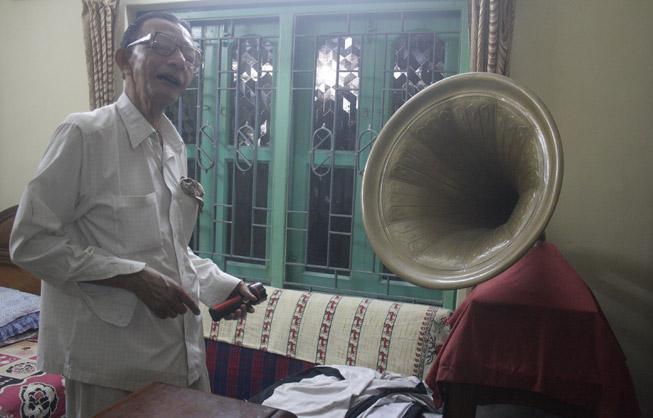
Panchu Gopal Biswas’s gramophone collection includes the first voice recorded in India, that of theatre actress Shoshimukhi - / Photo : SUDHITI NASKAR FOR THE CARAVAN
Panchu Gopal Biswas’s gramophone collection includes the first voice recorded in India, that of theatre actress Shoshimukhi – / Photo : SUDHITI NASKAR FOR THE CARAVAN

WHEN FREDERICK WILLIAM GAISBERG ARRIVED in India in 1902, he had a daunting task ahead of him. In a country that had never before encountered sound recording technology, Gaisberg, a recording engineer with the Gramophone and Typewriter Company had been assigned the job of recording promising voices for commercial distribution. On 11 November that year, in a hotel room in Kolkata, Gaisberg recorded the voice of Gauhar Jaan, a singer of Armenian descent.

Gauhar Jaan went on to become the first commercial recording artist in India, and her career and work are now legendary. But hers was not the first voice that Gaisberg recorded.

“It was Shoshimukhi,” said Indrani Majumdar, a Kolkata-based researcher and collector of old Bengali gramophone records. Shoshimukhi, Majumdar told me when I met her in her east Kolkata studio in March, was an actor in the city’s thriving theatre scene at the turn of the 20th century. “The first recorded content was a Bengali song, ‘Ami ki shojoni kusumeri’ (Is my beloved a flower),” Majumdar said. Gaisberg hadn’t been impressed with the voices of Shoshimukhi or Fani Bala, the other singer he recorded in his first session on 8 November. In his diary, he described them as “two little nautch girls … with miserable voices”.

Majumdar has been immersed in the early history of recording in India as part of a project to collect, digitise and archive 78 rpm gramophone recordings of Bengali theatre performed between 1900 and 1930. Her research, now funded by the India Foundation for Arts and the Berlin Phonogramm Archive, began seven years ago, after she chanced upon a collection of 400 records that belonged to her late grandfather. “Some had labels of drama companies on them,” Majumdar said. “Not much was known about the plays of this period. I thought it would be great if I could do something to restore that part of history.” In the course of her work, she has consulted a number of sources, among them Gaisberg’s own published diaries and researcher Michael Kinnear’s detailed book The Gramophone Company’s First Recordings, which identifies the matrix number of Shoshimukhi’s recording, India’s first, as 13024.

Majumdar’s research has given her a sense of how the theatre community in Kolkata reacted to the advent of recording technology. The fact that no recordings have been found of some theatre legends, like the actor, writer and director Girish Ghosh, suggests that not everyone took to the idea. “Probably because the 78 rpm records were considered a fluke”, said Majumdar. “These [records] typically played for two-and-a-half minutes to a minute more. How to cut down an hours-long play, or an elaborate thumri into that tiny time frame was the question.”

But others from the theatre community were enthusiastic, like Amarendra Nath Dutta, who introduced Gaisberg to Shoshimukhi, a performer with his company Classic Theatre. The theatre recordings went on to be successful, with listeners lapping up encore pieces of Bengali plays, theatre songs like Shoshimukhi’s, full plays recorded over multiple discs, and comic skits. “It’s not easy to know all the relevant information for lack of documentation. I have yet to find the song of Shoshimukhi. But the search is on.”

Having left Majumdar’s studio seized with curiosity about Shoshimukhi’s recording, I made some phone calls to friends in the Kolkata recording industry. Two days later, I sat in the Dum Dum house of Panchu Gopal Biswas, a retired employee of the Kolkata Municipal Corporation. “This is my collection,” Biswas said, pointing to the piles of records neatly stashed in cupboards all over the room. Fishing out a brown envelope from one pile, he carefully extracted a disc from it and laid it on the bed. A worn purple label had fading words on it—‘Shoshimukhi’, and in Bengali, the name of the song, ‘Ami ki shojonee kusumeri’. Stamped on the record was the matrix number—13024.

As the record began to spin on the player, the shrill voice of a young girl filled the room. I thought to myself: Gaisberg may not have been too harsh when he described the voice as miserable. The singer sounded nervous and out of breath. Then, midway through the song, she appeared to gain confidence. The breathing grew more controlled, the words clearer. The refrain was a passionate declaration of love—valo bashi, valo bashi.

“Don’t tell too many people about this,” Biswas said after the song was over, smiling apologetically as he put the record back in its pile. I asked if he would be willing to help a researcher like Majumdar. “Of course I will,” he said. “I’m in if it’s for non-commercial use.” As I made my way out of Dum Dum, my mind was filled with thoughts of Shoshimukhi, sitting in a hotel room all those years ago, surrounded by foreigners, singing into a machine.
_________________________________________________________________________

Sudhiti Naskar is a freelance journalist based in Kolkata. She likes to document people’s lives in moments of flux. She is regularly published in international magazines. She is currently represented by Agency Genesis.
_________________________________________________________________________

source: http://www.caravanmagazine.in / The Caravan / Home> Reporting & Essays> The Lede / by Sudhiti Naskar / June 01st, 2013

The Lede – Test of Metal : The Indian origins of a famous rugby trophy

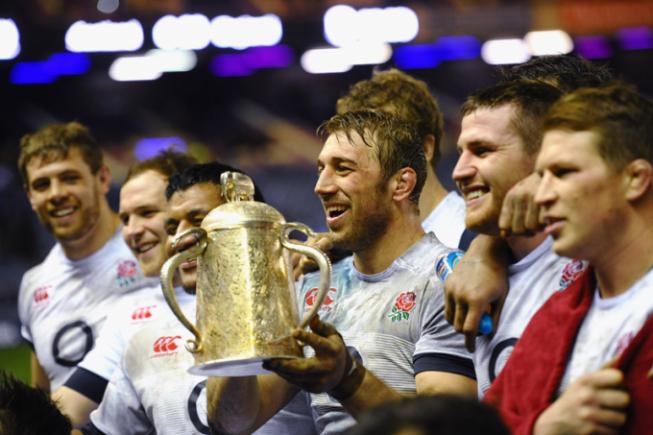
Chris Robshaw, the captain of the English rugby union team, holds the Calcutta Cup, which England retained in February - / Photo : Laurence Griffiths / Getty Images
Chris Robshaw, the captain of the English rugby union team, holds the Calcutta Cup, which England retained in February – /
Photo : Laurence Griffiths / Getty Images

On 8 FEBRUARY, before a crowd of 67,144 people, Scotland faced England at Murrayfield Stadium in Edinburgh as part of the 2014 Six Nations rugby championship. After 80 minutes of play on a muddy pitch, England secured an authoritative victory, with a score of 20–0. As disappointed home supporters filed out, up in the main stand Chris Robshaw, the jubilant English captain, held aloft an intricately engraved silver trophy, with three handles shaped like cobras and an elephant figure crowning its dome-shaped lid: the Calcutta Cup, the oldest trophy in international rugby.

The trophy Robshaw received was, in fact, a replica of the original cup, which is stored in the World Rugby Museum in Twickenham, near London. The museum’s curator, Michael Rowe, told me over the phone that although the cup’s significance has decreased in recent years, it was incredibly prestigious in its heyday, when it was “the Ashes in the sport of rugby.” What is most remarkable, Rowe said, was that the trophy’s origins can be traced back to the largely forgotten history of rugby in colonial India.

In the winter of 1872, a group of British émigrés having a hard time adjusting to life in Calcutta published letters in the Englishman, a prominent newspaper, asking that the administration organise rugby matches. A game was played on Christmas Day that year, with English players on one side and those representing Scotland, Ireland and Wales on the other. There is no record of who won, but the event was a success, and was repeated the following week. Those two matches led to the formation of the Calcutta Football Club in January 1873 (at the time, rugby was one of several related games called “football”). The club thrived—137 members joined in the first year alone—and it joined the Rugby Football Union, the sport’s governing body for all British territories, in 1874.

After a successful start, however, the club fell on hard times. A regiment of the British army left the city for a new posting, and new British arrivals were more interested in polo and tennis. According to Rowe, funds soon started running out, forcing the closure of the club’s free bar, which caused the membership to drop substantially. GA James Rothney, the club’s treasurer, secretary and team captain, considered several fundraising suggestions, but concluded that none of them would keep the club going.

Then, Rowe told me, in 1877, Rothney had an “ambitious” idea. He wrote to the Rugby Football Union suggesting that, to preserve the memory of the club, its remaining funds be used to make what he described as a trophy of “ornate Indian workmanship,” to be “devoted to the purpose of a Challenge Cup and presented to the Rugby Union to be competed for annually” in any way deemed “best for the encouragement of Rugby Football.” Both the Union and the club’s members agreed. Rothney withdrew the club’s remaining £60, a substantial sum at the time, in the form of 270 silver rupee coins. These were melted down in September 1878 by WE Jellicoe, a British silversmith and watchmaker on Calcutta’s Esplanade Row, to create the Calcutta Cup.

The cup was taken to Britain, and in March 1879 the Union organised the first Calcutta Cup match—a game in Edinburgh between England and Scotland, which ended in a draw. The contest was repeated in every following year, and the cup, Rowe said, quickly “became eponymous with the England–Scotland rugby game.” In 1883 it was incorporated into the Home Nations Championship, which eventually became the Six Nations—an annual rugby union competition involving France, Italy, Scotland, Wales, England and Ireland that is effectively the sport’s European championship. The cup has been contested every year since, except during the World Wars. England has won 68 of the 121 matches to date, with Scotland winning 39 and 14 matches ending drawn. England has retained the trophy since 2009.

Today, the original trophy is treated with special care. In 1988, on the night after England retained the cup, two drunk players, one English and the other Scottish, took it out onto the streets of Edinburgh, where they passed it between themselves and dropped it several times. The cobra handles were crushed, and the body and base badly dented. The Edinburgh jewellers Hamilton & Inches restored the cup to its original form, but, as Rowe told me, “silver is a soft metal,” and the restoration left the cup “in a fragile state.” The incident led to a decision to give both nations replica trophies, and store the original at the World Rugby Museum to avoid any further damage.

Rowe said that with the rise of other rugby-playing nations, the England–Scotland rivalry has mellowed in recent years, and so reduced the significance of the Calcutta Cup. But, he added, Rotheny’s idea to entwine the memory of the Calcutta Football Club into the history of rugby was a success. “It is quite remarkable that a short-lived club has such a place in the history of the sport,” he said.
_________________________________________________________________________

Atul Dev is a correspondent with The Sunday Guardian.
_________________________________________________________________________
source: http://www.caravanmagazine.in / The Caravan / Home> Reporting & Essays> The Lede / by Atul Dev / 2014

Prince Dwarakanath lies forgotten in a corner of London

On August 1, 1846, a treacherous thunderstorm raged through London. ‘Vivid flashes of lightning’ struck, the wind howled, and in a hotel room, very close to Bond Street, a ‘Prince’ died. Dwarakanath Tagore was only 52 when he died in the company of just two members of his vast family — a son and a nephew.

Four days later, they buried him, without ceremony in Kensal Green Cemetery. Among the mourners were his youngest son Narendranath, nephew Nabin Chandra Mukherji, four medical students who had accompanied him on his trip to England and his former partners Major Henderson and William Prinsep. Queen Victoria and Prince Albert — who had welcomed him to their court like ‘an old friend’ just over a year ago — sent four carriages. It was a princely send off.

Whatever may have been his reputation back home, in London Dwarakanath was the darling of fashionable society. He gave lavish parties, dined with royalty in England and France, showered his friends and hosts with expensive gifts and gave generously to charities. He was immensely popular with European ladies and made no attempt to conceal his many ‘friendships’. He even kept a boat on the Thames with a certain Mrs Caroline Norton — a divorced, small-time Victorian poet of some ‘beauty and wit’ — where he hosted the literati of the day from Charles Dickens to WM Thackeray.

It is all a very different picture today. Although, the city that he so loved continues to remain popular with most of his fellow countrymen, not many people come to see him. We took the Bakerloo Line on the Underground, got off at Kensal Green Station, and turned left. It was late September and the trees had started changing colour. Kensal Green is huge — 72 acres in fact — and is one of London’s oldest and most distinguished public burial grounds. It has many celebrated residents from scientists, botanists, actors and royalty — Ingrid Bergman and Freddie Mercury among them.

But just as we walked though the very impressive archway of the main gate, we realised we were quite lost. In the absence of any map or directions it was near impossible to find Dwarakanath. Although I knew what his grave looked like, I had no idea where it was. And there was not a soul in sight. A little later, a group of Americans ambled in for a guided walk with a ‘Friend’ of Kensal Green. And this ‘Friend’ – locals who volunteer their time – showed us the way.

Just yards from the main gate, where we had been rummaging the last half hour, lay Dwarakanath. The ground was a little sunken. The grave, simple and grey, simply said ‘Dwarkanath Tagore of Calcutta’. Obit 1st.

The ‘Friend’ who knew a bit about the man seemed curious in our interest. “Nobody visits him these days. Not even on his anniversary. You would think someone from the Indian High Commission or his fellow Bengalis would come to lay flowers. But, I have seen no one.”

Standing there — a little overgrown and overlooked by numerous other graves of different ages — it is difficult to imagine the life and times of Dwarkanath Tagore, once the ‘most prominent citizen’ of Calcutta and the leading force behind the first joint-stock commercial bank in India, Union Bank. Pioneer, philanthropist and partner in Carr, Tagore and Co, Dwarkanath dabbled in everything from customs, salt, tea, coal and steam navigation to indigo and sugar plantations and opium. A great friend of Rammohun Roy, he was a strong voice behind the anti-Sati movement, freedom of Press in India and women’s education. Never shy of controversy, he was almost the self-styled mayor of Calcutta at one point.

The hotel where he died still stands, although under a different name. Brown’s Hotel on 33, Albermarle Street is now a luxury five-star hotel in Mayfair. A room for a night costs anything between £460 and £3,000 and a Sunday three-course lunch for two will set you back by £100. A stay fit for a ‘Prince’ indeed.

— The author is a former journalist who has worked for British and Indian newspapers. She now works at Bath Spa University

source: http://www.timesofindia.indiatimes.com / The Times of India / Home> India / TNN / August 01st, 2014