Category Archives: Historical Links / Pre-Independence

The Royal Bengal Lion-tamer

World-renowned Suresh Biswas debuted to great acclaim in Argentina
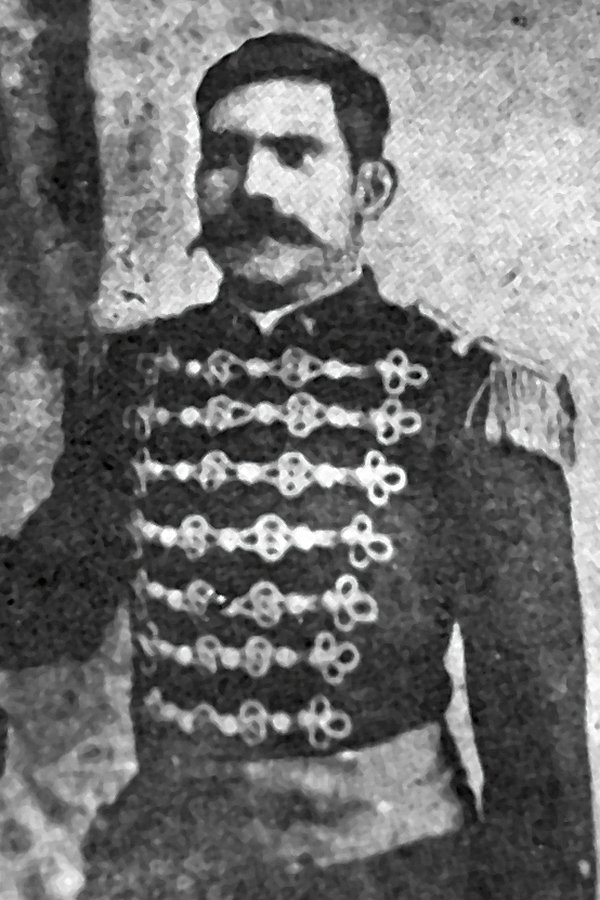
An 1899 biography of Suresh Biswas was republished by Jadavpur University Press
Image: The Telegraph

In 1970, a comic strip was published in the annual issue of a Bengali children’s magazine called Manihar. The hero of the strip, Bangadesher Ranga, was a fearless Bengali animal trainer living in Brazil. And his name was Suresh Biswas.

“The story was imaginary but the character was based on Biswas,” says Swagata Dutta Burman, who edited a volume of the collected works of illustrator Mayukh Chowdhury, the creator of the comic strip. There is mention of Biswas in one of Satyajit Ray’s Feluda stories too. But who exactly was Colonel Suresh Biswas?

Recently, an 1899 biography of the man was republished by Jadavpur University Press. This book by H. Dutt — titled Lieut. Suresh Biswas: His life and Adventures — and another biography in Bengali by Upendrakrishna Bandyopadhyay published in 1905 were the primary sources of information about Biswas for the longest time.

We know from these that Biswas, born into a Vaishnava middle-class family in Nathpur, Nadia, was an independent spirit and a rebel even when he was a boy. At 14, after an altercation with his father, he left home and converted to Christianity. Soon after, he started looking for a livelihood. The job hunt first took him to Rangoon and then Madras, after which he boarded a ship that sailed for London.

Once in London, Biswas did all kinds of odd jobs to stay afloat — he was a newspaper boy, a pedlar, an acrobat in a circus. It was at a circus company in Kent, a county in South East England, that he learned to be a lion-tamer.

The first independent mention of Biswas’s presence in Europe can be found in the publicity material for the World’s Fair (1881-82). They show him at the cage door with the lions seated behind. He is dressed in boots, red trousers and sash, blue jacket and turban. He also sports a luxuriant moustache. “He was allowed to give an exhibition of his wonderful mastery over the most ferocious and intractable beasts in the World’s Fair held at the Royal Agricultural Hall in London,” writes his biographer Dutt.

When Maria Barrera-Agarwal, attorney, scholar, writer, translator and married to a Calcuttan, read about Ray’s Bengali lion-tamer in Brazil, she was curious. A native Spanish speaker born in Ecuador, she looked up the government archives in Brazil and unearthed a fascinating story.

Biswas had arrived in South America for the first time in 1885, along with a tiger and two lions he had trained while in the employ of famed menagerie owner, Karl Hagenbeck of Hamburg. He had been contracted by The Carlo Brothers’ Equestrian Company and Zoological Marvel to perform with the wild cats and an elephant named Bosco.
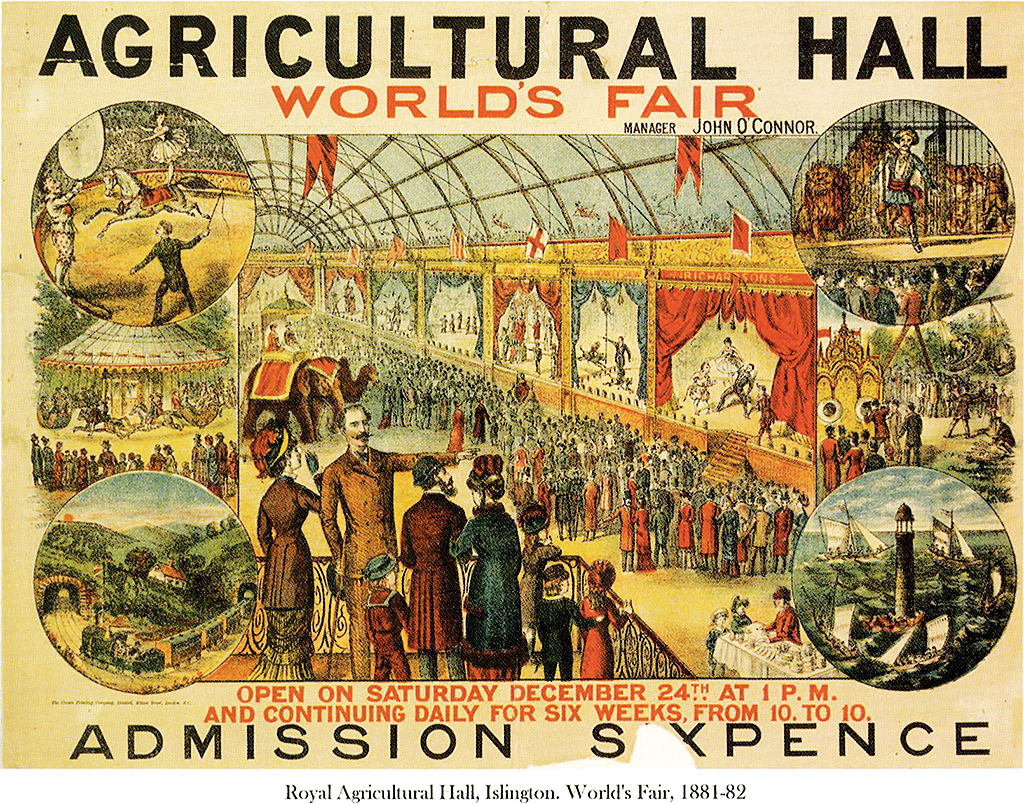
First record of his performance in Europe, at the 1881 World’s Fair (top right circle)
Image: The Telegraph File

A young Biswas debuted with his wild cats to great acclaim in Buenos Aires, Argentina. His success and top billing followed him to Rio de Janeiro in Brazil, where the royal family visited the circus to see his performance.

From Brazil, he went back to Hamburg, only to return in 1886. Some documents Barrera-Agarwal dug up, reveal his age at the time to be 26. The occupation noted against his name in the ship’s papers read “kunstler”, which is German for performing artiste. However, in a letter to his uncle dated spring of 1887, he writes that he has been transferred to St. Cruz, a village near Rio de Janeiro, to look after the horses of his cavalry regiment — indicating that in less than a year’s time he had decided to switch careers. He joined the PMDF, a military corps set up to protect the government of Brazil and the capital city.

Dutt sheds some light on the mystery of the great switch. It seems during a show in Rio, he caught the attention of a doctor’s daughter, Maria Augusta Fernandez. And it was she who gently suggested that she would like to see him in a soldier’s uniform. (In 1951, a member of the Indian consulate in Brazil sought the help of a local newspaper to trace Biswas’s family. He met with his wife, Maria Augusta, who spoke of her late husband very fondly.)

Corporal Biswas eventually rose through the ranks. It seems he showed such exceptional courage at the battle of Nitheroy, an 1893 naval uprising, that thereafter he was made first lieutenant.

Though in Indian lore Biswas is often referred to as colonel, Barrera-Agarwal points out that he never became one. When Biswas died in 1905 at the age of 47, he was captain.

Biswas continued to write letters to his uncle Kailash Chander all his life. In one of them he writes, “I will soon go away from here and invent something that will enable me to travel, because, by travelling only I am happy, for, this gives the idea and nourishes it, of reaching home some day…”

But home he never managed to return to. Perhaps he didn’t try hard enough, though it was on his mind all through as we gather from his letters. His iteration about how he, a vagabond, had done well, his pointed queries about his father who had disinherited him when he was barely out of his teens, and his wish to see his mother again.

In the Introduction to the 2018 republished version of Dutt’s biography of Biswas, Barrera-Agarwal writes: “The need of a hero is indispensable in human society.”

In the last available letter to his uncle, Biswas writes, “I have had several letters addressed to me by many young men of Calcutta, asking me if there is no means of coming here in Brazil. I shall answer them separately.”

source: http://www.telegraphindia.com / The Telegraph, Online Edition / Home> Culture / by Paromita Sen / November 18th, 2018
The war that epitomised the callousness of imperialism

Bengal was not a theatre of war in the 1940s, yet it lost seven times more lives than Britain

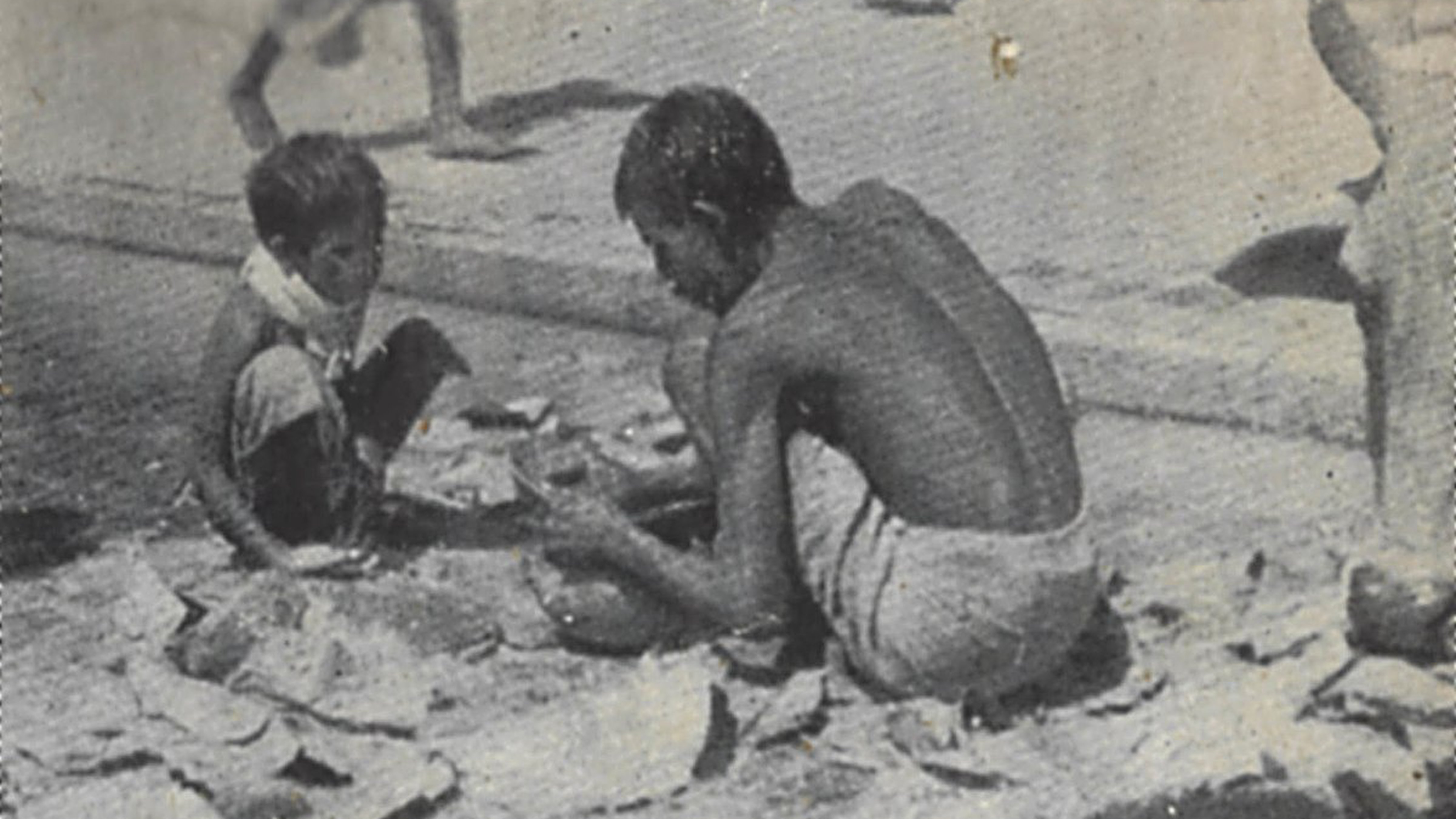
A boy, his father, and a cow rummage for scraps on a street during the Bengal famine of 1943 /
Wikimedia Commons

This year marks the 75th anniversary of the Bengal famine of 1943, a heart-rending episode in which three million persons died, and which epitomised the callousness of imperialism. The scale of devastation can be understood if we remember that in the United Kingdom, taking civilian and military casualties together, the total loss of life during the entire Second World War was just 0.45 million and in the United States of America 0.42 million. In Germany itself, the loss has been estimated as anywhere between 6.6 and 8.8 million and in the former Soviet Union, which suffered the most, at around 24 million. To say that the populations of these countries were smaller than India’s is beside the point; their comparison should be with the population of Bengal. In 1941, the population of undivided Bengal was only slightly higher, 60 million, compared to 47 million in UK; yet its loss of life was seven times that of the UK in spite of its not being a theatre of war.

The news of the famine was sought to be downplayed at the time, which is hardly surprising since the famine was a direct result of the escalation of British war expenditure on the eastern front. A war demands substantial resources; and the resources for Britain’s war against Japan were largely extracted out of the people of Bengal. Even so, such a massive loss of life could have been avoided if the manner of financing war expenditure had been different, but the same callousness which squeezed the innocent masses of a non-belligerent country for sustaining the war effort of the colonial power also prevented this squeeze from being exercised in a more humane manner than through the deaths of three million people.

If resources are to be raised from the people (let us overlook the absurdity of resources being raised from the colonised people of Bengal for the British war effort), then the obvious way of doing so is through taxation. But while taxation releases goods from those paying taxes, the goods so released may not match the goods required by the military. Moreover, the goods released by taxation may even fall absolutely short of the goods demanded by the expenditure of tax revenue, if tax payments come out of savings (that is,taxation releases no goods at all).

There would still arise therefore, even in the presence of a balanced budget (where a larger tax revenue finances a larger war expenditure), excess demand for certain commodities, and if these commodities happen to be essential goods like foodgrains, then acute food scarcity can arise in spite of the war expenditure being financed by an equivalent amount of taxation. Hence, it is imperative that the government, even while raising taxes to finance war expenditure, must simultaneously institute a regime of rationing of essential goods.

This is what Britain did at home during the war. It raised higher taxes and introduced a regime of universal statutory rationing of essential goods because of which the poor in Britain were reportedly better fed during the war than earlier. But in colonial India this did not happen; rationing, when it was introduced, was confined to urban Bengal, leaving rural areas to the mercy of the market, and resources were raised not through taxation but an altogether different method (Utsa Patnaik, Economic and Political Weekly, October 20).

The British government deposited IOUs drawn in favour of the Reserve Bank of India in London, and against these the RBI printed currency which was spent by Britain within India for its war effort. Since no goods could be imported against these IOUs, this basically meant creating additional demand for the existing amount of goods here, with the newly-printed money that was used for war expenditure. In addition, since British India also joined the war (without any sanction from the Indian people), its government also had to undertake war expenditure and this too was financed by a fiscal deficit, essentially by printing money; this further added to excess demand.

When expenditure is so financed, the goods for it are released as follows. Such excess demand generates inflation, because of which profits increase everywhere. While the working people with fixed money incomes lose, the profit-earners (including traders) everywhere gain correspondingly. But since the latter save more out of their incomes than the former, a good part of the gains they make is saved by them, so that the goods corresponding to such savings now become available to cover the government’s military needs. Hence, while the war expenditure is nominally financed by printed money, the real goods made available for it are obtained through generating such savings.

The inflation so generated is called a “profit inflation” and the additional savings generated through such inflation, which the government uses for its military requirements, are called “forced savings”. Britain’s, and British India’s, war expenditure on the eastern front was financed by a profit inflation generating such forced savings.

Such financing has three peculiar properties which make it utterly repugnant. First, the people who make the real sacrifice of consumption, because they cannot afford to buy goods at the higher prices caused by inflation, are the working people, while the persons who get the credit for such savings (those whose income and wealth increase) are the profit-earners, which is invidious. Second, if the profit-earners save, say, only half their income while habitually consuming the other half, then, for obtaining 100 units of goods for military purposes, the consumption of the working people has to be squeezed by 200, so that as the income of the profit-earners increases by 200 they can hand over 100 for military purposes while consuming an additional 100 themselves. And if they hoard a further 100, the squeeze on working people has to be 300. The squeeze is thus several times the military requirements. Third, the squeeze is imposed precisely upon fixed money income earners, who are the poorest segments of the population.

Financing war expenditure in this way imposed a heavy burden, especially on the poor people of rural Bengal who were net food purchasers (since much of the war expenditure was incurred there). The forced reduction in consumption they had to undergo entailed a drastic reduction in their foodgrain intake, and hence the famine. The poorest among them, with relatively inflexible money incomes and no cash reserves to fall back upon for maintaining real consumption in the face of higher prices, were the most severely affected (Amartya Sen, Poverty and Famines).

Ironically, the IOUs deposited in London (the so-called ‘sterling balances’) which were the counterpart of the forced savings imposed upon the hapless famine-stricken people of rural Bengal lost much of their value after the war. A strong official lobby wanted a complete repudiation of that external debt of Britain, arguing that India too had benefited from the British pursuit of the war on the eastern front. But while that opinion mercifully did not prevail, the post-war inflation, boosted by the Korean War boom, reduced the real value of sterling balances, as did the devaluation of the British pound-sterling in 1949 (which reduced their worth vis-à-vis the dollar and commodities with dollar-denominated prices). The death of three million people did not even yield much for posterity.

source: http://www.telegraphindia.com / The Telegraph, Online Edition / Home> Opinion / by Prabhat Patnaik / November 14th, 2018

3 quirky Indian tales from French Reunion Island

The Indian-origin community on this paradise isle is a blend of cultures and eras

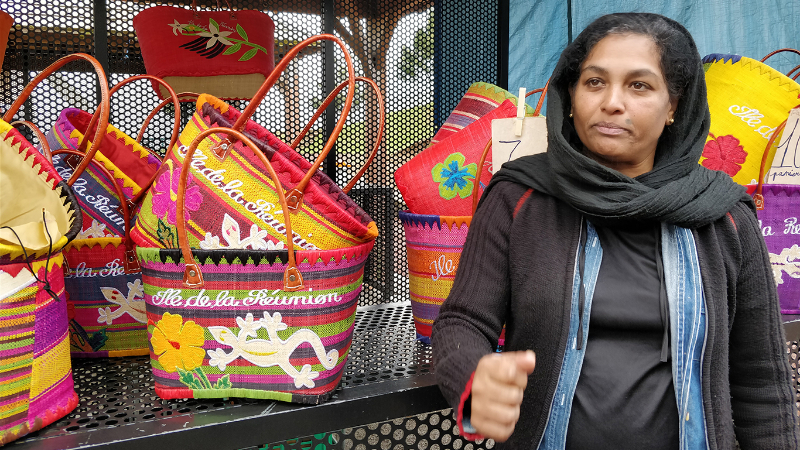
A basket maker on Reunion Island whose ancestors are from the Malabar coast
Image: Sudha Pillai

Reunion Islands in the Indian Ocean, an overseas department of France and about 9,000 km from Paris, is like a delicious kichdi – a goulash of African, Asian and European cultures. It’s the comfort food that would lift your spirits in an acrimonious world.

Sandwiched between Mauritius and Africa, this paradise isle has mountains, valleys, sandy beaches, pristine blue seas and vertiginous falls. But more than the natural beauty, it is the people of the island that give it its distinctive characteristics.

And people of Indian origin – about 45 per cent of the total population of 837,000 inhabitants – are shining testimonies to this amalgamation.

How they came to be there

The island, formed from a volcanic rising five million years ago, was first discovered by Arab traders. Soon the invaders — Portuguese, British and the French — arrived. Finally, the French colonised it, and christened it Reunion Island in 1793.

An apt name for what the island is today, if not historically accurate.

Reunion Island began as a place where prisoners were left to die. But the prisoners started living idyllic lives – swimming in the sea, climbing mountains, growing rice, vegetables and fruits in the fertile volcanic soil. After all, the island has 300 micro-climates.

The French decided to reclaim this paradise for themselves. First they brought Africans here as slaves for the sugarcane plantations. After slavery was abolished, they fetched indentured workers from India.

And that is how the Indian community started out on this unlikely island.

Mary Theresa Subramaniam

I met Mary Theresa Subramaniam at the Saint-Pierre market, where she’s been working for the past 30 years. Mary’s great-grandfather came to the island with his wife and nine children. But he abandoned them and returned to India. His young wife raised her children in a foreign land.

Clad in a skirt and lavender top, Mary has distinctive South Indian features. She’s never visited India. She believes she may have a “few relatives back in India” but has no clue about their whereabouts. This is also a typical story amongst the Indian community here.

Mary is both a Hindu and a Christian. And there are many like her on the island
Image: Sudha Pillai

Mary is both a Hindu and a Christian. And there are many like her on the island.

When the Hindu Indians got off the boat two things happened at the immigration office. First, their names were Frenchified. Mary says, “The immigration officers couldn’t get the Indian names right.” Vaidyalingam became Vaitilingam, Arumugam became Aroumougam, and so on.

Second, they were asked to embrace Christianity. Due to the fear of retribution, they embraced it and a few continued to practise Hinduism secretly. Over time, the lines between faiths blurred. When Reunion Islands embraced religious diversity, most Indian families found themselves both Christian and Hindu.

Priest Balaram

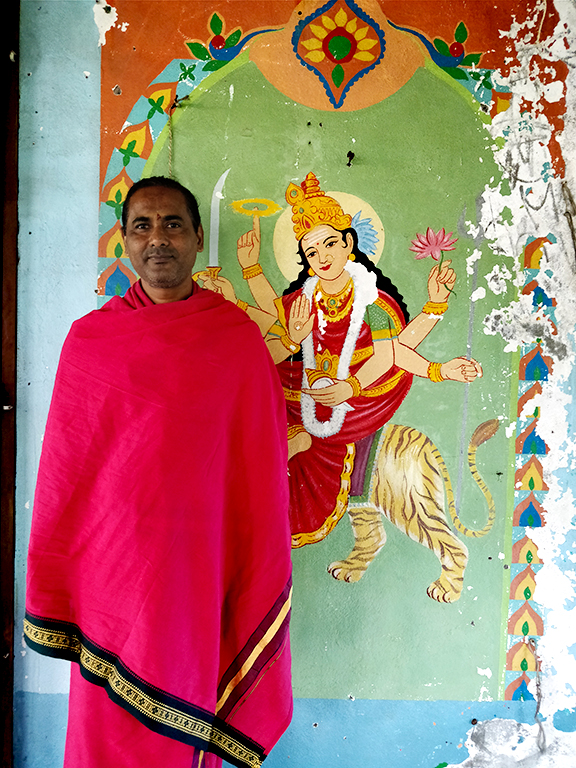
A short walk from the market is the Mahakali de Bazaar or the Mahakali temple. Mahakali Utsav and Tamil New Year’s Day are big celebrations on the island.

Tall and lanky Balaram, who can trace his roots back to Pondicherry, is the presiding priest at the Mahakali temple. He is, like most Indians here, fluent in French. “Because that is what we speak at home,” he says. Balaram’s great-grandfather came to Reunion Island. He is one of the few Indians on the island who still has some connection to India. Every year he goes to Munjod, a village in Kanjeepuram, to study Sanskrit.

Balaram, the presiding priest at the Mahakali temple, speaks French at home
Image: Sudha Pillai

On the island, Indians from South India, often Hindu, are known as Malbars. Immigrants from North India came later. Muslim Indians from North India are known as Zarabes.

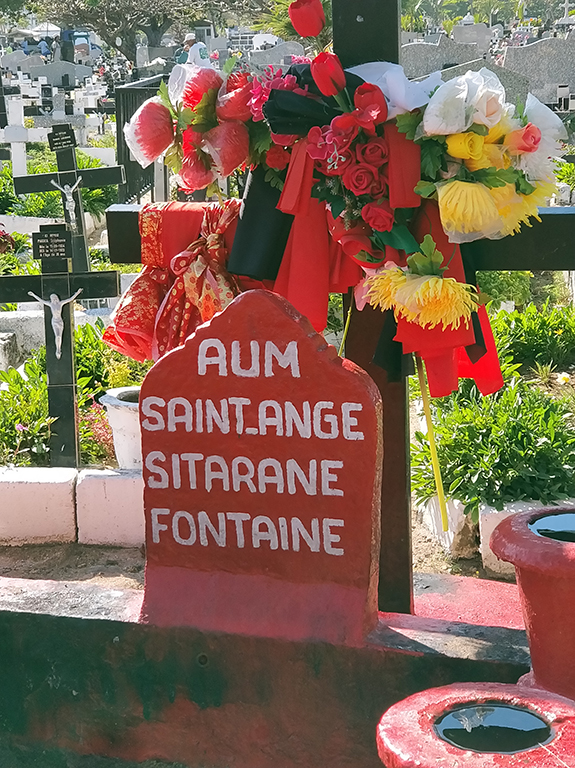
Temples and mosques – the first mosque of France was built here – stand alongside churches. Nowhere is this intermingling of faiths more evident than in the pretty cemeteries. At the St-Pierre Cemetery, amidst decorative family vaults and single graves with cherubs on tombstones, I found numerous graves of Indian-origin Christians. They had a saffron-coloured Trishul-cross combo on the headstones. This was the best religious khichdi I had ever seen.

Tombstones of Indian origin Christians at the St-Pierre Cemetery
Image: Sudha Pillai

Jacky Arourmougam

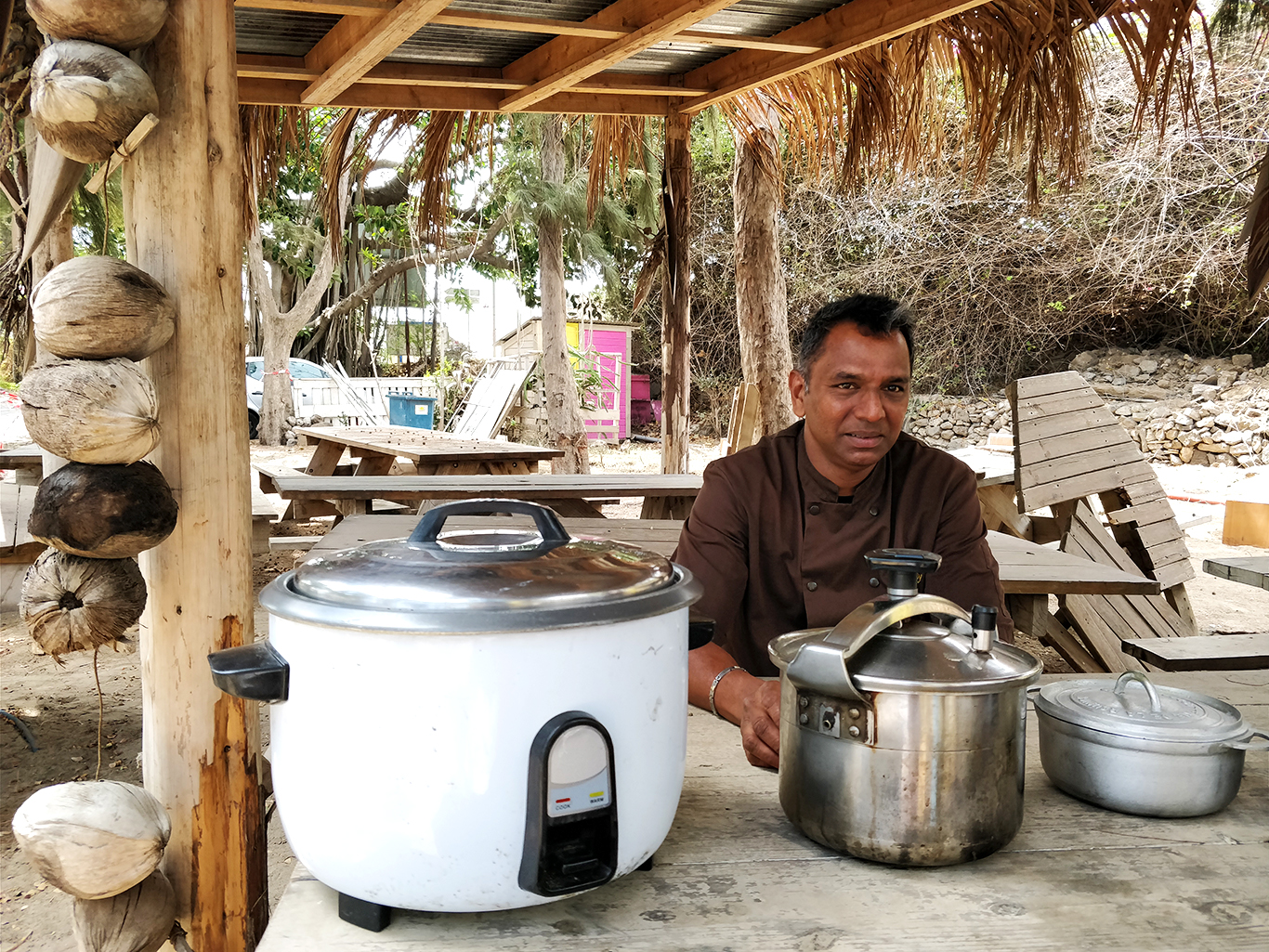
Many elements of India are integrated into the weave of the island. But the influence of Indian cuisine stands out. Jacky Arourmougam, a celebrity chef on the Island, says, “About 80 percent of Creole food is inspired by India.” Rice and lentils are staples along with croissants and baguettes. Samoussas or Samosa is the undisputed national dish.

I enjoyed an outdoor picnic at Trou d’eau at La Saline Les Bains with Jacky. His forefathers hail from Bengal and South India. Some of his unique dishes are inspired by the secret recipes of his mother and grandmother who came from Bengal. When the French-sounding ‘achhard’ is placed on the table, you realise it is but the spicy Indian achaar and that kurkuma is turmeric which is used extensively in the island cuisine. And chicken cari draws heavily from the Indian curry. No doubt, the mingling of communities has given Reunion Island its unique food culture.

Celebrity chef Jacky Arourmougam is inspired by the recipes of his mother and grandmother who came from Bengal
Image: Sudha Pillai

For most Indians in Reunion Island, their acquaintance with India has been through faded stories of their ancestors travelling through the family vine or the banyan and mango trees in the backyard, the seeds of which were brought to the island by their forefathers or the recipes that are carefully passed down from great-great-grandmothers. While few Indian-islanders desire to travel to India, most of them are indifferent to the distant association. Reunion Island is where they feel rooted. It’s not that they shun their past. It is just that they prefer to live in the present.

source: http://www.telegraphindia.com / The Telegraph,Online edition / Home> Travel / by Sudha Pillai / November 13th, 2018

Here lies Hindoo Stuart: Inside the 250-year-old Park Street cemetery

The Park Street cemetery, which is now 250 years old, is home to stories of Kolkata’s past and present.

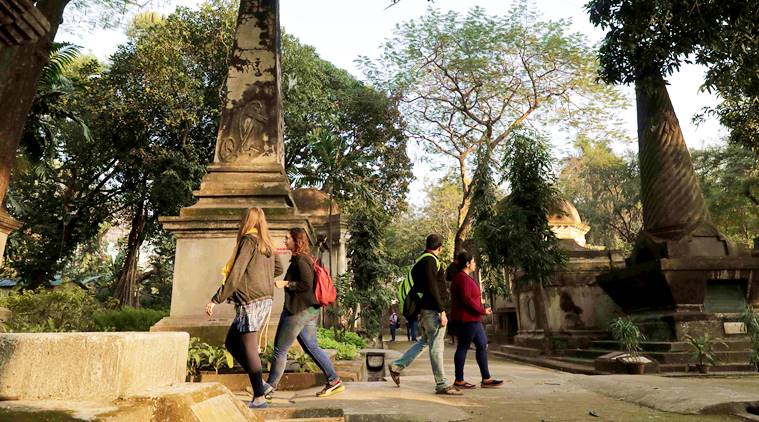
South Park Street Cemetery , one of the oldest Christian cemeteries celebrates 250th birthday on Saturday, January 06, 2018.It is a consecrated Christian Cemetery with mortal remains underneath each of the 1600 plus vaults with remarkable Tombs . Locals , tourist ,as well as embassy people seen in the cemetery during the programme Express photo by Partha Paul.

In the 250 years of its existence, the Park Street cemetery in Kolkata has seen its share of stolen kisses and frantic lovers, both gay and straight. In Vikram Seth’s 1993 novel, Suitable Boy, Lata takes a leisurely through the Park Street cemetery along with a friend, Amit. They visit the tomb of Rose Aylmer, a Welsh girl who sailed to India with an aunt in 1798, and died of cholera two years later. Famous British poet Walter Savage Landor, a suitor of Rose, immortalised her in a poem Rose Aylmer. Amit and Lata recite the poem together at the spot.

Not far from the bustle of one of Kolkata’s busiest streets, is the South Park Street Cemetery, with two functional old iron gates at the entrance. Inside, rows of obelisks and gazebos spread out on both sides in no particular order. A marble plaque on the left pillar declares that the cemetery opened in 1769 and closed in 1790, but historians will tell you that burials continued into the 1830s.

The cemetery is the final resting place of many like Rose Aylmer. As Souvik Mukherjee, assistant professor of English, Presidency University points out, most Europeans who would land in the muggy, mosquito-ridden city, would last only “two monsoons”. “They would almost always fall prey to malaria,” says Mukherjee, who specialises in the cemeteries of Bengal. The truncated pillars that dot the cemetery signify lives lost too soon. “You will find graves of many, many children here,” says Mukherjee.

According to Susan Hosking’s book, The Great Burial Ground at Chowringhee: Reflections on the South Park Street Cemetery in Kolkata, this is one of the oldest non-church cemeteries in the world. Hosking says that by the mid-18th century, the old Christian burial grounds in the ruins of the first Fort William, established in 1665, had become inadequate. Eight acres of relatively high ground in an uneven and swampy area were marked out for a new cemetery on what was then the southern outskirt of the town.

The oldest tomb in the cemetery, according to Mukherjee, is that of Mrs Sarah Pearson, who died on September 8, 1768. Very little is known of the oldest resident of the place but tomes have been written on the one who has the most prominent tomb of the cemetery — a blindingly white structure in a maze of greys. The tomb of Sir William Jones, renowned philologist and founder of Asiatic Society of Bengal, finds pride of place bang in the middle of the cemetery.

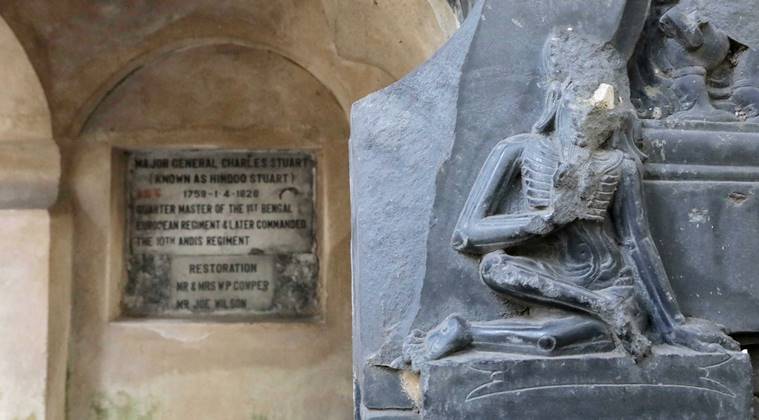
Major General Charles Stuart, known as Hindoo Stuart tomb at South Park Street Cemetery , one of the oldest Christian cemeteries celebrates 250th birthday on Saturday, January 06, 2018.It is a consecrated Christian Cemetery with mortal remains underneath each of the 1600 plus vaults with remarkable Tombs . Locals along as well as embassy people seen in the cemetery during the programme Express photo by Partha Paul.

It is definitely not the most beautiful structure in the premises. That distinction belongs to the tomb of Charles Stuart (1758- 1828) or as the officer of the East India Company was popularly known, Hindoo Stuart. A beautiful synthesis of Hindu, European and Islamic styles, the tomb looks like an exotic guest in a genteel gathering. “He was one of the few British officers to embrace Indian culture,” says Mukherjee. CP Hodson’s biography of Stuart mentions that he “had studied the language, manners and customs of the natives of this country with much enthusiasm, his intimacy with them … obtained for him the name of Hindoo Stuart.”

However, in 1984, this very tomb almost fell prey to the greed of realtors. “The cemetery continues to exist thanks to a legal intervention by the Calcutta High Court. An order was issued stopping a well known family business from turning the cemetery into an arts centre. The demolition work had already begun and the damage can still be seen. Innumerable graves have been lost, replaced by strewn rubble and a multi-storey car park. The tomb of Charles Stuart was demolished, later restored, and the demolition of DeRozio’s grave had begun. Justice Bagbati Banerjee saved the South Park Street Cemetery,” says Anthony Khatchaturian writer, guide and Kolkata Heritage activist.

Deepanjan Ghosh, who runs an exhaustive blog on forgotten chapters of the city’s history, says one of the most interesting personalities to be buried in the cemetery is Elizabeth Jane Barwell, popularly known as Miss Sanderson. The “celebrated Miss Sanderson”, daughter of a colonel in East India Company’s army, was widely known as the most beautiful girl in Calcutta when she arrived. She was also notoriously mischievous. “A popular story about her is that she told 16 of her suitors that she would be going to a ball in a Parisian dress and it would be marvellous if they wore a similar costume of pea-green, with pink silk trimmings. All of the men turned up in the exact same ridiculous outfit!” says Ghosh.

Not very far away from her tomb is the modest one of Henry Louis Vivian Derozio (died 1831), the revolutionary thinker and poet who, in many ways, shaped the then Bengali intelligentsia. At the age of 18, he got the post of a lecturer in English literature and history at the Hindu College. He was considered to be a rabble-rouser by the orthodox, Hindu-dominated management of the college as he encouraged his students to question social evils. Eventually, he was expelled. His untimely death soon followed. But his legacy lived on. “His grave is the most visited one in the cemetery,” says Ghosh.

Not surprisingly, the cemetery has inspired its share of ghost stories. There were rumours of a priest in white cassock haunting the premises. Mukherjee dismisses it with a simple, irrefutable logic. “Priests in India wear black cassocks,” he says.

source:http://www.indianexpress.com / The Indian Express / Home> Eye / by Premankur Biswas / January 28th, 2018

Balaichandi Durga Puja: In this Bengal village, Durga Puja starts on Dashami

Khadimpur village has celebrated Balaichandi Durga Puja for the last 500 years. The Durga idol here has four hands instead of 10, and you cannot find demon Mahisasur and his buffalo with Goddess Durga

(Photo: SNS)

Durga Puja may be over for all of us now, but things are different for the residents of Khadimpur village in Kamlabari-2 gram panchayat, 12 km away from Raiganj town in North Dinajpur district. The villagers here are still in a festive mood. As every year, Khadimpur is engrossed in observing the traditional Balaichandi Durga Puja that started on the night of Vijaya Dashami.

Around 7,500 members of 1,500 families living in the village began celebrating the Durga Puja with all pomp and grandeur on the day.

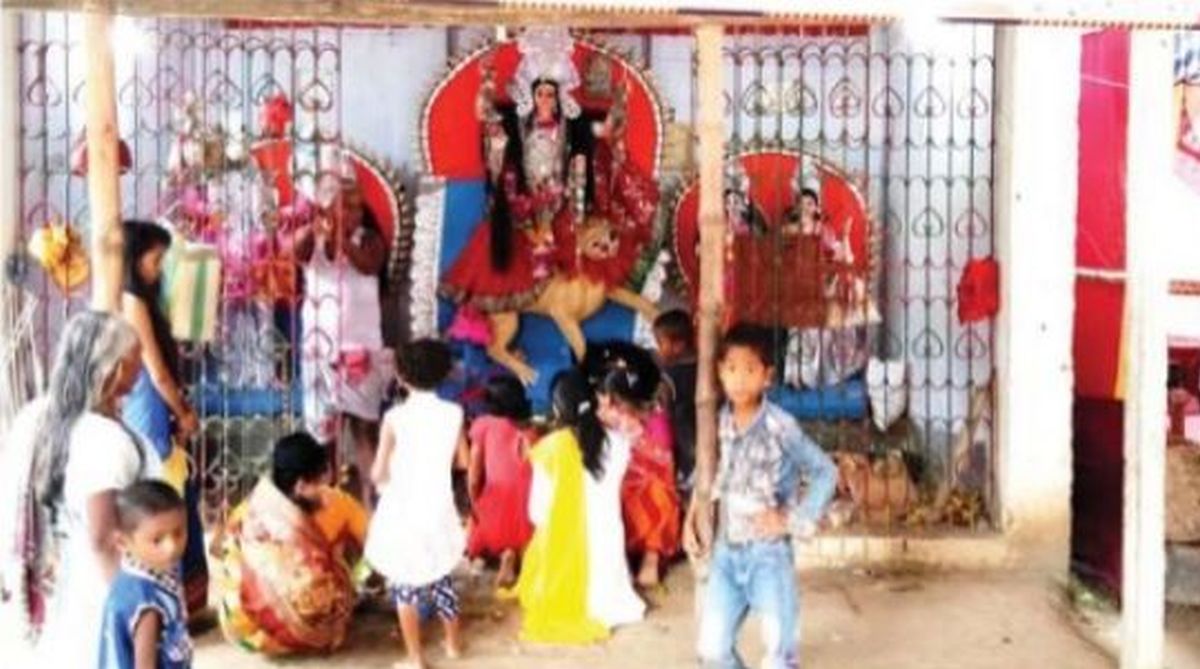
According to Puja organisers, the village has celebrated Balaichandi Durga Puja for the last 500 years. The Durga idol here has four hands instead of the usual 10. All the deities, including Goddesses Lakshmi and Saraswati, and Lord Kartik and Ganesh are present with the Goddess Balaichandi. However, the demon king Mahisasur and his buffalo are not worshipped here.

Numerous visitors even from outside the district visit the Puja pandals in Khadimpur in huge numbers every year.

“The Balaichandi Puja is being observed in our village since the past 500 years for the well-being of the village. According to rituals, the Puja starts on the night of Dashami and continues for the next five days. All wear new clothes during the Puja and eat vegetarian food in their houses till the Puja is over. An animal sacrifice is also a part of the Puja observed here,” the Secretary of the Khadimpur Balaichandi Puja Committee, Sreekanta Barman, said.

The priest of the Puja committee, Basudev Chakraborty, said, “Our forefathers used to worship Ma Blaichandi here and the Puja is observed here even after 500 years of its commencement.

“Once upon a time, on the day of Dashami during the regular Durga Puja, our crops got damaged due to drought which led to the death of several villagers due to starvation. Since then, on the day of Dashami, villagers here started the Balaichandi Puja. As predecessors, we will have to keep the tradition going. People from nearby villages and from outside the district turn up here to witness our Puja. We will be organizing different cultural programmes with participation of students of our village for the next five days. Villagers enjoy it with great enthusiasm,” added Mr Chakraborty.

source: http://www.thestatesman.com / The Statesman / Home> India / by Statesman News Service, Raiganj / October 23rd, 2018

The Downton Abbeys of Dhanyakuria

Wandering in the Bengal countryside could bring you to these accidental Indo-English castles

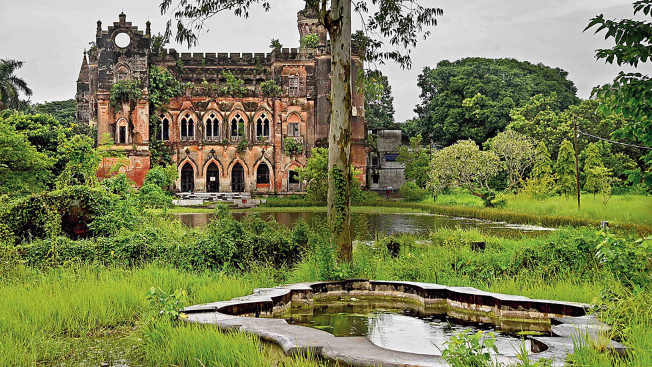
Gaine Garden on the Barasat-Taki highway looks every bit the English castle
Image: Ankit Datta

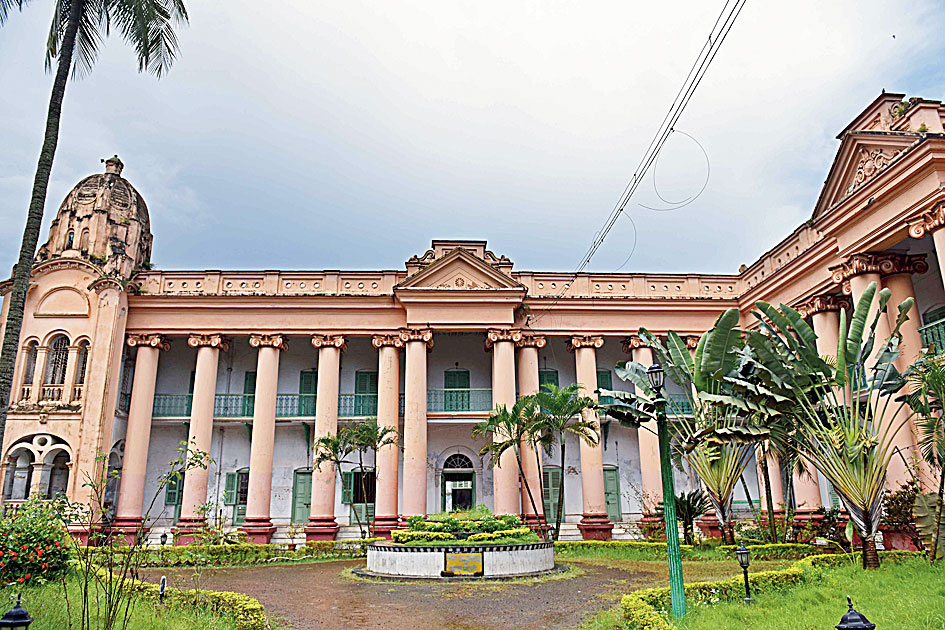
Anyone who has travelled along the Barasat-Taki road — northwards from Calcutta, towards Basirhat — would have noticed the picture-postcard castle. Visitors are not allowed inside the gated compound, but you can stop and admire the turrets, spires, the uneven roofline broken by stepped gables.

But that afternoon, when we reach the place, the gates are wide open. A truck is downloading bricks — we learn they are for the construction of a government office building. It is a 30-acre campus and we are eager to explore it. We sneak in and manage some quick clicks, when some security guards spring into action. We are chased out with a stern — “You need permission from the [social welfare] department.”

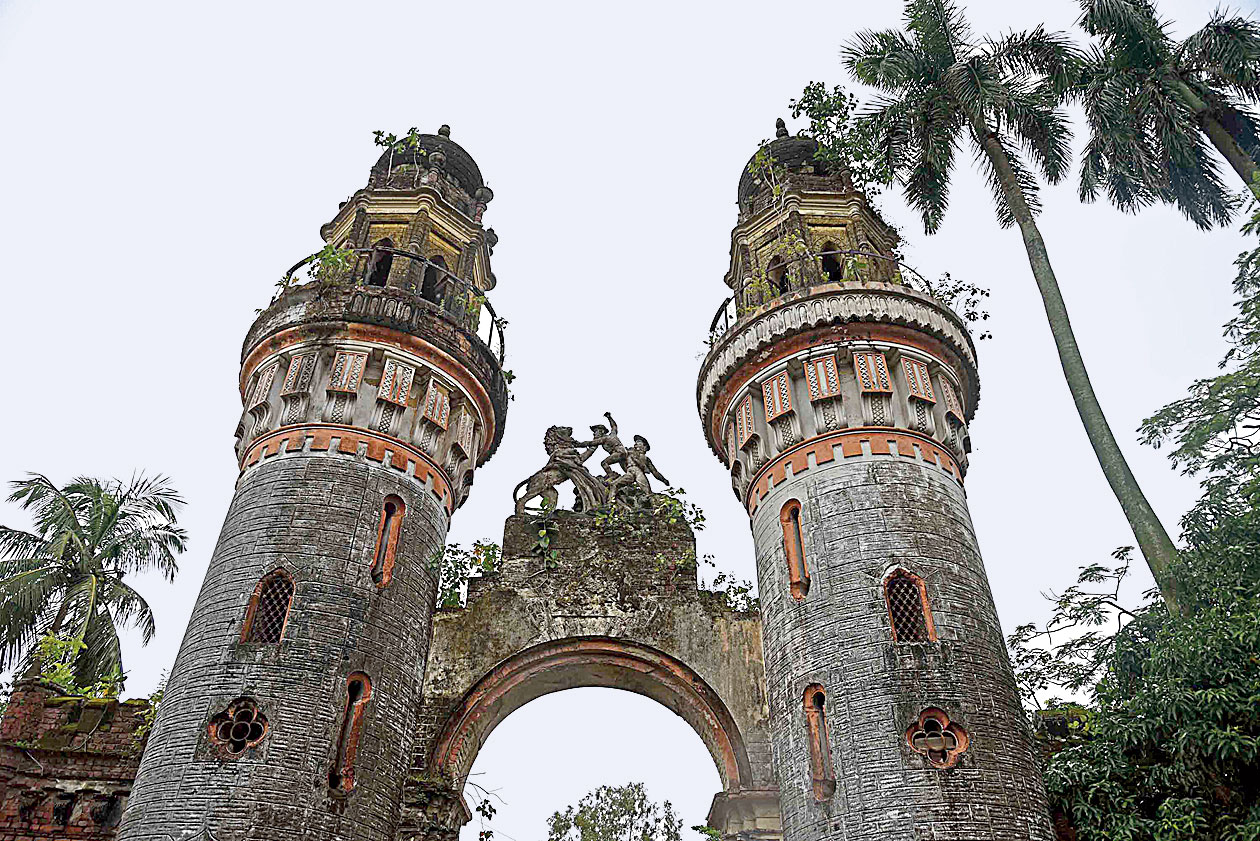
Atop the Gaine Garden gateway is some colonial baggage in stone — figures of two Englishmen overpowering a lion with bare hands
Image: Ankit Datta

Out on the road, we ask a passerby what this grand structure is called and what it’s meant to be. “This used to be called Gaine Garden, property of the Gaines,” he informs us, and for details redirects us to the Gaine progeny living in Dhanyakuria village in North 24-Parganas.

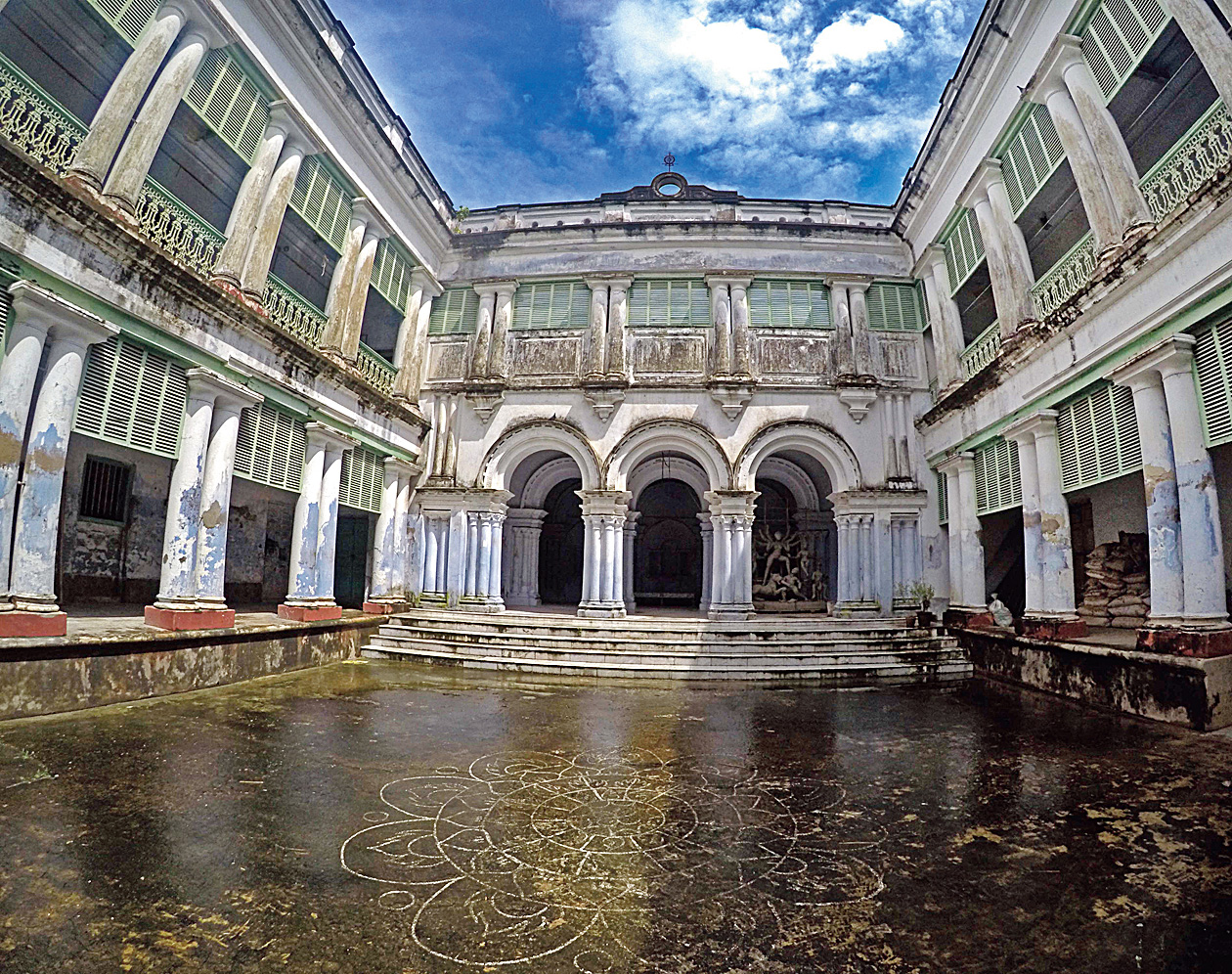
Teacher and writer Monjit Gaine lives with his elderly father, Kanchan Gaine, and his family in a portion of yet another grand structure of long, open corridors and many wings called the Gaine Rajbari. Monjit ushers us into the majestic thakurdalan or collonaded altar for Durga worship. He says, “Every other month some tele-serial or movie is shot here. Villagers call this ‘shooting bari’.” According to him, it is the rent from film production companies that aids the upkeep and maintenance of the huge mansion.

Unlike Gaine Garden, Gaine Rajbari was meant to serve as residential quarters and is located inside Dhanyakuria village
Image: Ankit Datta

The Gaines made a fortune trading in jute, jaggery and other agricultural products. They worked in partnership with two other families of Dhanyakuria — the Sawoos and the Ballavs. All of them enjoyed the patronage of the British. “Huge tracts of agricultural fields and land ownership turned them into zamindars,” says Monjit. “Family lore goes that our ancestral properties extended to Satkhira in present-day Bangladesh, and in north, central and south Calcutta,” he adds.

Gaine Mansion was built in parts, primarily by Gobinda Chandra Gaine and his son, Mahendranath Gaine, mid-19th century onwards. Mahendranath was a prominent member of the Bengal Chamber of Commerce and owned quite a few jute mills too. He was the one who built Gaine Garden by the main road. Post Independence, the state government acquired the property. Says Monjit, “A few years ago we heard it had acquired the heritage tag. [Once a property gets this tag, it cannot be defaced, its basic structure cannot be changed either.]” He has no clue about the ongoing construction.

Its thakurdalan has featured in films such as Guru Dutt’s Sahib Bibi Ghulam, the Indo-French production La Nuit Bengali and the Uttam Kumar-starrer Suryatapa. You can spy a Durga idol in one corner of the thakurdalan of the Gaine Rajbari. The Gaines have been commissioning the idols to the same family of artisans for nearly 200 years
Image: Ankit Datta

According to Monjit, the three leading families worked for the development of the area. They built hospitals, roads and schools. We cross the Sanskrit primary school-turned-private English medium prep-school founded by the Gaines. Beyond it, a little ahead of the trisection is the mansion of the Sawoos. The gate is locked, a neighbour says the caretaker has gone to the market and the owners don’t live here.

We peep through the collapsible gate and spy a thakurdalan almost as majestic as the Gaines’. Here too, there is a solitary and stark frame of an under-construction Durga idol. Later, we call Ashok Sawoo, who lives in north Calcutta. The house was built by his forefather, Patit Chandra Sawoo, 200 years ago.

The Sawoo Mansion usually remains closed; most of the family lives in Calcutta now. The house was founded by Patit Chandra Sawoo 200 years ago and extended by his son Rai Bahadur Upendra Nath Sawoo
Image: Ankit Datta

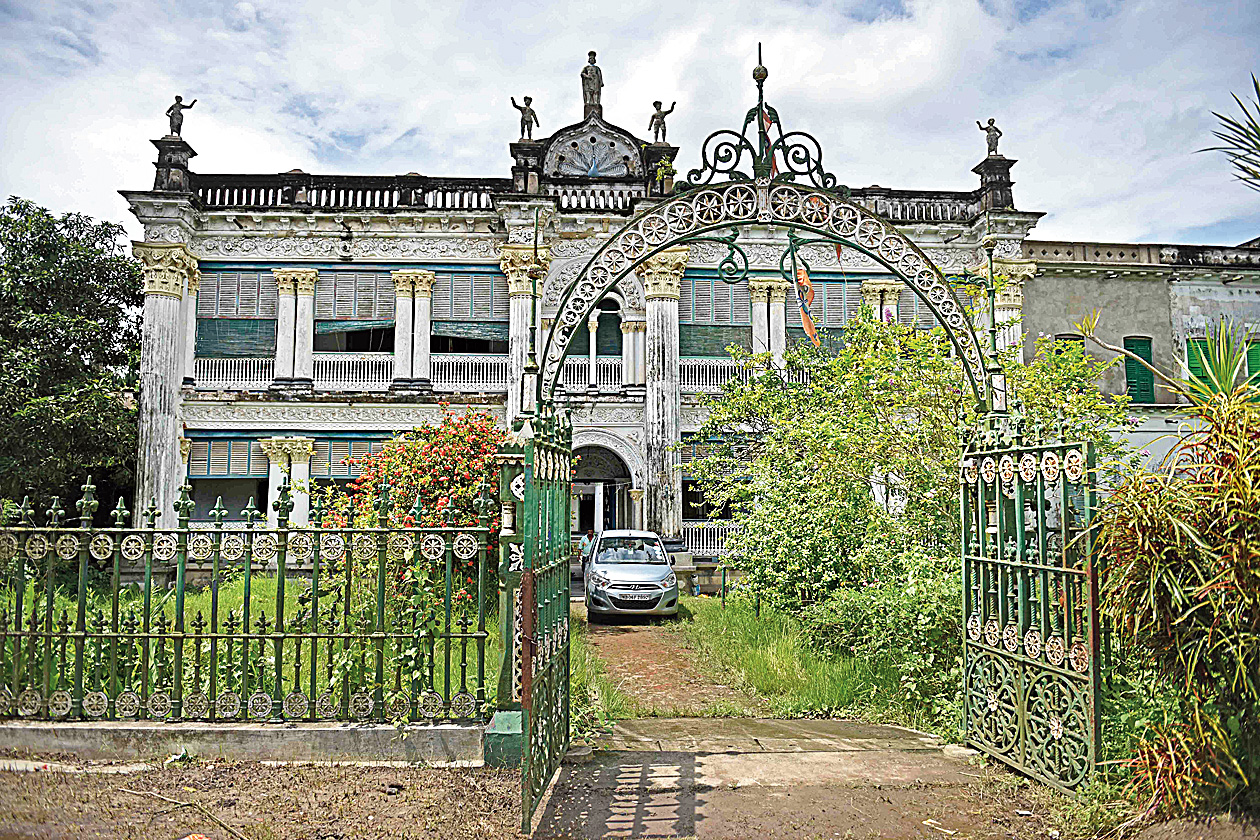
We walk down to Ballav Mansion next. Painted in green and white, the mansion has ornate cast iron gates and fencing. The Corinthian pillars, stucco work in the verandah and the grand thakurdalan reflect the wealth of the family. There is a well-kept garden too. Says family member Uma Ballav Biswas, “The house was built by my great-grandfather, Shyamacharan Ballav, 150 years ago. He made his fortune mainly in jute trade.”

At the time of filing this piece, Uma is looking forward to the annual family reunion on the occasion of Durga Puja. It seems the same artisans make the Durga idols for the Gaines, the Sawoos and the Ballavs. The same family of priests presides over the festivities. Says Monjit, “If anyone wishes to see our houses in full grandeur, this is the time. There’s no restriction on entries at this time. Just like our ancestors, we welcome villagers and visitors.”

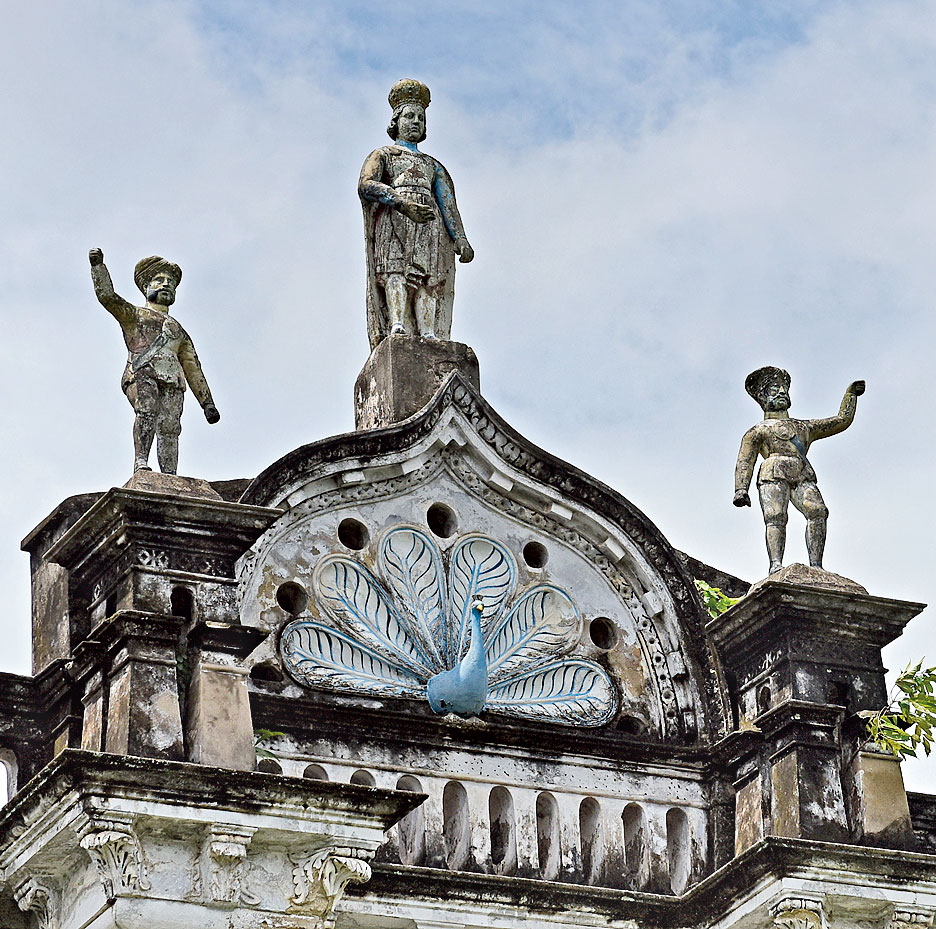
Ballav Mansion is referred to as ‘putul bari’ or dolls’ house by locals — after the figurines on the central arch and those on either end of the roof
Image: Ankit Datta
The centrepiece is a princely figure wearing a cape and fancy headgear; the rest of the figurines include moustachioed Indian sentries and a lone peacock
Ankit Datta

source: http://www.telegraphindia.com / The Telegraph,Calcutta,India – Online edition / Home> Heritage / by Prasun Chaudhuri / October 21st, 2018

Here lived Dr Rajendra Prasad

At a time when Calcutta’s Hindu Hostel is the subject of controversy, Moumita Chaudhuri chronicles the good ol’ days

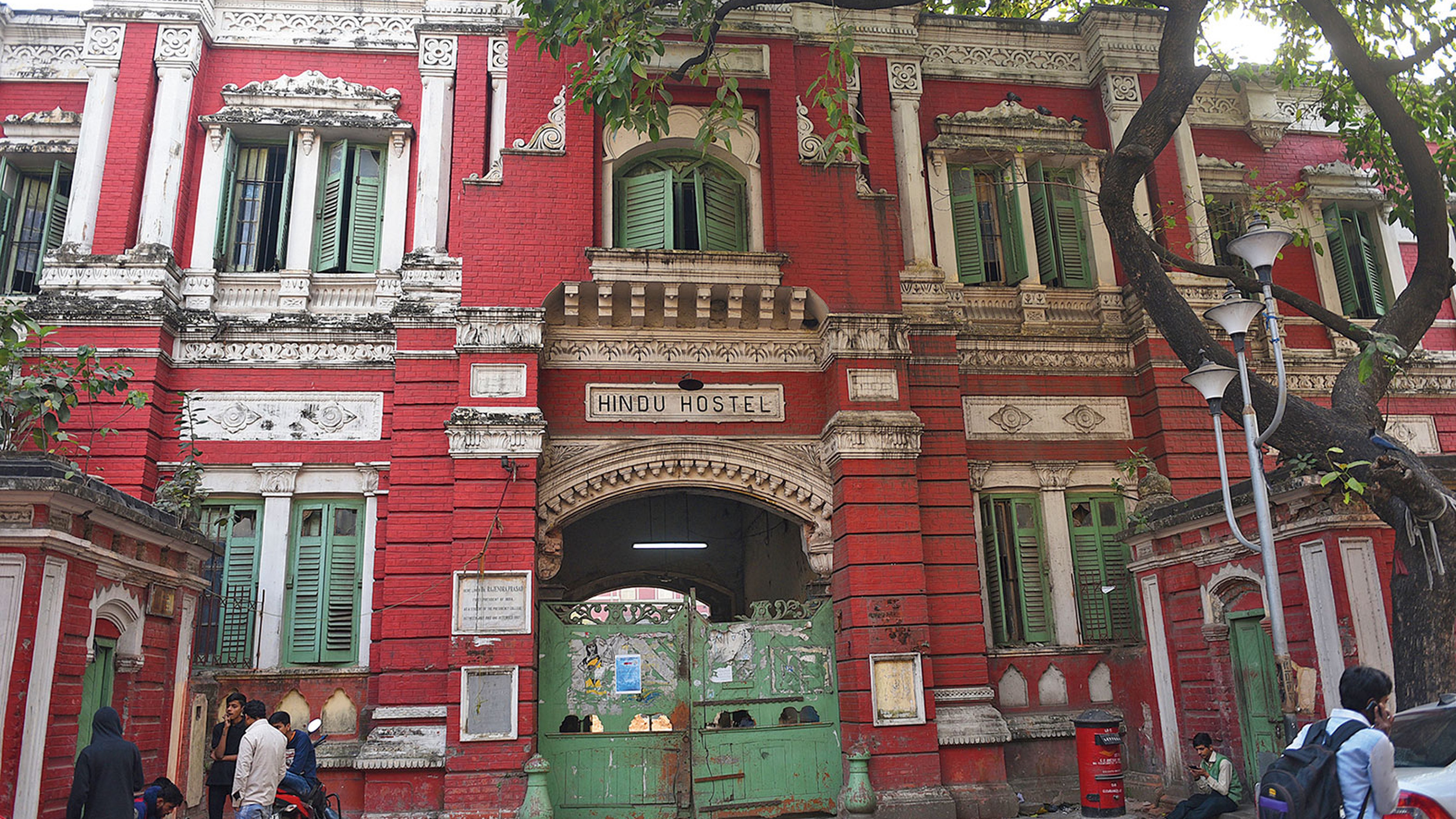
Hindu Hostel /
Telegraph file picture

In July 2015, Eden Hindu Hostel for male students of Calcutta’s Presidency University, Maulana Azad College, Sanskrit College and Goenka College of Commerce and Business was vacated for repair work. Three years on, it is yet to be reopened. On August 4, students launched a protracted protest. On September 11, the annual convocation had to be shifted after angry students locked the university premises. And Governor Keshari Nath Tripathi chose not to attend the off-campus abridged event.

In the heart of north Calcutta’s College Street area stands the red building with green fenestrations. A plaque outside it reads: Here lived Dr Rajendra Prasad first President of India as a student of the Presidency College between July 1902 and December 1907. Once you enter the premises, you realise Eden Hindu Hostel is not just one building. There is the main building that houses wards 1 and 2. Another to its east houses three more wards. Construction of a hostel for postgraduates began in 1988 and took seven years to complete. Many old boarders were shifted to this one.

Heritage conservationist and architect Partha Ranjan Das’s firm is overseeing the repair and restoration of a part of the hostel. Das says, “The older buildings take after early 19th century British colonial architecture. They display the soft style of the late Baroque era.” According to Das, when his firm assumed charge in 2015, it came to light that a lot of additions and alterations had been made. “Such interventions are not allowed while restoring a heritage building,” he says. “Additions were made to the original structure, which we have removed. The buildings cannot withstand extensions like these,” he adds.

The hostel was more than a boarding and lodging space for students. It was a place of bonhomie, politics and spirited debate. It was also a creative space. From the centenary publication of Presidency College, we learn that the hostel ran a bilingual magazine called Suhrid in 1894. There are references to an assembly of poets till the late 19th century. There was a keen rivalry between the wards, each of which ran its own manuscript magazine with names such as Sense and Nonsense and Highland Review. All the wards would come together for Saraswati Puja.

This is the space where friendships were struck and history was made. Scientist Meghnad Saha met freedom fighter Jatindranath Mukherjee aka Bagha Jatin here. Says Swapan Chakravorty, distinguished professor of Presidency University and former director-general of National Library, “Those days, caste seating was followed in the dining hall. Saha felt discriminated against and left the hostel in protest.” More stories. Nationalist and founder of the Congress, Surendranath Banerjee, was a student of Doveton College but would frequent the place. When deputy superintendent of police Basanta Kumar Chatterjee was murdered in 1916, the hostel was raided. No one could be nailed though. Much later, during the Naxalite movement, eight boarders were expelled. “A movement coagulated around this expulsion,” says Chakravorty.

Jyotirmoy Pal Chowdhury, director and chairman of the Institute for Civil Service Aspirants, stayed here in the 1950s. Those days, the boarding charge for a ground floor room was Rs 5, first floor and second floor room charges were Rs 7 and Rs 8, respectively. The monthly charge for food was Rs 32. (In 2015, the monthly charge including lunch and dinner was Rs 1,500.)

Pal Chowdhury talks about student politics and how any boarder contesting elections was sure to win. He recalls the time when college senior Amartya Sen asked him to contest elections. He talks about the canteen. How each of the five wards had a kitchen representative who would go grocery shopping, decide on the menu and arrange for a monthly feast. With relish he recalls the menu, obviously hungry for a taste of those times — “Pulao, luchi, two kinds of fish, mutton, doi-mishti and dilkhusha paan that was sold at the college gate.” He has his own hand-me-down hostel tales — “Scientist Satyen Bose would play football in the adjoining field. He used to be the goalkeeper.”

The condition of the hostel deteriorated in the 1990s. Debarshi Das, a professor of Economics at IIT Guwahati, was a boarder during those years. He recalls the thick walls, high ceilings, “big rooms” sans fans. He says, “We used to rent DC fans (AC fans were not easily available on rent). You had to stick carbon sticks that would not last long.”

Chakravorty says that by 2000 most government grants dried up. The here and now we piece together from students. Sayan Chakraborty, a final-year PG student, says, “The hostel was in very bad state when we vacated the rooms in 2015. There were 250 boarders staying in all 123 rooms. Each room was heavily partitioned with possibly Burma teak wooden panels.”

Das has not seen any Burma teak partition, only “low quality wooden panels”. He says, “Each room is as big as a big classroom with 15-foot high ceilings, and teak doors and windows. The staircase is all mahogany. We have tried to put back the heritage building with minimum intervention to its original structure. But we did not get the original plan of the heritage structure and so we had to use our judgment in some of the cases.”

Currently, the Eden Hindu Hostel stands heavily guarded. Students are continuing with their fast. Vice-chancellor Anuradha Lohia said earlier this month that it would take another 4-5 months to do what was not achieved in the last three years — make the place “habitable and safe”. Last week, however, after one of the fasting students had to be hospitalised, the state government ordered that Building 1 be readied by November 15 and the university comply with the set deadline.

Pal Chowdhury had told us of the climate and culture of Hindu Hostel from his times, “We did not believe in fighting. We believed in debate. We were the Argumentative Indians.”

Hindu History

A hostel for students coming to Calcutta was the brainchild of college teacher Pearycharan Sarkar

He set up a boarding house on Bowbazar Street in north Calcutta, followed by the first students’ hostel on the same street in 1861

It was for male Hindu students. The Baker Hostel which came up in the early 20th century took in Muslim students from Maulana Azad (then Islamia College)

In Calcutta in the Nineteenth Century: An Archival Exploration, Bidisha Chakraborty writes that more than a decade later, a piece of land was earmarked for the Eden Hindu Hostel

It was named after Lt General of Calcutta Ashley Eden, who led the campaign to raise funds

The ground floor came up in 1886. In 1898, the British Government took it over

In 1947-48, it was thrown open to students of other colleges too.

source: http://www.telegraphindia.com / The Telegraph,Calcutta,India /’ Home> Heritage / by Moumita Chaudhuri / October 07th, 2018

Telugu Bible turns 200

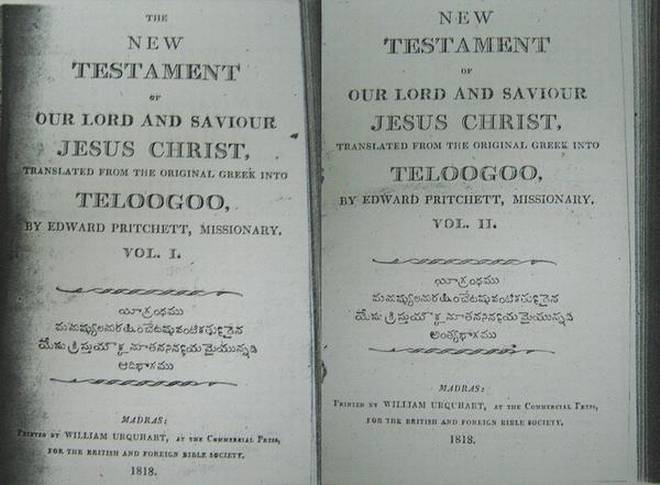
The cover page of the New Testament that was first translated and printed in Telugu in 1818. | Photo Credit: Special Arangment

It was translated in Vizag and West Bengal

On September 30, based on a resolution adopted by the United Nations, the world celebrates the International Translation Day (ITD). It is observed in honour of fifth century St. Jerome, a priest from northeastern Italy, who was the first to translate the Bible (New Testament) into Latin from Greek manuscripts. He also translated parts of the Hebrew Gospel into Greek.

The ITD has a unique connection with Visakhapatnam. The churches in the city will be celebrating this year the 200th year of the translation of Bible from original Greek to Telugu.

First attempt
The first attempt to translate the Bible (New Testament) was made by one Rev. Benjamin Schulz (1689-1760) some time in the mid-1760s, and the manuscripts were sent to Germany for printing, but it was not printed and the manuscripts were lost.

The second serious attempt was made simultaneously at Vizagapatam (as Visakhapatnam was then called) and Serampore, then unified Bengal, some time around 1805-1806.

Telugu Pandit’s role
In Serampore, the project of translation was led by Rev. William Carey of the Baptist Missionary Society. In Visakhapatnam, young Christian missionaries of London Missionary Society Rev. Augustus De Granges and Rev. George Cran took up the work of translating the Bible from original Greek to Telugu. The missionaries in Vizagapatnam were assisted by a local Telugu Pandit Anandarayar.

The untimely death of both Granges (1809) and Cran (1810), however, did not deter Anandarayar from pursuing the work of translation under the guidance of Rev. John Gordon and Rev. Edward Pritchett, said V. Edward Paul of INTACH.

“The first three gospels out of four translated in Vizagapatam were sent to Rev. Carey in Serampore and the translation work continued simultaneously at Serampore and Visakhapatnam. The full extent of translation was completed with the fourth gospel, letter and acts and sent to then Madras Presidency for expert opinion of Rev. Thompson and Mr. Campbell, a reputed Telugu scholar in the Presidency. It was certified and then printed in 1818, and that makes the translation 200 years old, as of today,” said Mr. Edward Paul. The Bible that was printed in 1818 in Madras Presidency is today considered the authentic Bible and has undergone several revisions.

source: http://www.thehindu.com / The Hindu / Home> News> States> Andhra Pradesh / by Sumit Bhattacharjee / Visakhapatnam – September 28th, 2018

Edit

Paintings that pioneered modern art in India to get a permanent gallery in Kolkata

Victoria Memorial Hall is all set to unlock a set of 5,000 paintings from the Bengal School that paved the path of modernism in Indian art.

Victoria Memorial Hall (VMH), one of the museums with the highest footfalls in the country, is all set to unlock a a set of 5,000 paintings from the Bengal School that paved the path of modernism in Indian art.

“This winter we will open a permanent gallery dedicated to this collection. It includes the largest and most important collections of the works of Abanindranath Tagore and Gaganendranath Tagore, two of the pioneering figures of modern Indian art,” said Jayanta Sengupta, curator and secretary of VMH.

Notable among this collection are the works by cousins Abanindranath and Gaganendranath, as well as Nandalal Bose. The three are among India’s nine artists of national importance whose works cannot be taken outside the country.

“This collection is one of the most important in the context of Indian modern art because modern art movement in India centred on Kolkata, and this collection comprises works of the formative days,” said Sushobhan Adhikary, art critique and former curator of the museum at Kala Bhavana of Visva Bharati.

The Bengal School art movement that started in the late 19th century led to the development of modern Indian art during the early 20th century.

The 300-odd works of Abanindranath is the most exhaustive collection of his works and include the iconic series on Arabian Nights, Mughal Empire, Mangalkabya and the mask series. Among most famous paintings are ‘Bharat Mata’ (1905) and ‘Passing of Shah Jahan’ (1902), Krishna Lila series and the 12 original illustrations for Omar Khayyam’s Rubaiyat (1909-1911).

Gaganendranath’s 200-odd works include those of cubist style and his signature-style of satiric works and caricature.

Besides, there are pencil sketches of Jyotirindranath Tagore, Rabindranath’s elder brother whose art influenced the poet’s drawings in his early days.

“The permanent gallery will be a treat for art lovers,” Adhikary added.

“Jyotirindranath had the unique habit of sketching people sitting in front of him and then to get the sketch signed by the person. The collection comprises several dozen of such signed portraits,” said Subhashis Mukherjee, treasurer, Rabindra Bharati Society (RBS).

The collection of about 5,100 paintings, sketches and doodles was in the strong-room of RBS from 1945 to 2011, when it was handed over to VMH on enduring loan.

The authentication and cataloguing was going on over the past six years and is now complete. The framing and mounting has been done afresh in most cases.

The gallery, which is almost ready, will be able to display about 250-300 paintings. The works from the collection will be put on display in turns.

“We already had an exhaustive collection of the Company school of art. Now, we have a great collection of modern Indian art. At present we are equipped to provide one of the best visual documentations in India of late-medieval and modern South Asian history from the late 17th century to the middle of the 20th century,” Sengupta said.

Among other important artists in this treasure trove are Mukul Dey, Radha Charan Bagchi and Sunayani Devi, Asit Haldar, Sudhir Khastagir and Sarada Ukil – all important personalities of Bengal art.

There is also a set of about 100 paintings of ‘unknown artists’, belonging to the Bengal school and the Rajput school.

source: http://www.hindustantimes.com / Hindustan Times / Home> Kolkata / by Snigdhendu Bhattacharya, Hindustan Times / September 19th, 2018

Kolkata revives the romance of the Raj

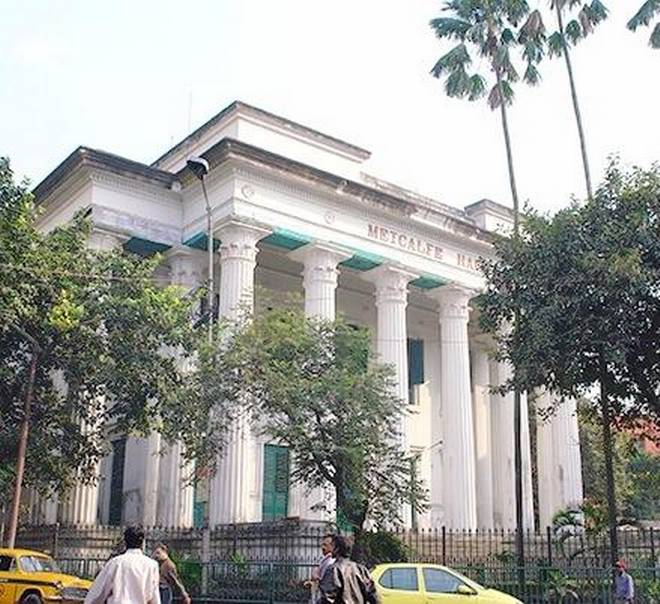
From another time: Metcalfe Hall, at left, and Currency Building are set to host exhibitions. | Photo Credit: The Hindu

Two colonial-era buildings to get a new lease of life as hubs of art and culture

Two of Kolkata’s oldest colonial buildings, Currency Building and Metcalfe Hall, both built in the 19th century, will soon become museums and galleries showcasing art and urban history.

The three-storied Currency Building in Dalhousie Square was built in 1833. Designed in the Italian style with Venetian windows and cast iron gates, its vaults and strong room once housed some of India’s oldest banks, including Agra Bank and the Reserve Bank of India.

But now the western wing is all set to become the office of the National Gallery of Modern Art (NGMA). Once the NGMA moves in, the Currency Building will host an exhibition of sketches and sculptures by Ramkinkar Baij, a pioneer of modern Indian sculpture.

“We are expecting that a portion of the Currency Building will be handed over to us by September. There are plans to have a large exhibition on Ramkinkar Baij,” said Adwaita Gadanayak, director general of NGMA.

Archaeologists say the Currency Building was not a mint but a place where currency was kept. Till 1937, it was occupied by the RBI, after which it fell into neglect. Its central dome collapsed later. The Archaeological Survey of India (ASI) took over its upkeep in 2005.

Barely 200 m away is Metcalfe Hall, with 30 Corinthian pillars built between 1840-1844. Located at the junction of Strand Road and Hare Street, it draws its name from Lord Metcalfe, the Governor General of India in 1835-36. It is in this structure that the city’s history will come alive as the ‘Calcutta to Kolkata’ exhibition.

Renovation dilemma

The ASI grappled with the question whether to rebuild the Currency Building’s dome, but decided to keep the existing structure.

In Metcalfe Hall, it shifted one lakh books for repair work. “The exhibitions will bring them back to life,” said G. Maheswari, Superintend- ing Archaeologist, ASI, Kolkata circle.

source: http://www.thehindu.com / The Hindu / Home> News> States> Other States / by Shiv Sahay Singh / Kolkata – September 02nd, 2018