Category Archives: Historical Links / Pre-Independence

Waltz of the Flower

As one of a handful of Baghdadi Jews living in Calcutta and perhaps the oldest of the lot, her story is not her story alone
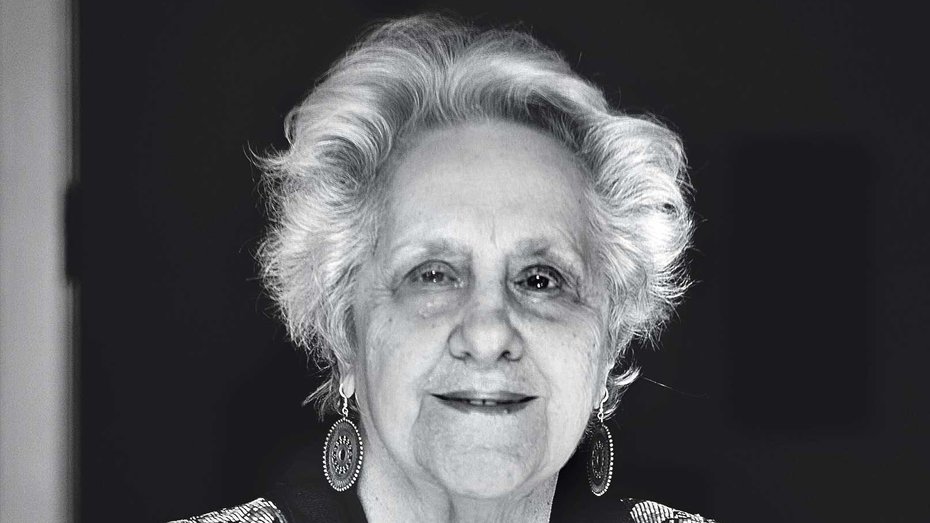
Flower Silliman / Courtesy: Jael Silliman

She is called Flower but there is nothing seemingly fragile about the 90-year-old woman. She is tall with broad shoulders. Her skin is smooth and barely lined. “I have seen a lot of history — 70 years of that century and 20 years of this,” smiles Flower Silliman, one of the 30 Baghdadi Jews still living in Calcutta.

We are at Flower’s residence on Moira Street and though it is just her and me in the room, the many Frida Kahlo portraits on the walls, on the sideboard, form our greater audience. She is in an easy chair, resplendent in a green floral nightgown. The sun is peeping through the netted windows of her living room and lighting up the red-oxide floor. Her green-gold eyes twinkle with memories and she adds in clipped English, “I have five children, 13 grandchildren and 12 great-grandchildren.”

Flower’s parents were born in Calcutta; it was her grandparents — both sets — who came from different parts of Iraq.

The paternal grandparents arrived in Calcutta from Basra. Her grandfather, a petty trader, would bring fezzes — short cylindrical peakless caps, sometimes with a tassel attached — from Baghdad and sell them all over the Far East and return home with spices. Says Flower, “All Muslims would wear fez caps then. In India, my grandfather would stop in Bombay and Calcutta. Otherwise he went to Penang, Jakarta, Singapore.”

Flower’s grandfather got married when he was 50. Flower dwells awhile on his fabled good looks — six-foot tall, blue eyes and so on — but it is his 16-year-old wife, Flower’s grandmother, who seems to have made a more enduring impression on her. In fact, Flower refracts her own story and the story of her entire family as it were, through the personas of her two grandmothers. The descriptions, the attention to detail, the emotions attached are so overwhelming that by the time the interview is over and I have taken my leave of her, I realise that I don’t even know the names of the two grandfathers.

Flower says, “My grandmother’s name was Farah. Farah is joy in Arabic. My name is Farah too. But I was born in the heydays of the Raj, which is why everything had to be anglicised. I became Flower. My two brothers had Arabic names but they were called Charles and Eric.”

Flower cannot stop talking about Farah. Farah lived a colourful life. Farah travelled to the Far East. In the Far East, Farah moved from one Jewish home to another with her husband. Farah had a beautiful Chinese shawl embroidered with red roses. Farah and her husband smoked the hookah. Flower is so into the Farah-tales that it would be rude to turn focus back on her own life. Says Flower, “My father was born in Singapore in 1899 and my aunt in Penang. This is all in a diary and I have it with me. It is written in Hebrew…”

As the story goes, Farah and her husband decided to settle down once the children reached school-going age and the city of their choice was Calcutta, where Baghdadi Jews were very many in number and mostly into indigo or opium trade.

Flower’s maternal side had their roots in Al Uzair. On that side of her family, until a couple of generations ago, most of the men were trained to be mohels, or priests. “Mohels are people who perform circumcision and other special religious duties. They were trained and sent out to places where the clergy was needed to read the prayers or maintain the synagogues,” says Flower.

Her maternal grandmother’s name is Simha. Most of Simha’s brothers went to Shanghai and one of them went to Poona [now Pune] to work as a steward in the home of Jewish businesswoman, scholar and philanthropist, Flora Sassoon. When Flora fell ill and someone was needed to nurse her, Simha was asked over. Says Flower, “When she died, she left some money for Simha to get married and that is how she and her brother arrived in Calcutta, where she got married soon after.”

Flower recollects how Simha would sew clothes and women’s garments. She says, “My mother experienced poverty. But Jews never had to beg. We looked after our poor.” The Jewish Girls’ School in Calcutta was set up by the Jews and everything from education to clothes to food was provided free of cost. Flower’s mother, Miriam Shooker, was among the first batch of students and she eventually went on to become a nursery school teacher.

In the early 20th century, there were around 5,000 Jews in the city. Everyone lived in close proximity to each other with the majority settled near Maghen David Synagogue in Burrabazar. The Jewish para extended to Bentinck Street, Grants Lane, Bowbazar, Phears Lane, Chaatawali Galli, Marquis Street, Kyd Street, Sudder Street and Middleton Row.

Everyone in the community knew each other, and frequented the same synagogues and clubs. The Judean Club in central Calcutta was a world unto itself. In her time, Flower and her friends would play badminton and housie here, dance and listen to music. Flower mixes her reminiscing with footnotes — Yom Kippur is the day of atonement; Hanukkah is the festival of lights, much like Diwali; traditionally Jews never mix meat and milk; Bar Mitzvah is like the thread ceremony and so on and so forth.

Flower’s parents, Miriam and Elias Abraham, married in 1920. Elias worked at the Calcutta port as a measurer of jute and gunny. Flower was born on April 20, 1930, at the Eden hospital — now part of the Calcutta Medical College. She says, “It was a British hospital and in those days it was the hospital of choice for Jews, Christians and Anglo-Indians.” By that time, both her grandfathers had passed away.

And then World War II broke out. Says Flower, “Jewish refugees came into our lives because they were relatives of someone or the other. When the Japanese entered Burma [now Myanmar], the Jews there had to leave. Some came here by ship. Some trekked via Chittagong and Assam to Calcutta. And many of them died on the way. A lot of these displaced people came to live with us. They had nothing. They slept on the sofas, on the floors, and they remained with us till they got a job.”

Flower looks out of the window, possibly remembering what her nine-year-old self had witnessed. As the Japanese came closer, they bombed the docks and Kidderpore. There was no casualty but it did scare the life out of people. Flower, along with her brother and mother, was sent away. The little girl found herself in Delhi for a few months, far from the comforts of home and fond things such as baklavas and Turkish Delights and cheese samosas.

At 13, Flower was sent away again — this time as a boarder to a school in Nagpur. This was where she first got a taste of a non-Jewish environment. She says, “From having only Jewish friends, now I had no Jewish friends, only Anglo-Indian and Christian ones. I was the only Jewish girl. I started to eat non-kosher food. I started going to church with my Christian friends.”

Her next stop was Delhi, where she joined Lady Irwin College — the director, Hannah Sen, was a Jew from Calcutta. Almost everyone around her now was a Hindu or a Muslim. Soon Flower found herself celebrating Guru Nanak Jayanti, Holi, Diwali. She says, “It felt like I had lived in a cocoon and now suddenly I was a butterfly. I loved Frank Sinatra and I had taken records with me. I told my friend Sheila to play them. She made a deal with me. If I listened to Pankaj Mullick, she would listen to Sinatra.”

After graduation, Flower returned to Calcutta and started teaching at St. Thomas’ School, Kidderpore. At 21, she married a Jewish man whom she had met at the Judean Club. He came from a family of foreign exchange brokers and was also the direct descendant of Shalom Aharon Obadiah Cohen — the first recorded Jewish immigrant who arrived in Calcutta in 1798. Says Flower, “Calcutta had changed completely. Suddenly the streets were full of people in khaki. We had never seen planes before and now there were planes on Red Road. Calcutta was a big war base. In 1939, the British army arrived and by 1942, there were American soldiers too. Many of them came to our houses for festivals and Friday night dinners. They got to know the families and started dating their daughters. Many fell in love with these soldiers — some of whom were Jews — and once the war was over most left. The exodus started.”

And then came a time when entire families started migrating. In May 1948, Israel was officially declared an independent state and many Jews shifted from Bombay and Calcutta. The Israeli government even airlifted people. In the meantime, a newly independent India was rife with a variety of rumours. Flower says, “There were rumours that Hindi would become the national language, everything would become Indianised. Jews felt they would not do so well in an independent India and were frightened. Jewish business firms such as the National Tobacco Company and the jute mills at Agarpara were sold out. People left. By 1955, we lost half the Jewish community.”

Flower too left the city but later, in 1975. She moved to Israel, where she set up a restaurant of kosher Indian food which she called The Maharaja. “Every evening, I would wear a sari and go to the restaurant. People would call me Maharani,” she recalls with a laugh. She eventually moved to the US for a couple of years before returning to India for good in 2008.

Mid-conversation, one of Flower’s neighbours enters the room. Flower asks her to check her computer’s Internet connection. The neighbour, a Mrs Ghosh, corrects Flower. She says, “It is not a computer, it is an iPad.” The nonagenarian replies, “Everything these days is a computer; even your phone is a computer. One of these days, we will be asked to swallow a tablet and we will all be computerised.”

And I thought to myself — not you, Flower. Never you.

source: http://www.telegraphindia.com / The Telegraph, Calcutta / Home> People / by Manasi Shah / April 05th, 2020
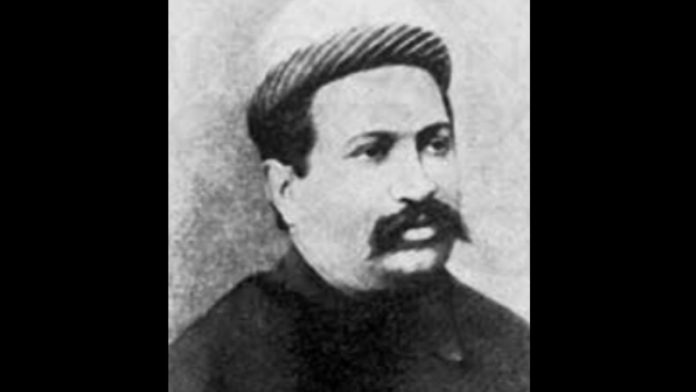
Jamsetjee Framjee Madon — a pioneer of Indian cinema and champion of Calcutta’s poor Parsis

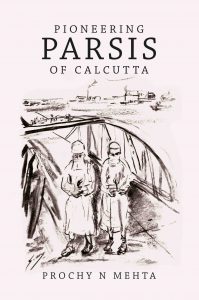
In Pioneering Parsis of Calcutta, Prochy N. Mehta chronicles the little-known lives of the first Parsis who came to the city during British rule.

Jamsetjee Framjee Madon | Niyogi Books | Prochy N. Mehta


Jamsetjee Framjee Madon was one of the pioneers of Indian cinema. He owned over 120 cinema halls at one time. Jamsetjee was very modern in his outlook and a reformist in his religious views. He was one of the first trustees of the Late Ervad D.B. Mehta’s Zoroastrian Anjuman Atash Adaran and was a supporter of the young Bella, to whom he left Rs 5,000 in his will to help her in her legal case. 

Jamsetjee Framjee Madon was born on 27 April 1856 in a very poor family in Bombay. The family being truly indigent, he had to seek employment at the tender age of twelve as a scene-shifter in the dramatic company of Cooverji Ratanji Nazir, at a salary of Rs 4 per month. The young lad got enamoured of the stage, copying the roles of the heroes and heroines of the plays and later playing small roles on stage. Since he had a good voice, he could act the part of a courtesan and became quite popular. 

He then joined Elphinstone Natak Company which toured the country and in 1875, on an auspicious day, he came to Calcutta with this touring company. Some time later he took over this company in partnership with a few others. This company prospered, thanks to his experience, far-sightedness and hard work, and made Calcutta its permanent home. Simultaneously he started dealing in auctioned goods and in 1885 started another business as wines and provision merchant at 5, Dharamtalla Street. His honesty, perseverance and gentle nature soon attracted important Indian customers and the shop became extremely popular among government officers and Englishmen. There were seven branches of this store including those at Calcutta, Darjeeling, Lucknow and Delhi. 

In 1903, at the time of the British invasion of Tibet, Jamsetjee opened food and provision stores all the way from Siliguri to Chumbi and assisted the armed forces in supplying food and provision to soldiers even at great personal risk. The British officers greatly appreciated Madon’s fortitude and bravery as a result of which Jamsetjee was given a large contract of supplying the army during the wars in Kabul. He carried out his work at great risk and in significantly difficult circumstances, to the utmost satisfaction of the military officers. In appreciation of these services, the British Government awarded him the Order of the British Empire in 1918.

On 30 March 1919, the Calcutta Parsis felicitated Jamsetjee at a function under the chairmanship of the trustee of the Anjuman, Seth Edulji Pestonji Guzdar. Madon Seth was congratulated on obtaining the Order of the British Empire and praised for his simple life, gentle nature, honesty and kindness and for his munificence towards the poor. 

Seth Jamsetjee, like the other Parsi elders of the community, had a generous nature and was always anxious to assist the needy. Having grown up in poverty he felt for the poor and gave employment to many poor Parsi youngsters in his cinemas and shops. He was thus responsible for the livelihood of a large number of Parsi families. Many of his charities were done secretly and it can be truly said of him that his left hand was not aware of what his right hand gave away. It was estimated that such secret handouts averaged Rs 5,000 every month. This help was not restricted to Parsis exclusively; all the needy benefitted from his charity, irrespective of caste or creed. Many institutions of public welfare owed their existence and prosperity to him. 

In 1907 Seth Jamsetjee took up the mission of building a second Tower of Silence in Calcutta. Starting a subscription list with his personal donation of Rs 5,000, he went from house to house and managed to collect a lakh of rupees from the Calcutta Parsis. It was due to his influence that the municipality gave a grant of Rs 27,000 towards the purchase of land for this second Tower of Silence, and he personally bore the expenses of Rs 20,000 towards building it. Seth Madon’s efforts and far-sightedness resulted in bringing together the priests of the Kadimi and Shahanshai sections for the first time in Calcutta. The Kadimi priests performed the religious rites at the time of the foundation and the Shahanshai priests performed the consecration rites. 


In 1912, at the time of the building of the Mehta fire temple, Seth Jamsetjee provided his devoted services. The building attached to the fire temple used as a residence for the priests was built and donated by him and his family to the Atash Adaran. He presented several chandeliers, lamps and carpets for the main prayer hall and also many tables, chairs, large cooking utensils for general use. This generous-hearted Parsi also had the foresight to start funds with initial personal donations to take care of the future maintenance of the Atash Adaran.

Seth Jamsetjee was deeply sympathetic towards the poor Parsi families in Calcutta. In Dharamtalla Street he built Khorshed Madan Mansion at an expense of Rs 1,10,176 in memory of his beloved daughter, Mrs Khorshed Rustomji Maneckji Mehta, who had died on 14 January 1920 during the lifetime of her parents. Seth Jamsetjee donated this house to the Anjuman on the understanding that the flats be rented out to the poor and middle-class Parsi families of Calcutta at a low rent. Further he set aside a sizeable fund for the maintenance of this building. 

He also secured the land for the ‘aramgah’ for the Parsis in Darjeeling and donated funds towards its maintenance. On several occasions he gave donations to the Anjuman on behalf of his friends and relations. Seth Jamsetjee organised several ‘benefit nights’ in many of his cinema houses to collect funds for charities for Parsis as well as other communities. 

In 1923, the British Government honoured him with the award of Commander of the Order of the British Empire in recognition of his many cosmopolitan charities. 

About twenty years prior to the advent of cinema on a commercial basis in India, Seth Jamsetjee experimented with this new media and perfected it for public viewing. He was truly a pioneer of the cinema industry in India. 

The young lad of twelve, who started his career as a scene-shifter at a salary of Rs 4 per month, aided by some lucky turn of events and greatly due to his own inherent ability, perseverance and hard labour, became, in the evening of his life, the owner of a hundred cinema houses in India. Seth Jamsetjee’s life is a shining example of Parsi adventure and philanthropy. Upon his death which took place in Calcutta on roz 22 Govad, Mah 10 Dae, Year 1292 y.z., corresponding to 28 June 1923, Calcutta lost a true benefactor of the poor. 

This excerpt from Pioneering Parsis of Calcutta by Prochy N. Mehta has been published with permission from Niyogi Books.

source: http://www.theprint.in / The Print / Home> Page Turner> Book Excerpts / by Prochy N. Mehta / April 04th, 2020

Tributes paid to ‘bhadralok’ soldiers of WW I

Kolkata :

A forgotten chapter of the Indian military history was retrieved from the oblivion and feted at a brief function organised as part of various events held in the city on Remembrance Day today.

The memorial erected by the British at College Square in Kolkata to honour members of the Bengali Regiment who died in the First World War is hard to locate on an ordinary day. Today, however, it saw visit by WB Minister Sadhan Pandey, who paid floral tributes to the soldiers, most of whom fell not by bullets but due to various diseases.“The 49th Bengali Regiment would go on to have a rather inglorious record. It reached Mesopotamia in September 1917, but never saw combat and struggled with the desert conditions and diseases. A commanding officer divided the regiment into ‘Measles Squad’, ‘The Whooping Cough Squad’ and ‘Scarlet Fever Squad’.

More seriously, there was infighting and a junior member opened fire on three senior colleagues while they were asleep. The regiment was demobilised soon after the war,” said Santanu Das, professor at London’s King’s College, who is known for his work on the first great war.

Ashok Nath, military historian, who is on the faculty of Stockholm University, however, said except for the Kumaon Rifles, all other army regiments raised by the British in India in view of the First World War were disbanded after the war.

Muhammad Lutfur Haq, retired Bangladesh Army officer, said 10 per cent of the members of Bengali Regiment were Muslims. The rest were all Hindus. “Bengalis were never put to the frontline. They were given static and security duty at rear,” Dhaka-based Haq, an expert in military matters, told this reporter.

It is likely that because of the poor show by the regiment (known as Bangali Paltan) in the war, the memorial at College Square does not arouse excitement among the city residents.


In honour of Bengali Regiment  

  • A memorial was erected by the British at College Square in Kolkata to honour members of the Bengali Regiment who died in the First World War
  • The 49th Bengali Regiment reached Mesopotamia in September 1917, but never saw combat and struggled with the desert conditions and diseases
  • The regiment was divided into ‘Measles Squad’, ‘The Whooping Cough Squad’ and ‘Scarlet Fever Squad’

source: http://www.tribuneindia.com / The Tribune / Home> Nation / by Tribune News Service / by Shubhadeep Choudhury / November 11th, 2019

Mini Europe by the Hooghly

Kolkata’s splendid history holds impressions of waves of European cultures

Kolkata :

Across the River Hooghly – a tributary of the River Ganges – one can still see signs of various European countries that had created their own unique areas, to facilitate trade through Calcutta’s Port. For those not too familiar with Bengal’s early history, a visit to the area is a real treat as one can see signs of the settlements of various European countries, along the banks of the Hooghly River.

The countries that settled here, creating their own spaces were Denmark, France, Holland and Portugal. As one drives along the riverside road, it is fascinating to see the structures that have survived over the years. The area occupied by the European settlement is the present Hooghly District. Fortunately, these countries have begun to appreciate the historical value of these old ruins. Denmark has recently restored a Tavern at Serampore and tourists now have a splendid place for a meal.

It was almost a century after the Portuguese adventurer Vasco da Gama landed on the western coast of India in 1498, that other European countries realised that they were losing out on trade with India. Soon the European settlements began inroads into Bengal, with the Hooghly being their main source of navigation. The first to create a settlement were the Portuguese who settled down at Bandel, long before the British made Calcutta their stronghold. They were soon followed by the Dutch in Chinsurah, the Danish in Serampore and the French in Chandannagar.

Across the River Hooghly – a tributary of the River Ganges (Photo: By Shona Adhikari) Image Credit: IANS

The Portuguese also built the first Christian church in Bengal in 1599.

In 1632, Mughal Emperor Shah Jahan attacked the Portuguese settlement and demolished their small fort and their church. The head of the Church, Father Joan De Cruz, was taken prisoner to Agra, where he was thrown in front of a ferocious elephant, who instead of trampling the priest, lifted him up and seated him on his back. Shah Jahan was so impressed that he freed the priest and provided free land for a new church.

Interestingly, such miraculous episodes continued. During another siege, Taigo, a local Christian, in a desperate bid to save the statue of Mary, dived into the Hooghly with it and was never seen again. However, on the day of the inauguration of the church, it was found on the river bank. Re-established, the statue came to be known as “Our Lady of the Happy Voyage”.

There is also a splendid Imambara worth seeing in Bandel. Designed by architect Keramtulla Khan, the two-storied building is centred round a rectangular courtyard, decorated with fountains and pools and has a sundial that is a great attraction. The structure has two 85-feet high towers with 152 stairs in each – one for men and the other for women. Built in the memory of the philanthropist Hazi Muhammad Mohsin, the structure took 20 years to build. The three-storied structure connecting the towers contains a clock at the top story. The lower rooms are said to contain splendid chandeliers, but are unfortunately out of bounds to the public.

The Dutch settlement ended in 1825, the Dutch fort of Gustava was demolished by the British and very little remains of the Dutch rule in Chinsura. The Dutch church was demolished in the 1980s, but the Dutch cemetery still stands containing an assortment of graves under the shade of ancient trees, with the oldest dating back to 1743.

It was after receiving Mughal Subedar Ibrahim Khan’s permission in 1673, that the French colony Chandannagar was established as a trading post on the right bank of the Hooghly River. Bengal was then a province of the Mughal Empire. The colony became a permanent French settlement in 1688 and in 1730, when Joseph Francis Dupleix was appointed governor of the city, its development included 2,000 new houses and a considerable amount of trade and commerce. For a short while, Chandannagar also became the main centre for European trade in Bengal.

Today, Chandannagar still boasts considerable French heritage.

The Strand is considered the most beautiful stretch of the Hooghly River. The tree-shaded promenade along the river is about 1km in length and 7 meters in width, and the area houses a number of French mansions. The Durgacharan Rakshit Ghat on the Strand is also an interesting mix of Indo- French architecture.

Also on the Strand is the Dupleix Palace Museum – one of the oldest museums of the region housing French antiques and period furniture. Just off the Strand is the Sacred Heart Church, dating back to 1884. It was designed by French architect Jacques Duchatz and has beautiful stained glass windows. A French colony till 1950, French is still taught as a third language in many of Chandannagore’s schools.

To make you aware that you are in French surroundings, there is the Chandannagar Gate constructed in 1937 to mark the Fall of the Bastille. Etched on stone is the slogan ‘Liberte, egalite, fraternite’ (Liberty Equality and Fraternity).

Serampore , the Danish Settlement, remained under Danish rule till 1845, after which the Danish Governor decided to sell it to the British East India Company. The Serampore college, remains well maintained with its grand facade. Danish missionary Carey along with Ward and Marshman, began the Serampore Mission Press and published the first Bengali translation of the Bible. They also launched the “Friends of India” newspaper. Another outstanding contribution was the installation of India’s first paper mill at Battala, set up by Marshman, which was powered by a steam engine.

The Baptist Mission Cemetery in Serampore contains the family graves of Carey, Ward and Marshman – three personalities whose immense contribution to literacy, cannot be disregarded. Between 1801 and 1832, the Serampore Mission Press printed 212,000 copies of books in 40 different languages.

IANS

source: http://www.gulfnews.com / Gulf News / Home> Asia> India / by Shona Adhikari / September 13th, 2019

Noble edifices: publication lifts veil on mysteries of Bengal’s Raj Bhavans

A view of the stately Raj Bhavan in Kolkata. File   | Photo Credit: Victoria Memorial Hall

Some of the policies that shaped colonial India, including the introduction of English education in India through Thomas Macaulay’s Minute of 1835, the Doctrine of Lapse, and the Partition of Bengal, were plotted in the Raj Bhavan.

A large room in the south of Raj Bhavan, Kolkata overlooking its gardens has a beautiful oil painting of Mahatma Gandhi by Jamini Ray, hung on the wall just above the desk of the Governor in a room that is called the Governor’s study. Not any people know that some of the most fundamentally transformative policies that shaped colonial India, including the introduction of English education in India through Thomas Macaulay’s Minute of 1835, the Doctrine of Lapse, the Ilbert Bill, the Partition of Bengal, and many others, were plotted in this very room. In words of Lord Curzon himself, the room ‘has witnessed discussions as agitated and decisions as heavily charged with fate as any private apartment in the wide circumference of the British Empire.’

Other rooms in the Raj Bhavan, Kolkata like the Council Chamber in the North-east wing of the first floor, which hosted the swearing-in ceremony for each new Governor-General or Viceroy, the Ball Room which from the very beginning was fitted with the original chandeliers and mirrors that once belonged to the French General Claude Martin and the Throne Room where the so-called throne of Tipu Sultan, captured from Seringapatam in 1799, is kept have all been witness to major historical events of the subcontinent in the 19th century.

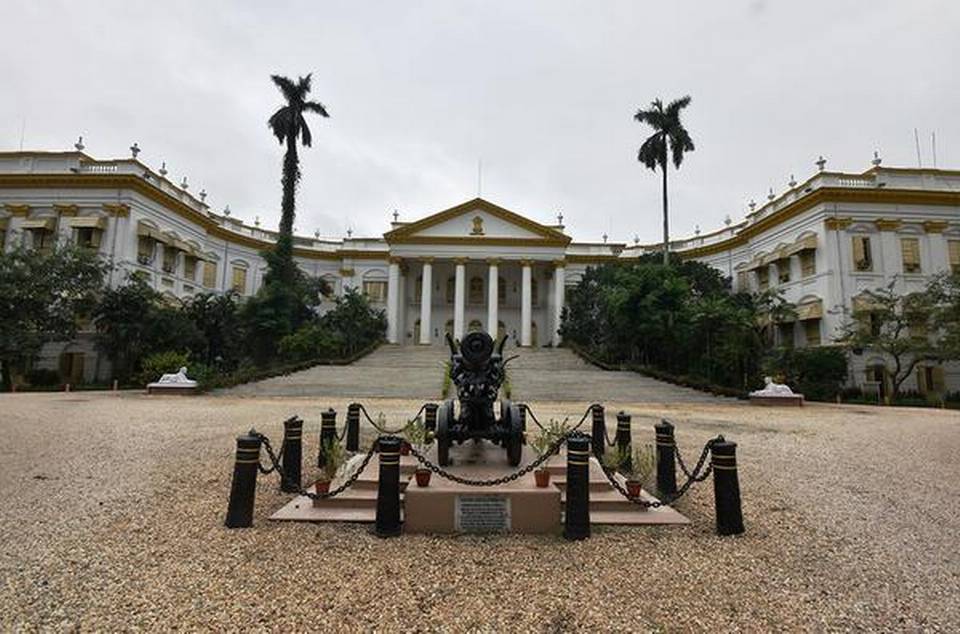
Several anecdotes about the Raj Bhavan, Kolkata, the building that remained the principle seat of power for entire subcontinent from 1803 to 1912 have been the documented in the book titled “Those Noble Edifices- The Raj Bhavans of Bengal” which was unveiled by Governor Keshari Nath Tripathi here on Thursday. In the foreword of the publication, The Governor said that, this volume was planned because “we wanted to share these ‘secrets’ and inside stories of Kolkata’s most hallowed precincts with the public” and “ the purpose is to bring the Raj Bhavan – including its exteriors and interiors – closer to the public”.

Jaynata Sengupta, secretary and curator of Victoria Memorial Hall, who has written the book ,said that this publication is an attempt to “ lift this shroud of mystery and show what lies beneath, what the Raj Bhavan really means as a residence, to its exalted overlords as well as to its humbler inmates and workers”. Mr. Sengupta, in the publication about throws light of three Raj Bhavans of Bengal, the Raj Bhavan build by Lord Wellesley in Esplanade in early 19 th century which is similar to architecture of the Kedleston Hall in Derbyshire and the Raj Bhavans at Barrackpore and Darjeeling.

Full of maps, hundreds of archival photographs, letters and manuscripts the 200 page publication also refers buildings older that the existing Raj Bhavans where Governor General and officials of the East India company lived, from the Old Fort located between the river Ganges and today’s BBD Bagh (erstwhile Dalhousie Square), a house on what is on the street that subsequently came to be named after him (Clive Street) and the Old Government House which was also known as the ‘Buckingham House,’ . It was at this very spot at the Old Government House that Lord Wellesley constructed the Raj Bhavan. The cost of building Raj Bhavan then to between £1,70,000 and £1,80,000, that is, between Rs. 22 and 24 lakh which angered the East India Company’s Board of Directors.

In fact Lord Wellesley had similar plans of making another Raj Bhavan at Barrackpore, which derives its name British barrack or cantonment, but the plans were rejected by the Board of Governors of East India Company. The first bungalows at Barrackpore, was bought by the Bengal Government in 1785 for the occupation of the British Commander-in-Chief. After assuming the title of British Commander-in-Chief, which was conferred to him after the Battle of Seringapatam in 1799, Lord Wellesely took over the house British Commander-in-Chief was Sir Alured Clarke. “Wellesley later described Barrackpore as ‘a charming spot which, in my usual spirit of tyranny, I have plucked from the Commander in Chief.” Mr Sengupta writes in the book. Documents like a minute dated 1 April 1857, in Governor-General’s Lord Canning’s own handwriting, “regarding the outbreak of the ‘disturbance’ (the Revolt of 1857) at Barrackpore on the occasion of the disbandment of the 19th Native Infantry” have been highlighted in the book. It is believed that Lord Canning’s note was written at Barrackpore not far from where the “disturbances” have broken out. Mr Sengupta said that the Government House at Barrackpore was a mere shadow of what Wellesley’s grand and ambitious plan could have produced, it was still spacious enough to serve as a country residence for Governor-Generals and Viceroys. After independence, the Raj Bhavan at Barrackpore came under the care of West Bengal Police, housing the police training academy. Now the academy has been shifted out and the building has been restored. The restored building now houses a museum.

The third important structure the book discusses in detail is the Raj Bhavan in Darjeeling which came up on what was not of the conquered territory of the British. After the introduction of Tea to Darjeeling in the early 1840s and the British negotiating treaties with both Sikkim and Bhutan in the 1860s, Darjeeling became formally a part of British India in 1866. By the 1870’s Darjeeling became the summer seat of the Bengal Government and a suitable accommodation for the Lieutenant-Governor was built in the late 19 th century. Unlike the Raj Bhavan at Kolkata, which was built without a Garden the Raj Bhavan at Darjeeling always had a Garden.

“The main house was so extensively damaged by the Nepal-Bihar earthquake of January 1934 that it had to be entirely demolished, and replaced by a new Government House built in ferroconcrete during the tenure of Sir John Anderson (1932–37),” Mr Sengupta writes.

source: http://www.thehindu.com / The Hindu / Home> News> National / by Shiv Sahay Singh / Kolkata – July 18th, 2019

Book on French connection

The revolution & its effect on the colonies

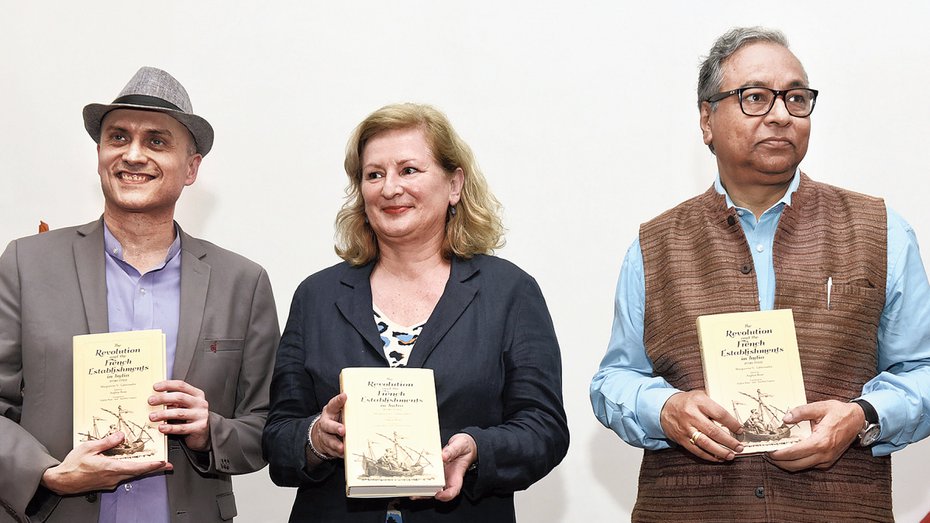
(From left) Alliance Francaise du Bengale director Fabrice Plançon, consul general of France Virginie Corteval and social historian Jawhar Sircar launch The Revolution and the French Establishments in India (1790-1793)./ The Telegraph picture

The fort of Bastille may have fallen in July 1789 but it was not until the British frigate La Vestale docked at Pondicherry in January 1790 that news of “the Paris Revolution” reached India.

The report was confirmed by the French barge Bienvenue which arrived soon after on February 22 from Port Louis, the capital of the Isle de France (now Mauritius).

A translation of a book, The Revolution and the French Establishments in India 1790 -1793, that sheds light on the happenings in the French colonies in the post-Revolution phase was launched on Thursday.

“The book in French published in 1930 was written by Marguerite V. Labernadie, a doctoral student who discovered the administrative archives of the French colonies in India lying almost in ruins in Pondicherry. The book offers fascinating insights into the relation between French colonial establishments in India and the effect of the French Revolution on them,” said Arghya Bose, the editor of the book.

Bose, a Chandernagore boy, chanced upon a dusty copy of the book at Bibliotheque Nationale de France (BNF) when he was a student at Sciences Po in 2015.

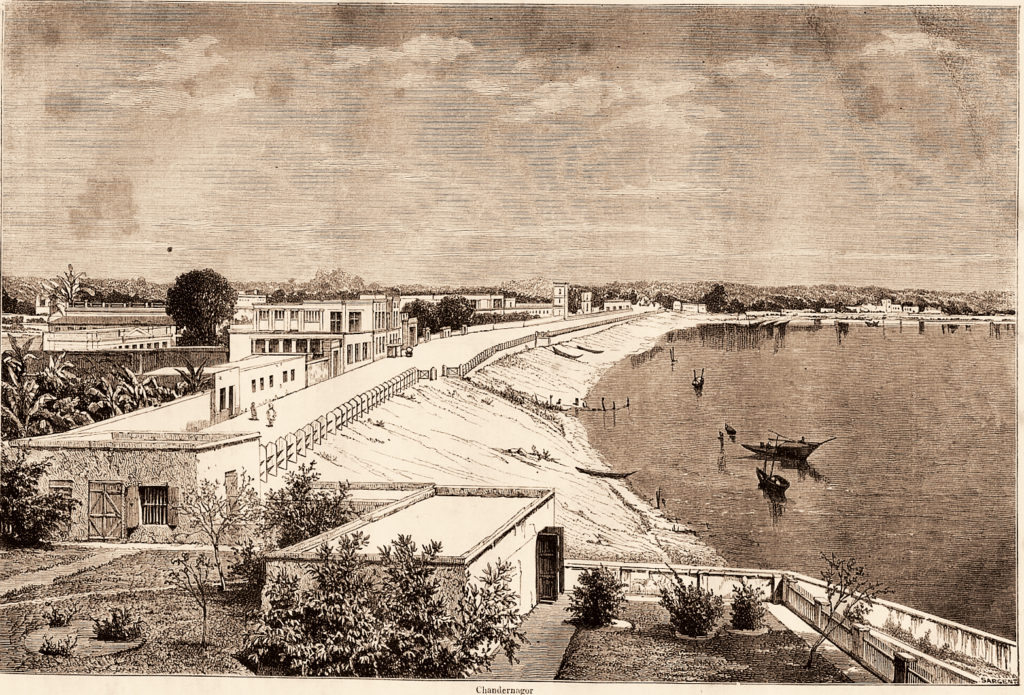
Chandernagore in Wood Engraving by Brickers & Sons, London (1878). / The Telegraph picture

On his return, he joined the Alliance Francaise du Bengale and met Sandhia Vasseur who had just joined as the librarian. “My grandparents on my mother’s side were French citizens of Indian lineage from Pondicherry. In 1947, when they were offered Indian citizenship, they refused and left for Cambodia, which was still a French colony. A war there in 1964 made them shift to France. I was interested in the Franco-Indian encounter as I have seen in my own family how important the French identity can be to people born in India. So when Arghya came up with the idea of translating the book I readily agreed. It was on Gallica, the BNF’s digital portal.”

The news of the revolution triggered political unrest against the French East India Company. “France was not sending money or armaments. The Bienvenue had embarkment orders for the paltry European artillery and troops, leaving Pondicherry defenceless. Chandernagore too faced frequent sieges and humiliation by the British. So people met Chevalier de Fresne, the governor general of Mauritius and Pondicherry, with a host of demands. Constituent assemblies were formed and decrees passed as they tried to replicate what they heard had happened in Paris. Such was the eagerness to conform to the changing political structure in France that they sent expensive gifts to relatives back home, seeking volumes of the minutes of the National Assembly,” said Bose.

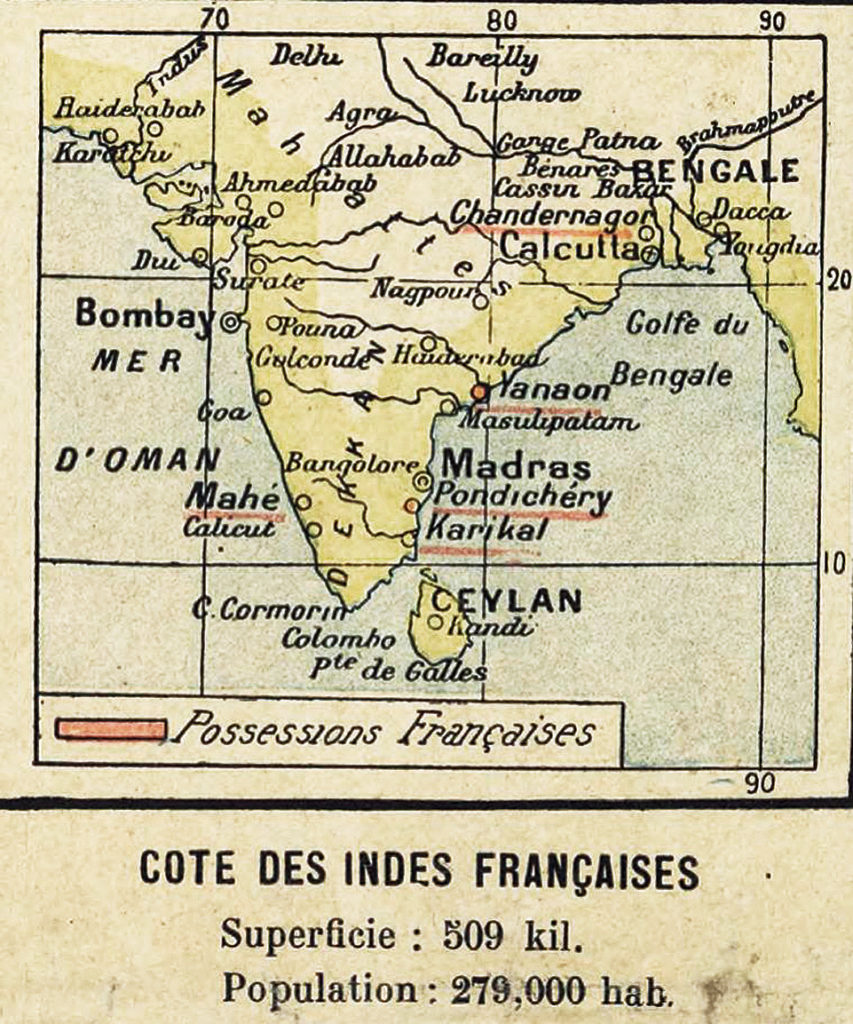
Another interesting aspect is the tussle between Chandernagore and Pondicherry. “While Pondicherry claimed administrative supremacy, Chandernagore, dealing especially in salt and salt petre, was the centre of trade. It paid enough revenue to the French government to offset deficits from the other Indian colonies Mahe, Karikal and Yanaon. They demanded control over the use of their revenue which Pondicherry refused.” The book ends with the British invasion and capture of the French colonies in India in 1793 as a fall-out of France going to war against England.

“The French colonies are not studied at length. Material available to Indian researchers on this subject is scarce. The book is a valuable addition to French colonial history in India,” said Jawhar Sircar, who was present at the launch.

source: http://www.telegraphindia.com / The Telegraph, online edition / Home> West Bengal / by Sudeshna Banerjee in Calcutta / July 08th, 2019

Birds of Bengal at Sweden auction

The paintings by Zayn al-Din were commissioned by Mary Impey, an English natural historian and patron of the arts in Bengal

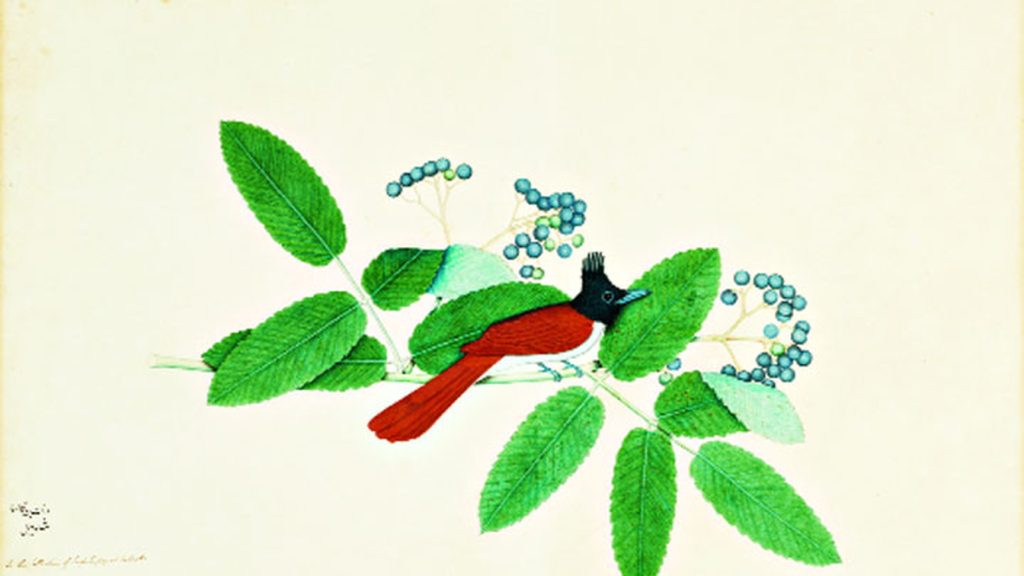
Falsa Tree with King’s Nightingale was painted on a 53.5cm x 75cm canvas by Zayn al-Din in 1782 . / Picture courtesy: Stockholm Auction House

Two watercolour and pencil-on-paper artworks painted in Calcutta in the late 18th century by one of the most famous exponents of the Company School of Art will go under the hammer at the world’s oldest auction house in Sweden on June 12.

The paintings by Zayn al-Din were commissioned by Mary Impey (March 2, 1749 -February 20, 1818), an English natural historian and patron of the arts in Bengal. She was the wife of Elijah Impey, the first chief justice of the Supreme Court at Calcutta (1774-82), who had infamously sent Maharaja Nandakumar — a highly-placed officer in the nawabi administration — to the gallows on charges of perjury.

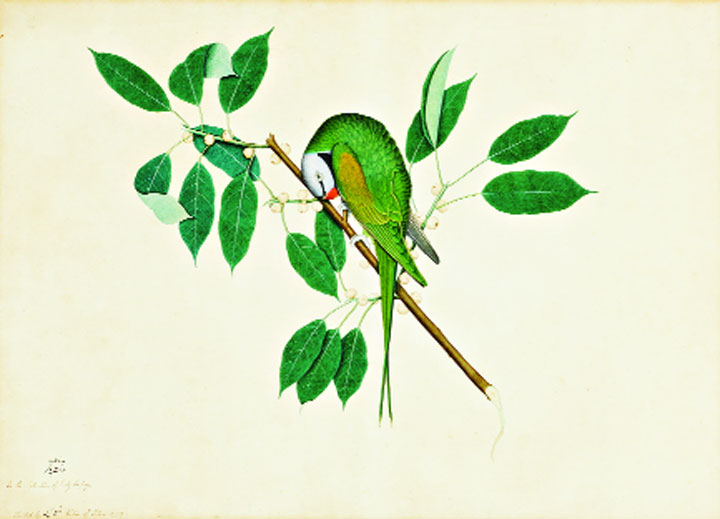
Falsa Tree with King’s Nightingale, dated 1782, and Parrot in a Parkar Tree, dated 1779, have been in the possession of a Swedish family for long.

“We are immensely proud to present these rare artworks. We are not sure how they reached Sweden. They have been in the same Swedish family for a long time and this is the first time that they reach the market,” Victoria Svederberg Bojsen, a specialist in classic and modern art at the Stockholms Auktionsverk (Stockholm Auction House), founded in 1674, told Metro over phone from Stockholm.

“The estimate price is Euro 51,000 (Rs 40 lakh) to 61,500 (Rs 48 lakh). However, we believe they will reach an even higher price. Our hope is naturally that they will now be returned to India where they originated,” she said.

Birds are the subjects of both the paintings. Falsa Tree with King’s Nightingale is a 53.5cm x 75cm canvas.

The inscriptions on both pictures read: In the Collection of Lady Impey of Calcutta. Painted by Zayn al-Din Native of Patna 1782.

“Both paintings include a description of the subject in Persian — Darakht ban falsa, Shah Bulbul in the first and Madna Tota, Darkaht Pakar in the other. The artist’s name is also written in Persian,” said Nandini Chatterjee, associate professor of history at the University of Exeter in the UK.

The painting (right), titled Parrot in a Parkar Tree, is signed and dated 1779. The inscriptions on both artworks read: “In the Collection of Lady Impey of Calcutta. Painted by Zayn al-Din Native of Patna 1782”. / Picture courtesy: Stockholm Auction House

Metro had sent the images to Chatterjee, who is part of a research on two sets of natural history drawings produced between the late 18th and early 19th centuries in Calcutta. The drawings are held at the Victoria Memorial Hall and the Royal Albert Memorial Museum & Art Gallery in Exeter.

The Impeys moved to India in 1773 after Elijah Impey was made the chief justice of Bengal. They set up a menagerie at their house in Calcutta’s Middleton Row. When they shifted to Fort William two years later, they started a collection of native birds and animals on the extensive gardens of the estate.

Mary Impey commissioned several local artists to paint the fauna and flora they had collected. Her three principal artists were Sheikh Zayn al-Din, and brothers Bhawani Das and Ram Das. All three had come from Patna.

Together, Zayn al-Din and the Das brothers painted more than 300 artworks, half of them of birds. The collection, often known as the Impey Album, is an important example of Company style painting.

“With the decline of the Mughal courts, the artists sought the patronage of Europeans. These artists had to change their traditional techniques to suit their new masters. These revisions included a more accurate representation of the subject and a change in perspectives,” said Jayanta Sengupta, the curator of the Victoria Memorial.

Little is known of Zayn al-Din, the artist whose works will be auctioned in Sweden next month. He is known for his extraordinarily detailed paintings for the Impey Album. His drawings of mountain rats, hanging bats, parrots and storks serve as interesting zoological studies and are now preserved at the Ashmolean Museum in Oxford.

“The artworks from the Impey Album rarely reach the international market and the few that have been sold previously at Christies, Sothebys and Bonhams have fetched between $80,000 (Rs 55.5 lakh) and $140 000 (Rs 97.7 lakh),” Bojsen said.

The real study of the Indian subcontinent’s natural history is said to have started with the Mughals. Baburnama — the memoirs of the first Mughal ruler — has beautiful illustrations of birds and animals. Shah Jahan also took a keen interest in the flora and fauna.

With the fall of the Mughals, the artists sought the patronage of Europeans. Calcutta became a thriving centre of the (East India) Company school of painting.

“India was an unknown land for Europeans and along with its indigenous archaeology and history, they also wanted to explore its abundant flora and fauna. Imperial documentation differs from its Mughal predecessor in scale and systematic approach,” Sengupta said.

“Mary Impey was part of a circuit of Europeans who commissioned paintings of Indian natural history. Apart from the pictorial documentation of flora and fauna, the extensive notes kept by her about their habitat and behaviour were of great use to later biologists,” he said.

The collection went to England with the Impeys in 1783 and were sold at a London auction in 1810. Several pieces are in various museums, including the Metropolitan Museum of Art in New York and the Victoria and Albert Museum in London.

“The style of inscription, and the handwriting is identical to other paintings all around the world. I do not believe Zayn al-Din’s name is in his own handwriting. It was probably written by a British collector, maybe Lady Impey herself. Many such British Orientalists (and perhaps some of their spouses) knew Persian,” Chatterjee said.

Some of Zayn al-Din’s works are at the Royal Albert Memorial Museum too. “But those have his name written in English and Bengali, perhaps by a collector who was interested more in the vernacular language, than Persian, which was the Mughal language of administration and courtly culture,” Chatterjee said.

source: http://www.telegraphindia.com / The Telegraph, online edition / Home> West Bengal / by Debraj Mitra in Calcutta / May 28th, 2019

The romantic story behind Odisha’s Belgadia Palace

A 200-year-old palace in Odisha has a Bengal connection — a little-known love story

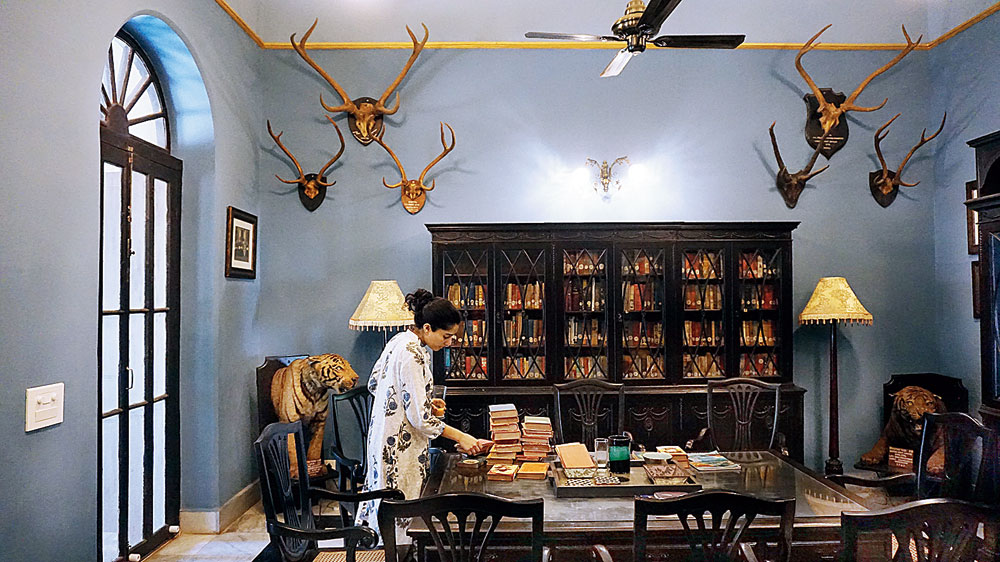
The Belgadia Palace was built in the early 19th century but repurposed by Sriram Chandra Bhanj Deo for his second wife, Sucharu Devi. The king, however, could never live in this palace with his wife / Picture: Prasun Chaudhuri

For most tourists, Baripada is nothing more than a gateway to the Simlipal National Park, famous for its tigers and elephants, in Odisha. That there could be tucked deep within the small town an iridescent palace with an untold love story at its core, is not common knowledge.

Belgadia Palace is now home to the descendants of the erstwhile kings of Mayurbhanj, the Bhanj Deos. Praveen Chandra Bhanj Deo belongs to the 47th generation. He lives in a part of the palace with his wife, two daughters and his 91-year-old mother. On the initiative of his daughters, Mrinalika and Akshita, most of this 215-year-old palace is now open for pubic viewing. Says Akshita, “We want to make people aware of the legacy of our ancestors in the district as well as in the state of Odisha.”

Before throwing open the palace doors, the sisters undertook a thorough recce of the place that revealed a gem too many. One such was the tumultuous love story of their ancestor Sriram Chandra Bhanj Deo and Sucharu Devi, the third daughter of Keshub Chandra Sen, philosopher and social reformer of 19th century Bengal.

Akshita Manjari, the daughter of the current owner of the Belgadia Palace, Praveen Chandra Bhanj Deo, in the palace library / Picture: Prasun Chaudhuri

Sriram Chandra met Sucharu Devi in Darjeeling. She was educated, enlightened and a 15-year-old girl who was not in purdah. He was 18 and looking for a wife who would be his companion. After a brief courtship they got engaged.

That was in 1889. But the crown prince’s family vehemently opposed the match. “The daughter of Keshub Chunder Sen as Maharani of Mayurbhanj! The daughter of that rebel, that revolutionary! To the conservative, orthodox powers in the Hindu state this was preposterous,” reads Sucharu Devi’s biography written by her daughter, Joyoti.

The young prince was no rebel; he toed the family line and married a girl from a local royal family. But the romance between him and Sucharu Devi did not die. “We tried to persuade her to marry but nothing would induce her to forget her lover,” writes Suniti Devi, her elder sister — the erstwhile queen of Coochbehar — in her autobiography.

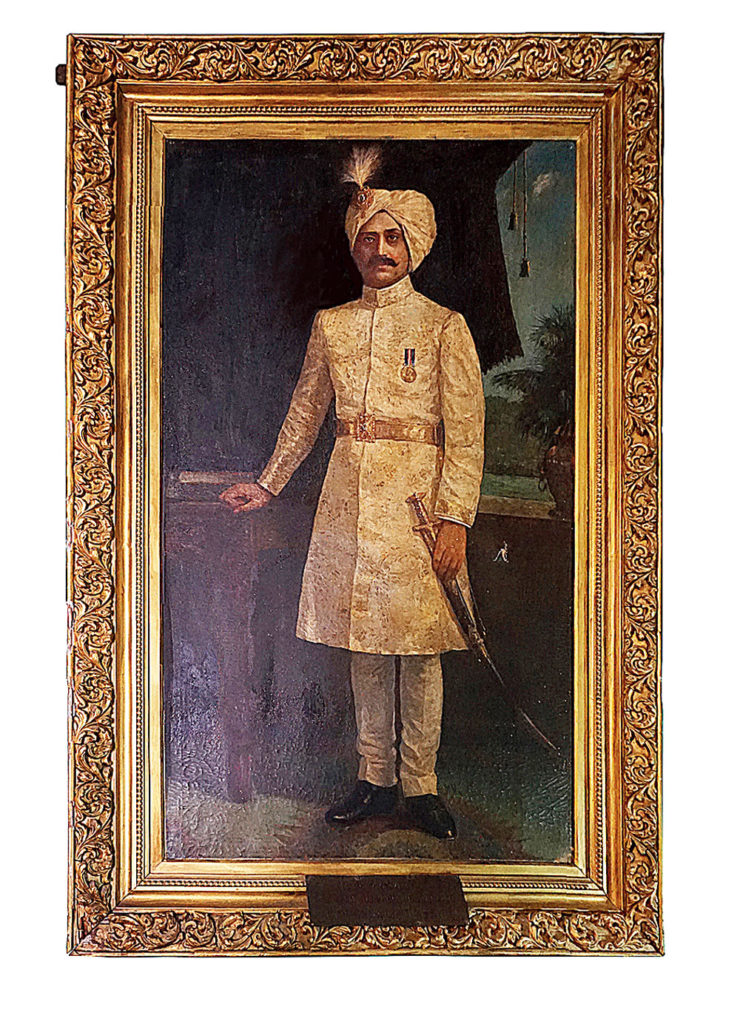
An oil painting of Sriram Chandra Bhanj Deo that adorns the palace walls along with spoils from the countless royal hunting expeditions / Picture: Prasun Chaudhuri

Sriram Chandra’s first wife, Lakshmi Devi, gave birth to two sons and a daughter and thereafter, she died of smallpox. Writes Suniti Devi, “The Maharaja’s wife died, and he came back to ask my sister to marry him. The marriage (sic) took place in Calcutta, and for some time they led the happiest lives.” This was 1904.

Since the Maharaja never dared to take Sucharu Devi to his native state, he built for her the Rajabagh Palace in Calcutta’s Mayurbhanj Road — now the building houses the J.C. Ghosh Polytechnic. They had two children — Dhrubo Narayan and Joyoti. Sriram Chandra met with an untimely and mysterious end in 1912. The accepted version is that he was accidentally shot while he was out on shikar.

Even though the construction of the palace began in 1804, it was developed in several phases. The present interiors were especially designed for Sucharu Devi since she was not welcome in the main Mayurbhanj Palace. But she visited Mayurbhanj and her palace for the first time only after her husband’s death, on invitation of her stepson, Purnachandra Bhanj Deo.

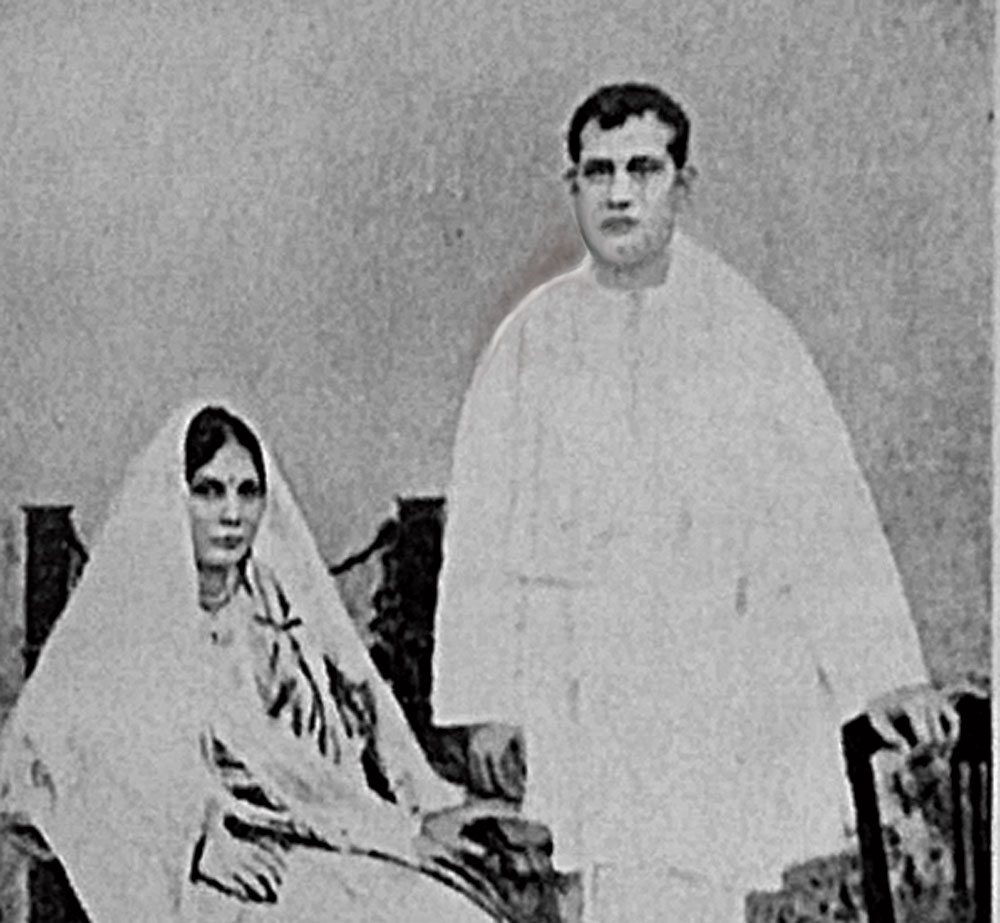
Sucharu Devi and Sriram Chandra on their wedding day. The photograph is from An Illustrated Biography: Sucharu Devi Maharani of Mayurbhanj by Joyoti Devi Kaye, their daughter

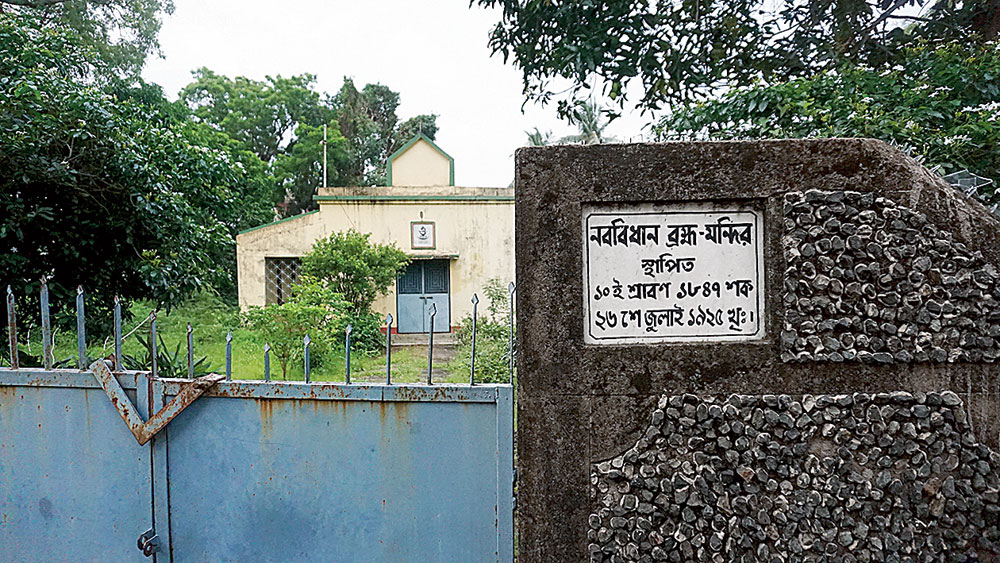
She continued to visit Mayurbhanj occasionally and was associated with social work and spiritual work in Baripada. Her involvement with the Nababidhan Brahma-Mandir in the centre of the town is known. A torch-bearer of feminism in India, she was elected president of Bengal Women’s Education League in 1931.

Sucharu Devi died in 1961 in Calcutta. To date, the rooms and verandahs of Belgadia Palace, we are told, are imbued with her refined sensibilities. As she was an accomplished painter it is believed that artists like Jamini Roy and Hemendra Nath Majumder had visited the palace.The furniture, furnishings, paintings and photographs in the palace continue to reflect her touches. Says Akshita, “She had a deep influence on most of the activities of the Maharaja, who was known as the philosopher king and also revered for his public welfare efforts.” And that is what makes intriguing the fact that to date, there is no portrait of the woman herself on display at Belgadia Palace. “This happened probably because she was never accepted wholeheartedly by the larger family and state subjects because of the difference in caste, creed and religion,” reasons Akshita. She and Mrinalika have plans to find and display the love letters and photographs of Sriram Chandra and Sucharu Devi, for all to see and appreciate.

In a letter dated January 31, 1904, the 32- year-old Sriram Chandra writes to Sucharu Devi proposing marriage once again. It goes: “Dear S… Will you then share my sacrifices if I ask you to sacrifice all worldly pleasures and to be my spiritual companion? That seems to me at present to be the voice of the Almighty. Yours S.R.C. Bhanj Deo.”

The Nababidhan Brahma-Mandir in Baripada / Picture: Prasun Chaudhuri

source: http://www.telegraphindia.com / The Telegraph, online edition / Home> Heritage / by Prasun Chaudhuri / June 02nd, 2019

The story of the fifth Bishop of Calcutta

When engineers chanced upon a vault in Calcutta’s St Paul’s Cathedral, they also unearthed a singular story of a singular man


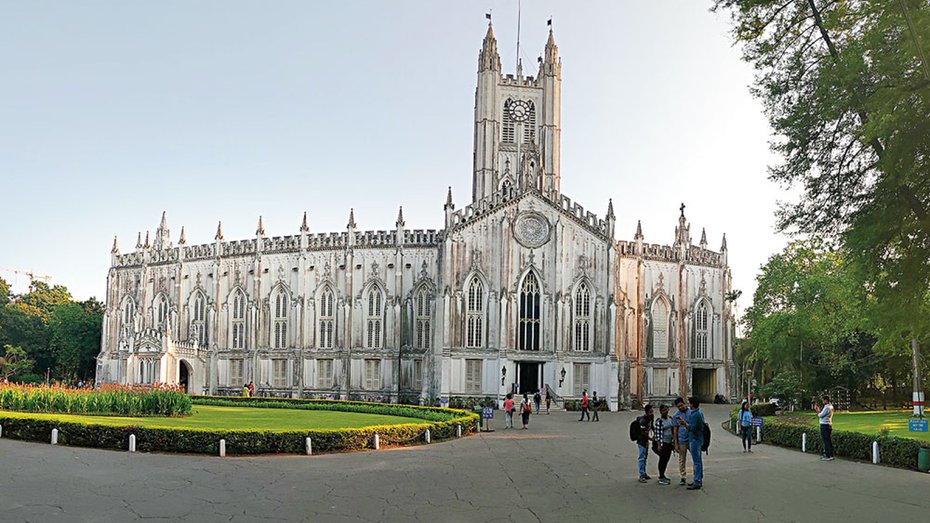
St Paul’s Cathedral in Calcutta / Picture by Pradip Sanyal

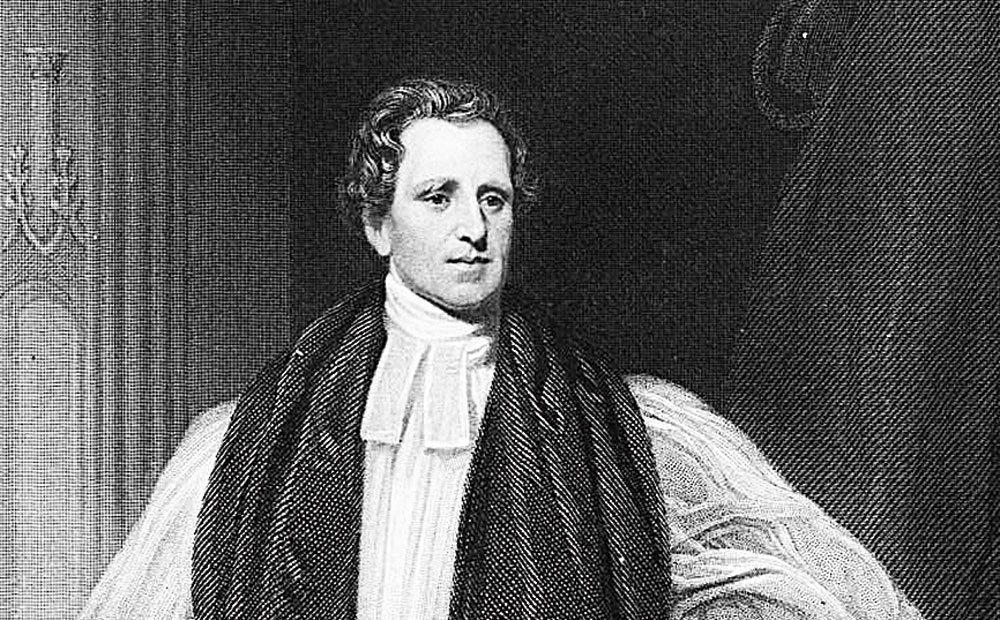
Sometime ago it was reported that the coffin of Daniel Wilson was found in a vault under the main altar of Calcutta’s St. Paul’s Cathedral. Wilson was the fifth Bishop of Calcutta and founder of St. Paul’s, which came up in 1847.

“This is not some out-of-the-box discovery. We were all aware that the coffin was kept there,” says an official from St. Paul’s Cathedral who does not want to be identified. He continues, “In fact, there is a small opening on the outer wall of the cathedral for ventilation. It was kept covered so that no stray dogs could go in. We could see the ornamentation on the coffin. The remains of the bishop were never missing. It was just that we had never gone down into the vault.”

It seems Wilson himself had made provision for the vault under the altar. “There is a reference to his musings in the book, The Final Report of St. Paul’s Cathedral, Calcutta, written by Archdeacon Pratt, who was a close associate,” says senior researcher Mary Ann Dasgupta.

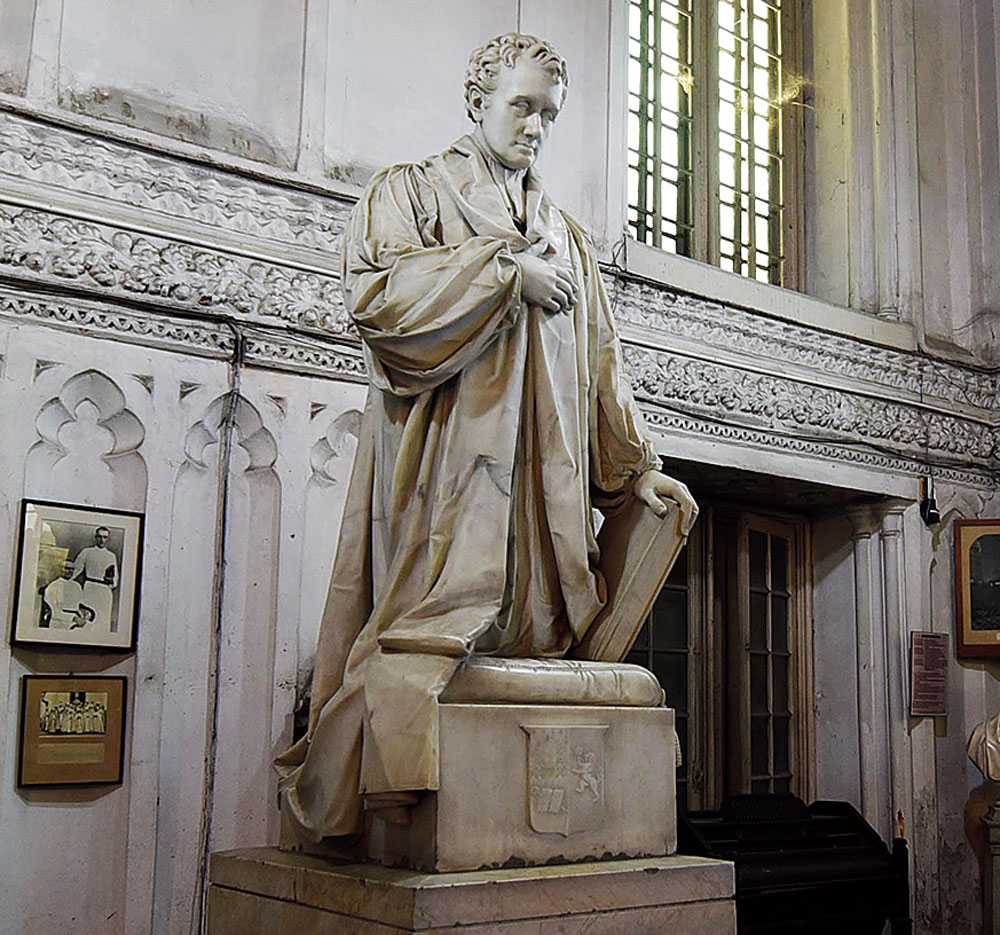
St. Paul’s is said to be the first Anglican cathedral of the Victorian age. In his book, Splendours of the Raj: British Architecture in India, 1160-1947, Phillip Davies writes: “The building was constructed in a peculiar brick especially prepared for the purpose, which combined lightness with compressional strength; the dressings were of Chunar stone, and the whole edifice was covered inside and out with polished chunam.” Up the stairs of the cathedral and next to the main door is a marble bust. Would that be of Wilson? No, it belongs to Reginald Heber, who was Bishop of Calcutta in 1827.


The bust of Reginald Heber in the cathedral / Picture by Pradip Sanyal

The story goes that when Heber’s bust was sent from England, Wilson couldn’t find a suitable space to display it. St. Paul’s hadn’t been built and St. John’s Church in BBD Bag, often referred to as the “old cathedral” in later years, was not spacious enough.

In a proposal written in 1839, Wilson wrote, “…subject of reproach, not only to the good taste, but to the piety of the greatest Empire in the Eastern world, that our Government House, our Mint, our Town Hall, our Custom House, our Bridges and even our Ghats… to say nothing of our official residences and private dwellings… should be upon a scale in some measure correspondent with the position we hold in India, whilst our Cathedral [St. John’s Church, built in 1787] is mean, inappropriate and incommodious…”

Heber’s bust became the peg on which Wilson put forth an application to the government for a site for a new cathedral. He wrote to Lord Auckland: “I beg permission to enquire of your Honour and the Government of India whether it would be possible to grant me a small angle of ground on the Esplanade near the Chowringhee Road for the purpose of erecting a Church.” Auckland gave consent and land and signed his missive “I am Your Lordship’s most truly Auckland”. That was May 1839. Eight years later, St. Paul’s Cathedral was ready.

Dasgupta is working on the history of St. Paul’s. She says, “It is not possible to explore the history of the cathedral without delving into the history of the man who founded it.” She has visited the library at Bishop’s College, St. Xavier’s College archives and the Asiatic Society.

Daniel Wilson was born in central England’s Spitalfields in 1778. The eldest son of a wealthy silk manufacturer, he was barely in his teens when he joined his uncle — an even wealthier silk manufacturer in London — as an apprentice. The young Wilson was, however, more inclined to religious studies than business. He pursued higher studies and eventually graduated from Oxford University and was ordained a priest in 1802.

Wilson was a vicar in north London when he accepted the call to become the Bishop of Calcutta. In Wilson’s biography, his son-in-law Josiah Bateman, writes: “In October 1797, Daniel Wilson felt his spirit stirred to go as a missionary to heathen lands; and in October 1832, he stood on the banks of the Hooghly as Bishop of Calcutta.”

From her explorings, Dasgupta has pieced together a portrait of Wilson. Wilson, the disciplined man. Wilson, who did not like wasting time. Says Dasgupta, “Most of the previous bishops of Calcutta did not survive for long, most probably due to the hectic schedules they had to follow. They used to go for long tours — Burma, China, Malaysia. Bishop Wilson did not do this at the onset. He waited for some time to adjust to the climes. He took care of his health.”

Bateman writes, “His personal habits at this time were very simple and regular. He rose early, and rode on a small black horse, brought from the Cape, which for a time, was able to take care both of itself and its master…”

We learn that he was a prolific letter writer and well-read in the classics.

“He had friends back in London with whom he would correspond,” says Dasgupta. In one letter to his children dated 1840, he wrote about the construction of the cathedral. It read, “Every morning I ride round on my horse and watch the different views which the Cathedral will present (sic).”

Besides being a devout Christian, Wilson was a dynamic man, full of energy. According to his biography, the jurisdiction of the Bishop of Calcutta in 1832 was far-reaching.

Bateman writes, “It was manifestly a burden too heavy to be borne. It must not be supposed that he found abundant records, well-defined duties; and established precedents… The Palace was a blank, the correspondence of his predecessors with the Government and clergy had disappeared, and the Registry contained little but a list of licensed chaplains.”


The coffin of Daniel Wilson was found recently at St Paul’s Cathedral in a vault under the main altar / Wikipedia

Bateman elaborates, “Sixty or seventy servants, turned loose into the house, and speaking an unknown tongue, had to be recognised and mastered. Guests were to be entertained, and sick friends watched over, nursed, and cheered. It will easily be imagined that some time elapsed ere light shone upon this darkness, and order issued from this chaos.”

Wilson loved good food and people and had a reputation of being a great host. Dasgupta has read his journal entries where he writes how “the wonderful young editor of Friend of India” had breakfast with him and so also “Mr Hunt, the great railway man” and Mr Wylie, “who is one of those noble, kind-hearted, thoroughly good men, of whom there are so few in the world”. Yet another entry reads, “This morning I had all my Cathedral clergy and their wives to breakfast… there were 46 present.”

But when engrossed in work, the same man did not like being disturbed and could be very impatient. Dasgupta says, “Before the visitor would settle down in his chair, Wilson would start up in a hurried but determined way and say, ‘Well, my dear friend, you must excuse me; good morning, good morning, here is your hat and here is your umbrella,’ and before the visitor left the room, he would again be buried in his books and papers. But he was always polite in his approach.”

The day Wilson formed the St. Paul’s Cathedral Committee, he also announced that he had signed his will. Dasgupta came across a photocopy of it. In it, he states that he has given Rs 1 lakh for the building of the cathedral and another lakh will be paid out after his death. He also bequeathed his grand collection of 8,000 books to the cathedral library.

He died in 1858. Fifteen years before that he had inspected the vault which was being built for him under the communion table. He wrote in his journal:

“I could not but think as I walked up and down the abode of death how soon I might be called to lay down my pastoral staff and rest in that bed or grave as to my mortal frame, till the Resurrection morn (sic).

source: http://www.telegraphindia.com / The Telegraph – online edition / Home> Heritage / by Moumita Chaudhuri / April 28th, 2019

Meet the survivors of the 1943 Bengal Famine

In the 75th anniversary year of the Bengal Famine, Prasun Chaudhuri travels to K-Plot in the Sunderbans to meet survivors .


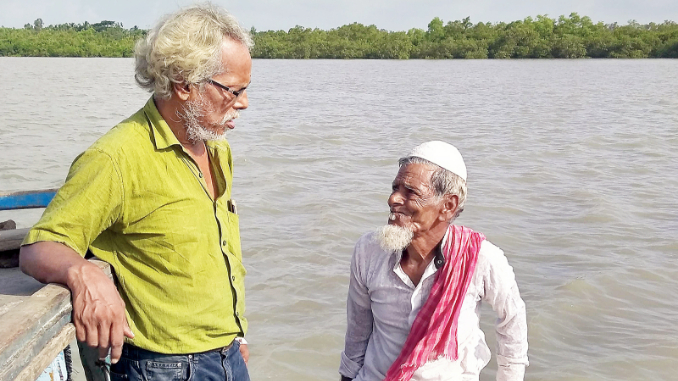
Memory Bank: Writer Sailen Sarkar hears out Khoshain Sheikh, who was 16 when he came to K-Plot / Prasun Chaudhuri

The island is called K-Plot. It might be only 130 kilometres south of Calcutta, but it is not easy to access. First, you have to take the Lakshmikantapur-bound local train from Sealdah. Get off at Mathurapur. Pack yourself into a crowded mini-van to reach Raidighi. Get off it and into another shared vehicle that will drop you to the Raidighi ferry ghat. Then board a motorised country boat to Bamunghat in K-Plot. In all, you need about six hours to touch this southern tip of the Sunderbans surrounded by Thakuran river on the east and west, Shibua river on the north and the Bay of Bengal on the south.

The name K-Plot is a British legacy. Successive officials of the East India Company had unimaginatively named these islands after the English alphabet sometime in the late 18th century. These settlements had been conceived by Collector General Claude Russell in 1771, soon after the company got Diwani rights or the permission to collect taxes on behalf of the Mughal emperor. Russell had initiated extensive reclamation of mangrove forests and offered pieces of land ranging from five to 10,000 bighas to businessmen, landlords and government employees based in Calcutta. (In Bengal, the bigha was standardised under colonial rule at 1/3 acre.)

Years later, post the notorious Bengal famine of 1943, which killed an estimated 35 million, many people sought a home in the Sunderbans in general and K-Plot in particular. Most of them were from Midnapore district, which was the worst affected. Turns out many of these famine survivors managed to give both tide and time a slip and are still around to tell their olden tale.

It is late afternoon by the time we reach K-Plot. We meaning, myself and writer Sailen Sarkar. A retired schoolteacher, Sarkar travelled extensively across southern Bengal before he wrote his Bengali book, Durbhikkher Sakkhi or Witness of the Famine.

It is one long walk to famine survivor Bijoykrishna Tripathi’s house. On the way Sarkar tells me, “I discovered these survivors by chance during my travels. While chatting with the elders of the islands, it emerged that many farmers have roots in Midnapore and clear recollections of panchasher manwantar (the famine happened in the Bengali calendar year 1350). These conversations opened up for me bits and pieces of oral history of one of the biggest tragedies of modern Indian history.”

Sarkar’s first interviewee, Sripaticharan Samanta, didn’t open up to him at first. Instead, he wept and asked, “Why did you come so late?” Soon after the interview, Samanta died. Says the writer, “That’s when I realised the urgency of documenting the oral narratives of famine survivors. I knew we were about to lose pieces of history, the legacy and tales of the indomitable spirit of ordinary human beings.”

When we finally find Tripathi, the 108-year-old patriarch is sitting in the courtyard of his home surrounded by six grown-up great-grandsons and some relations from East Midnapore who have come to seek his advice regarding a land dispute. Tripathi stands up to greet us; a tall man, ramrod straight, wearing a dhoti and uttariya, his sacred thread wound around his bare torso.

“Our misery began with a crazy rainstorm,” begins Tripathi. “It was Ashtami day of 1942, the year of the Quit India movement.” Shortly before the Pujas, an agitating 33-year-old Tripathi had burnt down a police station in East Midnapore’s Bhagabanpur village. That night, he recalls, there was a terrible cyclone. It ravaged the farms and turned everything into a wasteland. The next morning, Tripathi says, he saw hundreds of human corpses floating around along with carcasses of cattle.

The widespread devastation was followed by an acute shortage of rice. Says Tripathi, “The price of rice that cost an anna a seer [16 annas make rupee; one seer equals 1.25 kilos] doubled immediately after the cyclone and tripled in a few weeks. There was starvation and then famine.”

Some people survived on bulga or soup made from discarded wheat served at community kitchens; most others died like flies. According to Tripathi, many sold their wives and daughters in exchange for sacks of rice. He says, “Women ran away with complete strangers for two square meals a day.”


There were hundreds of human corpses floating around along with carcasses of cattle, recalls Bijoykrishna Tripathi, 108 / Prasun Chaudhuri

Researcher and writer Madhushree Mukherjee, who interviewed many famine survivors of Bengal, toes the line that the catastrophe was engineered largely by the then British Prime Minister, Winston Churchill. For her 2010 book Churchill’s Secret War, she delved into oral accounts of survivors and official documents. She cites documents and exchanges to support the view that Churchill ordered the diversion of food from starving Indians to add to stockpiles of grains in Britain and Europe.

In a more recent research, historian and anthropologist Janam Mukherjee writes, “High colonial policy, of course, usually in the name of the war effort, played an important role, but responsibilities were widespread. Seeking colonial favor, or entrenched in ‘opposition’, the response to famine by Indian politicians in both Bengal and New Delhi, was also guided, often enough, by political interest rather than public welfare.”

By November of 1943, much of the Bengal countryside lay in ruins. Artist and active member of the Communist Party of India, Chittaprosad Bhattacharya, journeyed through the innards of the famine-struck Midnapore district. In page after page of ink drawings, he tried to capture the general predicament. The visuals came lined with annotations, observations. Eventually, all those sketches came to be his book, Hungry Bengal. The book, however, was banned by the British government and thousands of copies were destroyed.

Destruction, epidemic and mass death had people fleeing cityward. A lot many died on the way, those who made it starved on the streets of the city. But there were people like Tripathi who ventured beyond the city, to the marshes of the Sunderbans, in pursuit of food and new life.

Initially they landed up as raiyats or cultivators who farmed on lands held by absentee landlords. The chain of command ran thus: first came chakdars, who further sublet the land to raiyats.

One of the reasons Tripathi chose K-Plot was that he knew a chakdar who was looking for a raiyat to cultivate 50 bighas of land he had taken at lease. “Initially I farmed the land with some labourers and sent half of the harvest to the chakdar. But the chakdar was a kind man. He eventually gifted me a part of the land when I got married.”

Khoshain Sheikh is also a resident of K-Plot. When we arrive at his hut on the edge of the island, his younger brother, Qurbat, tells us that he is gone to sow paddy saplings. He takes us to the field and we find the 92-year-old crouched there in knee-deep water. “I have been sowing paddy since I was 12,” says the man with a goatee. Then, over a bowl of puffed rice, he tells us his story.

Sheikh was 16 when he arrived here. He says, “The famine actually started before 1943. While foodgrains were fast disappearing into hoarders’ godowns, the cyclone dealt a deadly blow to the belly. My father left our village in Bhagabanpur months before the cyclone.” The Sheikhs crossed the Hooghly and reached the island via Kakdwip. “It took over 12 hours to get here that day,” he reminisces.

All 12 brothers tilled the land, sowed paddy and harvested rich crop within a year. “When we first arrived, we had to deal with wild beasts and snakes. Many of my relatives succumbed to snakebite,” says Sheikh. Then adds, “We desalinated the water by boiling tamarind in it. In the initial period, we survived on gimey shaak and other wild herbs.” The landless are now land owners. Sheikh shows us around K-Plot. He points to the greenery, new embankments and plantations.

Next, Sarkar takes me to Maipith, a neighbouring island. “Maipith is one of those rare islands where tigers and humans co-exist. There is just an embankment that separates the tiger forest from the villages,” he says as we cross two wide rivers.

Pulin Samanta has been living on the edge of Maipith in Nagenabad village since early 1944. He has turned 100 this year. Tigers often enter his paddy fields but he feels these beasts are not as scary as the black-marketeers. “The day we left Jugiberi [Midnapore], the price of rice went up to eight annas per seer, an eight-fold increase in just a year. Only the very rich could buy from hoarders.”

The Samantas had to walk for four hours to reach Rasulpur on the banks of the Hooghly. “On the way, we saw starving people lying on the fields and vultures circling them.” They crossed the river to reach Kakdwip, where they met a chakdar. He had been looking for able farmers. “We rowed for two days to reach this place,” he says. “The first thing the family built was a ‘tonger bari’ or a tree house to survive the wild beasts at night.”

Samanta’s great grandson is trying to recharge his smartphone with a solar battery. Pump sets, parts of mechanised boats and a dish antenna on the roof of the double-storey house are obvious signs of prosperity.

Samanta’s neighbour, Abedan Bibi, is the last famine survivor we meet. The sun has set by then, LED lamps can be seen all around. Rural electrification has been patchy in the island because people here have always voted against the ruling party, says Asura Khatun, who shows us the way to Abedan’s home. The 103-year old woman used to cook her own food and roam the village on her own until she lost her eyesight a few years ago. That night, by the time we reach, she has already finished dinner.

When her granddaughter-in-law informs her that we’ve come to meet her for an interview about the famine, the frail woman crawls out of the mosquito net. She settles down on a wooden stool. In the faint rays of a solar light, we can barely discern her tiny figure in a white cotton printed sari with a blue border.

She begins, “I had got married a few years before the famine.” Her father-in-law, it seems, was an enterprising man who decided to switch his base to the island soon after the cyclone. “He had apprehended the famine as the problem of food shortage had been gradually deepening.”

She continues, “The first few weeks were difficult. We survived on boiled gira shaak and shapla — aquatic plants — fished out from ponds. Occasionally, we got some flour sent by the government in flood-relief boats.”

Sarkar and I leave the island the next day at the crack of dawn. As our motorised boat sputters across Thakuran river, I try to imagine how the scattered bits of land with its dense mangrove forests would have appeared to boatloads of people trying to escape starvation and death, 75 years ago. Like a green beckon perhaps, who can say.

source: http://www.telegraphindia.com / The Telegraph, online edition / Home> Culture / by Prasun Chaudhuri / December 09th, 2018