Category Archives: Green Initiatives / Environment

Couple’s mati-manush tale with roots in Kentucky and shoots in Calcutta farm

AparjitaKOLKATA28sept2014

Kentucky, 2005: Aparajita Sengupta, a 25-year-old English literature student doing her PhD in Indian cinema, and Debal Mazumder, a 31-year-old senior software developer, rush out of their Kentucky home with a cup of cereal each in their hands, she to her university and he to his software firm. Weekends are a blur, driving around town, visiting malls and meeting friends over drinks at a pub.

Calcutta, 2013:
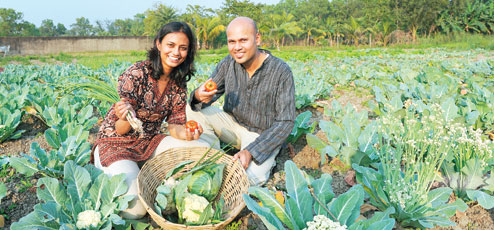
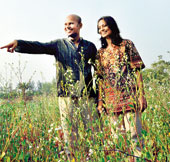
Aparajita and Debal are eight years older and in a different time zone, living a very different life. They have ditched their formal shoes to slip into work chappals. Instead of shopping and pubbing on weekends, they shovel manure and harvest crops. Meals are no longer about takeaways but growing food using organic and biodynamic methods. In their farm, called Smell of the Earth, said to be the first of its kind in the country!

“I am a full-time farmer now!” exclaims Aparajita, 33, her broad smile and sickle in perfect sync.

She is standing in an 11-bigha community-supported agriculture (CSA) farm in Thakurpukur on the southern fringes of Calcutta. “I join in the digging and harvesting but not the tilling because that requires a bullock and a plough, which I still don’t know how to handle,” she says, almost apologetically.

This rare mati-manush tale, with roots in Kentucky and shoots in Calcutta, began with Aparajita and Debal starting their life together in the US like any other young immigrant couple vying for their own small piece of the so-called American dream. Then something happened. Not professional instability, illness or a family crisis. Just a simple realisation that the food they were eating was “poison”.

“We were drawn to food-related issues in the US and the growing influence of GMO (genetically modified organisms) back home. It scared us that the rate of disease, birth defects, cancer and allergies related to food production was so high,” says Debal, 39, who continues to work as a software developer for his American employer while pursuing his other dream.
ArgiKOLKATA28sept2014

We had witnessed the beginning of farmers’ markets and CSA in the US, a movement that has gained unprecedented momentum in the last eight years. But India was going in the reverse direction and we felt the need to come back and do our bit in spreading awareness, starting with Calcutta’s urban population.”

And so, in the summer of 2011, the couple left their adopted American way of life to return to the chaos of Calcutta. “When we left Kentucky, we weren’t sure we would be able to start immediately because we knew we wouldn’t be able to afford land sufficient for farming in Calcutta. Our first aim was to raise consciousness among middle-class families by writing articles or filming documentaries,” says Debal.

An opportunity came knocking when a friend offered a family-owned plot in Thakurpukur, which they happily “borrowed” through a land-share agreement. In a matter of months, Debal and Aparajita’s Smell of the Earth farm had found 26 members, including software and advertising professionals, college professors, an accountant, a banker and a photographer. They pay Rs 2,000 each for organic vegetables every month.

The farm, over an hour’s drive from the couple’s Santoshpur home, is not your usual faux rural setting meant for weekend outings. It is a plot of land meant for agriculture and Debal and Aparajita intend to keep it that way.

Smell of the Earth had its first harvest in January with fresh leafy greens, radish, peas and cauliflower. Coming up are cabbage, coriander, French beans, tomato, pumpkin, brinjal, bitter gourd, potato, onion and chillies.

“Ours is a low-tech, low-energy and low-input poly and multi-cropping farm. We do inter-cropping instead of using pesticides to avoid disturbing the biodynamics. We use pond water and not ground water, and plan to make a transition to solar power,” says Aparajita.

She and Debal are quick to dispel the notion that they are in it for the money. “We don’t want to grow as a farm or expand as a business. What we would like to see grow is the idea. We want more people to look at our model and replicate it so that there can be a large network of such communities. If 30 more families were doing what we are doing, we could move towards a sustainable environment of healthy people,” Debal says.

What makes the couple happy is the enthusiasm of friends, colleagues and neighbours about their initiative. “When they came and saw the farm and attended meetings, they realised that this wasn’t just about paying Rs 2,000 for organic vegetables every month but about participation, building a community and protecting the ecosystem. The vegetables come as a bonus, as one of our members puts it,” says Aparajita.

The CSA model had started in Germany in the 1960s and was adopted by Japan before it made inroads into North America two decades later. But it was only in the new millennium that the movement gained momentum in the face of environmental awareness and food scandals in the US. Today, there are more than 7,000 CSA farms in the US and around 2,000 in Central and Eastern Europe, but just about a hundred in Asia.

A typical CSA farm comprises a community of individuals who pledge their support to an urban farm operation where the growers and consumers share the risks and benefits of food production using organic and biodynamic methods. In exchange for a monthly membership fee and a little labour during harvest, members receive shares from the farm’s bounty throughout the growing season, delivered every week.

At the Thakurpukur farm, Wednesdays and Fridays are reserved for delivery, when Aparajita fills organic cotton bags with the harvested veggies and ferries them across the city to members’ homes.

All other days, too, Aparajita is busy at the farm, having given up a post-grad teaching stint. She helps with the work and planning for the season with Manoranjan, a local farmer who has been appointed caretaker. Debal joins in on Sundays with the couple’s three-year-old daughter Kulfi.

Once a month, the members go on farm visits and assemble at the farmer couple’s Santoshpur home to watch documentaries and share books. “We keep updating our Facebook page [Smell of the Earth] with pictures of the farm and share tips and recipes on vegetables growing for the season,” says Debal.

“We recently had a wonderful experience: a two-week permaculture course [the development of agricultural ecosystems intended to be sustainable and self-sufficient] in a small village near Darjeeling. It’s still a learning process because what did we know about farming?” adds Aparajita.

Back in 2000, Jadavpur University alumnus Debal couldn’t see beyond the career that awaited him in Kentucky as a software developer, while ex-Presidencian Aparajita left Calcutta four years later to do her PhD at the University of Kentucky. It was in the US that they met, fell in love and got married.

“When we had left India we were looking at diverse opportunities of building our careers and starting a new life. We were quite unclear if we would ever come back. We bought a house, a car, had our daughter there, but once this issue started affecting us, we were convinced that we wanted to come back,” recalls Aparajita.

“We had never really been conscious about what we were eating until we started getting bothered by the taste of vegetables, the idea of processed food and TV dinners that simply go into your microwave. Onions were the size of papaya,” says Aparajita. “And chicken tasted like soap,” quips Debal.

A chance meeting with an Indian couple growing organic food helped them understand the difference between what they were eating and how nature meant food to be. “We borrowed some of their books, watched movies and visited websites they recommended. We started buying our grocery from organic food chains even though it cost us three times as much before exploring food co-operatives and farmer’s markets,” says Aparajita.

Joining a CSA farm at Lexington in Kentucky — set up by Erik Walles, “an American scientist who gave it all up to start farming” — sealed the dream Aparajita and Debal are now chasing.

WHO ARE THEY?

Aparajita Sengupta, 33, and Debal Mazumder, 39. They gave up their life in Kentucky to come back to Calcutta in 2011 and start a community-supported agriculture (CSA) farm in Thakurpukur, called Smell of the Earth.

WHAT IS A CSA FARM?

A farm comprising a community of individuals who pledge their support to an urban farm operation where food is produced using organic and biodynamic methods.

WHAT ABOUT SMELL OF THE EARTH?

Aparajita and Debal’s farm has 26 members who pay Rs 2,000 each for organic vegetables every month and participate in the movement. Its first harvest in January comprised fresh leafy greens, radish, peas and cauliflower. Coming up are cabbage, coriander, French beans, tomato, pumpkin, brinjal, bitter gourd, potato, onion and chillies.

source: http://www.telegraphindia.com / The Telegraph, Calcutta / Front Page> Calcutta> Story / by Mohua Das / Saturday – March 02nd, 2013
IITians create solar-powered cold storage with no running cost

Kolkata:

Young IIT engineers have come up with an affordable solution to the wastage of agricultural produce by developing a unique solar-powered cold storage system which works at almost zero running cost.

Developed at the Science and Technology entrepreneurship Park (STEP) of IIT-Kharagpur by mechanical engineering student Vivek Pandey and his team, the micro cold storage system has been successfully tested in a Karnataka farmland.

“It is a first of its kind product developed anywhere in the world as there are no running costs for the farmer and works on clean and sustainable technology for all 12 months. We have even applied for four patents for technologies used in the product,” Pandey said.

Under the banner of Ecofrost Technologies, the young graduates are now ready to move out of the campus and start a manufacturing and assembly unit in Pune next month.

Using a uniquely designed thermal storage methodology that controls compartment cooling in tandem with regular cooling, micro cold storage helps increase the shelf life of agricultural produce using solar panels of 2.5 KW-3.5 KW.

“The power generated is sent directly on to the compressor which can run at various speeds to adjust itself to the cooling demand. Instead of batteries, the system has a thermal storage unit which can store power for more than 36 hours to provide power in case there is no sun during cloudy or rainy weather,” the young innovator said.

Existing solar-powered units run on batteries which need to be replaced after 2-3 years making the running cost very high for farmers. It is estimated that every year India loses around 30 per cent of food production due to wastage and contamination.

“We want to provide farm-level solar cold storages in areas that lack access to grid connected electricity. By increasing the shelf life of agriculture produce, it will improve farmers’ livelihood by reducing losses and allowing better price realisation,” Pandey said.

Meant for horticulture produce, the micro cold storage system has a capacity of 5 metric tonnes and a price varying between Rs 5 to 6 lakh.

“We have started getting orders and will start a manufacturing and assembly unit in Pune next month. We have a target to manufacture 20,000 such cold storage units in the next five years,” the IITian said, adding that they are looking to raise around Rs 5 crore from venture capitalists.

Their promising innovation has won the first prize of Rs 10 lakh in the national university competition ‘DuPont: The Power of Shunya’.

Besides selling directly to farmers, they are also trying to create village-level entrepreneurs who will act as nodal points for cold storage in mandis where any farmer can store his produce at a fixed cost.

source: http://www.ibnlive.in.com / IBN Live / Home> India / by Press Trust of India / Kolkata – September 18th, 2014

Bengal ranked top in cut flowers’ production across India: Study

Kolkata :

West Bengal is ranked on top with production of over 250 crore cut flowers across India thereby clocking highest compounded annual growth rate (CAGR) of over 597 per cent during five-year period of 2007-08 and 2011-12, noted a recently concluded study by apex industry body ASSOCHAM.

“West Bengal has also emerged numero uno with highest share of about 34 per cent in production of over 740 crore cut flowers throughout the country as of financial year 2011-12, production of cut flowers in India is growing at a CAGR of over 14 per cent,” according to a study titled ‘Value addition to rural economy: The promise of floriculture,’ conducted by The Associated Chambers of Commerce and Industry of India (ASSOCHAM).

“Festivals, weddings, large scale political functions and other special occasions are driving demand for cut flowers as they are mostly used for decorative purposes, as gifts/bouquets for formal events,” said D.S. Rawat, national secretary general of ASSOCHAM while releasing the findings of the chamber’s study.

“Though the initial investment is very high, flower production gives much higher returns compared to traditional crops, however, one has to wait for four to five years for breakeven,” said Mr Rawat.

West Bengal is ranked eighth in terms of production of loose flowers. The state produces about 64,000 tonne loose flowers clocking a CAGR of over seven per cent during the aforesaid period. While loose flower production in India is growing at a CAGR of over 17 per cent as India produces over 16.5 lakh tonne loose flowers annually.

However, area under flower production in West Bengal has shrinked from about 27,000 hectares in 2007-08 to about 24,000 hectares in 2011-12 thereby registering fall at a CAGR of over three per cent, pointed out the study prepared by the ASSOCHAM Economic Research Bureau (AERB).

Apart from this, share of West Bengal in area under flower production across India also plummeted by seven per cent during the aforesaid period i.e. from about 16.5 per cent share in 2007-08 it came down to 9.4 per cent in 2011-12, highlighted the study.

It is estimated that about two lakh people are involved cut flower production in West Bengal which is blessed with diverse agro-climatic conditions suitable for flower production.

Dedicated cold storage facilities for flowers near to the main production centres would give a boost to exports of flowers from West Bengal, besides promotion of bio-technology especially tissue culture and genetic engineering would only further help the in realising its potential in floriculture industry in the state, noted the ASSOCHAM study.

Ensuring availability of quality seeds and improved varieties of planting materials, domestic development of capabilities for establishing poly-houses/shade-houses, providing loans at attractive interest rates to farmers willing to produce flowers, luring private sector participation for investments by offering tax rebates and incentives, conducting buyer-seller meets across India and even abroad are certain key policy recommendations listed in the ASSOCHAM study to further promote floriculture industry in West Bengal and other parts of India.

source: http://www.timesofindia.indiatimes.com / The Times of India / Home> City> Kolkata / by Udit Prasanna Mukherji, TNN / September 01st, 2014

Coconut Board of India starts residential training camp for farmers

Raiganj :

With an objective to make the farmers interested for the start of the coconut cultivation, the officials of Coconut Board of India started six days professional and residential training camp for the farmers in the office of Comprehensive Agricultural Development Corporation at Kaliyaganj of North Dinajpur district since today.

Forty farmers including some women from different blocks of the district are receiving this training here.

The Deputy Director of Coconut Board of India Mr Khakan Debnath reportedly inaugurated this training today.

The officials of district horticulture and officials of CADC organized this training.

Deputy Director of Coconut Board of India Mr Khakan Debnath said: Farmers had an idea that sea side was only ideal field for coconut cultivation.

But recently we prepared a high breed coconut plant which is ideal for cultivation in the soil of North Bengal districts.

So we invited the farmers to get training and start coconut cultivation on profession ways in North Dinajpur district.

Such coconut saplings will be available from the office of CADC in Kaliyaganj.

After five years the plant will bear fruit. If the farmers cultivate on the baisis of professional ways ,then government will provide them special subsidy.

The farmers will get atleast Rs 1000 from each tree in a year.

The Horticulture Officer of North Dinajpur Mr Samarendranath Khara said: We are helping the Coconut Board of India to conduct this training for the rise of coconut cultivation in our district.

Through a projector skin they are demonstrating the farmers about the way of nurturing coconut plants.

The farmers are being taught about the using of manure to the trees, its lookafter and the way of climbing the trees with a modern machine. We hope that such camp will create an interest among the farmers for cultivation of coconut in our district.

source: http://www.thestatesman.net / The Statesman / Home> Bengal / Statesman News Service / Raigang – August 25th, 2014

Bahar Dutt’s ‘Green Wars’ in Kolkata

Kolkata :

It’s all right to brag about India evolving as the next super power, but what about its impact on wildlife. For once, why can’t we prioritise GEP (gross environment product) over GDP? Bahar Dutt, author of Green Wars, made the audience sit up and deliberate on the questions during her engaging conversation with British Council director Sujata Sen on Tuesday evening.

At the launch of Dutt’s maiden literary attempt in Kolkata, the Green Oscar recipient, whose environment investigations for a television channel stalled an illegal shopping mall project on the Yamuna river bed, an illegal mine coming up on the Goan forest land and an airport on wetlands that were home to Sarus cranes in Uttar Pradesh, pertinently wondered aloud: Whose development is it, anyway?

“When we say development, it’s this brutal development that we are going through where we need to find out if the development is reaching the people living close to those resources,” said Dutt, giving a presentation on her experience as wildlife conservationist to find out how this conflict between a modernizing economy and saving the planet can be resolved. “That is why I have called my book, ‘Green Wars’,” explained Dutt, after Nayantara Pal Chowdhury, president of the Indo-British Scholars’ Association introduced her to the august gathering at the British Council.

“It doesn’t read like a first book,” said Sen, initiating the dialogue with Dutt. “One just gets hooked on to reading this book. It’s very personal, but for every personal encounter, she takes you to the larger views. It’s so captivating …”

The British Council director made the most intriguing query. What made Dutt write the book? “For a television story, you spend 48 hours trekking through the forests, waiting for the animal that might never show up (supposing it’s a tiger). Then your story comes down to two minutes. So I thought, in the humdrum of television reporting, how to get to the depth of the problem. You could say, ‘Green Wars’ is a back-story to my stories,” Dutt said, recalling: “I can’t say I was involved in the prevention of illegal mining in Goa. But in one of the chapters I have written about the incident where we were physically assaulted by the mining mafia, they tried to snatch our camera.”

Dutt, who had told her television editor in no certain terms that: “I don’t want to do cute-cuddly stories on wildlife, but the politics of it”, would take down notes after every reportage – perhaps to relive those exhilarating moments of her confrontations with gharials and the grand old organg-utan and similar creatures facing an uneasy future in ‘Green Wars’ someday. Moving away from charismatic mega fauna, the book focuses on lesser known species, she has focussed on special like Hoolock gibbons (she helped one find his mate). One of the chapters deals extensively with the ‘Himalayan Tsunami’ in Uttarakhand and why it happened.

For the past one year, she has spent hours in rigorous research to come up with data analysis like India losing 333 acres of forest every day to large development projects like dams, roads and mining. Calling to save all that is precious in a ‘development without brakes’ model of economy, she said, “Indians get rich their lifestyles are getting more and more carbon intensive.”

source: http://www.timesofindia.indiatimes.com / The Times of India / Home> City> Kolkata / by Ajanta Chakraborty, TNN / August 21st, 2014

Untold stories of a green warrior

Kolkata :

It’s all right to brag about India evolving as the next super power, but what about its impact on wildlife? Why can’t we prioritize GEP (gross environment product) over GDP? Many such questions raised by Bahar Dutt, author of ‘Green Wars’, at an engaging conversation with British Council director Sujata Sen made the audience sit up and give them a serious thought.

At the launch of Dutt’s maiden literary attempt in Kolkata recently, the Green Oscar recipient, whose environment investigations for a television channel stalled an illegal shopping mall project on the Yamuna river bed or an airport on wetlands that were home to Sarus cranes in Uttar Pradesh, pertinently wondered aloud: Whose development is it, anyway?

“When we say development, it’s this brutal development that we are going through where we need to find out if the development is reaching the people living close to those resources,” said Dutt. “That is why I have named my book ‘Green Wars’,” she explained, after Nayantara Pal Chowdhury, president of the Indo-British Scholars’ Association, introduced her to the gathering at the British Council.

“It doesn’t read like a first book,” said Sen, initiating the dialogue with Dutt. “One just gets hooked on to reading this book. It’s very personal, but for every personal encounter, she takes you to the larger views. It’s so captivating.”

The British Council director made the most intriguing query. What made Dutt write the book? “For a television story, you spend 48 hours trekking through the forests, waiting for the animal that might never show up. Then your story comes down to two minutes. So I thought, in the humdrum of television reporting, how to get to the depth of the problem. You could say, ‘Green Wars’ is the back-story to my stories,” Dutt said, recalling: “I can’t say I was involved in the prevention of illegal mining in Goa. But in one of the chapters I have written about the incident where we were physically assaulted by the mining mafia, they tried to snatch our camera.”

Dutt, who had told her TV editor: “I don’t want to do cute-cuddly stories on wildlife, but the politics of it”, would take down notes after every reportage – perhaps to relive those exhilarating moments of her confrontations with wild animals in ‘Green Wars’ someday.

source: http://www.timesofindia.indiatimes.com / The Times of India / Home> City> Kolkata / TNN / August 22nd, 2014

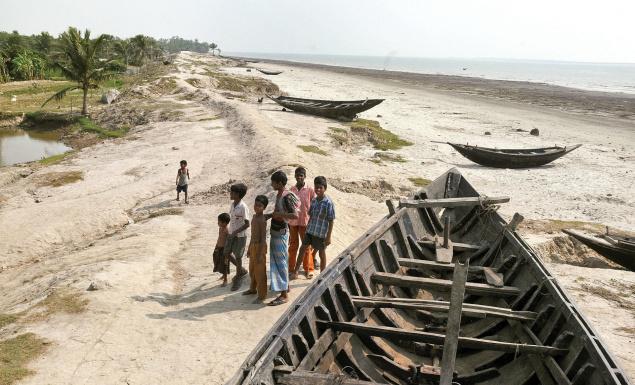
Rising tides pose a threat to sinking island in Sunderbans

Mousuni, one of the 52 inhabited islands of the archipelago, and a vulnerable climate change hotspot, is sinking at a rapid pace. File photo. / The Hindu

Over 2,000 families affected, acres of farm land submerged

Large parts of Mousuni, a sinking island in the Sunderbans archipelago, have been submerged with tides rising because of the spring equinox.

“More than 2,000 families have been affected and hundreds of acres of agricultural land and several fisheries have been destroyed by the high tides,” Sheikh Ilias, panchayat pradhan of Mousuni told The Hindu on Tuesday.

Ilias said that he himself was standing in knee-deep water. Mousuni, one of the 52 inhabited islands of the archipelago, and a vulnerable climate change hotspot, is sinking at a rapid pace.

The island with a population of over 20,000 lies in the estuarine system and is open to the sea, said Tuhin Ghosh of the School of Oceanographic Studies, Jadavpur University. “As the sea level continues to rise, flooding will become a regular phenomenon,” Dr Ghosh said.

The 24-sq km island is the second most vulnerable island of the Sunderbans, next to Ghoramara island, whose population is about 5,000.

The panchayat pradhan claimed that damage to the island and the impact on the people is far more than it was during super cyclone Aila, which hit the Sunderbans in May 2009. “The embankments here have not been repaired since they were breached by Aila. About nine km of embankments has to repaired to prevent seawater flooding. The western part of the island is vulnerable to tides and regular flooding occurs, but this time the situation is grave,” said Ilias. He said the State government had provided foodgrains, but supply is not proportionate to the number of people affected. A UNDP report published in 2010 said that 15 per cent of the delta will be submerged by 2020.

source: http://www.thehindu.com / The Hindu / Home> News> Cities> Kolkata / by Shiv Sahay Singh / Kolkata – July 16th, 2014

Businessman with green thumb turns sabziwallah for pleasure, not profit

ALL FOR THE LOVE OF FARMING

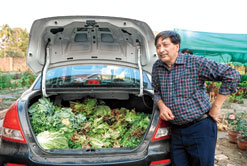
Pawan Khaitan packs the boot of his car with fresh produce to deliver to family and friends Pictures by Sanjoy Ghosh

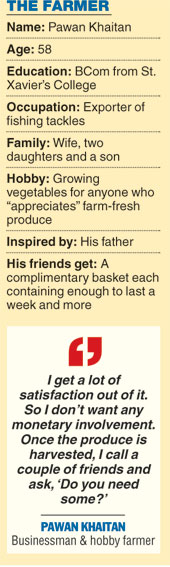
Some watch movies, some play cards and some go salsa dancing. For businessman Pawan Khaitan, life after work is largely devoted to playing sabziwallah.

Khaitan, a 58-year-old resident of Lake Road, exports fishing tackles for a living and plays golf at leisure but nothing gives him more pleasure than getting his hands and feet dirty on his 40-cottah Rajpur farm and carrying back a carload of garden-fresh produce for family and friends.
FarmerKOLKATA11jul2014

“Different people get a kick out of different things. Some people go to a bar, spend a lot of money and get a kick out of drinking. Planting seeds and seeing them grow gives me a lot of happiness,” he says of his love of gardening, which he inherited from his father.

Khaitan has been involved in hobby farming for four decades, investing money, time and effort in it without ever expecting financial gain. “I get a lot of satisfaction out of it. So I don’t want any monetary involvement. Once the produce is harvested, I call a couple of friends and ask, ‘Do you need some?’ That’s my way of gauging whether they share my excitement,” smiles the businessman.

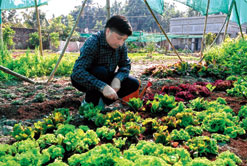
Pawan Khaitan works on his farm in Rajpur, South 24-Parganas /  Pictures by Sanjoy Ghosh
Pawan Khaitan works on his farm in Rajpur, South 24-Parganas / Pictures by Sanjoy Ghosh

He vividly recalls the day he told a chef at Taj Bengal about the different kinds of lettuce he grows on his farm and offered to send him a complimentary basket. “After receiving it, he and his general manager called back, offering me a year’s contract. I said no. I said I wouldn’t mind sending him a basket every Sunday but I won’t do business with this.”

Khaitan, who loves being on the RCGC green when not tending the greens in his garden, visits farms and agriculture fairs whenever he is touring. “From Delhi to Holland, there is something to learn everywhere because what grows in one place you might not find in another,” he smiles.

The businessman has reserved five hours every Sunday for his farm, “checking, watering, planting, instructing and harvesting the plants from start to finish”.

“I learnt how to cultivate vegetables from my father on his 80-cottah farm in Narendrapur,” he recalls. “Now there’s so much more information available, new technologies and reliable sources for seeds that I can bulk order online. Twenty years ago, we would depend on the para supplier or Chetla Haat and end up buying spurious seeds that would hardly sprout!”

This winter, Khaitan grew 13 varieties of lettuce alone. He is also fond of philodendrons (money plant), of which he has several species on his farm.

The most surprising thing about Khaitan’s hobby is that the bulk of the vegetable produce doesn’t go into his own kitchen. “Je ranna kore shey khaye na (the one who cooks doesn’t eat). I see these plants grow, so I don’t obsess about eating them. I give away the produce to friends, who appreciate it for what it is worth. That’s my way of being happy,” he says.

After every round of harvest, the produce is loaded in a van and taken to Khaitan’s Lake Road home, where he soaks the greens in ice-cold water. “I give them a cold bath with my own hands and put them in hibernation,” he says.

Khaitan then neatly arranges the produce in baskets layered with crushed ice, ready to be home delivered to members of his family and friends, “almost 20 of them”.

Even the Royal Calcutta Golf Club has benefited from having a green thumb like Khaitan among its members. It was while playing a round of golf at his club one day that the businessman realised the course didn’t have a flowerbed and proposed that there should be one. “I managed to trace a spot between tee numbers 9 and 11, collected flower seeds from my farm and planted them there.”

Voila! The RCGC course now has a flower patch, thanks to Khaitan. “I intend to get some summer flowers from my Delhi farm like sunflower and zinnia (for the course). I love nature. Even my business is linked to fishing. I interact with nature all the time,” smiles the businessman.

For the employees of his farm, Khaitan arranged a surprise feast of farm-fresh produce one day to show them how tasty a simple salad could be.

“I brought a big bottle of olive oil and balsamic vinegar to the farm and tossed some leaves in it and made a big salad platter for them to try,” he says.

Noorjahan Bibi, one of the workers, didn’t know what to expect but was pleasantly surprised by what was served. “At first, I thought what is this vegetable that we hadn’t grown before, let alone eat. Then, one day he organised a meal for 25 of us, including some neighbours, and we really enjoyed it. We have since learnt to prepare the soil with special manure for this type of lettuce and it seems quite easy now.”

Each winter, Khaitan grows vegetables different from the previous year’s mix. His next season is already planned — he intends growing varieties of spinach, greens and tomatoes that are not available in the market.

“I like to grow everything that you don’t get in the market. I plan to have six types of Italian spinach, six types of lettuce, six kinds of Chinese greens and different kinds of tomatoes, including Mexican and Spanish,” says Khaitan. “If I were to grow a flowering vegetable, it would take a long time to harvest. Leafy vegetables grow a lot faster. One can harvest in a month,” explains Khaitan, who also grows basil, celery, parsley and oregano.

His passion for farming doesn’t end there. Khaitan has printed a booklet containing traditional recipes to go with every kind of lettuce he has harvested this season.

So does he see more people taking up hobby farming like him to stay rooted to nature?

“Some years ago, there was a mass exodus from the villages to urban areas; now people are going back to the rural areas. It’s definitely happening in Delhi, Mumbai and south India, where people are setting up farms outside the city,” says Khaitan.

Do you know anyone like Pawan Khaitan. Tell ttmetro@abpmail.com

source: http://www.telegraphindia.com / The Telegraph, Calcutta / Front Page> Calcutta> Story / by Mohua Das / Monday – March 03rd, 2014

“India should invest more in green sector”

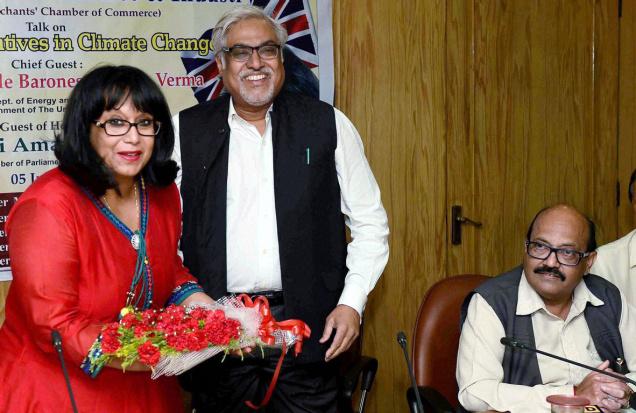
Vice president of MCC Chamber of Commerce and Industry Arun Kumar Saraf welcomes Baroness Sandip Verma, U.K. Minister, at an interactive session in Kolkata on Saturday. Rajya Sabha MP Amar Singh looks on. / The Hindu

It has a great potential for using its renewable energy resources: U.K. Minister

Stating that India has a huge potential in tapping its renewable energy, U.K. Minister of Department of Energy and Climate Change Baroness Sandip Verma said that India should invest more in green sector.

“Unlike in the U.K., India has a great potential for using its renewable energy resources. While in the U.K., we are still relying on nuclear and coal for our power resources, we are trying to do away with coal. India and the U.K. share a lot of similarities and I think India should consider options of investing in green sector,” Ms. Verma said.

She was participating in an interactive session on ‘India-UK initiatives on climate change’. Vice president of MCC Chamber of Commerce and Industry Arun Kumar Saraf was present.

Observing that India should learn from Bhutan in using clean energy, Amar Singh, Rajya Sabha MP, said there are a lot of untapped clean energy sources in Arunachal Pradesh.

Stressing on the need to uniform rule in banning constructions near river banks, Mr. Singh said after the flash floods in Uttarakhand [June 2013], there was a sweeping ban on constructions along river banks in the State so that future disasters could be avoided. “Why wasn’t there a similar ban in States like Himanchal Pradesh?” Mr. Singh asked.

“There is a huge scope in India and the U.K. to use low-carbon approaches not only to fight climate change but to deliver energy security, economic growth, and inclusive development. Although on a per capita basis, India’s carbon emissions remain a small fraction of those of developed countries, the country’s rapid economic growth has brought with it higher emissions,” Mr. Saraf said.

source: http://www.thehindu.com / The Hindu / Home> News> Cities> Kolkata / by Staff Reporter / Kolkata – July 06th, 2014

Snow leopard, red panda get new conservation centre in Darjeeling

SUMMARY
At present, the zoo has 14 snow leopards and 17 red pandas. It is the first Asian Zoo to have started captive breeding of snow leopards.
_______________________________________________________________

To reintroduce captive-bred endangered animals like red panda and snow leopard into the wild, the Darjeeling zoo has now started a new breeding conservation centre for wildlife.

Built in an area of five hectares inside the zoo, the centre hosts three pairs of snow leopards and two pairs of red panda, the Padmaja Naidu Himalayan Zoological Park director, A K Jha, said.

“As per the guidelines of the Central Zoo Authority, our main objective would be to ensure a safe and healthy transition of captive-bred animals from the zoo to the wild. This new centre with all the required facilities will help us achieve that,” he said.

In the years 2003 and 2004, they had released four red pandas, born under captivity, into the wild. Two of them, however, died later on for not being able to take the pressure of jungle.
“Our resources were limited that time, but now we have guidelines from IUCN and CZA. We are also doing our own feasibility study before we restart the process. We are very cautious this time,” the zoo director said.

Although snow leopards have been born under captivity here since 1989, yet none have been released into the wild so far. The official said they should be able to release red pandas into the wild in the next 1-2 years, but the snow leopards would take around 4-5 years.

Two female cubs were recently born to a snow leopard brought from Czech Republic.

“Releasing them into the wild will take time. We will have to train them to be able to hunt food in a forest,” Jha said, adding that they would also have to find a proper habitat which the species can adopt as their new home.

At present, the zoo has 14 snow leopards and 17 red pandas. It is the first Asian Zoo to have started captive breeding of snow leopards.

An endangered species, snow leopards are found in higher altitudes of the Himalayas and are hunted for their valuable fur.
A joint initiative of both the state and central government, the Darjeeling zoo is also conducting conservation programmes for other endangered Himalayan species like Tibetan wolf, Himalayan salamander, etc.

source: http://www.indianexpress.com / The Indian Express / Home> Cities> Kolkata / by Press Trust of India / Kolkata – June 27th, 2014