Category Archives: Education

City wins teen chef crown – Calcutta Girls student tops it

Garima Poddar plates her dishes at IIHM Young Chef India Schools 2014 at the University of West London

Garima Poddar likes her friends calling her Garry after Gary Mehigan, her favourite judge on Masterchef Australia.

And true to the Masterchef nickname, the Calcutta Girls High School Class XII student won the IIHM Young Chef India Schools 2014 contest at the University of West London on Saturday and retained the crown that Simran Kapur had won for Calcutta last year.

The finals of the inter-school cooking competition — held by the International Institute of Hotel Management (IIHM), in association with t2 — saw six finalists from six Indian cities (Calcutta, Delhi, Hyderabad, Bangalore, Pune and Ahmedabad) battle it out with their plates and pans to serve up meals to some of the best-known Indian chefs in London.

Wearing the judges’ hat at the London finale were Andy Verma, who owns restaurants Vama and Chakra in the UK, Dipna Anand whose family owns and runs Brilliant restaurant in London’s Southall area largely inhabited by Indians, Romy Gill of Romy’s Kitchen in South Gloucestershire, and closer home t2 columnist Shaun Kenworthy and Sector V IIHM’s chef Sanjay Kak.

How apt it was for the IIHM Young Chef India Schools contest to culminate in London was underlined by Virendra Sharma, MP, Ealing Southall, the chief guest at the evening prize distribution, who pegged the number of Indian restaurants in the UK at 60,000.

10dishesKOLKATA05jul2016

But what did Calcutta girl Garima do that the others didn’t? For one, she churned out 10 dishes in a three-hour-long cookout, a number unmatched by any other contestant. “Her biggest challenge was getting all her dishes right because she made so many,” agreed the judges, all of who gave Garima the highest score.

The Southern Avenue resident pinned her win down to two factors — confidence and practice. “I know it sounds cliched but practice does make perfect. I strived to make at least three dishes a day to prepare for the finals. One day, I did a 100 roti challenge just to get that perfect roti shape and all the rotis were given to the needy,” said Garima.

Like Garima, her other five competitors made it past 8,000 students who participated in the Young Chef competition over six months. Two got their visas in the nick of time and reached two hours before the contest kicked off while the Jaipur girl had to give it a miss, cutting down the number of finalists to six from seven.

In the two days they all spent in London before the finals, food was the only thing on Garima’s mind. Ask the Lebanese hairdresser at Eli’s Hair & Beauty on Kew Bridge Road who was unexpectedly pulled into a casual conversation on tahini, babaganoush and shawarma as she settled down for a wash-and-blow dry! Or the Kadai Chicken that was sampled at a local restaurant down the road from the hotel.

“In fact, it was for this competition that I started having non-veg,” said the spunky Marwari girl. “Non-veg is not cooked at home but we eat it outside. Initially, I would nibble on chicken; now I can eat a whole chicken meal!”

Which is why chicken featured on what the judges called her “buffet”. There was Chicken Garam Masala Roast, Nageese Kofta (egg wrapped in chicken keema) “learnt from my mom’s friend”, Kheera Ka Kachoree “learnt from dadi”, Bhaap Tashtari, Fish-E-Hariyaali, Lemon Rice, Gobi Dahi Ki Sabji and a fusion dessert Gajar Ka Halwa with Lemon Cheesecake. She also made an Amuse Gueule called Salata (frozen salad) and an Assamese dish called Narasingha Paator Maas “inspired by a YouTube video of Gordon Ramsay cooking Assamese food in Assam”.

The commerce student who loves economics also made all the right calculations and moves. Like when she used micro-greens to garnish her dishes, an idea picked up from Shaun’s cooking demonstration the previous day. Or when “I decided not to make rotis because they would have to be made last and would eat into my plating time”, she said.

Her future plans? “It’s either economics or cooking and after this contest, the scales are tilting more in favour of the latter,” she signed off, clutching in her hands the winning trophy, a cheque for Rs 5 lakh and a placard that read ‘Garry’s Kitchen’, which she had proudly displayed on her table.

What is your message for Garima? Tell ttmetro@abpmail.com

source: http://www.telegraphindia.com / The Telegraph,Calcutta,India / Front Page> Calcutta> Story / by Karo Christine Kumar in London / Monday – October 20th, 2014

Swings & slides to attract students – School play plan prompts space query

Calcutta :

The Bengal government has decided to install swings, slides, sea-saws and other recreational equipment in state-aided primary schools to attract more students and prevent dropouts.

But the move has also prompted questions among many education department officials on the implementation of the plan in schools that don’t have playgrounds or ample empty space.

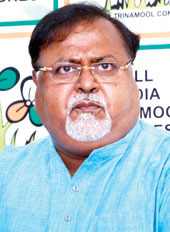
 Partha Chatterjee
Partha Chatterjee

“We want to make education more enjoyable for primary students…. Children are often deprived of games as the schools do not have the required facilities…. So we have planned to install swings, slides and other such equipment in the schools,” education minister Partha Chatterjee said in the Assembly lobby after announcing the decision in the House.

There are around 53,000 state-aided primary schools in Bengal.

In an attempt to prevent dropouts, the government has recently started distributing free shoes among students of Classes I to IV. Free textbooks and uniforms are also given to students up to Class VIII.

Minister Chatterjee also referred to the lack of space in many schools, saying the scheme would “take time” to be implemented in full.

Education department officials said scarcity of space was more acute in Calcutta schools. Although most schools in the districts have big grounds, few are equipped with recreational facilities such as swings, slides, merry-go-rounds and gyms.

“We want as many schools as possible to have such facilities…. These help in creating a conducive environment for the mental and physical development of children,” an education department official said.

Sources said the decision to set up recreational facilities in primary schools had been conveyed to authorities in most institutions.

Around 12,000 schools are said to have responded to the plan.

“The heads of many schools are still unaware of the decision. We expect a better response once the decision is communicated to all schools,” the official said.

Schools wanting to have recreational facilities on the campus have to apply to the district inspector of schools in their respective zones.

The district inspector will then conduct an inspection to ascertain what equipment can be installed. Once the district inspector approves the proposal, the government will install the facilities.

The heads of many Calcutta schools this newspaper spoke to said it was not possible for them to implement the education department’s plan.

“The move is welcome. But there is hardly any space to offer,” said the headmaster of a school in central Calcutta.

Separate panel

The government is planning to set up a separate commission to recruit non-teaching employees in state-aided schools.

The proposed commission will conduct a centralised test for recruiting the employees. But the managing committees of the schools will make the final appointments.

“We are planning to set up a central commission for recruiting non-teaching employees in state-aided schools. This will establish more transparency in the recruitment process,” education minister Chatterjee said.

At present, the West Bengal School Service Commission conducts the recruitment test for non-teaching employees.

source: http://www.telegraphindia.com / The Telegraph,Calcutta,India / Front Page> Bengal> Story / by Our Special Correspondent / Calcutta – June 27th / Pub June 28th, 2016

JU offers rare live recordings for free listening

JadavpurKOLK22jun2016

Kolkata :

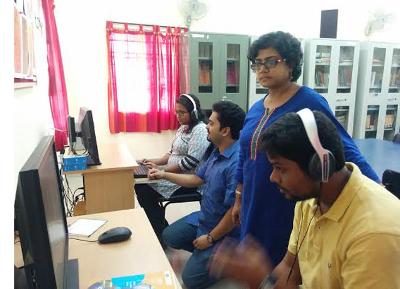
Imagine being present at a mehfil where Begum Akhtar is presenting a ghazal. Imagine listening to a house concert of Annapurna Devi. Imagine listening to Ustad Amir Khan singing a bandish in Persian. All these can be a part of reality if one goes to Jadavpur University’s School of Cultural Text and Records (SCTR). On World Music Day today, any connoisseur can walk into the kiosks set up in the school and listen to the treasure trove of archived music. The best part is that all that comes free of cost!

Director of the School, professor Amlan Das Gupta said, “Collectors from across India have generously donated to this archive that was set up in 2003. The work done here helps in cultural preservation.” In a country where rare records and tapes are lost at regular intervals, such an endeavour has been welcomed by all.

Barring weekends, the archive storing more than 10,000 hours of music is open to any listener between 11 am and 5 pm. Musicologist Anindya Banerjee donated rare live recordings of courtesans like Malkajaan, Bade Moti Bai, Rasoolan Bai and Siddheswari Devi to this archive. “I’ve donated rare live recordings of my guru, Ustad Ali Akbar Khan’s rendition of ‘Lankadahan Sarang’ too,” Banerjee said.

Some years back, Delhi-based collector James Stevenson had sent an aluminium trunkload of cassettes by train. Many still talk about the excitement of receiving that trunk at the Howrah station and then transporting a slice of history to the School. Resoom Pal, an intern at SCTR, said, “I was floored to stumble upon Vidushi Annapurna Devi’s surbahar recital in raag ‘Kaushiki’ and ‘Manjh Khamaj’ from this collection.” All recordings are of superior quality than what is available at any online portal, insists Shantanu Majee, project fellow of SCTR. “We try to preserve these tracks in audio files of superior quality that are uncompressed and preserved in large ‘WAV’ format. This is possibly sound at its best quality,” Majee said.

Some years back, collector Ghulam Naeem donated his collection of spool recordings from house concerts at his residence. In the 70s, Naeem used to import spools to record the programmes! After digitization, the clarity and sound precision of these recordings are of international standards.

One such recording is from a mehfil of Begum Akhtar where she sang a rare ‘ghato’ song – ‘Jal jaumuna bharan ke jaun sajni’ – that was usually sung when women went to fetch water. This ‘ghato’ song leads on to another song – ‘Chha rahi kari ghata’ – in the same recital. Arnab Ghosh, PhD scholar at the JU’s Bengali department, was pleasantly surprised when he discovered a live recording of Ustad Amir Khan’s recital of raga ‘Yaman’ in this collection.

“It was a revelation to hear Khan sahab sing ‘Shah Ze Karam Bar Man-E-Darvesh Negar’ by Amir Khusrau. Listening to such superior quality of music is as good as reliving the live performance,” Ghosh said.

So, what are you waiting for? Just pick up the headphones and let the music play!

Rare recordings:

The Hemanga Biswas archive includes the legendary folk singer’s world music collection of English contralto singer Kathleen Ferrier and German actress and singer Gisela May.

Apart from his created ragas like ‘Chandranandan’, ‘Alamgiri’ and ‘Gaurimanjuri’, this archive also has rare recordings of Ustad Ali Akbar Khan playing raag ‘Gour Sarang’, ‘Barhans Sarag’ and ‘Maligaura’.

One house concert has Ustad Vilayat Khan exploring various kinds of raag ‘Kannada’. This leisurely performance is almost like a lecture demonstration.

There is a recording of Ustad Allauddin Khan playing raag ‘Nat’ and ‘Darbari Kanada’ in sursringar. A rare interview of the maestro with Bhopal radio has him singing raag ‘Komal Bhimpalasri’ and raag ‘Sugadh’.

Pt Ravi Shankar’s early 1950s rendition of raag ‘Mian ki Todi’ and ‘Aalahiya Bilawal’ at the Dixon Lane residence of guru Gyan Prakash Ghosh.

A pre-independence duet of Vidushi Annapurna Devi and Pt Ravi Shankar playing raag ‘Yaman Kalyan’ at Delhi’s Constitution Hall.

source: http://www.timesofindia.indiatimes.com / The Times of India / News Home> City> Kolkata / by Priyanka Dasgupta / TNN / June 21st, 2016

Restaurant school with French help

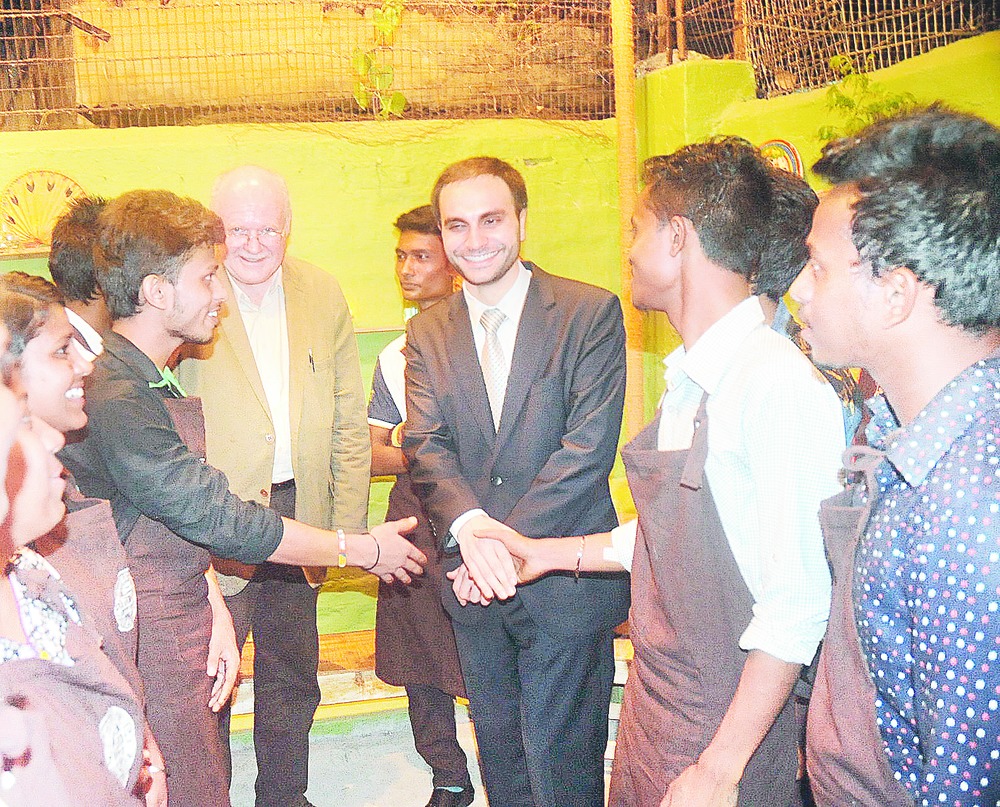
French consul general Damien Syed and German consul general Olaf Iversen meet the underprivileged youths being trained at Toto in Chetla. Picture by Bishwarup Dutta

Falafel served with pita bread. Chocolate cake. Apple pie.

These dishes were part of the food served by underprivileged youths from colonies in Kalighat and Tollygunge. The occasion was the inauguration of French restaurant school Toto in Chetla.

The school, which will also run a café, is a joint initiative of the local NGO Tomorrow’s Foundation and the French NGO Life Project 4 Youth (LP4Y), and is being supported by the French consulate in Calcutta.

“Our objective is education to employability. This is an entrepreneurship development project and we are looking at it as a business school,” said Arup Ghosh, founder of Tomorrow’s Foundation. Four volunteers of LP4Y have come from France to start the Calcutta project. “They are providing the knowhow, we are providing local help.”

In a two-storeyed house in Chetla which is housing both the school and the eatery, 15 youths are being trained to run a business when they are not busy picking up European recipes in the kitchen. “We had started off in October by recruiting five girls. When we started to think of the kind of business activities we should focus on, they suggested baking. It was important to take the idea from them based on their interest,” said Constance Delawstre, one of the volunteers.

That is how the seed of Café Toto germinated. The management is intent on serving only vegetarian fare. “We want to serve fresh and healthy food. We do not want to take a chance with meat in this heat,” says Delawstre.

The French volunteers are taking recipes of chosen Western dishes off the internet, preparing the dishes themselves for the students to taste and teaching them how to cook them. And if the reactions at the opening of guests like Marc Salesse, head of the consulate’s visa section, are anything to go by, their apple pie and chocolate cake are already tasting “just like back home”.

Not just cooking, the youths are also being trained in soft skills, like greeting a guest and taking orders, and management. “The youths have too much fire in the belly to not succeed. Once they complete the 12-month course, they should get entry-level jobs or set up their own place,” said Ranadeb Banerjee, a food and beverage industry veteran who is one of the coaches. The school offers them the option to continue beyond the course duration till they become self-sufficient.

Rama Rao and Gobindo Das, both orphans brought up in a Tollygunge NGO, are the biggest instances of the will to succeed. Rama had dropped out of school after Class VI but has taught himself spoken English. After a six-year gap, he has enrolled in an open school to appear in Madhyamik. Gobindo, too, picked up English on his own and took the Higher Secondary exams last year.

Other students stay with their families in slums. “I have to support my mother and two sisters. I am learning how to run a business,” said Sonu Kamti, who aims to deal in garments. Others like Laltu Singh and Gobindo Das are in it to learn computers. Such is their involvement that they have even sawed the café’s furniture themselves.

The guests left with a promise to return. “There was a need for such a café in our neighbourhood. The food is authentic and simple and the atmosphere convivial,” said Damien Syed, the French consul general. “It is a wonderful idea to create jobs through vocational training. Perhaps they can cook some German dishes too,” said Olaf Iversen, Syed’s German counterpart.

For now, the café will deliver food home on order and stay open only on advance booking. “Once the youths get trained, we will open thrice a week,” said Daniella, another volunteer.

source: http://www.telegraphindia.com / The Telegraph,Calcutta,India / Front Page> Calcutta> Story / byu Sudeshna Banerjee / Wednesday – June 01st, 2016

Indian-American scientist wins Springer Theses Award

Mr. De has dedicated his PhD thesis to cricketing legend Sachin Tendulkar and his alma mater, Kolkata’s Presidency University.

An Indian-American scientist has received the prestigious Springer Theses Award in recognition for his outstanding research in which he developed transgenic mice to study a critical tumour-suppressor called A20.

Arnab De’s thesis was nominated by New York’s Columbia University. Before this, Mr. De, who has also developed peptide-based prodrugs as therapeutics for diabetes, had received the Young Investigator Award at the American Peptide Symposium.

The thesis prize is awarded by Springer, a leading global publisher of renowned scientific journals and books, to recognise outstanding PhD research.

Internationally top-ranked research institutes select their best thesis annually for publication in the book series: “Springer Theses: Recognising Outstanding PhD research”.

Additionally, winners also get a cash prize of 500 euros.

The research work was highlighted by the European Molecular Biology Organization (EMBO) Reports.

Only research considered to be of ‘fundamental relevance to a general readership’ is chosen to be highlighted by EMBO.

Mr. De has dedicated his PhD thesis to cricketing legend Sachin Tendulkar and his alma mater, Kolkata’s Presidency University.

Mr. De said: “Two things that have influenced me the most is sports and education. This thesis is dedicated to Sachin Tendulkar not only for the cricketing joy he provided me, but also for being a constant source of inspiration to all Indian youth.”

Ole John Nielsen (University of Copenhagen), who shared the 2007 Nobel peace Prize as a member of the Intergovernmental Panel on Climate Change along with US vice president Al Gore, had in 2012 described the Springer award as an “insanely great honour”.

source: http://www.thehindu.com / The Hindu / Home> International / PTI / Singapore – May 28th, 2016

Young student from Bengal chosen for Boston Math Workshop

Kolkata :

Soumen Ghosh, a meritorious student from Narendrapur Ramkrishna Mission, has been selected for prestigious Promys, a challenging mathematical summer programme at Boston University. Soumen is one of five students in India selected for Mehta Fellowship that facilitate participation of students in this pogramme.

A resident of Katwa in Burdwan district, Ghosh was also ranked 8th in this year’s Higher Secondary examination. His teachers said that he is a math-champ, who scored 100 out of 100 in every math examination in his career. The Fellowship posed 10 complex mathematical problems. Soumen solved them and mailed. Soumen was one of seven students selected from India. It was followed by online interview in which Soumen was selected.

Approximately 80 mathematically talented pre-university students and 20 undergraduate counselors are carefully selected from around the world. Under graduate students focus primarily on a series of very challenging problem sets, a daily lecture, and exploration labs in Number Theory. There are dozens of additional seminars, mini-courses, and guest lectures on a wide range of mathematical topics, advanced seminars and mentored research are offered.

His father Nani Ghosh is a teacher. He said that his son got excited if he confronted any complex mathematical problems. His schools syllabus hardly appealed him. He looked for mathematics of higher classes. Soumen is also very excited about joining the workshop which will expose him to best of the mathematicians.

Apart from development of mathematical habits of mind that support independence and creativity in facing unfamiliar mathematical challenges, it will also train them in asking good questions, precision of thought and depth of understanding. The workshop is of six-week duration with a collaborative and supportive community. There will be rigorous student discovery of fundamental mathematical truths. Students receive daily feedback from their counselors on their Number Theory problem sets.

source: http://www.timesofindia.indiatimes.com / The Times of India / News Home> City> Kolkata / by Krishnendu Bandyopadhyay / TNN / May 18th, 2016

LMG two blaze Harvard trail

– Two bright young minds with shared roots in La Martiniere for Girls, Calcutta, are lighting up an Ivy League campus with their brilliance.

Jhinuk Mazumdar spoke to Vedika Khemani, Junior Fellow designate at Harvard University, and Tarang Kumar, Teaching Fellow at Harvard College, to chart their inspiring journeys
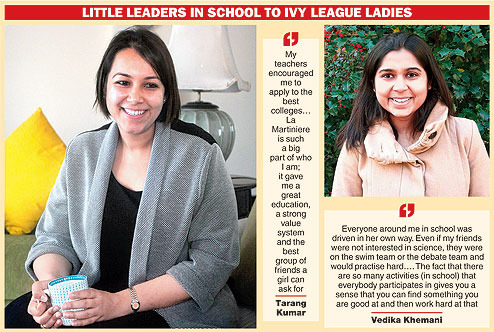
VedikaKOLKATA16may2016

VEDIKA KHEMANI

As a toddler, she was fascinated by science museums. As a student of Class IV, she had already made up her mind to specialise in either physics or mathematics. As a teenager, she would hunt for answers to her inquisitiveness in the pages of books by Richard Feynman and Stephen Hawking.

Vedika Khemani, “science geek” from the Class of 2006 at La Martiniere for Girls, will now get to dine and discuss physics with Nobel laureates.

The 27-year-old has been designated Junior Fellow at Harvard University with effect from August, a position she earned by clearing an interview by a panel of distinguished academicians that included Nobel laureate Amartya Sen. She is the 94th and only the ninth woman physicist to be admitted to this elite group. No other Indian woman physicist has gone where she has.

The Harvard Society of Fellows, founded in 1933, is the most prestigious postdoctoral research fellowship in the US. Only 12 fellowships are awarded each year across fields ranging from physics to literature to law. The list of Junior Fellows in physics since the inception of the society includes top scientists and Nobel laureates like David Gross, John Bardeen and Kenneth Wilson.

Vedika’s extraordinary journey started at La Martiniere, where the school topper would help her friends with their math problems the day before an exam. After completing her ISC in 2006, she went to Harvey Mudd College and is currently finishing her PhD in theoretical condensed matter physics at Princeton University.

So, how did a girl of barely 10 decide in Class IV that she would study physics or math? “Those were the subjects I really enjoyed, and everything else I kind of did because I had to,” she told Metro.

Vedika describes her favourite subjects the way a poet would give voice to feelings. To her, math is “beautiful, pristine, neatly tied with a bow” while physics is “messy, chaotic, but then you discover patterns in that mess”.

She also finds it fascinating that “this really complicated system of so many trillions of electrons actually follows this one very simple and beautiful equation”.

A teacher in school remembers Vedika as “effortlessly brilliant, with an amazing memory”. But the able – and humble – student feels there is no alternative to hard work, discipline and drive.

“Everyone around me in school was driven in her own way. Even if my friends were not interested in science, they were on the swim team or the debate team and would practise hard…. The fact that there are so many activities (in school) that everybody participates in gives you a sense that you can find something you are good at and then work hard at that,” she said.

Her history teacher Behula Chowdhury, who Vedika remembers fondly, said the most striking thing about the precocious girl in class was the ease with which she could assimilate knowledge. “She was not one of those students who would jot down every note in class. Everything was inside her head,” recalled Chowdhury.

Vedika owes her love of physics and math to her father Navneet and maternal uncle Rajesh Kanoria, who she remembers would “willingly spend hours discussing esoteric math and physics problems that were well outside my course of study at school”.

Even when he returned home late from work, Navneet would not turn away from discussing any math problem his daughter came up with. “A message for all dads everywhere to invest time in their children instead of just paying the bills!” quipped Vedika.

To her mother Rashmi, Vedika gives credit for giving her “the courage to dream without thinking about any misgivings or limitations”.

Vedika had received fellowships from Berkeley, Stanford and Caltech, and a position from Microsoft, but she chose Harvard over everything else.

Last December, when she was to be interviewed at Harvard for the position of Junior Fellow, Vedika was struck by nerves just like any other young person on the cusp of a great career opportunity. The nervousness, which she says helps her prepare for such big occasions, disappeared the moment she stepped into the room filled with brilliant minds.

For half an hour, Vedika took questions and presented her work on “Many-body localisation” with the confidence of someone who knew her subject. “I had spent a lot of time on this project and the fact that all these people were interested in it and asking questions was really exciting,” she recalled.

But for all her achievements, Vedika compares her entry into Harvard as “that of one electron among those trillions” and refuses to dwell on it. “This position is only based on my potential to do something. In the grand scheme of things, what have I really discovered about physics yet? There is the prestige of a position, but that is nothing compared to actually figuring something out,” she said.

Vedika is still the same Wood Street girl who loves to have chaat near Vardaan market, Chinese at Flavours of China and rolls on Park Street. Whenever she is in town, which is at least once a year, she visits College Street to buy textbooks on physics and misses the stores that once dotted Free School Street.

And to all those who aspire to be the next Vedika, she is never far away for some friendly advice. “I always try to write back to students who email me asking how and where to apply,” smiled the 27-year-old.

TARANG KUMAR

Tarang Kumar, 31, had cited her experience of taking two classes in her alma mater, La Martiniere for Girls, in her application for the post of Teaching Fellow at Harvard College. “You have never learnt something until you are made to teach it,” she wrote in the application.

Tarang, who passed out of La Martiniere in 2003, is doing her MBA at Harvard Business School and the opportunity to be a Teaching Fellow is something she hadn’t planned for. The last time she had taught was 12 years ago – she was then a student of economics at Delhi’s St. Stephen’s College – and Tarang was drawn to the information session primarily because it was to be addressed by Gregory Mankiw, whose books she had read in college and wanted to “put a face to the name”.

“He was on the campus and it was super convenient,” she said of the session, attended by 600-odd students.

The experience encouraged Tarang to take “a shot” at becoming a Teaching Fellow and she was soon on board as part of “an army of 25-30” selected to teach economic theory to undergraduates. But Tarang refuses to make a big deal out of it even though “there are many who apply for the job but don’t get it”.

“The undergraduate college has developed a system where they recruit teachers from Harvard Kennedy School, Harvard Law School, Harvard Business School, PhD students and also full-time teachers,” she explained.

Although Tarang didn’t have any long-term career goal when she was in school, she always knew that she would study economics. “And my teachers encouraged me to apply to the best colleges…La Martiniere is such a big part of who I am; it gave me a great education, a strong value system and the best group of friends a girl can ask for,” she recalled.

Whenever she makes a trip home, Tarang’s to-do list includes time with her school friends and trips to Kookie Jar and Tolly Club.

At La Martiniere, Tarang had been the president of the Drishti Club that organises cultural events. Being involved in these activities gave her the opportunity to learn about teamwork and leadership, skills essential to success in any workplace. “All the activities we had, whether it was sports, debate or elocution, gave us a lot of opportunities to step up and take leadership positions even at the school level,” she reminisced.

Sharmila Mazumdar, her economics teacher in school, said of Tarang: “There is not much growth in our profession and the maximum reward we get is when our students do well across the country and the world.”

According to Tarang, what makes La Martiniere different from a lot of other institutes is that “even if academics is not your strong suit, you still could find a place”.

At Harvard, Tarang teaches for three hours a week and “prepares for two hours for every class that I take”. Preparation is something she can’t do without because students “are smart and ambitious and some of the questions stump you”.

The hours that she puts in mean “giving up on other things such as great speaker events, opportunities to travel, socialise, take certain courses and sleep”. Two to three classes a week is a “huge time commitment” also because there are occasions when her students need her help to prepare for an exam in the middle of her own tests.

But Tarang won’t have it any other way. “This has given me an opportunity to relearn economics; to stand up in front of the class and teach. I have had the benefit of having some good teachers and to share the experience with someone is a great opportunity,” she signed off.

What message do you have for Vedika and Tarang? Tell ttmetro@abpmail.com

source: http://www.telegraphindia.com / The Telegraph,Calcutta,India / Front Page> Calcutta> Story / by Jhinuk Mazumdar / Monday – May 16th, 2016

Armenia still lives in the heart of Kolkata

City’s 195-year-old Armenian school had a near-death experience when its student body shrank to one. But it has now returned to life, thanks to immigrant students.

What Parsis were to Mumbai, Armenians were to Kolkata -a refugee race that washed up on Indian shores before the British, and proceeded to establish iconic businesses and institutions that live to this day.One such in Kolkata is the Armenian College and Philanthropic Academy (ACPA), nearly two centuries old.

Built in 1821 as a residential school for children of Armenian descent, ACPA was founded by two Armenian merchants, Astvatsatur Muradkhanian and Manatsakan Vardanian who hailed from Julfa (now in Iran). The school was founded to impart an `Armenian’ education to its students, in their language, and about their culture.

In the early 19th century, the Armenians were a prominent business community in Kolkata that ran coal mines, indigo and shellac businesses, and built some of the city’s famous landmarks, including Stephen Court on Park Street and Grand Hotel (today Oberoi Grand).

But after the British quit India, so did most of the Armenians, who migrated abroad. Half a century ago, Kolkata’s Armenian population dwindled to just 2,000, vanishing still further to leave behind only around 150. Two of these Indo-Armenians are counted among the 68 students currently studying at the school; the rest are immigrant Armenians from Iraq, Iran, Russia and Armenia.

The school -in whose original building novelist William Makepeace Thackeray was born -has had its ups and downs. Its student body shrank and expanded -going from 138 in 1932, to 149 in 2003, and even plummeting to a solitary student in 1990, perhaps marking the most trying year in the school’s long history.

In February 1999, a Calcutta high court ruling transferred the school’s administration to Armenia’s Mother See of Holy Etch miadzin, the administrative headquarters of the Armenian Apostolic Church. It is now the Pope of Armenia who appoints the school manager.

“Since the institution’s guardianship was vested with the church, the school has maintained its standards and a minimum number of students,” said Rev. Zaven Ya zichyan, manager of Armenian College and pastor of the Indian-Armenian Spiritual Pastorate.

Following the transfer of power, the first batch of 34 immigrant students reached Kolkata from Iraq, Iran, Russia and Armenia -sent here for the free education and boarding provided by the school. Often, Armenian families in places like Iraq and Iran send their children here even as they plan to migrate to the West, the school be coming an interim harbour for their children. ACPA now routinely invites the diaspora abroad to enroll their children here.

In the run-up to their 200th year celebrations in 2021, Rev. Yazichyan has been at tempting to revive the institution. Among the ambitious projects is the preservation and digitization of the Araratian library, set up in 1828 and named after Mount Ara rat, the place where Noah’s Ark landed after the Flood. Other efforts include the creation of a databank of all Armenians from Kolkata (the last was created in 1956) and for malassociations with other international educational organizations.

To retain a cultural identity , ACPA teaches Armenian history , language and religion.

On visiting the campus on Free School Street (some say it got its name from the free Armenian school), the students seem content. Hovhannes Saringulyar, who teach es Armenian history, says, “If they miss their parents, they talk to them on Skype.”

Incidentally , the school also provides boarders with a free passage back home once every three years.

source: http://www.timesofindia.indiatimes.com / The Times of India / News Home> City> Kolkata / Ajanta Chakraborty / TNN / April 24th, 2016

Quality education comes to town

Narayana Schools, Asia’s largest group of educational institutions, opened its new branch in Siliguri on Monday.

The branch at 3rd Mile, Sevoke Road, will be another feather in the Narayana crown, school officials said, as Inspector General of the BSF, Kamal Nayan Choubey, formally declared the school open by lighting the traditional lamp.

Also present on the occasion were Deputy Commandant, BSF, Priya Darshi, Senior DGM of Narayana Schools, Anil Saxena, Dean of Narayana Schools Ajay Kumar Saha, social activist and advocate GS Hora, and a host of other dignitaries.

Another guest at the event, Senior Vice-President (Operations) of The Statesman newspaper, KK Choudhary, was not able to make it due to unavoidable circumstances.

He, however, sent a message that was read out to the gathering there. Thanking the organisers for inviting him, Choudhary, in his message, assured the Narayana Group of his “whole-hearted cooperation and moral support in your noble endeavour.”

Senior DGM, Saxena, said Narayana Schools does not want its students to leave the schools with only the certificates in hand. “We want our students to become engineers, doctors, chartered accountants, and IAS and IPS officers etc, but most of all we want them to be good human beings and good professionals,” Saxena said.

“Narayana Schools is known for career-oriented teaching and outstanding performance in competitive examinations,” Principal, Narayana Schools, Siliguri, Rajiv Ghosh Roy, told the august gathering.

Later, Ghosh Roy told journalists that the group has 549 schools across India, and that 2600 students have enrolled in the Siliguri branch of the CBSE school from the nursery class onwards so far.

“The school boasts infrastructure like other school in the region, with all the modern facilities and equipment required for imparting valuebased education to our students,” he said.

He added that the students in the school include those from far flung areas in north Bengal and neighbouring states, and also as far as Bangladesh.

Asked how he plans to go ahead as there are already so many private English medium schools in the region and as the competition is tough, Ghosh Roy said: “We go by loving and respecting all other schools and education institutions around us. While we have recruited some local teachers, most of the teachers are from outside north Bengal.”

Meanwhile, addressing the occasion, Choubey said education was his primary passion, “the thing that I love the most.”

“I look at education in a much larger context, on a much bigger platform,” he said. “As the nation decides to build itself as a powerful country, a country that is respected and hounoured by other nations in the globe … education is going to be the single most important factor,” he said.

Speaking of his meeting once with noble laureate Amartya Sen, Choubey said: “I asked him what is one thing India should do to develop it at a pace that it comes out of the tag of developing nation or a third world country, and his answer was very simple. He said ‘primary and secondary education.’” “If you are able to give quality primary and secondary education, India has every reason to cheer in the next two-three decades,” he said, quoting Amartya Sen.

He also complimented Narayana Schools, “the pioneers in the field of modern education,” for coming to Siliguri.

source: http://www.thestatesman.com / The Statesman / Home> Bengal / SNS – Siliguri / April 19th, 2016

US scholar on tea trail to dig up treasure trove

RomitaKOLKATA13apr2016

Kolkata:

A research on the treasure trove of tea in India has earned an associate professor of art history at Syracuse University, with roots in Kolkata, the prestigious National Endowment for the Humanities Fellowship 2016.

Romita Ray is not oblivious to the crisis ailing the tea industry, but she is working to strike a balance between the desolation associated with the sector and the shining aspect of the golden brew. “These (starvation deaths at tea estates) are a reality of the industry, but one needs to balance the bleakness with identifying tea as a botanic exotic. After all, it’s a living history that continues to connect Kolkata and Britain even after so many years,” said the Loreto House alumna who migrated to the US many years ago.

Her unique research is set to culminate in a book, tentatively titled ‘From Two Leaves and a Bud: The Visual Cultures of Tea Consumption in Colonial and Modern India’.

This will be the second literary attempt by the Yale University scholar, who specializes in art and architecture of the British empire in India, her earlier work being ‘Under the Banyan Tree: Relocating the picturesque in British India’.

Her passion for the evergreen shrub seems to run in the family, her great grandfather, Tarini Prosad, being the founder chairman of the Indian Tea Planters’ Association in Jalpaiguri.

Her current project, funded by the exalting and year-long National Endowment for the Humanities Fellowship (NEH) 2016, will be her second literary attempt. NEH is one of the largest funders of humanities programs in the United States, and highly competetive.

WhatsBrewingKOLKATA12apr2016

Ray now is set to deliver her first “tea talk” in Kolkata on Monday at Victoria Memorial Hall, when she is going to deliver a lecture on ‘Botanical treasure, ornamental wonder: Aestheticizing tea in Britain and Colonial Calcutta’.

She will focus on how Chinese tea, once a botanical novelty in the 18th-century Britain, crystalized into a paradigm of the “tea time”, a fashionable culinary ritual in the 21st century Britain.

“Calcutta’s (‘Kolkata’ doesn’t roll off Ray’s tongue so easily) connection with tea goes back to the 18th century when East India Company started the Canton tea trade,” said Ray, explaining why she had to be in Kolkata, away from her classes in the US, for her research.

“My book is about the visual cultures and landscapes… it is about consumption of tea in colonial and post-colonial India. It looks at the tea plant as an ornamental curiosity, the tea planter (British and Indian) as a pioneer figure whose portraits are rarely discussed, and the tea plantation as a multi-layered landscape of cultivation and leisure.”

The book will not be launched soon. “Academic books take a long time to research and write,” Ray said. The task involved extensive research at museums, archives, private collections, tea estates and libraries in the UK, India and Sri Lanka.

Being the epicentre of the Indian tea industry, Kolkata houses the Tea Research Association, Indian Tea Association and the Tea Board, along with auction house J Thomas, and even tea companies McLeod Russell and Goodricke are headquartered here.

This is where she will find the East India Company records.

“The Shibpur botanic garden is a mine of information,” said Ray, who has visited Assam, Darjeeling and the Dooars and intends to travel to south India as well as Sri Lanka.

She also intends to dig out family records with the help of multi-generations of tea families.

source: http://www.timesofindia.indiatimes.com / The Times of India / News Home> City> Kolkata / April 10th, 2016