Several aspirants from Kolkata cracked the civil services final exam, the results of which were declared on Friday. Among the successful candidates were Azar Zia, who ranked 97th, Shekhar Kumar Chaudhary, who bagged the 216th position and Purnava Ganguly 498th.
Son of a retired state civil servant, Tiljala resident Zia was confident of clearing the exam in his third attempt. “The first time I took the exam in 2015, I was unprepared, and during the next attempt in 2016, I was down with chikungunya. This time I prepared well,” said the St James’ School alumnus. Finishing plus-two in 2005, Zia scored over 90% in both ICSE and ISC. “I did my BTech in electronics and communication engineering from a private engineering college in Kolkata. Though I got placed, I didn’t take up a job immediately. I studied for CAT in 2009. I pursued MBA from FMS Delhi and in 2012, landed a job in a corporate biggie. But I quit in 2015 and from 2016, started preparing for UPSC,” he said.
What made him shift to civil service? “After three years in the corporate sector, I realized money was not my motivation. I wanted to contribute to society,” Zia said. He studied at a residential campus in Delhi for UPSC. “I was mostly dependent on online material.” The two main areas Zia wants to focus on are alleviation of poverty and uplift of kids through education.
Shekhar Kumar Chaudhary cracked UPSC even last year and is now undergoing IPS training at Hyderabad. He did his MTech from IIT-Delhi in communication engineering, before studying physics at Presidency College and BTech at Rajabazar Science College. “Earlier, I worked as a state civil service cadre in the commercial tax department.
After I cracked UPSC last year, I joined IPS. But since my rank is better now, I will probably move to a different service,” said the Teghoria resident. “I will work to help generate more employment.”
For Purnava Ganguly, success came at the fifth attempt. “I went to Patha Bhavan, after which I graduated in civil engineering from JU in 2010. I did my Masters in international business from Delhi School of Economics. I currently work at a central government undertaking at Jharsuguda, Odisha.” Ganguly expects to get through IRS or Indian Audit and Account service. “I am also interested in Indian Trade Service,” he said, adding his parents living in Garia were happy with his performance.
“My advise to youngsters is get into civil services. The more aspirants we have, the better for Bengal,” said Jyotirmoy Pal Chaudhuri, who runs a civil service coaching school here.
source: http://www.timesofindia.indiatimes.com / The Times of India / Home> News> City News> Kolkata News> Schools & Colleges / by Somdatta Basu / TNN / April 29th, 2018
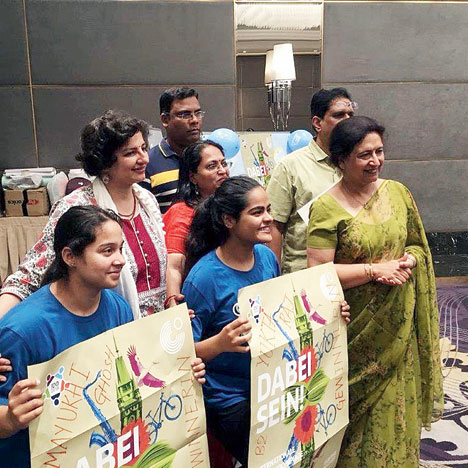
Modern High girls to represent India in contest with learners from 72 countries Mayukhi Ghosh and (right) Yukta Raj, who will represent India at the International German Olympiad this July
Ballygunge:
Two students from Modern High School for Girls have German television soaps and pop music to thank for topping a national-level language competition and earning the opportunity to represent India at the International German Olympiad in Freiburg this July.
Yukta Raj, a student of Class XII, and Mayukhi Ghosh, who is in Class X, have been learning German for many years. But the fluency they needed to compete with other learners in a language Olympiad came as much from following popular culture as from classroom lessons.
“I started watching German TV shows like Jojo sucht das Gluck and Tyrkisch fur Anfanger to prepare for the competition. It was basically learning while enjoying oneself,” said Yukta, who is the president of her school’s Deutschind club.
For Mayukhi, who inherited her love of German from her mother, pop music has been an unlikely learning tool. Her favourites include the rapper Cro and fellow artiste Namika.
Mayukhi was in Class I when she heard her mother speak a smattering of German and tried to emulate her. A decade later, it is the teenager who insists that her mother converse with her in the language and “keeps correcting her”.
“My mother is not fluent now for lack of practice. I ask her to randomly have a conversation with me in German,” Mayukhi said.
She and Yukta see the chance to compete with learners from 72 countries in the IDO – Internationale Deutscholympiade as an extension of their future plans. Both girls are looking at Germany as an option for their undergraduate studies. Yukta is fascinated by German “discipline” while Mayukhi loves the concept of artists’ colonies, of which that country has several.
For now, Yukta and her junior teammate are focused on enhancing their ability to not just speak and write German but also think in that language. “It’s started happening a lot. Since I started practising for the Olympiad, thinking in German has become a habit,” said Yukta.
Bina Ghosh, who teaches German at Modern High, said inter-school events and an exchange programme with a school in Germany had helped increase her students’ proficiency. “Even communicating over WhatsApp and Skype helps,” she said.
source: http://www.telegraphindia.com / The Telegraph,Calcutta,India / Home> Calcutta / by Jhinak Mazumdar / April 25th, 2018
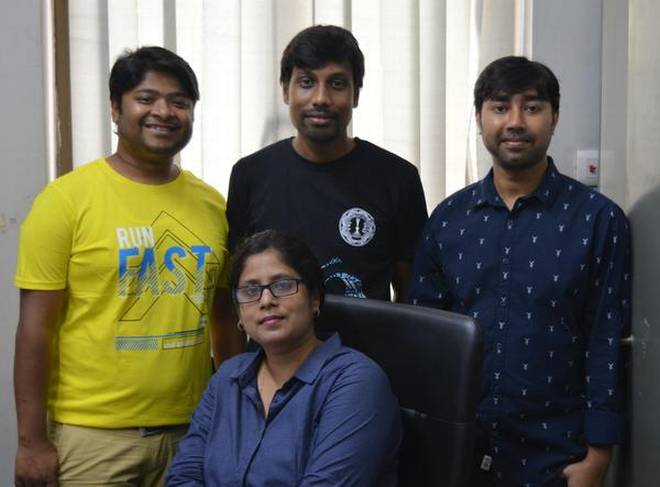
“The logic system can be recycled for three cycles by adding a heat deactivation step,” says Jyotirmayee Dash (sitting).
Sixteen combinations of different enzymes were used to make up the desired outputs
Scientists at the Indian Association for the Cultivation of Science (IACS), Kolkata, have been successful in designing DNA-based logic devices that would find application in DNA-based computation. They have designed reusable YES and INHIBIT logic systems by using a small molecule that serves as a fluorescent probe and binds to both a four-stranded DNA structure (G-quadruplex) present in human telomeres and nucleic acid cleaving enzymes (nucleases).
Fluorescence
The fluorescent probe — carbazole ligand — selectively binds to the G-quadruplex over other DNA structures present in the human genome. Once it binds to the DNA (G-quadruplex), the small molecule inhibits certain enzymes (nuclease S1 and exonucleases) from degrading the DNA. However, certain other enzymes (DNase I and T7 endonuclease I) can degrade the DNA even when bound by the small molecule.
While the small molecule by itself shows weak emission at 373 nm and 530 nm, the fluorescence intensity gets enhanced 14-fold at 530 nm once it binds to the DNA. Similarly, the small molecule bound to the DNA exhibits different fluorescence behaviour in the presence of different enzymes and this has been taken advantage of by the team led by Prof. Jyotirmayee Dash from the Department of Organic Chemistry to design conceptually novel logic devices. The results were published in the journal ACS Synthetic Biology.
Computation
For instance, DNase I enzyme degrades the DNA-bound small molecule and so when both the DNA the DNase I enzyme are used as inputs the fluorescence at 530 nm weakens. The output is therefore taken as zero. On the other hand, nuclease S1 enzyme does not degrade the DNA bound by the small molecule and so when both DNA and nuclease S1 enzyme are used as inputs the fluorescence at 530 nm does not get affected. The output is taken as one.
“So the INHIBIT logic gate is constructed using DNA and DNase I as inputs while the inputs of DNA and nuclease S1 form a YES logic gate,” says Prof. Dash.
Once the DNA is degraded by the DNase I enzyme, the logic system can be reused by supplying heat to deactivate the enzyme. “The logic system can be recycled for three cycles by adding a heat deactivation step. After three consecutive cycles, the efficiency of the system decreases by only 33%,” says Prof. Dash.
The team went a step further to design combinatorial logic systems (individual logic gates integrated into one another such as INHIBIT−INHIBIT and NOR−OR) by using different combinations of four nucleases (enzymes) as inputs.
16 combinations
The researchers were able to get 16 different combinations by adding one, two, three or four enzymes (nuclease S1, Exo I, T7 Endo I and DNase I) to the DNA-bound small molecule. The different combinations of the four enzymes are taken as inputs and the fluorescence response at 530 nm is taken as the output.
Of the 16 combinations, only four combinations are fluorescent (output taken as 1) and 12 are non-fluorescent (output taken as zero). The square numbers (1, 4, 9, 16) are assigned as fluorescent combinations, whereas the rest are assigned as non-fluorescent combinations. “So by suitable programming we can modulate the system to carry out complex calculations (for example, identification of square numbers up to 16) by varying the inputs,” she says.
“We hope that these DNA logic gates will provide the ability to not only create more complicated, sequential DNA computations but also create interfaces between silicon and DNA-based computers. The DNA-based nanodevice could be useful for diagnostic sensors and other biomolecular machines,” Prof. Dash says.
source: http://www.thehindu.com / The Hindu / Home> Science / by R. Prasad / April 21st, 2018
It was the annual fest of the best-dressed campus in town. National Institute of Fashion Technology (NIFT), in Sector III, held Spectrum 2018, with the theme of alternate reality, and colleges came from near and far to join what was one big party.
Off-stage events like “Task it up” had teams rushing to complete a series of fun activities before others. One round had all of them take off their shoes at a spot, run a distance and come back to put them on. Laughter and chaos ensued.
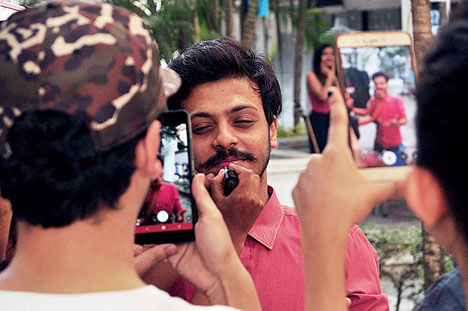
A round of “task it up” asked teams had to apply lipstick on a man
Another round saw all the males on the campus disappear. The task was for teams to apply lipstick and eyeliner on men. “Please, please, please!” a group of girls begged a male student who had set up a chaat counter. “We’ll eat all your phuchkas!” But the boy would have none of it.
Aritra Sarkar, another youth who was helping an NIFT friend put up a stall, was a rare man who allowed himself to be decked up. “I thought I’d help the teams out,” he smiled through scarlet lips as the teams fumbled to click a selfie with him to show the judges.
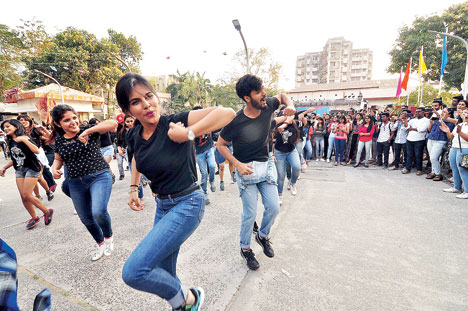
Students break into a flash mob. Picture by Prithwish Karforma
Students broke into flash mobs and came together to watch dance contests. Bhawanipur Education Society College won accolades for their dance to a medley of Bollywood songs with a message. Pratik Khatri played Mogambo, a skirt-chaser who finally gets nabbed by a gay man, played by Rounak Verma. “We wanted to portray gender equality, and show that men, women and LGBT all have equal rights and that no one has the right to harass another,” said Rounak.
Students had put up stalls selling cupcakes, stationery and accessories.
Madhurima Mukherjee, a first year student, had put up a tattoo corner. Some visitors longed for tattoos but were afraid their parents might not like it. Jhanvi Priya, another student, had found a way out. “I really love my dad and wanted my first tattoo to be dedicated to him,” she said, shutting her eyes tight as Madhurima prepared to ink a heart beat sign on her wrist with the word “Dad” on it. “It’s a surprise for my dad but I’m sure he won’t scold me now,” winked Jhanvi.
Style quotient
Piyush Kedia and Venkatesh Jaiswal of IIT Kharagpur nailed the quiz. “Our weakest link was the fashion-related questions but over all, I guess we pulled through,” said Piyush.
They fielded posers such as: Who introduced blue jeans? (Levi Strauss) Which actress, when asked what she wore to bed, had said “Channel No. 5 of course”? (Marilyn Monroe) and What kind of jewellery became popular in the hippy movement of the 1960s? (Bead jewellery).
The most awaited act had to be the fashion shows. The Bhawanipur college, for instance, interpreted the “alternate reality” theme by fixing the necktie and breast pocket behind one’s shirt and the Ionic Fashion Academy girls wore long flowy gowns that reminded one of leafy vegetables.
Other students in avant garde costumes
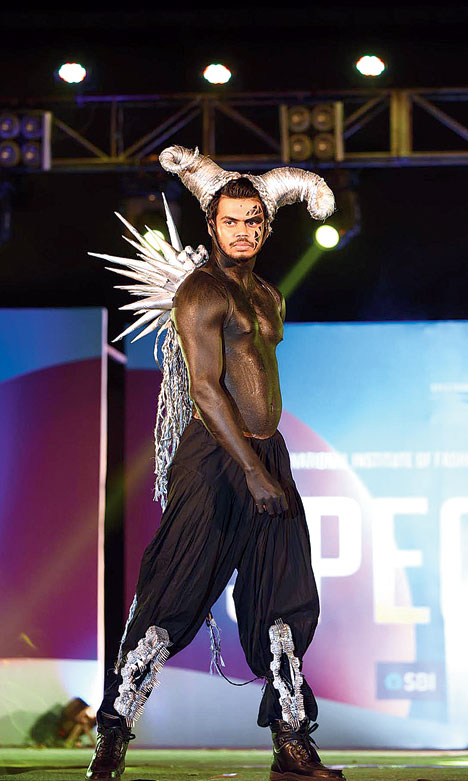
The host college had three entrants. The fashion and lifestyle department showed men with ram horns and girls with snake-like wraparounds with lights blinking on their clothes. The audience gasped collectively as one model took a fall but she recovered and the student emcee, Nandita Banerjee, couldn’t have handled it better. “A round of applause for the team and another one for the model who reminded us that the show must go on!” she smiled.
A student in a fashion show on the theme of “abaya and hijab” .
Another act that was warmly received was the fashion show by women in burkhas and hijabs with layers, sequins, and designs.
“We wanted to show that a woman in hijab can be fashionable too,” said Taqdis Fatma, a student of the clothing production technology department who walked the ramp. “Many of us wear abayas every day but it’s not that we’re forced to do so. It’s a choice and we’re comfortable in it.”
The segment featured seven girls, one boy and even a child. They paraded holding up placards with words like “Peace, love and harmony”.
“There is such camaraderie and brotherhood in the air,” smiled Nift director Col (retd) Subroto Biswas, who had joined the college during Spectrum last year. Harsha Singh, the cultural president of Nift, said the event had been a learning experience for the entire team.
source: http://www.telegraphindia.com / The Telegraph,Calcutta,India / Home> Calcutta / by Brinda Sarkar / April 20th, 2018
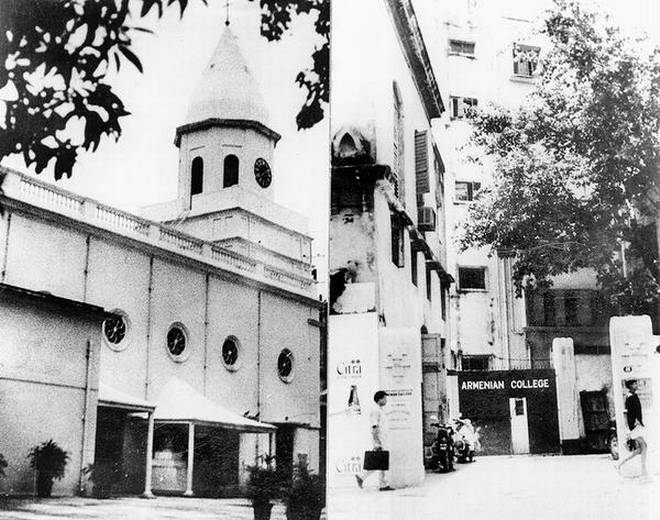
The Armenian Church of Nazareth, the oldest church in Kolkata; and (right) The Armenian College. | Photo Credit: PTI
For 197 years, the Armenian College and Philanthropic Academy has offered not just education but a sanctuary for children torn by conflict.
It was a birthday party of a different kind.
Brought together often by conflict and exile and nurtured in a regime of tough love, the dozen alumni and 70 present students of the Armenian College and Philanthropic Academy (ACPA) of Kolkata were celebrating 197 years of the institution on April 2.
Amid the animated discussions on the crisis in West Asia, Razmik Hakobyan, a 24-year-old Iraqi, an alumnus of the school, said he was dispatched to the ACPA in 2007 for “safety and education,” after a bomb exploded close to his house in Baghdad’s upmarket Kembel Gilani area. Mr. Hakobyan’s father, a retired soldier, decided distant Kolkata was safer.
“A friend who studied in Kolkata told us about the school and my parents got interested,” said Mr. Hakobyan, who left Baghdad when he was just 13. He would like to visit Baghdad, he said, but only on vacations.
“Baghdad is not getting better and nor is its education,” said the young man, whose family has since shifted to Kurdistan. Close to completing his graduation at the city’s St. Xavier’s college, Mr. Hakobyan says he is indebted to the Armenian College and its teachers.
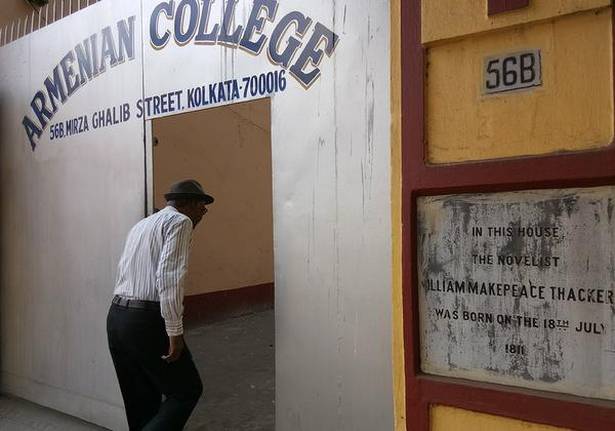
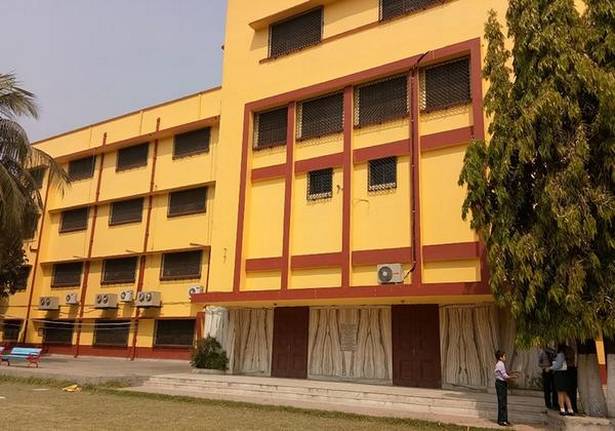
Set about 500 metres north of Park Street in the heart of the city, a plaque at the entrance of the imposing yellow building announces that “the novelist William Makepeace Thackeray was born on the 18th July, 1811” in the premises. Since 1821, it has housed the Armenian College and Philanthropic Academy — a school for Armenian students from all over the world up to Class X.
India as home
The Armenians adopted Christianity in 301 AD and were invited “to come and settle in his dominions” by emperor Akbar in the 17th century.
They arrived in Bengal in 1645 and settled along the Hooghly’s fertile western bank like most traders of the time. Anne Basil in her seminal book Armenian settlements in India writes that the community grew in size and influence and felt the need to have its own school. An informal school was set up in 1798, which was replaced by the present Armenian College and Philanthropic Academy on April 2, 1821, at 358, Old China Bazar Street near the Armenian Holy Church of Nazareth, Calcutta.
Following the genocide of more than a million Armenians in eastern Anatolia by Turkish forces in 1915, “hundreds of children of uprooted families…found shelter and a roof and received sufficient education…” at the Kolkata school, notes Basil.
Open to all Armenians
Armen Makarian, a former student and school’s coordinator, said the institution is the only Armenian school of its kind in the world.
According to Very Reverend Father Movses Sargsyan, head of the Davidian Girls’ School (DGS) — the girls’ wing — and Armenian College, the school is globally known among Armenians. “Internet, website and social pages informed the guardians,” Father Sargsyan said. While a majority of the students are from Armenia, the rest are from the Armenian disapora in Iran, Iraq and Russia and a handful of Indian-Armenians.
“We would like to have Armenian students from across the world — from Germany, Italy or France and even Syria,” Father Sargsyan said.
Like most boarding schools, the Armenian College has an intensely packed, exacting schedule. Mobile phones and laptops are a strict no-no, with the students allowed two hours out of the premises for shopping.
“But we like it,” said Vladimir Grigoryan, a ninth standard student, who was born in Russia but now stays in the Armenian capital, Yerevan.
“My parents were paying $2,500 annually for my education in Armenia. But the teachers never cared if we were learning — unlike here where teachers are constantly demanding,” said Vladimir, whose father runs a chain of hotels in Russia.
For Sevak Azarian Namagardi from Iran, who just appeared for his ICSE examinations, life is a “little boring” at times. Being a trained singer and a regular at choirs, he looks forward to weekly chats with his family over Skype.
“As the summer vacation approaches, I’m making arrangements to leave for Tehran,” he said. He has more reasons to cheer. “This time the family and I will visit Armenia, our motherland,” said Sevak. He, however, is equally keen to get back to friends at the school.
Academic challenge
Imparting education to students from such diverse backgrounds, however, is not easy. Soumitra Mallik, Principal at the Academy said the key problem was to match various levels of education.
“We do not know if the student who has studied up to Class V in her or his country is on par with what is taught here under the ICSE syllabus. So, this content mapping and matching is a problem,” he explained.
The other problem is communication as the students usually come from non-English speaking backgrounds. While Armenian teachers teach Armenian language, history, and culture, most of the around 25 faculty members at the Academy are Indian.
“So, we have six-month preparatory courses where we intensely teach English, some Mathematics and a bit of the Sciences to provide an outline of what the student will study and to hone their English language skills,” Mr. Mallik said. So far, it has worked well as many of the students are quickly able to leapfrog to reading Shakespeare’s Merchant of Venice within a few years!
Arindrajit Saha, the English teacher, said, “Studying Shakespeare within a brief period of time can be considered an important marker.”
Though the students indeed are grateful for the free and quality education they receive, there are regrets of a lost childhood back home.
“Saddam Hussein may have been a dictator but Iraq was not doing too badly and there was peace. With his departure, the country permanently collapsed and I had to leave my incomplete childhood behind,” said Mr. Hakobyan.
The different countries that the students hail from may not share friendly diplomatic ties, but the bond that Mr. Hakobyan or Sevak develop at the Kolkata school go beyond political compulsions or geographical boundaries.
“We are from the same tree, with same roots. The branches move in different directions, but the root remains,” says Arian Makarian of Iran, an alumnus.
source: http://www.thehindu.com / The Hindu / Home> News> Cities> Kolkata / by Suvojit Bagchi / Kolkata – April 14th, 2018
The exhibition match at St Lawrence School on Friday. Picture by Sanjoy Chattopadhyaya
Ballygunge:
An online chess challenge for students of Jesuit schools across four continents was launched at St Lawrence School on Friday with a face-off between two grandmasters and a grand prize to checkmate all prizes: global peace.
Around 20 students from schools in the US, Europe and South America have already registered for the event, scheduled to start in mid-April.
The tournament, called Chess ‘n’ Mate, will be played in a league format with each player guaranteed more than one match. The draw will be such that players from countries that traditionally have had strained relations will be clubbed together so that they get to know each other and become friends.
“What happens after the game is just as important as competing. There will be the usual prizes for the winners of the tournament, of course, but what sets us apart is the concept. Competitors will have to coin slogans after each match and the five best lines on the theme “Peace through sport” will be rewarded,” said Rahul Mukherji of the St Lawrence Old Boys’ Association, which is organising the tournament in collaboration with the school.
Jesuits are members of the Society of Jesus, a Roman Catholic order of priests founded by St Ignatius Loyola, St Francis Xavier and others in 1534. They run schools in 160 countries.
The three exhibition matches on Friday were between Grandmaster and former women’s world champion, Alexandra Kosteniuk, who was in Paris, and Grandmaster Dibyendu Barua, who made his moves sitting inside the Fr Wavreil Hall at St Lawrence School.
Barua won one of the matches and Kosteniuk the other two.
The matches were streamed live and the recording would be used to promote the online tournament.
Speaking on Skype later, Kosteniuk, who is an ambassador for an organisation called Peace and Sport, told the students to spread the word. “Let’s work towards a day when there are no wars… Battles should be fought only on the chessboard,” she said.
Students from Lithuania, Brazil, the US, Albania, Spain and India have registered for the challenge.
source: http://www.telegraphindia.com / The Telegraph,Calcutta,India / Home> Calcutta / by Rith Basu / April 07th, 2018
A Purulia youth engaged in researching Antartica’s climate died at the world’s southern tip.
Suvojit Sen (23) was part of the 37th Indian Scientific Expedition to Antartica, a project his family said sees few applicants owing to the risks it involves.
Brother Subhankar was informed of his death on March 27; the family is unaware of when his body will reach them.
Goa-based National Centre for Antarctic and Ocean Research (NCAOR), where Suvojit was employed, said in a release: “He met with an accident during convoy operations at Ice Shelf and suffered major trauma late March 26. He was immediately rushed towards the expedition vessel and doctors joined with medical help. Unfortunately, attempts to revive him went in vain.”
The convoy operation was heading from the Indian Research Base, Maitri, to Ice Shelf, a distance of approximately 80 km.
Subhankar finally told father Dilip Sen and mother Mukta of Suvojit’s death on Thursday. They were shell-shocked and unable to speak when TOI visited their home in Purulia’s Dulmi-Nadhia locality.
Suvojit graduated from JK College in Purulia. His outstanding Geology scores in 2014 helped him get into IIT Bhubaneswar for his Masters.
Suvojit applied for the 37th ISEA project last year and was selected. He left home on October 19, 2017.
Subhankar said: “Suvojit would call us from Antartica regularly and tell us of his experiences amid ice and snow. He was very happy with his work and the opportunity to have a unique experience so early in his career. Suvojit was staying with his colleagues at a base camp named Maitri. He would tell us it felt like being in a completely different world.”
The family said that during his last call on March 24, Suvojit said his project was nearing completion and that he would be returning home before his 24th birthday on April 13 and be around for Subhankar’s wedding on April 26.
source: http://www.timesofindia.indiatimes.com / The Times of India / Home> News> City News> Kolkata News / TNN / March 30th, 2018
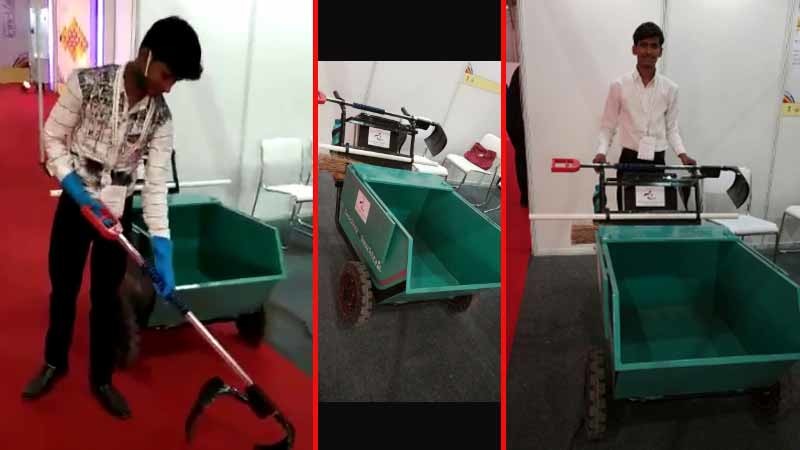
Shikanto Mandal, 15, from Mathura, who had developed a unique machine to collect garbage, was invited by the President for dinner on Tuesday. However, it was cancelled at the last moment and the dinner was hosted by science and technology minister Dr Harsh Vardhan at the CSIR centre at Lodhi Gardens in New Delhi.
Mandal, who hails from West Bengal, had showcased his innovative machine at the Festival of Innovation being held in Delhi from March 19 to 23. Earlier speaking with TOI while on his way to New Delhi, Mandal said he had dined with then President Pranab Mukherjee during the Festival of Innovation.
The young inventor said hopes to become a successful engineer one day and fulfil all wishes of his parents and give them every comfort of life. Mandal’s parents are daily wagers. Talking with TOI, Mandal’s teacher Manoj Kumar, who helped him in his project and under whose guidance he built the machine, said he had developed the manual waste lifting and dumping machine when he was in Class IX at Jai Gurudev Balya Balak Vidyadan Higher Secondary School in 2016. He is presently studying in Class XI at KR Inter College, Mathura.
Mandal’s invention, inspired by Swacch Bharat Mission, was chosen for display at the district-level exhibition organized by the department of science and technology in 2016. His machine’s model was then showcased at a state-level exhibition held in Lucknow and later, at the national level.
His model has been patented by a Gujarat-based company, where he holds a 50% stake of the market share.
In January, Mandal was invited by film star Akshay Kumar his movie, “Padman”, screened at the Innovation conclave in which 16 innovators from across the country participated and received Rs 5 lakh each for their innovation.
source: http://www.timesofindia.indiatimes.com / The Times of India / Home> News> City News> Agra News / TNN / March 21st, 2018
A team of scholars from the English department of the Vidyasagar University has travelled through one tribal village to another in an effort to save dying tribal dialects, scripts and folk performances.
The entire body of nearly lost dialects and scripts that was conserved from there will now be a part of a massive digital archive. Folk performances will also be showcased in a two-day open-air public presentation on the university campus, starting Tuesday.
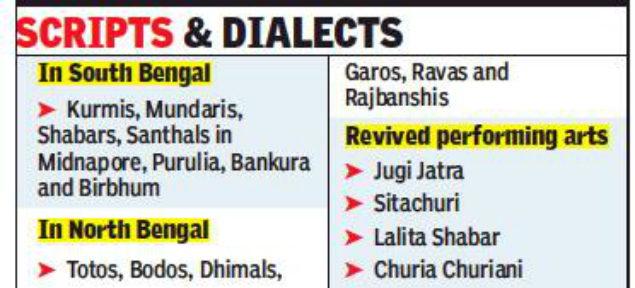
The team visited habitats of communities like Kurmis, Mundaris, Shabars, Santhals in West Midnapore, Purulia, Bankura and Birbhum in south Bengal and also documented their visit to the Totos, Bodos, Dhimals, Garos, Ravas and Rajbanshis of north Bengal. The team visited the villagesto conserve their dialects and scripts, which are nearing extinction.
During field work, they witnessed performances like Jugi Jatra, Sitachuri, Lalita Shabar, Churia Churiani that were popular in the folk life of the Jangalmahal tribes even two decades ago, but are now no longer practised because they are not considered entertaining enough anymore and do not get audience.
The research team extensively quarried written scripts in old diaries, faded manuscripts and oral traditions from homes of elderly people, many of whom were also performers of these folk art forms. “Linguists working in the team have deciphered the texts, which are a curious mix of Oriya and Bengali dialects.
They are transcribed in phonemic forms and then translated into English for a wider audience,” said Debashish Bandyopadhyay, head of the department of English and also co-ordinator of the project.
The project, because of its uniqueness, has been supported under the departmental research support (DRS) scheme of UGC’s special assistance programme. Vice chancellor and historian Ranjan Chakraborty, has also helped out in the research.
The project and the two day programme, that has been christened, “Performance and the Prospects of Tribal Folkloric Culture of Eastern India”, has generated a lot of attention among international publishers and scholars of indigeneous cultures, who work towards conserving endangered cultures.
source: http://www.timesofindia.indiatimes.com / The Times of India / News> City News> Kolkata News / by Jhimli Mukherjee Pandey / TNN / March 20th, 2018
The chief minister will present Banga Ratna to nine persons from north Bengal for their contribution in different fields at the inauguration of the Uttar Banga Utsav here on Monday.
Mamata Banerjee is scheduled to launch the eight-day cultural fest at Kanchenjungha Stadium here.
Official sources have said among the recipients of the Banga Ratna are Manas Dasgupta (economist from Darjeeling), Dinesh Chandra Roy (researcher on folk culture of the region from Jalpaiguri), Prem Kumar Bhutia (social worker of Kalimpong) and Debkumar Mukherjee (educationist from Cooch Behar).
The others are Malin Das (folk music instrumentalist of Cooch Behar), Dilip Kumar Roy (writer from Alipurduar), Prem Bihari Thakur (retired teacher from North Dinajpur), Tapas Kundu (researcher on Molecular Biology from South Dinajpur) and Radhagobinda Roy (social worker of Malda).
“Each award will carry a prize of Rs 1 lakh, a shawl and a certificate.
Apart from the awards, a total of 54 meritorious students from eight districts of north Bengal will get Rs 10,000 each from the chief minister.
Thirteen of them will get the assistance at the inaugural and the rest will be provided with the amounts by the administrations of their respective districts,” an official of the organising committee of the festival said.
source: http://www.telegraphindia.com / The Telegraph, Calcutta,India / Home> West Bengal / by Bireswar Banerjee / January 08th, 2018