Category Archives: Education

Citizens take inititaive to restore heritage school

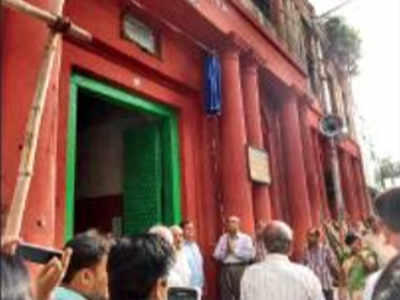
A plaque was unveiled at the school on Saturday

Kolkata :

A dilapidated portion of the Burrabazar branch of Metropolitan Institution, which was pulled down by the KMC on April 7, is getting a new lease of life with a group of residents taking the initiative to restore the heritage structure to its old glory. The initial, rudimentary repairs have been carried out with school funds and the subsequent renovation is likely to depend on government assistance as well as crowdfunding.
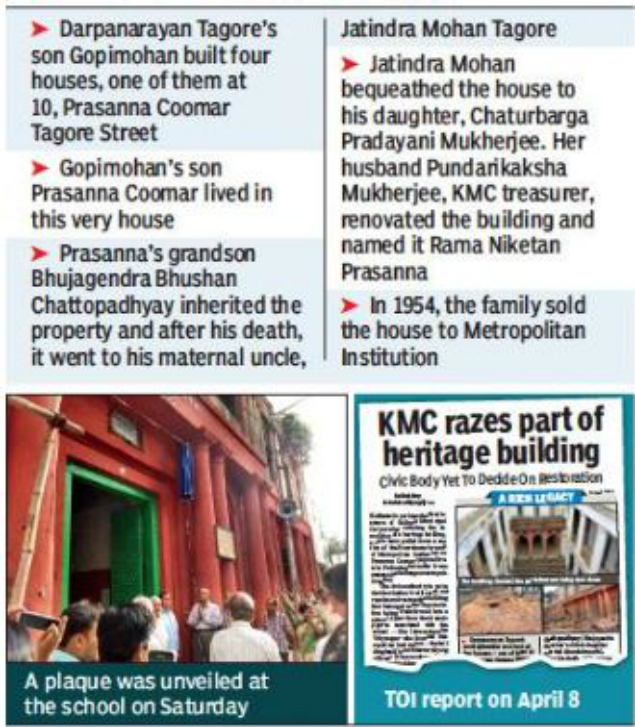
Members of ‘Purono Kolkatar Golpo’, a Facebook group that has taken up the project, organized a programme on the premises of the institution on Prasanna Coomar Tagore Street at Pathuriaghata on Saturday, when they unveiled a plaque, with the building’s “heritage status” written on it.

This plaque, they hope, would make Kolkatans and authorities aware of the historical significance of the school, which was founded by Ishwarchandra Vidyasagar.

The unveiling was followed by discussions and a cultural programme, which was attended by current and old students, teachers, neighbours and local councillor, Ellora Saha, who advised to form a development committee that would work towards procuring money from the government. “It is a proud moment that ordinary people have come together to conserve the historical institution. Our aim is to restore the building,” said P N Palit, secretary at Vidyasagar Institute trustee board. He added the initial repair, white-wash and clearing trees and undergrowth from the compound were carried out with school money.

Heritage enthusiast Swarnali Chattopadhyay said, “It’s high time we did something to save such structures of architectural and historical significance. For restoration, we are looking to state help and crowdfunding as and when required.”

Till 1954, the building belonged to the Tagores and was known as Rama Niketan.

Thereafter, the Burrabazar branch of Metropolitan Institution was set up on the premises, where the school ran out of rooms on the ground and first floors. Now, with only 60 students on the roll, classes are held only on the ground floor. The Pathuriaghata post office shared the same compound. “To save the building, it is important to save the school.

Different activities have to be started there as the institution and the building are interdependent. A proposal has been given that other small schools in the area may use the huge compound, and if need be, they can be merged into one institution,” said Jayanta Sen, heritage activist and another member of Purono Kolkatar Golpo.

Councillor Saha said, “The building still has Vidyasagar’s chair and it is where Madhusudan Dutta composed ‘Sharmistha’. It is my duty to help people conserve the place.”

Conservation architect Kamalika Bose hailed the initiative: “This is a great example of residents doing something at the grassroots level, without expecting the government to take the first step.”

source: http://www.timesofindia.indiatimes.com / The Times of India / Home> City News> Kolkata News> Schools & Colleges / by Dipawali Mitra / TNN / June 17th, 2018

1st-time tribal students at Jhargram school pass HS with flying colours

The students and teachers at Ekalavya Model Residential School

Jhargram:

All 22 first-generation students at Ramakrishna Mission Vidya Mandir (Ekalavya Model Residential School) in Jhargram have come passed the Higher Secondary examinations with flying colours.

The students, 13 boys and nine girls, belong to tribal families and none of their parents has ever studied till the highersecondary level.

Barring one, who wrote his exam from hospital and secured second division marks, the rest got first division, with eight of them securing star marks. School topper Budhor Mahali scored 84.2%. Three students got letter marks in English, nine in Santhali, two each in philosophy and political science and one in science.

Commending all students and teachers for the results, school secretary Swami Shuvokarananda Maharaj said, “Two years ago, Ramakrishna Mission was given responsibility to run the school. We have 374 students, all of whom are tribals. We have 48 teachers here. Parents of none of the 22 Higher Secondary examinees this year have studied till the plus-II level. The results show how children from the tribal community are making a headway in studies.”

source: http://www.timesofindia.indiatimes.com / The Times of India / News> City News> Kolkata News> Schools & Colleges / by Sujay Khanra / TNN / June 10th, 2018

IIT robot goes the distance

Robot-driven vehicle, Eklavya

Kharagpur:

A robot-driven vehicle called Eklavya won IIT Kharagpur the runner-up position in the Intelligent Ground Vehicle Competition at Oakland University in Rochester, Michigan, recently.

The robots were ranked according to the distance they covered in the designated arena while keeping to the lanes given by GPS coordinates, all the while avoiding obstacles on the way.

Eklavya, designed by the Kharagpur institute’s autonomous ground vehicle (AGV) team, covered 260 feet, said an official of the institute.

The AGV team is a multidisciplinary research group.

The team that won (left to right) Rahul Krantikiran, Indu Kan Deo, Sanskar Agarwal, Poojan Shah and Harsh Maheshwari

“For prototype purposes, we work on Eklavya which is a three-wheeled, front-driven and front-steered electric vehicle fitted with cluster wheels,” an official of the institute said.

Work for building the robot started in December last year under the supervision of Debasish Chakravarty, a professor of mining engineering at IIT Kharagpur.

“Students were required to work on image perception, simultaneous localisation and mapping, path planning algorithm, mechanical design and electronic design to come up with the robot-driven vehicle,” Chakravarty said.

Rahul Krantikiran, one of the five members of the participating team, said they were asked to cover a distance of 600 feet.

“We covered a distance of 260 feet. Though the time was not specified, I think we took around 2.5 minutes to 3.2 minutes to cover the distance. The only team that could outperform us was the team from CART (Center for Applied Research and Technology), Inc. from Bluefield State College, US,” said the student of computer science and engineering.

The team is exploring whether Eklavya can be fitted to an existing fuel-run vehicle.

“It requires advanced research. If it can be fitted to fuel-driven car, it will gain popularity,” Chakravarty said.

Seven teams from India, including ones from IIT Kanpur and IIT Madras, took part in the competition held from June 1 to 4.

source: http://www.telegraphindia.com / The Telegraph,Calcutta,India / Home> Calcutta / by Subhankar Chowdhury / June 09th, 2018

Sunity flaunts 4 toppers

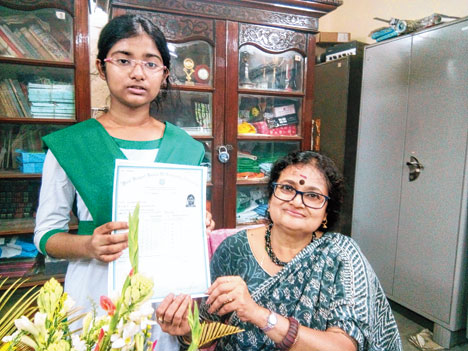
Sanjibani Debnath with headmistress Manideepa Nandi Biswas at Sunity Academy on Wednesday. Picture by Main Uddin Chisti

Cooch Behar:

Had Maharani Sunity Devi lived now, she would have been happy.

Four girls of Sunity Academy, set up by her husband and Cooch Behar king Nripendra Narayan in 1881, have made it to the state-wide list of top 10 Madhyamik examinees this year.

A few among the Indian woman to be awarded a CIE (Companions of the Order of the Indian Empire) by the British, Sunity was the daughter of Brahma Samaj reformist Keshab Chandra Sen.

“Her initiatives to impart education to girls and women are well known in Cooch Behar. Not only that Sunity Academy was set up in her name (it was initially Suniti College), but she was also instrumental in setting up the Maharani Girls’ High School in Delhi. During her days as the queen of Cooch Behar, she had helped girls ensure that they get education. She would have been definitely happy to see girls of her school performing so well,” said Shaukat Ali, a senior academician based in Cooch Behar.

In the Madhyamik this year, Sanjibani Debnath of the school has topped in the state with 689, followed by Mayurakhi Sarkar (687, third in the state), Ankita Das (685, fifth in the state) and Aitihya Saha (681, ninth in the state).

“It is great day for us. Back in 2013, a student from our school had topped in the state in Madhyamik. In our school, there is a close relation among teachers and students. Though many take private tuitions but all the students are always dependant on the school to improve their performances,” said Manideepa Nandi Biswas, the proud headmistress.

Pankaj Kumar Debnath, the father of Sanjibani and a college principal, has appreciated the school.

“My daughter has been studying here since Class III and I have always found that each teacher is caring and giving individual attention to students. They keep on encouraging students and do not relent unless a student understands a subject,” said Debnath.

Along with the performance of the girls of Sunity Academy, Cooch Behar residents have another reason to cheer. In the Madhyamik this year, the district has come up with nine students in total – the highest in any district of Bengal – who have secured positions in the top 10 slot.

They are Sumit Bagchi of Dinhata High School (684, sixth in state), Mahasweta Home Roy of Manindra Nath High School (683, seventh), Debosmith Roy of Rambhola High School (682, eighth), Suman Saha (680, tenth) and Baidurjya Biswas (680, tenth), both of Mathabhanga High School.

“All these students have made our district proud. We will felicitate them for their success,” said NB development minister Rabindranath Ghosh, who also hails from Cooch Behar.

source: http://www.telegraphindia.com / The Telegraph,Calcutta,India / Home> West Bengal / by Main Uddin Chisti / June 07th, 2018

Student on pad mission

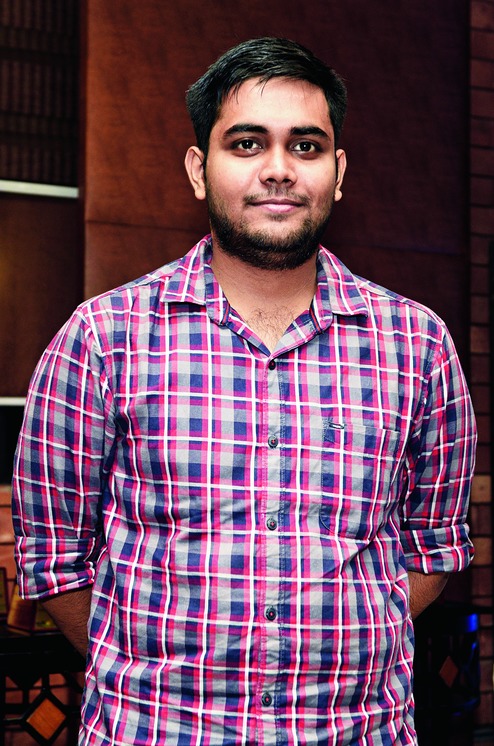
Sobhan Mukherjee at Monday’s event. (Gautam Bose)

Calcutta:

Sobhan Mukherjee of Bansdroni has been breaking many stereotypes.

Since last year, the postgraduate student of geography at Asutosh College been spending over Rs 11,000 a month to stock up sanitary napkins at public toilets to promote menstrual hygiene. Till now, he has stocked up 30 toilets with 100 sanitary pads.

“I buy branded pads for Rs 3 and sell them at CMC’s pay-and-use toilets for Rs 2,” said the student who procures fund for his Bandhan Sanitary Napkin Project by running a little magazine. Some of the areas he has covered include Bansdroni, Golpark, Garia and Sonarpur.

On Monday, he was part of a campaign organised by Unicef to mark Menstrual Hygiene Day. #LetsTalkAboutPeriods saw government officials, activists and enthusiasts joining hands to break the culture of silence and promote menstrual hygiene.

The campaign aims to spread awareness about menstrual hygiene through various media. It also plans to engage all sections of society in discussions to break myths and taboos surrounding the menstrual cycle.

“When I found my friend so uncomfortable and distressed to talk about the issue, I realised I needed to do something to break the stereotype,” said Sobhan, who is also pursuing health studies at Indian Institute For Health Training.

He now wants to build a team of young boys and girls who will reach out to villages where menstrual health is a bigger issue. “Let boys and girls of a particular village fund their own Bandhan Sanitary Napkin project. I need to build a self-sustaining model,” he added.

As of now, around 40 per cent of girls in Bengal are using sanitary pads, said Sonali Datta Ray, joint secretary in the panchayat and rural development department. “There are sanitary napkin incinerator in around 12 per cent schools and vending machines in around eight per cent schools in rural areas,” said Datta Ray, who was part of a panel discussion on breaking myths.

Burdwan, Purulia and Nadia are some of the districts that are forerunners in the effort. “Here the schools, panchayats and the health department are working in tandem to promote safe hygiene among students,” she added.

“We need to focus on sensitising men and encourage them to talk about the issue,” added Dibyendu Sarkar, additional secretary in the panchayat and rural development department and another participant in the panel discussion.

Other participants included Ananya Chakraborti, chairperson of West Bengal Commission for Protection of Child Rights, and Choten Lama, secretary of panchayat and rural development.

“When you pair lack of awareness with cultural barriers, there is a higher risk of girls using unsanitary material, not taking the proper diet, not recognising any irregularity in their menstrual cycle and thus inviting health complications,” added Mohammad Mohiuddin, Unicef chief in Bengal.

source: http://www.telegraphindia.com / The Telegraph,Calcutta,India / Home> Calcutta / by Chandreyee Ghose / May 29th, 2018

Science goals & helping hand

Young Metro

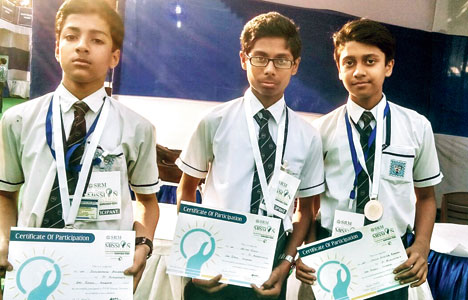
St Augustine’s Day School, Ripon Street, has introduced a robotics club to keep students abreast of development in science and technology. The club, an initiative of principal Richard Gasper, organises workshops, where students are encouraged to make models and devices. Buzzer circuits made by the students at robotics workshops have, for instance, been used during a quiz in the school. The children have taken part in many national as well as international competitions and won accolades.

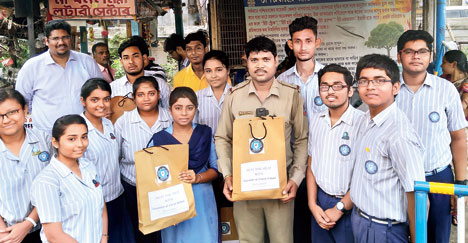
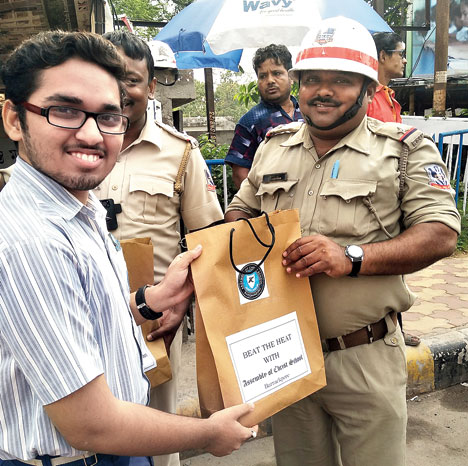
Students of Assembly of Christ School hit the road to express their gratitude to traffic cops who have to be on duty under the scorching sun. The students, along with vice-principal Rev. G. Samuel Davis, visited traffic kiosks between Barrackpore and Sodepur and handed over goody bags to the traffic cops. The campaign started from Lalkuthi in Barrackpore and covered Chiriamore, Titagarh and Khardah before ending at Sodepur. Each bag carried fruit juice, bottles of packaged drinking water, glucose drink and cucumbers.

source: http://www.telegraphindia.com / The Telegraph,Calcutta,India / Home> Calcutta / May 28th, 2018

Future hope for young rowers

Medal glory for school with a passion

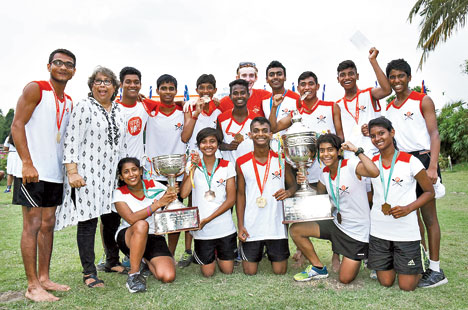
The Future Hope rowers celebrate their wins with CEO Sujata Sen (second from left) and guide (standing in last row, red Tshirt) Will Allen

Lake:

Sujoy Sen was drenched in sweat but couldn’t stop jumping in joy. His parents have little idea about rowing and think their son pulls boats. The gold-winning rower thinks his real prize will be when they see him in action.

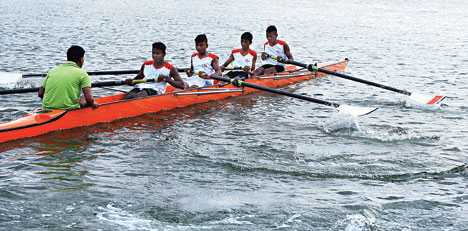
Sujoy was part of one of the three teams from Future Hope that bagged medals at the 17th BRC Students’ Rowing Championship, partnered by TTIS, on Sunday,

The Uluberia boy has been rowing for the past three years.

The junior girls’ team from Future Hope that won bronze

“A race is exciting only when the opponent is equally good. We were neck and neck with La Martiniere for Boys in today’s race and that is what made it so challenging, I enjoyed every second of it,” said Sujoy, who wants to take up rowing professionally.

The junior boys who struck gold

Future Hope won gold in the boys’ junior and senior races and bronze in the junior girls’ race.

For the girls, this was their first time at the regatta. “Juman da (rower Juman Ali) has inspired me a lot. I would love to be a professional sculler,” said Samira Khatoon of Class VIII. Her team beat National High School (CBSE).

Teammate Debasrita Das, found the competition tough but inspiring. “While rowing, we felt a certain anger and power which ultimately helped us perform,” said the Class X student. Her takeaway from her debut regatta: “It’s a team sport and each member should support the other while rowing.”

The senior boys from Future Hope finished first. Pictures by B. Halder

For Future Hope CEO, Sujata Sen, it was the sheer determination of the young rowers that fetched them success. “We don’t have money but we do have a lot of passion. The kids practise every day, be it rain, hail or storm.”

Setaur Rehman, Class XII, a part of the senior boys’ team of Future Hope, admitted there is no alternative to hard work and regular training.

“I have been rowing since six years. I have played many sports like rugby, football, cricket but rowing remains the most challenging of them all. We have to practise every day, there is no break,” said the Malda boy who wants to crack the civil services examinations while continuing rowing for life.

Guiding the Future Hope rowers this time was Will Allen, a student of Westminster School, London, who is volunteering with the school in his gap year.

“They were already going through training and practice, I just helped them do what they were already doing. When it comes to mental strength and focus, these guys are the best,” said Will, who cheered the teams throughout the races.

The rowing championship at BRC is aimed at encouraging more children to take up the sport.

“Initiatives like the BRC Students’ Rowing Championship have changed the future of the sports in Calcutta. This path-breaking effort will not only help rowing grow as a sport in the city but also help stimulate the sport’s development at the national level. This championship plays a key role in changing mindsets,” said Ujjal Dugar, the chairman of the rowing committee at Bengal Rowing Club (BRC).

Additional reporting by Rupsha Chatterjee

source: http://www.telegraphindia.com / The Telegraph,Calcutta,India / Home> Calcutta / by Samabrita Sen / May 21st, 2018

Nasa trip for math wizard

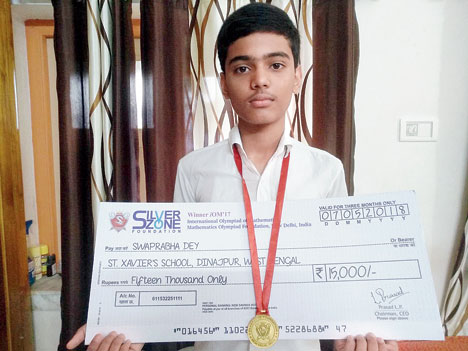
Swaprabha Dey. (Kousik Sen)

Raiganj:

A Class IX student of Raiganj who topped a math Olympiad has won an educational trip to Nasa.

Swaprabha Dey, a student of St Xaviers School of the town, had stood first in the International Olympiad for Mathematics, 2017 conducted by the Delhi-based Silver Zone Foundation. He will visit Nasa on a week-long trip to the US in August this year.

“After the (Olympiad) results were announced, we were informed that he will be rewarded in cash and be taken to Nasa,” said Swaprabha’s father Sanjib Dey, a central government employee.

The boy, his parents said, is an ardent reader of science fictions. Professor Shanku, a character penned by Satyajit Ray, is one of his favourites.

“It is a matter of pride for the school,” Fr. David Raj, the school principal said.Ayesha Rani A, the DM, said the administration will “felicitate” Swaprabha for his success. “His performance has brought laurels,” said the DM.

source: http://www.telegraphindia.com / The Telegraph,Calcutta,India / Home> West Bengal / by Kousik Sen / May 20th, 2018

High performer in marks and spirit

ICSE and ISC exam results throw up stories of success in the face of extreme adversity

Neelangshu Saha

Calcutta:

The weekend before his ISC mathematics paper, Neelangshu Saha was in hospital for chemotherapy. When the examination results were declared at 3pm on Monday, he was undergoing a PET scan in a Mumbai hospital.

Neelangshu scored 84 in mathematics, each mark bearing testimony to his effort in writing a paper for three hours after having been discharged from hospital just the night before.

The student of Adamas International School in Belghoria did even better in terms of aggregate – 86.75 per cent – after battling a relapse in the middle of the examination. His individual scores are 78 in English, 88 in physics, 82 in chemistry and 97 in computer science.

The 18-year-old had been diagnosed with alveolar rhabdomyosarcoma, a cancer originating in the muscles, in 2016. He seemed to be in remission after treatment, but the cancer returned in two years.

Doctors had told Neelangshu that he wouldn’t be able to write an examination immediately after chemotherapy, but he wasn’t ready to give up.

“I had already lost a year during the first spell of illness (with 33 cycles of chemotherapy and 51 rounds of radiation) and could not write the examination along with batchmates I had studied with for 10 years. That was a major push for me. My mother encouraged me to do so,” Neelangshu said from Mumbai.

The relapse was diagnosed two days after the teenager wrote his physics paper. His mother went to Mumbai to consult doctors on postponing treatment till the ISC examination was over.

“Doctors at the Tata Memorial Centre in Mumbai said treatment was more important than writing the examination. We then decided to get chemotherapy done in a Calcutta hospital,” said mother Aditi Roy, an economics teacher.

“It was a Monday, the day of his mathematics paper. He was so weak that he could barely open his eyes. But he showed tremendous mental strength and went to school,” Aditi recounted.

Despite the side effects of chemotherapy like nausea and not being able to sit for long hours, Neelangshu wanted to write the examination with his classmates.

“Chemotherapy would leave me feeling very hot and I could not continue in the examination hall. My school then arranged for me to write the examination in an air-conditioned room. Had it not been for my school’s support and that of my teachers, I would not have been able to write the exam,” Neelangshu said.

Before being diagnosed with cancer, Neelangshu had been an athlete with two gold medals in sprinting events in his last school sports meet in 2015. “The way he has fought illness is amazing, especially to write an exam between chemotherapy sessions,” said Mittra Sinha Roy, principal of Adamas International School.

A swelling in his left leg last January was the first sign of a relapse. “It (alveolar rhabdomyosarcoma) is a rare cancer with an unpredictable outcome. If it has not spread to the lungs and liver and is limited to the local area and site of origin, there are chances of the cancer being cured. The boy’s willpower is inspirational,” said oncologist Gautam Mukhopadhyay, although he hasn’t treated Neelangshu.

source: http://www.telegraphindia.com / The Telegraph,Calcutta,India / Home> Calcutta / by Jhinuk Mazumdar / May 15th, 2018

‘Logged out’ of school at 10, boy turns IITian at 19

Nirmaan J. Sarkar with sister Sohana at their father’s office in New Town. Pictures by Sanjoy Chattopadhyaya

New Town:

A 19-year-old Calcutta boy who had been pulled out of school by his father when in Class V has made it to IIT Kharagpur without a conventional education in between.

Nirmaan J. Sarkar, a second-year student of agriculture and food engineering, believes that being homeschooled since the age of 10 suited his later goal of cracking IIT-JEE to study in his father’s alma mater. He revelled in the freedom of learning at home and focusing on what he liked even as his sister Sohana pined for the structure and company that school provided.

The siblings’ father, Sourabh J. Sarkar, had had a normal schooling and taken the usual long, hard route to IIT. But he was disillusioned with the education his children were getting and wanted to free them from what Nirmaan now calls “the cage”. The decision to “log out of the system” came after much disagreement at home.

Sohana, for one, did not take kindly to being told she would not go to school again. For some time, she was even ashamed of it.

Nirmaan showed no such withdrawal symptoms. “After I quit school, I started learning programming in my father’s office from his technology team…I also learnt things from the Internet,” he recounted.

It wasn’t always homeschooling and no play. Nirmaan would visit the Sports Authority of India complex every day for basketball, was part of the orchestra at the Calcutta School of Music and also learnt to play the tabla.

Realising his son’s proficiency in mathematics, Sourabh hired a tutor in the subject who would come home to teach Nirmaan for 10 hours on some days. At the age of 15, Nirmaan was sent to a coaching institute started by three IITians.

“By then, I wasn’t interested in going to any other college. I was fascinated by IIT Kharagpur, having heard from my father and tutors about the campus culture there. I wanted to experience that,” he said.

While Nirmaan’s progress through homeschooling and private coaching was an affirmation that the method was working, his parents grappled with the thought that he and his sister still needed a group environment.

According to Sourabh, who lives in New Town, the challenge was to provide his children with peers representing a certain diversity “because life is not made up of a group of people of your age only”.

Sourabh J. Sarkar

He and his wife Reena conducted a talent hunt to identify children from remote villages with different talents so that they could come and stay with them. The group was required to follow a routine, which included making breakfast and wearing uniform.

“We selected 30 underprivileged children with different talents like theatre, music, yoga and dance. We told their parents that their children could stay with us and we would help them get better at what they do,” Reena said.

Sohana, who will appear for the Class X examination through the National Institute of Open Schooling next year, appeared to miss school less after that. She started learning dance and is now also pursuing art.

After Nirmaan went to IIT Kharagpur, the thought of putting Sohana in a formal school did cross Reena’s mind but she ultimately decided against it. “Schooling would take away a lot of the things my daughter is doing,” she said.

Like her brother, Sohana has a clear goal. She wants to study fashion, albeit without going to college. “I don’t need to go to college to do what I want to do. I can do internships…. They teach circles and squares and I don’t want to do that. Now, I don’t lie to anyone that I go to school,” she said.

Sourabh refuses to label the education his children has had as homeschooling. “I think the term homeschooling is misleading for this set of children. The decision was to log out of the system. And when we decided that, I had no clue what the alternate system would be,” he said.

For Nirmaan, graduating from IIT won’t be the end of the road in terms of learning. “I don’t think just getting into IIT labels me as a success story. A real measure of the success will be what I learnt in the seven years I was out of school and studying at home. IIT isn’t the one big success in my life,” he said.

Father Sourabh gives himself “only 20 out of 100” for doing what he has for his children. “Till this day, I don’t think we have been successful in giving them the ideal option that I would have wanted,” he said.

source: http://www.telegraphindia.com / The Telegraph,Calcutta,India / Home> Calcutta / by Jhinuk Mazumdar / May 01st, 2018